AN IMAGINARY COMPILATION ALBUM : #262(b) : TRACEY THORN

PART TWO OF A GUEST POSTING by ECHORICH

TRACEY THORN – A COVERS ICA

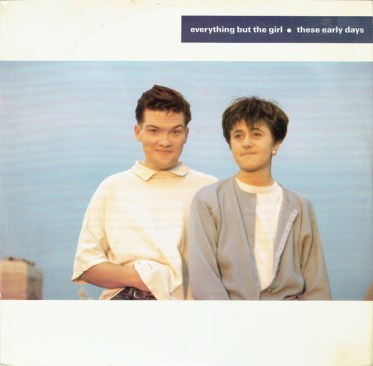
From the earliest days of Everything But The Girl, Tracey and Ben recorded some astonishing covers of popular and not so well known songs that spoke to them. Their first single, Night And Day, Kid, Time After Time, I Don’t Want To Talk About It, The Only Living Boy in New York, English Rose, are just a few.

As a solo artist, Tracey hasn’t shed away from sharing her take on a rather eclectic series of others’ songs. The majority of her 4th solo album, Tinsel And Lights features 10 covers of songs related to Christmas and Winter. None of her covers are perfunctory or covers by numbers. All of them are imbued with the magic Tracey has as a performer and some, for me, outshine the originals because of that magic.

Here are 10 covers performed by Tracey Thorn from her solo work of the last 13 years that show off that magic.

1. Under The Ivy – Kate Bush Cover – released as a digital single in December of 2014. Just a piano and Tracey with strings filling in on the second verse. The intimacy is intense.

2. Come On Home To Me – Lee Hazelwood cover – a track from Love And Its Opposite, it’s a duet with Jens Lekman. Lekman’s baritone adds to the darkness of the song arrangement.

3. Kings Cross – Pet Shop Boys cover – originally a bonus track on the iTunes version of Out Of The Woods and was initially slated for inclusion, but cut due to running time of the album. It was released as a stand-alone single in December of 2007 with a Hot Chip Remix and a thank you to Neil Tennant who Tracey states motivated her to record a new solo album after 25 years. Tracey softly presents the song with pastoral addition of English horn and respect to the simplicity of the PSB original. I hold this version as an equal to a song I think is certainly among Pet Shop Boys best.

4. Sister Winter – Sufjan Stevens cover – a Christmas single released on Ben’s Strange Feeling label for Christmas 2010, it would reappear on the Tinsel and Lights album two years later. Tracey approaches the track with a simpler arrangement and a bit more focus on the vocals.

5. Get Around To It – Arthur Russell cover – released as a track on Out Of The Woods. The most eclectic track on Tracey’s wonderfully eclectic 2007 solo album, she and producer Ewan Pearson play up all of the wonderful mutant disco sounds so familiar to fans of Russell and the Sleeping Bag Records label. It’s a joy filled musical romp.

6. Smoke And Mirrors – Magnetic Fields cover – b-side to the Raise The Roof single. Where the original is all cool, dark, synth-folk and very knowing, Tracey brings a much more feminine, yet still knowing feel to her interpretation.

7. Hard Candy Christmas – Dolly Parton cover – released as a track on Tinsel and Lights. A song I had never heard before and approaching it as a cover is a bit difficult. Popularized by Dolly, but also recorded by Cyndi Lauper, Garth Brooks and Trisha Yearwood, Reba McIntyre, it’s a bit of a modern Christmas standard that no one really deviates from as written by singer/songwriter Carol Hall. But Tracey captures a quiet, lonely Christmas in her version that sounds so much like an EBTG song, no least of all because husband Ben contributed to some very familiar-sounding electric piano.

8. Night Time – The XX cover – released on the Night Time EP. Originally chosen to be included on a covers compilation of The XX songs at the invitation of the band, the project fell through, but Tracey with Ben assisting still recorded the track with producer Ewan Pearson. Again there is some EBTG DNA in their version of the song that really works.

9. Snow in Sun – Scritti Politti cover – released as a track on Tinsel and Lights. Another very contemporary cover by Tracey, the original can be found on the wonderful 2006 Scritti Politti album White Bread Black Beer. Tracey smartly doesn’t attempt anything too far from the perfection of the original here, instead paying homage to Green’s own reading of the song.

10. You Are A Lover – The Unbending Trees cover – released on Love And Its Opposite. From Strange Feeling stablemates The Unbending Trees, Tracey give a much more approachable, I might say less suicidal sounding, outing here, making it a more subtle form of torch song.

ECHORICH

JC adds……

Any excuse to offer up a Jens Lekman track on which Tracey provides a co-vocal.  From the album Life Will See You Now

mp3: Jens Lekman – Hotwire The Ferris Wire

and here’s the remix mentioned above:-

mp3: Tracey Thorn – King’s Cross (Hot Chip remix)

Huge thanks to Echorich for this incredible effort and for sending me down a Tracey Thorn cul-de-sac for a couple of days after I pulled all the track together….and above all else, for introducing me to that astonishing cover of King’ s Cross, a release I wasn’t previously aware of.

AN IMAGINARY COMPILATION ALBUM : #262(a) : TRACEY THORN

A TWO-PART GUEST POSTING by ECHORICH

I’ve been quite loud and proud about my love for all things Everything But The Girl over the years. So many things make their work stand out for me, not the least of which is the very individual sound of Tracey Thorn’s vocals. Like a very fine wine they have become more complex with age, but at the same time they are quite ageless. They mark for me the sound of an age which is now almost 40 years strong.

Tracey is a singular lyricist, a brilliant writer – you can’t go wrong with any of her books, and keen social commentator with her regular contributions to the New Statesman.

After Everything But The Girl ‘closed shop’ with the release of their final album, Temperamental, in 1999, she took time to be a mum, raise a family, catch up on life away from the world of recording and touring. But by 2006 her focus was back on music. Her first solo album in almost 25 years, Out Of The Woods, would be filled with collaborations with writers, producers, mixers, but no credited input from husband Ben Watt. It is a diverse and engaging album, with tracks ranging from electronic ballads to dance floor fillers, ambient chillers and pop.

The follow up album, Love And It’s Opposite, found her working with electronica producer Ewan Pearson and creating an album focused on getting older, relationships and navigating life. In comparison, to the previous release, the synths are toned down and a more minimalist approach shines through. This manages to give even more power and nuance to the beauty of Tracey’s vocals. There are hints of earlier EBTG songs and approaches, but there isn’a a song that feels like it’s treading past waters.

Never to be pigeonholed as predictable, Tracey chose to release a Christmas/Holiday/Winter themed album for her fourth solo effort. It is is an album filled with nontraditional choices, covers of songs by White Stripes, Sufjan Stevens, The Magnetic Fields, Green Gartside, Randy Newman and Joni Mitchell among them. You get an instant reminder of just how strong and familiar Tracey’s work has been over the years, as these songs seem to fit right in to her wheelhouse with no need to grease the gears. Importantly, Tinsel and Lights sees the return of husband Ben Watt on guitar and piano throughout the album. But most importantly there are two new tracks from Tracey to round out the collection. For me, one has become among my favorites of all her songs.

For the next 5 years, Tracey concentrated on writing two acclaimed books – Bedsit Disco Queen: How I Grew Up And Tried To Be A Pop Star and Naked At The Albert Hall, raising her teen son and twins girls along with Ben, and representing my generation in her commentary column in the New Statesman. During this break she did find time to score the soundtrack to independent film director Carol Morely’s 2015 release, The Falling.

2017 found Tracey in the studio, again with producer Ewan Pearson in tow, to make an album that is as wonderfully feminist as it is personal, Record. Record sees the synthesizers and keyboards make a comeback in a big way. Most songs are all synth with the exception of an occasional bass, guitar, drum or string instrument finding their way in the mix. Tracey manages to take the idea of Girl Power and turn it into Woman Power, focusing on the battles, losses and triumphs of being a woman in the 21st Century.

This ICA is a compilation in two halves. I knew I was going to stretch the concept, once again, beyond 10 tracks and offer a Baker’s Dozen. But in trying to narrow down those 13 tracks I began doubting I could really be satisfied with my choices. In the end, I am presenting an ICA focused solely on songs written by Tracey from solo albums 2 – 5 and a second, accompanying ICA of Tracey’s recording of other songwriters work. I hope you will allow my indulgence, but I came to the realization there wasn’t going to be any other way for me to proceed.

TRACEY THORN – An ICA for a New Millennium

1. It’s All True – Escort Extended Remix (12” Single) – Released a month prior to Out Of The Woods, the song was given to a few remixers to have a go with. Escort, a “Nu Disco” band from Brooklyn bring their indie disco ethics to the albums lead single. Its mid-tempo and the electro grooves give it a feeling of early 80s NYC to these ears.

2. Long White Dress (Love And Its Opposite) – Tracey’s vocals are strikingly intimate, as if we are hearing her thoughts more than vocals. The music is spare – a guitar reminiscent of EBTG’s Idlewild period, simple melody and drum brush work is all the song really needs.

3. Grand Canyon (Out Of The Woods) – It would be easy to just let the gentler, singer-songwriter side of Tracey take over this ICA, but that’s far from all that I love about her. Grand Canyon is a pulsing dance floor beast, where Tracey leads the proceedings, but also allows her vocals to become part of the mix. Everybody loves you here – is the song’s refrain…Indeed.

4. Dancefloor (Record) – An instant classic from Record, Dancefloor is deep, rubbery and unapologetic in its celebration of “me.” Good Time, Shame, Golden Years and Let The Music Play are where her mind, soul, and body are and she is reveling in the abandon.

5. Hands Up To The Ceiling (Out Of The Woods) – A contemplative song that looks back at the past – one filled with missed opportunities, vanished expectations and reality. There is a beautiful longing in Tracey’s voice as she tries to reach back to a time that was filled with promise.

6. Why Does The Wind? (Love And Its Opposite) – One of the album’s uptempo tracks, shows off just how complimentary Tracey’s vocals are when they meet up with a good beat. What I love about the song is that it feels like three songs in one, giving it much more credit than just a dance floor number.

7. Smoke (Record) – my choice for JC’s ‘Some Songs Are Great Short Stories.’ It’s the simplest of melodies, you might say it really doesn’t carry much melody at all. The lyrics tell of the life lived by a couple, but also the feeling of belonging or finding a way to belong.

8. Hormones (Love And Its Opposite) – a bit of Indie-Pop here and thoughts on confronting the next generation, especially when they are your own kids.

9. Easy (Out Of The Woods) – Echoing some of the sounds and beats that made EBTG’s penultimate album Walking Wounded so magnificent, Easy is about knowing how bad someone might be for you, still pursuing them and knowing it won’t last, all because it’s just that easy.

10. Queen (Record) – the album’s teaser track, but not released as a single. The 80s flow easily from the song. Had it been released in say ’83 or ’84, MTV would have been all over this song, but the subject matter is far from the shiny, the world is your oyster feel of those days gone by. Queen is a great example of how Tracey can slip right into a character and start exploring.

11. Raise The Roof (Out Of The Woods) – Certainly one of my favorite tracks that Tracey has ever sung, Raise The Roof is all about realizing the clock is ticking and it’s time to take a chance and find love. It’s a funky mid-tempo, almost bossa nova track that build and builds with Tracey’s vocals. I have to recommend the remixes of Raise The Roof, in particular Richard Norris and Erol Alkan’s Beyond The Wizards Sleeve Re-Animation.

12. Sister (Record) – Sister is a Tracey Thorn Tour De Force! It is a no punches pulled ode to Womanhood. Over a rolling bass and percussion, counterpointed by a stabbing, repetitive guitar riff, Tracey, along with the assistance of Corrine Bailey Rae and Jenny Lee Lindberg and Stella Mozgawa from Warpaint, draws a line in the sand, daring anyone to cross it and threaten her/womanhood’s right to be strong and independent. It is the album’s stand out track as well as one of the top tracks of 2018. It swirls in and out of you and spins around you until the last fading notes. Do yourself a favor and get your hands on Andrew Weatherall’s Remix and Dub mix. You won’t be disappointed.

13. Joy (Tinsel And Lights) – Finally, one of the two new tracks that appeared on Tracey’s 4th solo effort. It is one of the most touching and tender songs of Tracey’s song canon. Reflecting life at the end of the year and leading up to Christmas and the New Year, it is a call to rejuvenation and strength in the face of the coming unknown. The final verse tugs at my heartstrings every time I hear it…take a listen.

ECHORICH

JC adds……

Our learned scribe isn’t wrong about the remixes he refers to in its text.

mp3: Tracey Thorn – Raise The Roof (Beyond The Wizards Sleeve Re-Animation)
mp3: Tracey Thorn – Sister (Andrew Weatherall Remix)
mp3: Tracey Thorn – Sister (Andrew Weatherall Dub)

Part 2 of this ICA will appear tomorrow.

THE SINGULAR ADVENTURES OF R.E.M. (Part 13)

As I mentioned last week, the ultra-poppy Stand did not give R.E.M. the super-sized global hit the record company had no doubt been hoping for, despite being released twice. Strange, then, that the most political single the band had put out to date – released in-between the two Stands – saw the band crack the UK Top 40 for the very first time.

mp3: R.E.M. – Orange Crush

Orange Crush had already topped the US Mainstream Rock charts (based on radio plays) for a record-breaking 8 weeks. It saw a physical release on this side of the pond in May 1989 and had by far the biggest impact of any track they’d put out to date. It was also one of their most frenetic. Opening with the rapid machine-gun effect of guitar and drums, the song tackles the controversial use of the chemical nerve gas Agent Orange by the US in Vietnam. Stipe often preluded the song on the Green Tour by dedicating it to the flag of the USA before singing the US Army’s tagline “Be all that you can be in the army.”

mp3: R.E.M. – Orange Crush (live from ‘Tourfilm’)

Rising all the way to number 28 in the UK, it saw the band make their debut on the flagship chart TV show Top of The Pops, where Stipe, with long plaited ponytail, mimed with a megaphone, a prop he used during the Green Tour to sing the chorus of Turn You Inside-Out. In fact, the megaphone was a protest at being forced to lip-synch rather than sing live. But that wasn’t the worst of it.

For the benefit of those overseas or not old enough – Top Of The Pops was one of the tackiest shows on TV, yet at its peak, it was THE show to be on if you had a single out. Usually appearing on it guaranteed an increase in sales and a higher chart position the following week. It was presented by BBC Radio 1 DJs, most of whom were utterly cringe-worthy and shockingly unknowledgeable. Occasionally, if we were really lucky, we might get John Peel, Janice Long or Tommy Vance fronting the show. Unfortunately, on the night R.E.M. appeared, they had Mark Goodier (who had an OK evening show at one time) and someone else I can’t even remember the name of. At the (premature) end of R.E.M.’s performance, nameless bloke, thinking he was being all clever and witty, commented: “Especially nice on a hot day – Orange Crush.” The song was about chemical warfare and this pillock thought it was about a soft drink. Legend has it the band were so upset at the comment, they refused to go on the show again (though they were coaxed back in 1995).

(JC adds…..I did a bit of detective work on this as the pillock was certainly not a TOTP regular and therefore not a Radio 1 DJ. It seems it was Simon Parkin, a continuity announcer with Children’s BBC, a service which broadcast on BBC1 on school days, between 4 and 5.30pm, as he was an occasional guest presenter of TOTP alongside Mark Goodier during 1989).

Unusually, Orange Crush had decent b-sides. Both covers, the 7” featured a version of Suicide’s Ghost Rider, while the 12” included a wonderful take on Syd Barrett’s Dark Globe. Both songs had been played live during encores of some shows throughout 1988 and also made it regularly into the Green Tour sets.

mp3: R.E.M. – Ghost Rider
mp3: R.E.M. – Dark Globe

Stand and Orange Crush were the only tracks put out as singles in the UK. In the States, they had Pop Song 89 and Get Up (the latter of which was a real highlight of ‘Green’). A promo of Turn You Inside-Out was also released in the US and Spain.

The Robster

SATURDAY’S SCOTTISH SONG : #227 : ORANGE JUICE

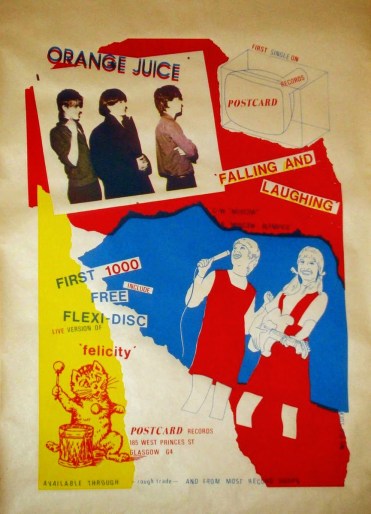
It remains the holy grail.  I know I’ll never own a copy – a fact confirmed a few years ago when I learned that even Edwyn Collins doesn’t have one in his collection, and both of us being canny Scotsmen will not entertain the asking price nowadays.

mp3: Orange Juice – Falling And Laughing (Postcard Records 80-1)

The fact everyone involved was appalled by the shamateurish way it ended up being recorded, with the loud bass drum pedal far too much to the fore, only adds to its charm.

Forty years ago?   Jings, crivvens, help ma boab!*

JC

*a phrase beloved of a cartoon character in a Scottish newspaper.  It is an exclamation of surprise, bewilderment and a gentle, playful cry for help all rolled into one saying. (I’ve added that to save Jonny asking what the hell it means….)

A REPEAT POSTING….WITH NO APOLOGIES

4 April 2014

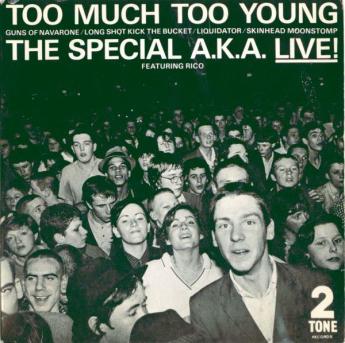
A LOT OF THE FOLK PICTURED ON THIS SLEEVE WILL BE GRANDPARENTS NOW…

There are loads of stats that can be thrown about from today’s offering.

– in February 1981, this became just the second EP ever to reach #1 in the UK singles charts; the first had been back in 1976 when greek crooner Demis Roussos took his Phenomenon EP to the top of the hit parade

Too Much Too Young became the first live track to reach #1 in more than 9 years; the previous occasion had been Chuck Berry with My-Ding-A-Ling

– at 2:04, the lead track was the shortest #1 throughout the 80s

– the five tracks on the EP had ten different composers

Terry Hall‘s dad was in the audience for the Coventry gig at which the b-side was recorded; this was the first time he’s seen The Specials perform in concert (the two songs on the a-side were from a separate gig in London)

——-

The thing was, back in 2014, the mp3s put up were of appalling quality with all sorts of hisses and crackles.  The fact I’ve now picked up a better copy gives me the excuse to re-post the music.

mp3 : The Specials – Too Much Too Young (live)
mp3 : The Specials – Guns Of Navarone (live)
mp3 : The Specials – Skinhead Symphony (live)*

* features Longshot Kick The Bucket, Liquidator and Skinhead Moonstomp

I feel it is only right that I should close with the two comments which were contributed to the original post, as one is smart/witty and the other is educational.

Jacques the Kipper says:
April 4, 2014 at 12:47 pm

I can see Ellen Degeneres at the back on the left…

Peerless.

Stevo Kifaru says:
April 12, 2014 at 9:24 pm

And ironically/coincidentally the three live tracks on the b-side of this E.P. were recorded at Coventry Tiffany’s where the previous (and first-ever live recording to hit the U.K top spot) No1 My Ding-a-ling was also recorded, albeit the venue was called the Locarno then….

That’ll be The Locarno which is namechecked by Terry Hall in this stunning b-side:-

mp3: The Specials – Friday Night, Saturday Morning

JC

TRANSFORMER

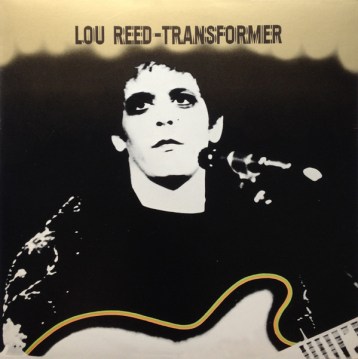
Transformer, the second solo album by Lou Reed was released in November 1972 and is nowadays considered a classic, being voted at reasonably high positions in all sorts of polls. Rolling Stone magazine has it just inside the Top 200 in its list of greatest albums of all time (#194 back in 2012), but it’s fair to say that the original reviewer wasn’t fully convinced:-

Nick Tosches, January 4,1973

A real cockteaser, this album. That great cover: Lou and those burned-out eyes staring out in grim black and white beneath a haze of gold spray paint, and on the back, ace berdache Ernie Thormahlen posing in archetypal butch, complete with cartoon erectile bulge, short hair, motorcycle cap, and pack of Luckies up his T-shirt sleeve, and then again resplendent in high heels, panty hose, rouge, mascara, and long ebony locks; the title with all its connotations of finality and electromagnetic perversity. Your preternatural instincts tell you it’s all there, but all you’re given is glint, flash and frottage.

Lou Reed is probably a genius. During his days as singer/songwriter/guitarist with the Velvet Underground, he was responsible for some of the most amazing stuff ever to be etched in vinyl; all those great, grinding, abrasive songs about ambivalence, bonecrushers, Asthmador, toxic psychosis and getting dicked, stuff like “Venus in Furs,” “Heroin,” “Lady Godiva’s Operation,” “Sister Ray,” “White Light/White Heat,” and those wonderful cottonmouth lullabies like “Candy Says” and “Pale Blue Eyes.” His first solo album, Lou Reed, was a bit of a disappointment in light of his work with the Velvets. Reed himself was somewhat dissatisfied with it.

Between that album and this one came the ascendancy of David Bowie, a man who had been more than peripherally influenced by the cinematic lyrics and sexual warpage of the Velvet Underground. Lou Reed, in turn, was drawn to Bowie’s music. Bowie included Velvet tunes such as “Waiting for the Man” and “White Light/White Heat” in his stage repertoire; Reed, last summer, made his first English appearance with Bowie. Now, on Transformer, Bowie is Reed’s producer.

David Bowie’s show biz pansexuality has been more than a minor catalyst in Lou Reed’s emergence from the closet here. Sure, homosexuality was always an inherent aspect of the Velvet Underground’s ominous and smutsome music, but it was always a pushy, amoral and aggressive kind of sexuality. God knows rock & roll could use, along with a few other things, some good faggot energy, but, with some notable exceptions, the sexuality that Reed proffers on Transformer is timid and flaccid.

“Make Up,” a tune about putting on make-up and coming “out of the closets/out on the street,” is as corny and innocuous as “I Feel Pretty” from West Side Story. There’s no energy, no assertion. It isn’t decadent, it isn’t perverse, it isn’t rock & roll, it’s just a stereotypical image of the faggot-as-sissy traipsing around and lisping about effeminacy.

“Goodnight Ladies” is another cliche about the lonely Saturday nights, the perfumed decadence and the wistful sipping of mixed drinks at closing time.

“New York Telephone Conversation” is a cutesy poke at New York pop-sphere gossip and small talk, as if anyone possibly gave two shits about it in the first place.

Perhaps the worst of the batch, “Perfect Day” is a soft lilter about spending a wonderful day drinking Sangria in the park with his girlfriend, about how it made him feel so normal, so good. Wunnerful, wunnerful, wunnerful.

And then there’s the good stuff. Real good stuff. “Vicious” is almost abrasive enough and the lyrics are great: “Vicious/You want me to hit you with a stick/When I watch you come/Baby, I just wanna run far away/When I see you walkin’ down the street/I step on your hands and I mangle your feet/Oh, baby, you’re so vicious/Why don’t you swallow razor blades/Do you think I’m some kinda gay blade?” It’s the best song he’s done since the days of the Velvet Underground, the kind of song he can do best (his voice has practically no range).

“Walk on the Wild Side” is another winner, a laid-back, seedy pullulator in the tradition of “Pale Blue Eyes,” the song is about various New York notables and their ramiform homo adventures, punctuated eerily by the phrases “walk on the wild side” and “and the colored girls go ‘toot-ta-doo, too-ta-doo.’” Great images of hustling, defensive blowjobs and someone shaving his legs while hitchhiking 1500 miles from Miami to New York that fade into a baritone sax coda.

“Hangin’ ‘Round” and “Satellite of Love” are the two remaining quality cuts, songs where the sexuality is protopathic rather than superficial.

Reed himself says he thinks the album’s great. I don’t think it’s nearly as good as he’s capable of doing. He seems to have the abilities to come up with some really dangerous, powerful music, stuff that people like Jagger and Bowie have only rubbed knees with. He should forget this artsyfartsy kind of homo stuff and just go in there with a bad hangover and start blaring out his visions of lunar assfuck. That’d be really nice.

——-

I think it’s fair to say there would be an outraged reaction if this was a newly released album and this was a contemporary review.  It’s quietly satisfying that we have come along way since 1973.

I’m way too young to remember Transformer, but as I mentioned previously, I have very vivid memories of Walk On The Wild Side, albeit I didn’t, as a ten-year old, buy the single.

It’s been a long long time since I listened to Transformer in its entirety….probably in the region of 35 years since my student days.  I don’t have a CD copy but Mrs Villain does own a vinyl copy that she bought in 1973 (it was the Bowie/Ronson connections that clinched it for her teenage self) and so, with my purchase of a decent turntable and amp a short time ago, it was given a spin.

Tosche’s review highlighted that four songs were classics.  He’s spot on about Vicious – it is still, after all these years, a tremendous song, and must be up there with the best opening tracks of any album in the history of pop music (the old blog had that as a regular feature and I’m often tempted to resurrect it).  Walk On The Wild Side is one of the most memorable tunes ever written and recorded.  Satellite of Love has stood the test of time but I’d argue that Hangin’ ‘Round has lost much of its initial impact from the fact that the tune became something of a template for years to come, but a template that later singers and bands were able to improve.

Of some the songs that Tosche finds unappealing, I find myself nodding in agreement but not for the vindictive and homophobic reasons he’s used in his review.

Goodnight Ladies might well have been fun to write and record, but its jazz persona offers a tune and style that does nothing for me.

He’s right about Perfect Day.  It’s a run-of-the-mill soppy ballad that far too many folk have tried to say, over the years (particularly after its inclusion in the film Trainspotting) that it has a deeper meaning around drug addiction.

He’s also right about New York Telephone Conversation and even if it is a song that does find favour, credit has to be given for the catty putdown that nobody really gave a toss about such whispering and gossip in the first place.

But he’s way wrong that Make Up has no energy and isn’t assertive nor rock’n’roll seems to simply highlight that he was let down by a lack of aggressive energy as it is a song full of assertion while being decadent and, in the early 70s, perverse in a way that would have shocked the majority of people.

The review makes no mention of three other songs – Andy’s Chest, Wagon Wheel and I’m So Free – but it is interesting to note that many later reviews that are available online, written when the album was reissued or when it was a significant anniversary, rarely mention the tracks either.  I actually like the first two but the third of them just jars as a sub-standard throwaway that when I heard it again had an opening that reminded me of Parklife by Blur.

If I was asked to come up with a one-word review of Transformer, it would be ‘patchy’.  There are some bits of magic that are offset by a bits of whimsy that are easily disposable and a number of bog-standard numbers. It’s one that I was never driven to own although I do fully get why it is seen by many as such an important album in the history of pop music, but I look on it in the same way as other ‘important or influential albums’ by The Beatles or Led Zepellin or The Beach Boys or Pink Floyd or Bruce Springsteen.

Feel free to take the mic and argue the toss.

Oh, and before I go, ripped from the vinyl bought by Rachel back in the day, well before the big hit single:-

mp3: Lou Reed – Vicious
mp3: Lou Reed – Walk On The Wild Side
mp3: Lou Reed – Make Up

JC

FAC 272

Blue Monday is probably the best-known of all the songs ever released on Factory Records. Love Will Tear Us Apart might have a counter-claim on that statement and it could well be a photo-finish at the line. I reckon the Happy Mondays take on a John Kongos song from 1970 would be the other track on the 1-2-3 podium.

I’ve featured the song before, posting the album version. I’ve been doing a bit of Discogs shopping in recent weeks, picking up a few bits’n’bobs to complete some holes in the vinyl collection that will enable a few more posts to be worked up over the next few weeks. As ever, many of the sellers offer combined postage rates when you add a few more bits of desired rather than essential vinyl, which is why I came to pick up a copy of the 12″ version of FAC272, with its two very enjoyable extended mixes:-

mp3: Happy Mondays – Step On (Stuff It In Mix) (5:53)
mp3: Happy Mondays – Step On (One Louder Mix) (6:03)

It’s a song in which over-familiarity and too much radio exposure hasn’t spoiled it for me.

JC

DID YOU KNOW?????…..

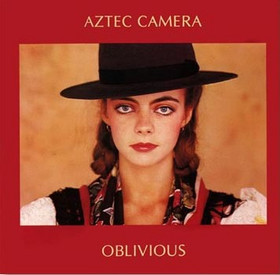
….that the single version of Oblivious is five seconds shorter than the version which opens up High Land, Hard Rain?

mp3: Aztec Camera – Oblivious (single version)

The difference is just after the two-minute mark. The lovely, almost flamenco style of guitar playing has an additional bar on the album version. Something I only picked up when I pulled out the 12″ copy of the single for the first time in years to have a listen on the new turntable.

mp3: Aztec Camera – Oblivious

The single, in its 7″, 12″ and its later re-released form (with a different sleeve) contains one of the greatest of Roddy Frame‘s love songs on the b-side

mp3: Aztec Camera – Orchid Girl

The other track wouldn’t have been out of place on the parent album either (and indeed, like Orchid Girl, was added when it was eventually issued on CD):-

mp3: Aztec Camera – Haywire

I will never tire of telling folk that Roddy Frame was just a few months past his 19th birthday when High Land, Hard Rain hit the shops in April 1983. It will always be very near the top of my all-time favourite albums by a Scottish singer or band – indeed there are days when I think it might well be my actual favourite.

JC

BREAKING IT ALL DOWN : PUMP UP THE VOLUME

I did state, when pulling together the first installment of this series back a couple of months, that it was likely to be, at best, an occasional thing as the final pieces will always require a fair bit of digging and research and there will be extended periods of time when I can’t be bothered with that.

Pump Up the Volume was a huge hit back in 1987 and is seen as the biggest milestone in the way that snatches of music were sampled to create something fresh and new.

mp3: M|A|R|R|S – Pump Up The Volume

Wiki has a page devoted to Pump Up The Volume in which a table is laid out with info on all the samples that were used on the various different versions of the song.  There are 21 samples identified for the UK radio edit.

Sample 1: Unity – Afrikka Bambaataa and James Brown

The sampled portion is the repeated vocal ‘Ah….’.

Unity dates from 1984 and was the first recording in which James Brown collaborated with anyone who was primarily associated with rap or hip-hop. Despite the impressive pedigree, the single was a flop.

Sample 2: Holy Ghost – The Bar-Kays

The sampled portion is Drums, with moog (at the “put the needle…” part)

Holy Ghost is the opening track on Money Talks, an album released in 1978 but recorded between 1972 and 1975.

Sample 3: Super-Bad (part one) – James Brown

The sampled portion is the vocal “Watch me”

Super Bad is one of James Brown‘s best-known songs, going to  #1 on the R&B chart and number 13 on the Billboard Hot 100 in 1970.

Sample 4: Funkin’ For Jamaica (N.Y.) – Tom Browne

The sampled portion is the trumpet

A top ten hit for the jazz trumpeter here in the UK in 1980 and while it made the dance and R&B charts back home in the USA, it didn’t break into the Billboard Top 100. Was also the first track on side one of Dancin’ Master, the first of what would be many NME mail-order cassettes following the success of C81, released in October 1981.

Sample 5: Put The Needle To The Record – Criminal Element Orchestra

The sampled portion is the vocal “Put the needle on the record when the drum beats go like this”

A hip-hop single from 1987 which itself sampled from many others.  Criminal Element Orchestra is one of the names adopted over the years by legendary NYC-based producer, Arthur Baker.

Sample 6: I Know You Got Soul (a capella version) – Eric B and Rakim

The sampled portion is the vocal “Pump up the volume, dance”

I Know You Got Soul was the third single to be released from the 1987 album Paid in Full, one of the legendary albums in the history of hip-hop.

Sample 7: Change le Beat – Fab 5 Freddy featuring Beside

The sampled portion is the Beep effect and distorted vocal sample, “Ah”

Fred Brathwaite, aka Fab 5 Freddy, is a hip hop pioneer immortalised in 1981 with the mention by Debbie Harry on the hit single Rapture.

Change the Beat is a single dating from 1982 with its B-side lead vocals performed by rapper Beside and rapped entirely in French, making it one of the first multilingual hip-hop releases.

Sample 8: Mean Machine – D.ST and Jalal Mansur Nuriddin

The sampled portion is the chanting -“Automatic, push-button, remote control; synthetic, genetics, command your soul.”

D.ST was the early stage name of GrandMixer DXT, one of the first to use turntables as a musical instrument in the 1980s. The late Jalaluddin Mansur Nuriddin (July 24, 1944 – June 4, 2018) was one of the founding members of The Last Poets, a group of poets and musicians that evolved in the 1960s out of the Harlem Writers Workshop in New York City. Mean Machine was a single from 1984 and was an update of a track originally recorded by The Last Poets in 1971.

Sample 9: The Jam – Graham Central Station

The sampled portion is the Drums and repeated vocal, “Hu, ha”.

Graham Central Station was an American funk band named after founder Larry Graham (formerly of Sly & the Family Stone). The Jam is the opening track on Ain’t No ‘Bout-A-Doubt, the band’s third album, released in 1975.

Sample 10: It’s Just Begun – Jimmy Castor Bunch

The sampled portion is the vocal “It’s just begun”.

James Walter Castor (January 23, 1940 – January 16, 2012) was a funk, R&B, and soul multi-instrumentalist. It’s Just Begun is the title track of his band’s album from 1972 and is a piece of music, whether the vocal or sax, that has been much sampled.

Sample 11: Jungle Jazz – Kool & The Gang

The sampled portion is the drumbeat

Kool & The Gang first really got noticed in the UK in the late 70s/early 80s through a succession of hit disco/pop singles. But they had been around since 1964, recording and releasing a large number of pioneering soul and funk records. The instrumental Jungle Jazz can be found on the 1975 album Spirit of The Boogie and itself is linked to Jungle Boogie, released two years previously and which later became well-known from its inclusion on the soundtrack to Pulp Fiction.

Sample 12: Positive Life – Lovebug Starski and The Harlem World Crew

The sampled portion is the vocal “That’s right, dude, this gotta be the greatest record of the year/Check it out”

Lovebug Starkski (May 16, 1960 – February 8, 2018) was a DJ, MC, musician, and record producer who was part of the emerging hip-scene in The Bronx at the outset. Positive Life is a single dating from 1981.

Sample 13: Im Nin’Alu – Ofra Haza

The sampled portion is the vocal.

Im Nin’alu is a Hebrew poem by 17th-century Rabbi Shalom Shabazi that has been placed to music and sung by many, including Israeli singer Ofra Haza. Her first televised performance was in 1978 but the version sampled is from the 1984 album Yemenite Songs. The vocal/tune was later sampled by Eric B. & Rakim on Paid In Full and, of course, M|A|R|R|S on “Pump Up the Volume” which led to Haza releasing a dance remix of her own recording in 1988 that went to #1 in Finland, Norway, Spain, Switzerland and West Germany, while in the UK it peaked at #15.

Sample 14: Pump That Bass – Original Concept

The sampled portion is the vocal “Pump That Bass”.

Another NYC-based act, Original Concept hailed from Long Island, and were one of the earliest signings for Def Jam Records. Pump That Bass was released as the b-side to a single in 1986 and then later on their sole LP, Straight From the Basement of Kooley High, which came out in 1988.

Sample 15: Celebrate the Good Things – Pleasure

The sampled portion is the horn.

A soul/funk/jazz group from Portland in Oregon, Pleasure released a number of singles and albums in the last 70s and early 80s without ever making a commercial breakthrough. Celebrate The Good Things is the opening track, Get To The Feeling.

Sample 16: You’re Gonna Get Yours – Public Enemy

The sampled portion is the vocal “You’re Gonna Get Yours”.

Arguably, the best-known of the samples, it came from a single released just a few months earlier, albeit it pre-dated the commercial breakthrough of Public Enemy.

Sample 17: I Don’t Know What This World Is Coming To – The Soul Children

The sampled portion is the vocal “Brothers and Sisters”.

The Soul Children recorded soul music for Stax Records in the late 1960s and early 1970s. The sample is actually from the MC’s introduction to their performance at Wattstax, a concert to commemorate the seventh anniversary of the 1965 riots in the African-American community of Watts, Los Angeles that took place at the LA Coliseum on August 20, 1972. The MC was the Rev Jesse Jackson.

Sample 18: Pump Me Up – Trouble Funk

The sampled portion is the vocal “Pump Me Up”.

Trouble Funk are from Washington, D.C. and released six albums in the 80s before disbanding (since when they reformed in the late 90s). Pump Me Up is from the 1982 album Drop The Bomb, and has become one of the most-sampled bits of vocal over the years.

Sample 19: Introduction to the J.B.’s – Fred Wesley and The J.B’s
Sample 20: More Peas – Fred Wesley and The J.B.’s

The sampled portions are the vocals “Without No Doubt” and “Yeah Yeah”

Fred Wesley is an American trombonist who worked with James Brown in the 1960s and 1970s. The J.B.’s was the name of James Brown’s band from 1970 through the early 1980s. In addition to backing Brown on stage and on record during this era, the J.B.’s also recorded albums and singles on their own, and these two tracks can be found on the 1973 album, Doing It To Death. The former is another which involves a sample from the MC who is doing the introduction…..

Sample 21: Abu Zeluf – Dunya Yunis

The sampled portion is the vocal

This particular piece of music was sampled back in 1980 by Brian Eno and David Byrne on the track Regiment, which can be found on the album My Life In The Bush of Ghosts. The original recording is from “The Human Voice in the World of Islam” which was released in 1976. Not much is known about the singer – she is described only as a “Lebanese mountain singer” in the Eno/Byrne release. It appears, from what I can gather from browsing various corners of the internet, that Ms Yunis had been recorded by Poul Rovsing Olsen (November 4, 1922 – July 2, 1982) a Danish composer and ethnomusicologist at some point during his career and she has never been compensated from the Byrne/Eno work or indeed from the M|A|R|R|S sample.

This post took about three times as long to finish in comparison to an ICA in that there was a ridiculous amount of research involved and with 21 different bits of music to explore, there proved to be a lot of threads to it, almost all of which were new to me.  I feel it’s been the equivalent of climbing Everest as far as this series goes, and as such, I’m retiring it forthwith!

JC

THE SINGULAR ADVENTURES OF R.E.M. (Part 12)

If ‘Document’ saw R.E.M. move wholeheartedly into the political rock arena, then its successor ‘Green’ cranked it up another gear. Released during the 1988 US Presidential election campaign, the band wore their colours on their sleeves, endorsing the Democrats while heavily criticising the Republican candidate George Bush. Among its main themes was environmentalism, the album title being the giveaway. Musically, the band regard it as experimental following Michael Stipe’s request that they “didn’t write any more R.E.M.-type songs.”

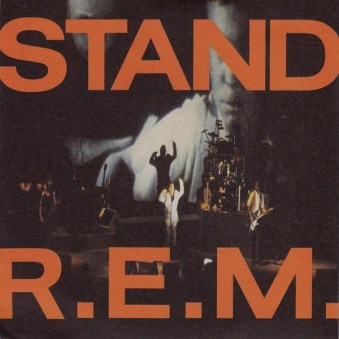
In the UK, it was released with no singles preceding it. I bought it on the day of release (7 November 1988), the first time I’d done that for an R.E.M. record. It wasn’t until late January 1989 that, Stand was issued as the first UK single from ‘Green’. I suppose it was the obvious choice, but it seems to confirm my previous observations in this series about the choice of singles the band (or label) made to promote their albums. This was the first R.E.M. record on a major label, yet the same theme remained. Peter Buck described Stand as “without a doubt the stupidest song we’ve ever written.” Stipe added that his lyrics were deliberately inane to match the “super bubblegummy songs” the band offered up following a discussion about 60s pop groups like the Banana Splits and the Archies.

mp3: R.E.M. – Stand

Does Stand represent ‘Green’? Absolutely not. Does it sound like an R.E.M. single? Totally. In fact, Warners thought it was worthy of releasing twice! First time around, the 7” was backed by a short instrumental called Memphis Train Blues, essentially a mandolin-led blues song. A typically throwaway, non-essential piece.

mp3: R.E.M. – Memphis Train Blues

The 12” added an instrumental version of the album’s closing track. Unlisted on the album sleeve and label, the track was officially known as 11 for copyright purposes. On it, the band switched instruments with Buck on drums, Berry on bass and Mills on guitar. The b-side version was given the title (The Eleventh Untitled Song), was 45 seconds longer and omitted the vocal.

mp3: R.E.M. – (The Eleventh Untitled Song)

This original release stalled at #51, something of a dud when you consider the band’s increasing renown and ever-growing fan-base, coupled with the overtly radio-friendly nature of the song. So it’s perhaps no surprise that, given the next single became R.E.M.’s first UK top 30 hit, Stand was given a second crack at the whip later in the year, with new cover art to boot.

This time, the b-sides were a little more interesting. An acoustic version of ‘Green’’s opener Pop Song 89 graced the 7” format, while a live cover of the Ohio PlayersSkin Tight was added to the 12”.

mp3: R.E.M. – Pop Song 89 (acoustic version)
mp3: R.E.M. – Skin Tight (live)

The re-release coincided with the European leg of the Green Tour, the band’s biggest, most expansive jaunt to date. I had, just a month earlier, seen them for the first time at Wembley Arena in London. Unfortunately, none of this was enough to propel the single to dizzy heights, this time stalling at an only slightly better #48.

Stand was a better track than Cant Get There From Here, no doubt about it, but it still doesn’t rate among the band’s finest songs. It doesn’t rate among the finest songs on ‘Green’, in my opinion (they would be World Leader Pretend, Turn You Inside-Out and You Are The Everything). It did not give the band the super-sized global hit the record company had no doubt been hoping for, but mega-stardom was a lot closer than many people thought…

The Robster

SATURDAY’S SCOTTISH SONG : #226 : ONE DOVE

Pinched from elsewhere on t’internet:-

One Dove were a Scottish electronic music group active in the early 1990s, consisting of Dot Allison, Ian Carmichael and Jim McKinven.

Originally called Dove, the group released its debut single, “Fallen”, on the Glasgow-based label Soma in October 1991. It was a significant club hit and brought them a deal with the Junior Boy’s Own label. Changing their name to avoid confusion with a similarly named group, in 1992 JBO issued a new recording of “Fallen”, produced by Andrew Weatherall, which brought the group to greater attention from the British music press. The single was withdrawn one week after release however, due to an unlicensed sampling of a harmonica from a Supertramp song. Further critical acclaim followed with the release of the 12″ single “Transient Truth”.

At this stage, One Dove were still primarily a club-oriented group, but for the single “White Love”, an attempt was made to make their music more radio-friendly by including a commercial remix by Stephen Hague. With this increasingly commercial sound, the band became a favourite with publications such as Select and Q, and were often favourably compared with Saint Etienne, another female-fronted group who were having success with pop-dance crossover recordings.

In 1993, One Dove released their only album, Morning Dove White, which included the Weatherall version of “Fallen” (minus the Supertramp sample) together with 12″ mixes of “Transient Truth” and “White Love”. The album was originally set for release in 1992 but was delayed for a full year through disputes between the band and their new record company – London Records had taken over the Boy’s Own label. The band were unhappy about the commercialisation of their sound, and the disputes were only resolved when the band agreed to release singles mixed by Stephen Hague, if they could work with him in the studio during the remix sessions.

The album was preceded by the single “Breakdown”, with remixes by Stephen Hague, William Orbit and Secret Knowledge and a further track from the album, “Why Don’t You Take Me,” was subsequently released as a single for the Christmas market. For the B-sides of the “Why Don’t You Take Me” single (which included a reworking of Dolly Parton’s song “Jolene”), the group expanded to a five-piece with the addition of Ed Higgins on percussion and Colin McIlroy on guitar, and showcased a more heavily dub-influenced sound. This line-up later went into the studio to begin work on a second album, but frustrated by record industry politics, split up midway through the sessions.

The first time I heard them was in 1993.  I’d missed the whole initial fuss and the link-up with Weatherall and so it was the radio mix of White Love that pulled me on board:-

mp3: One Dove – White Love

I still can’t get my head around the fact that something as smooth and classy as this was the work of a bunch of Glaswegians, including one who had enjoyed a fair stint in Altered Images at the height of their commercial success.

JC

SOME WORDS ON MICRODISNEY

Microdisney was an Irish band that was founded in Cork in 1980, with its two mainstays being Cathal Coughlan (keyboards, vocals) and Sean O’Hagan (guitar). The band broke up in 1988 with Coughlan going on to form the Fatima Mansions while O’Hagan fronted the High Llamas.

After some 30 years, they got back together and then broke-up again following live shows in London in the summer of 2018 before Dublin and Cork in February 2019.  An extensive interview, given subsequently by Cathal Coughlan to an Irish newspaper, provides all the explanation you need. Here’s an edited version of it:-

Where there is an end, there might also be a cautious beginning. Cathal Coughlan, the Cork man perhaps best known for being the vocalist and lyricist of Microdisney, is wrapping up the group, setting alight to the package and scattering the ashes on to waters that will transport them to the afterlife.

“There are a number of things that persistently matter to me,” says Coughlan of his next creative step, “and one is the art song. Whether it’s German theatre, Sinatra, Tin Pan Alley, Northern Soul or discordant, pernickety song composition from the late 20th century, those are the things I care about. A lot of what I’m doing is in that range. The challenge is: how do you do something noir that doesn’t allude? I don’t want to allude if I can help it.”

Now in his late 50s, with robust features, Coughlan has much more a measure of himself than he once had. He is the exact opposite of Joni Mitchell’s pronouncement as a songwriter to comfort more than disturb. He speaks slowly, cautiously. He has the manner of someone who has come through conflict intact yet is very much in charge because of it, and he has a knack for closing circles with precision.

He did the same with his post-Microdisney groups, Fatima Mansions and Bubonique, but this time last year he had to re-open the box that his first band had been sealed in for over 30 years. The reason was Microdisney being, in 2018, the first recipient of the IMRO/NCH Trailblazer Award, which celebrates culturally important albums (in this case, 1985’s The Clock Comes Down the Stairs) by iconic Irish musicians, songwriters and composers.

“I felt very humbled,” he says of the award being bestowed. In acceptance, he includes the other band members, particularly fellow Cork colleague Sean O’Hagan. “Obviously, Sean and I are more rooted in Ireland, and so it possibly meant something different, but everyone was blown away by it.”

It shows how Ireland has changed, says Coughlan, who recalls that in the mid-1980s, the band could never have afforded to self-finance a journey from London to Dublin. “It would be unwise not to accept that there was a generational aspect to it, but it meant a hell of a lot to be given such an award by a major cultural institution.”

Was there a sense that Microdisney had either been completely forgotten about or were little more than a fond memory for a certain demographic of music fan? “The dust had settled for us,” says Coughlan with an unsentimental air of finality. “Any emotional stuff that we had from the ’80s had long ago drifted off into the ether; we knew we could play the material, and I knew that I could relate to a lot of the emotional aspects of it.”

If the Microdisney shows last June (two at the National Concert Hall, one of which was invite-only, one at London’s Barbican) proved anything, it was that their songs have stood the often perilous test of time.

Regarding talk of further Microdisney shows, Coughlan says: “There was an ellipsis more than a discussion. Other than we had all enjoyed it and that the shows exceeded our expectations – which were high enough to begin with – we all had other stuff going on, so it got a bit quiet.”

Cue a promoter’s offer, however, to play gigs in Dublin and Cork. “We just decided to do it, yet not the same as last year. The two shows, however, is really the extent of it.”

Why such a definitive end?

“Because in the context of being a songwriting and recording outfit, Microdisney ran its course. Yes, people appreciated it, and it made a big difference to my life, but let’s just leave it, for the most part.” He says the band can be revived, and that fun would certainly be had, “but that’s about the size of it”.

So there you are…..a band that was well-loved in their native land doing the decent thing by playing a very small number of shows in acknowledgment of a major award then calling it a day before their legacy runs the risk of being tarnished. A number of their peers should take heed…

Here’s a 12″ single, complete with two b-sides, from the 1985 album, put out on Rough Trade Records, that received that IMRO/NCH Trailblazer Award:-

mp3: Microdisney – Birthday Girl
mp3: Microdisney – Harmony Time
mp3: Microdisney – Money For The Trams

The a-side is very poppy and radio-friendly….a sort of cross between Prefab Sprout and Deacon Blue.

Selected today as it is Mrs Villain’s actual birthday…..

JC

AN IMAGINARY COMPILATION ALBUM : #261 : GREEN GARTSIDE

A DEBUT GUEST POSTING by KHAYEM

Inspired by JC’s recent post, my first attempt at an ICA is Scritti Politti, or more specifically, the wonder that is Green Gartside. Like most, it’s been a challenge to pick just ten songs but I’ve tried to avoid straightforward ‘greatest hits’ and instead capture the breadth and consistency of Green’s output over several decades. Ironically, my first exposure to Scritti Politti wasn’t the music, but the lyrics to The ‘Sweetest Girl, printed in Smash Hits. The words alone and the accompanying striking image of Green & co. was enough for me to check out their records and I’ve been along for the ride ever since.

I think Green is one of the finest songwriters and singers and, whether DIY indie, anarcho-political, ‘perfect pop’, reggae, dancehall, electronica-acoustic or future folk, the trinity of words, music and voice is hard to beat.

SIDE ONE

1) Boom! There She Was (Sonic Property Mix ft. Roger) (UK 12” single, 1988)

Perfect pop sounds to begin. I got this 12” single before the accompanying album Provision and it’s remained the definitive version for me. There is a US edit of this song which, at 9 minutes, slightly outstays its welcome but the album and single versions feel too short. This is just the right balance of mid-80s sounds, enhanced by remix titans Steve Thompson and Michael Barbiero and guest vox from talkbox champion Roger Troutman. Also, the second Scritti pop song (that I’m aware of) to reference philosopher and author Jacques Derrida.

2) A Little Knowledge (Cupid & Psyche 85, 1985)

This duet with B.J. Nelson is one of the highlights of the album and one of my favourite Scritti songs, full stop. It’s a perfect meld of sound and feeling, brimming with great lines including this one:

Got a little radio
Held to my body
I can feel your back beat boy
Moving a muscle of love

3) Petrococadollar (White Bread Black Beer, 2006)

Green often creates an unsettling mix of honeyed vocals and unsettling aural backdrops and this is a great example. It’s almost as if the music is coming through the walls from the neighbour next door whilst he’s riffing lyrics over the top. Comforting and creepy at the same time.

4) Take Me In Your Arms And Love Me (Nice Up The Area Mix ft. Sweetie Irie) (CD single, 1991)

Scritti Politti entered the 1990s with a trio of cover version singles, one with B.E.F. (see the ‘Bonus EP’ below) and two with on-the-money reggae guest vocalists. I prefer this cover of the Gladys Knight & The Pips song to The BeatlesShe’s A Woman. The latter was a bigger hit, but this is a better song and Sweetie Irie tops Shabba Ranks, no question. Of the multiple mixes on the 12” & CD this one by Green and Heaven 17/B.E.F.’s Ian Craig Marsh is the stripped-down superior.

5) Flesh & Blood (Version ft. Ranking Ann) (The Word Girl EP/Cupid & Psyche 85 bonus 12”, 1985)

Though 1999’s Anomie & Bonhomie was seen by many as a controversial departure, with Green frequently ‘guest vocalist’ on his own songs to rap artists, the seeds had been planted a decade and a half before. Limited copies of Cupid & Psyche 85 came with a bonus 4-track 12” of ‘Versions’ and this alternative take on reggae pop of The Word Girl is dominated by Ranking Ann, with an occasional snippet of Green in the background. This version also appeared on the single’s B-side, which remains Scritti Politti’s biggest UK hit to date, peaking at No. 6.

SIDE TWO

6) Confidence (4 ‘A Sides’ EP, 1979/Early, 2005)

Kicking off Side Two, this doesn’t quite go right back to the beginning but appeared on the aptly 4 ‘A Sides’ EP from 1979. I heard this for the first time on the Early compilation. As the EP title suggests, this is a shift towards pop, though as ever Green has an individual lyrical take on the relationship song:

Competence inherent in what a man must do
Facts I admit only in confidence to you
But you haven’t got the heart to tell me…

7) Tinseltown To The Boogiedown (Album Version ft. Mos Def & Lee Majors) (Anomie & Bonhomie, 1999)

I first heard and saw the video on The Chart Show and missed the opening few seconds and title, so I didn’t realise it was Scritti Politti until Green’s unmistakeable vocals appeared on the chorus. I loved this song and the Anomie & Bonhomie album and, for me, it seemed a natural evolution. The Black Keys did pretty much the same thing ten years later, with their Blackroc album, but Green was there first and this is better. And Mos Def is most definitely the rap chief.

8) Wishing Well (Tangled Man EP, 2020)

The release earlier this year of a two-song solo single of Anne Briggs cover versions was a welcome surprise. I belatedly picked up on an earlier Green Gartside cover version on a Nick Drake tribute album (Fruit Tree, on 2013’s Way To Blue) which kind of points the way to these songs. This song would also sit comfortably with the White Bread Black Beer album, and is further evidence of Green’s consummate skill as an interpreter of other people’s songs. And his voice grows ever richer with time.

9) Gettin’, Havin’ And Holdin’ (Songs To Remember, 1982)

With lyrical nods to Percy Sledge (“When a man loves a woman”) and Ludwig Wittgenstein (“It’s true like The Tractatus”), this also has the dubious distinction of allegedly inspiring Wet Wet Wet’s name. Why this song hasn’t been covered innumerable times is a mystery to me but it remains an all-time favourite and has been an essential inclusion on every Scritti Politti or ‘skewed love songs’ mix tape that I’ve done for friends over the years.

10) Forgiven (Live Acoustic Version) (Charles Hazlewood, BBC Radio 2, May 2007)

This was one of two new songs that Green premiered on the Charles Hazlewood show in 2007, both with working titles (the other being Unfrozen). Forgiven has synth-based bird tweets, broken acoustic chords and lyrical references to a shady character going to “settle scores with a man with a Nike holdall”.

The entire segment, including a short but fascinating interview with Green, is still available on the excellent Bibbly-O-Tek website (http://bibbly-o-tek.com/2007/05/17/green-gartside-in-the-charles-hazlewood-show/). I was fortunate to see Green Gartside a couple of weeks later as part of the Venn Festival in Bristol. Although billed as a solo gig, it was the full Scritti Politti touring band: Rodhri Marsden, Alyssa McDonald & Dave Ferrett. Although a relatively short set of 9 songs, 5 (including Forgiven) were brand new songs at the time and one song (Robert E. Lee) had been finished in the dressing room before coming on stage. As far as I’m aware, Forgiven has not been re-recorded or released since, but this version could appear on an album as it is and, in my opinion, is a perfect closer to this ICA.

BONUS EP “TOUCHED BY THE VOICE OF GREEN GARTSIDE”

A sampler of songs that Green has lent his voice to and which are all the better for it.

a) I Don’t Know Why I Love You (But I Love You) (Album Version) (B.E.F., Music Of Quality And Distinction Volume 2, 1991)
b) Come And Behold (Green Gartside Revoice) (King Midas Sound, Without You, 2011)
c) When It’s Over (7” Version) (Adele Bertei, UK 7” single, 1985)
d) Between The Clock And The Bed (Manic Street Preachers, Futurology, 2014)

The Adele Bertei song was also co-written and produced by David Gamson and Fred Maher and sounds entirely like a Scritti Politti backing track/outtake from the Cupid & Psyche 85 sessions.

KHAYEM

SOME SONGS ARE GREAT SHORT STORIES (Chapter 38)

Here we go again, it’s Monday at last
He’s heading for the Waterloo line
To catch the 8 a.m. fast, it’s usually dead on time
Hope it isn’t late, got to be there by nine

Pinstripe suit, clean shirt and tie
Stops off at the corner shop, to buy The Times
‘Good Morning Smithers-Jones’
‘How’s the wife and home?’
‘Did you get the car you’ve been looking for?’

Let me get inside you, let me take control of you
We could have some good times
All this worry will get you down
I’ll give you a new meaning to life, I don’t think so

Sitting on the train, you’re nearly there
You’re a part of the production line
You’re the same as him, you’re like tin-sardines
Get out of the pack, before they peel you back

Arrive at the office, spot on time
The clock on the wall hasn’t yet struck nine
‘Good Morning Smithers-Jones’
‘The boss wants to see you alone’
‘I hope it’s the promotion you’ve been looking for’

‘Come in Smithers, old boy’
‘Take a seat, take the weight off your feet’
‘I’ve some news to tell you’
‘There’s no longer a position for you’
‘Sorry Smithers-Jones’

Put on the kettle and make some tea
It’s all a part of feeling groovy
Put on your slippers turn on the TV
It’s all a part of feeling groovy
It’s time to relax, now you’ve worked your arse off
But the only one smilin’ is the sun-tanned boss
Work and work you wanna work ’till you die
There’s plenty more fish in the sea to fry

mp3: The Jam – Smithers-Jones (single version)
mp3: The Jam – Smithers-Jones (album version)

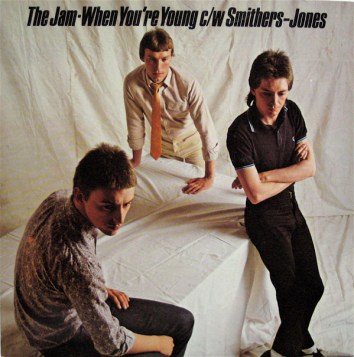
Written by Bruce Foxton.  Originally released as the b-side to When You’re Young in August 1979.  Completely re-recorded for the album Setting Sons which was released three months later.

JC


ADDITIONAL VOLUME, CONTRAST AND BRILLIANCE

One of the most popular postings round these parts was last October when I offered up some thoughts on twelve singles released by The Monochrome Set between 1979 and 1985.

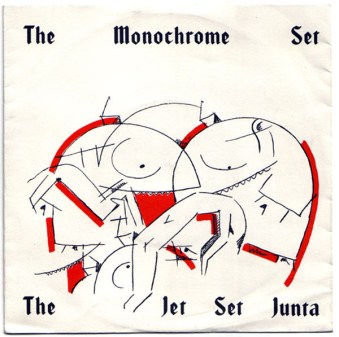
I mentioned that the version of The Jest Set Junta released in 1983 as a 45 was different from that which could be found on the album Eligible Bachelors, with it instead being a radio session version dating from December 1981. It was put out as a single to accompany Volume, Contrast, Brilliance….. a Cherry Red compilation of radio sessions and hard-to-find B-sides from earlier singles dating back to the era when the band was signed to Rough Trade.

I tracked down a decent copy of the single a few weeks back for the simple reason that the two b-sides, from a John Peel Session that dated back to February 1979 hadn’t been included on Volume, Contrast, Brilliance…

mp3: The Monochrome Set – Love Goes Down The Drain (Peel Session)
mp3: The Monochrome Set – Noise (Eine Kleine Symphonie) (Peel Session)

It was the latter of the two that I was really keen to get my hands on as it is an earlier take on Eine Symphonie des Grauens, which I’ve long regarded as my favourite of all songs by The Monochrome Set. It turns out that the Peel Session is shorter (by almost 30 seconds) and is a slower-paced version than the eventual studio recording – it also ends with one of those tricks whereby the needle slips into a repetitive groove which prevents the song coming to a natural conclusion – it took me a while to realise what was actually happening and I’ve kept the recording intact so that you too can enjoy the manic, almost mocking, laughter conclusion.

JC

A HAPPY SOUNDING SONG, BUT TINGED WITH TRAGEDY

Heavenly emerged, in 1989, from the rubble of the disintegration of Talulah Gosh, a band that has very much come to represent all that folk love/loath about the genre referred to as twee-pop. To begin with, there wasn’t much to distinguish between Heavenly and Talulah Gosh, which is no great surprise given that four of the musicians were common to both line-ups and there was less than a year between the last single from one band and the first single from the other.

There was a gradual, if slight, shift in the music made by Heavenly during the first half of the 90s. The tunes remained very upbeat and perfect for much airing at the indie-disco, but the subject matters were less innocent or far from flimsy. The band members were aging gracefully and their growing confidence, both on stage and inside the recording studio, looked like putting them on the ladder to a wider commercial success, especially as the UK music press was in the middle of its Britpop frenzy period and were talking up all sorts of bands, many of whose collective charms and talents were minuscule in comparison. The fourth studio album was in the can and there were a number of songs that had ‘likely hit’ stamped all over them.

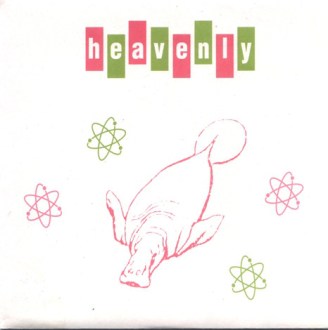
Tragically, the group’s drummer Matthew Fletcher took his own life in June 1996 shortly after the recording of the album was complete. It was devastating for all concerned, none more so than his sister, Amelia, the lead vocalist and in the eyes of many, the main focus of the band. The album, Operation: Heavenly, was released in October 1996. It was an absolute classic of its kind, cutting the ties almost entirely with twee and packed with tunes that were tailor-made for the daytime radio of the times. Understandably, the band members didn’t/couldn’t do much to promote it and it faded away into obscurity, other than having one 45 issued to help things along:-

mp3: Heavenly – Space Manatee

It took a while to get over the loss but the remaining came back together some 18 months later as Marine Research, by which time the Britpop era was over and very few executives were interested in four-piece bands who relied on catchy pop tunes.

I’ve long had a copy of the final album on CD but I recently picked up a copy of that final single and was delighted to discover that its two b-sides were both cover versions:-

mp3: Heavenly – You Tore Me Down
mp3: Heavenly – Art School

The former was originally by The Flamin’ Groovies and is from their 1976 album, Shake Some Action. The latter is a homage to The Jam with a fairly faithful musical interpretation, short and sharp at under two minutes, of a track from In The City (1977).

JC

THE SINGULAR ADVENTURES OF R.E.M. (Part 11)

As it turned out, a little bit of miscommunication resulted in both myself and The Robster thinking we had responsibility for pulling together a piece on the eleventh single to be released in the UK.  Rather than have anything go to waste, we felt it would be worthwhile giving you two for the price of one.

The Robster

The One I Love may have been the first R.E.M. song I heard, but it would only have been on the radio in the background so I wouldn’t have taken much notice of it. It was another track that was the first that I heard properly. In March 2014, I wrote about the revelatory moment when a mate at college lent me a copy of ‘Document’ when I was just 16, thus kickstarting a two-decade obsession with a band who would become responsible for me meeting and marrying the love of my life.

The full article is here [http://isthis-thelife.blogspot.com/2014/03/the-college-years-part-two-document.html] but if you don’t have the time/can’t be bothered, I’ll summarise parts of it here.

Nils Horley was a guy who fed my music obsession, blasting blues and rock at me whenever I visited his bedsit. One Friday afternoon in December, he approached me and asked: “Ever heard any R.E.M.?” “Errr, no,” came the reluctant reply.  I so wanted to say yes and sound cool, but I couldn’t tell a lie. “Listen to this,” he said as he handed me a cassette. “I bought it for my brother for Christmas so can I have it back on Monday?” And thus the seed was sown.

What Nils lent me was a copy of R.E.M.’s fifth album ‘Document’. Before I even played it, I was intrigued, just by the curious artwork alone. At 4pm, I boarded the bus outside the college, slipped the cassette into my Walkman and hit play. POW! There were a number of things that hit me between the eyes immediately. The opening snare hit, the distorted, single-note guitar line backed by the drums, eventually giving way to a voice the likes of which I’d never heard before – its reedy, almost sneering resonance disconcerted me for a bit. It was something I clearly needed time to get used to. It took about 40 minutes.

“The time to rise has been engaged,” Stipe sings as the album’s opening lines. To a 16-year-old raised as a working-class socialist through the god-awful Thatcher years, this was an inspiration; a call-to-arms, a rallying cry. “What we want and what we need has been confused.” Another line that still resonates 33 years later. Those first 20 seconds of ‘Document’ woke me from my teenage slumbers. I already sensed I was listening to something special, even if it did take a little longer to realise just how special R.E.M. were.

The journey home from college that day was like no other. ‘Document’ was my soundtrack not just for the bus ride, but most of that entire evening and throughout the weekend. I don’t think I played anything else. It has since become one of the most important records in my life, if not the most important. It was certainly a game-changer of gigantic proportions.

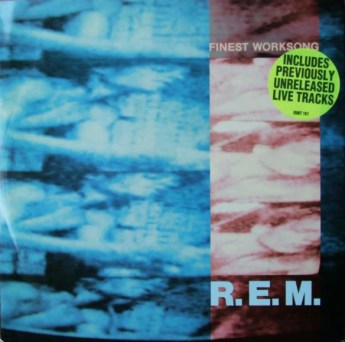
That opening song which thrust me headlong into the world of R.E.M. was Finest Worksong, and by the time it was released as the third and final single off ‘Document’ in March 1988, I had become North Devon’s biggest R.E.M. fan and had already started seeking out their back catalogue. It also became the first R.E.M. single I bought. There was a 7” released in the UK and Europe which contained the album version, but the global 12” release featured two alternative versions.

The first of these was the first R.E.M track to get the remix treatment for a 12” and as 12” mixes go it’s OK. I’ve heard a lot worse. Both mixes included an added horn section. The ‘Other Mix’ was initially intended as the official single version, but for some reason the album version was preferred for the 7”. It later appeared on the compilation ‘Eponymous’ retitled the ‘Mutual Drum Horn Mix’. To this day I’m undecided exactly what the horns add to the song. They’re not bad or anything, they’re just… there. Whatever – Finest Worksong reached number 50 in the UK charts, the band’s highest placing to date.

The b-side of all formats was the real treat though. Recorded live in Holland during the 1987 Work Tour, Stipe and Buck run through a medley of three songs in the quietest, tenderest, most utterly spellbinding finale to a show you’ll ever hear. Buck gently chimes on his Rickenbacker to two songs from ‘Reckoning’Time After Time and So. Central Rain – hyphenated by a brief interpretation of Peter Gabriel’s Red Rain, while Stipe sings delicately, as if the songs were lullabies, before allowing his voice to soar towards a climax.

It’s 8+ minutes of perfection, and a breathtaking conclusion to the ‘Document’ period. In fact, it was the end of the band’s indie status as less than 8 months after the single’s release, the first R.E.M. album for a major label would appear. A new chapter would begin and nothing would be the same for Athens, GA.’s finest ever again.

JC

You’ll have gathered by now that the release of R.E.M. singles was very much hit and miss, with I.R.S not really sure what to do.

The third and final single lifted from Document almost, on its own, made up for all mishaps over the previous years.  I’ve written previously about this single, with its first appearance being on the old blog as long ago as June 2007, the words of which I was able to find in the archives and re-post in September 2013.  But, if the record label can get away with repeat re-releases, then I’m going to follow its example and re-produce the words which have appeared previously.

“Yesterday (20 June 2007), I picked up second-hand copies of a couple of 12″ singles from the IRS days.

This single was released in April 1988, a full 7 months after the album Document came out, and so it was given a different recording and mix featuring a horns section. A shorter version of this was later put on the compilation LP Eponymous, but to the best of my knowledge, the track in all its glory is only available on the 12″ single. The band left IRS two days after the UK release of Finest Worksong and signed for Warner Brothers.

The b-side to the Worksong single is a live medley taken from a recording made by Vara Radio in Holland of the band’s concert in Utrecht on 14 September 1987. According to the set-list reproduced in the book Adventures In Hi-Fi : The Complete R.E.M. by Rob Jovanovic and Tim Abbott (Orion Publishing 2001), the three-track medley, which comprises Time After Time, Red Rain (a cover of the Peter Gabriel song) and So. Central Rain was the fourth and final encore of the show. Much of it is Michael Stipe singing acapella, with Peter Buck seemingly the only other band member on stage. It’s a very quiet recording, so you may have to crank up your volume for best effect.

The other track on the b-side of the 12″ was this. more or less, the version of Worksong that was later included on Eponymous.”

I said at the outset that the release of this single by I.R.S. almost made up for previous mishaps.  By that I mean we finally saw the band get the remix treatment and while the addition of the horns for the full 12″ version, reaching to just under six minutes, is just a bit much, the other mix does give what was already an outstanding song that little bit more oomph and there are days I sometimes think of it as being superior to the original….and then I come to my senses!!

I am, however, very grateful for the live medley getting to see the light of day. It’s very very lovely.

mp3: R.E.M. – Finest Worksong (Lengthy Club Mix)
mp3: R.E.M. – Finest Work Song (Other Mix)
mp3: R.E.M. – Time After Time etc.

And with that, we have reached the end of the I.R.S. era.  The Robster will be flying solo for the next three weeks to guide you through the initial instalments of the major years.

JC

SATURDAY’S SCOTTISH SONG : #225 : ODEON BEATCLUB

Some of you might recall that I gave a couple of previous mentions to Lonely Tourist, including as Part 190 of this ridiculously long-running series.

Lonely Tourist is the name adopted by singer-songwriter Paul Tierney, and for years it has been bugging me where I ought to know him from.  The fact that this series has finally reached the letter ‘O’ provided me with the solution.

From wiki:-

Odeon Beatclub were a Scottish indie band from Glasgow, formed in 1999 by friends Gerry Callaghan (vocals) and Paul Tierney (guitar). Initially the band included Paul’s sister Joanne Tierney (bass) and Des McCabe (drums). The band received support from Steve Lamacq for their self-released single, “Past Gone Mad”. Callaghan left the band in 2000, and vocal duties were taken over by Paul Tierney.

The band continued as a three-piece until Joanne Tierney left in 2001, to be replaced by James Pritchard (guitar), and eventually his girlfriend Sarah Brand (bass). The band’s first label release was I Need More Time through the Glasgow-based independent record label, Play Records.

In 2002, the band won a place at T in the Park after playing the T-break heats. The band was selected for Best Of T-break and the gig was later broadcast by long term supporters Vic Galloway and Gill Mills on their BBC Radio 1 show. One of the judges of the event was a pre-world fame Gary Lightbody of Snow Patrol, who subsequently asked the band to support them later in the year.

The band released a number of self-released, mail order only, CD singles from 2002-2003. In 2003 they released “Behind My Eye” through Stow College’s Electric Honey label.

In 2004 they contributed the track “1000 Arguments” to the Glowing Underground EP on Fierce Panda, and played as support to Ballboy, Camera Obscura and Half Man Half Biscuit. The band also released The Midnight Service Station EP on their own Polyester Records.

After a change of management, and a couple of false starts in 2005, the band started work on their debut album. Kenny Patterson was chosen as their record producer as he had worked with The Coral, Ian Broudie and Swayzak. The album was recorded at Goldtop Studios in London, in 2005. The band filled in at the last minute for a support slot in Greenock with Pete Doherty’s band, Babyshambles, in September 2005, and were subsequently asked to play the remaining Scottish dates of their tour. This led to the band supporting Babyshambles on another Scottish tour in 2006.

The much delayed first single, “Last Gasp”, from the debut album was released in August 2006. Brand left in September 2006 to be replaced by Rob McKinlay. Due to personal commitments, he was replaced in the summer of 2007 by Jon Paul Brownlow. The band’s self-titled debut album was released on Beatclub Recordings in March 2007.

Pritchard left the band in January 2008 to pursue his own solo work. He was replaced by Jim Lang. The band released “The New Kate Moss” in May 2008, and picked up airplay on numerous radio stations including BBC Radio 2 and 6music. This was followed by “How to Kill a Man” in November 2008, with a session on Radio Clyde’s Billy Sloan show the same month.

The band released another single, “Strike Me Down” in mid-2009, splitting up shortly afterwards.

I must have caught Odeon Beatclub at least once given the number of support slots they undertook over the years, but I can’t be certain.  I do recall them being written and talked about a fair bit which is why, when I saw it for sale in a second-hand store, I picked up a copy of a 7″ single which, as it turns out, was the debut mentioned above:-

mp3: Odeon Beatclub – Last Gasp

Think back to 2006 and there’s a great deal of this sort of music all across the airwaves and it felt that we were on the verge of another period when indie-pop with guitars was about to be fashionable again with, as it turned out, Arctic Monkeys leading the way.  Last Gasp is a more than decent enough record but it just doesn’t do enough to make it stand out and become a memorable one.  There must be a substantial number of musicians out there, singers, guitarists, bassists, drummers and keyboardists alike, who had a fleeting brush with fame and sniff of success back in the mid-00s who are now fast approaching or just turned 40 who will be looking back and wondering just why it didn’t last. The office or factory job now being held just won’t cut it in comparison.

The same thing goes for those who are a little bit older and had similar experiences in the 80s and 90s.  It must be hard not to get a tad bitter about things but all I’ll say is that those of us who were never talented enough to get near a stage or recording studio will always be jealous of what you did actually achieve.  And that applies to everybody associated with Odeon Beatclub.

JC

THESE EARLY DAYS…..AND B-SIDES

There are some days when a bit of easy-listening bordering on AOR is just what is needed. It doesn’t happen too often, but there are occasions when I just want everything around me to slow down and I find that putting on some low-key music can be a huge help.

One of my go-to albums on such days is Idlewild by Everything But The Girl, released in 1988. I’ve always loved Tracey Thorn‘s voice and Ben Watt‘s very accomplished acoustic guitar work, and they have never sounded better in that regard on this often quiet and very reflective album. It was the duo’s fourth LP and one of its songs, a cover of I Don’t Want To Talk About It went Top 3.

Worth mentioning in passing that this is a song that is famous/infamous in the UK when Rod Stewart‘s version was #1 in the summer of 1977 but sales figures are strongly rumoured to have been rigged to prevent God Save The Queen by The Sex Pistols being top of the charts. It was EBTG’s first, long overdue Top 20 single and it seemed as it would be a one-off until seven years later with the move into the dance/club sounds and the Todd Terry remix of Missing, provided a second visit to the heights of the singles charts.

Despite the lack of success on the 45s front, EBTG were popular with the record-buying public.

Idlewild, as I said earlier, was the fourth studio album and; like its predecessors, would sell enough copies (500,000) to qualify for a gold disc from the British Phonographic Industry. As is often the case, the record label issued one of the album’s best songs as the lead-off single, and it’s one which encapsulates that easy-listening vibe I referred to at the start of this post:-

mp3: Everything But The Girl – These Early Days

It’s a wonderfully emotive and hopeful lyric, written (I assume) to celebrate a nephew coming into the extended family. The infant James will now, all being well, be in his mid-30s and I wonder if he looks back on the song with a sense of awe that he could be immortalised in such a way

You’re only two and the whole wild world revolves around you,
And nothing happened yet that you might ever wish to forget.
It doesn’t stay that way, if I could I’d make stay that way.
And this you will recall in after years,
Though you may weary of this vale of tears –
These days remember, always remember.

You’re only two and I’ve no wish to worry you,
So pay no mind to those who say the world is unkind –
That’s just something they’ve read,
And if I could I’d strike them dead.
And this you will recall in after years,
Though you may weary of this vale of tears –
These days remember, always remember.

And honey there’s no rush,
The world will wait for you to grow up.
And this you will recall in after years,
Though you may weary of this vale of tears –
These days remember, always remember.

I hope you never change,
I’ll call you Jimmy, they call you James;
Don’t ever change,
I’ll call you Jimmy, they call you James.

I’ve been buying recently a fair amount of second-hand stuff on Discogs and I’ll often add a few things in if the seller is one of those who offers a deal on postage for multiple items, and as such I recently picked up a 12″ copy of These Early Days for the first time. There”s two tracks on the b-side, the first of which veers, certainly at the outset, in a frighteningly close musical tribute to True by Spandau Ballet but is more than saved by that wonderfully smooth voice and the way that Ben harmonises on the verses:-

mp3: Everything But The Girl – Dyed In The Grain

Dyed In The Grain was also available as the b-side on the 7″, but surely I’m not alone in thinking it was wasted there and should have been included on the parent album. It’s a lovely number and just captures perfectly what EBTG were about at this point in their career.

The bonus track on the 12″ is also an absolute gem:-

mp3: Everything But The Girl – No Place Like Home

I knew it was a cover from reading the info on the label. I had to turn to wiki:-

No Place Like Home is a song written by Paul Overstreet, and recorded by American country music artist Randy Travis. It was released in November 1986 as the fourth and final single from his album Storms of Life. The song reached number 2 on the Billboard Hot Country Singles chart in March 1987.

Paul Overstreet is an American country music singer and songwriter. He recorded 10 studio albums between 1982 and 2005, and charted 16 singles on the Billboard country charts, including two No. 1 hits. He has also written singles for several other country acts, including Randy Travis, Blake Shelton, The Judds and Kenny Chesney.

A totally new name for me, but I’m thinking my good friend CC will be able to offer up some thoughts……

This version, with just Tracey’s voice and Ben’s acoustic guitar is sublimely beautiful.

JC