SHOULD’VE BEEN A SINGLE ?(6)

A couple of years back, I came up with the idea of a series in which I’d feature songs that would have been massive hits if the band and/or record label had released them as singles. I was full of great intentions, but the series got lost as I got distracted by other things and disappeared off the TVV radar after just these five suggestions:-

The Clash – Clampdown
The Chameleons – Looking Inwardly*
New Order – Age Of Consent
Echo & The Bunnymen – Heaven Up Here
Teenage Fanclub – Don’t Look Back

* a guest posting by Adrian Mahon

I’m going to try again, without promising that it will be a very regular thing.

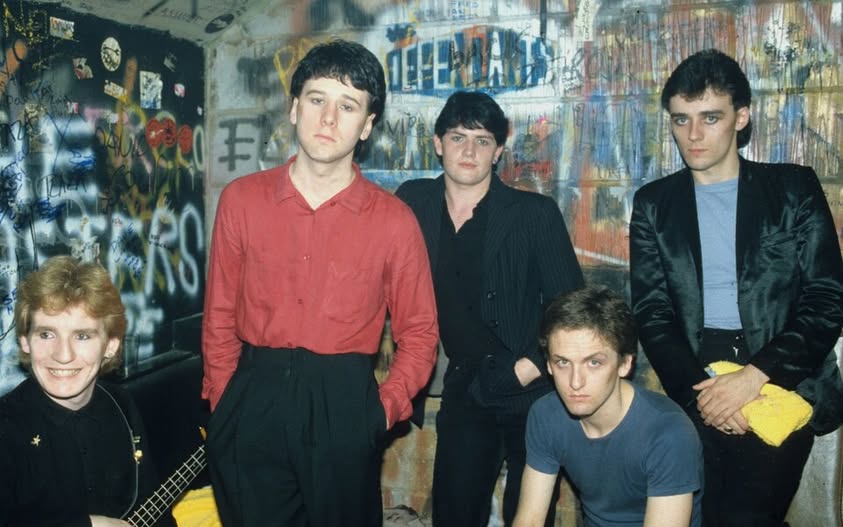
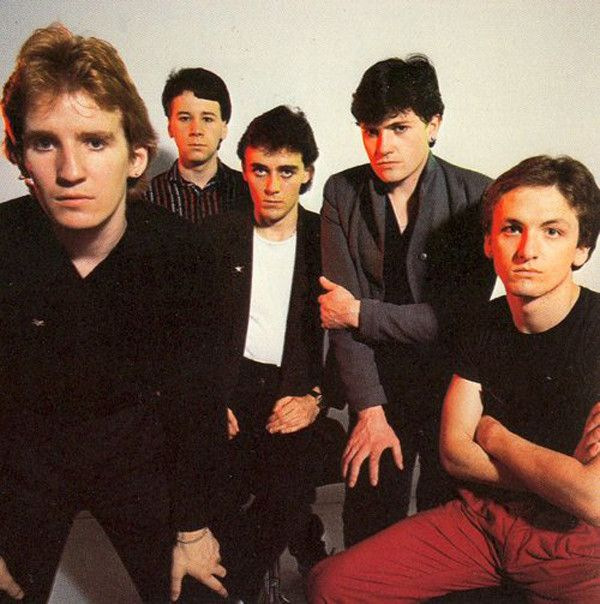
The story of early Simple Minds is one of frustration and, with the benefit of hindsight, loads of missed opportunities from Arista Records.

Debut single Life In A Day did sneak into the charts at #62 in May 1979, but follow-up Chelsea Girl sunk without trace, although the debut album (also called Life In Day) did hit the Top 30.    There was a degree of dissatisfaction among the group as to how the songs on the first album had been produced, and they decided to quickly return to a studio, with a new producer in the shape of John Leckie, and work on a new album with a bit more spontaneity.

It all meant Real To Real Cacophony was ready for release in November 1979.  The only problem?  Arista Records hated the results, and the marketing/promotion efforts were almost non-existent.  The album failed to make it into the Top 100, and it took until January 1980 before a single was lifted from the album and giving a grudging release.

The song chosen was Changeling.  It’s a more than decent number and perhaps, if it had been given any decent support by the label, it might have been a hit.

The b-side was another track lifted from the album, and given what would eventually happen with Simple Minds, then someone at Arista should still be hanging their heads in shame for relegating it to a b-side and not recognising that it had ‘hit’ written all over it.

mp3: Simple Minds – Premonition

I do get that with a running time of more than five minutes, Premonition wasn’t tailor-made for radio, but a bit of judicial editing, perhaps bringing in the vocals a bit earlier than the one-minute mark and an earlier fade-out, perhaps just after Jim Kerr has sung his last note, and you’d have had something quite special.

As it was, Arista would make a further mess of the band’s third album, Empires and Dance, as well as its two singles I Travel and Celebrate, and their full potential was only realised when they moved over to Virgin Records.


JC

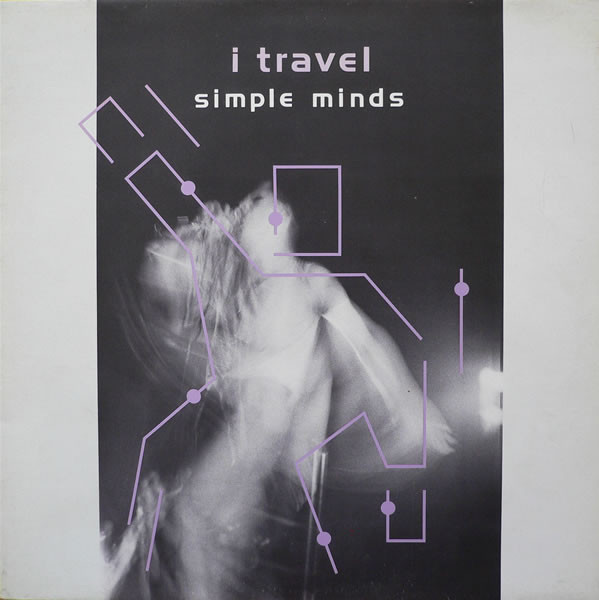
THE 12″ LUCKY DIP (21): Simple Minds – I Travel

R-51248-1214583426

Today’s 12″ offering is from 1983, and it features the re-release of a song that hadn’t charted as a single on two previous occasions, in 1980 and 1982.  It’s also kind of appropriate as I’m actually out and about just now, hitting Manchester for a couple of days, during which time I’ll have the privilege of hooking up with Swiss Adam for a long-overdue catch-up.

mp3: Simple Minds – I Travel

The 1980 release was on 7″ only, and was an edited version (about a minute or so shorter) of that which was on Empires and Dance, the album released In September 1980.  It was the band’s final album for the Arista label.  It was the failure of both the single and album that led to the end of the relationship with the label, and the move to Virgin Records for all releases of new music up until 1998.

The long-awaited chart success for Simple Minds after the move to Virgin led to the folk at Arista feeling they had a chance to cash-in, which is why the compilation album, Celebration, containing ten tracks from the first three albums, appeared in February 1982.  I Travel was also reissued as a single, this time on both 7″ and 12″, with the latter being a magnificently extended version.  The single didn’t bother the chart compilers, but the compilation album did reach #45 during a six-week stay.

This irked the folk at Virgin, and their response was to acquire the entire back catalogue and take control of all future releases.  It meant that the Arista pressings of Real to Real Cacophony, Life In A Day and Empires and Dance, as well as Celebration, were withdrawn and replaced in the shops in 1983 by pressings on Virgin Records.  And as part of the marketing campaign, I Travel was given a third release as a single, but this time on 12″ only.

The b-side to the 1983 re-release was this:-

mp3: Simple Minds – Film Theme

An instrumental that had originally been included on Real to Real Cacophony. It gives a great insight to how much the band’s sound had evolved in such a short period of time.


JC

WHEN THE CLOCKS STRUCK THIRTEEN (March – Pt 2)

Following on from yesterday’s witterings………

18 – 24 March

The first two weeks of this chart hadn’t seen any spectacularly high new entries.  Nothing changed this week, although It’s A Miracle by Culture Club did arrive at #14 en route to its eventual peak at #4.

I’ll mention in passing that Depeche Mode, another of the big 80s bands who I’ve never managed to really take a liking to (certainly in the post Vince Clarke era), would enjoy a tenth successive success with People Are People coming in at #29.  It would eventually reach #4, which incidentally is the highest position any Depeche Mode single would ever reach – they would achieve similar with Barrel Of A Gun in 1997 and Precious in 2005.  I reckon that would make for a good question in a pub quiz….

mp3: Siouxsie & The Banshees – Swimming Horses (#33)

Another of the chart regulars throughout the 80s. This was the 14th successive single to reach the Top 75, but only three of which had gone Top 20 – Hong Kong Garden, Happy House and Dear Prudence.  (Later singles This Wheel’s On Fire and Peek-A-Boo would do likewise – some facts to form another decent pub quiz question?).

Swimming Horses is not among my favourites from Siouxsie et al, and its experimental non-commercial nature set the tone for what would emerge on their sixth studio album, Hyæna, which would emerge in June 1984.

mp3: Simple Minds – Upon The Catwalk (#36)

It was a long way removed from the sounds that had first attracted me to Simple Minds a few years previously.  It was the third and final single to be lifted from their sixth album Sparkle In The Rain, which had entered the charts at #1 the previous month.  An album which helped propel the band to arenas and stadia the world over.  It wasn’t for me….as evidenced by the fact that ICA 72, penned in May 2016, was drawn exclusively from the band’s first five albums.

mp3: The Bluebells – I’m Falling (#65)

I don’t think anyone would have imagined The Bluebells would still be going strong 40 years after I’m Falling became their first ever ‘big’ hit, eventually reaching #11.  But they are, with recent (2023), and critically acclaimed material emerging on Last Night From Glasgow along with a series of sell-out gigs in their home city here in Glasgow.  They remain very good value in the world of indie-pop.

25 – 31 March

As with last week’s, the highest new entry was courtesy of an 80s chart staple with You Take Me Up by The Thompson Twins coming in at #13 en route to peaking at #2 (a victim of Lionel Ritchie’s seemingly never-ending stay at the top).

Michael Jackson released a fifth single from the nine songs which had made up his 1982 album Thriller, but such was the demand and desire for his material that P.Y.T (Pretty Young Thing) entered the singles chart at #20; this was a full 69 weeks after it had first been heard on the album.

Having said that, Can’t Buy Me Love by The Beatles entered this particular chart at #53….a full 1,500 weeks (30 years) 1,000 weeks (20 years) after it had been a #1 hit.

Another act associated with Liverpool (albeit he’s not from that city) sneaked in at #75

mp3: Julian Cope – The Greatness and Perfection Of Love

The second and final single lifted from his debut solo album, World Shut Your Mouth, which had peaked at #40 when issued at the end of February 1984.  It’s long been one of my favourite 45s of his.

I think it’s fair to say that the singles chart of 1984, on the whole, is proving to be a lot more mundane and bland than 1979.  And I fear it’s going to get even more dull, but I hope you’ll stick with the series for the occasional gem such as that from St Julien.

JC

WHEN THE CLOCKS STRUCK THIRTEEN (January)

The 1979 series was so well-received that I felt there really should be some sort of follow-up.

The 1979 series went into great detail, partly as I wanted to demonstrate just how magnificent a year it had been for singles.  The spotlight on 1984 won’t quite be as intense, but I still intend to pick out quite a few tunes that have stood the test of time.

The year began with the #1 slot being occupied by a novelty song in the shape of The Flying Pickets acappella cover of Only You.  The rest of the Top 20 was equally gruesome, with the likes of Slade, Billy Joel, Status Quo, Paul Young, Cliff Richard and Paul McCartney all vying with Roland Rat Superstar for the right to be exchanged for the record tokens that had been left under the Xmas tree. There were a few decent enough tunes from the likes of The Smiths, The Style Council, Aztec Camera, The Cure and Blancmange in the lower end of the charts that had been released towards the tail end of 1983 to make things slightly bearable.  But in terms of new entries in the chart of 1-7 January 1984, there was nothing to write home about.

Fast-forward a week, and The Police had the highest new entry, at #32, with the distinctly underwhelming King of Pain, the fourth single to be lifted from the album Synchronicity.  Just a few places below that was the fifth chart 45 from one of the many bands to emerge out of the Liverpool area in the early part of the decade:-

mp3: China Crisis – Wishful Thinking

In at #36, this was given a wonderful retrospective write-up by Post Punk Monk back in October 2011, and I’m sure he won’t mind me quoting him:-

“This single is one of my all time favorites by the group in that the A-side is sweetly melancholic and unapologetically gorgeous, with a wonderfully played synthetic string section sweeping the tune along. Other tracks on the album this single is from have live strings, but I guess the recording budget didn’t extend that far. The synth strings still sound rather good and more importantly, the addition of oboe and fretless bass, two of my favorite instruments, on this track lends it a gentle nobility that carries it far above the sound of the crowd in the charts at the time of its release.”

Loads of folk in the UK clearly agreed with him, as Wishful Thinking would eventually climb all the way to #9 and prove to be the band’s best charting single.

This week’s chart also saw the debut of someone who would, in quite a short period of time, become, arguably, the biggest pop icon of the late 20th century.  It’s a tune that was later given this accolade many years later on one of the biggest digital sites out there:-

“A song as utterly ’80s as Rick Astley or the Pet Shop Boys, it is also surely the most evocative theme tune ever created when it comes to packing a suitcase and jetting off for beach cocktails […] A feel-good pop giant with an infectious chorus – and the closest thing we have to bottled sunshine”.

mp3: Madonna – Holiday

In at #53, it would reach #6 in mid-February, the first of what thus far have been 64 Top Ten hits in the UK for Madonna, of which 13 have reached #1.

The third of the new entries into the Top 75 being highlighted this time around turned out to be one which became a big hit six years down the line:-

mp3: Talk Talk – It’s My Life

The lead single from the band’s forthcoming second studio album came in at #67, and two weeks later peaked at #46.  It was then re-released in May 1990 to support a Greatest Hits package, at which time it reached #13.

Scrolling down now to the chart of 15-21 January.

mp3: Big Country – Wonderland (#13)
mp3: Thomas Dolby – Hyperactive (#45)
mp3: The Colour Field – The Colour Field (#53)
mp3: Spear of Destiny – Prisoner of Love (#60)
mp3: Talking Heads – This Must Be The Place (#61)

I’m not going to argue that all of the above have aged well, but they provide a fine snapshot of the variety that was on offer to anyone seeking to expand their 7″ or 12″ vinyl collection. I certainly bought all five back in the day.

22-28 January. Have a look at what hit #1

mp3: Frankie Goes To Hollywood – Relax

Even back then, in an era when it was possible for a slow-burner to reach #1, it was almost unheard of for it to take 12 weeks. But that’s what happened with Relax. Released in late October 1983, it had spent two months very much at the lower end of the chart, reaching #46 in the final chart of that year, and reaching #35 in the first chart of 1984, which earned Frankie Goes To Hollywood an invitation onto Top of The Pops for the show broadcast on 5 January.

The following week it climbed to #6, at which point Mike Read Reid, one of the highest-profile DJs on BBC Radio 1, publicly expressed his disdain for the single and said he wouldn’t be playing it on any of his shows, leading to a chain of events where the single was banned right across the BBC on radio and television. None of which stopped it being played on independent radio stations, or indeed on The Tube TV show which aired on Channel 4; Relax would spend five weeks at #1, and indeed would go on to spend a total of 48 weeks in the Top 75, not dropping out until the chart of 14-20 October.

All of which kind of overshadowed these new entries that week:-

mp3: Echo and The Bunnymen – The Killing Moon (#17)
mp3: Simple Minds – Speed Your Love To Me (#20)
mp3: The Smiths – What Difference Does It Make (#26)
mp3: Prefab Sprout – Don’t Sing (#62)

Looking back at things, the singles charts of January 1984 weren’t too shabby, were they?

As with the 1979 series, I’ll be consulting my big red book of indie singles to identify those 45s that didn’t bother the mainstream charts, but were well worth forking out some money for. It should be with you in the next week or so.

JC

PS : Total coincidence that thirteen songs feature in this post…….or is it?????

(It is!!!)

SHAKEDOWN, 1979 (June, part two)

79

The chart hit single in June had some quality, but not much in the way of quantity.  What about the 45s that didn’t make it as far as the Top 75?

mp3: Adam and The Ants – Zerox

Prior to becoming a pop icon in the early 80s, Adam Ant had been part of the punk scene in London.  He had a role in Derek Jarman‘s 1978 film Jubilee, while Adam and the Ants were filmed performing the Plastic Surgery (the song, that is….not the procedure!!).    This led to a deal for a one-off single with Decca Records, but Young Parisians failed to gain traction.  London-based Do It Records signed the band, and Zerox was the first offering.  It did well enough in the Independent Chart, but didn’t sell enough copies to trouble the Official Chart, at least not in June 1979.   It was re-released in January 1981 on the back of the initial burst of Ant-mania and made it to #45.

mp3: The Adverts – My Place

The Adverts had been one of the first of the punk bands to enjoy chart success, with Gary Gilmore’s Eyes hitting #118 in September 1977. By the following year, they were on RCA Records and began making music that had more of a pop feel to them.  Critically, they were still being championed in some music papers, but none of the three singles nor the one album they made while at RCA made the charts – and, of course, they weren’t eligible for the indie charts.

mp3: Cabaret Voltaire – Nag Nag Nag

Having turned down an offer from Factory Records, the Sheffield-based Cabaret Voltaire signed with Rough Trade, with their debut EP being released in late 1978.   The first actual 45 was released in June 1979, and has since been acknowledged as one of the most pioneering 45s of the era, but back then it was largely dismissed as being too arty and weird.

mp3: The Cramps – Human Fly

London-based Illegal Records, founded by Miles Copeland III, issued Gravest Hits, a 12″ EP bringing together tracks that had featured on the first two singles released by The Cramps back in 1978.  The other songs on the EP were The Way I Walk, Domino, Surfin’Bird, and Lonesome Town.   It would take a further 11 years before The Cramps ever made it into the UK singles chart, by which time Miles Copeland III was enjoying the riches from the success of his next label, I.R.S. Records, home to early R.E.M. among others (including, for a short time, The Cramps).

mp3: Devo – The Day My Baby Gave Me A Surprise

The men from Akron, Ohio continued their run of failure. Come Back Jonee had flopped back in January, and while the album Duty Now For The Future did chart at #49, its lead-off single did nothing

mp3: Simple Minds – Chelsea Girl

There were really high hopes among the band for the follow-up to Life In A Day which had sneaked into the lower echelons of the chart.  Such hopes were dashed…..the harpsichord-like sound produced by Mick MacNeil on keyboards failed to capture the attention of the radio pluggers, and the 45 disappeared without a trace.

mp3: Swell Maps – Real Shocks

The second single from Swell Maps issued by Rough Trade in 1979.  I didn’t know about this back when I was 16 years of age. If I had, I’d most likely have bought it and driven my parents crazy.

mp3: Talking Heads – Take Me To The River

Talking Heads were, pardon the pun, much talked about in 1979.  The previous year, they had enjoyed a hit album with More Songs About Buildings and Food, and there was near universal acclaim for their live shows.  Fellow New Yorkers Blondie were flying high, and it really only seemed a matter of time before The Heads were equally popular.  As we know, they did eventually become a household name, but in June 1979 the record label was reduced to releasing a single from the previous album as their way of trying to get a cash-in on a prestigious gig that month in London. The cover of the Al Green number was issued as a 2 x 7″ release (for the price of a standard 7″) along with art work in the shape of a Talking Heads family tree as designed and drawn by Pete Frame.  It didn’t chart.

mp3: Wire – A Question Of Degree

The story of how Outdoor Miner had been a minor hit, but should have been a major hit, was told a few months back.  Harvest Records, keen to atone for the errors made with the previous single, threw their weight behind another track lifted from the 1978 album Chairs Missing, but nobody was interested…which is a shame, as It’s a belter of a single

mp3: Toyah – Victims Of The Riddle

This piece started with a member of the punk scene who appeared in Jubilee, and now finds itself ending the same way.  Toyah Wilcox‘s first foray into the performing arts was as an actor, but with a number of her early parts involving singing, it led to her wanting to have a parallel career in music. She ended up fronting a five-piece band – all the other musicians were male –  with everyone content that it take its name from the lead singer, given how unusual it was.  London-based Safari Records signed the band, and Victims of The Riddle was the debut.  The band would remain with Safari over the next six years, going on to enjoy more than a fair degree of chart success.

JC

SHAKEDOWN, 1979 (May)

79

The top end of the first new chart of May 1979 didn’t unearth as many gems as recent weeks, but there was the appearance of a bona-fide disco classic to get the limbs all movin’ and a shakin’

mp3: Earth Wind and Fire with The Emotions – Boogie Wonderland

This proved to be one of the sounds of the summer.  It came into the charts at #30 on 6 May and didn’t leave the Top 75 for 13 weeks, including seven in a row inside the Top 10.  It even pulled off that rare achievement of looking as if it was going to start dropping out of the charts when it slipped from #4 to #5 after 7 weeks, only to go back to #4 in Week 8 of its stay.

Two other new entries worth giving a mention to are songs whose titles have a word in common and provided Swindon’s finest troubadours and one of Glasgow’s greatest exports with their first entries into the singles chart:-

mp3 : XTC – Life Begins At The Hop
mp3 : Simple Minds – Life In A Day

The former was a minor hit – in at #62 and peaking at #54.  XTC‘s breakthrough was still a few months off.  The latter came in at #67 and peaked at #62.  Simple Minds would have to wait a further three years before they ever went Top 20.

Oliver’s Army had been one of the most surprising huge songs of early 1979, and just 7 days after had it finally dropped out of the Top 75 after 12 weeks, the follow-up entered at #71

mp3: Elvis Costello & The Attractions – Accidents Will Happen

An almost under-the-radar sort of hit in that it would spend 8 weeks in the Top 75, but never get any higher than #28.

A different type of new wave was the highest new entry in the chart of 13 May:-

mp3: Blondie – Sunday Girl

The fourth single to be lifted from Parallel Lines came in at #10.  Seven days later, it was up at #1, bringing an end to the six-week-long occupation of the top spot by Art Garfunkel.  It was helped by a brilliant piece of marketing from Chrysalis Records with the inclusion of a French language version of the song on the 12″ release, one that I reckon was bought by just about every teenager and young adult who was infatuated with Debbie Harry.

One of my own favourites from all of 1979 entered the charts in the second week of May:-

mp3: The Clash – I Fought The Law

It was hard to believe this was a cover version, given how it captured The Clash at their post-punk finest.  The lead track from The Cost of Living EP came in at #35 and then went up to #23 before falling back down to #32.  But then, gravity was somehow defied as it went back up again over the next three weeks to #24, #23 and #22.  Just imagine how big this would have been if The Clash had actually broken the habit of a lifetime and played Top of The Pops.

Coming in at #51 is one I have always considered as a bit of a classic:-

mp3: McFadden and Whitehead – Ain’t No Stoppin’ Us Now

The one and only song with which the Philadephia-based R&B duo of Gene McFadden and John Whitehead ever tasted success in the UK.  The song, and later re-recorded/remixed versions, is reputed to have sold 8 million copies the world over. Both men would later die at young ages in the 00s. Whitehead was 55 when he was fatally shot outside his home studio in May 2004 – the perpetrators were never caught.  McFadden passed away from liver and lung cancer in January 2006, aged 56.

Those of you who pay attention to the companion pieces to this series might recall that back in March, I looked at a flop single called Down In The Park.

“They had started out as a guitar-based new wave band, Mean Street, but the dawn of 1978 saw a change of name to Tubeway Army, albeit the new wave element was still to the fore (they supported The Skids at gigs in the summer of ’78).  By the end of the year, a debut album had been released, with the lead singer changing his name from Gary Webb to Gary Numan, and looking to incorporate synths into the group.  The album sold modestly, but there was enough interest at Beggars Banquet to fund a follow-up for planned release in mid-1979, and Down In The Park was seen as being the advance single.  It didn’t sell very well, but things were about to change…”

The bottom end of the chart of 13 May 1979 was the first indication of said change:-

mp3: Tubeway Army – Are Friends Electric?

This is another one that I’ll always associate with the summer of 79.  In at #71……it took until its 7th week in the charts to reach #1 where it would enjoy a 4-week stay, not finally dropping out of the Top 75 until September had come around.   Turned out to be Tubeway Army‘s last single before breaking up, so it would be accurate to describe them as a one-hit wonder, albeit Gary Numan would enjoy solo success.

Looking now at the chart of 20 May, and the arrival of this tune made sure ‘one-hit wonders’ couldn’t be a label to attach to the doyens of Dunfermline:-

mp3: The Skids – Masquerade

This came in at #29 and peaked at #14. Not quite as successful as Into The Valley, but it would prove to be the second-highest position The Skids would reach in their career, despite the fact that later singles would prove, in my opinion, to be better and more enduring.

Masquerade was one of 13 songs to enter the Top 75 in this particular chart, but none of the others are fondly recalled in any shape or form.  Which takes us to the chart straddling the final week of May and the first few days of the month when I turned sweet sixteen.

mp3: Squeeze – Up The Junction

It’s now one of my favourite songs of all time, but it didn’t really ‘speak’ to me when I was a teenager.  As I’ve written before when featuring Up The Junction on the blog:-

“A soap opera story in just over three minutes.

The boy about town gets caught out with his trousers down. He can’t cope with the fact that he has to grow up and take responsibility. The woman of his dreams soon moves on and all he has left are bittersweet memories.

A massive hit and one of my favourite songs of all time, albeit as a 16-year old I didn’t quite understand the full nuances. But now I’m 51 nearly 61 and I’ve seen it this story play out in real life far too often over the years.

Tears and saying sorry are just not enough.”

It came in at #50, and in an 11-week stay in the Top 75, would peak at #2…denied the top spot by Tubeway Army.

JC

DON’T LOOK BACK IN ANGER (11)

11092687_0

Chart dates 30 October – 5 November

If you’ll recall the closing few sentences from last month, then you’ll know that the first week of November was likely to have some decent stuff kicking around the charts, with The Cure, Siouxsie and the Banshees and New Order still hanging around the Top 20, while PiL, Joy Division and Bauhaus were all a bit further down.   On the flip side of things, Billy Joel, Lionel Ritchie and Culture Club were still dominating the very top-end of things

It was also a week in which loads of new singles became eligible for a chart placing – 15 songs appeared for the first time in the Top 75 (20% of the total), although most of them were utter pish and/or unrecallable.  Here’s the full list of new entries

#75: Brian May and Friends – Starfleet
#73: The Danse Society – Heaven Is Waiting
#66: Imagination – New Dimension
#65: David Bowie – White Light/White Heat
#63: Major Harris – All My Life
#61: Aztec Camera – Oblivious
#47: Marilyn – Calling Your Name
#45: Eurythmics – Right By Your Side
#43: Rainbow – Can’t Let You Go
#34: Limahl – Only For Love
#26: The Police – Syncronicity II
#25: ABC – That Was Then, This Is Now
#24: Status Quo – A Mess Of Blues
#21: Madness – The Sun and The Rain
#19: Shakin Stevens – Cry Just A Little Bit

The Danse Society, one of the many goth-rock bands who were suddenly finding success )of sorts), were on a roll as Heaven Was Waiting was the second 45 of theirs to crack the Top 75 in 1983.  It would actually make it as high as #60, while the parent album of the same name, released just in time for the Xmas market in December 83, got to #40.  Wiki offers the reminder that the album wasn’t well by professional critics, with reviews such as “further plodding nonsense” and  “Heavy on gloomy atmosphere […] but short on memorable songs.”  The fact I can’t recall anything of them maybe bears that out.

David Bowie was having a stellar year in 1983, sales wise at least, thanks to Let’s Dance selling in millions and all his other albums enjoying resurgent sales (in July 83, ten Bowie albums could be found in the Top 100).  This live cover version of the Velvet Underground staple had been released as a single to promote a live album, Ziggy Stardust: The Motion Picture, which was hitting the screens that very month.

Aztec Camera had moved from Postcard to Rough Trade to Warner Brothers, and the promotional efforts of the major took them into the charts with the first ever time with a re-release of an old song.  Oblivious is a great pop song, and while I’m not normally a fan of re-releases, it was good to see this going on to do so well, eventually climbing up to #18 before the year was out, the first of what proved to be eight Top 40 hits for Roddy & co.

The Eurythmics might have burst onto the scene earlier in the year with the majestic Sweet Dreams (Are Made Of This) but the release of new album Touch, had seen the adopt a more commercial and mainstream pop sound that brought huge success all over the world.  Not a sound, however, that I recall with much love or fondness.

Talking of changing style and sound, ABC had gone down a different road from that taken with debut album The Lexicon Of Love.  It didn’t go down well with critics or fans but the first single from what turned out to be The Beauty Stab, did eventually reach #18. It proved to be their last ever Top 20 hit single. They had just one further top 20 hit, courtesy of When Smokey Sings, in 1987 (and thanks to the observant readers who spotted this error!)

Madness were enjoying their 17th successive Top 20 single.  The quite excellent The Sun and The Rain would eventually get as high as #5 which actually turned out to be the very final time they would make the Top 10.*

*in the 80’s, I should have added.  A re-released It Must Be Love was a hit in 1992, while a much later single, Lovestruck, reached #10 in 1999.  Again, my thanks to the ever-helpful readers…..)

Chart dates 6-12 November

It was inevitable after the previous week’s glut of new entries that things would slow down a bit.  The highest new entry came from the Rolling Stones, offering up something that was a bit more funk/dance orientated than much of their previous material. Undercover of The Night came in at #21 and later climbed to #11.  Who would ever have imagined back then that 40 years on, they’d still be going strong and having hit singles?

Some notes of interest from further down.

mp3: The Assembly – Never Never (#36)

It proved to a one-off collaboration between Vince Clarke and Feargal Sharkey, and this electronic ballad soon took off in popular fashion, hitting #4 just two weeks later.

mp3: Care – Flaming Sword (#58)

One of the great long-lost bands who really should have been much bigger than things turned out.  This was their second single, but the only one that cracked the charts.  Main songwriter, Ian Broudie, would have to wait a few years with The Lightning Seeds to enjoy commercial success.

Oh, and I almost forgot about this one.

mp3: The Smiths – This Charming Man (#55)

It would spend 12 weeks in the Top 75 all the way through to February 1984, peaking at #25 in early December 83.  It was the first of what proved to be sixteen singles from The Smiths that would crack the charts over the next four years, only two of which reached the Top 10 (and both peaked at that particular number).  Have a think and see if you can remember….the answer will be given as a PS at the foot of the post.

Chart dates 13-19 November

Fourth single of the year and a forth chart hit.  It was only a year since The Jam had split up, but Paul Weller was proving to be every bit as popular as ever.

mp3: The Style Council – A Solid Bond In Your Heart (#12)

I remember at the time being a bit let down by this one.  It certainly didn’t seem up to the standards of the previous three singles, but in some ways it was just a minor bumop in the road as the imperious pop phase of TSC was just around the corner. Oh, and a couple of years later, we would learn that Solid Bond had been demoed while The Jam were still going, so it could very well have come out as one of their later singles if they hadn’t disbanded.

mp3: Grandmaster Flash and Melle Mel – White Lines (Don’t Do It) (#60)

One of the very best of the early rap singles, it sneaked into the bottom end of the charts in November 83 and then disappeared, only to re-emerge in the following February from where it would spend 37 successive weeks in the Top 75, the first 18 of which were outside the Top 40, before really being picked up on by the general public and hitting the #7 for two weeks in July/August 1984.  It was inevitable after the previous week’s glut of new entries that things would slow down a bit.  It’s the full 12″ on offer today, as that’s the one I have in the collection.

mp3: Julian Cope – Sunshine Playroom (#64)

I’d totally forgotten that this had been released as a single.  It was actually the first time that Julian Cope had taken solo material into the Top 75.   Again, it’s a quiz question with the answer at the bottom.  How many JC singles went into the Top 75 between 1983 and 1996?

Don’t be fooled into thinking that all was sweetness and light in the singles chart some 40 years ago.  The top 4 consisted of Billy Joel, Paul McCartney & Michael Jackson, Shakin Stevens and Lionel Ritchie.   Some of new entries and highest climbers this week included Paul Young,  Genesis, Tina Turner, Nik Kershaw, and Roland Rat Superstar – a grim reminder that the British public have always been suckers for novelty records.

Chart dates 20-26 November

A couple of the new entries were Christamas-related and readying themselves for all-out assaults in the month of December.  Yup, I’m looking at you The Pretenders and The Flying Pickets…..

There were some things worthy of attention.

mp3: Simple Minds – Waterfront (#25)

It was booming, bombastic and anthemic, and it was the beginning of the end of the cutting-edge Simple Minds.  But it was a song totally inspired by home city of Glasgow, and in pulling together the promo video for the single, the band hit upon the idea of opening up and using the Barrowland Ballroom for a live performance.  A huge debt is owed to them for that…..

mp3: Blancmange – That’s Love, That It Is (#43)

The duo had enjoyed a great 12 months, with the previous three singles (Living On The Ceiling,  Waves and Blind Vision) all going Top 20, as indeed would their next again single (Don’t Tell Me) in April 1984.  This is the one nobody remembers as it got stuck at #33 in mid-December among all the stuff that tends to dominate the charts in the month of the year.  Maybe, in hindsight, it should have been held back six or eight weeks.

mp3: Yello – Lost Again (#73)

This has long been a favourite of mine and I was disappointeed that it flopped so miserably.  The record buying public were seemingly far from convinced by the merits of off-centre electronica musicians from Switzerland.

And finally this month.

mp3: Frankie Goes To Hollywood – Relax (#67)

For the next six weeks, this single hung around the lower end of the charts, making its way up to #46 with steady but unspectacular sales.

It then eventually reached #35 in the first week of January 1984 which led to an appearance on Top Of The Pops….it wasn’t their first UK TV apppearance as they had already been on The Tube, broadcast on Channel 4, on a number of occasions. The TOTP appearance resulted in huge sales the follwowing week and it went all the way to #6.

A this point in time, long after the horse had bolted, Radio 1 DJ Mike Read announced he wasn’t going to play the record due to the suggestive nature of the lyrics.  He also felt the record sleeve was disgusting and amoral.  The BBC then decided Relax should be banned from any daytime play, but this didn’t stop the likes of David ‘Kid’ Jensen and John Peel having a bit of fun and airing the song in their evening shows. The ban was extended to include Top of The Pops.

All this only prompted a bit of mania among the record-buying public, and Relax initally went to #2 in the wake of the ban and then spent five weeks at the #1 slot through to the end of February 84, going on to spend 48 succesive weeks in the Top 75, including a rise back up to #2 when FGTH’s follow-up single, Two Tribes, went massive.

The BBC eventually relented and dropped the ban -it had become a joke in as much that the commercial radio stations and the non-BBC TV channels were more than happy to play the song or have it performed on programmes.

Who ever said there was no such thing as bad publicity was certainly right on this occasion.

One more month in the series to go.  It’ll appear sometime in late-December.

JC

PS (1): The two singles by The Smiths to hit the Top 10 were Heaven Knows I’m Miserable Now and Sheila Take A Bow.

PS (2): Julian Cope had 16 singles reach the Top 75 between 1983 and 1996.  Seven of them actually cracked  the Top 40, with World Shut Your Mouth being the best-achieving of them all, hitting #19.

60 ALBUMS @ 60 : #35 is

R-4490200-1384980107-8491

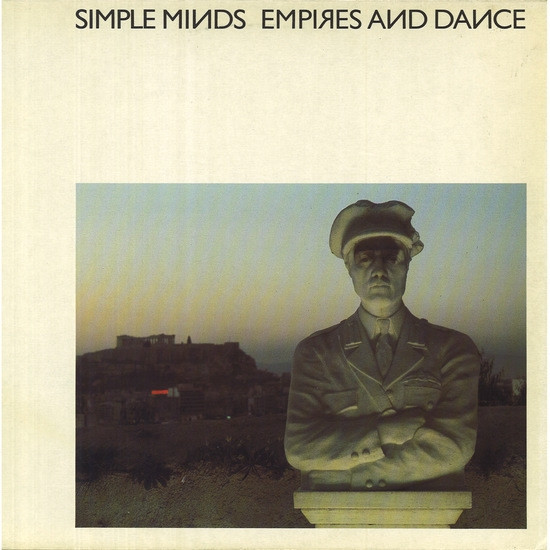
Empires and Dance – Simple Minds (1980)

Here’s where I begin to wonder if I’m boring you with repetition in this rundown.

I don’t think any of the albums featured thus far will have raised any eyebrows, and I’m sure that none of the remaining 34 will be the least bit surprising.  But that’s the problem of having been churning out the blog for what is now coming up for 17 years – I’ve probably said all I really need to say, or indeed want to say, on so many records, groups or singers. But here’s something a bit different about one of the best-known groups to ever emerge out of Glasgow.

I’ve never hidden my love for early-era Simple Minds, right up to New Gold Dream, and some of what would appear on 1984’s Sparkle In The Rain.  Not too long ago, I had a long chat with a good friend who is somewhere around 10 years younger than me.  His earliest memories of the band is Once Upon A Time, the 1985 ‘stadium-rock’ effort that took Simple Minds to a bigger audience, at the cost of leaving behind the sounds that had made them an essential part of the post-punk era.  He is firmly of the belief that songs such as Alive and Kicking, All The Things She Said and Sanctify Yourself are their greatest songs.  He maintains this view, and it’s one I admire, as he has gone into the back catalogue and is also someone who is not afraid to champion great music from many eras that are alien to him.

I, of course, disagree with him.  In the strongest possible terms!  But, as I’ve said many times in many places, musical taste is very much a personal thing and there’s not really a right or wrong answer when it all comes down to it.

The odds on anyone out there on Planet Earth coming up with the same 60 albums as will be found in this rundown will be astronomical.  Indeed, I think it’s nigh on impossible.  Empires and Dance might feature on a few lists, but there’s plenty folk out there who, if any Simple Minds record was to feature, would offer up something else. And fair play to them.

This is a record that should have been massive, except that the record company made a mess of things.  And in particular, one song suffered really badly:-

mp3: Simple Minds – I Travel

I’ve said before, (see what I was saying at the beginning of this post!!!!), that it’s a cross between disco-stomping Giorgio Moroder and early experimental Roxy Music, but played at 100mph, coming with an almighty punch in which every member of the band played/sang as if their very future existence depended on it.   The remainder of the album goes to corners and places that not many people in Glasgow were aware of back in 1980. It’s an album that has aged quite spectacularly, with folk as diverse as James Dean Bradfield, John Foxx and Julian Cope among the many who have given it the highest possible praise.

But as my mate would say, it’s not a patch on Once Upon A Time……..

JC

SATURDAY’S SCOTTISH SONG : #296: SIMPLE MINDS

There’s been loads said on the blog about Simple Minds, sometimes positive, but occasionally they’ve taken a kicking.  I’ll just stick to the music today:-

mp3: Simple Minds – Premonition (Peel Session)

Recorded on 19 December 1979 and first aired on 7 January 1980 along with Changeling, Citizen (Dance Of Youth) and Room, which means the session comprised three tracks from the then recently released album Real to Real Cacophany, while Room would make it onto the next album, Empires and Dance.

I thought this was the first time the Peel Session version of Premonition had been posted, but I just checked and remembered it was the final track on Side B of ICA 72, back in June 2016.  It’s hard to keep up.

JC

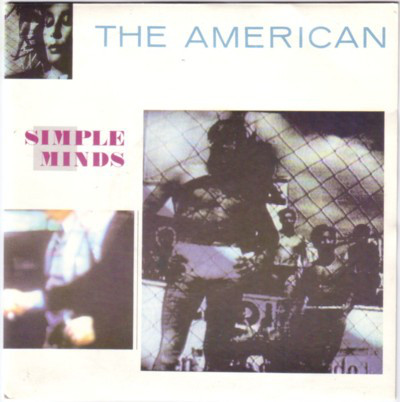
THE MONDAY MORNING HI-QUALITY VINYL RIP : Part Twenty Two : THE AMERICAN

Well, it is nearest Monday to the 4th of July.

mp3: Simple Minds – The American (12″ version)

The band’s official website advises that The American was written in a back of a van while driving through the East Coast of America in March 1981 and was first played live during the same tour. It was inspired by the bright colours of an exhibition of modern American art that Jim Kerr had visited.

It has a fairly abstract lyric:-

Here comes the shake,
The speed-decade wake.
I see you wake,
Shake,
Fit on those overalls,
What do you know about this world anyway?

I see a man,
With an airfield plan.
I caught a boy fall out of the sky.
What do you know about this world anyway?

Ameri-Ameri-Ameri-Ameri-Amer-American,
In collective fame.
Ameri-Ameri-Ameri-Ameri-Amer-American,
Nassau club day.
Ameri-Ameri-Ameri-Ameri-Amer-American,
Across a curved earth,
In collective fame.
Ameri-Ameri-Ameri-Ameri-Amer-American,
The eventful work-outs,
Nassau club days.

Here comes the flag,
I’m walking in the black.

Every time you touch this place,
It feels like sin.
Every time the handshake starts,
The face draws thin.
What do you know about this world anyway?

Here comes the sun,
The american sun,
In here the sun shines so bright,
Eyes blind.
What do you know about this world anyway?

Ameri-Ameri-Ameri-Ameri-Amer-American,
The eventful workouts,
Nassau club days.

Here comes the flag.
Hand-shake.
This world…..

The 12″ version really gives space to Derek Forbes on bass and Mick MacNeil on keyboards to demonstrate their talents, and yet the tune was largely written by guitarist Charlie Burchill. It flopped to #59 on its release in May 1981, but at that point in time was the band’s most successful single.

JC

ALL OUR YESTERDAYS : NEW GOLD DREAM (81-82-83-84)

Album: New Gold Dream (81-82-83-84) – Simple Minds
Review: NME, 18 September 1982
Author: Paul Morley

ONE
THIS RECORD is something of a glow. Whatever your preference you will find it memorable and instructive. Find its qualities and fix your place. Be swept, be drained…This is really all I have to say, but I shall not stop on that account. Indeed, I shall begin again.

TWO
MY LOYALTY towards Simple Minds is known to be considerable, yet even I am jarred by the constant beauty of this music. Truly, all I need to say is that New Gold Dream robs me of my breath – but let’s continue. Be swept, be drained, believe me.

THREE
After their last (double) LP it could be said that despite their undoubted ability the group threatened to settle down into an overwhelming, agitating monotony devoid of nobility: a heat-switch has been turned on, the looming Simple Minds solid has melted, is melting into a bewitching, fresh sound. Suddenly the group sound acutely aware of space and emptiness, and their impact is a lot harder because of that. (When I say harder, I am just as likely to mean “softer” – it depends whether you’re stood on your head or not.)

Simple Minds took a certain way with rhythm and motion to its limits; they’ve now shook away what was becoming a kind of concussion, to be left with a very clear head. And, clearly, a heat. ‘Melting’ is a useful word to use in connection with this record. Not only are the known Minds clichés melting into new forms and shapes, but also more general clichés melt into new meanings. The familiar deliciously falls in on itself. This ‘melting’ results in an exotic re-orientation.

Indeed, and this is perhaps because the Minds’ aspirations sometimes seemed too great for the pop context to hold, the music contained here is as searching a representation of the meltings between what is ‘memory’ and what is ‘imagination’ as that which troubles me in the workings of Beckett and Baudelaire. New Gold Dream is the perfect attack upon those who think pop too small to think big.

The group, confounding banal limitations and their duff reputation as kids muddling in areas roughly outside their scope, have outgrown what was previously their defiant restlessness, a celebrated stoicism, and turned their song into an adventure: an adventure embedded in memory/imagination, patient and dark, as intoxicating as the adventure of Buckley, as personally aggressive as the adventure of Joy Division. It is responsible to no one and nothing, it is sensation for sensation’s sake, but it takes the working listener to wherever, it suggests to the working listener that…everything is possible.

Let’s face it, it’s a glorious achievement to produce something that works generously in the usual sweet way – tucked inside the trivialised pop context, yet that stretches far beyond those coloured walls to stand strong as an exhilarated, canny comment on the “state of the world’s flow”, on the position of hope and anxiety. There’s plenty of light and melody through the Dream to please you; but enough heat to chill you.

There’s a number of outstanding instrumental performances to turn to – Forbes‘ arrogantly commanding bass, Burchill’s shrewd and eager guitar, MacNeil‘s expressive and seemingly infallible keyboarding – but ‘Dreams’ music is something that succeeds smoothly yet provocatively as ‘a whole’. A rippling, humming, beating, rustling, driving, melting ‘whole’, with Kerr‘s voice, his glancing, broken words, as if tiny holes allowing glimpses into the world-view that enabled such noble music to appear. The ‘whole’ is an ardent, tender sound that sweeps and sways between the sly and the open with pleasured mastery; as for Kerr’s ‘holes’, there’s nothing wrong with his spelling, his spelling is binding, his images and touches spellbinding. If previously he could be irritating, now he and his words insist on response. And measure the words’ intrigue by the depth of that response. The working listener will be quietly, carefully, profoundly re-placed.

The absolutely gripping opening song ‘Someone Somewhere In Summertime‘ immediately announces that Simple Minds have shed old skin. What accounts for this shedding, the ‘melting’, the shaking away of concussion, is the group swallowing the pill of simplicity: rather than try to make a point or point towards mystery through a rush and rush of overcompensation – this is where many other groups, ie. Bauhaus, flip and flop into the muddle of futility – the group have moved out into the opening of understatement, tweaking will and snatching heart through implication.

It’s the kind of simplicity Joy Division smashed into accidentally and to devastating effect: a proof of articulacy and sensitivity through keen selectivity. The two ’82 singles ‘Promised You A Miracle‘ and ‘Glittering Prize‘ fit into this record not as blatant shows of concession for the charts but as bright, confident celebrations of this simplicity: the group scatter their assault rather than channel it.

Listening to the completely satisfying instrumental ‘Somebody Up There Likes You‘ it sounds as though Simple Minds believe they are creating magic: and in a way they are, conjuring up from nowhere such vital, cajoling systems as ‘Big Sleep’ and ‘King Is White And In The Crowd’, systems that will connect themselves to your experiences without wasting your time or minimising your energy. The title track confirms that Simple Minds’ diagnosis of what is up and down about the bits and pieces of the world is as shocking, shaming and indignant as any pop group’s.

And then when Herbie Hancock glides in to embellish the lovely ‘Hunter And The Hunted’, one doesn’t sense a clumsy, irrelevant intrusion by a name pianist with a huge erratic musical background, just an apt, almost hidden contribution by one musician to the effort of other musicians. It’s a fine moment, sealing the group’s (radiant) simplicity, and claiming that the group can exist on any terms – no longer must they be locked into a strained-art-pop closet.

So certainly this is Simple Minds’ most distinguished collection. It also continues, powerfully, a period of music that melts and scatters around ‘For Your Pleasure’, ‘Correct Use Of Soap’, ‘Closer’, ‘Sulk’, ‘Tin Drum‘, a music that went to follow through how Iggy somersaulted through good and bad possibilities, how Reed reached below the functional surfaces of city life, how Bowie travelled, how Hamill hoped, how Eno twisted and treated the pop song to the edge of ‘the marvellous’. A music swerving and unnerving through recollection and recognition and habit and faded sensations…searching for connections and new vantage points, using pop to mind more about memory than the order of guitar notes.

Simple Minds have produced something as inventive, as cleansing, as suggestive as anything by the musicians, The Heroes, who first inspired them to form around the days and nights in Glasgow. This will thrill them, for it is still in them to be thrilled. And what will thrill you is that it is possible to pluck something as special and triumphant as this out from amidst all the painful failures. Its uses are abstract, but its signifance is universal. And the feeling grows, as I listen, that they’re just beginning.

FOUR
AND NOW you begin…

JC adds…….

There’s a couple of Paul Morley reviews going to feature in this occasional series.  For the most part, I’ve long enjoyed his musings and his writings, but there were plenty of times when I thought he was being a dick and a show-off.

Thankfully, I don’t recall ever reading this particular review; for all that he clearly loves the album and the band at this point in history, he has obviously woken up that day much more in love with himself and determined to get as much of that feeling across to the NME readers. And, while I don’t want my reviews to stoop to the banal level of Smash Hits or tabloid newspapers, I do want those who are writing the pieces to offer me something just a little less pretentious.

History shows that New Gold Dream, the fifth album by Simple Minds, was the one which put them onto the golden path as the long-standing critical support from the likes of Morley turned into commercial success, certainly in the UK and Europe.

The album was released in September 1982 and It made No. 3 in the UK Albums Chart.  Having said that, the foundations had been laid a few months earlier with Promised You A Miracle, in April 82 and Glittering Prize, in August 82, both reaching the Top 20 in the singles charts, the first time the band had ever broken into the Top 50.

mp3: Simple Minds – Someone Somewhere In Summertime
mp3: Simple Minds – Somebody Up There Likes You
mp3: Simple Minds – Hunter and The Hunted

It’s one of those fairly rare occasions when the commercial success didn’t come at the cost of diluting the quality of the music that a group had been making for some years.

JC

EMPIRES AND DANCE

It was 40 years ago this very month that Simple Minds released Empires and Dance, possibly the most un-Scottish of albums ever to be released by any world-famous Scottish band.

It’s an LP that saw Arista Records make a complete balls-up, failing to realise what Simple Minds had been progressively gearing up to over the previous 18 months, effectively dismissing it from the outset by pressing up just an initial 15,000 copies of the album and, once these had been cleared from the shelves of the record stores that had managed to obtain copies, choosing to press just a further 15,000 copies, making it difficult for many fans to find (although, to be fair, it wasn’t a big problem in Glasgow with all the shops, large and small having it on sale).

It was the culmination of an unhappy time with the label. The previous two albums, while critically acclaimed, hadn’t provided any great commercial success, while none of the singles had charted. The band was deeply in debt to the label, chiefly from the costs involved with touring, and in later years, the band members revealed that there were serious discussions around splitting-up to get out of the mess.

Luckily, other A&R folk were paying attention to Empires and Dance and realised that it contained songs which could be part of the changing scene in clubs, where ‘pure’ disco was increasingly giving way to electronica, especially the ‘heavier’ European-vibe with its co-reliance on great bass notes. And, while Empires and Dance is very much the work of the five-man collective, it is the contributions from Mick MacNeil on keyboards and Derek Forbes on bass that make it stand out. So, when Arista let the band go just four months after the album came out, the folk at Virgin Records pounced and, having agreed to a sum to pay off part of the debt to the old label, took the band on and put them firmly on the road to superstardom.

It is quite bemusing to look back and wonder why Arista made such a mess of things. The album opens up with the genuinely jaw-dropping I Travel, a song that I’ve previously said is a cross between disco-stomping Giorgio Moroder and early experimental Roxy Music (but played at 100mph!!), coming with an almighty punch in which every member of the band played/sang as if their very future existence depended on it.

It surely had hit single written all over it….but not on Arista’s watch in 1980. Indeed, the label only realised what they had missed out on a couple of years later when the cashed-in on the new-found success the band were enjoying and pushed out Celebration, an admittedly excellent 10-song compilation of material from the first three albums, with its b-side containing three tracks lifted from Empires and Dance together with a b-side from the I Travel single.

I Travel might be the cornerstone of Empires and Dance but there is so much more to the album, and I’ll crib from a review that can be found over at Julian Cope‘s Head Heritage website to illustrate:-

“Empires and Dance is their most European album- Bowie/Eno, Can, Kraftwerk, Neu!, Nite Flights, Fear of Music all appear to be influences. Opening single “I Travel” is like Trans Europe Express on speed…..a pulsing pop song that delivers on the influences of Kraftwerk and Moroder.

“Today I Died Again” has more in common with Magazine than U2- the lyrics in the same avenue as Ian Curtis ruminating on fascism (“Walked in Line”, “Dead Souls”) “The clothes he wears date back to some war…She can’t remember before this heat/He can’t remember his wife’s Christian name…Back to a year, back to a youth/Of men in church and drug cabarets…”- can’t help but think of films like Cabaret, The Damned, The Night Porter & Salon Kitty. Maybe The Tin Drum also?

“Celebrate” sounds like Chic producing Gary Numan, robo-funk at its finest; while This Fear of Gods pre-empts 23 Skidoo’s “Coup”- (the influence/sample for Chemical Brothers’ “Block Rockin Beats”) & the keyboards are very Trans Europe Express also. Epic stuff, though like a lot of great records, I haven’t got a clue what is being sung about.

“Capital City” and “Constantinople Line” continue the Europa themes, alienation and paranoia rule then- & this leads into “Twist/Run/Repulsion” – a series of oblique mantras (“Contort!”) over a female voice sample creating a track not far from those found on Eno/Byrne’s sampledelic-classic My Life in the Bush of Ghosts.

Even better is “Thirty Frames a Second”, which recalls the time-reversal themes of books like Counter-Clock World (Philip K Dick) & Time’s Arrow (Martin Amis) and musically is their most Krautrock inflected moment. Brief instrumental interlude “Kant-Kino” is very side 2 of Low, and segues into final track “Room” – the most melody-driven track here. Shimmering guitars, pulsing percussion & almost funky bass- pity it’s so brief though! This is the kind of song that would make music critics wet themselves if Primal Scream or Radiohead produced it now…”

I probably listen to Empires and Dance a couple of times a year at most, thus ensuring it retains its fresh and vibrant feeling.  My vinyl copy has long been trashed and I’ve made do with a CD version that was later issued by Virgin Records.  But, having now got myself that decent turntable again, I sought out a copy of the original vinyl via Discogs, one that was actually delivered by the postie on Saturday 12 September, which was 40 years to the very day that it was released.  These have been ripped from the album:-

mp3: Simple Minds – Today I Died Again
mp3: Simple Minds – This Fear Of Gods
mp3: Simple Minds – Thirty Frames A Second
mp3: Simple Minds – Room

Looking back, it’s head-scratching that none of these made it onto the ICA I pulled together back in May 2016…..

JC

THE SINGULAR ADVENTURES OF (EARLY) SIMPLE MINDS (Parts 16-20)

I said last week that the first nine months of 1984 were a complete whirlwind for Simple Minds.  It was nothing compared to 1985, although the roots of events dated back initially to June 1984 and then later again in November 1984.  I’ll rely on words lifted from a website associated with the band:-

Whilst writing the score for John Hughes’ latest (and in retrospect best) brat-pack film The Breakfast Club, Keith Forsey and Steve Schiff penned Don’t You (Forget About Me), intended for the film’s opening credits. Recording a rough demo, Forsey wanted it recorded by an established band and started to hawk both the tape, and himself, around the record companies of bands he admired and felt could suitably record it and add gravitas to the soundtrack.

Which is why Simple Minds found him in their dressing room after one of the Tour De Monde gigs in America, clutching a collection of Simple Minds bootlegs, and enthusing about this great song he’d written. (After hearing the song A&M invited him backstage but neglected to tell Simple Minds anything about it.) Bemused, and no doubt amused by the episode, they declined.

Bryan Ferry also declined. As did Billy Idol, who Forsey was successfully producing at the time.

Forsey was not one to give up and flew to the UK to persuade Simple Minds again to record the track. He found them in London, working on the demos for Once Upon A Time. With Forsey on their backs, and A&M on their backs, the band relented, thinking the song was just another incidental track to a forgettable brat-pack movie. They booked a studio in Wembley, and nailed the song in three hours. One of the caveats was they could play with the arrangement, and Jim added the “la la las” on the day.

The band carried on with Once Upon A Time and completely forgot about the song.

The band played three frantic sell-out gigs at Glasgow Barrowlands from 3-5 January. The set-lists provide an indication that these were very much about pleasing the local crowd:-

I Travel / Glittering Prize / Book Of Brilliant Things / Up On The Catwalk / Promised You A Miracle / Speed Your Love To Me / Celebrate / Someone Somewhere (In Summertime) / The American / Waterfront / New Gold Dream (81,82,83,84)/ Take Me To The River – Light My Fire

The next gig that Simple Minds would play was six months later at Live Aid, and as part of the Philadephia bill. Three songs made up the setlist:-

Ghostdancing / Don’t You (Forget About Me) / Promised You A Miracle

The second tune aired at Live Aid was the one that a few months earlier, in March 1985, been released in America where it went to #1. A month later, it was released in the UK, where it reached #7:-

mp3 : Simple Minds – Don’t You (Forget About Me)

The fact that the b-side, A Brass Band In Africa, was the same as had been included on previous UK single (Up On The Catwalk) provides a fair indication that there was never any intention to do anything with the song, a situation that only changed with the American success.

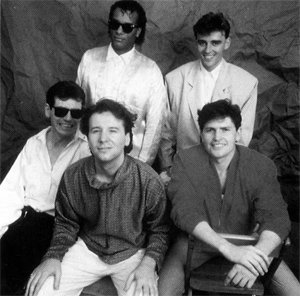
The other thing about the Live Aid gig, and as can be seen from the photo at the top of this page which was taken on the day, was that Derek Forbes was no longer part of the band, having been sacked during the sessions for the new album. His replacement was John Giblin, in whose studio they had been writing and recording, and whose previous credits including working with John Lennon, Kate Bush and Peter Gabriel.

John Giblin played bass on the new album, Once Upon A Time, that was released in October 1985. It contained four singles:-

mp3 : Simple Minds – Alive and Kicking – #7 in October 1985
mp3 : Simple Minds – Sanctify Yourself – #10 in February 1986
mp3 : Simple Minds – All The Things She Said – #9 in April 1986
mp3 : Simple Minds – Ghostdancing – #13 in November 1986

Yup, the fact that a song, more than a year after its first appearance on an album, could sell enough copies to go Top 20 in the UK, tells a lot about just how popular Simple Minds had become.  And listening to it, just how far removed it was from I Travel, from which part of the lyric was lifted…..

I don’t actually own a copy of Once Upon A Time, but almost 1,000,000 folk in the UK have bought it, so my holding back £10 or so wasn’t that big a deal to the band. I also never bought any singles after those on Sparkle In The Rain, so all the mp3s today have been sourced from elsewhere.

The band wouldn’t release its next studio single until 1989 (albeit there was a live album and 45 released in 1987). In fact, the single was an EP entitled Ballad of The Streets which went to #1. But to me, that’s later Simple Minds and well outside of the confines of this series. Indeed, I was in two minds about staying on as far as these five singles but chose to so so after a chat with one of my fellow Simply Thrilled DJs who, being a fair bit younger than me, advised that this was the era of his introduction to the band and he adores the album.

As ever, I really have appreciated that so many have come in and offered their own views, thoughts, observations and comments these past few weeks. I really must single out Alex, Echorich, Friend of Rachel Worth, JTFL and postpunkmonk for what have been an outstanding series of contributions throughout the entire series, many of them proving to be substantial, stand-alone review pieces bordering on genius.

I’ve said it before, but it does bear repeating, that the quality of responses and critiques left at this little corner of t’internet constantly blows me away. So again, thank you!

And remember, guest postings are very welcome at all times…..so if there’s something you would like to share with a few hundred like-minded folk, then drop me a line anytime.  The address is over to the side of the blog, failing which scroll down and it will be underneath.

Tune in next Sunday to find out who is next for the Sunday spotlight.

JC

THE SINGULAR ADVENTURES OF (EARLY) SIMPLE MINDS (Parts 14 & 15)

The first nine months of 1984 were a complete whirlwind for Simple Minds.

It began in January with the release of their new single, which went Top 20:-

mp3 : Simple Minds – Speed Your Love To Me

Again, there was a harder, rockier edge to the song than previous material, with a backing vocal courtesy of Kirsty MacColl, particularly on the 12″ version which came in at more than seven minutes upon which producer Steve Lillywhite used his entire box of techniques and studio sounds.

The b-side was an instrumental:-

mp3 : Simple Minds – Bass Line

It would later transpire that the instrumental had later been fully devoped, with lyrics, and would appear, as White Hot Day, on the new album Sparkle In The Rain which, upon release in February 1984 entered the UK charts at #1, eventually spending more than a year in the Top 75.

Despite the sales and success of the new album, many fans of old, attracted to the band through the post-punk synth-led music, were bitterly disappointed by the new material. I loved the fact the local boys were now doing good finacially and were now plastered all over the media, but the songs left me cold. The four-night residency in February/March at the Barrowlands could have sold out three or four times over, but the band were on a tour that had already visited Australia, New Zealand and Ireland and was due to take in another three weeks of dates across the UK (although the end dates were cancelled from Jim Kerr being flu-ridden and exhausted)

Having said all that, the choice of next single was my favourite song on the album as, aside from the ridiculous 1-2-3-4 count-in (and the 80s pounding drums), it goes back a bit to the older songs with keyboards to the fore and a far from straight-forward lyric.

mp3 : Simple Minds – Up On The Catwalk

It stalled at #27, perhaps down to the fact that most folk would have the song through its inclusion on the album, but then again, it’s not the most straightforward of numbers nor as anthemic as more recent singles.

The b-side was another instrumental which was a fine reminder of the more experimental side of the band:-

mp3 : Simple Minds – A Brass Band In Africa

In April, an extensive European tour was undertaken, before returning to the UK to fulfill the re-arranged gigs postponed earlier – this culminated in a eight-night residency at the Hammersmith Odeon in London, proof if any were needed of the band’s popularity with the public.

The band would admit later to finding it a tedious experience and it was then that thoughts turned to making the transition to arenas and stadiums.

May and June saw them zigzag their way across North America, playing venues way bigger than previous visits, and after a brief interlude to play some European festivals, they went back to the States for an arena tour in August and September as support to The Pretenders – oh and somewhere along the line, Jim Kerr married Chrissie Hynde.

They were clearly a hard-working band, putting on tight and crowd-friendly shows night after night.  All that was needed now, was some sort of real crossover hit single, one that would cement their place in 80s folklore on both sides of the Atlantic….but in all likelihood, alienate the fanse who were becoming disinchanted with the direction the music was taking.

JC

THE SINGULAR ADVENTURES OF (EARLY) SIMPLE MINDS (Part 13)

The success of New Gold Dream led to Simple Minds being put on the bill of a number of outdoor festivals in mainland Europe in June/July 1983 after which the band returned to the studio to begin work on a new album. They did come out of hibernation on 14 August to appear as special guests of U2 at a massive event in Phoenix Park, Dublin at which they opened with a new song, one that signified yet another shift in sound.

They returned to the studio and, in typical style, quickly finished off work on the new album under the watchful eye and helping hand of producer Steve Lillywhite.

Virgin Records took the decision to delay the release of the new album, partly on the basis of New Gold Dream still selling in reasonable numbers and also the fact that they now wanted Simple Minds to be a band that had a worldwide release for new material rather than it being issued firstly in the UK.

But, as had been the case with the earlier LPs recorded for Virgin, there was an advanced release of a 45 (see the previous features on The American and Promised You A Miracle).

mp3 : Simple Minds – Waterfront

This was Simple Minds as never heard before. Big, bombastic, anthemic and tailor-made for radio, thanks in part to the one-note bassline that dominates in so many places.

I can honestly say that Glasgow went nuts for this song. The band had always been proud to say it was their home city, arguing in interviews that it suffered from an ill-deserved reputation in terms of grime, poverty and violence. They were proud of its and their own working-class roots and firmly believed the city was about to undergo something of a renaissance. The video for the new single was made in Glasgow, with many evocative outdoor scenes intermingling with live footage that had been shot at the Barrowlands Ballroom, a rundown and derelict venue in the east end of the city in front of an audience that had applied for tickets via a local radio station.

It really is no exaggeration to say that Simple Minds single-handedly saved the live music scene in Glasgow. The only realistic venue for touring bands, The Apollo, had closed down and was scheduled for demolition. The alterative would be the soon-to-be-completed Exhibition Centre with its cavernous shed holding 10,000, but that wouldn’t have been suitable for most bands who were looking for a capacity of 2-3,000. The Barrowlands had been a dance hall of reputation in the 60s and early 70s but had long been neglected as folk flocked to the new discotheques. There had been talk of it perhaps becoming a replacement for the Apollo but nothing was happening until Simple Minds, on 27 November 1983, got its doors re-opened for a gig (with limited capacity) that would be filmed as part of promotional videos for upcoming singles.

One month later, with more work done in terms of health and safety, Simple Minds returned to the Barrowlands for three pre-Xmas gigs, all of which could have sold out ten times over. By this time Waterfront had been a #13 hit in the UK charts, it would have sat at #1 in Scotland for months if there had been a separate chart. Worth noting too that all three of these gigs opened with Waterfront and that the song was also used to round off the final encore.

I’ve never been a lover of Waterfront but, at the same time, I am full of admiration and gratitude for what it did in terms of making Glasgow such an important location in terms of live music, one that has been built on to great effect over the past 35 years.

The b-side was a live version of a song on New Gold Dream, taken from a show at Newcastle City Hall back in November 1982:-

mp3 : Simple Minds – Hunter And The Hunted (live)

There was a palpable contrast in songs that were just a year apart in terms of them being recorded and it was going to be interesting to see what direction the new record would take. Given that Steve Lillywhite’s reputation had been forged with guitar-based music, it was a good bet that Simple Minds would be moving away from the sounds of the Arista years……

JC

THE SINGULAR ADVENTURES OF (EARLY) SIMPLE MINDS (Parts 11 & 12)

Some six weeks after Promised You A Miracle took its leave of the charts, the follow-up single was released:-

mp3 : Simple Minds – Glittering Prize (edit)

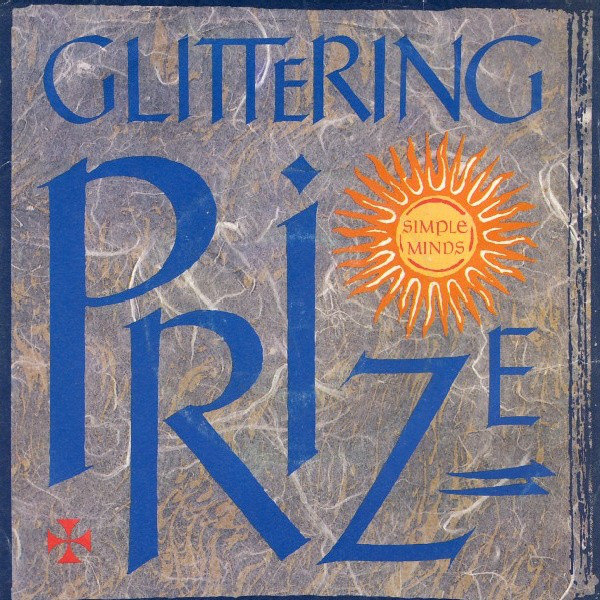
Where I’d been a bit iffy about Promised You A Miracle, I pounced on Glittering Prize, telling anyone who cared to listen, that it was a magnificent piece of music whose shimmering majesty, particularly via its Associates-like guitar, bass and keyboard sounds, was the perfect soundtrack to the final few days of what had been the first long summer of my university years….I was happy and this song made me even happier.  I was certain it would be a massive hit, but it was very much a slow-burner, taking what seemed like ages to make its way into the Top 20 and only doing so at the same time as the LP New Gold Dream (81,82,83,84) hit the shops.

Looking back, the lack of b-sides for Glittering Prize didn’t help, with just instrumental versions of different lengths appearing on the 7” and 12” releases, with no new tracks or old live recordings to flesh things out:-

mp3 : Simple Minds – Glittering Prize (theme)

The new album went straight into the Top 10 on its release and a week later was Top 3 (the new Dire Straits album, Brothers In Arms, Love Over Gold, went straight in at #1 when New Gold Dream hit its peak).

Virgin Records were desperate to issue a third single from the album but had to hold off until Glittering Prize stopped selling and dropped out of the charts which it did in early November. Just two weeks later, the new single came in at #36,

but to the shock and surprise of all concerned, that’s as high as it got:-

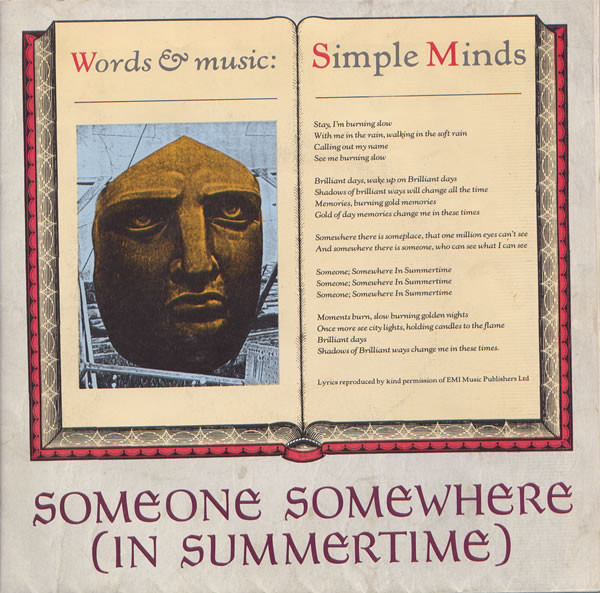
mp3 : Simple Minds – Someone Somewhere (In Summerime)

By general consensus, this was the highlight of the album and of the live shows the band were now playing to packed audiences. The 12” version even included a new extended introduction, one which Charlie Burchill had worked up during the live renditions and in doing so turned the song into a six-minute epic (and, although nobody knew it yet, gave an indication of what was about to come round the corner…..hiya U2!!)

mp3 : Simple Minds – Someone Somewhere (In Summertime) (extended)

Fans, however, seemed content with the fact they had bought the album, and perhaps it also suffered from the fact that many were also investing in what was by now an extensive back catalogue.

The band didn’t have much in the way of any new music for the b-side and so, for the 7” it was decided to offer up an early version of another track from New Gold Dream:-

mp3 : Simple Minds – King Is White and In The Crowd (session version)

This had been recorded back in February 1982 and broadcast on the Radio 1 evening show, hosted by David ‘Kid’ Jensen. It’s quite demo like, certainly in comparison to what was issued six months later on the album, providing evidence of the role that producer Pete Walsh had played in the studio.

The 12” did have a previously unreleased track:-

mp3 : Simple Minds – Soundtrack For Every Heaven

It later transpired that the music had been worked on for what had hoped would be the tenth track on New Gold Dream but had been abandoned as the band hadn’t been able to do quite get what they were looking for. In effect, what you have, is an unfinished demo……………..

New Gold Dream was placed high in just about every list typed up by the critics in their consideration of the best records of 1982. Simple Minds were now, at long last, a household name, and had even solved their drummer conundrum by keeping session player Mel Gaynor for the live shows and offering him a permanent position for going back into the studio for the follow-up.

JC

THE SINGULAR ADVENTURES OF (EARLY) SIMPLE MINDS (Part 10)

10 April 1982 and a new single by Simple Minds is released.

1 May 1982 and Simple Minds finally have the euphoria that comes with a single hitting the Top 20 in the UK.

mp3 : Simple Minds – Promised You A Miracle

It was the fourth successive week the single had climbed the charts, something it would do for a further two weeks, peaking at #13. It would hang around the lower parts of the charts for a while longer, finally taking its leave in mid-June.

It was really strange seeing the band achieve such high-profile success after five studio albums, one compilation LP and two record labels. It’s a single that didn’t quite gel with me at the outset. It seemed really light and sparse sounding, very much lacking the bite and energy of many of the previous singles but it was one that I came to appreciate after hearing it in the live setting and how it was actually all part of yet a further shift in sound with more reliance on the keyboard skills of Mick MacNeil and the thumping bass lines from Derek Forbes. It was more pop-orientated than ever and of appeal to fans of bands such as ABC, Associates and Yazoo, all of whom would enjoy stellar years in 1982 – it was also similar to the latest Roxy Music album, Avalon, which itself was a million miles removed from the art-house and experimental stuff from the 70s that had been such an influence on early Simple Minds.

A new producer, Pete Walsh, was also at the helm, the job his reward for the impressive remix work he had done on Sweat in Bullet. What very few knew at the time was that Walsh was a total rookie, just 21 years of age, but considered by the band, and indeed the label bosses, to be something of a genius in terms of eking out all sorts of new and fresh sounds from the advances in production technology.

As had happened the previous year with The American, the band rush-released Promised You A Miracle, it being the among the first of the completed songs from the studio sessions in London. There wasn’t really any new material well-developed enough to appear as a b-side and so the decision was taken to use an instrumental track from Sister Feelings Call.

mp3 : Simple Minds – Theme For Great Cities

It’s one of the bands finest bits of music in their entire career, capturing the moment when they stood on the very threshold of fame and fortune. I’m guessing that many of those who weren’t familiar with the band until this 45 would have had their minds blown by the b-side and gone exploring the back catalogue, much of which was available at reasonably cheap prices.

The big question, however, was whether time would show Simple Minds to be just a one-hit wonder. We didn’t have too long to wait to find out.

JC

THE SINGULAR ADVENTURES OF (EARLY) SIMPLE MINDS (Part 9)

Something of a brief interlude this week.

As mentioned before, Arista Records still held the rights to the back catalogue of Simple Minds and having looked with some envy at the sales generated by Sons and Fascination/Sister Feelings Call, the decision was taken to have the ultimate of cash-in with the release, in February 1982, of the compilation album Celebration, ten tracks lifted, for the most part, from the first three studio albums.

The album even came with a very cheeky peel-off sticker on the front of its sleeve stating it was The Very Best of Simple Minds – includes I Travel, Chelsea Girl, Life In A Day’

I Travel was re-issued as a single to promote the album, with previously unreleased live tracks on the b-side of the 7” and 12”. The source of these live recordings was never revealed by Arista, but it is likely they came from the Hammersmith Odeon gig of 25 September 1981; if so, it shows that Virgin Records, who held the license for the recordings from that gig, were equally as guilty of any accusations of trying to cash-in.

mp3 : Simple Minds – Thirty Frames A Second (live)
mp3 : Simple Minds – I Travel (live)

The single, again, didn’t trouble the charts (which probably came as a relief to the band as they more or less disowned this particular 45 from the word go).

JC

THE SINGULAR ADVENTURES OF (EARLY) SIMPLE MINDS (Parts 7 & 8)

22 August 1981.

Simple Minds finally get a single into the Top 50 of the charts. A few more sales and a Top of the Pops appearance beckons. It’s an era of great electronica pop music with Human League, Soft Cell, Depeche Mode, Visage and Ultravox all in the Top 40 while Kraftwerk had just that week dropped out. Sadly, for the band and the folk at the label, one of THE great singles of the era didn’t find enough favour with the record buying public and #47 was as good as it got:-

mp3 : Simple Minds – Love Song

I included this at #14 in my 45 45s at 45 rundown back in 2008 and it still remains one of my all-time favourite pieces of plastic. The subsequent album(s) released the following month would reveal the band had all sorts of strange and weird titles attached to a number of tracks, but here was something with a title as straightforward as it comes. It’s a pulsating, vibrant and highly energetic piece of electronica with crashing guitars, slightly less frantic than the earlier I Travel, but with a pace that fitted in perfectly with the uber-cool style crowd whose club nights, particularly in London, were centred around music that sounded futuristic. Incredible to look back and think, just four years after new-wave had bulldozed its way forward, that the death of guitar music was now being predicted.

The b-side, as with previous single The American, was another very interesting and enjoyable instrumental, highlighting that Mick MacNeil was now increasingly important to the still evolving sound of the band:-

mp3 : Simple Minds – This Earth That You Walk Upon

The hope had been that Love Song would be riding high in the charts when the new album, the band’s fourth in less than two years, was released.  Did I say fourth album?  As things turned out, the band’s fifth album ended up being issued on the same day as the fourth……

Sons and Fascination was released in September 1981. It consisted of eight tracks, including the 12” version of Love Song and to everyone’s surprise, a vocal version of This Earth That You Walk Upon. The initial copies of the album came with a free bonus LP entitled Sister Feelings Call, consisting of seven tracks and including the 7” version of The American. It was also revealed that Brian McGhee had quit the band at the conclusion of recording and that a temporary drummer would be brought in for the live shows to promote the new material. The packaging of the two albums for the price of one was a great selling point and helped it enter the Top 20 on release, where it stayed for three weeks, which was a fine achievement for a band without any hit singles to their name.

This time around, the tour included a show at the Glasgow Apollo and ended with a gig at the Hammersmith Odeon in London, a show that was recorded by Virgin records with an eye on a possible live album for future release.

In November 1981, while the band was coming to the end of an extensive tour of North America and about to head for the first time to Australia, a third single from the new albums was released:-

mp3 : Simple Minds – Sweat In Bullet

It was an excellent remix of one of the tracks on Sons and Fascination and its b-side was lifted, but not remixed, from Sister Feelings Call:-

mp3 : Simple Minds – 20th Century Promised Land

A quick PS to this post is that 1981 closed triumphantly for the band. I hadn’t got to the show at the Apollo, having just started university and taking stock of few things, but along with some old friends from school (all of whom were now working) and a couple of new student mates, we trooped along to Tiffany’s in Glasgow, at the very end of December, and were privileged enough to witness what we felt would be the band’s best ever show….little did we know what the following year would bring.

JC

THE SINGULAR ADVENTURES OF (EARLY) SIMPLE MINDS (Part 6)

Last week’s posting took us up to April 1981 and Arista Records very belatedly releasing Celebrate despite the fact Simple Minds were now part of Virgin Records and in the studio recording their next album (part of the deal to enable the band to leave Arista was an agreement that the songs from the era of the first three albums stayed behind with the band losing control).

One month later, the first 45 under the new arrangements hit the shops:-

mp3 : Simple Minds – The American
mp3 : Simple Minds – League of Nations

It wasn’t part of the original plan to release anything on Virgin as early as May 1981, but there was a great deal of anger and resentment about what Arista had done in issuing Celebrate, as well as the fear that a further single could be issued at any point in time. It was about drawing attention to the fact Simple Minds had moved on and were, again, exploring and recording slightly different sounds in the studio. The American was one of the earliest tracks to be completed that was felt had some sort of commercial potential and so it came out on 7” and 12” vinyl. The band, however, were still very busy in the studio with new producer Steve Hillage and there was no time available to shoot any promo video, a situation that hindered getting maximum exposure for the new song.

It’s a single I fell in love with immediately. It fitted in perfectly with the increasing popularity in electronica dance here in the UK, and was a piece of music that sounded equally as good coming out of your radio as it did blasting through the speakers at the under-18s disco I frequented at weekends. It’s one that, nowadays, certainly in its 12″ form sounds just a little bit more dated than others – a mix which at the time seemed almost revolutionary now sounds very gimmicky and of its time – and this is perhaps a reflection of it being rushed a bit so as to be in the shops. One of the things I most loved, and still do about it, is Derek Forbes‘ bass playing bring such a tribute to that of Barry Adamson from his Magazine days.

The b-side was a new, near-instrumental number which showed that the band were still capable of making atmospheric almost experimental music amidst the new more pop-orientated approach.

The American didn’t really trouble the charts, reaching only #59.

JC