THE BEST OF SWEDISH MUSIC IN 2019

A GUEST POSTING by MARTIN ELLIOT

Happy New Year! I have again tried to summarize the best of Swedish music from last year, though I have to admit 2019 won’t go down in history as the best vintage but I put together something like a 5 track sampler 12″. My personal favourite is the closing track by Honungsvägen (Honey Road) from their eponymous debut album – by far the best Swedish album from 2019, unfortunately for most of the TVV crew in Swedish.

A. Electronic side:

A1. Red Mecca – Centrum

Red Mecca is the keyboard player from 80’s post-punk outfit Brända Barn (Burned Children) with a female voice having turned electronic in his “old” days. Maybe not revolutionary considering he played keyboard already back then, but with Red Mecca he’s gone fully electronic. At a gig last year they were joined on stage by the former singer of Brända Barn and together they made a version of their own classic “Centrum”. With the great response they decided to record it properly in the studio. Originally released in 1983, this version provides a darkwave update to a lyric sadly still valid on murky right-wing nationalism.

A2. ionnalee – Some Body

ionnalee was represented also last year and in a productive flow she released another album in 2019. Remember The Future has trademark sound, great track here – however her creative rush combined with a world tour took its toll and she now suffers from exhaustion.

AA. Alternative side:

AA1. The Polaroids – Getting By

They have Velvet Underground high on their list of influences, which is probably more predominant live than in the studio but speaks of high aspirations. The album sounds maybe more like Arctic Monkeys, Franz Ferdinand or something in that vein. Their debut “Whatever Makes A Profit” is 30 minutes energy and well worth checking out.

AA2. Delagoon – Shimmering (feat. Groovy Rickz)

True indie/punk style they flew high on several music blogs around the world (or at least around europe), recorded a great album and disbanded all in a matter of a year having played around small clubs in Stockholm way below any attention for a couple of years before. Being the pop-iest track on the album this has hit potential and is a good door opener.

AA3. Honungsvägen – Kroppen Din Och Hjärtat Mitt

A bit of a northern Sweden indie super group, especially when you consider the people around the group itself contributing with song writing, playing on a track, mixing – you get the picture. The back cover printing is almost a “who is who” in (northern) Swedish indie – and with the very distinct brittle (in search for a better word) sound of groups like The Wannadies, Hello Saferide and the likes. A beautiful song of a lover lost. This suffers a bit for non-Swedish speakers, hopefully you can enjoy anyway.

Bonus track: Brända Barn – Centrum (1983)

All the best!
Martin

AN IMAGINARY COMPILATION ALBUM : #236 : THE SCHRAMMS

A GUEST POSTING by HYBRID SOC PROF,
our Michigan Correspondent

I only have a vague recollection of Yo La Tengo releasing Ride the Tiger (1986). I knew they were from the musical world that bounced between Hoboken and New York, so their mixture of acoustic and electric guitars, folk, rock and experimental sounds made sense… I liked it, but not enough to go see them. I did see them in San Francisco a few years later, after President Yo La Tengo (1989) was released, which I liked more. But live, at that point, only three songs really worked for me. Otherwise, they seemed somewhere between pretentious, precious and annoying.

Perhaps what was missing was Dave Schramm. Schramm had played guitar on Ride the Tiger before parting to start his own band, The Schramms. Their first record, Walk to Delphi (1989), came out around the same time as President Yo La Tengo and I instantly fell in love with it. Like so many bands/musicians I like, Schramm’s commitment to singing is deeper than his talent – but his voice blends really well with his guitar (and that guitar is wonderful) and the tone of the band’s songs. Acoustic and electric guitars blend and intertwine, there’s sustain and vibrato to make your heart go pitter-pat, he put poems by Emily Dickinson to music, and there’s a quiet instrumental about a little green inchworm. The songs are sweet but never saccharine, they’re romantic yet never cloying… “It’s Not What She Wants” and one of the Dickinson poems, “Out of the Earth,” are included here. The version of “Number Nineteen,” originally recorded for Walk to Delphi (and the other Dickinson poem), that I’ve added is from a solo record release in Germany, Folk Und Die Folgen (1993.)

Rock, Paper, Scissors, Dynamite (1992) was a decent follow up but the band members had changed and, to my ears, some of the soul was missing. I’ve included my favorite, the bouncy “How Many Lives” in this set. Around this time, I first saw the band appear on one of the many song collections they’ve contributed to. Neurotically Yours: A Tribute to the Saints from 1992is really uneven but the Schramms’ cover of “In the Mirror” rings and soars and makes me smile just to think about. It’s the fifth cut here.

When Little Apocalypse (1994) was released, my time on radio was coming to an end and I was a little tentative about giving it a listen. I’d read that the composition of the band had shifted once more, and I really didn’t want to be disappointed… It’s a superb record, solid-to-excellent throughout. The standout cut Schramm wrote himself is the lament, “Where Were You” but the best song on the record is a cover of Lucinda Williams“Side of the Road”… To my ears it’s noticeably better than the original, possibly the best among the many and diverse versions so easily found.

Dizzy Spell (1996) followed two years later, with fewer changes to the line up, and – while not as good as Little Apocalypse – is close (to my mind.) “Wild Season” fits the flow of the ICA and is among my favorite songs on the record. The version of “Tell Me Again and Again,” the fifth song on Dizzy Spell, I’ve added is from 2000 Weiss Beers from Home (2003), I high quality solo live recording from a show in Regensberg, Switzerland.

The ICA ends with “Simple Arithmetic” from One Hundred Questions (2000). In one way, it’s more of the same style and tone but I learned, some time back, that about half the time what I want from a band is to continue to do what they do as well as they can do it. Hope you like the set.

1. Dave Schramm – Number Nineteen, from Folk Und Die Folgen (1993)
2. The Schramms – Side of the Road, from Little Apocalypse (1994)
3. The Schramms – It’s Not What She Wants, from Walk to Delhi (1989)
4. The Schramms – How Many Lives, from Rock Paper Scissors Dynamite (1992)
5. The Schramms – In the Mirror, from Neurotically Yours: A Tribute to the Saints (1992)
6. The Schramms – Tell Me Again and Again, from 2000 Weiss Beers from Home (2003)
7. The Schramms – Where Were You? , from Little Apocalypse (1994)
8. The Schramms – Out of the Earth, from Walk to Delhi (1989)
9. The Schramms – Wild Season, from Dizzy Spell (1996)
10. The Schramms – Simple Arithmetic, from One Hundred Questions (2000)

HSP

45 45s @ 45 : SWC STYLE (Part 2)

A GUEST SERIES

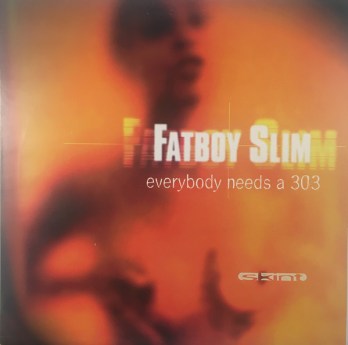
44. Everybody Needs A 303 – Fatboy Slim (1996 Skint Records)

Released in February 1996 (Reached Number 191)
Re-released and remixed in October 1997 (Reached Number 34)

Back in 1996 I was a student and I was editing the music pages of the student rag. I used to get sent a bunch of stuff every week and I would trudge back to my digs and spend three hours listening to it all. One week I walked into the room set aside for the paper to find a bloke in there waiting for me. He was called Ben and he worked for one of the promotion companies that supplied the records for me to review.

He handed me a 12” record and said that this was “The next big sound, dirty acid house-y dance music”.

He then vanished as quickly as he had appeared. Like a goatee bearded spectre.

Back then of course, Britpop was still just about king and I used to strut around the mean streets of Guildford in my skinny fit Salad Tshirt, so my colours were firmly tied to that mast, but something was happening to music. Indie music had started a passionate and potentially damaging affair with dance music, and the result was music that had beats that were massive and this noise that sort of twitched and bleeped like a demented warthog in a bath. But I knew relatively little about it. Pretty much the only dance record I owned in 1996 was ‘Leftism’ by Leftfield and I had no idea what a 303 was, I thought it was the road to Devon.

So I stuck this record on, poured myself a cup of tea and waited.

It turns out Ben was right because ‘Everbody Needs A 303’ blew my tiny mind. A staggering twitchy, bleeping acid house ode to the TB-303 synthesizer (I looked it up in my Penguin Big Book of Music) that also samples Edwin Starr. The beats kind of thump against the side of your speakers, the 303 squelched and chirps along getting faster and faster and more distorted as it goes.

I rarely dance, even back then, when I sort of could, I considered myself way too cool to throw shapes on a dancefloor (I mean I was a twat, let’s make that clear). But this record made me want to dance. I wanted to bop along to these filthy beats.

The next week I was due to DJ at University’s ‘indie club’ a Thursday shindig in a basement and when the floor was busy I chucked it on. It was bedlam and indeed the Next Big Sound.

The 12” I mentioned earlier had this on the B Side –

Going Out Of My Head

Not sure if this was actually on the official release or not, but it’s still a tune.

Oh and one for all the fact fans out there. The first ever record to reach the UK Top Ten that featured the use of a 303 was this

Rip It Up – Orange Juice.

SWC


45 45s @ 45 : SWC STYLE (Part 1)

A GUEST SERIES by SWC

I’ll be honest, 2019 was the year that I feel out of love with music. For a good six months, everything I listened to sounded boring, dated, uninteresting and worthless. I mean everything. I have my reasons. I downloaded precisely zero music throughout 2019. I listened to a lot of podcasts instead.

This malaise ended in December. Three days before Christmas I came home for work and found my daughter sitting on the sofa listening to music via the Amazon sponsored listening device that is Alexa. The song she was listening to was ‘the Mince Pie Song’ by Santa.

Which is awful but it does contain the immortal line ‘Oooh they are so tasty, they are my favourite kind of pastry’. When it had finished, my daughter told me that it was ‘Her Favourite song of the year’ and then she asked me ‘What my favourite song of the year was’ and I didn’t know. Normally I could reel off a Top 50 for her (not that she’d be interested in whether I thought Denzel Curry was better than Jamelia Woods or not – he’s not, just in case).

So I said “Well, ‘The Mince Pie Song’ I suppose”. And I meant it because it was genuinely the only song that I heard in 2019 that stayed in the mind. At that point I thought I must be able to do better than that. So that evening I went online and read a ton of end of year charts, I listened to a bunch of playlists and slowly the love ebbed back into my life.

There was this for example

Big – Fontaines DC

Or this

Would You Rather be Lonely? – Red Rum Club

And, rather unpredictably, this

Hero – Michael Kiwanuka

All of which made me realise, exactly what it was I loved about music.

By New Years Day, music was back in my life. On January 2nd I sat at my computer and found myself browsing old posts of the Vinyl Villain (I was looking for a particular track by The Fall, I’m not some weirdo fanboy, well I am, but…anyway…) and I stumbled across the excellent 45 45’s at 45 series and a little light pinged somewhere – this is my 45th year on the planet and I suddenly whirled away into a reverie compiling a list of my favourite 45 records of all time. Which I’ve sort of already compiled elsewhere in the past at a blog that no longer exists. So instead I’ve compiled a list of 45 singles that have in some way influenced my life – they are not the Best 45 Records Ever (although some are) and if JC will indulge me I’d be honoured if you’d let me talk you through them. To tempt you further I’d like to start with this.

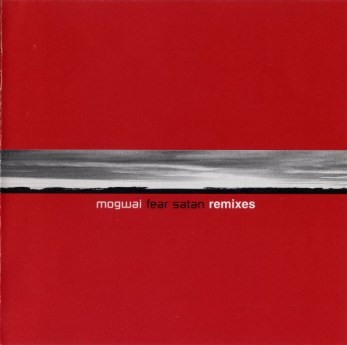
45. Mogwai Fear Satan – Mogwai (1997 Chemikal Underground Records)

Released a single in March 1998 – it did not chart

In 1999, I saw Mogwai play in Berlin, by complete chance at it happens, (I’ve told this story before) in a burnt out cinema, it was one of the greatest evenings of my life – they ended show with Mogwai Fear Satan and it was utterly incredible. I could barely hear for three days afterwards.

‘Mogwai Fear Satan’ for those in the dark is a sixteen minute instrumental track that closes Mogwai’s debut album ‘Mogwai Young Team’. It is an incredible sixteen minutes of music that is centres around a chaotic drumbeat that fades in and then out again and then in again and a guitar riff that does the same thing. It also features a flute before it fades away into a blur of feedback.

In March 1998 it was released as a single to accompany ‘Kicking A Dead Pig’ a Mogwai Remix album. Which saw the likes of u-ziq, Surgeon and My Bloody Valentine tweak the track beyond all recognition.

Mogwai Fear Satan (My Bloody Valentine Mix)

SWC

JC adds…….

This new series will appear at regular intervals over the coming weeks and months, leading up to the #1 song being revealed on the day that swc turns 45.  The second part is tomorrow…..

THE BIG HITS…..30 YEARS ON

A new feature. It may prove temporary, but I’ve a feeling I’ll get 12 postings out of it.

It’s partly inspired by reading somewhere that anyone who was born back in 1990 is now just as close to the year 2050 as they are to the year of their birth.

Back in the late 70s and 80s when I was beginning to immerse myself in music, the sounds and songs of three decades earlier seemed totally alien and of no interest to me. But these days, thirty years doesn’t feel all that long a time period with many songs from three decades ago still very much an essential part of listening lists, often inspiring memories of happenings, events and gigs that were life-changing (it’s no coincidence that 1990 was the year that myself and Rachel moved in together).

Each month, I’m going to have a casual look back at the songs that hit the UK charts 30 years ago; it’s not going to about sneering at some of the awful pap that reached the top end of the charts, nor is it going to highlight a singer or band scraping into the lower echelons of the Top 75 for a week and then doing nothing else during their career, but it will make mention of minor hits by major bands.

The introduction to the series will be something of a slow burner as record companies have always tended not to push out too much in the way of new singles in the month of January, preferring to let the Xmas market fade away slowly. There were some great singles kicking around in the charts in January 1990, but almost all of them had been released the previous year. Here’s some, however, that did break through during the month in question:-

Welcome To The Terrordome – Public Enemy

Entered the charts on 20 January at #26, reaching its peak of #18 just a week later.

Public Enemy were very much at their peak in terms of awareness, including here in the UK, on the back of two hit albums, sell-out tours and supplying music for Do The Right Thing, a critically acclaimed and commercially popular film by Spike Lee. Some of the wider awareness, however, was to what had happened in mid-1989 when the band had seemingly broken-up and then re-formed, all related to them having to respond to Professor Griff making inflammatory anti-Semitic comments during an interview with the Washington Post.

Welcome to The Terrordome was the band’s first new piece of music since the row. It was a response to the turmoil that had engulfed them, with Chuck D hitting out hard, reminding the world just how often the black community had been victimised throughout history. I don’t recall this 45 getting played much on radio at the time, and it is quite remarkable to realise it went Top 20.

Boing.

Nothing Compares 2 U – Sinead O’Connor

Entered the charts on 20 January at #30. Climbed to #3 the following week and then spent four weeks at #1, before finally dropping out of the Top 40 in April.

One of the best known cover versions of all time, and one of the best examples of a promotional video boosting sales. A song in which sadness and anger are conveyed in equal measures, it propelled Sinead O’Conner from cult to mainstream status, something which subsequent events proved she was not fully prepared for. It is reckoned that  3.5 million copies of the single were sold in 1990 and it reached #1 in more than 20 countries. See that thing I mentioned earlier about inspiring life-changing memories? This was hanging around the charts as myself and Rachel braved up to deal with the domestic fall-outs from both of us leaving someone else for one another…….

Hello – The Beloved

Entered the charts on 27 January at #44; it would enjoy a seven-week stay, peaking at #19 in mid-February.

A superb and mellow dance-track in which a shout-out is given to some friends of The Beloved, as well as a number of famous people, some of who were fictional. Jeffrey Archer (politician and novelist), Fred Astaire (actor and dancer), Bobby Ball (comedian), Charlie Brown (cartoon character), Tommy Cannon (comedian), Billy Corkhill (soap opera character), Leslie Crowther (TV presenter), “Freddie” Flintstone (cartoon character), Paris Grey (singer), Brian Hayes (broadcaster), Vince Hilaire (footballer), Barry Humphries (comedian), The LSO (orchestra), Kym Mazelle (singer), Mork and Mindy (TV characters), Little Nell (character in a novel) Friedrich Nietzsche (philosopher), Charlie Parker (musician), André Previn (musical conductor), Little Richard (musician), Salman Rushdie (author) Jean-Paul Sartre (philosopher), Mary Wilson, Di and Flo (The Supremes), William Tell (Swiss folk hero), Sir Bufton Tufton (fictional character in a satirical magazine), Desmond Tutu (religious leader), Willy Wonka (character in a novel), Zippy and Bungle (TV characters).

The references to Peter and Paul are in respect of apostles and gospel writers; Chris and Do are friends of the band while Steve and Claire was a reference to guitarist Steve Waddington and his then girlfriend.

Hello was also given countless remix versions, some of which still sound great while others have date badly.

Telephone Thing – The Fall

Entered the charts on 27 January at #58. Dropped out of sight the following week

The first non-cover version to get into the Top 75. The previous year had been a horrific one for Mark E Smith – Brix had left him, his dad had passed away and he’d been dropped by Beggars Banquet, the label that had seemingly been the one to finally understand how to get the best out of him in terms of commercial success. It was a huge surprise that 1990 got off to a bang with a single recorded with Coldcut, a duo of English electronica producers who had enjoyed chart success previously with the likes of Yazz and Lisa Stansfield. The lyrics were written on the back of MES believing he had evidence his phone was being tapped.

Ride – Chelsea Girl (from Ride EP)

Entered the charts on 27 January at #72. Went up one place the following week and then fell back down again

Their first official release by Ride, issued by Creation Records. I’ll admit to it totally passing me at the time. Indeed, I’ll go further by admitting that I never bought anything by Ride at the time they emerged. Shoegaze was never quite my scene.

I’m thinking that reading all of this today might make a few of you feel quite old.

JC
(aged 56 years and 7 months)

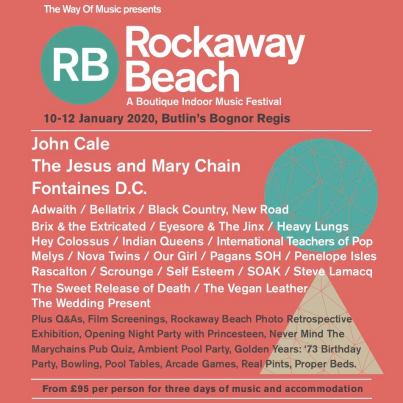
ROCKAWAY BEACH : A BOUTIQUE INDOOR MUSIC FESTIVAL

A GUEST POSTING by STEVE McLEAN

Righttttt! So let’s say this upfront! This wasn’t a Butlin’s ‘themed weekend’ populated with tributes acts, Sonja and one member of Five Star pretending to be Five Star. This was a bona fide curated music festival, we know that because there was loads of posters saying so.

Piss taking aside, it WAS FUCKING BOSS! I’m not kidding, I had a better time there than I’ve had at any music festival since my teens. If I have one complaint, there wasn’t enough ‘Butlinsy’ type stuff. A lot was closed down for the winter. Shame!

We (myself and my pal Tom) got there after kick off, meaning we missed Bellatrix and a few others but it’s not all bad as we were given a chalet bigger than we were expected. You know you’ve hit your 40s when you get excited about having a spare room that no one will sleep in.

So the first thing we took in was John Cale chatting about his life. I say chatting about his life, he tells stories like Grandpa Simpson, there was one where he caught the bus to Shelbyville with an onion on his belt (which was the style at the time). It was kinda endearing. John Robb did a good job of livening things up a tad. Look man, when John Cale speaks, you listen, even if he’s doing his best Stanley Unwin.

The first music act we saw was also John Cale. We didn’t really have our shit together, so we had a double Cale first day. It’s cool though, I’ve seen Cale around half a dozen times and Paris 1919 shows aside, I’ve never heard so many Cale classics in one sitting. It’s a pity not one of them sounded like they did on the records. That’s the beauty of Cale, not one fuck was given by him. He must have seen Bob Dylan and thought ‘I’ll have some of that’. It was fucking fab in places though and a bit patience testing wank in others. We didn’t need a spoken word / ambient version of Half Past France, but it was great to hear Do Not Go Gentle Into That Good Night back in the setlist.

Someone shouted out for Hallelujah and then someone else shouted out ‘wanker’, I think it was a response to the first shout out, rather than an attack on JC. (editor’s note…..it wasn’t an attack on me either!!)

He opened with Helen of Troy which is in my top 10 Cale tunes and while a roaring version of Waiting For The Man predictably got the biggest cheer. Villa Albani was the only song I’d not heard him do live before, so that to me was a special treat.

mp3 : John Cale – Do Not Go Gentle Into That Good Night
mp3 : John Cale – Villa Albani

After Cale we headed off to the chalet as we were pretty knackered after the traveling and such. We stopped by Burger King, which was open until 3am, for fuck sake. THREE AYE EMM!

Saturday kick off, all you can eat breakfast. That’s where we made our money back. I’ll be surprised if they do a buffet again next year as I think we took them to the cleaners in hashbrowns alone. After about an hour we went to the swimming pool. The pool was only open for about 4 hours on one day. That fucking sucks man, plus we didn’t find out until afterwards…. basically we’d have gone earlier and stayed later if we’d known. Those flumes are the balls.

Music wise, we kept our powder dry until Peter Perrett. We’d seen a bit of his talk and if I’m honest it was like watching a model made by the Jim Henson creature shot. Wanna feel old? Peter Perrett is what the robot Lou Reed from No Money Down looks like now

But Jesus, he fucking nailed it. His band were tight AF and cool AF and rocking AF and just AF. Peter is still the teller of stories rather than the singer of songs. I didn’t recognise much of the material as most of it was culled from his solo albums that I’ve heard but not digested. Surely the sign of a great act and great songs is when you’re hooked without knowing a note? He rewarded the non-fans with Another Girl, Another Planet and a rollicking cover of the Velvets What Goes On, but he didn’t need to. He had the songs to leave without the fan service. Baby Don’t Talk from his 1990s outing The One was a nice opener while War Plan Red and An Epic Story are up there with his classics.

mp3 : Peter Perret & The One – Baby Don’t Talk
mp3 : Peter Perret – An Epic Story

We went off to watch some footy on the big screen and play some pool. The pool got quite contentious but the final score was 3 to Steve and 2 to Tom. It’s not my fault he loves potting the black. I tried my best to lose to him, I really did. Then more food. I mean fucking loads. We went to the American style diner. I had a cheeseburger, topped with a chicken burger and some bacon. Yeah, I know what you’re thinking ‘Steve you earned that burger topped burger after all your swimming’ Damn straight.

We got back in time for the The Nova Twins, they had come highly recommended so we were eager. They were okay I guess, but I didn’t click with them. That said, the crowd fucking loved them and I was in a food coma. so I might not the best person to ask. They looked lively. The tune Vortex is a banger.

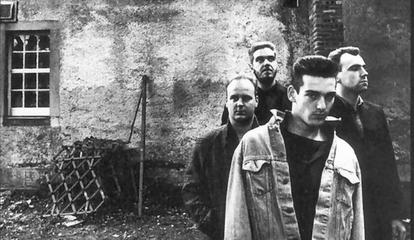
After that it was the Jesus and Mary Chain. One of the main reasons I’d come was for JAMC. I love my bands when they have dry ice and strobes so you can’t see how badly they’ve aged. Nice one lads, you should have seen the rest of us, not a proper hair line among the crowd although many of us were convinced that our skinny jeans still fit (imagine the buzzer noise from Family Fortunes here)

A crowd pleasing set followed, April Skies, Just Like Honey, Candy Talking, Head On etc etc.. they also played a couple of newer songs – Amputation stands out as a clear winner although they didn’t play my favourite song, Snakedriver, so in their own vernacular they can get tae fuk.

mp3 : The Jesus and Marcy Chain – Amputation

After that we opted again for Burger King and back to the chalet. The other option was listening to Steve Lamacq playing some records and I’d spent hours in the 1990s doing that. I can’t imagine he’s improved.

Sunday! Bloody Sunday! More breakfast! The good thing about a buffet at breakfast is the amount of melon I eat. I never eat melon after a fry up in real life. It was practically a health spa weekend. Seriously, melon for breakfast, like I’m Meghan Markel or something!

After breakfast we went for a walk along the beach. We saw a seagull the size of a fucking bouncer. Hard bastard he was, instead of stealing chips, he was nicking B&H out of ten year old’s mouths.

There was more pool after the beach, some would say that Tom won because a 5 – nil drubbing meant he was ahead 7-3 but those people would be wrong as it was clearly a two legged affair where goal difference doesn’t count. The ‘final’ was decided Tom potted the black. Sorry man, I *don’t* make the ”rules”.

Music wise, Sunday had a lot to offer. True to form we dicked around too long so the first band we saw was Brix and Extricated. It was curio for me as I was only ever ‘okay’ with The Fall . The best songs they played were Fall songs. The stand out was Glam Racket , from 1992 which was co-written by guitarist Steve Hanley. You have the feeling that this band consider themselves a sequel to The Fall.

Brix was followed by The Wedding Present. The Weddoes were another reason for me being here. I have loved them in most of the forms they have taken. I am more of a Bizarro fan than Seamonsters or George Best and I was well served with Brassneck, Kennedy and What Have I Said Now. There was enough classics and enough ‘new stuff’ to keep everyone happy. For new stuff read post 2004 reunion. My fave WP song is Montreal which they didn’t play. I am more forgiving than I am of JAMC because of all the Bizarro stuff. Gedge introduced the band as an Indie supergroup as they have the drummer from My Life Story and the guitarist from Sleeper. To paraphrase Ross’s girlfriend from Friends; Playing it fast and loose with the word super, there.

mp3 : The Wedding Present – Kennedy

Closing band of the weekend were Fontaines DC. or The Fontaines as everyone seemed to be calling them. I’d not encountered them before, but alarm bells rang when my friend Ian mentioned that they were like Oasis crossed with the Pogues. If only it was the other way around, Ian.. If only.

Look, I know I’m a contrarian. My favourite Byrds album is Byrdmaniax, I think Squeeze is a legitimate part of the VU discography and Greedo shot first (that last one is bollocks, but my back is up). Seriously, I’m not on board with these guys. Tom (who has more of an open mind than me when it comes to not pre-judging) looked at me with a face that said MEH and I thought he was being generous. It was like every student uni band that you ever saw. I can only assume that people are enjoying them because new bands are so insipid that anyone offering a slight element of danger seems like The Stooges. Sorry guys. BUT! Look on the bright side, I’m in my 40s, you don’t fucking want me in your fan base… all of those people who were there getting into you who were also in their 40s were taking some real cool points off you though. Soz.  (editor’s note……I disagree with the our reviewer’s take on Fontaines DC…Santa was kind enough to bring me the debut album….and they will be getting a further mention on this blog in a couple of days time)

And that was that. We skipped Burger King (I’m lying here, for effect.. we had double Burger King because we knew it’d be our last… Take that colon!) Then breakfast again and then nothing. Fuck. Well not completely nothing, we got back to the chalet and the radio was playing Five Star! Proper Five Star with all the members intact. WOO HOO!

To sum up – It’s fucking rubbish not living in Butlins, they have a little shop that charges three quid for a diet coke. That’s an amazing mark up. A few years ago I was offered a job with Pontins and I’ve sent them an email to see if it’s still going. Oh and I’ve booked Rockaway Beach for next year. Bands, burger king, amusements, swimming, pool, grabby machines and rambling old men.

Rockaway Bi-atches!

STEVE

JC adds……

I’ve known Steve a good number of years, initailly through our collective love for Butcher Boy.  He was kind enough to allow me to use his FB thoughts on a Sgt Pepper tribute album for a posting last year and I was delighted when he said yes when I asked if he fancied penning a review of Rockaway Beach 2020.  Here’s hoping he feels like contributing more stuff over the coming months.

SATURDAY’S SCOTTISH SONG : #195 : LOWLIFE

Lowlife are a band that I know next-to-nothing about despite them enjoying a recording/performing career of some twelve years in the 80s/90s. All I could have told you was that I was aware of the name, partly from the fact it had been taken from an exceptional album by New Order and from reading somewhere that Will Guthrie, formerly of Cocteau Twins, was a member. I can’t recall ever hearing their music played, although looking the artwork across the five albums they released during the time they were together, I can recall seeing some of their CDs in the racks of record shops. What I had no idea of was that Hugh Duggie, who is both a lifelong friend of Jacques the Kipper and whose work with Foil and Sons of the Descent have featured previously on the blog, was also a member of Lowlife for a period of time. What now follows is gleamed from on-line research.

The band had originally began life in the early 80s as Dead Neighbours, by all accounts a psychobilly four-piece band heavily influenced by The Cramps. They hailed from Grangemouth, which was the home town of Liz Frazer and Robin Guthrie, and indeed it was the latter’s brother, Brian Guthrie who managed the band. It was during the recording of Dead Neighbours second album in 1983 that Will Heggie came on board to help out after the unexpected departure of the bass player. By the following year, the guitarist had also left, unhappy with an increasing shift away from the psychobilly stuff, and the new-look four piece decided to do away with the original name and begin again as Lowlife, consisting of Craig Lorentson (vocals), Will Heggie (bass), Stuart Everest (guitar), and Grant McDowall (drums), with Brian Guthrie not only maintaining his role as manager but forming a new label, Nightshift Records, specifically to release their material.

This line-up would release two albums, two singles and two albums between 1985 and 1987, a period in which they supported The Go-Betweens on a UK tour (sadly, a tour that I didn’t see) as well as appear on a number of shows recorded by BBC Scotland. It was most likely around this time that I would have read about Lowlife and the Cocteau Twins connection, but it didn’t spur me on to check them out.

There would be three more albums between 1989 and 1995, recorded by different line-ups, with the latter two featuring the afore-mentioned Hugh Duggie on guitar. Vocalist Craig Lorentson was the only member to appear on all releases.

It is worth mentioning that the band came through a number of periods when circumstances where things were stacked against them, not least the collapse of Rough Trade Distribution in 1991 which impacted immensely on Nightshift Records, while earlier on, in 1988, they came very close, through a publishing arrangement, to landing a deal with Warner Brothers only for it to collapse as result of an internal changes within the company. The lack of any commercial success eventually took its toll and the band called it a day in 1997.

The one track I have in my possession comes courtesy of the New Gold Dreams boxset:-

mp3 : Lowlife – Hollow Gut

It is the lead track on the Vain Delights EP from 1986, which was recorded and issued in-between the first and second albums. It’s really very listenable…..you can hear all sorts of influences on it, and it wouldn’t have sounded out of place at an indie/goth night. If anyone out there has any more material, I’d be very happy for a guest contribution, possibly an ICA?

In 2007, LTM Recordings re-released the first four albums recorded by Lowlife, adding in the EPs, singles and radio session appearances, together with extensive notes provided by Brian Guthrie. This led to something of a re-kindling of interest in the band but any plans to fully reform couldn’t be followed through as Craig Lorenton wasn’t in the best of health, and indeed he passed away at the tragically young age of 44 in June 2010, as a result of liver and kidney problems.

JC

AN IMAGINARY COMPILATION ALBUM : #235 : MICHAEL HALL

A GUEST POSTING by HYBRID SOC PROF,
our Michigan Correspondent

My last five years on the radio in Santa Cruz, there were two ideas behind my show. The first was that there was a staggering amount of great music being made that hardly anyone was hearing and, relatedly, if I could start my show more quietly and accessibly with each set getting louder and each set being louder than the last, then I might push the bounds of listeners’ existing tolerances into new realms.

Michael Hall began his musical career as one of the two consistent members of the cowpunk -as I knew it in the mid-80s – band, Wild Seeds. Big in their hometown of Austin, Texas, and a group people who frequented independent record shops and/or listened to college radio had likely heard of, even if they hadn’t heard much from them. Hall wrote, sang and played guitar for the band, though he handed off vocals to the magnificent Kris McKay (see “Baby You Scare Me” as well as the bonus track below) over the course of the band’s short life… a life killed off by the bankruptcy of their label in 1989.

The release of his first solo record, Quarter to Three (1990), was sufficiently limited that I full on missed it and only started to catch up with Love is Murder (1992). You’re not into music if you haven’t purchased or taken a listen to a record for no other reason than the cover art… Love is Murder has a young 1950s couple looking out the back window of a yellow sedan, smiling, below which you read the album title. Then there are the song titles, “Let’s Take Some Drugs and Drive Around” (included here), “Put Down that Pig”, “What Did They Do with the President’s Brain”? What I found was that Hall was absolutely irreverent, a great recounter of the crap life can be and yet utterly and completely and totally infatuated with the prospect of robust, deep, permanent love… while unstinting in chronicling its contradictions. See “Baby You Scare Me.” If you want the more humorous tunes, they’re on youtube, you’ll enjoy them, but the others are more skillful and moving, rich and rewarding (I’ve been reading Horkheimer and Adorno on “The Culture Industry,” mea culpa.)

1994’s Adequate Desire was next, and Hall introduced a new theme to his work, on top of love, there’s now death. The death of love and just plain murder, untethered from love, arrives with Day (1996), but so also does “The Museum of Giant Puppets, PA.” The next two records are with a band he assembled, The Woodpeckers, before a final album, The Song He Was Listening to When He Died, in 2006. As far as I can tell, and as others I’ve read have reported, it seems like Hall called it quits after that record. You can find articles by him in publications connected to Austin in one way or another, after 2006, but I tried writing him an email to express my admiration and hopes for more in the pipeline 7-8 years ago… no response.

Even to his most conventionally structured songs, there’s a narrative and visual quality to Hall’s work that always moves me in one way or another. There’s an emotional sophistication and nuanced analytic sensibility I rarely find in any genre. It irked me that musicians like Hall didn’t get recognition, fame, and money for their skills when I was younger and maybe that these ICAs (my first outlet for 25 years for getting music out into some semblance of a public arena) that is what’s dredging these feelings up again, but I simply can’t understand how work this good didn’t sell. (Yeah, yeah, yeah, I know labels and distribution deals and cost structures and life happenings and the fickle blinders of popular taste but jeez so, so, so much talent has been denied/wrecked/wasted over the years, it’s just not right.) Hope this goes over well and you drink of it deeply.

1. Michael Hall – Let’s Take Some Drugs and Drive Around – from Love is Murder (1992)
2. Michael Hall – Amelia – from The Song He Was Listening to When He Died (2006)
3. Michael Hall – Las Vegas – from Day (1996)
4. Michael Hall – Baby You Scare Me – from Love is Murder (1992)
5. Michael Hall – I Just Do – from Adequate Desire (1994)
6. Michael Hall – The Museum of Giant Puppets, PA – from Day (1996)
7. Michael Hall – Hello, Mr. Death – from Adequate Desire (1994)
8. Michael Hall – Their First Murder – from Day (1996)
9. Michael Hall – River of Love – from Love is Murder (1992)
10. Michael Hall and the Woodpeckers – The Train will Surely Come – from Dead by Dinner (1999)

Bonus: Kris McKay – One Man Crusade (Rainer Ptacek cover) – from The Inner Flame – A Tribute to Rainer Ptacek (2012 – second release)

HSP

SOME SONGS ARE GREAT SHORT STORIES (Chapter 30)

As I said in the previous entry in this series, some songs make for the very saddest of short stories. Particularly when they are true.

Between Marx and marzipan in the dictionary there was Mary
Between the Deep Blue Sea and the Devil that was me

If ever anyone could help me with my obsession with
The young Suzannah York
It was Mary

In my pink pajamas she asked me for something
I gave her the short answer

She read our stars out loud
And I knew then that we should have gone sailing

But we stayed home instead
Fighting on the water bed
Like the honeymoon couple on drugs

Me and Mary

What happened in the past
Remained a mystery of natural history

She should have been the last
But she was just the latest

If she wanted to be a farmer’s wife
I would endure that muddy life
I would dig for victory

And the sound of happy couples
Coupling happily in the dark
While you and I sat down to tea
I remember you said to me
That no amount of poetry
Would mend this broken heart
But you can put the Hoover round
If you want to make a start

All my friends from school
Introduce me to their spouses
While I’m left standing here
With my hands down the front of my trousies

I just don’t know what’s to be done
I wonder sometimes how did Dad meet Mum
And how did they conceive of me

Tell me Mary

The boys who came to the shop
Always made her laugh much more than I did

When I told her this must stop
She didn’t bat an eyelid

She said you know honey it’s such a shame
You’ll never be any good at this game
You bruise too easily

So said Mary

Her two brothers took me out
Of circulation for the duration

So we went our separate ways but does she still love me
She still has my door key

Like a bully boy in a Benetton shop
You’re never happy with what you’ve got
Till what you’ve got has gone

Sorry Mary

mp3 : Billy Bragg – The Short Answer (Peel Session)

The opening line is just genius. The remainder are incredibly moving, with just the right mix of nostalgia, regret and an understanding that some things, in the long run, are for the best. We’ve all been there, haven’t we????

JC

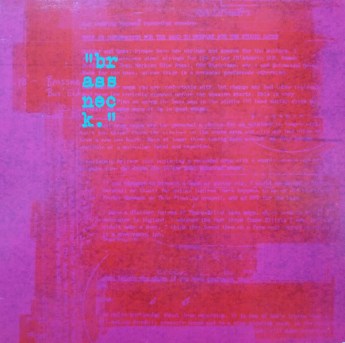
BRASSNECK

It was turning into a dull and routine Friday at work in mid-November, counting down the hours till the freedom of the weekend arrived, when this text from Aldo flashed up on the phone:-

“You going to the Weddoes tonight? Only just noticed they were playing.”

I too, hadn’t picked up they were in town, despite the fact it had been included within a couple of previous e-mails sent out to everybody of the TWP/Cinerama mailing lists. Luckily, there were a small number of tickets still available and six hours later, along with Mrs Villain, the three of us made our way inside The Classic Grand, a former porn cinema long ago converted into a music venue.

The band were on tour for the 30th anniversary of Bizarro and the promise was that the songs from that album would be aired alongside some other old favourities and a few new songs. The venue was mobbed….Aldo at the age of 39 was within the 3% minority of those aged under 45. I caught up with a few old friends who I had an inkling would be there, including Robert and Carlo from the Simply Thrilled Team, and Drew from Across the Kitchen Table fame, who was there with his other half, L.

You only need to take a glance at the set-list to see the sort of night we were treated to:-

California
Brassneck
Crushed
No
Don’t Give Up Without a Fight
Thanks
Kennedy
Montreal
Click Click
Don’t Touch That Dial
Deer Caught in the Headlights
A Song From Under the Floorboards
What Have I Said Now?
Telemark
Granadaland
Bewitched
Be Honest
Take Me!

California was a lovely way to open the night, but the place truly erupted with the opening notes of the song which opens Bizarro:-

mp3 : The Wedding Present – Brassneck

It is still hard to believe that the band weren’t entirely happy with the way the song had turned out after their initial stint in the studio, but then again, as I’ve only recently discovered from reading published and on-line material, the band were, certainly in the early days, just about consistently critical of the recorded versions of their songs, taking the view that they lacked a certain energy or excitement in comparison to how they were played live.

Kennedy had been the only single lifted from the album and while it had taken the band into the Top 40, its peak of #33 had been a bit disappointing to RCA, the major label to which the band had recently signed. There was always a wish to have a second single but the band persuaded all concerned that everyone’s interests would be better served if they could go back into the studio and have another go at Brassneck, this time with the irrepressible Steve Albini in the producer’s chair (albeit his preference is to be referred to as the audio engineer).

He trimmed down the track by about thirty seconds while beefing up, (to put it mildly), the arrangement with a few of his specialities including what many have referred to as the sound of a distressed beached whale during an instrumental break (something he would make huge use of later on when he worked with the band on Seamonsters (1991).

mp3 : The Wedding Present – Brassneck (single version)

This one went Top 30…..an improvement on last time out but still a bit too low for the liking of the bosses. The continued failure of the band to really make a dent in the charts led to the situation in 1992 when the band released a single on the first Monday of each month, only to have it deleted within a matter of days, meaning there would be enough sales to propel the 45 into the charts for one week only – it was something of a mixed success but it did lead to Come Play With Me giving them their one and only Top 10 success in May 1992.

The relative success of Brassneck did, however, provide the band their first ever appearance on Top of The Pops. It wasn’t the most memorable of performances, explained in later years by David Gedge:-

“I wasn’t pissed off and I was just following an old tradition established by some of my heroes… those punk bands who didn’t take Top Of The Pops seriously and who took the mickey out of the whole ‘miming’ thing. I started doing it during the TV rehearsals, fully expecting a producer or director to tell me to stop messing about but no one did. So with each run-through it became a little more… extreme. The Brassneck video was the inspiration for the Top Of The Pops performance, actually, with the band looking bored and oblivious to the frantic, theatrical performance art going on around us. The two things aren’t that dissimilar…”

The re-recorded single was released on 7”, 12”, cassette and CD, with another three tracks on offer, all recorded with Albini on engineering duties:-

mp3 : The Wedding Present – Don’t Talk Just Kiss
mp3 : The Wedding Present – Gone
mp3 : The Wedding Present – Box Elder

The first two are Gedge originals, while the last of them is a cover of an early Pavement song, with all of them featuring heavily over the years in any lists of favourite songs drawn up by TWP fans.

Brassneck itself is one of the best and most enduring numbers the band ever recorded, as epitomised by its reception that evening in Glasgow  – only the cheers after Kennedy and Take Me! were louder, and the latter was mostly to do with it signifying the end of the show as TWP, for those who don’t know, never do encores…..

It’s a song that shouldn’t really be mucked about with, but fair play to Mr Gedge in that he selected it as one that should be given the this treatment for a one-off live set he performed in 2009 with the BBC Big Band. Click here if you dare…..

JC

AN IMAGINARY COMPILATION ALBUM : #234 : POP WILL EAT ITSELF

A GUEST CONTRIBUTION by ACIDTED

Sixteen Different Flavours of PWEI – ICA

I’ve admired all the ICAs over the years and read the majority. I was going to do one on Weatherall but Swiss Adam beat me to it (and, frankly, did a better job than I would have done). But it’s rankled that the spread of artists has left out one of the most successful acts from that fertile period of the late 80s through to the mid-90s. I talk of the mighty Pop Will Eat Itself (hereinafter PWEI). This ICA has been two years in the making, hoping that someone else would remember their glittering brilliance. I can wait no longer. If no-one else it going to do it properly then I’m going to have a half-arsed go at it.

PWEI seem unfairly airbrushed out of UK pop history. They were never cool. But they were better than many (Hello, The Fall). They had 11 Top 40 UK hits in the period 1989-1994. Fundamentally, they were fun and raucous but capable of striking an unexpectedly political note. This ICA is a double album. 16 tracks (14 on the regular LP and an extra two on the remix 12″) in honour of their Sixteen Different Flavours of Hell track, which was also the name of their 1993 compilation album.

PWEI, originally Wild And Wandering, started in the mid-80s and their members included Clint Mansell, Graham Crabb, Adam Mole and Richard Marsh. They were famously named after a phrase in a David Quantick review in NME of Jamie Wednesday (who would go on to become Carter (The Unstoppable Sex Machine)). On with the music…

Side One

1. Def Con One 7″ Mix (from Feasting Frenzy)

A kinda chronological set of hits on this side. But starting with their final single before breaking into the Top 40. The Poppies’ early work had been indie racket, Grebo and a bit of a mess. The less said about Beaver Patrol the better. But then they clearly had a bit of an epiphany with The Beasties Boys and gleefully grabbed onto the hip hop sampling with guitars that defines their best work. Starting with scratching and a sample this blasts us into orbit with their party vibes and adoption of popular culture icons, with the chanting of “gimme Big Mac and fries to go.” I should admit that for many. many years I misheard it as “Big Mac and the price of gold.”

2. Can U Dig It? (from This Is The Hour… This Is The Day… This is This)

More party vibes here. Lots of rocky guitar and lyrics that are a list of all good things. These include AC/DC, Twilight Zone, Optimus Prime, Run DMC, Terminator, Hit The North and “Alan Moore knows the score.” In the wrong hands this could be a drunken closing time singalong. But it’s way more fun than that and the selection shows a balance between low brow and high brow.

3. Wise Up! Sucker (taken from This is The Hour… This is the Day… This is This!)

Although this follows the guitars and samples of Can U Dig It? it’s a sort of love song to lost love. The chorus of “She Loves Me. She Loves Me Not” It’s also where the Sixteen Different Flavours of Hell lyric comes from. But the angry title is also a warning. All very blokish, yes. But great nonetheless.

4. Touched By The Hand of Cicciolina – The Incredi-Bull Mix

Ahead of the 1990 World Cup in Italy, they released this cracking track that showed a different style. There’s still hip hop here. The title steals from New Order and references Italian pornstar Ilona Staller. But it also takes in dub and in this version dispenses with shouty lyrics altogether in favour of something that should have been used as the theme music for the ITV World Cup goals show reel. Sadly, that was not to be. The Bull in the title is a reference to their West Midlands roots, support for Wolves legend Steve Bull.

5. Dance of the Mad Bastards (taken from Cure For Sanity)

The shoutiness returns on this track but there are funky drummer breaks, funk bass and a greater sense of space and self-confidence. I’ve always assumed the “get Up And Get On It” is Lemmy from Motorhead. But I don’t really know. This track also marks their move from hip hop into the fringes of house. They would get closer still but never quite gave up their fondness for industrial and axe attacks.

6. X, Y and Zee (taken from Cure For Sanity)

This track from 1991 and the successor 92° mark the closest they got to house music. But it’s also a more obviously political track. Hidden among the pop culture references to George Jetson is an environmental and unity theme.

7. 92° (The Third Degree) – Boilerhouse “The Birth Mix”

This starts off with that optimistic house staple the choppy house piano that sets a lighter than usual musical tone. There’s talk of a “hardcore dance floor.” And in a UK that was getting more house obsessed by 1991 this got to #23 in the Charts. Proper wave your hands in the air stuff.

8. Karmadrome (taken from The Looks or The Lifestyle?)

This 1992 track ends side 1. It also marks a step back from house music and back towards hip hop and industrial guitars. But it also has the most wonderful choir chorus of the title, starting at 0:50. As they say, “The Power Exists in Everyone.”

Side 2

9. PWEIzation (taken from Very Metal Noise Pollution EP)

Side 2 is more of a delve across the PWEI archives. And it seemed fitting to start with this tune that seemed almost like a theme track. This offers a rallying cry, to keep watching the skies. A signal to cure isolation. Sirens wail, guitars tumble and beats clatter around in wild abandon.

10. Not Now James. We’re Busy (taken from This is The Hour… This is the Day… This is This!)

A paean to James Brown. But with the Poppies usual undercutting humour he isn’t allowed a look in. Whenever JB wants to “get up and do my thang” he’s told “Not now James, we’re busy.” In actuality the track is based around James Brown’s arrest and jailing in 1988 following a car chase that started in Georgia, went through South Carolina before returning to Georgia, where he was arrested.

11. Ich Bin Ein Auslander (taken from Dos Degos Mis Amidos)

A turn for the straightforwardly political. A track that asks us to face attitudes in England towards immigration and identifies with the other. It talks of the “rise of the right” and shows that today’s Stormzy controversy is nothing new. The track takes Eastern instruments and a load of Led Zep samples to produce probably their most powerful track. Musically works today, politically still sadly works today.

12. Bulletproof! (taken from The Looks or the Lifestyle?)

After that, something lighter. Is Everybody Happy? The young and invincible sounds of Bulletproof! More singalong choruses than you could shake a stick at and even plenty of “yeah, a-ha” for the terminally stupefied.

13. Eat Me Drink Me Dub Me Kill Me

Although the title As the album starts to wind down a bit of Lewis Carrol referencing in the title to this track. Alice is absent but what you do get is a dubbed out version of this track from 1992. The beats do sound a bit dated in places but the Ofra Haza sample and thundering bass drum dub save it. It’s a bit of contemplation of mortality with its references to Belushi and private hell.

14. Reclaim The Game – Funk FIFA

Although PWEI disbanded in 1995 (despite a brief reformation in 2005) there is a Pop Will Eat Itself going today. They are clear that they’re a different band, despite having a couple of original members. But they’re not out of ideas. This funky Brazilian influenced attack on FIFA’s management of the beautiful game stands up alongside anything from their heyday.

Remix 12″

Side A.

Get The Girl, Kill The Baddies! – Part Man Part Machine

Graham Crabb had a career as Golden Claw Music producing serious ambient sounds after PWEI folded. This wandering 14 minute ambient remix of PWEI’s only top 10 hit shows that this was some time in the gestation. It’s an industrial ambient track full of alien menace and waves on the shore.

Side B.

Cape Connection – Transglobal Underground Cossack In UFO Encounter Confusion (taken from Two Fingers My Friends!)

Before they disbanded PWEI released a double album of remixes from which this track is taken. It ranks among their finest. And this is the standout track. PWEI’s guitars are set far back. World Music Beats and tablas are brought to the forefront, with the most enormous bass drum. All topped off with a Russian choir. What more could you ask for? Play loud. Very loud.

PWEI were pop stalwarts that never got the credit they deserved. Their more serious moments didn’t get fully acknowledged. But for a singalong party they can’t be bettered.

https://shop.popwilleatitself.net/

PWEI ICA, a playlist by acidtedblog on Spotify : A playlist featuring Pop Will Eat Itself

acidted

JC adds……

This dropped in to me over the Festive period.  It put a huge smile on my face as acidted has been my longest-serving guest contributor – it was the fact that so many of his efforts were wiped out by Google when they took the old blog that got me particularly angry.

He was also the first non-Glasgow blogger I ever met face-to-face – way back in October 2009 when I was down in London to watch the Tampa Bay Buccanners get thrashed by the New England Patriots – and to my eternal shame we haven’t managed to get together in person since that Sunday morning. But we have stayed in touch by e-mail over the years – and I will always be in his debt for the times he stepped in to keep TVV up and running when personal circumstances meant I had to take a couple of extended breaks in 2010 and 2011.

PWEI were on my list of ‘must-do’ ICAs.  I’ve written preciously about some of the songs in this amazing compilation and there’s a number of others that I would have included in a future effort; however, I wouldn’t have been able to bring you Reclaim The Game or Cape Connection as I wasn’t aware of them until now.

Thanks mate.   Hugely appreciated.

Oh, and there’s a few more equally wonderful guest ICAs coming up over the next few weeks, all of which I’ve been sitting on for months.  Cheers to the contributors for their patience and understanding.

THIS SEARING LIGHT, THE SUN AND EVERYTHING ELSE

I’m the proud owner of a substantial number of books which, as a result of my sad inability to throw anything away, are taking up an increasing amount of space in Villain Towers to the disgust of Rachel whose efforts to modernise and improve its interiors are constantly thwarted by my storage requirements.

The vast majority of the books are music and sports related, consisting in the main of biographies in some shape or form. Among these are something in the region of 20 books related to Factory Records/Joy Division/New Order/The Hacienda, with the latest two additions coming via Christmas presents, one of which was the wonderfully entertaining first volume of autobiography by Stephen Morris, whose often self-deprecating effort far surpasses those of his bandmates Hooky and Barney, as much for the fact that he doesn’t use the book to rant about old grievances – but given that Record Play Pause only goes up to the formation of New Order, it may well be that a further and much anticipated volume will go down that path.

The other new book was This Searing Light, The Sun and Everything Else: Joy Division – The Oral History , whose author is Jon Savage.

The book was published in April 2019 and received great reviews, but I refrained from buying it at the time as I thought it would be more or less a cut’n’paste effort consisting of a re-hash of the tales told elsewhere in books by so other authors over the years. It was only when I pulled out the author’s Unknown Pleasures review from 1979 as part of the Festive Period series (click here) did I realise that here was someone who really did get to the heart and soul of the band and was probably the most qualified to do justice to the task, and so it was put on Santa’s list.

The book duly arrived on 25 December and I began to read it that evening, on the basis that it would be an easy enough book to dip in and out of while also turning my attention to some of the other books that had ended up under the tree. I spent hours engrossed in its contents and ended up not going to bed until some ungodly hour which set the tone for a stupid sleep pattern right through until my return to work on 6 January. As soon as I woke up, my nose was back in between its wonderful looking hardback cover and plans to watch or do other things were put on hold as what I was devouring and enjoying immensely was the definitive story of Joy Division that hasn’t been bettered.

For the most part, there was very little I didn’t already know – but the new snippets of information were invaluable and, in one particular case, a real game-changer in terms of how I’ve always thought about things over the past almost 40 years since Ian Curtis took his life. The author lets others do the talking, and offers a mixture of new interviews with those still living as well as dipping into archives to enable the voices of people such as Tony Wilson, Martin Hannett and Rob Gretton to be heard. It’s very clear that the questions Jon Savage has posed to everyone while carrying out the work involved to piece the book together were far from run-of-the-mill, and there’s a sense that everyone responding has been able to be wholly open and transparent about things, secure that what they say will be written down and then put in print, even if it those words are at odds with one of the other contributors or indeed are different from what has been said by them before.

One of the most fascinating things about this book is that it gives much more space to Peter Saville and Annik Honore than any previous publications, enabling them to fill in some gaps and to also offer up a sense of what really went on when so many others, over the years, have mythologised many of the events and happenings.

There’s also some incredibly reflective words throughout from the late Tony Wilson, many of which feel as if they were provided in what must have been one of the last of the detailed interviews he gave before his death. It is entirely fitting that the book is dedicated to Wilson, a lifelong hero of mine and my memory of the one time we met and spoke briefly for all of 45 seconds will never leave me; worth mentioning also that the book’s seemingly strange title is taken directly from one of the quotes he provided to the author.

This Searing Light also benefits from being exactly what it says on the cover. There’s just a few reflections into the early lives and upbringings of everyone in the band and it comes to a halt just after Ian Curtis’s funeral, with no mention of what was still to come for Factory or the emergence of New Order. It is the story of a band whose fans at the time could never ever have imagined the impact they would make or the legacy they would provide, so much so that more than 40 years on, there is still much to be fascinated by.

One thing it did remind me of was just how young and largely inexperienced the other band members were at the time. The infamous Stiff/Chiswick challenge took place on 14 April 1978….all four members were 20-22 years old. They had yet to have Gretton, Wilson or Hannett come into their lives to help shape things. Just two years and one month later, it was all over.

So much transpired between April 78 and May 80 that even now it feels overwhelming, so it must have been nigh on impossible to deal with first-hand.

The book also provides a stark reminder that Joy Division, being on a largely unheralded and small label in Manchester, didn’t ever really find too much fame, until they were no more, beyond the pages of the music papers. The biggest shows they ever played was as the support act on a UK tour by Buzzcocks and nobody was getting rich from any of it, with life seeming to be not far off a hand-to-mouth existence for the most part. There was little glamour and a lot of hard slogging.

The onset of the singer’s epilepsy does seem to have been beyond the belief and understanding of all concerned – including the university-educated Wilson – and it wasn’t helped by the fact that the treatment on offer from the medical professions seems to have been haphazard and involved a lot of guesswork – it certainly got me re-assessing my own long-held views that if the others around him had been more understanding or proactive back in the day, then the suicide could have been prevented.

mp3 : Joy Division – Love Will Tear Us Apart

18 May 2020 will mark the 40th anniversary of the suicide, and will be a time when you’ll be sure to read many tributes, words and reflections across all forms of media. I’m willing to bet that none of them will better what Jon Savage has delivered across these 326 pages.

JC

ALL OUR YESTERDAYS (22/22)

Album : Power, Corruption & Lies – New Order
Review : Rolling Stone, 18 August 1983
Author : Steve Pond

Few rock bands have had as daunting a past to live up to, and overcome, as New Order. But Power Corruption & Lies is a remarkable declaration of independence; for the first time since lead singer Ian Curtis hanged himself three years ago, the survivors of Joy Division have shrugged off the legacy of that band’s grim, deathly majesty and produced an album that owes as much to the currents of 1983 as to the ghosts of 1980. This record is a quantum leap over Movement, the band’s first album, and over most of the music coming out of Britain lately.

Leap is the appropriate word, because on the surface, this is largely a stirring, jumpy dance record. Forget about New Order’s reputation as gloom mongers or avatars of postpunk iciness; forget about the artiness and mystique that envelop them. Just put this stuff on the radio, in clubs or on American Bandstand: you can dance to it, it deserves a ninety-eight, and a song like “Age of Consent” merits heavy rotation, not reverence.

That’s not to say New Order have turned into A Flock of Vultures or anything. But there’s a newfound boldness on Power that was sorely missing from Movement. On that LP, New Order were tentatively trying to break free of Joy Division’s style, if not their tone; too often, the result was turgid and solemn and sprinkled with the kind of whistles, whooshes and beeps that suggest novices halfheartedly tinkering with dance-oriented rock.

Working on subsequent singles toward a surer control of the studio and a more ambiguous emotional stance, the band hit its stride with the epiphanic “Temptation.” A tenacious, gripping, rock-hard dance tune, it was also the first New Order song to suggest that maybe love doesn’t always tear us apart – that, in fact, it just might bind us together, though at great risk. (That song and four others make up the highly recommended EP New Order: 1981-1982.)

Though not as forceful as “Temptation,” the songs on Power glow with confidence – musical confidence, mostly. While Steve Morris‘ drums weave patterns around the unrelenting kick of an electronic drum machine, the band masterfully interlaces layer after layer of sound: Bernard Albrecht‘s alternately slashing and alluring guitar lines, Peter Hook‘s melodic bass playing, broad washes of keyboard color from Gillian Gilbert and such percussive effects as chimes. It’s a bracing, exhilarating sound, equally suited to feverish dance workouts like “Age of Consent” and “586” as to such murkier, more impressionistic outings as “Your Silent Face.”

Lyrically, New Order still rely too readily on emotional vagueness and stock portentous images. Having partially abandoned the frigid, nocturnal chill that permeated Curtis’ work, the band’s current viewpoint is closer to simple pessimism than outright despair. Still, the group likes to draw the drapes and usher in a little darkness at the end of its songs. Power has some of the most foreboding lines in rock: “I’ve lost you.” “Their love died three years ago/Spoken words that cannot show.” “For these last few days/Leave me alone.” And then there’s the jarring conclusion of “Your Silent Face,” a glorious, understated reverie that rails against passivity (and, perhaps, against Curtis) with lines like, “A thought that never changes/Remains a stupid lie.” As the tune closes, Albrecht turns contemptuously dismissive: “You caught me at a bad time/So why don’t you piss off.”

With spiritual anguish and failed redemption no longer an obsessive theme, it’s now easier to focus on New Order simply as a rock band as strong as any in British pop. And as has been pointed out before, once you get past the romantically murky stance, New Order are (just as Joy Division were) a terrific singles band–not a consistent one, but one whose best singles, “Ceremony” and “Temptation,” have been transcendent.

“Blue Monday” isn’t in that class, but in its own way, it’s a breakthrough, getting the band heard on radio stations and in dance clubs. Neither New Order’s boldest song nor their most telling, it is instead their best sounding. The drum machine pounds away with an appropriately inhuman thunk, the band pumps hard to keep up, and after seven searing minutes, it soars to a close with layers of lush keyboards.

That song is included on the cassette version of Power Corruption & Lies; by itself on the twelve-inch single, though, it’s backed by “The Beach,” its dub remake and a tougher, better version of the tune. The point of “Blue Monday” is sound, after all, and the second version takes more sonic chances and shows just what sure-handed producers and assured musicians New Order have become. For the members of a band once known for one man’s sensibility, that’s the last thing many of us expected and, in a way, the best thing they could have become.

mp3 : New Order – Age of Consent
mp3 : New Order – Your Silent Face
mp3 : New Order – Leave Me Alone

JC adds : Possibly the most important record that I’ve ever purchased.  It certainly contains, in the album opener, my favourite song of time.  It felt like the right way to close off this series.  Things return to normal from tomorrow.


ALL OUR YESTERDAYS (21/22)

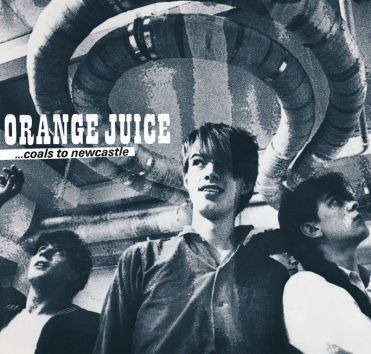
Album : Coals to Newcastle – Orange Juice
Review : Drowned in Sound, 9 November 2010
Author : Aaron Lavery

Over the last decade Orange Juice have been cited as a key influence by all manner of acts. Unfortunately the casual punter has for some time had difficulty in discovering what the big deal is. The Glasgow band’s key components – their spindly, DIY take on soul, Edwyn Collins’ unusual croon, their joy with an absurb lyric – were clear to see as an influence on everything from their Eighties contemporaries right up to modern indie adventurers such as Wild Beasts, but there was never any sense of completeness for anyone really wanting to get their teeth in. To see the sleeve of 1982’s You Can’t Hide Your Love Forever proudly displayed on the sleeve of a Belle & Sebastian DVD but not be able to go out and listen was perhaps the indiest cock-tease available.

For anyone wishing to fully delve into the strange of world of Orange Juice, the drip-drip availability of compilations and reissues was both alluring and frustrating. However, the itch can now be comprehensively scratched with Coals To Newcastle, a seven disc box set that gathers together Orange Juice’s complete discography, including radio sessions, B-sides and a collection of videos and live performances that couldn’t be more of their time if they came on VHS.

Like a lot of box sets, this sudden torrent of material can initially be overwhelming. Although Orange Juice come from an era when the B-side could be just as impressive as the main event, it can still be a struggle to maintain enthusiasm when listening in massive stretches. But then again, it’s probably not designed to be devoured that way – Orange Juice were such a strange beast, changing their line-up and musical leaning so quickly, that the only real mainstay was Collins’ absurd, cocky but vulnerable voice at the heart of it all. Instead, Coals To Newcastle works as a series of Postcards (arf!) showing how Orange Juice morphed from a gangly, awkward bunch of boys who should know better into a more widescreen but ultimately frustrated group.

The first disc on Coals To Newcastle is actually a bit of a misstep, as it’s already been released as 2005’s The Glasgow School. Appearing here with some changes to the track listing and a couple of interesting additions, it essentially serves up an initial taster of Orange Juice #1. This is the Orange Juice that felt they had the world at the feet, that had the London music scene scrabbling up past Hadrian’s Wall to find ‘the sound of young Scotland’, only to find it dressed like “a member of the aristocracy down on its luck”.

This era of Orange Juice, the one that has probably caused the most ripples in indie circles since, is encapsulated by discs one and two, the latter of which contains You Can’t Hide Your Love Forever plus myriad extra tracks. Together, they encapsulate what made the band so exciting at the time, and what has intrigued certain sensitive types ever since.

To suggest that the band’s ability never quite matched up to their ambition here might sound cruel, but it’s meant as a compliment. The likes of ‘Falling And Laughing’ and ‘Simply Thrilled Honey’ are solid gold classics, a rush of adolescent feeling wrapped in furiously strummed guitars. Elsewhere, the band’s almost punkish belief that they can do anything – write grandiose reflections on catching your reflection in a mirror, or imaginings of retribution to local bully boys – is rendered more human by the slight missteps the band make, words packed in like an overstuffed suitcase and rhythms discarded mid-song before being picked up again later on. The giddy sense of abandon can still be heard today, and is still infectious for the listener.

The benefit of the box set is captured in the first track of Coals To Newcastle’s third CD, ‘Rip It Up’, easily the most recognisable Orange Juice song and their only real hit. It’s a shock here as it marks such a change from the earlier discs, with the first incarnation of the group dissolved and Orange Juice reconstituted as a pop-funk curiosity, and most significantly joined by Zimbabwean drummer Zeke Manyika. To hear the Rip It Up LP, full of sax solos, squelching keyboards, and Manyika’s multi-layered rhythms is quite jarring, but the juxtaposition underlines the similarities with the earlier Juice.

Collins’ unmistakable voice is still there, and so is his grand ambition. Opening the album with their perfect pop single, the band follow it with ‘A Million Pleading Faces’, an afro-beat inspired shake-up of proceedings, and then follow that with ‘Mud In Your Eye’, a slice of blue-eyed soul that wouldn’t sound out of place on a Style Council LP. Elsewhere, Collins resurrects an old b-side that opens with him proclaiming “breakfast time! Breakfast time!!” over a slouching reggae rhythm.

Rip It Up is full of enough strange stuff to keep us intrigued today, and plenty of genuine pop moments – the Motown homage ‘I Can’t Help Myself’ for instance – that should have fired it to big success. That it didn’t perhaps explains Orange Juice’s next move.

Discs four and five are based around the band’s next official releases, mini-album Texas Fever and their swansong, The Orange Juice, both released in 1984. The contrast between the two is intriguing as it shows a side of the band that hasn’t really been captured in the Orange Juice compilations released so far. It’s clearly still from the same minds that concocted the jittery, excitable early act and the smoother, shades-wearing Orange Juice that appeared on Top Of The Pops, but it’s somehow a bit harder, musically speaking.

This is where Coals To Newcastle really earns its spurs. To hear Texas Fever is to find a band stripped of the musical excess of ‘Rip It Up’, replacing it with a Sixties-inspired world of close harmonies and even – shock horror corduroy fans – guitar solos. It still finds time for Collins to fit in a ridiculous ‘scary’ voice on ‘Craziest Feeling’, but it wouldn’t be Edwyn if it didn’t slide towards the ludicrous on occasion.

Listening to The Orange Juice, made when the band was officially just Collins and Manyika, again underlines the benefit of the box set. Overshadowed by the more popular and more influential parts of the back catalogue, here it can be judged on its own merits. Thankfully, it stands up well. Its mood is captured on ‘A Little Too Sensitive’, on which Collins turns his trademark cynicism inward, and seems to analyse just why he’s been left standing (almost) alone whilst the music he helped to create has gone on to soundtrack the early part of the decade.

It’s a reflective end to the band’s discography, albeit enlivened by the track ‘What Presence?!’, an early indicator of the guilty pleasure silliness Collins would bottle on ‘A Girl Like You’, and ‘Salmon Fishing In NY’, a heavier number that ends the record in a blizzard of guitar feedback. Accompanied here by numerous b-sides, live tracks and, believe it or not, dub mixes, plus that extra disc of radio sessions, it means Coals To Newcastle lacks a real finale, but that’s a problem of box sets in general, not just this one.

So what to make of the whole thing? Well, as an introduction to the band, it won’t work, simply because of its size. For that, you can get The Glasgow School and hear the influence of that early Orange Juice. For those that want to delve deeper however, this is pretty much darned essential. It confirms Orange Juice as more than an influential indie band – it shows up their ridiculousness, their ambition, their open-mindedness, their limitations, their self-reliance. It leaves you converted to their cause, whatever it is and however foolish it may be. It’s also something you can see yourself returning to, rather than keeping on a shelf for posterity. You can’t really ask for more than that, can you?

mp3 : Orange Juice – Falling and Laughing (Peel Session, 1980)
mp3 : Orange Juice – Mud In Your Eye
mp3 : Orange Juice – Craziest Feeling
mp3 : Orange Juice – What Presence?! (Kid Jensen session, 1984)

JC adds : You really should delve.  It’s bloody marvellous.  And I still can’t quite get my head round the fact that I got a thank you in the credits within the accompanying booklet.


ALL OUR YESTERDAYS (20/22)

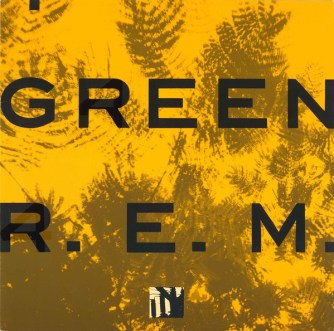
Album : Green – R.E.M.
Review : Rolling Stone, 12 January 1989
Author : Michael Azerrad

On Green, R.E.M. dares to think positive. Songs like “Stand,” “Get Up,” “World Leader Pretend” and “The Wrong Child” are a continuation of the upbeat call to arms sounded on Document‘s “Finest Worksong.” It was no coincidence that such a hopeful record was released on an election day whose outcome was a foregone conclusion. Now is not the time for despair, R.E.M. seems to be saying, but for a redoubling of efforts.

Having made the leap from a small label, I.R.S., to a monolithic major one, Warner Bros., R.E.M. hasn’t sold out; rather, the band has taken the opportunity to crack open the shell it’s been pecking at since it recorded its first album. On Green, R.E.M. acknowledges the outside world with a slew of musical references and some relatively pointed lyrics.

As Michael Stipe’s vocals get more distinct, so does his message – instead of meaning almost anything you want them to, his noticeably improved lyrics seem to be about at most two or three different things. Stipe even makes an effort to enunciate. And perhaps more remarkable, this is the first R.E.M. album with printed lyrics – actually, it provides the lyrics to just one song, “World Leader Pretend,” but with this band you take what you can get.

Green reveals a much wider range than previous efforts, including a playfulness that wasn’t there before. Some songs have a downright bubble-gummy feel: on “Stand,” Peter Buck lets fly with a ridiculously wanky wah-wah guitar solo. Still others reveal more emotion than the band has shown in the past; “You Are the Everything” and the untitled track that closes the album are frank love songs with few strings attached.

Except for those tender ballads, R.E.M. has completely lost its folk inflections. A heavy guitar sound has replaced the old Byrdsy jangle (which scores of college bands continue to ply). The trademark asymmetrical song structures are gone, too; now, verses are repeated for maximum catchiness.

The band’s last two albums – Life’s Rich Pageant and Document – seemed very much of a piece, but Green is a distinctive record with a new feel, at once slightly synthetic and deeply felt, with Stipe conveying strong conviction without shouting and subtle emotion without disappearing into the woodwork. (Green was coproduced by Scott Litt, who also coproduced Document, the band’s commercial breakthrough.)

“Turn You Inside-Out” includes percussion by former Sugar Hill Records house drummer Keith LeBlanc, but it’s no rap jam – rather, it’s the heaviest rock these guys have yet recorded. R.E.M. won its reputation as a great rock & roll band as much with its live shows as with its earnest, evocative records, and this album begins to approach the concert experience – not necessarily in its visceral impact, but in its stunning contrasts: the song that follows “Turn You Inside-Out,” the mandolin-laden “Hairshirt,” is the most delicate and affecting thing the band has ever done. “I am not the type of dog who could keep you waiting for no good reason,” Stipe fairly croons.

Musically, Green quotes a lot of sources. Listen closely and you can hear references to the Doors, Led Zeppelin, Sly Stone and others. If R.E.M. were any more calculating, one might suspect this is the band’s sneaky way of squeezing into tightly formatted AOR radio, with its emphasis on classic rock bands.

Just as it’s fascinating to watch elder statesmen like Keith Richards reconcile rock & roll with middle age, it’s fascinating to see how R.E.M. handles fame and commercial success. On paper, this looks to be the band’s biggest album ever – strong singles material (“Get Up,” “Stand” and “Orange Crush”), a major label, a more accessible sound. So it’s not for nothing that the album is titled Green, although environmental concerns, naivete and the generally positive attitude of the record must also have something to do with it.

R.E.M. may be dangerously close to becoming a conventional rock & roll band, but Green proves it’s a damn good one.

mp3 : R.E.M. – World Leader Pretend
mp3 : R.E.M. – Turn You Inside Out
mp3 : R.E.M. – Orange Crush

JC adds : Given that nobody had any idea just how massive R.E.M. would become, not quite with Green but the following two albums – Out of Time and Automatic for the People – then this review is very clairvoyant.


ALL OUR YESTERDAYS (19/22)

Album : Free All Angels – Ash
Review : The Guardian, 20 April 2001
Author : Betty Clarke

Nowadays it’s not cool to be young and enjoy it. Instead, adolescence is surrounded by negativity and teenagers just bemoan the fact that they have their whole lives in front of them. Fun without responsibility has been diluted by the likes of Wheatus, who celebrate the poor personal hygiene and dodgy taste in music that youth entails, by Westlife and their middle-aged, middle-of-the-road sentiments, and by dismissive declarations of “my generation” from the greying Limp Bizkit. Where are the head-spinning thrills, the heart-stopping lust, the celebration of golden summer holidays that seem to last for ever?

Step forward Ash, who (while they themselves wrestle with the complexities of mid-20s angst) have crystallised the pleasure and pain of being a teen. Back in 1996, when they kicked up some punk-pop dust with the single Kung Fu, Tim Wheeler, Mark Hamilton and Rick McMurray were the naughtiest kids in the Britpop class. Juggling a record deal with their A-levels, they hit the charts with the adrenaline-filled debut album 1977. Spawning indie classics Girl from Mars and Oh Yeah, 1977 conjured up playground longings and Kodak memories and set them to lush melodies and spiky guitars. Ash held on to their innocent exuberance, their Star Wars fixation and the knowledge that girls were an unknown but desired quantity.

Following a foray into soundtracks with A Life Less Ordinary, Ash acquired a new guitarist in Charlotte Hatherley and released their second album, Nu-Clear Sounds. But the joy had evaporated into thrash and an affection for the Jesus and Mary Chain that vanquished the optimism and fun of the past. Personally, things weren’t so great either. After two years of non-stop pop, the sweetness of success turned bitter for Wheeler, who gradually retreated into depression. Cue 18 months of suffering, silence and recovery.

But with Free All Angels, Ash have rediscovered their enthusiasm, and Wheeler – not just the singer but the band’s chief songwriter – has a smile on his face. From the beginning, you know it’s going to be good. Walking Barefoot has that trademark sense of nostalgia for a time you’re still experiencing. A great festival song, it’s about relishing a perfect moment while knowing it’s about to come to an end. “Remember when the sun was hot, remember when the days were long,” Wheeler sings, a homage to both lazy days and golden years.

The perfect pop ethic of simple, epic singalong songs continues with Shining Star, Ash’s greatest single since Girl from Mars, a celebration of someone special in sixth-form prose. World Domination is another call to arms to kids everywhere to kick off their trainers and jump up and down. With its “we don’t give a fuck how we’re meant to be” feelgood factor, plus count-in intro, speeding drums and rock guitars just distant enough from Status Quo to be cool, it’s destined to be an Ash anthem.

But Wheeler knows life isn’t all about good times, and Free All Angels has its share of sadness. New single Burn Baby Burn initially sounds joyful, but listen closer and you’ll hear how the nagging guitar really captures the sound of confusion in an ode to the slow death of a relationship. “You’re all I have in this teenage twilight,” Wheeler sings, while admitting that the bitter words and anger characterise the death of what was once his lifeline.

The obsession with stars is still apparent in many of the songs – from There’s a Star to the winsome hymn Sometimes, which blames the realignment of the stars for the loss of love – and so too are the layered harmonies and Beach Boys sound. Pacific Palisades in particular is very like the Barracudas, a fantastic melody rising like a wave before crashing into scrunched-up pop.

There’s some unlikely stuff too. On Nicole, Wheeler adopts a deranged serial-killer persona as he shouts: “I said no, I killed my baby, but I love her.” He gives the impression that the blood is still on his hands. The weirdness continues in Submission, which would find a suitably seedy home on Soft Cell’s Non-Stop Erotic Cabaret: a wannabe homage to S&M that doesn’t work because Wheeler’s voice is too thin to be scary. It’s like discovering your little brother’s secret stash of porn mags – it just makes you giggle.

Frothy, bizarre but beautiful, Candy is the most interesting song on the album. Wheeler does Dusty as the string section from the Walker Brothers’ Make It Easy on Yourself meets the sparse keyboards of Dr Dre‘s Next Episode in a song of sweetness and reassurance. Some unnecessary guitar messes up the ending, but it’s a brave and confident fusion of genres.

Free All Angels is simply great. Sometimes introspective, a bit strange, but most of all fun, it’s what being young is all about.

mp3 : Ash – Walking Barefoot
mp3 : Ash – Shining Light
mp3 : Ash – Candy
mp3 : Ash – World Domination

JC adds : As this series has demonstrated, there’s been a severe lack, over the years, of female writers when it comes to music reviews of the sort of stuff I’ve a love for, and it is interesting that I had to go to a broadsheet newspaper to dig this one out.  It’s a review that would make me want to buy the album, rightfully acknowledging that a very fine debut effort had been followed up with something of a mishap, but passing on the news that the boys and new girl were back on track again.

I listened again to Free All Angels in its entirety for the first time in ages on the back of reading this review and found myself falling for its charms all over again.  It certainly doesn’t feel or sound like an album that is not far short of 20 years old, and arguably deserves to be thought of as one of the best releases by a UK band from the period in question.


ALL OUR YESTERDAYS (18/22)

Album : Nevermind – Nirvana
Review : NME, 21 September 1991
Author : Steve Lamacq

Nirvana do here what Sonic Youth did so emphatically with ‘Goo’ last year – making the move from cult indie to major label with not as much as a hiccup. In fact, just as the Sonics impressed and outstripped the sceptics’ expectations, Nirvana have made an LP which is not only better than anything they’ve done before, it’ll stand up as a new reference point for the future post-hardcore generation.

For starters, this makes a refreshing change from the recent crop of groups – both British and American – who’ve used the Dinosaur Jr/Husker Du sound as their base starting point. Nirvana’s rawk, instead, draws upon their roots in Sub Pop grunge, but also takes in chunks of heavy ’70s bass/guitars and ideology.

Normally, this would spell the sort of appalling disaster you’d usually associate with ITV’s autumn schedules, but Nirvana, in their defence, have attacked rock and changed the format. This is monstrous in the sense of a good drama series, rather than a cheap US thriller. While various American grunge bands seem content to slosh around in their respective hardcore genres – albeit with some success and lucidity – Nirvana have opted out of the underground without wimping out of the creative process.

‘Nevermind’ is a record for people who’d like to like Metallica, but can’t stomach their lack of melody; while on the other hand it takes some of the Pixies‘ nous with tunes, and gives the idea new muscle. A shock to the system. Tracks like the excellent ‘In Bloom’ and best of the lot, ‘Come As You Are’, show a dexterity that combines both a tension and a laid-back vibe that work off each other to produce some cool, constructed twists and turns.

‘Come As You Are’ has something eerie about it, while opening track (and forthcoming single) ‘Smells Like Teen Spirit’ has a ‘Goo’ey feeling inherent in its lurching structure. At other times, the threesome lean into thrashier territory with the berserk ‘Territorial Pissings’ and screaming-pop of ‘Breed’.

This is the natural progression from their debut LP ‘Bleach’, exploring different avenues. They are less specific lyrically than SY, sometimes annoyingly so, but yet they still produce these vivid moods with ‘Drain You’, ‘Polly’ and the closing, quieter ‘Something In The Way’.

‘Nevermind’ is the big American alternative record of the autumn. But better still, it’ll last well into next year.

mp3 : Nirvana – Come As You Are
mp3 : Nirvana – In Bloom
mp3 : Nirvana – Something In The Way

JC adds : For a man who would become, thanks to his BBC Radio 1 Evening Session shows, so closely associated with the rise of Britpop just a few years later, credit has to go to Steve Lamacq for such a concise and well-thought review of an album that nobody could have predicted, at the time of its release, would later become so omnipresent.  His prediction that the impact of Nevermind would last a year or so was likely what everyone thought, not least the trio of musicians who made the album.


ALL OUR YESTERDAYS (17/22)

Album : Mezzanine – Massive Attack
Review : Rolling Stone, 28 May 1998
Author : Barney Hoskyns

Elder statesmen of the moody dance genre that used to trade under the facile name of trip-hop, Massive Attack like to take their time making albums – so long, indeed, that they perpetually run the risk of being overtaken by the very people (Björk, Tricky, Portishead, et al.) they’ve influenced.

One of Massive Attack’s strengths, though, is their indifference to passing fads. In a field where career longevity is a contradiction in terms, the assiduously anonymous trio from Bristol, England, give themselves the time and space to create music that lasts. And Mezzanine, their third album proper after Blue Lines (1991) and Protection (1995), shows that their creative edge is far from dulled.

Like its forebears, the record is a richly eclectic, unpigeonholeable artifact – king dubby meets the rockers uptown, with funk and jazz and hip-hop and even kraut rock all showing up for the party. Like its forebears, too, Mezzanine demonstrates exemplary taste in guest singers: no husky Tracey Thorn (who sang on Protection) this time, but an admirable substitute in the shape of Cocteau Twins siren Liz Fraser, together with the unearthly high tenor of Jamaican veteran Horace Andy.

Andy, who appeared on both Blue Lines and Protection (and who has his own marvelous anthology, Skylarking, on Massive Attack’s Melankolic label), is the star of two high points here. The opener, “Angel,” starts like some lean and mean R&B; track, then builds slowly through Andy’s haunted vocal to explode in a guitar-heavy chorus. Even better is the ominous “Man Next Door,” a troubled tale of urban angst that brilliantly evokes the pressure-cooker intensity of modern-day Kingston, Jamaica.

There are weaknesses on the album: Sometimes rhythm and texture are explored at the expense of memorable tunes, and the absence of the bizarre Tricky (who appeared on Blue Lines and Protection) only highlights the flat, monotonous rapping of the group’s 3-D. But Mezzanine remains a splendidly mercurial record, packed with amazing sounds and mesmeric grooves – a trip, in fact.

mp3 : Massive Attack – Angel
mp3 : Massive Attack – Teardrop
mp3 : Massive Attack – Man Next Door
mp3 : Massive Attack – Mezzanine

JC adds : I’ve long admired Barney Hoskyns as a writer and I was genuinely surprised to discover that he had contributed in the past to Rolling Stone.  It’s great to see that the prejudices previously on show in that publication (and highlighted in an earlier part of this series) had been swept away come the late 90s.


ALL OUR YESTERDAYS (16/22)

Album : Unknown Pleasure – Joy Division
Review : Melody Maker, 21 July 1979
Author : Jon Savage

“To talk of life today is like talking of rope in the house of a hanged man.” Where will it end?

The point is so obvious. It’s been made time and time again. So often that it’s a truism, if not a cliche. Cry wolf, yet again. At the time of writing, our very own mode of (Western,advanced, techno-) capitalism is slipping down the slope to it’s terminal phase: critical mass. Things fall apart. The cracks get wider: more paper is used, with increasing ingenuity, to cover them. Madness implodes, as people are slowly crushed, or, perhaps worse, help in crushing others. The abyss beckons: nevertheless, a febrile momentum keeps the train on the tracks. The question that lies behind the analysis (should, of course, you agree) is what action can anyone take?

One particular and vigorous product of capitalism’s excess has been pop music, not so much because of the form’s intrinsic merit (if any) but because, for many, bar football, it’s the only arena going in this country, at least. So vigorous because so much has to be channeled into so small a space: rebellion, creation, dance, sex energy, and this space, small as it is, is a market ruled by commerce, and excess of money. It’s as much as anyone can do, it seems, to accept the process andcarefully construct their theatre for performance and sale in halls in the flesh, in rooms and on radios (if you’re very lucky) in the plastic. The limits imposed especially as far as effective action goes) by this iron cycle of creation to consumption are as hard to break as they are suffocating.

“Trying to find a clue/trying to find a way/trying to get out!” “Unknown Pleasures” is a brave bulletin, a danceable dream; brilliantly, a record of place. Of one particular city, Manchester: your reviewer might very well be biased (after all, he lives there) but it is contended that “Unknown Pleasures,” in defining reaction and adjustment to place so accurately, makes the specific general, the particular a paradigm.

“To the centre of the city in the night waiting for you…” Joy Division‘s spatial, circular themes and Martin Hannett‘s shiny, waking-dream production gloss are one perfect reflection of Manchester’s dark spaces and empty places: endless sodium lights and hidden semis seen from a speeding car, vacant industrial sites – the endless detritus of the 19th century – seen gaping like rotten teeth from an orange bus. Hulme seen from the fifth floor on a threatening, rainy day… This is not, specifically, to glamourise; it could be anywhere. Manchester, as a (if not the) city of the Industrial Revolution, happens only to be a more obvious example of decay and malaise.

That Joy Division’s vision is so accurate is a matter of accident as much as of design: “Unknown Pleasures,” which together with recent gigs captures the group at some kind of peak, is a more precise, mature version of the confused anger and dark premonitions to be found (in their incarnation as Warsaw) on the skimpy “Electric Circus” blue thing, the inchoate “Ideal For Living” EP, and their unreleased LP from last year. As rarely happens, the timing is just right.

The song titles read as an opaque manifesto; “Disorder,” “Day Of The Lords,” “Candidate,” “Insight,” “New Dawn Fades” – to recite the first, aptly named, “Outside”. Loosely, they restate outsider themes (from Celine on in): the preoccupations and reactions of individuals caught in a trap they dimly perceive – anger, paranoia, alienation, feelings of thwarted power, and so on. Hardly pretty, but compulsive.

Again, these themes have been stated so often as to be cliches: what gives Joy Division their edge is the consistency of their vision – translated into crude musical terms, the taut danceability of their faster songs, and the dreamlike spell of their slower explorations. Both rely on the tense, careful counterpoint of bass (Peter Hook), drums (Stephen Morris) and guitar (Bernard Dickin): Ian Curtis‘ expressive, confused vocals croon deeply over recurring musical patterns which themselves mock any idea of escape.

LIve, he appears possessed by demons, dancing spastically and with lightning speed, unwinding and winding as the rigid metal music folds and unfolds over him. Recording, as ever, demands a different context: Hannett imposes a colder, more controlled hysteria together with an ebb and flow – songs merge in and out with one another in a brittle, metallic atmosphere. The album begins unequivocally with “Disorder”: “I’ve been waiting for a guide to come and take me by the hand”; the track races briskly, with ominous organ swirls – at the end, Curtis intones “Feeling feeling feeling” in the exact tone of someone who’s not sure he has any left.

Two slower songs follow, both based on massively accented drumming and rumbling bass – in their slow, relentless sucking tension, they pursue confusion to a dreamlike state: “Day Of The Lords” is built around a wrenching chorus of “Where will it end?” while the even sparser “Candidate” fleshes out the bare rhythm section with chance guitar ambience. In a story of failed connection and obscure madness, Curtis intones: “I tried to get to you” – ending with the pertinent “It’s just second nature/It’s what we’ve been shown/We’re living by your rules/That’s all that we’ve known.”

The album’s two aces are “Insight” and “She’s Lost Control”; here, finally, Gary Glitter meets the Velvet Underground. Both rely on rock-hard echoed drumming and bass recorded well up to take the melody – the guitar provides textural icing and thrust over the top.

The former leads out of “Candidate” with a suitable hesitation: whirring Leslie ambience leads to a door slamming, then a slow bass/drum fade into the song. The attractive, bouncing melody belies the lyrics: “But I don’t care anymore/I’ve lost the will to want more” – at the end Curtis croons, his voice treated, ghostly: “I’m not afraid anymore” to drown in a flurry of electronic noise from the synthesised snare.

“She’s Lost Control”, remixed to emphasise guitar and percussion, is a possible hit single: it’s certainly the obvious track for radio play. Deep and dark vocals ride over an irresistible, circular backing that threatens to break loose but never does: the tension ends in a crescendo of synthesised noise.

On the “Inside,” three faster tracks follow – mutated heavy pop, all built around punishing rhythms and riffs it’d be tempting to call metal, except control is everywhere. “Shadowplay” is a metallic travelogue – the city at night – with Curtis fleeing internal demons; the following couple, “Interzone” and “Wilderness,” wind the mesh even tighter.

“Wilderness” externalises things into Lovecraftian fantasy,all echoed drumming and sickening guitar slides, while “Interzone” moves through a clipped, perfect introduction to guitar shrills and “Murder Mystery” mumbles: “Down the dark street the houses look the same trying to find a way trying to find a clue trying to get out! Light shine like a neon tune no time to lose no place to stop no place to go…”

Both sides, finally, end with tracks – “New Dawn Fades” and “I Remember Nothing” – so slow and atmospheric that alienation becomes a waking dream upon which nothing impinges: “Me in my own world…”

Leaving the 20th Century is difficult; most people prefer to go back and nostalgise, Oh Boy. Joy Division at least set a course in the present with contrails for the future – perhaps you can’t ask for much more. Indeed, “Unknown Pleasures” may very well be one of the best  white, english, debut LPs of the year.

Problems remain; in recording place so accurately, Joy Division are vulnerable to any success the album may bring – once the delicate relationship with the environment is altered or tampered with, they may never produce anything as good again. And, ultimately, in their desperation and confusion about decay, there’s somewhere a premise that what has decayed is more valuable than what is to follow. The strengths of the album, however, belie this.

Perhaps it’s time we all started facing the future. How soon will it end?

mp3 : Joy Division – Disorder
mp3 : Joy Division – Shadowplay

JC adds : No matter how you look at it, this is an extraordinary review.  It opens with a quote from Raoul Vaneigem, a Belgian writer closely associated with the Situationist movement, that refers to suicide by hanging, the ultimate fate of Ian Curtis less than a year later. It also quotes the lyrics extensively, hinting at the troubled mind of the songwriter, and yet in the period after his death his bandmates would state constantly that they weren’t aware of what exactly was being sung, that they paid no attention and as such weren’t aware of the mental state of their friend. It does beg a few questions, not least whether any of the musicians of Joy Division actually read the album reviews…..

It’s now more than 40 years since the release of Unknown Pleasures and it still gets millions of words devoted to it on a yearly basis as fans, old and new, try to make sense of it all.  I don’t think, however, anyone has ever written anything as chilling as ‘Joy Division are vulnerable to any success the album may bring’.


ALL OUR YESTERDAYS (15/22)

Album : To Bring You My Love – PJ Harvey
Review : Rolling Stone, 9 March 1995
Author : Barbara O’Dair

“Call me Lazarus,” growls Polly Jean Harvey on the astonishing To Bring You My Love. It’s funny, it’s impressive, and we should take her at her word. Never a shrinking violet on record — and perhaps tired of being called a slip of a girl — Harvey bawls and shouts and moans her way through a set of blues-inspired tunes that are strange, skewed and solitary. “It’s my voodoo working,” she declaims elsewhere, and there’s nothing to say but “Yes, yes!”

On her first three albums, the heralded Dry (1992), the more problematic Rid of Me (1993) and the Rid of Me spinoff, 4-Track Demos (1993), Harvey rocked and roiled her way through female traumas and triumphs. While working traditional thematic turf — the body and soul of the suffering woman — she ripped to shreds staid truths about femininity. Such paradoxes generate power.

Harvey reckons with more than that, too: She has ambitions to remake rock & roll and its myths in her own guise. In the process she stretches her musical references. Her covers of such classics as Bob Dylan’s “Highway 61 Revisited” (on Rid of Me) and Willie Dixon’s “Wang Dang Doodle” (on John Peel’s British radio program) show an abiding interest in taking on the past, more particularly its male legends. In the same spirit in which Liz Phair answered the Rolling Stones on Exile in Guyville — but to a very different end — Harvey dive bombs the canon on To Bring You My Love.

She may get her sense of play from Captain Beefheart and her sense of drama from Patti Smith, but it’s the blues and blues-schooled greats whom Harvey transfigures — John Lee Hooker, Howlin’ Wolf, Jagger-Richards, Hendrix, Zeppelin. Nevertheless, listeners will probably find To Bring You My Love a relief after the beating producer Steve Albini gave the occasionally glorious Rid of Me. This time, Harvey co-produces (with U2 producer Flood and percussionist John Parish) for a result that combines Dry‘s ecstasy with Rid‘s agony. Harvey plays organ on every cut — along with singing and playing some guitar — adding still more dimension. The other musicians — guitarist Joe Gore, percussionists Jean-Marc Butty and Joe Dilworth, plus a string quartet on three tracks — help fuel the fire.

To Bring You My Love, full of portents, searching for grace, pulls its themes straight from the mythological terrain of the blues. Harvey forces personae to fit this music; her imagery is highly symbolic — not personal but essentially private. On the title track, over a chugging bass riff, she sings: “I was born in the desert/I’ve been down for years/Jesus, come closer/I think my time is near…. I’ve lain with the devil/Cursed God above/Forsaken heaven/To bring you my love.” On a hissing, rubbery blast called “Long Snake Moan,” a raw-voiced Harvey warns: “Bring me, lover/All your power…. In my dreaming/You’ll be drowning…. You oughta hear my long snake moan.”

On “The Dancer,” Harvey feelingly sings: “He came riding fast/Like a phoenix out of fire flames/He came dressed in black with a cross bearing my name/He came bathed in light and the splendor and glory/I can’t believe what the Lord has finally sent me.” And then she gives a few toy shrieks: it’s so over the top that you’re not sure her vision of a male savior on a horse isn’t a put-on.

So what’s this young, white, bluesdrenched woman doing? In attempting to create a sexual landscape as charged as the Midnight Rambler’s, Harvey envisions a teeming underworld where she is victim, aggressor and accomplice, song by song. The sexual menace, the left-behind woman, allegories about a son, a daughter, a “blue-eyed whore” — all these are put in the service of a primal vision on To Bring You My Love: Harvey’s bitter struggles with her demons and her wicked, wanton sympathy for the devil.

mp3 : PJ Harvey – To Bring You My Love
mp3 : PJ Harvey – Long Snake Moan
mp3 : PJ Harvey – The Dancer

JC adds : Try as I might, it was near impossible to find old album reviews by female journalists that are easily accessed on-line, certainly of the records that mean something to me.  I loved reading this and thinking back to everything that accompanied it, particularly the seemingly overnight and jaw-dropping change in PJ Harvey as she donned tight dresses, wore wigs, applied lurid shapes of lipstick and acted all seductive in the promo videos, styles she would then adopt when she made her return to the live setting.

Barbara O’Dair’s review captures the energy on show throughout the album, quietly acknowledging that after the disappointments associated with Rid of Me, the singer had taken full control of the entire process, dispensing with her old band, getting involved on the production side of things and determining that this new souped-up, aggressive and powerful sound required a look and style to match.  It’s the album that ensured PJ Harvey could leave behind the indie-circuit forever and provided the foundations for a career that has remained consistently outstanding.