SHAKEDOWN, 1979 (June)

79

I’m really glad about the positive reception being afforded to this series….I’ve long been of the view that there was no finer year for singles than 1979, but then again, I would imagine most music fans will look back on the music they were listening to in their formative teen years and look to make a case that it was ‘the best.’   What did the month of June bring us, aside from my 16th birthday?

One other good thing about 1979 is that it didn’t clash with any major football tournament that summer, which spared us the possibility of Saturday Heroes finding themselves in a recording studio to inflict torture on us.  Except for the fact that the highest new entry on the chart in the first week in June, entering at #55, was Head Over Heels In Love with the singer being Kevin Keegan, ex-Liverpool but now plying his trade with Hamburg in Germany, and who in 1979 had been voted as the best player in European football.  I’ll spare you the song, but you can, if you want to be masochistic, find it on YouTube.  It spent six weeks on the chart and peaked at #31.

There wasn’t too much to get excited further down the charts in terms of new entries, bar these two:-

mp3: Janet Kay – Silly Games (#65)
mp3: The Tourists – Blind Among The Flowers (#66)

Janet Kay has proven to be the classic definition of a one-hit wonder.  The London-born singer was just 21 years old when Silly Games was released.  It was one of the big hits of the summer months, spending 14 weeks in the chart, peaking at #2.  It’s a song written by Dennis Bovell, who was recently the subject of this wonderful guest ICA from Khayem.  It has all led to Janet Kay being unofficially crowned as the Queen of Lovers Rock, and while she never again had a single breach the charts, she has enjoyed a long and illustrious career in music and theatre, leading to her being awarded, in 2023, an MBE for her services to music.

The Tourists is where it all began for Annie Lennox and Dave Stewart, who would conquer the planet in the mid-80s as the driving force behind Eurythmics.  Their first band was more of a traditional rock sort of combo, and Blind Among The Flowers was their first single, eventually peaking at #52.  There’ll be more from this lot later in the year.

The chart of 10-16 June saw the first chart entry from another of the new bands emerging as part of what was a real explosion in post-punk in the UK.

mp3: The Ruts – Babylon’s Burning

The Ruts were from London, so this was an instance when the A&R men didn’t have to look too far. The band formed in 1977, and they began to make a name for themselves from the fact that they brought reggae influences to their brand of punk.  John Peel was a big fan, as indeed was fellow Radio 1 DJ David ‘Kid’ Jensen, both of whom offered sessions at the beginning of 1979.  Their debut single In A Rut was issued on a small indie label, but led to an offer from Virgin Records, a label which was really hoovering up many of the emerging bands.  Babylon’s Burning was their first release for the new label.  It’s a genuine classic of the era, eventually reaching #7 and spending 11 weeks on the chart. As with The Tourists, there’ll be more later in the year.

This was also the week when a Leeds-based post-punk combo enjoyed their first chart hit

mp3: Gang Of Four – At Home He’s A Tourist

There’s a similar pattern here.  Gang Of Four were championed by Peel.  The debut single had come out on an indie label which led to an offer from a major label, in this instance, EMI.  This was the first single for the new label. To my surprise, this has proved to be the biggest hit that Gang of Four ever had in terms of a single, entering at #65 and peaking the following week at #58.

June appears to be a month when very few new songs of any genre came into the charts.  The week of 17-23 June saw no new entries into the Top 40.  The highest new entry was at #53, and like Janet Kay, was a song which was omnipresent in the summer months but ended up being the only hit for a singer who is still going strong today.

mp3: Rickie Lee Jones – Chuck E’s In Love

Rickie Lee Jones was 24-years old at the time. Chicago-born but California- based, she made her name performing in coffee bars and jazz clubs.  She was also, for a period of some two years, in a relationship with Tom Waits.  She was signed by Warner Bros whose A&R men felt that Chuck E’s In Love had the potential to go what we would now describe as ‘viral’.  It certainly did, thanks to a massive marketing push via radio and TV stations in the US, leading to it becoming a Top 5 hit on the Billboard chart and making its way across the Atlantic shortly afterwards.  It would spend 9 weeks in the chart and peak at #18.  None of her later singles, and there have been dozens in the decades that followed, ever bothered the chart compilers.

June 1979 closed with Tubeway Army hitting the top spot in the singles chart. A small selection of the songs featured last month as well as earlier in the post were keeping Mr Numan company, but for the most part, it wasn’t a great month.  A tune with a great bass line came in at #53

mp3: Chic -Good Times

This would eventually get to #5 and thus prove to be the latest in what seemed to be a conveyer-belt of hit singles for Nile Rodgers and Bernard Edwards which showed no sign of slowing down.  This, however, proved to be that last of the mega-smashes, and the last time they would enjoy a Top 10 hit.

So, returning to the question posed at the start. What did the month of June bring us, aside from my 16th birthday?  The answer, it appears, is not all that much……

I’ll be back soon with the companion piece to the series looking at singles from June 1979 which didn’t make the charts.  I’ve had a sneak look ahead to the chart of the first week of July 1979, and there’s a couple well worth highlighting, so please tune in again around the same time next month.
JC

CLOSE-UP : THE CINERAMA SINGLES (Part 6)

A GUEST SERIES by STRANGEWAYS

Close Up: The Cinerama Singles #6 :  The Torino singles

R-956610-1316815782

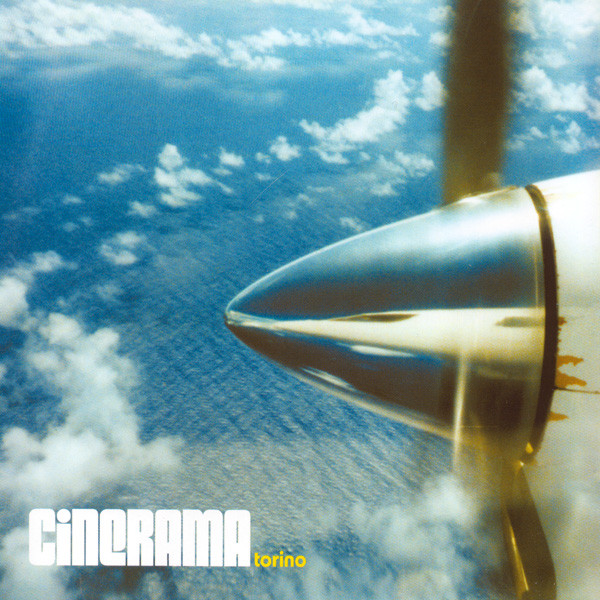
Album-wise, where debut Va Va Voom had been the sound of a project finding its feet, its follow-up Disco Volante had perfected the Cinerama formula. So which way would Torino, the next LP, jump?

Let’s find out via the three releases from that third and final Cinerama album (although there’s a bit of a twist in that tale). In this post we’ll look at just one single, though, then wrap-up the remaining Torino releases next time.

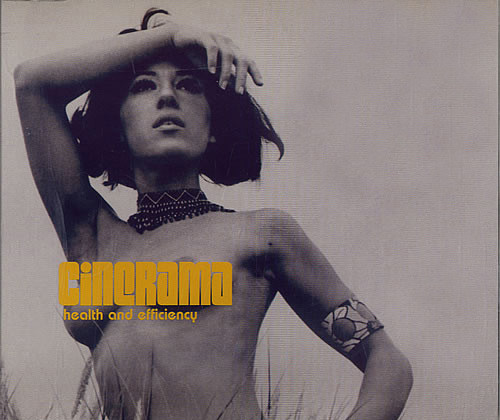
Health and Efficiency (2001, Scopitones)

Health and Efficiency, named after the long-established British naturism magazine, was the first Torino-featured single out of the block. Released in 2001, its sleeve notes don’t reference the 2002 LP at all so it’s possible this was technically a standalone release. It does actually close the album though, so in my book it’s OK to lump it in under the Torino banner.

Anyway, Health and Efficiency is a beezer of a song and, if you’ve not heard it, is worthy of the six-plus minutes this task requires. Predicated on the passing of time, it’s one from the trusted quiet/loud stable and was recorded by the late Steve Albini. Here, the engineer mixes orchestration with absolutely huge guitar parts – almost as huge as the Weddoes’ own Bewitched, Dalliance or Niagara – to thrilling effect.

In keeping with much of Torino, Health and Efficiency signalled a significant shift towards the bigger, darker sounds that characterised Wedding Present albums like Bizarro and Seamonsters. It was a record also that welcomed back the Weddoes’ Saturnalia-era guitarist Simon Cleave.

mp3: Cinerama – Health and Efficiency

The track opens and closes with speech, covertly captured via MiniDisc recorder, by David Gedge on the streets of New York City. At the tail-end of the piece this voice, which the book Sleevenotes tells us is providing a nostalgic commentary concerning urban loss, asserts that We have become a very cold society – prior to a will-o’-the-wisp plink that abruptly ends the number.

On the LP, so long as you’re listening to it in intended sequence, this shrill, resonating little note provides a full-stop, really, to Cinerama as a band. It’s almost as if, job done, into the ether they disappear.

Looking at Torino’s tracklisting now, the lilting Cinerama sound is certainly across it, most notably via moments of lightness like the feathery Airborne and the ecstatic, bawdy-as-it-sounds Tie Me Up. But for the most part the guitars are back, and Health and Efficiency was the single that announced this.

Your B-sides are Swim, a sprightly number – one I hadn’t heard in such a long time – and Diamonds Are Forever. That’s, of course, a cover of the John Barry-composed, Shirley Bassey-sung theme from the 1971 James Bond film of the same name.

mp3 : Cinerama – Swim
mp3 : Cinerama – Diamonds Are Forever

Diamonds are Forever is built, really, for what the idea of Cinerama was possibly all about: a bit of glamour and nostalgia, quiet scandal and sophistication. Here, a somewhat throaty David Gedge – a delivery heard throughout these three tracks – delivers a respectful take that doesn’t overdo things or camp it up.

It’s a version that popped up again – on Not From Where I’m Standing, the LP of Bond-related covers we referenced a while back in this series. This was a release whose sales raised funds for the mental-health initiative CALM, the Campaign Against Living Miserably.

Wrapping up, an eye-catching sleeve, one of Cinerama’s best, may well be a clipping from an issue of Health and Efficiency itself. Upon the cover an elegant lady strikes a graceful pose, whilst the band name, splayed across her chest, artfully preserves her modesty.

Health and Efficiency

Tune in next time for a double feature: those two remaining Torino-era singles.

strangeways

SATURDAY’S SCOTTISH SONG : #407: ALUN WOODWARD

AW

The collection in Villain Towers contains loads of music on which Alun Woodward has played.   The vast majority come, as you’d expect, via The Delgados, but there’s also his songs as Lord Cut-Glass, the alter-ego he adopted for a fabulous solo album back in 2009.

I’ve also got this:-

mp3: Alun Woodward – In School

This is part of the soundtrack written by Alun for the 2016 documentary film, Battle Mountain, about Scottish cyclist Graeme Obree‘s participation in the 2013 World Human Powered Speed Championships in Battle Mountain, Nevada.   The soundtrack was released by Chemikal Underground and the above track was included on Twenty One Years of Chemikal Underground, a compilation CD that was commissioned back in 2016 to be given away at a music/tourist conference and never released commercially.  Digital copies are available here.

JC

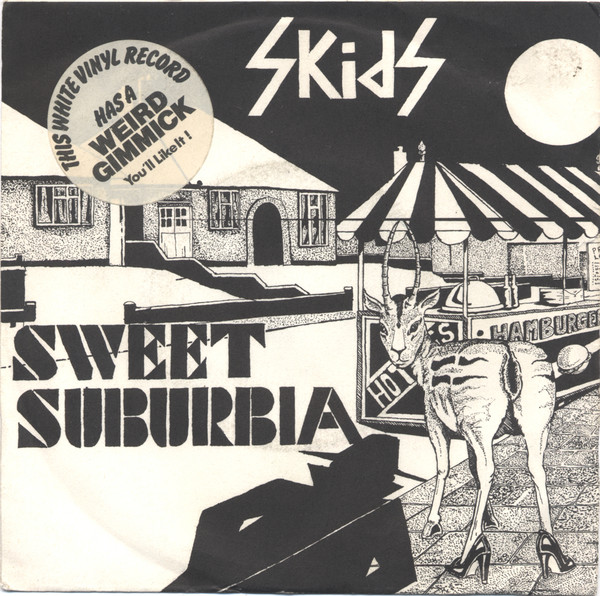
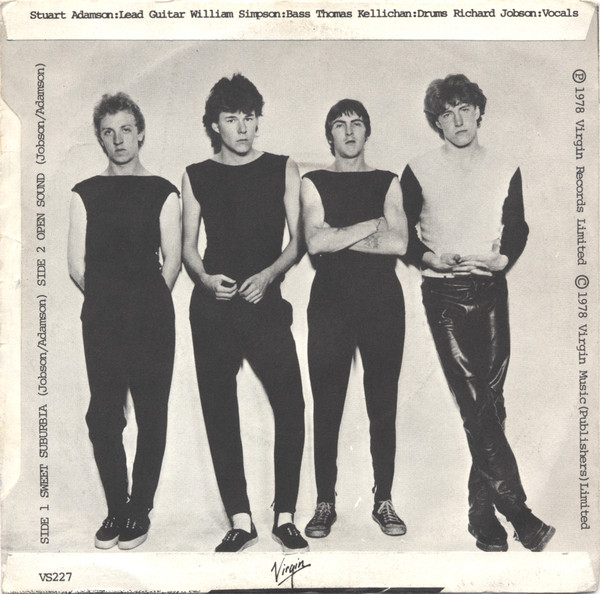
THE 7″ LUCKY DIP (18) : The Skids – Sweet Suburbia

R-1217615-1488188614-2767R-1217615-1488188619-9074

After the last one in the 7″ series being a tad on the crackly side, I thought I’d try to make it up to you all today.

mp3: The Skids – Sweet Suburbia

Released in September 1978, you have to admit that it sounds really crisp and sharp, with not a single crackle, pop or jump to be found anywhere.  But that’s because I’ve cheated.

And while it is true that I have a second-hand copy of the original 7″ single, on white vinyl, sitting here in Villain Towers, the copy you’re listening to comes courtesy of the remastered version of the album Scared To Dance, issued by Past Night From Glasgow back in 2022. The reissue was a 2xLP release, consisting of the original twelve songs from the album on one piece of vinyl, while the other contained eight bonus cuts of non-album A and B sides from the era – Sweet Suburbia, and its b-side, were on the bonus disc:-

mp3: The Skids – Open Sound

If you’d care to have a look at the sleeve of the 1979 release, you’ll spot that the folk at Virgin Records were suggesting to would-be buyers that it contained a weird gimmick.  As far as I know, the gimmick was simply that the first 15,000 copies came on white vinyl.   If you’d care to look a bit more closely at the drawing of the rear of the deer, you’ll perhaps agree it was maybe a bit surprising that it was allowed to be put on public display in certain record shops.

The PNFG re-release also comes complete with lyrics.    Despite what your ears may be trying to convince you, this is exactly what Richard Jobson is singing:-

Remnants of the ancient heart remain
Time for one to seek an anti-soak
Bars for 3 and only room for 2
Box and box, a lift for legless hope

Sweet Suburbia

Living on the paper periscope
Hot dog life cold for the antelope
Concrete days and white electric nights
Steel and steel life on the open plain

Sweet Suburbia. Sweet Suburbia

Excavate a land for restless days
Contemplate a chance for future ways
Clip and hate to centralise the world
Food and food and cardboard expatriates

Sweet Suburbia. Sweet Suburbia

Birth and birth and birth and birth and birth
Live and live and live and live and live
Mate and mate and mate and mate and mate
Die and die and die and die and die

Sweet Suburbia…

This one reached #70 back in 1978.   Deserved much better.

JC

THE CD SINGLE LUCKY DIP (9) : Belle and Sebastian – Legal Man

R-378313-1396621138-7541

Last time round in the CD single lucky dip, you had the opportunity to listen to an early release by Snow Patrol, one that had come out on Jeepster Records back in 1998.

The label was best known as being home to Belle and Sebastian – the band’s first five albums were issued by the label between 1996 and 2002 (albeit debut LP Tigermilk was via a re-release in 1999), along with four EPs and three singles.

I thought it would make come sense to hark back to that era, and to offer up a modified (shortened, yet enhanced!!) version of something from June 2016, when I was in the middle of using Sundays to look at the various Belle and Sebastian EPs and singles.

From wiki:-

“Legal Man” is a single released by Belle & Sebastian on Jeepster Records in 2000. The title track also features Jonny Quinn (on congas), Rozanne Suarez (on vocals) and The Maisonettes (on vocals). The cover features band members Stevie Jackson and Isobel Campbell along with Adrienne Payne and Rozanne Suarez.  The track became their highest charting single up to that point, reaching #15 in the UK singles chart. They also made their debut on Top of the Pops to perform this song.

The two B-side tracks are notable for their historical significance; “Judy Is a Dick Slap” is the first instrumental released by the band, while “Winter Wooskie” is the third and final lead vocal from former bass player Stuart David, who left the band in 2000. Initially a demo, the track was completed by the other members after David’s departure as a farewell gesture.

mp3 : Belle and Sebastian –Legal Man
mp3 : Belle and Sebastian – Judy Is A Dick Slap
mp3 : Belle and Sebastian – Winter Wooskie

Legal Man was released in May 2000, and was the first new music following the band picking up best new act at the 1999 Brit Awards, a result that had left many establishment figures in the music industry speechless.

What had happened was the vote for this award was open fully to the public with the winners fully anticipated to be Steps who had enjoyed a run of hit singles and massive media exposure; however, it was the first real use of internet voting for an awards ceremony, and the B&S fanbase, many of them using both personal and student e-mail addresses, voted en masse and pulled off a result nobody anticipated.  The reaction of the tabloid press in the UK was hilarious – how dare a band who nobody had ever heard of it take such a prestigious award?

The new single was a dramatic shift in sound for the band.  It was aimed full-on at radio stations, and it did get daytime play and, as mentioned above, led to a TOTP appearance:

For many people, it was the first time they had bought a B&S record/CD.  I’m sure many of them would, the following month, go out and buy the new LP Fold Your Hands Child, You Walk Like A Peasant and be bamboozled by the fact that none of the songs sounded anything like Legal Man!

JC

ONE HUNDRED AND ELEVEN SINGLES : #058

aka The Vinyl Villain incorporating Sexy Loser

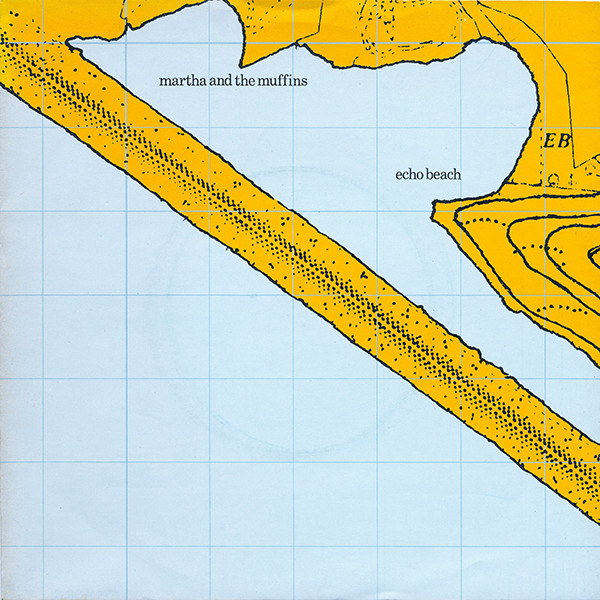
#058: Martha & The Muffins– ‘Echo Beach’ (Dindisc ’80)

MatM1980jpg

Good morning friends,

today our singles-journey (thinking about this term: it sounds like a weekend trip of desperate middle-aged losers from the village into the big city. Which, of course, can’t be more far from the truth!) takes us to Canada, to Toronto in fact. Toronto is a place which has a certain meaning to our humble host, JC, but no: he did not put any pressure on me in putting this record in, I always liked it, and I still do … despite the fact that it has been a big hit and everything.

There are of course nerds or purists who automatically rule out a song just because it had some brief chart success. Mrs. Loser often accuses me of the very same behaviour, but obviously she does not know what I know: 99.9 percent of what’s in the charts these days is utter rubbish. Bring in something really good there and I will approve of it, promised!

As I would have done in 1980, when Martha and The Muffins lifted today’s song from their debut album ‘Metro Music’. Now, if you ask me, ‘Metro Music’ is one of those tragic cases where the success of the single fully overshadowed the excellence of the album. If you don’t know it yet, do yourself a favour and get your hands on it. It can easily be found for small money in nearly every second-hand crate on your preferred flea-market, I would think. It really is a listenable album (still today) which does not only live from Martha Johnson’s wonderful voice, but also from some great dynamic melodies. Comparisons to Blondie are, or rather: have been back then, so I assume, inevitable somehow.

But either way, another underrated record, this. Plus: sleeve design by Peter Saville, for you Factory-completists!

It’s fair to say though that it was the right decision to release ‘Echo Beach’ as the single from ‘Metro Music’ – it is the best number on the record, I would think. Again, the tune has everything a good tune needs: musically, but also lyrically. I mean, don’t we all have a place where we’d rather be sometimes, even if it doesn’t exist in real life? Apparently Mark Gane, the guitarist with the band, had such a place in mind when he wrote ‘Echo Beach’, but, unlike us, he had the chance to have it immortalized by one of the finest songs ever:

R-186224-1425066765-3406

R-186224-1425066766-1157

mp3:  Martha & The Muffins – Echo Beach

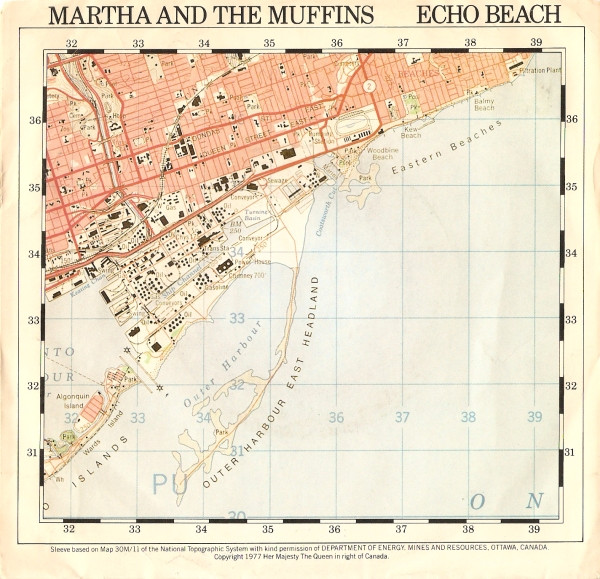
As JC will surely be able to confirm: the map shown on the cover of the Canadian and US version of the single is of the eastern part of Toronto, including the Beaches neighborhood, the Leslie Street Spit, and a portion of the Toronto Islands.

All other versions though, mine as well (from Portugal of all places) – they show Dorset’s bloody Chesil Beach! Which is probably a nice place to go to, but still: come on …. !

Take care,

Dirk

JC adds……

R-3159025-1318449532

The sleeve for the US/Canadian release of the 45 (on Dindisc/Virgin) did indeed have a different sleeve, with a map of the south-east area of Toronto, taking in part of the Beaches area, a community I spent a fair bit of time during my time working there in 2007 – and indeed when I went back to the city in 2013 as part of my 50th birthday celebrations, accompanied by my brother SC, and my two dear friends Aldo and Jacques the Kipper, we visited the Islands and the Beaches area as they are both well worth the effort).

AN IMAGINARY COMPILATION ALBUM : #368: THE BUG CLUB

A GUEST POST by THE ROBSTER

art banner

IS THIS THE MUSIC YOU LIKE?
The Bug Club

an Imaginary Compilation for the (new) vinyl villain
(with a bit of a gig review thrown in for good measure)

Imagine one of your favourite local bands. They have been getting national acclaim and have acquired a large cult following over the few short years of their existence, gaining coveted airplay and live sessions on BBC radio, including 6 Music. They’ve released 10 singles, two albums (one of them an ambitious double), two EPs, three things nobody knew how to describe, and a live album of exclusive material under a different band name, all since 2021, and while playing 200+ gigs a year.

The local shows sell out almost instantly, including in such spaces as Clwb Ifor Bach which regularly hosts shows for some of the brightest emerging talents on the international circuit, while further afield they present a very attractive live proposition, both as a headliner and a support act.

Now imagine them playing in the corner of a tiny function room above a pub for an audience of no more than 50 people, much like they would have done when they first formed. That, my friends, is The Bug Club.

MrsRobster and I were delighted to have caught them on the last Bank Holiday at the City Arms in Cardiff, where they played not one, but TWO shows to the lucky few who managed to get tickets. We caught their evening set (they had also played a few hours earlier, late afternoon).

city arms poster

For the uninitiated, The Bug Club hail from the historic Welsh market town of Caldicot, located between Chepstow and Newport. (Apparently, the man who invented self-raising flour was born there…) They consist of Sam Wilmett (vocals/guitar) and Tilly Harris (vocals/bass) along with whoever they can find to play drums with them at the moment (founder member Dan Matthew recently left the fold). Their mate Helen filled in for the Bank Holiday shows, and dead good she was too.

The thing about The Bug Club is they don’t hang about. Their songs are short, they play them with real vigour and energy, and they don’t spend much time yakking (though when they do, it’s usually Tilly making us laugh). It’s just one blast after another – bam-bam-bam! A Bug Club show is a lot of fun. They came on about 8:15 and were all done by 9:30 – it wasn’t even fully dark outside – but MrsRobster and I felt we’d had a proper night out.

The set covered the full gamut of their catalogue, featuring tracks from all their releases to date, including the set-closer, current single Quality Pints, a song about finding the best beer in whichever town they happen to be playing in. Yeah, they don’t take themselves too seriously, with subject matters ranging from birds to haircuts, from being in space to swearing in love songs, from hiding your real feelings from your mum to getting married. Tonight’s set was sprinkled liberally with their customary sardonic humour and loud, garagey guitars in the style of the Velvet Underground, Jonathan Richman, Pavement and Kim Deal. But it’s the songs that make The Bug Club what they are, and so, inspired by this show, I decided to sit down and do what I’d intended to do for some time – compile, write and submit an ICA for this wonderful internetty space that I kind of think of as something of a second home. OK, maybe a third home. JC’s published all sorts of nonsense from me over the years, so I figure another one won’t hurt.

I should point out that I’ve tended to go for the faster, more lively side of The Bug Club in this set as it’s more akin to one of their live shows. If you want depth, I suggest you buy all their records and compile your own Bug Club ICA of slower songs. Good luck though, they don’t do many of those. I’ve even broken the 10-tracks rule and included a full dozen for your enjoyment, and even then some of my personal faves (Can Ya Change A Thing Like This?, A Love Song, It’s Art) have had to be left out. It still weighs in at a mere 30 minutes, but there’s not a second wasted here. So let’s get going…

SIDE ONE

1. Is This The Music You Like? [2023, from ‘Rare Birds’]

This is nothing more than a silly punk song that does everything it needs to in less than 60 seconds, drops the mic and leaves the stage. Job done. Next!

2. My Baby Loves Rock ‘n’ Roll Music [2021, from ‘Pure Particles’ EP]

If you wanted to hear the Jonathan Richman and Velvet Underground influences in full effect, then look no further. Not just a live favourite this one, but a proper fan fave too. You WILL catch yourself humming it at the bus stop, down in the Tube station at midnight, in the queue at your favourite bakery or while desperately searching for something to rid yourself of that bloody earworm TheRobster posted at JC’s in his Bug Club ICA!

3. Marriage [2023, from ‘Rare Birds’]

How many words can you think of that rhyme with marriage? The Bug Club come up with precisely two. Have they never heard of Steve Claridge? [https://en.wikipedia.org/wiki/Steve_Claridge]

4. Pick Me Like A Flower In The Rain [2022, from ‘Intelectuals’ EP]

‘Intelectuals’ (sic) is one of those aforementioned releases that “nobody knew how to describe”. Two tracks are listed: Intelectuals and Intelectuals [money version]. The former is actually five songs performed live in the studio in a single take, back to back as they would perform them in concert, and in the order they were written. One of them is the title track and another is this delightful tune which is another crowd favourite. I was surprised how many people sang along to this one at the show.

5. We Don’t Need Room For Lovin’ [2021, debut single, from ‘Launching Moonbeam 1’ EP]

Five years after first forming (no doubt hampered by that COVID thing everyone has forgotten about), The Bug Club released their first single. Mark Riley played it lots on his 6 Music show. Thus, it set the template for all the shenanigans that followed.

6. Out In The Streets [2023, single]

Between albums 1 and 2 came this single. I previously posted it in a piece over at my place a year ago to all-round general malaise. It’s worth another outing though. It also appears on side two of a 12” called ‘Picture This!’, another of those multi-song pieces like ‘Intelectuals’.

SIDE TWO

1. Only In Love [2022, from ‘Green Dream In F#’]

The opening track of the debut album, and it’s another one that flows in the same valley as the Velvets and is done and dusted before you can dig out your copy of ‘Loaded’.

2. Intelectuals [money version] [2022, from ‘Intelectuals’ EP]

The ‘proper’ studio version of the ‘Intelectuals’ title track which the band refers to as “a single of sorts”.

3. The Fixer [2021, from ‘Pure Particles’ EP]

This is the one that’s going round and round in my head as I type this. I never get sick of it, for some reason. If I did though, I wonder if the Fixer could fix it? I love the whole of ‘Pure Particles’ I have to say. They call it an EP, but it’s got 9 songs on it, so it’s more of a mini-album really. Mini as it’s only 20 minutes long, but quality over quantity, right?

4. Yesterday’s Paper [2022, from ‘Green Dream In F#’]

Which is probably why this track gives up the ghost after 56 seconds. No point drawing things out for the sake of it, is there?

5. Clapping In Time [2023, from ‘Mr Anyway’s Holey Spirits Perform! One Foot In Bethlehem’]

The record label writes: “In January and February 2023 The Bug Club toured around Independent Venue Week, and were supported by a mysterious band called Mr Anyway’s Holey Spirits. We knew absolutely nothing about this band, but we were crafty enough to have somebody record the gigs on a cassette machine and we are now putting it out without them knowing. Some people sign bands and write up fair contracts; we just keep a cricket bat close to hand in case somebody comes looking for us. Luckily it turned out they were just The Bug Club in disguise. These tracks will never be recorded or released again. They might not be played again, either. Well, they played Clapping In Time at the City Arms, so…

6. Rare Birds [2023, from ‘Rare Birds’]

The Bug Club’s second album was an adventurous double album their label dubbed “The Bug Club’s Hex Enduction Hour. South Wales’ Double Nickels On The Dime. It’s The Faust Cycle for people with shorter attention spans.” Containing 24 songs with 23 spoken word interludes, it’s like The Small Faces had Ivor Cutler round for tea and cake. Or something. Actually, nothing like that at all, but you get my drift. You don’t? Never mind. This is the title track, in which Sam and Tilly exchange English and Latin names of some rare birds. So it’s kind of like exactly what it says it is. Get it now?

The day after our Bug Club encounter, the band was supposed to be embarking on a tour supporting the legendary Shellac. Sadly, as you all know, the great Steve Albini passed away suddenly a few weeks before, meaning the tour was cancelled. Such a shame, that would have been one hell of a bill. (For what it’s worth, I’m still in mourning for Steve. MrsRobster and I enjoyed the new Shellac record ‘To All Trains’ turned up VERY LOUD in the car last weekend.)

The Bug Club are, however, playing dates in Spain in June, festival dates in July and there’s a UK tour in November (though lookout for one-offs in London and Edinburgh as well). All their stuff is on Bandcamp [https://thebugclub.bandcamp.com], and while on a US tour earlier in the year, they signed to Sub Pop, their first track for the seminal label being Quality Pints, included here as a bonus: [https://youtu.be/WwYLt4WGOqE?si=dZM6soZy_Pio3WSp]

The Robster

JUNE’S TUNES

june

It’s the first non-weekend day of a new month.  So, without further ado….

mp3: Various – June’s Tunes

Arab Strap – Allatonceness
Electronic – Feel Every Beat (7″ mix)
Barry Adamson – The Last Words of Sam Cooke
Massive Attack ft. Tracey Thorn – Protection (single version)
The Wedding Present – Dare
Bikini Kill – Reject All American
Ducks Ltd – Hollowed Out
Talking Heads- Crosseyed and Painless
The Streets – Has It Come To This?
Sugababes – Overload
PJ Harvey – Big Exit
Johnny Cash – The Man Comes Around
The Go-Betweens – Bye Bye Pride
Les Negresses Vertes  – I Love Paris
The Clash – Police & Thieves

This is the sound of the summer……

JC

CLOSE-UP : THE CINERAMA SINGLES (Part 5)

A GUEST SERIES by STRANGEWAYS

Close Up: The Cinerama Singles #5 :  Disco Volante singles (2)

R-1436923-1219617993

The year 2000 had been a prolific and highly creative year for Cinerama. LP #2 Disco Volante had been backed, as was usual, by fairly extensive touring across the mainland UK and out to the USA. In addition, a compilation of John Peel sessions had been released.

The DJ had been an enthusiastic and instrumental supporter of The Wedding Present from the band’s earliest days and this patronage had carried across to the new group. Now Peel got just what he always wanted: a song that, beyond his incalculable influence as a broadcaster, he himself had directly made happen.

Your Charms, inspired by a chat/challenge between Peel and David Gedge on the nature of old song titles, had begun life as a Peel session track in June of 2000

mp3: Cinerama – Your Charms (Peel Session, June 2000)

Subsequently re-recorded and appearing on Disco Volante, Your Charms was effervescent and catchy, lifted by a sing-along chorus and therefore absolutely prime single material. Resplendent with a summery sheen, there’s an argument that this song, and not Lollobrigida, should have been announcing the new LP.

R-690816-1148172091

mp3: Cinerama – Your Charms

B-sides? First up was Reel 2, Dialogue 2 – its title a subtle nod to the origins of the bleeping Star Wars droid R2D2. The space references begin and end there though, with David Gedge and bandmate Sally Murrell swapping lead vocals in a sort of call-and-response dialogue concerning the familiar foibles of the heart. It’s solid enough, and it’s good to hear Sally M’s plaintive vocal unfettered by harmonies or battling with instrumentation amid which it could be easily lost.

mp3: Cinerama – Reel2, Dialogue 2

Girl on a Motorcycle – another of a zillion Gedge titles pinched from films – is ace. A winner of a chorus stays with you long after the song has zoomed off into the distance, plus Murrell’s accompanying ahhhs are so much more the sum of their parts.

mp3: Cinerama – Girl On A Motorcycle

Finally, for reasons of trainspotting and pedantry, it’d be remiss at this point not to mention that the single version of Your Charms clips a short pre-song patch of dialogue heard on the album take.

R-690834-1148174858

mp3: Cinerama – Superman

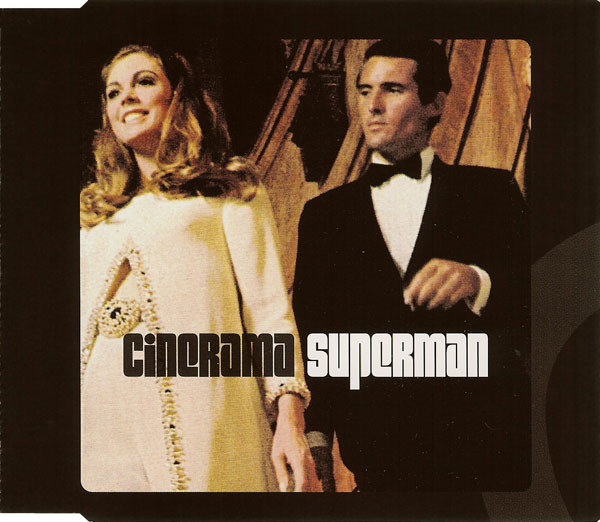
Is it a bird? Is it a plane? No, it’s Superman. The fourth and final Disco Volante single from Cinerama.

The likes of Lollobrigida had tried its best to stretch and pull at my own shamefully narrow musical preferences. But in short order Superman, clothed in a more recognisable and comforting get-up, swooped down as if to scoop me far from the accordion.

To be honest, good song that it is, I’ve always found the words and overall sentiment of Superman to be a bit too self-pitying. That said, I do admire the entrance into the plot of the Man of Steel and the applying of the familiar comic-book phrase ‘that’s a job for Superman’ to a breakup issue rather than to one of global significance. Illustrating again a real purple patch for Sally Murrell contributions, her backing harmonies add texture throughout, whilst more substantial, if brief, vocals are latched onto the closing seconds.

Flips are Starry Eyed, its tinkling keyboard sections, its pace and prominent distorted guitar parts perhaps previewing what would be a switch in Cinerama’s sound.

Segueing on the CD single with little or no break from Starry Eyed is a corker: a cover of Yesterday Once More, the lovely song made famous by The Carpenters. This Cinerama take introduces things with several seconds of crackling, channel-hopping radio and the whole thing, with guitars-a-plenty is how you might imagine The Wedding Present tackling such a task. It’s recommended if you haven’t heard it.

mp3 : Cinerama – Starry Eyed
mp3 : Cinerama – Yesterday Once More

Worth mentioning is the Spanish-language version of Superman (Superman Versión en Español to give it its nombre del domingo). This was released on Scopitones as a limited seven-inch – all pressed up on thick green vinyl: the colour, it now strikes me, of Kryptonite.

mp3: Cinerama – Superman Versión en Español

Your B-side was Dura, Rápida y Hermosa (known in another life as Hard, Fast and Beautiful – one of the key tracks from debut LP Va Va Voom). This studio take – again in Spanish – is preceded by a clip of amusing gig banter.

mp3: Cinerama – Dura, Rápida y Hermosa

The four Disco Volante singles, their B-sides, and those Spanish-language takes are collected on the Cinerama Holiday compilation. This was released by Scopitones in 2002.

Trivia Time : Chansons dans d’autres langues

Superman, with is comic-book connection, and those Spanish versions of a couple of tracks, was only continuing tradition, really, where Gedge compositions are concerned.

As early as 1988, The Wedding Present – disguised as Cadeau De Mariage – released another limited seven-inch: Pourquoi Es Tu Devenue Si Raisonnable? – a French-language version of Why Are You Being So Reasonable Now? Since then, other non-English-language takes, in a list unlikely to be exhaustive, have included:

In French, Cinerama, 2001: Health and Efficiency

In French, Cinerama, 2002: Lollobrigida

In German, Cinerama, 2004: Erriner Dich

In French, The Wedding Present, 2012: Deer Caught in the Headlights, End Credits, Metal Men, and Mystery Date

In German, The Wedding Present, 2013: Back A Bit… Stop!, The Girl From the DDR, You Jane and 524 Fidelio

In Welsh, The Wedding Present, 2014: 1000 Fahrenheit, Meet Cute, Journey Into Space, and Can You Keep a Secret?

And of course, a whole LP of Ukrainian-language folk songs (Wedding Present, 1988)

Pow!

As for comics and superhero references, I wouldn’t even attempt a full list, but in addition to Superman, connections across either LP/song titles or within lyrics have offered:

Bizarro – (Wedding Present, 1989)

Brassneck – (Wedding Present, 1989)

Dan Dare – (Wedding Present, 1991)

Catwoman – (Wedding Present, 1994)

Flame On – (Wedding Present, 1994)

Real Thing – (Wedding Present, 1996)

Cat Girl Tights – (Cinerama, 2002)

Santa Ana Winds – (Wedding Present, 2008)

Spider-Man on Hollywood – (Wedding Present, 2008)

Hulk Loves Betty (Wedding Present, 2008)

Metal Men (Wedding Present, 2012)

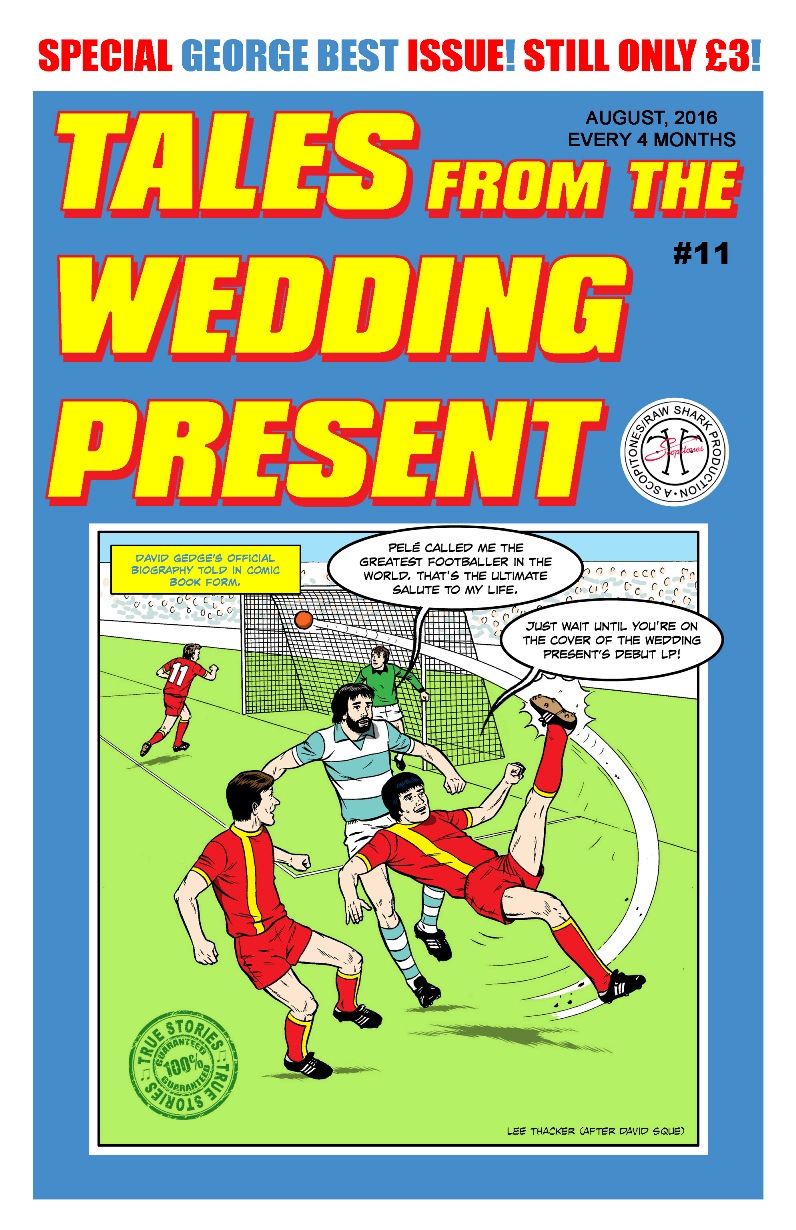
Connected, kind of, with these is Tales From The Wedding Present – billed as David Gedge’s autobiography in comic-book form. Recounted by the band and associates, and illustrated by Lee Thacker, these are well worth a read.

TFTWP #11

The separate issues have all but sold out, but gathering and supplementing all of the original comic material, an anthology has been released.

You want it darker? Next up, Cinerama enters a new stage. One that would bring Gedge closer than ever to territory largely unvisited for six-plus years. It was the beginning of a phase whose sound was increasingly glancing back whilst moving forward and would eventually, logically, culminate in the return to the indie scene of a very familiar name.

And on that unnecessarily dramatic note, thanks as ever to JC and all readers.

strangeways

SATURDAY’S SCOTTISH SONG : #406: ALISON EALES

Alison+Eales

Alison Eales has featured a few times on the blog over the past year, but she’s never been part of this series.

This is another one entry where the musician qualifies under the residency rules.  Alison is from north-east England, but she has lived, studied and worked for decades in Glasgow.

A quick reminder that she’s long been more than just the keyboard player with Butcher Boy, having been immersed in music her entire life, to the extent that she achieved a PhD a few years back, with her thesis offering a critical history of the Glasgow Jazz Festival from its inception in 1987 through to 2015. She sings with the Glasgow Madrigirls, a 40-strong choir closely associated with Glasgow University and whose work has featured on a number of film and television soundtracks. And of course, over the past 18 months, has released an album and an EP via the London-based label, Fika Recordings.

mp3: Alison Eales – Rain Song

One of the four tracks to be found on Four For A Boy, the EP which was released back in March.  Click here to make a physical purchase (with added bookmark and badge) direct from Alison.

Or if digital is more your thing….click here.

JC

ONE SONG ON THE HARD DRIVE (10)

A-1392819-1496179753-8070

Tribute albums can often be hit-and-miss affairs.  I’d love to be able to bring you my thoughts on Right Here – A Go-Betweens Tribute, released back in 1996 on the Australian label, Hippy Knight Records, but as I only have one track from it, picked up from some other blog or website at some point in history, I’m unable to do so.

The track I do have is from a duo called Sunglass.  Info is quite sparse, and here’s what I’ve gleaned from wiki:-

Sea Stories were an Indie pop / folk rock band from Melbourne, Australia. They existed from 1986 until their break-up in 1993. They released 2 full length albums and a number of EPs and singles. Two of their members, Simon Honisett and Penny Hewson, re-emerged in 1994 as acoustic duo Sunglass.

An eponymous album was issued in April 1994, followed by the EP When Stars Collide in June, and then just over a year later in July 1995, there was the single How Long Can You Stay Angry?.

Hewson released her debut solo album Me in 1998 on her own label Wasabi Records before relocating to Los Angeles where she played in a short-lived band called My Zuko. After living there for a decade, Hewson returned to Melbourne and released her second solo album It’s an Endless Desire on Popboomerang Records in August 2012″

So what about the song I downloaded such a long time ago?

mp3: Sunglass – Bye Bye Pride

It’s upbeat Aussie pop as re-imagined by a Velvet Underground tribute band……and I quite like it, mainly as it’s such a different take on the original. Feel free to disagree.

My thanks to whoever it was that once posted this elsewhere.  I’m annoyed I never took note of things at the time.

JC

THE EVOLUTION OF SOUND

A guest posting by Fraser Pettigrew

Edison

For me, one of the most wonderful things about vinyl records is that they constitute a current technology that in essence hasn’t changed in nearly 150 years. Apart from the migration from a wax cylinder onto a flat disc and advances in electronic amplification, the reproduction of sound by means of a needle transmitting vibrations from the physical rotation of an etched groove is the same technology that Thomas Edison patented in 1877. That’s pretty remarkable when you consider how radical our technological evolution has been in most other respects over the same period.

I had never really thought much about the development of different record formats until relatively recently when I spent a year and a half working at New Zealand’s film, TV and radio archive. Ngā Taonga Sound & Vision doesn’t really cover music records in its collection, but I was interested to discover that the origins of the 33 1/3 rpm vinyl LP – as distinct from the 78 rpm disc – actually lie in the development of sound in the movies, and in radio, not in the music industry.

But first, some early history.

It was about ten years after Edison’s patent that the lateral disc first emerged, and a few more years until the end of the century before it evolved as a viable commercial sound format. The 78 rpm disc did not become standard until around the start of WW1 – early discs varied in diameter and rotation speed, from 7 to 12 ½ inches and from 60 to 130 rpm. The Gramophone Company settled on 78 rpm in 1912 simply because it was the average speed of most of the records it had been releasing up to then. It wasn’t until the mid-1920s that 78 rpm became the industry standard.

Even then, electrically powered gramophone players would vary according to the rating of the local power supply. So, in a city with a 50hz AC supply your 78rpm disc would play slower than in a city with a 60hz supply. If you were still using a hand-cranked spring driven gramophone you were at the mercy of all sorts of mechanical malfunction.

Electricity didn’t play a part in the recording process until the mid-1920s. Louis Armstrong’s second wife famously recalled a recording session in 1923 where the young Armstrong and band leader King Oliver played side by side into the large horn that acoustically channelled the sound to the lathe cutting the master disc. King Oliver couldn’t be heard at all in the resultant recording, so Satchmo was made to stand about fifteen feet away for the next take.

mp3: King Oliver’s Creole Jazz Band – Dippermouth Blues (1923)

When electricity began to play a part in both recording and amplifying the contents of discs, it was the film industry that took the technology and initiated a development that was the first step towards the vinyl LP that we know and love.

Films had long been accompanied by live musicians, sometimes a single pianist or organist, but also whole ensembles. Filmmakers began commissioning arrangers and composers to create suites of music, scored to complement the action on screen, including sound effects. Clever-clogs Charlie Chaplin composed his own musical accompaniments. Where musicians were too difficult or costly to provide at screenings, the obvious alternative was recorded discs, but the 78rpm disc has one significant drawback here – each 10-inch side can hold barely three minutes of music. The sound man would need to do more flipping than a McDonald’s burger chef.

mp3: Charlie Chaplin (composer) – Afternoon (from ‘City Lights, 1931)

Some short films had used synchronised 78rpm discs to provide sound as early as 1902, but it wasn’t until the development of the Vitaphone system in 1926 that the technique matured to provide sound for full-length features. Vitaphone used 16-inch discs that ran at the slower speed of 331/3 rpm, enabling the sound man to relax and enjoy a fag or two between side changes. Vitaphone was used for numerous films up until 1931, by which time the use of optical soundtrack technology had been perfected.

This proto-talkie history helps to explain how the art of sound mixing and soundtrack direction seemed to emerge almost fully-formed in the earliest years of sound cinema. The way, for example, that Hitchcock was able to use sound in ‘Blackmail’, a film that began production as a silent feature, seems miraculously advanced, but then you can see how filmmakers had been thinking about, if not actually using sound for several years already.

Despite its obvious advantages, it’s strange that the 33 1/3 rpm disc did not immediately find favour in the music industry even as it fell out of favour in the cinema. It continued in use for radio transcription, still often using 16-inch discs, right through until after WW2 when magnetic tape began to displace the large and fragile lacquer discs. Meanwhile the 78 still reigned in the world of music, and was still in use at the beginning of the rock’n’roll era. Early Elvis Presley and Bill Haley 78s will fetch a pretty sum these days.

hh

mp3: Elvis Presley – Heartbreak Hotel (78rpm)

In part, the slow advent of the vinyl 33 can be attributed to the simple barrier of having to replace one universal standard format with another. The 78 rpm gramophone players to be found in consumers’ homes couldn’t play any other sort of record. It’s akin to the change from vinyl to CD that occurred in the late 1980s and 1990s. To play the new format disc you needed to buy an entirely new hi-fi component.

This explains why most of the first CD releases were classical rather than pop. Classical enthusiasts tended to belong to a wealthier stratum of society who were in a position to invest in the new technology. A large chunk of my own classical vinyl collection was picked up for buttons in the late 1980s at Edinburgh’s Record Shak boutique on Clerk Street, where some well-heeled collector had deposited all his unwanted records after replacing the whole lot at a stroke with new CDs!

Throughout the 1930s and 40s the development of the 33 crept forwards in relative obscurity. As mentioned, radio continued to make recordings for broadcast (or from broadcasts) onto the long-playing format, on 10, 12, 14 or 16-inch discs. These were mostly on incredibly fragile ‘acetate’ discs – aluminium platters covered in a lacquer onto which the sound lathe could cut directly, prone to cracking with age or if temperature changes caused the metal base to expand and contract.

Typically these discs were one-off recordings and did not need to be reproduced, but increasingly they would be pressed in multiple copies so that they could be sent to numerous radio stations simultaneously. Advertisers for radio exploited this possibility too. Polyvinyl chloride (‘vinyl’) as a medium for reproducing these discs was developed and proliferated during the late 1930s and 40s owing to its ability to be transported and even posted without risking breakage like acetates or heavy, brittle shellac.

RCA Victor had attempted to launch vinyl 33s as early as 1931. Their timing was off, however. The Great Depression ensured that there were not enough buyers prepared to invest in new equipment for many years. It wasn’t until after the war that the record companies came back to the idea for another try. This time the conditions were right as the legacy of the New Deal and post-war recovery put money in ordinary people’s pockets.

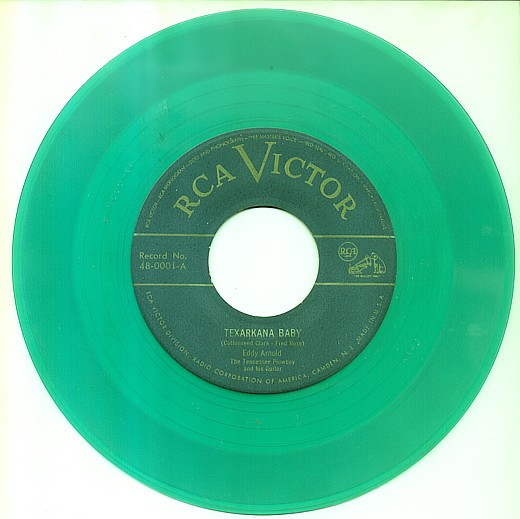
Interestingly, Columbia’s first 12-inch 33 1/3 RPM ‘long-players’ released in 1948 were classical, perhaps prefiguring the same economic dynamic of the CD era. The following year, RCA Victor re-entered the vinyl market with the first 45 RPM 7-inch discs, in seven different colours of vinyl according to music genre! Green (country), yellow (children’s), red (classical), orange (R&B and gospel), blue vinyl/blue label (semi-classical instrumental) and blue vinyl/black label (international).

R-1255170-1265188274

mp3: Eddy Arnold – Texakarna  Baby (RCA Victor Green Vinyl & Label, 1949)

At first the 33 and the 45 were seen by the two companies as competing formats, but within two years each had also adopted the other’s innovation, and the familiar ‘single’ and ‘LP’ distinction quickly formed across the whole industry.

That then, in a very large nutshell, is the story of the vinyl record. Before I finish, here’s a couple of further random bits of record info:

It might be thought that the music album is a commodity born from the emergence of the 33 1/3 long-player in the 1950s. However, the first so-called ‘albums’ of music date back to the first decade of the 20th century. While a single 78 only held three or four minutes of sound per side, longer pieces of music (such as classical compositions) were recorded onto several discs and then packaged together into a book-like format, where the pages were the individual record sleeves. Because of their resemblance to large format photographic albums, already common to many families, the name was borrowed for the collection of discs. The first such music albums were classical collections (funnily enough) produced in 1908 and 1909. You could soon buy empty albums in which to store your own collection of 78s, rather like those portable CD cases you can possibly still get. When the 33 1/3 LP format became established with the ability to hold a dozen or more songs on one disc it became the natural inheritor of the ‘album’ label.

Finally, there is another iconic technology invented at almost the same time as Edison’s phonograph that has similarly survived almost unchanged into the current era – the bicycle. Aside from the advancement in materials and adaptations for different terrain, the bike that Bradley Wiggins toured France on or Danny MacAskill rides down mountains is in its fundamentals identical to the ‘safety bicycle’ of the late 1870s that quickly consigned the penny farthing to history.

All of which must make my vinyl copy of Kraftwerk’s Tour de France Soundtracks the ultimate retro-modernist artefact, most especially when it’s played on this: https://peewee.com/2015/10/16/tgif-a-bicycle-that-plays-vinyl-records-on-its-wheels/

mp3: Kraftwerk – Tour de France

Fraser

THE 12″ LUCKY DIP (10): Associates – Poperetta EP

R-972203-1426526155-9052

I’ve a dozen or so Associates singles on 12″ as well as a handful released by Billy Mackenzie under his own name.   There’s only one that I really don’t enjoy listening to and when any of its four tracks happen to come up on the i-pod or i-phone, then the FF button is reached for as quickly as possible.

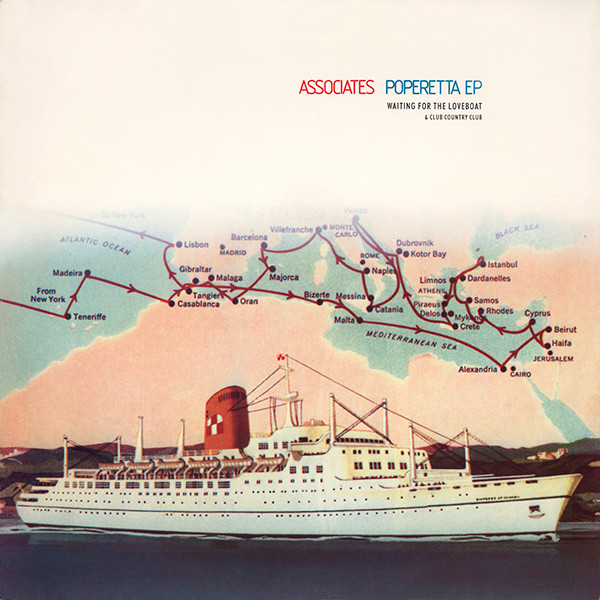
It’s all down to the tracks being remixes of songs whose original versions I’m very fond of. They can be found on the Poperetta EP, released in 1990 on EastWest Records as part of the promotional activities around Popera,  a then newly compiled singles collection (10 on vinyl, 17 on CD).

The EP took two songs and handed them to Thomas Fehlmann and Marathon, two German-based producers whose expertise centred around creating music and sounds for the club scene in which they were heavily involved.  I can sort of get the thinking behind the idea of trying to expand the market/audience for Associates.  But it doesn’t seem to me that it worked.

Now it might well be that, given I’m not easily disposed to music which is made purely for the club scene, I’m not the best person to judge their takes on the songs.  It does feel, however, that the remixes have sucked out all that made the originals feel special/unique (especially Club Country) and replaced them with sounds that could be attributed to almost any act making a particular kind of dance music in 1990.

mp3: Associates – Waiting For The Loveboat (extended voyage)
mp3: Associates – Club Country Club
mp3: Associates – Club Country Club (time unlimited)
mp3: Associates – Waiting For The Loveboat (slight return)

Feel free to disagree.

JC

AN IMAGINARY COMPILATION ALBUM : #367: THE STOOL PIGEONS

video-020

This one has been inspired by an event that took place back in June 2015, one that I wrote about at some length at the time.

To summarise.

The premiere of the documentary film, Big Gold Dream, took place in Edinburgh.  The film tells the story of the post-punk scene in Scotland, with a particular focus on what happened in Edinburgh with the formation of the label Fast Product, and onwards to Postcard Records and the Glasgow story. It was a hot ticket, one that I hadn’t thought I’d land, but Jacques the Kipper came up trumps, and the two of us headed along.

The film was every bit as good as hoped for, and was the screening was followed by a Q&A session featuring Jo Callis (Rezillos and Human League), Ken McCluskey (Bluebells) , Malcolm Ross (Josef K, Orange Juice and Aztec Camera) and Vic Godard (Subway Sect) who, despite being a Londoner, has always spoken highly of how things developed in Scotland, and who to this day is close friends with many who were part of the scene.

The Q&A was followed by a truly special and unique event, namely a gig by The Stool Pigeons, a band put together for the occasion and comprising the afore-mentioned Messrs Goddard and Ross together with Russell Burn (Fire Engines and Win) on drums, all under the direction of Mick Slaven and Douglas Macintyre, two musicians who have long been at the heart of decent indie music in Scotland for decades.

The band, named after a Subway Sect song, played ten songs, all of which were relevant to the era covered by the film or were seen as being a huge influence.  I thought the set list, in the order it was played, would make for a very fine ICA.

1. Holiday Hymn – Orange Juice

This is a Vic Godard composition, dating from 1981.  Subway Sect had played it live, but never released it.  Edwyn Collins thought it would make for a perfect Orange Juice song, and so having recorded it one night direct from the mixing desk, he and his bandmates set about learning it.   The first time anyone heard would have ever hear it, was when it was part of a John Peel session, broadcast in August 1981.  Eleven years later, a studio version was belatedly released on Ostrich Churchyard which was the Orange Juice album intended for release on Postcard Records but shelved when the band signed to Polydor.

Vic Godard finally got round to recording it in 1985, as part of his swing album In T.R.O.U.B.L.E. Again.  Oh, and the The Chesterf!elds also did a cover of it, with it appearing on their 1987 debut album, Kettle.

2. Falling and Laughing – Orange Juice

The first ever single to be released on Postcard Records.  Nothing else need to be said.

3. Stool Pigeon – Vic Godard & Subway Sect
4. Ambition -Subway Sect

Two tracks from Vic’s own releases.

The latter was their second single, released on Rough Trade in 1978.   The documentary film highlights the White Riot Tour of 1977 as playing a huge part in the formation of the post-punk scene in Scotland, especially the gig at the Edinburgh Playhouse on 7 May.  The Clash The show was opened up by The Slits, who were followed on stage by Subway Sect, then Buzzcocks and finally The Clash as headliners.  By all accounts, the Slits and Subway Sect mingled freely with the crowd, many of whom would later form their ow bands and/or set up labels, and the friendships formed that day remain in place almost 50 years on.

It was the 1977 version of Subway Sect who played on Ambition, but manager Bernie Rhodes then sacked everyone, with the exception of Vic Godard.  It took two years for things to get back to some sort of normality, and the new line-up took the name of Vic Godard & The Subway Sect, recording the debut album What’s The Matter Boy? in 1980.  Stool Pigeon is taken from that record.

5. It’s Kinda Funny -Josef K

One of the first post-punk bands to emerge out of Edinburgh, the debut double-A side single Chance Meeting/Romance was issued on Absolute Records, a label newly formed by Orange Juice drummer, Steven Daly.   One thing led to another, and Josef K ended up being the second band to sign to Postcard Records.   This was their second single for the label, released at the end of 1980.

6. Be My Wife – David Bowie

Low was Bowie‘s first album of 1977, and is widely regarded as one of the biggest influences in the development of a post-punk movement.  It can be no real surprise that Stool Pigeons aired their take on one of the album’s high points.

7. Nobody’s Scared -Subway Sect

The debut single from 1977, the only piece of vinyl ever released on Braik Records, a label founded by the afore-mentioned Bernie Rhodes.

8. Born To Lose -The Heartbreakers

Another one that was included to acknowledge the influences on the development of post-punk, with a nod to what had been happening States-side.  I’ll hold my hands up and say that I never quite understood what all the fuss was about Johnny Thunder and his cohorts.

9. Candyskin – Fire Engines

Davey Henderson of Fire Engines was one of the stars of the documentary, thanks to his many funny and larger than life anecdotes. Candyskin is just one of those songs adored by everyone in Scotland who is of an age is a fan of the post-punk music.  I believe it’s also increasingly appreciated and acknowledged as an influence by the newer generations of musicians.

Fay Fife, from the Rezillos, joined the band for the second half of Candyskin and also was part of the final song of the night.

video-030

10. Sweet Jane – The Velvet Underground

The unwritten rule of post-punk music in Scotland.   Tribute must always be paid to The Velvet Underground.  And it was the perfect ending to a night that I’ll never forget.

JC

PS………

Grant McPhee, the director of Big Gold Dream, filmed the gig, and many years later added it to his rather splendid YouTube channel.

Myself and Jacques the Kipper can occasionally be spotted in the audience for the eagle-eyed among you.

THE 7″ LUCKY DIP (17) : Psychedelic Furs – Sister Europe

R-449328-1642081408-6616

This one is a bit crackly, but hopefully it won’t distract too much from your enjoyment.

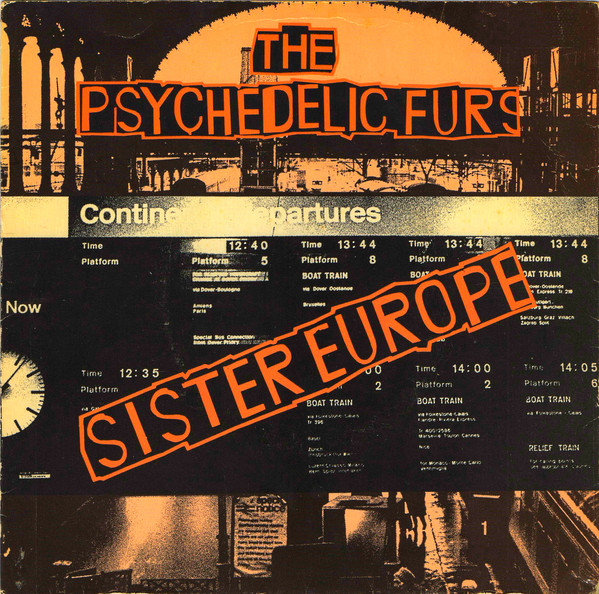
Sister Europe dates back to February 1980.  It was the second 45 to be released by The Psychedelic Furs, and it came out just a few weeks in advance of the eponymous debut album.  As it turned out, the 45 was an edited take on the version that would appear on the album, coming in almost a full minute-and-a-half shorter.

It’s a strange, eerie number – a contemporary review in the UK music paper Record Mirror highlights that it was a hard one to think of as haviing any sort of crossover commerial appeal:-

“Unpromising start is saved by some “Man Who Sold The World” vocals. In fact, the vocals are the only interesting bit of this, which sets a heavy atmosphere that I find really listenable.”

Pretty In Pink, it most certainly is not.

mp3: The Psychedelic Furs – Sister Europe

The story goes that singer Richard Butler was having difficulties getting it just right, which led to producer Steve Lillywhite telling him to go to the pub and have a couple of beers, after which Butler should come back to the sing it it’s three in the morning, and he was talking on the telephone to someone. It certainly seems to have done the trick.

I didn’t buy this at the time – I’d get to know the song when a friend put the debut album on one side of a C90 cassette for me.  In due course, I’d end buying the album a few years later. Parts of the song remind very much of Secondhand Daylight-era Magazine.

I found the single a few years back in a second-hand shop and from recollection paid £1 for it.  It sounds like the original owner had little regard for keeping his vinyl in good nick.

Here’s the strangely named b-side:-

mp3: The Psychedelic Furs – ****

An Instrumental that’s every bit as strange as the title, the fact there’s very little cracking/popping/hissing on it makes me think the original owner probably played it once and thought ‘never again’.

JC

CLOSE-UP : THE CINERAMA SINGLES (Part 4)

A GUEST SERIES by STRANGEWAYS

Close Up: The Cinerama Singles #4 :  Disco Volante singles (1)

R-1436923-1219617993

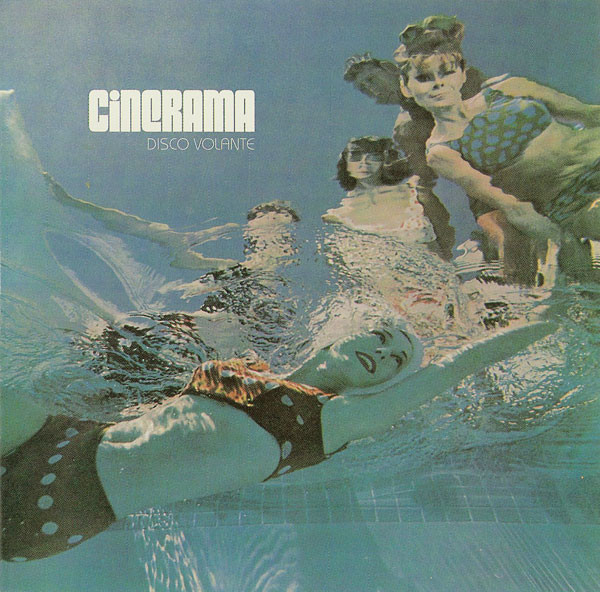
September 2000 would see the release of second Cinerama LP Disco Volante (yet another Bond reference, this time named for the luxurious yacht used by the villain Emilio Largo in the 1965 film Thunderball).

Two singles warmed us up for the new LP – we’ll cover those in this post – and a further two went out post-release. It was an unusually high number, but one that would provide space for some high-quality B-sides.

R-690685-1148166414

mp3: Cinerama – Wow

Wow indeed. An absolute must-listen, Wow hit the racks in June 2000. Theme-wise we were on hardly new ground here, but musically this was ferocious and graced by a really robust sing-along chorus. Wow was possibly the first Cinerama-song-that-could-have-passed-as-a-Wedding-Present-song. It also featured the greatest use of flute in a pop tune since My Bloody Valentine stuck one on When You Sleep.

Not to be deliberately a nuisance, but it’s well worth noting that an extended mix of Wow is found on Disco Volante. Thanks to a thrilling must-hear instrumental coda, it’s almost three minutes longer than this single cut and in my view is the finer of the two tracks.

B-sides here contributed to a terrific single release. Whereas for me Wow leaned towards The Wedding Present, 10 Denier went the other way and possibly perfected the Cinerama sound. Piano-led and elevated by harmonies and strings a-go-go, was 10 Denier the greatest Eurovision song there never was?

mp3: Cinerama – 10 Denier

Gigolo, the final track on the Wow single, was a harder counterpoint. Fragmented and angular, it was closer in tone to the material that would present itself a couple of years later on Cinerama’s next LP.

mp3: Cinerama – Gigolo

Wow also marks the point at which bass guitarist Terry de Castro would join Cinerama. Formerly of the Nude Records band Goya Dress, de Castro is well worth a mention as she would become a long-time creative collaborator, make the switch to guitar, and contribute backing vocals (and one lead) across -spoiler alert – subsequent Wedding Present output.

R-690795-1148171298

From Wikipedia:

Luigia “Gina” Lollobrigida (4 July 1927 – 16 January 2023), known professionally as Gina Lollobrigida, was an Italian actress and photojournalist. She was one of the highest-profile European actresses of the 1950s and early 1960s, a period in which she was an international sex symbol.

If we count the admittedly different version of Wow as a Disco Volante single, the second track taken from the LP would be Lollobrigida. It emerged in late August 2000, just a few weeks prior to the album’s release. Like all eleven Disco Volante tracks, Lollobrigida was recorded by Steve Albini, the producer and sound engineer hardly noted for the gauzy, accordion and keyboard-accented confections that characterise this song.

mp3: Cinerama – Lollobrigida

Beginning with a trademark intake of breath, this is one of Cinerama’s most delicate compositions. Sleeve-wise, Lollobrigida was wrapped in a rosy, harshly cropped image of the eponymous actress. A version, sung in French, featured on a Peel session broadcast on 17 September 2000, just a day prior to the release of Disco Volante.

mp3: Cinerama – Lollobrigida (French Version – Peel Session)

B-sides? See Thru is another of Gedge’s quietly bawdy Cinerama titles (see also 10 Denier, Unzip, Quick, Before It Melts, Tie Me Up and Sparkle Lipstick). It’s antsy, restless and concerned with the perennial topic of deception. Here the offender does his best to make lemonade with lemons by asserting that You say I never tell the truth, at least you know when I am lying. It’s an admirable comeback, but one unlikely to prevail.

mp3: Cinerama – See Thru

On the Second flip, Sly Curl is a finer fit to its A-side. Here the pace drops, a dependable pop trope – ‘why do you have to go out with him/her when you could go out with me?’ – is expressed before the late comedian, actor, writer and Weddoes nut Sean Hughes’ affectingly delivered spoken words close a gentle, very Cinerama number.

mp3: Cinerama – Sly Curl

It’s tracks like Sly Curl, and several on Disco Volante (the chorus-monster Heels, plus Après Ski and Let’s Pretend) that make me think this was the point at which Cinerama perfected its sound and hit the sweet spot: far enough from The Wedding Present, familiar enough to connect. Hey, it’s just my take on it, but it strikes me that this was a band with, broadly speaking, three distinct eras, each one defined by its LP and by extension those records’ associated singles and B-sides.

Purely for trivia: it’s been edited out, but once upon a time Wikipedia’s Gina Lollobrigida entry, under the In popular culture section, referenced a group that’s been featured right here on the (New) Vinyl Villain. Here’s what Wikipedia noted: English rock band Cardiacs included a song titled “Gina Lollobrigida” on their 1984 album The Seaside.

With customary thanks for making it this far, our next post will focus on the remaining two singles of Cinerama’s Disco Volante era.

strangeways

SATURDAY’S SCOTTISH SONG : #405: ALEX FERGUSSON

R-825480-1362329845-4814

R-825480-1362329853-4367

From the booklet accompanying the Big Gold Dream box set (Cherry Red Records 2019)

“If Glasgow auteur Alex Fergusson‘s snappy piece of dancefloor synth-pop sounds like it was paving the way for Depeche Mode and Co., bear in mind that producer Larry Least was actually Daniel Miller, aka, The Normal and founder of Mute Records.

Fergusson had played with Sounds journalist Sandy Robertson as The Nobodies before forming Alternative TV with Sniffin’ Glue fanzine writer Mark Perry. As a producer, Fergusson also worked with Postcard-era Orange Juice and The Go-Betweens. He then joined Cash Pussies, the conceptual brainchild of journo provocateurs Fred and Judy Vormel, who released the Sid Vicious-sampling ‘99% Is Shit’.

For five years, he played with Genesis P. Orridge‘s cult collective, Psychic TV. Since his departure. Fergusson has released several albums, including 2001’s The Essence, which featured a guest vocal from former Strawberry Switchblade co-vocalist Rose McDowall.”

mp3: Alex Fergusson – Stay With Me Tonight

This single was released in November 1980 on the London based Red Records, a label in existence between 1978 and 1982.

JC

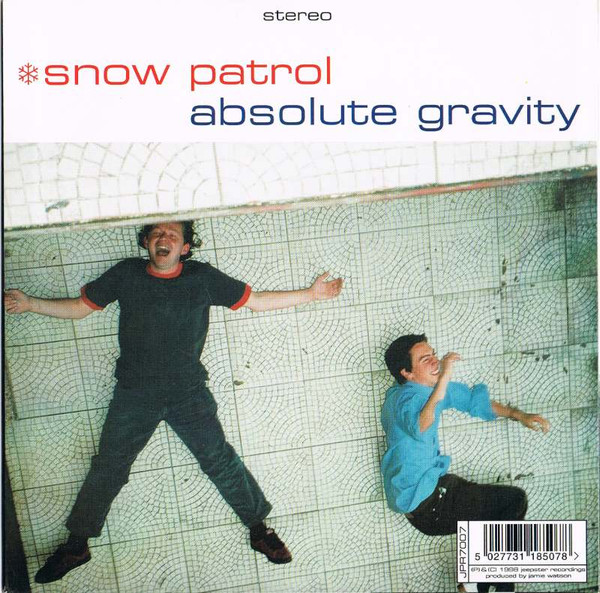
THE CD SINGLE LUCKY DIP (8) : Snow Patrol – Velocity Girl/Absolute Gravity

R-1459193-1502007236-4141

The origins of Snow Patrol date back to 1994 when Gary Lightbody (vocals and guitar), Mark McLelland (bass) and Michael Morrison (drums), three students from Northern Ireland who were studying at the University of Dundee, formed a band whom they named Shrug.  By 1996, the name had changed to Polarbear, and they had signed to Electric Honey Records, the in-house label at Stow College, Glasgow. It was around this time that Michael Morrison suffered a breakdown, quit the band and returned home.  The debut EP for Electric Honey, entitled  Starfighter Pilot, saw Richard Colburn of Belle & Sebastian lend a hand on drums, while lead singer Stuart Murdoch played keyboards and added some vocals.

Another name change came in 1997 – this time to Snow Patrol – and an offer was accepted to sign up with Jeepster Records (the label that a year previously had signed Belle & Sebastian via the Electric Honey route).  By this time, Jonny Quinn, another drummer from Northern Ireland, had joined.   There would be a number of releases in 1998, beginning with two singles Little Hide (February 1998) and One Hundred Things You Should Have Done In Bed (May 1998), with debut album Songs For Polarbears hitting the shops on 31 August.

None of the releases sold in any great numbers.  I was aware of the band’s name but knew nothing of their actual music.  It would have been later in the same year that I picked up second-hand CD copies of some of their releases, including what turned out to be a third single from the debut LP:-

mp3 : Snow Patrol – Velocity Girl (Sell Out edit)
mp3 : Snow Patrol – Absolute Gravity
mp3 : Snow Patrol – When You’re Right, You’re Right (Darth Vadar Bringing In His Washing Mix)

The first two songs can be found on the debut album, albeit this version of Velocity Girl (NOT a cover of the Primal Scream song) is slightly shorter.

These songs sound nothing at all like the material with which Snow Patrol would hit payola between 2004 and 2006 with the albums Final Straw and Eyes Open, along with the numerous hit singles they spawned.  The first few notes of Velocity Girl, and indeed the way Gary Lightbody delivers his vocal, is very reminiscent of Pavement, while Absolute Gravity has the sort of turntable action associated with Beck.  The additional track on the CD is a strange, improvised sounding number.

Very few people were interested in Jeepster-era Snow Patrol. Plenty of material ended up in bargain bins and even today, it can all be picked up for very modest sums on the likes of Discogs.

JC

ONE HUNDRED AND ELEVEN SINGLES : #057

aka The Vinyl Villain incorporating Sexy Loser

#057: The Marabar Caves– ‘Seeds That Never Grew’ (Tiki Records ’84)

Caves

The Marabar Caves are fictional caves which appear in E. M. Forster‘s 1924 novel ‘A Passage to India’ and the film of the same name. The caves are based on the real life Barabar Caves, as pictured above, especially the Lomas Rishi Cave, located in the Jehanabad District of Bihar, India which Forster visited during a trip to India.

The caves serve as an important plot location and motif in the story. Key features of the caves are the glass-smooth walls and a peculiar resonant echo, amplifying any sound made in the caves. The echo makes the sound “ou-boum” and that sound haunts the characters afterwards. Forster chose the caves to set a turning point in the novel, not just for the character Adela, but also for Mrs Moore, Cyril Fielding and Dr. Aziz: the caves mark a turning point in the novel and their lives. The caves are significant because they mark the hollowness in the lives of the four main characters. None of them are getting what they want and are trying to find a balance in life amid expanding chaos.

But, as so often, you knew that all along, didn’t you? What you did not know though is that, as ace and important for Indian tourism the above Marabar/Barabar Caves might possibly be, sunny Northampton has its own Marabar Caves! And you know what? If you made me choose which ones I should go and see, it wouldn’t be the Indian ones, even if you paid for the trip!

Nah, I would rather go and see one of the finest psychedelic rock bands ever to come from Northampton, only to witness their performance of what was a B-Side of a single, ‘Sally’s Place’, on Tiki records back in 1984 (that golden year):

the-marabar-caves-sallys-place-tiki-records

the-marabar-caves-seeds-that-never-grew-tiki-records

mp3:  The Marabar Caves – Seeds That Never Grew

Now, apparently The Marabar Caves are still going strong these days … new records, touring: just as you do some 42 years after your formation. I haven’t gone through all their stuff, so there might be some surprises which I haven’t found yet, but up until now nothing is nearly as good as the above, an absolute favourite of mine. If you listened closely, I bet you’ll have heard a slight “ou-boum” therein as well … just like in the bloody caves!

Hope you enjoyed it as much as me,

Dirk

SHAKEDOWN, 1979 (May, part two)

79

So, what about those marvellous singles released in May 1979 that didn’t bother the charts.  There’s a couple of personal favourites in here….

mp3: The Cure – Boys Don’t Cry

Seven years after its initial release, this wonderful 45 got to #22 when it was reissued in support of a Greatest Hits package.  It’s not that The Cure had few fans in the UK, but they had shown they were more likely to buy the debut album, Three Imaginary Boys (#44) than they were for any singles, with this failing to chart in much the same way as the debut Killing An Arab.

mp3: Japan – Life In Tokyo

Another 45 whose time would eventually come.  The 1979 release on Hansa Records sunk without trace, a rare misfire for anything associated with Giorgio Moroder.  By 1982, Japan had become popular thanks to the album Tin Drum and its associated singles, all of which came out on Virgin Records.  Those involved over a Hansa weren’t slow to miss a trick, and three singles from the 79 era – I Second That Emotion, Life In Tokyo and European Son – together with a compilation album, Assemblage, were put into the shops, with all of them subsequently charting.

mp3: Essential Logic- Wake Up

Lara Logic had been the saxophonist with X-Ray Spex, but chose to leave the band after the debut single Oh Bondage Up Yours.  She then formed Essential Logic, for whom she also provided lead vocals.  Virgin Records signed the band and an eponymous EP was released in May 1979 to no fanfare at all.  Wake Up was the lead track. The band would move to Rough Trade before the year was out.

Talking of Rough Trade….

mp3: Stiff Little Fingers – Gotta Getaway

A great largely forgotten post-punk 45 that was later polished up and re-recorded for inclusion on the 1980 album Nobody’s Heroes by which time Stiff Little Fingers had moved to the bosom of a major label in the shape of Chrysalis.

JC