SATURDAY’S SCOTTISH SONG : #446: DANCER

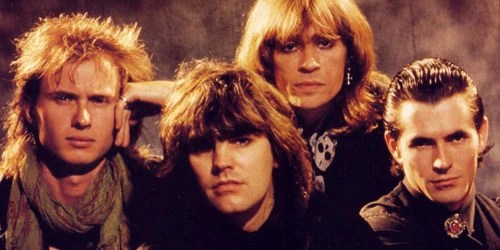
A short while back, myself and Aldo headed along to catch The Bug Club play a gig in Glasgow.  One of the support acts on the night was Dancer, a band that had been picking up a great deal of positive press round these parts, not least for being included in the list of Top 20 best albums of 2024 as chosen by highly influential and important record-shop, Monorail.

For a short while, Dancer felt like our city’s own little secret. The group, made up of Glasgow DIY mainstays (from the likes of Current Affairs and Order of the Toad), released only a few singles but gigged often at Bloc and the Old Hairdressers before their debut full length 10 Songs I Hate About You. The 10 songs in question are a sonic mash-up of melodic warmth and perfectly crafted pop songs with crunch. There’s a similarity to Life Without Buildings in Gemma’s vocal delivery and Chris’ erratic-slash-melodic guitar work, but there’s also, at times, a more chaotic and experimental storm brewing under the surface. A record which takes left turns into new territory every so often when it’s least expected; Gemma cackles, Gavin’s hi-hat taps out a new rhythm, Dancer is no longer a secret. I couldn’t be more glad”

They proved to be an excellent watch and listen in the live setting, and I subsequently went out and bought the debut album, which was released back in March 2024.  It was preceded by a couple of EPs and has been followed by a couple of split releases, an EP with Portland-based Whisper Hiss and a 7″ single with R.Aggs, who is better known perhaps as being one half of Glasgow’s Sacred Paws, whose debut release Strike A Match, was given the accolade, and associated prize-money, for being named Scottish Album of the Year in 2017.

The band members are Gemma Fleet (vocals), Chris Taylor (guitar), Andrew Doig (bass) and Gavin Murdoch (drums)

mp3: Dancer – Bluetooth Hell

The opening track on 10 Songs I Hate About You.


JC

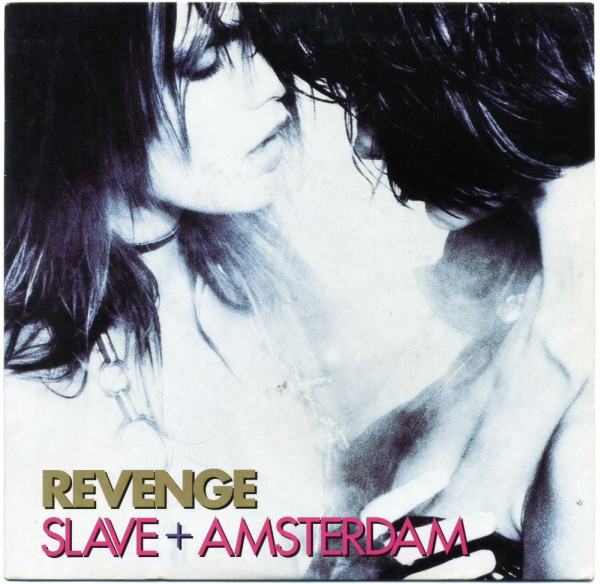
THE 7″ LUCKY DIP (31) : Revenge – Slave

By the time New Order were celebrating the success of #1 single World In Motion in the summer of 1990, the various members were already working on or planning various side projects – Gillian and Stephen were The Other Two, Bernard had teamed up with a few superstars to form Electronic, while Hooky chose to form Revenge.

Initially, it was a trio with Hooky (vocals, bass, keyboards) being joined by Davyth Hicks (guitar and vocals) and Chris Jones (keyboards).  The debut single, 7 Reasons, was released, on Factory Records in 1989, and the following year saw an album One True Passion, from which the singles Pineapple Face and Slave were lifted.  I’ve copies of all three singles on either 7″ or 12″ vinyl, all bought many years after the event for not a great deal of money.  They might all be on a cult label, and feature a member of one of the most influential and important bands of the late 20th Century, but that doesn’t mean there’s ever been much demand across the second-hand market.

There’s a straightforward explanation as to why this is the case – Revenge aren’t all that good.  Here’s the third and final single lifted from the album:-

mp3: Revenge – Slave

It sounds like a minor hit for New Order as imagined on one of those cheap Top of The Pops albums where session musicians did their best to mimic the stars and hitmakers of the day.

The b-side was a cover.  A very obscure cover, with the original being found on John Cale‘s 1970 album, Vintage Violence.

mp3: Revenge – Amsterdam

Revenge did tour the debut album across Europe, America and Japan, and for the live shows, they were supplemented by David Potts (bass and guitar) and Ashley Taylor (drums).  Shortly after returning from Japan, Hicks quit, citing the perennial ‘musical differences’.  There would be one further EP in 1992, Gun World Porn, after which Hooky returned to New Order for the recording and promotion of Republic, released in 1993.


JC

ANOTHER SLICE OF LOVELINESS

Inspired by yesterday’s remarkable ICA from strangeways, I thought it was time, again, to offer up what I think is one of the loveliest tracks of all time.

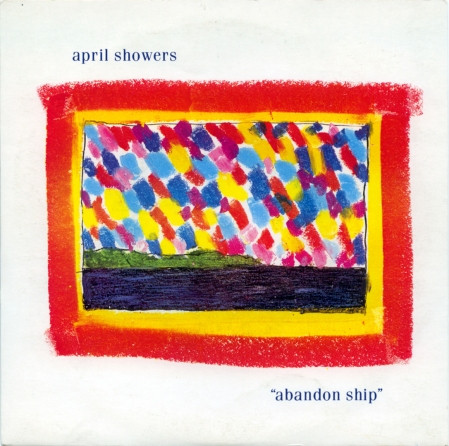
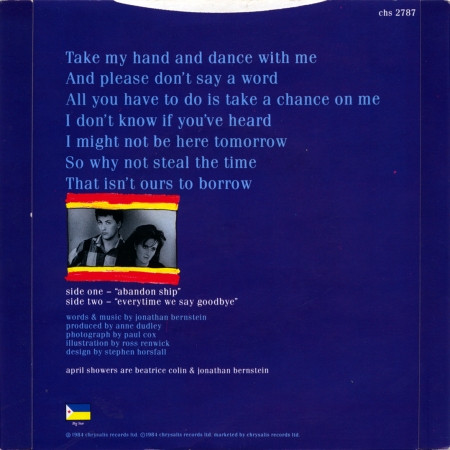
I’ve written about Abandon Ship a couple of times before.  It was the only single ever released by April Showers – and yes, the turning of the calendar into a new month got me thinking about things, too.  A Glaswegian pop duo comprising Jonathan Bernstein and Beatrice Colin who had met and formed the group while at Glasgow University. Jonathan has subsequently forged a career for himself in recent years over in his native America as an author and screenwriter. Beatrice, sadly, passed away from cancer in 2019 at the age of 55, having led a full life in the creative arts, working in radio production and then journalism, before becoming an award-winning author and playwright, as well as a lecturer in creative writing at the University of Strathclyde.

It’s a single I regret not buying back in the day, relying instead on listening to it from the collection belonging to a flatmate.  In due course, I was able to add the song to my own collection thanks to its inclusion on the compilation CD, 10 Years Of Marina Records, released in 2004.

Now, at long last, I have a copy on vinyl after Pete Paphides included it on the superlative Sensitive pop anthology recently released on his Needle Mythology label.  It’s not only a beautifully and lovingly compiled collection, but it comes with extensive sleeve notes courtesy of Pete, which alone are worth the cost of the double album.  Here’s some of what he has written about Abandon Sip:-

Prior to Beatrice’s arrival, Jonathan hadn’t been able to interest any labels in his demos. That changed when she sang ‘Abandon Ship’ and Chrysalis heard the result. Enter Anne Dudley. This being 1984 – the year in which she arranged strings for Frankie Goes To Hollywood and Lloyd Cole And The Commotions – it’s not as though Dudley could have sone with the extra work, but she clearly heard something here that left her powerless to refuse.

If you’re an arranger listening to a song for the first time, you’re also listening to the beginnings of your own arrangement for it. To hear those strings rush in to help launch that first chorus skywards is like experiencing an early version of augmented reality.  And while none of this was possible without an achingly pretty song at the centre of it. Imagine ‘Abandon Ship’ without those strings and what’s left is a bittersweet song of resignation, from a protagonist who can no longer pretend that life hasn’t overwhelmed them.  Those strings give Beatrice’s vocal an added shot of energy : ‘Why don’t you come on in?/The water’s lovely!

mp3 : April Showers – Abandon Ship

At long last, a vinyl rip.


JC

AN IMAGINARY COMPILATION ALBUM : #386: TEN LOVELY TRACKS

A GUEST POSTING from STRANGEWAYS
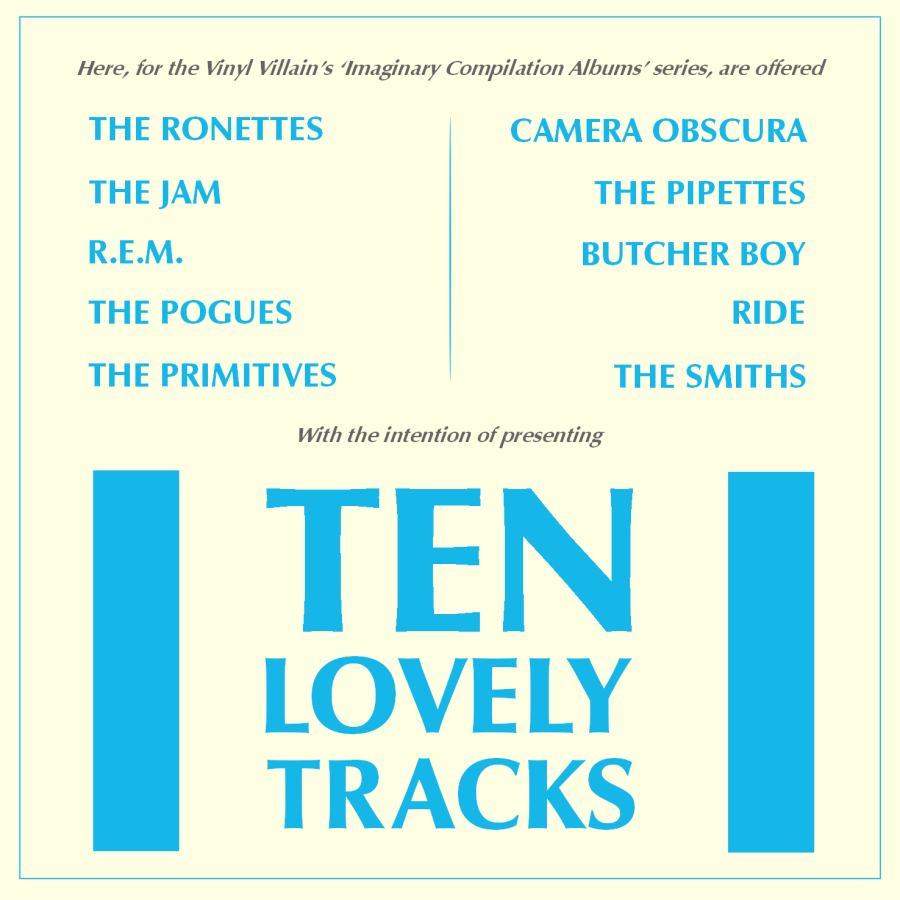
Ten Lovely Tracks : An Imaginary Compilation Album

Welcome to a lovely Imaginary Compilation Album. That’s not me bigging-up this mix, but rather offering a literal description, for this is an ICA of songs deemed to be ‘lovely’ in nature. Immediately this business of a song being lovely is subjective of course. But the closest I got to a criterion was including tracks that, when you hear them, kind of wrap their arms around you.

It should be stated that this list is very, very far from exhaustive; the mountain of should-have-rans continues growing.

Side 1

1. The Ronettes: Walking in the Rain (single A-side, 1964, Philles)

I won’t attempt to add too much to the weight of words that must have been written about this song since The Ronettes released it in October 1964. I’m really not qualified, so to do so would be like writing about lofty cultural fixtures like the Mona Lisa or Ant & Dec’s Saturday Night Takeaway.

That said, a thunderclap kicks the track off and immediately we’re in a dreamland co-created of course by an ace Phil Spector production. With its references to shyness, its grown-up assertion that ‘sometimes we’ll fight’, its fondness for wishing on stars and of course its championing of rain over sun you could say that thematically Walking in the Rain gifted a bit of a blueprint to the indiepop genre that would emerge fifteen or so years later.

The track is just super, and so far as its inclusion here is concerned, its sheer loveliness fought off the likes of Past, Present and Future by the Shangri-Las, Thinkin’ ‘Bout You Baby by Sharon Marie and A Lover’s Concerto by The Toys.

Loveliest line: ‘Walking in the rain and wishing on the stars up above, and being so in love… ’

2. The Jam: Wasteland (Setting Sons LP track, 1979, Polydor)

I am really no Jam expert whatsoever. It’s daft, of course, that I haven’t explored beyond the singles and a couple of LPs. Moron. But the album I know best is Setting Sons. And the track I love most is Wasteland.

That Paul Weller was only, what, 21 max when he wrote the elegant words of Wasteland is astonishing to me. Listing the wasteland’s decorations – including punctured footballs, ragged dolls and rusting bicycles – he conjures up the grimy props of a world in which ‘to be caught smiling’s to acknowledge life’ as two lovers? Ex-lovers? Never-were lovers? Just friends? sit amid the trash and stoke over the past. Certainly if the theory that Setting Sons was intended – but not realised – as a concept album concerned with the lives of three childhood friends, the relationship could well be platonic. The reference to hand-holding though perhaps hints at something else.

Adding to the overall loveliness of this track are notes from a recorder – an instrument, in the UK at least, recalling tuneless school music classes. Here though, sounding not unlike the calls from a bird on high, it puffs out an innocent intro and pops up again at a key line.

Finally, that Weller gets so much detail of his wasteland – ‘meet me on the wastelands, the ones behind the old houses, the ones left standing pre-war, the ones overshadowed by the monolith monstrosities councils call homes’ – to even scan properly is remarkable.

Loveliest line: ‘Meet me later – but we’ll have to hold hands… ’

3. R.E.M.: At My Most Beautiful (Up LP track, 1998, Warner Bros.)

Of all the bands selected to populate this ICA, R.E.M. gave me the most trouble. In surveying the songs I know of them – and to be fair that although it’s not 100% knowledge it’s not by any stretch horrendous either – it rapidly became apparent that you could, before breakfast, create an ICA of ‘Lovely Songs Just by R.E.M.’.

So what to do?

That’s easy – choose a total slushfest, and from an unfancied LP, that will annoy the readers of this blog. So apologies to the exalted likes of Perfect Circle, Wendell Gee and The Flowers of Guatemala, plus Half A World Away, Nightswimming and Electrolite. Here instead is At My Most Beautiful, from 1998 album Up.

I seem to remember that at the time a common brickbat chucked at this song was that it was ‘R.E.M. trying to sound like The Beach Boys’. It is. And I further remember thinking ‘great’.

Sure, it’s kind of saccharine and soppy, but the overall result is lovely – which is of course what we’re after here. Added to this, the words of this big value track also provide…

The Grand Indie Boy or Girl’s Guide to Snagging a Partner

Three sure-fire ways to reverse the joy of solitude:

1. Read bad poetry into their machine (or, for the less ancient, their mobile phone)

2. Save their messages just to hear their voice – (perhaps keep this one to yourself)

3. Count their eyelashes, secretly (and for bonus points, with every one whisper ‘I love you’)

Loveliest line: You always listen carefully to awkward rhymes, you always say your name like I wouldn’t know it’s you, at your most beautiful.. ’

4. The Pogues: Lullaby of London (If I Should Fall From Grace With God LP track, 1987, WEA)

The Pogues are probably at their best when they’re rocking the furious likes of Boys From The County Hell and Sally MacLenanne, or Turkish Song of the Damned and Bottle of Smoke. But grand as these are, you could hardly call any of these breathless beauties lovely. That’s a job instead for Lullaby of London, from the revered 1987 album If I Should Fall From Grace With God.

Here, Shane MacGowan takes us on a kind of stroll located by a river and in the springtime. On this jaunt, in the main, his words are mystical and supernatural (ghosts and haunted graves and angels are present). But he ambles also in the urban: and despite noting the absence of a cry from a lonesome corncrake – any twitcher will tell you i) that’s a bird and ii) its binomial nomenclature is Crex crex – he seems satisfied enough with the sounds of cars and bars and laughter and fights.

This is a song that feels older than it is or, to put it more delicately, could be of another age. Were it not for that reference to motor cars, the whole expedition could be taking place a century-and-a-half ago. Remove the pubs and you spool back even further. Laughter and fights though have surely been with us since the first caveman cracked an off-colour joke and instigated a brawl.

Enough. All that’s left to say is that if the words to Lullaby of London are remarkable, the band is totally on point too, especially via the lilting mandolin that quietly matches the lyrics for sheer emotional punch.

It’s odd, but a speck of dust always lands in my eye whenever I hear this track.

Loveliest line:May the wind that blows from haunted graves never bring you misery, may the angels bright watch you tonight and keep you while you sleep… ’

5. The Primitives: We Found a Way to the Sun (Really Stupid 7” single B-side, 1986, Lazy Recordings)

Somewhat inevitably the band with the LP titled Lovely was always going to make it onto this ICA. And, also somewhat inevitably, the song selected here does not in fact feature on that album. Instead, it’s We Found a Way to the Sun – curiously styled, on the subsequent Lazy 86-88 compilation, and other anthologies that followed, as (We’ve) Found a Way (to the Sun).

Bracketed or not, it is just one of several absolutely killer formative Primitives B-sides. Delivered inside yet another early Prims sleeve to die for,
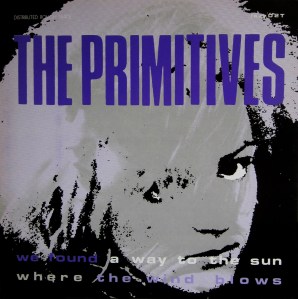
this smasher popped up in 1986 on the Really Stupid 7” single and, on 12”, alongside Where the Wind Blows. That gem of a fellow B-side, set at the witching hour and chockful of associated imagery, is the one I’d actually started writing about for this post. But that was before the handbrake turn you’re now reading.

Why the switch?

The truth is that either track could have made it, but the distorted, beautiful intro and subsequent melody of We Found a Way to the Sun just pipped Where the Wind Blows to the post. Add to these Tracy Tracy’s wide-eyed and hurt-sounding vocal, and we really do achieve Primitives perfection. Also, there’s a curiosity to celebrate: no chorus is offered – just one bewitching verse followed by repetition of the song’s title.

Loveliest line: ‘But it’s all too good to be true, I don’t know just what I should do, I love everything about you… ’

Side 2

1. Camera Obscura: My Maudlin Career (My Maudlin Career LP track, 2009, 4AD)

This title track to Camera Obscura’s fourth LP is both eminently huggable and a real bruiser. Its opening twenty-five seconds could be mistaken for a Wall of Sound production as keys and strings and brass add layer after layer of sock-knocking assault. And as the late Carey Lander’s incessant, trebly keys heroically wrangle it all into a followable structure, Tracyanne Campbell’s words speak of a relationship – the maudlin career of the title – going wrong (perhaps best distilled in the lines ‘we were love at first sight, now this crush is crushing’).

Despite the tale of a partnership on the skids, this is yet another lovely song from a band that specialises in them.

Loveliest line: ‘I’ll brace myself for the loneliness, say hello to feelings that I despise… ’

2. The Pipettes: A Winter’s Sky (We Are the Pipettes LP track, 2006, Memphis Industries)

Oh crumbs, not again. Look, I know I included this track on the Pipettes ICA I scribbled several years ago, but it’s just too lovely a fit not to revisit it. And what I wrote then remains, so I won’t deviate from it. The harmonies. The shimmer. The warm pootle of brass before the little Smithsy sound effect that chills the closing line ‘the last we saw of her, it came too soon’.

This is only ever played in our – that’s me and the furniture – house during winter (official three/four-month winter, I mean, not the Scottish one).

Loveliest line: ‘Underneath a winter’s sky, her eyes were bright, tonight he finds her underneath a winter’s moon… ’

3. Butcher Boy: I Could Be in Love With Anyone (Profit in Your Poetry LP track, 2007, How Does It Feel To Be Loved?)

A bit like R.E.M., there are loads of Butcher Boy songs you could tag as lovely. ‘Poetic’ is kind of a lazy descriptor for John Blain Hunt’s lyrics, but that doesn’t stop it being any less accurate. He’s a master of fastidious and forensic observation, and an expert in uplifting and championing the ordinary: pebbledash and paper chains, chimes and chewing gum.

Despite, or perhaps because of, the sheer quality that threads through Butcher Boy’s three LPs so far, this is a band that adheres stoically to a less-is-more philosophy. Releases are sporadic – bookended by years that meanwhile continue their business of totting up births and marriages and deaths. Gigs, at best, the same. World Cups occur more regularly. Plus, in spite of heavyweight patronage from names including Stuart Murdoch and John Niven, Ian Rankin and Peter Paphides (whose Needle Mythology label released the 2021 BB compilation You Had a Kind Face), there remains a Sundays-like reticence to seek the limelight. As listeners, we’re the losers in these arrangements of course. But you kind of wouldn’t really have it any other way.

To the song though. Winning out for this compilation is I Could Be in Love With Anyone, the fourth track on the first Butcher Boy LP Profit in Your Poetry.
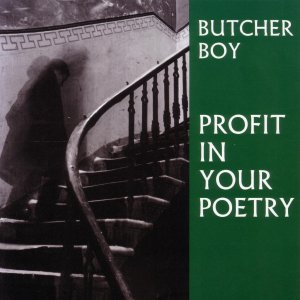
Lyrically there’s a little of the celestial in this tale of a character who visits in dreams and flies around the walls of a room. Amid some good intentions there seems to be selfishness too, characterised by a title that could be delivered with a shrug, and also by the delight taken in ‘breaking hearts for fun’. From hearing this treasure years ago I quickly, and surely wrongly, settled on the idea that the words are describing my own favourite antihero Peter Pan.

Loveliest line: I’m actually going to reproduce the song entire for this entry, and hope you agree that choosing just one lovely line would be something of a disservice.

Listen, please don’t close your eyes
I don’t know how I know what you’re thinking but I

I’ve never felt so far away
Blood is chiming bells through you

But listen, that’s OK ‘cos I’m frightened too

And tenderly I write today

That I could be in love with anyone

I’ve been breaking hearts for fun


Listen, tell me what’s gone wrong

And I will come in dreams and I’ll bleed into songs

So you can sing them back to me.
Sun suspends my days in dust

If my love made you lonely I’m sorry but

The feeling flowed so easily

But I could be in love with anyone

I’ve been breaking hearts for fun

Glass reflects my eyes and skin

But still my lips will crumble like ash when we kiss

So cynically I shift the blame
I could fall upon this house

Or fly across these walls with your heart in my mouth

But honey I would rather stay


Where I could be in love with anyone

I’ve been breaking hearts for fun

4. Ride: Vapour Trail (Nowhere LP track, 1990, Creation)

This is probably the song that inspired the whole ICA. I’ve always struggled to find a better word than ‘lovely’ to summarise the romantic Vapour Trail, the track that closes Ride’s debut LP Nowhere.
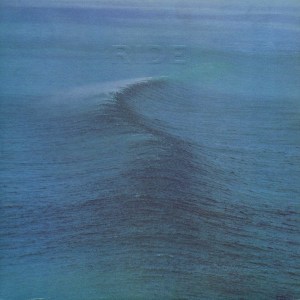
Vapour Trail is dreamy and delicate and from its wispy intro to its choppy string-laden exit lifts you into a whole other place. Best of all, the words – describing total adoration and beguilement – feel like they were scratched onto a jotter during double geography, a carefully crooked arm shielding them from the ridicule of the class bully.

Loveliest line: ‘You are a vapour trail in a deep blue sky… ‘

5. The Smiths: I Won’t Share You (Strangeways, Here We Come LP track, 1987, Rough Trade)

After – literally – decades of internal debate and agony I concluded some years ago that My Favourite Smiths Song is this: I Won’t Share You, the very last track on the very last LP.

I mention its placement on Strangeways, Here We Come deliberately as it is crucial to its victory. That’s thanks really to Simon Goddard’s 2002 book Songs That Saved Your Life (Reynolds & Hearn Ltd.) – a painstaking track-by-track analysis of the band’s discography (and so dippable it should be sold with a lollypop and inside a poke of sherbet). There, Goddard notes that I Won’t Share You melts out with the subtlest little breath of faded-out harmonica. It’s an addition so brief and gentle in fact that it’s essentially drowned at birth. But, and here’s the kicker, Goddard – who beautifully and correctly describes the song as ‘a deeply affecting lullaby’ – cleverly connects this sigh of a coda with the band’s first offering, the Hand in Glove single, which begins with, amazingly, a faded-in harmonica.

This, the writer states, returns The Smiths full circle, pinging them from 1987 back to 1983, and all without a DeLorean and flux capacitor in sight.

You can call this proposed loop a reach of course, and it’s an unashamedly romantic way to view the band’s birth and death (and perpetual rebirth-by-harmonica). Amid these gymnastics after all is the troubling and inconvenient fact that The Smiths’ actual last recordings occurred in May 1987, a month after Strangeways had wrapped. These were created at a B-side session whose content and atmosphere so browned-off the already irritated Johnny Marr that it’s not dramatic to state it contributed significantly to the band’s ending.

So for fans of Cluedo, you could say it was the Cilla Black cover, in the studio, with the microphone wot did it.

Even so, the harmonica yarn is a notion I utterly subscribe to and, throughout that years-long agitation across which any helpful criteria was welcome, it earned I Won’t Share You my top spot.

Prettifying the number even further there is of course the debate regarding its lyrics. Specifically, this is concerned with whether or not they constitute Morrissey’s farewell to Johnny Marr. The song would have been completed just a few months before the group dissolved, then released just weeks after the split. It’s widely thought the singer disliked the idea of the guitarist collaborating with others, or even getting close to essential associates like managers and producers. Against those assumptions it’s easy to make a case for the disputed possibility that I Won’t Share You is the sonic equivalent of a note left upon the kitchen table (or, for Smiths trainspotters, perhaps pinned beneath a windscreen wiper).

Whatever the truth, and whether or not you buy the Magic Harmonica Theory and/or the potential Dear Johnny nature of the lines, it’s a song that’s a worthy last word on both The Smiths – it was surely the only serious track ten candidate – and on this collection of lovely songs, which I hope you’ve enjoyed reading about and maybe visiting/revisiting.

Loveliest line: ‘I’ll see you somewhere, I’ll see you sometime, darling… ’

Thanks as ever to Jim for the space and opportunity, and to you for reading.


STRANGEWAYS
ANOTHER VOLUME OF UNRECONSTRUCTURED RUBBISH

First midweek day in April.   What else could I do?*

mp3: Various – Another Volume of Unreconstructed Rubbish

The Jesus and Mary Chain – April Skies
Lloyd Cole – Fool You Are
Pet Shop Boys – I Started A Joke
Everything But The Girl – Laugh You Out The House
The Smiths – The Headmaster Ritual
The Bug Club – Pop Single
Felt – Penelope Tree
Nick Cave & The Bad Seeds – We Call Upon The Author
Siouxsie and The Banshees – Metal Postcard
Massive Attack – Blue Lines
The Prodigy – Firestarter
The Big Moon – Trouble
Soulwax – NY Excuse
Billy Reeves – Never Cross
The Frank and Walters – Fashion Crisis Hits New York
Say Sue Me – B Lover
The Clash – 1977

* I did think about re-posting this previous offering from the date of 1 April in which a bit of fun was had.  I try not to take things too seriously too often on the blog.

JC


ON THIS DAY : THE FALL’S PEEL SESSIONS #4

A series for 2025 in which this blog will dedicate a day to each of the twenty-four of the sessions The Fall recorded for the John Peel Show between 1978 and 2004.

Session #4 was broadcast on this day, 31 March 1981, having been recorded on 24 March 1981.

Another truly great recording, (Mojo listed it as the greatest Fall session in the wake of Peel’s passing); packed full of light and shade, comedy and chat. The recording highlighted only one song from the soon to be released ‘Slates’: the anti-football hooliganism rant ‘Middlemass’, which had now been in the group’s repertoire for five months.  The abandonment of Grotesque’s ‘C’n’C’ for the spot-on parody of Coast To Coast’s ‘Do The Hucklebuck’ after Smith’s announcement that comic Arthur Askey had been shot demonstrates the acute sense of humour near the group’s surface. The session is notable for the debut of Smith’s signature tune ‘Hip Priest’, as well as a tentative run through of ‘Lie Dream Of A Casino Soul’.

DARYL EASLEA, 2005

mp3: The Fall – Middlemass (Peel Session)
mp3: The Fall – Lie Dream Of A Casino Soul (Peel Session)
mp3: The Fall – Hip Priest (Peel Session)
mp3: The Fall – C’n’C – Hassle Schmuck (Peel Session)

Produced by Dale Griffin, engineered by Martyn Parker

Mark E Smith – vocals; Marc Riley – guitar; Craig Scanlon – guitar; Steve Hanley – bass; Paul Hanley – drums; Dave Tucker – clarinet

JC

SUPER FURRY SUNDAYS (aka The Singular Adventures of Super Furry Animals)

A guest series by The Robster

#5: Something 4 The Weekend (1996, Creation Records, CRE235)

The third single from ‘Fuzzy Logic’ wasn’t a direct lift. Something For The Weekend was an album highlight, showcasing the Furries jauntier side. However, for whatever reason, a decision was made to release a different version for the single.

mp3: Something 4 The Weekend

Note, firstly, the slight difference in the title. Secondly, the change in tempo. It was slightly slower than the album version, which is interesting as it doesn’t have quite the same impact. It’s also unusual for a single in that it’s 20 seconds longer than the original. As ever, with Super Furry Animals, you should always expect the unexpected. Regardless of all that, Something 4 The Weekend powered its way to number 18 in the UK charts following its release on 1st July 1996. It was the band’s debut in the top 20.

The single’s sleeve art depicts notorious Welsh drug dealer Howard Marks, who the band befriended, wrote a song about and even collaborated with. His autobiography Mr Big is a brilliant and hilarious read.

The 7” and cassette formats contained a song considered for the album, but which was passed over.

mp3: Waiting To Happen

If you think this sounds like a cover, you’d be… wrong. It sounds like it should be though, it’s not very Furry-like, which may explain its exclusion from ‘Fuzzy Logic’. The other b-side on the CD single though was much more conventional. Well, conventional in a SFA sense.

mp3: Arnofio/Glô In The Dark

Essentially, two songs welded together. Arnofio (trans: Floating) is a slow, trippy, keyboard-led tune sung in Welsh. After 2 minutes 18 seconds, the altogether louder, noiser (and English) Glô In The Dark kicks in for a verse. Arnofio is reprised briefly before Glô returns to the conclusion. It’s a great track this, and one the band loved too. It was aired during their 2015 reunion gigs and completely bemused the hipsters who were only there for a social media post, while the actual fans went mad. Oh, and there’s a bit of word play here as well, as glô is the Welsh word for coal.

The CD single also contained the album version of the title track (though it’s worth noting, on the US release of ‘Fuzzy Logic’, the single version replaced the UK’s album version)

mp3: Something For The Weekend

Two versions not enough for ya? OK then, here’s a bonus track bonanza! The fabulous 1995 demo version, the BBC Radio 1 Evening Show take, and a live version recorded at the ill-fated Phoenix Festival in 1996.

mp3: Something For The Weekend [1995 demo]
mp3: Something For The Weekend [Evening Session]
mp3: Something 4 The Weekend [live at the Phoenix Festival]

Five versions of the same song in a single post? Blimey. I just keep repeating myself. I just keep repeating myself. I just keep repeating myself…..

The Robster

SATURDAY’S SCOTTISH SONG : #445: CUBAN HEELS

A bio from the Big Gold Dreams box set.

“When Johnny and The Self Abusers split, while Jim Kerr and Co. planned world domination with Simple Minds, vocalist John Milarkey formed The Cuban Heels whose mix of pop-funk stridency teetered just the right side of anthemic. They debuted with a breathlessly bratty cover of the Petula Clark classic, Downtown, while second single Walk On Water (November 1980) – the first offering on the Cuba Libre label through Virgin – felt like a speedier, less angular Talking Heads.  A sole album. Working Our Way To Heaven was released by Virgin in 1981, with their final single a re-recorded version of Walk On Water, coming with a free flexi disc of Cat StevensMatthew And Son.”

mp3: Cuban Heels – Walk On Water

The original version, as included on the BGD box set.  The Talking Heads comparison is frighteningly valid…certainly when listening to the lead vocal delivery.


JC

SONGS UNDER TWO MINUTES (12): FELL IN LOVE WITH A GIRL

From 2002.  And no, I can’t believe it is such an old song!

mp3: The White Stripes – Fell In Love With A Girl

I’ll just cut’n’paste from the ‘Critical Reception’ section of the song’s wiki page:-

“The song was met with widespread critical acclaim. Comparing it to that of the Ramones, Tom Maginnis from AllMusic called it “an attention-grabbing chunk of primal punk rock confection that flames out in a breathless one minute and 50 seconds. … Surrendering is the only option; to fight against the infectious brutal and relentless energy of “Fell in Love With a Girl” is an exercise in futility.”

The May 3, 2007, issue of Rolling Stone magazine listed the song as one of the forty songs that changed the world.

In 2011, NME placed it at number 6 on its list “150 Best Tracks of the Past 15 Years”.

The Times said that the track “mixes the blues with the Pixies.”

The Village Voice’s “Pazz & Jop critics’ poll named “Fell in Love with a Girl” the sixth-best song of 2002. Paste and Stereogum ranked the song number six and number two, respectively, on their lists of the greatest White Stripes songs.”

Some of the above might be a bit OTT, but it’s surely up there as one of the band’s finest songs.  It’s certainly my favourite.


JC

WHEN THE CLOCKS STRUCK THIRTEEN (March Pt 3)

This would normally be Part 2 from March 1984, but I did of course, a few weeks back, spread the chart hits across two days worth of posts.

This is the usual half of the series looking at singles which failed to find much popularity with the record-purchasing public, but have proven to be of enough cultural significance to be recalled here on the blog.

mp3 : Crispy Ambulance – Sexus

A Manchester band who signed to Factory Records, albeit the two of their three singles and one album recorded and released between 1981 and 1984 came out on Factory Benelux, the Belgian imprint of the label.  Sexus was issued only on 12″ vinyl and is atypical of the band’s sound…..which many at the time (myself included) thought was too much like a cut-price early Joy Division in the days before Martin Hannett added his box of tricks to the sound. Indeed, lead singer Alan Hempsall stood in for Ian Curtis when he wasn’t well enough to perform the opening numbers of the set at what is now a very infamous gig in Bury on 8 April 1980, which ended in a riot among the audience and the band.

mp3: Danse Society – 2000 Light Years From Home

I’ve mentioned in earlier editions of this series that 1984 was a year in which goth, or variations of the genre, seemed to be everywhere.  Danse Society were from Barnsley, a blue-collar town in the north of England who formed in 1980 and by 1983 had signed with the major label, Arista Records.  The album Heaven Is Waiting, released in December 1983, had gone Top 40, but the subsequent release of this Rolling Stones cover, one which came with a touch of dance, made no impact on the singles chart.

mp3: Felt – Mexican Bandits

Felt may well have been a band, but to all intent and purposes it was the name under which the Birmingham-born Lawrence Hayward recorded and performed (albeit he never used his surname).  Signed to Cherry Red in 1981, there had already been two albums and four singles, all of which were critically acclaimed prior to Mexican Bandits which, like its predecessor 45s, would reach the indie chart but not come close to the mainstream chart.  But this really suited Lawrence who didn’t seem to want fame and all the hassle that comes with it.

mp3: Jasmine Minks – Think!

Originally from Aberdeen in north-east Scotland, the four-piece band relocated to London and signed to Creation Records, becoming a key part of that label’s early output and live scene centred around venues in central London.  Think! was the debut single, with the catalogue number of CRE 004, and it’s a belter.  In a previous mention of this 45, I said that I was waiting on either Edwyn Collins or James Kirk to start singing after that initial 20-second burst of energy.

mp3: Jazz Butcher – Marnie

The late Pat Fish (he passed away in October 2021 at the age of 63) was the one constant factor in the ever-changing line-up of Jazz Butcher.   The first single and album had come out in the Autumn of 1983, and Marnie, issued through the London-based indie Glass Records, was the first of the new material. For more on the life and times of Pat Fish, I’d like to refer you to the Friend of Rachel Worth’s wonderfully written guest ICA from back in March 2108.

mp3: The Pastels – Something Going On

Formed in Glasgow in 1982.  This was the band’s fourth single, but their first for Creation (it had the catalogue number of CRE 005).  Still very much on the go today, and while they have never had any meaningful commercial success, they have long been one of the most important and influential band to emerge from my home city given how much advice and support they have given to others who have come along in the subsequent decades.

mp3: Lou Reed – I Love You Suzanne

Don’t think any background info is required. The sole single issued in support of his thirteenth studio album, New Sensations.

mp3: R.E.M. – So. Central Rain (I’m Sorry)

Don’t think any background info is required. The band’s third ever 45, and the advance single for their second album, Reckoning,   Still sounds immense 40 years on.

mp3: The Pale Fountains – (Don’t Let Your Love) Start A War

See the January edition (Part 2) of this series for the background on The Pale Fountains.   I hope you’ll agree, it’s turning out to be a great month for flop singles……

mp3: The Wake – Talk About The Past

A Glasgow-band who signed to Factory Records.  Probably best known for the fact that Bobby Gillespie was their bassist for a while, he had been involved in the debut album Harmony (1982) and the later single Something Outside (1983).  By the time Talk About The Past (FAC 88) was released, he’d been asked to leave.

Happy listening.


JC

ONE HUNDRED AND ELEVEN SINGLES : #088

aka The Vinyl Villain incorporating Sexy Loser

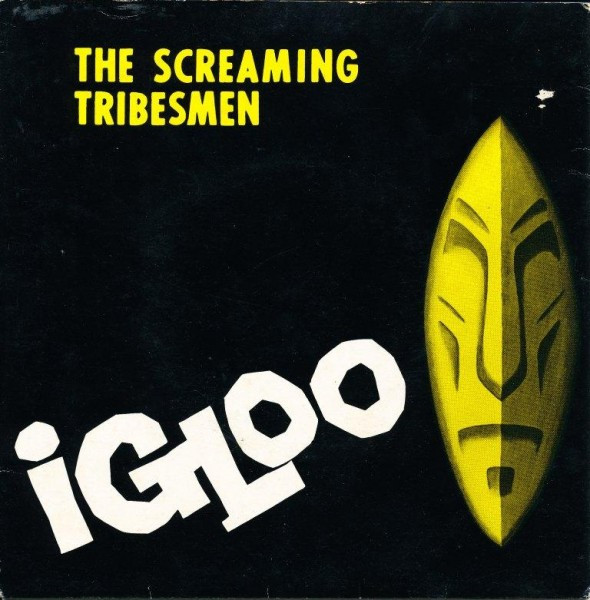
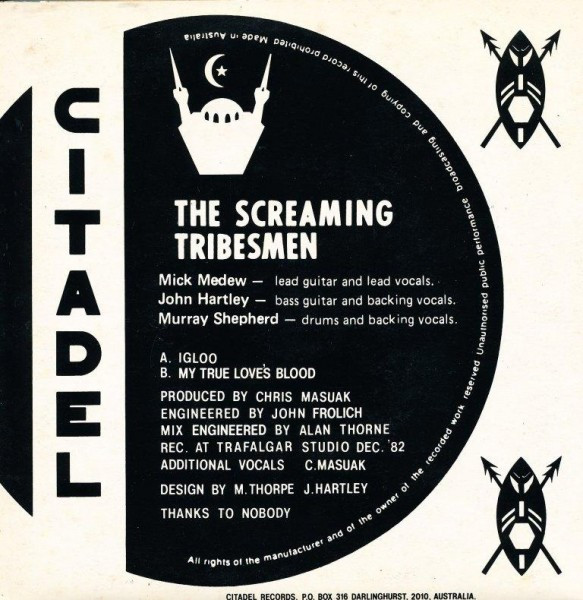
#088: The Screaming Tribesmen – ‘Igloo’ (Citadel Records ’83)

Dear friends,

for today’s single we have to go back to Australia again – and don’t you just love it there?

The thing is with Australian underground: its origins are rather complicated, at least they are for me. I know this is a vast generalization, of course, but the scene has not been the biggest one some 40 years ago and by and large there were just three important cities anyway. Perhaps these were the reasons that many bands, excellent as they may have been then, had a rather short life, who knows?

Not so The Screaming Tribesmen! I’m willing to bet you have never heard of them (and if you have, I’m sure you’ll only know their fabulous ‘Date With A Vampyre’) – although they played together for several years, toured the USA and Europe with some of the ‘big’ names (Damned, Cult, Dictators, Pursuit Of Happiness, Jane’s Addiction).

Originally from Brisbane, the Tribesmen relocated to Sydney, because that’s where they finally found a label which would release their stuff: Citadel Records. And today we have the first single for the label, recorded in ’82 and released a year later – ‘Igloo’.

Its roots date back to 1979 when Tribesmen singer/guitarist Mick Medewand still played in the 60’s garage rock band The 31st. Some folk left (to join Died Pretty and The Hoodoo Gurus), others came, and in ’81, The Screaming Tribesmen were born.

What I always loved about ‘Igloo’ is that in my mind it never fails to create a chilling landscape, making me feel like I am there, sheltering from the storm, while an arctic wind whips outside. This and its message of isolation, loneliness and despair combined with the melodic guitar sound makes the song so wonderful.

But to me it always reaches its peak with the line „I felt so lonely when my Samoyed died/I felt my tears freeze when I finally cried”. Now, how many of you know what a Samoyed is? I surely didn’t. A Samoyed is a breed of dog that is suited for colder climbs, originating from North-West Siberia. Find a picture, and you’ll see one of the happiest looking dogs ever. If this dog died, I’d cry too!!

And while I’m in my smart alec-mode: towards the end of the song comes the refrain “listen to The Shoeshine Boys”: this in fact was a black 50s doo-wop band from Alabama.


mp3: The Screaming Tribesmen – Igloo

One of my all time favourites, this: I do hope it meets with your approval as well!!

Enjoy

Dirk


LOST IN CRYSTAL CANYONS

A guest posting by Fraser Pettigrew (aka our New Zealand correspondent)

I know it’s hard to believe, but my musical life has not always been filled with ineffably cool and mould-breaking alternative rock and avant-garde sounds of impeccable obscurity, as it is now. I consider myself a child of punk rock, but I can’t say I was there at its birth, nor even that I embraced it in its infancy. There was a time before punk, and I was there, listening to other stuff. I warn you, some of what follows may shock you…

In the early 1970s I was a typical pre-teen pop fan, captivated by the glam stars on Top of the Pops, especially the rock-weighted hits of T-Rex, Slade, Sweet, Suzi Quatro, David Bowie and Gary Glitter. Particular singles lodge in my memory from that era: Gudbuy T’Jane, Wigwam Bam, Blockbuster, Solid Gold Easy Action, Children of the Revolution, Starman, The Jean Genie, Rebel Rebel, Can the Can, 48 Crash, Leader of the Gang, Rock’n’Roll part 1.

(JC interjects………anyone born in the UK in 1963 will have a similar story……I know I have!)

So far, so cool. Most of that music was still loved by the kids that started sticking safety pins through their ears a few years later. But the glitter faded in the middle of the decade as pop fashions changed or inspiration wore thin, and I was changing too. By the end of 1976 I was 13 and had already begun listening to more mature sounds on account of my older brother’s developing taste. This is where it gets ugly.

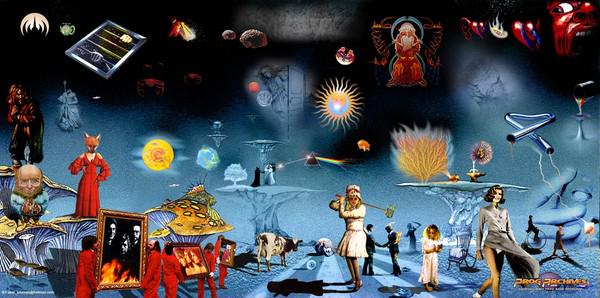
My brother’s record collection was a roll-call of prog-rock’s finest: Genesis, Yes, Pink Floyd. Also, God help us, Emerson, Lake and Palmer. Obviously singles were no longer the thing, and my borrowed playlist was now a run-down of the early-70s album charts, strangely still contemporary with the glam era but stylistically a million miles away from it: Trespass, Foxtrot, Selling England by the Pound, Fragile, Dark Side of the Moon, Wish You Were Here

(JC again interjects…..at which point I’m delighted by the fact I was the oldest child in the family!!!)

There were brighter moments. Rolled Gold, Abbey Road and Let It Be got consistent exposure, and a smattering of Sensational Alex Harvey Band lightened the prog landscape, if lightened is quite the word for Harvey’s gritty and somewhat misanthropic world-view. The song Anthem from The Impossible Dream album is an enduring echo from that time, evoking strong recollections of the young adult science fantasy ‘Sword of the Spirits’ novels by John Christopher that I was reading at the time.

But I was deeply embedded in the prog albums. I played them often enough to fairly say that I knew them inside-out. Meticulously hand-drawn reproductions of artist Roger Dean’s stylised Yes logo were a favourite adornment for school jotters. Admiration for Genesis caught up with the current moment with Trick of the Tail and Wind and Wuthering. My brother bought Pink Floyd’s Animals. My own record collection started, not with prog, but with Sgt Pepper’s Lonely Hearts Club Band and The White Album.

And then something happened. 1977 happened, to be precise. I was not, as you have probably sensed, keenly aware of what was going on in the music scene at that time. Despite the growing media panic, the first I heard of punk rock was on a school trip in May ’77. Although punk history goes back well into 1976 it wasn’t until the following year that it made a serious impact on the mainstream. If you were into punk in 1976 you must have been part of the Bromley Contingent, or you’re suffering from false memory syndrome.

A couple of punk bands appeared on Top of the Pops soon after I became aware that punk was a thing. The Boomtown Rats were Looking After No. 1 and Mary of the 4th Form brazenly appealed to our stirring hormones. I remember The Jam playing All Around The World and The Stranglers declared there were No More Heroes. The notorious Sex Pistols and the pure of principle Clash never appeared, of course, but I came to know who they were, and they all stood, or rather slouched in marked contrast to the saccharine disco pish that filled up the rest of the weekly show.

At school, one of our music teachers periodically offered us the chance to play some of our own favourite records in the class. My mate Drew brought in Rattus Norvegicus and invited the teacher to play the first track. “Some day I’m going to smack your face!” barked Hugh Cornwell. “Beeeeeeat you honey till you drop!” Miss Cavaye tried not to look disapproving and may have made some courteous observations on Dave Greenfield’s arpeggiated keyboard figures. Another girl in the class followed up with a track by Rush. We probably didn’t try to disguise our disapproval, and would have made disparaging remarks about arpeggiated guitar figures if we had the faintest idea what it meant.

The next time The Jam appeared on Top of the Pops I was fully invested, and deployed three pounds of accumulated pocket money to buy This Is The Modern World. It didn’t matter to me that it was neither then nor now considered to be a very good album; to me, it was the first step into a new world and the first manifestation of a personal metamorphosis.

I was still listening to The Beatles, but I was susceptible to the influence of my friends from whom it had become clear that music with long hair and flared trousers was no longer tolerable. I think the adrenalin energy of punk was gradually rendering the elongated indulgence of prog incompatible for me in any case, but I would have to be honest and admit that I didn’t reject my old favourites entirely of my own accord. I sought peer approval, as you tend to when you’re 13, but the explosive change of 1977 made it easy to switch.

It’s fair to say that all of us will have gone through changes in our musical taste as we moved from childhood into adulthood, growing out of the music that appealed to us in youth faster than our clothes got too small for us. The coincidence of that growth spurt with the revolutionary moment of punk was a momentous one for me. It’s a time in life when we crave independence, assert our individuality and search instinctively for our own personal identity. Punk laid an epochal transformation on a plate for me and I lapped it up.

My brother clung faithfully to the old guard. Not being the best-buddy kind of siblings, that probably only encouraged me to reject his record collection as I established mine along quite different lines. Yes logos were blotted out and by the end of the year I was artistically proficient in rendering The Jam’s spray-can design and even imitations of Jamie Reid’s ransom note lettering of the Sex Pistols, despite not actually owning anything by them at that point.

By the start of 1978 I was a mature and discerning fan of the new wave, ready to embrace the radical eclecticism spawned by the effective death (already!) of punk, symbolically marked by the final debacle in the brief career of the Sex Pistols that January. I had started listening to the John Peel Show and buying the NME and Sounds. From all of this a kind of philosophy emerged that has guided my cultural life ever since. Embrace the new, seek out the inventive and the innovative, the unconventional and the iconoclastic. Reject imitation and repetition, stasis and complacency, the status quo. Especially Status Quo.

In old wave parlance we might have said ‘Keep on runnin’ and ‘Don’t Look Back’. The music of Yes and Genesis and Pink Floyd was now most decidedly of the past and became dead to me. In the years since, I have discovered and come to love a great deal of music from that old, long-haired, flared-trousered past, from Neil Young and Joni Mitchell to Van Morrison and Bob Dylan. But I’ve never been able to go back to the prog. It now exists in my memory like a kind of dream, an unreal world of English whimsy, science fantasy landscapes and gigantic hallucinatory stage sets and light shows. It feels unconnected to any sense of reality or actual lived experience. I just can’t go back there.

Neil Young put it well on his 1979 album Rust Never Sleeps. In the song Thrasher he drew out an extended metaphor for restless artistic integrity. I searched out my companions, they were lost in crystal canyons”: I pictured them floundering in a Roger Dean landscape, though other kinds of crystals were probably involved. “It was then that I knew I’d had enough, burned my credit cards for fuel/Headed out to where the pavement turns to sand…”

“It’s better to burn out than it is to rust,” he sang on the opening track, My My Hey Hey (Out of the Blue), referencing ‘Johnny Rotten’. He wasn’t about to go all punk rock, but the point was clear.

In writing this piece, however, I realise I have potentially put myself in a difficult spot, as JC might dredge up something dreadful from Nursery Cryme or Tales from Topographic Oceans and I’ll feel compelled to listen to it, at risk of precipitating some kind of psychological flashback crisis. I recommend therefore that any of you who might feel similar trepidation ensure that you have a paramusical crash-team on stand-by, ready to administer a life-saving dose of 1977 by The Clash, or Art School by The Jam. Anything that delivers a full-bore shot of life-giving energy from that pivotal moment in popular music history. Anything that screams ‘keep on runnin’, or ‘don’t look back’.

mp3: T-Rex – Solid Gold Easy Action
mp3: Slade – Gudbuy T’Jane
mp3: SAHB – Anthem
mp3: Yes – Roundabout
mp3: Genesis – I Know What I Like
mp3: Pink Floyd – Great Gig in the Sky
mp3: Neil Young – Thrasher
mp3: Stranglers – Sometimes
mp3: The Clash – 1977
mp3: The Jam – Art School
mp3: The Adverts – New Church

Fraser

ON THIS DAY : THE FALL’S PEEL SESSIONS #14 & #6

(This one is a day later than planned…..I don’t want to interrupt the flow of The Robster‘s series on Super Furry Animals)

The continuation of this series for 2025 in which this blog will dedicate a day to each of the twenty-four of the sessions The Fall recorded for the John Peel Show between 1978 and 2004 – and you’ll have by now spotted that March was traditionally a popular month for the band to record a session, and once again 23 March proved to be a date on which two were broadcast.

Session #14 was broadcast on 23 March 1991, having been recorded on 5 March 1991.

To promote arguably their best Phonogram album, ‘Shift-Work’, the ‘four plus one’ line up of the group convened to record an especially vibrant session. A lumpy version of ‘A Lot Of Wind’ aside, Kenny Brady’s fiddle on ‘The War Against Intelligence’ is of note, further ahead in the mix than on the album.  A generous swipe at Madchester, ‘Idiot Joy Showland’ is performed with requisite venom; the use of megaphone on ‘The Mixer’ is pronounced and the similarities between the song and New Order’s ‘Thieves Like Us’ seem heightened.  Smith is on fantastic, crooning form.

DARYL EASLEA, 2005

mp3: The Fall – The War Against Intelligence (Peel Session)
mp3: The Fall – Idiot Joy Showland (Peel Session)
mp3: The Fall – A Lot Of Wind (Peel Session)
mp3: The Fall – The Mixer (Peel Session)

Produced by Mike Robinson

Mark E Smith – vocals; Craig Scanlon – guitar; Steve Hanley – bass; Simon Wolsencroft – drums; Kenny Brady – fiddle

Session #6 was broadcast on 23 March 1983, having been recorded on 21 March 1983.

The first session without Marc Riley (and also the quickest to air, fact fans – and also the longest time-wise) was as spiky as its soon-to-be parent album ‘Perverted By Language (the session material, for once, eas all to feature on the forthcoming album). ‘Smile’ is, as always knotty. ‘Garden’, the sluggish centrepiece of PBL, is rendered fascinating in its excessive repetition. Just when ‘Hexen Definitive – Strife Knot’ is running into its ninth minute, the exaggerated manner in which Smith intones “Ladies and Gentlemen, The Fall” is one of this box set’s highlights. ‘Eat Y’Self Fitter’ genuinely stirred Peel, who stated on air that he fainted listening to it and John Walters had to resuscitate him. It’s a great, upbeat rendition of the track

DARYL EASLEA, 2005

mp3: The Fall – Smile (Peel Session)
mp3: The Fall – Garden (Peel Session)
mp3: The Fall – Hexen Definitive – Strife Knot (Peel Session)
mp3: The Fall – Eat Y’Self Fitter (Peel Session)

Produced by John Porter, engineered by Dave Dade

Mark E Smith – vocals; Craig Scanlon – guitar; Steve Hanley – bass; Paul Hanley – keyboards; Karl Burns – drums

JC

SUPER FURRY SUNDAYS (aka The Singular Adventures of Super Furry Animals)

A guest series by The Robster

#4: God! Show Me Magic (1996, Creation Records, CRE231)

By the Spring of 1996, Super Furry Animals’ debut album was ready to go. A second preview of it came in the form of a track that had already been released, albeit in a different version, on the previous year’s Moog Droog EP.

mp3: God! Show Me Magic

This brand new recording wasn’t drastically different to the original in terms of its arrangement, but the bigger budget meant the production was much improved and gave the song a bit more of the welly it deserved. God! Show Me Magic has long been a fan favourite, but even at the time it was the single that thrust the band into the fore of the emerging Cool Cymru scene. Not that they cared about being part of any scene, SFA were too different to be part of anything but themselves. Even so, it made John Peel’s Festive 50 that year and became the band’s first top 40 hit.

It was released on 29th April 1996 on 7”, CD and cassette and invaded the charts at #33 before dropping out the following week. The b-sides had both been demoed and recorded for the album, but never made the final cut.

mp3: Death By Melody (CD only)
mp3: Dim Bendith

I’m not a big fan of Death By Melody. Even by the Furries standard, it was a little light and novelty-ish. Dim Bendith (trans. No Blessing) is the better of the two by far.

Three weeks after the single’s release, Super Furry Animals’ debut album ‘Fuzzy Logic’ was in the shops. It really was a refreshing change to hear something so new, yet so… old. The band chose to record it in their native land at the legendary Rockfield Studios near Monmouth. Their reasoning? “We heard they had jacuzzis and you got three meals a day, all the wrong reasons for going to a studio,” according to Gruff Rhys. Regardless, it was a triumph, with the media lauding it with gushing praise. It featured in all the relevant Best Of 1996 end-of-year lists, and even nowadays gets huge retrospective acclaim.

Being so out-of-step with the trends of the time, it’s somewhat surprising ‘Fuzzy Logic’ became such a success. But then, as I said earlier in the series, Super Furry Animals were proving to be the antidote to Britpop which was becoming stale and ugly. It was almost like the perfect protest record against that increasingly smug, self-congratulatory movement. While Blur sounded like The Kinks and Oasis wanted so desperately to be the Beatles, SFA bathed in Syd Barret and glam-era Bowie vibes, while occasionally hinting at a cheeky electronic undertone that would gradually come more to the fore and define their sound.

God! Show Me Magic was the hectic opener to the album. It wasn’t demoed for the record – I assume because they had already released a version at the time they were demoing these songs – but they did demo the track that followed it.

mp3: Fuzzy Birds [demo]

Fuzzy Birds is a song about a dream Gruff had about guitarist Bunf’s hamster Stavros. In the dream, Bunf wired Stavros’ wheel up to a dynamo to produce electricity for his house. The lyrics depict the conversation between owner and pet – the verses being Bunf, the chorus being Stavros’ reply.

Mad but brilliant! Or maybe it has a more serious message than you think:

[Gruff]: “Stavros came into Bunf’s life and it was a very beautiful moment for all of us, because we all loved Stavros: funky hamster! He had special tricks where he would slide up chairs. I had a dream that Bunf had wired up his wheel to make electricity for his house, so I wrote a song about it. But it dawned on me that it was also a song about the slave and the enslaver, and I think you can apply that to the worker and the employer, or the landlord and the tenant. It’s a pop song about a psychedelic dream I had, but basically Stavros was shouting for more worker’s rights.”

The first Super Furry Animals song about a super furry animal. There would be plenty more.


The Robster

SATURDAY’S SCOTTISH SONG : #444: THE COWBOY MOUTH

The Cowboy Mouth formed in the early 90s and consisted of Grahame Skinner (ex-Hipsway) on vocals and Douglas MacIntyre (far too many bands to rhyme off!!!) on guitars.  The duo wrote and recorded two albums, My Life As A Dog (1994) and Love Is Dead (1995), both of which were released by the Hamburg-based Marina Records.

In 2023, Past Night From Glasgow (the label connected to Last Night From Glasgow but with the purpose of focussing on ‘lost’ albums), gave a re-release to My Life As A Dog.   This led to Skinner and MacIntyre hatching plans to reform and perform, and for that purpose they recruited Laughlin ‘Lox’ Allan on bass and Dougie Hannah on drums.

This led to new material being written, and a new album, Faultlines is due for imminent release by LNFG.   The album was actually launched this time last week at a gig in Cottiers Theatre in Glasgow, on a night when the ninth birthday of LNFG was celebrated, and I can report that a very good time was had by all.

mp3: The Cowboy Mouth – The Swimmer

One of the songs you’ll find on the new album.  Click here for more info and purchase options.


JC

AN IMAGINARY COMPILATION ALBUM : #385 : THE JAM (3)

The relatively recent passing of Rick Buckler went unmentioned on the blog.  It wasn’t as much an oversight on my part as the fact that I really couldn’t find the right words to say at the time.  To be honest, I still really don’t think I can really add to the many hundreds of fine tributes that can be found out there across mainstream and social media outlets, other than to mention that I found it incredibly sad to realise that one of the first of my genuinely musical idols had died, at the all-too-young age of 69.

I was sure that I had written a review of That’s Entertainment : My Life In The Jam, the booked penned by Rick and published in 2017, but I can’t find it in the archives.  Maybe there was no review, and it was only it was mentioned in passing perhaps as a recommendation for adding to your Xmas lists.  Either way, I’m going to dig it out an re-read it, and this time pen something for the blog.

The Jam, as I’ve mentioned on so many occasions, were the first band I fell for in a very big way, and although it is now more than 40 years since they last made music together, I still find myself going back and playing the singles and albums on a frequent basis, never tiring of anything…well, almost anything as much of The Modern World album hasn’t aged well.

There’s been two previous ICA’s, the first being #52 back in December 2015 and the second being #152 in January 2018.

They were both a bit unusual in that neither featured any singles or b-sides.  The logic behind that was ICA 52 came almost immediately on the back of a long-running series on the band’s singles, while I self-imposed a rule for #152 that nothing on the previous ICA or any singles could be used.  But as my delayed tribute to Rick, I thought I’d try and come up with a definitive ICA.  I think it’s a more than decent selection, but there’s so many incredible tunes that I’ve had to leave off.  Many of the words in the description of each song have been lifted from previous postings.

SIDE A

1. Funeral Pyre (single, 1981)

One of the great things about The Jam is just how instantly recognisable so many of their tunes are, even after all these years.  The post-punk riff of In The City, the bass and organ which kick off A Town Called Malice, the acoustic strum of That’s Entertainment, the rat-a-tat first three notes of Going Underground….the list is endless.  Right up there among the best must be Funeral Pyre, which opens with a tour de force from the rhythm section before the lead/guitar and vocals come in.

There can be no better way to to acknowledge and appreciate Rick Buckler than to open the ICA with the one song on which his drumming prowess really stands out across the Jam’s entire output, and indeed the one song on which he was given a writing co-credit.  When I heard about Rick’s death, my mind went back to those amazing live shows at the Glasgow Apollo and how the lights shone directly on him as he smashed his way through the song’s final few seconds, inevitably and rightly leading to a huge roar from a very appreciative audience.

2. Strange Town (single, 1979)
3. The Butterfly Collector (b-side 1979)

All Mod Cons, released in November 1978, will, I suspect, be my all-time favourite album until my own dying day.  But just as I thought there was no way  The Jam could top its magnificence, they released an incredible new single and arguably an even better b-side in March 1979.

There surely can be no disputing that this remains an incredible record. The A-side is powerful and fast while the B-side is slow and haunting….but both contain really sad and moving lyrics. The A-side being the tale of someone lost, lonely and alienated having been lured to the capital by the bright lights and promises of streets paved with gold, while the B-side is a sorry and lurid tale of a groupie whose best days are behind her, but not that she has cottoned on. It’s worth remembering that back then, Paul Weller was a young musician very much in love with a long-term girlfriend, and this was his response to the sorts of offers which come the way of rock musicians while they are out on tour.

4. Saturday’s Kids (from the album Setting Sons, 1979)

As a 16-year-old who was becoming increasingly aware of politics and the difference between the ‘haves’ and ‘have-nots’, the sentiments of this lyric really hit home.  The fact it came accompanied by a killer, albeit atypical post-punk new wave tune, gave me a sense at the time that it was one of the greatest songs anyone had ever written and had recorded.  I’m old enough to know better, but I will never forget the euphoric feeling throughout my brain and body every time the needle hit the groove on this one.  The fact that Weller, Foxton and Buckler didn’t want the studio albums to be full of singles is the only reason this one never became a huge and memorable chart hit.

5. Town Called Malice (single, 1982)

One of the things I most loved about Town Called Malice was that it felt such a return to form after what, to me, had been the disappointing Absolute Beginners 45.   Looking back, I probably wasn’t alone in having such sentiments, given it came straight in at #1.

OK, there was the fact that, kind ahead of its time, Polydor Records indulged in a form of multi-formatting by releasing the studio version on 7″ and a live version on 12″ thereby just about guaranteeing it would go in at #1 given just how many fans that band had at the time.  The thing is, if Malice had been a bit of a duff number, then there’s every chance the 12″ version would have gathered loads of dust in record shops; after all, who would shell out for a live version of a song that was brand-new if it hadn’t been an instant classic? It could very well be argued that it has become the band’s best-known song, given it is very much a staple of the golden oldies slots on UK radio. And it still remains a belter to sway your hips to on the dance floor.

SIDE B

1. When You’re Young (single, 1979)

The anthem of my late(ish) teens.  The one which said it all, with a few, what felt like prophetic lines from the man who could do no wrong.

Life is timeless, days are long when you’re young
You used to fall in love with everyone

Life is new and there’s things to be done
You can’t wait to be grown up

but then there’s the words of warning, which really didn’t make sense at the time, but certainly did just a few years later after the halycon days of university were disappearing in the rearview mirror

And you find out life isn’t like that
It’s so hard to understand
Why the world is your oyster but your future’s a clam
It’s got you in its grip before you’re born
It’s done with the use of a dice and a board
And let you think you’re king but you’re really a pawn

I look back and there’s an increasing astonishment that Paul Weller, born in May 1958, wasn’t barely out his teens when he wrote so many of his greatest lyrics.

2. Going Underground (single, 1980)

In 1980, singles didn’t enter the charts at the #1 position. Instead, they came in somewhere in the 20s and that got you onto Top of the Pops. The single would sell well on the back of this TV appearance, would climb a few places and then again the following week into the Top 10. The second TOTP appearance would follow, and if it was different enough from the first one and Radio 1 was still playing it, then the Top 5 and a chance at #1 would follow. It was always a 3-4 week cycle to hit the top slot.

Going Underground broke all the rules of the game. It flew in at #1 and stayed there for three weeks, and in doing so, confirmed that my favourite band was also the biggest and best band of the time.

3. All Mod Cons
4. To Be Someone (Didn’t We Have A Nice Time)

OK….this means the ICA goes beyond the normal ten tunes, but I do find it hard to ever separate the opening two tracks which open up All Mod Cons…and besides with them having a combined running time of under four minutes, then it’s not as if I’m going to be accused of overcrowding this side of the vinyl.

It didn’t make too much sense to me at the time that there could actually be any downside to being famous and rich from being a footballer or a rock singer.  But then again, I never actually appreciated back in the day that, along with perhaps being a professional boxer, there were very few avenues open to working-class boys to really make it big.  Things might have been bad back in the late 70s when Weller offered up his cautionary words, but it surely was nothing in comparison to the horrific media frenzies which have become ubiquitous with celebrity life in subsequent decades, accelerated by the horrors of social media.

5. Thick As Thieves (from Settings Sons)

This is one of the key tracks from the band’s fourth and most ambitious album. There’s no doubt that in Weller was intending to go against the grain of the post-punk/new wave era by attempting to come up with a concept album telling the story of three childhood friends whose lives don’t go the way of their youngdreams with everything changing after them fighting, but surviving, a war.

The concept wasn’t fully realised, but then again to have taken on and complete such a task would probably have meant having to get off the treadmill when the band was at the height of its fame and popularity, and besides, the dangers of the fickle music media turning against Weller if he had realised such an audacious ambition were all too real.

6. Down In The Tube Station At Midnight (from All Mod Cons and also a single, 1978)

There are days when I think this may well be the greatest record of all time, especially with each passing year.  I almost always instantly offer up Temptation by New Order if asked the specific question, but depending on my mood, especially if I’m a bit more reflective than normal, then I could easily change my mind.

An incredible tune with an incredible lyric which, to a 15-year old who hadn’t yet set foot in London, was genuinely terrifying.  Not only did I never want to bump into the muggers but please don’t ever let me cross the path of the atheist nutter who sprays ‘Jesus Saves’ onto walls.  My first trip on the London Underground came in 1983. It happened to be on the Piccadilly line at King’s Cross, and I was genuinely intrigued at how deep down I had to go to get to the platform.

All the way down on the escalators I was quietly singing this song to myself, and to my amazement when I finally reached the end of the escalator ride down into the bowels of the city, I found I could indeed make out the distant echo of faraway voices boarding faraway trains.

Thankfully, I never met the atheist nutter, not knowingly at least.

The album version is closing out this ICA just as it did with the All Mod Cons album.  Where the single version fades out, the album version ends abruptly, followed by the  sound of a train departing the platform and a musical refrain of a guitar solo. It always felt as if this was the ‘real’ version of the song, with the horrific realisation that the victim of the mugging had in fact been murdered…….

I know it’s not the most upbeat of thoughts on which to end an ICA, but that’s entertainment.


JC

THE RETURN OF A LONG-LOST FRIEND

Once upon a time, many many many years ago during that short-lived period when long-form blogs such as the one you’re visiting today were all the rage, there was a fabulous place called Pretending Life Is Like A Song. Named after a line in a tune by The Wannadies, it was wonderfully curated by Adam F (not to be confused with Adam T aka Swiss Adam, whose Bagging Area continues to delight, inform, move and entertain in so many ways each and every single day.

Adam F called a halt to his blogging activities quite some time ago – probably around 2012 or early 2013 as I’m sure he stopped prior to the original Vinyl Villain site being unceremoniously destroyed by blogger in July 2013. Out of the blue, he dropped me an e-mail last week:-

“Hi guys – I’m guessing this is JC on the email but looking at the blog you never can tell.
I was trying to find something I once upon a time wrote for Matthew at SongByToad, browsing through the wayback machine and failing, but when I tried to find it more directly I found your new place instead.

I have been quietly playing with myself in the corner since Christmas, if you see what I mean…

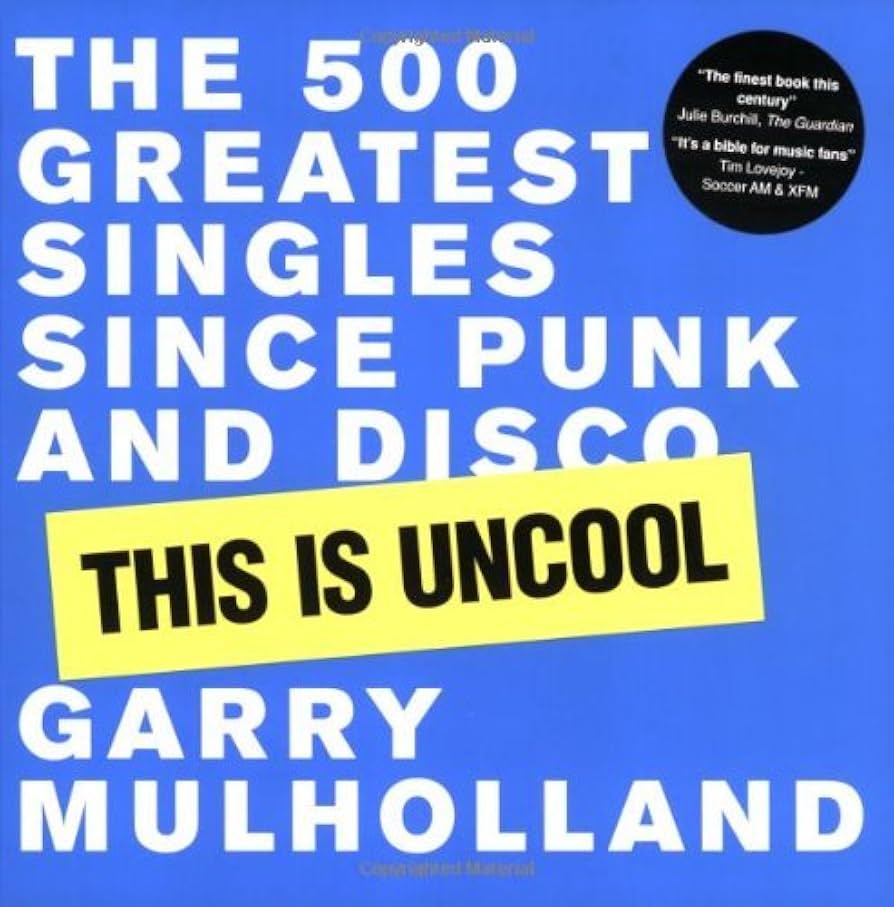
(I read Garry Mulholland’s books again at christmas and just thought ‘youknow, I’d quite like to do that again’ – I thought I’d try to write about a hundred songs with a url called ‘century’ but then wordpress gave me ‘century199’ as a url so it became 199 songs. I honestly don’t know what I’ll do when I get there – I thought i’d be finished and gone within a week.)

Anyway. Hi.

take care

Adam

x”

Adam was one of many early inspirations for, and supporter of, The Vinyl Villain, and it really is great to see he’s writing again. The blog is called 199 Songs and here’s what you’ll find if you click on the about section:-

“I don’t know how I’m going to do this – I don’t know how often, or if there’s any kind of order, or how many might be throwaway and how many might be core. I had an idea to write about a hundred songs without any plan about what those hundred songs might be but WordPress has given me a URL numbered ‘199’ so… we’ll see.”

He started things off on 25 December 2024 with She Loves You by The Beatles. He’s been prolific, and is just about halfway to through the task he set himself. It’s proving to be a very eclectic choice of songs, and without any question, there truly is something for everyone. Adam’s style of writing is rather lovely, and I’m incredibly jealous of his wonderful self-discipline which enables him to summarise things so deftly and so eloquently.

There’s a link going up in the sidebar of TVV. In the meantime, click on http://www.century199.wordpress.com and immerse yourself in some wonderful writing.

mp3: The Wannadies – Might Be Stars

For old times sake.

JC

ONE HUNDRED AND ELEVEN SINGLES : #087

aka The Vinyl Villain incorporating Sexy Loser

#087: S-Chords – ‘Voran! Voran!’ (Smarten-Up! Records ’89)

Hello friends,

and yes, back to Germany we go today, to sunny Düsseldorf! Who does not love it (apart from the people of Cologne, of course), capital of North Rine-Westphalia, home of a million Japanese and of terrible beer!

But Düsseldorf has also always been Germany’s musical capital, I think it’s fair to say. There are so many people I know who love at least one band from Düsseldorf, sometimes they even love a few: I know that Adam from the wonderful and constantly inspirational Bagging Area has a huge faible for all things kosmische: Kraftwerk, La Düsseldorf, Neu! – they all came from Düsseldorf, of course!

Our friend Walter from A Few Good Times In My Life will surely approve of the above as well, but knowing him, he’ll also like Deutsch Amerikanische Freundschaft, Family 5, Fehlfarben, Male, Charley’s Girls/Mittagspause, Der Plan, Rheingold … as I said, this city had a lot to offer!

My neighbour Klaus played bass for Shades Of Dawn in fact, whereas his wife Silke may well be more fond of Liaisons Dangereuses or, probably, Asmodi Bizarr.

My wife totally adores everything Die Toten Hosen ever did – me, I stopped listening to them after their second single from 1982, because as far as I’m concerned after this they became just goddamn awful. Nevertheless they are one of Germany’s biggest bands, partly because of still pretending to be original anti-establishment-punks in 2025 … whilst making squadrillions of Euros by issuing their pretentious rubbish incl. coffee mugs etc. on Warner Records.

Also, I once told their singer to bugger off when he tried to get in front of me at the bar at an early Green Day gig. So this band’s output (and my behaviour) remain a controversial issue within our marriage, believe me, but for 21 years I have stood my ground and I have no plans to change this!

So what about me, my Düsseldorf favourites, you’re asking? Well, I will not say today’s song is by Germany’s best band, that would be unfair. But unless someone comes up with a better 7“ from Germany, this has to be it:

mp3: S-Chords – ‘Voran! Voran!’

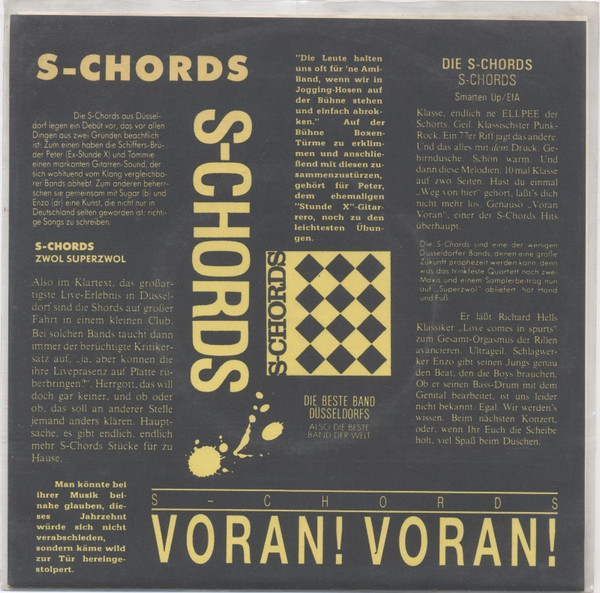
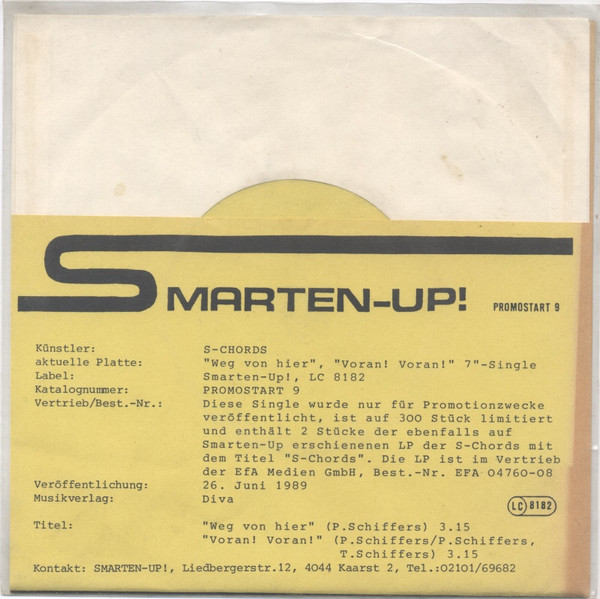
Now, The S-Chords have remained fairly unknown alas. Upon the strength of this song alone this is a mystery to me, as usual – but there you are. Then again all the names above are so big, perhaps this was one reason they did not make it at the time. ‘Voran! Voran!’ (‘Forward! Forward!’, should you be wondering) was first released on a cassette in ’85, then on 12“ one year later and finally as a limited promo 7“ with ‘Weg Von Hier’ on the A-Side in ’89.

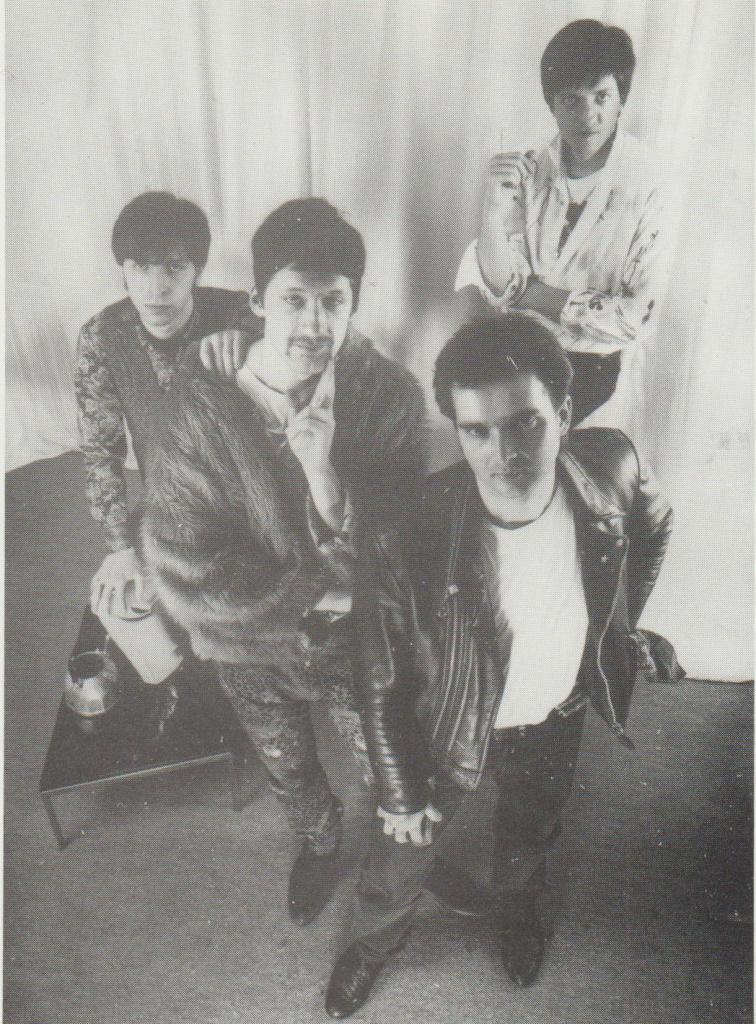
There isn’t much I can tell you about the band, I’m afraid. The S-Chords were led by the Schiffers-brothers, Peter (g, v) and Thomas (g, bv), and accompanied by Sugar (b) and Enzo (d, v).

Peter played with Stunde X for a while, but apparently has stopped making music altogether, as far as I know. Whatever became of the other three, I have no idea at all …

But anyway, in my humble opinion: if you view this 7“ alone as their legacy in life, they have achived a great deal more than I will ever achieve! A stunning tale of not giving up, not just looking behind/living in the past, of always being aware of the new chances life may offer to you: what more can you ask for in a song?

Enjoy,

Dirk


JC adds

Given how many acts have been listed in this, as ever, wonderful offering, surely I’m not alone in asking Dirk if he’d be able to find time to offer up a Düsseldorf ICA…….

THE CD SINGLE LUCKY DIP (18) : Teardrop Explodes – Serious Danger

R-1431658-1593867194-9677

Most of the time, the versions of songs released as singles are edited down from the album versions, usually to make them more radio-friendly, either in terms of production and/or running time.  Not in this instance……

mp3: The Teardrop Explodes – Serious Danger

At 4:23 in length, it’s fully 50 seconds longer than the album version.

Now, if Serious Danger is a song you’re not familiar with, then don’t worry….you probably won’t be alone.

It was written and recorded in September 1982 for what was intended to be the band’s third album.  This was a few months after the version of The Teardrop Explodes which had recorded and toured Wilder had imploded, and were now down to a trio comprising Julian Cope, Gary Dwyer and David Balfe.

Tensions in the studio were high, driven the fact that Cope and Balfe were at loggerheads about how the record should sound, the former wanting to write ballads and quirky pop song while the latter was determined to record synth-based music.

Julian Cope, who many folk regarded as being The Teardrop Explodes, quit the sessions.  Mercury Records tried to salvage things by issuing an EP, You Disappear From View, in February 1983, and to all intent and purposes, that was that.

However, after Julian had some success as a solo artist, the record label, in April 1990, decided to issue Everybody Wants To Shag….The Teardrop Explodes.  It was marketed as a Teardrop Explodes album, and while technically that night be the case, it is very much the work of David Balfe with the occasional vocal contribution from Julian Cope and some drum work from Gary Dwyer.  Serious Danger was chosen as a lead-off single….and it really is quite unlike any previous 45 by the band.

The two extra songs on the CD came from the first two Teardrop Explodes albums.

mp3: The Teardrop Explodes – Sleeping Gas (from Kilimanjaro)
mp3: The Teardrop Explodes – Seven Views Of Jerusalem (from Wilder)

It really was a strange release.  An early 80s synth-album coming out at a time when baggy was at its height.  It’s no surprise the single and album sunk without trace, albeit I reckon Serious Danger has some merit……but that’s me listening to it at some distance and placing it in the early 80s – I really hated it back in 1990!

JC

BOOK OF THE MONTH : MARCH 2025 : ‘TAX, DRUGS AND ROCK’n’ROLL’ by DAMIAN CORLESS

A good friend of mine spent time last year touring much of the coast of Ireland in a camper van.  He drove from Scotland to Cork to get things underway, and while in the city he picked up the book, Tax, Drugs and Rock’n’Roll to accompany him on the journey, having come across it in a store and reading the back page blurb:-

“How did an influx of British pop stars in the early 1980s kick-start a cultural transformation in Ireland?  The stars hadn’t come for the atmosphere or the creature comforts. They’d come for the tax breaks, to endure a ho-hum year of exile beyond the grasp of the UK taxman. What they found exceeded their expectations.”

Having read the book during the three-and-a-bit weeks he was on the road, my friend passed the book to me, saying that he’d be interested to hear what I thought of it.  Crucially, he didn’t say whether or not he had liked its contents…..

The author is Damian Corless, a Dublin-born music journalist, author, part-time bass player in bands and occasional writer of comedy sketches for TV programmes in Ireland and the UK. He begins the book with a prologue dating back to February 1981 when a newly emerging star of the Irish scene called Bono crashed his car into a telegraph pole outside the Corless family home, a random accident which changed the course of Damien’s life, and just four years later he landed a job on Hot Press, a monthly music and politics magazine based in Dublin.  There is no question that he’s very well-placed and connected to tell this story.

The book doesn’t just look at the musicians who came for the tax breaks in the 80s.  Indeed, its early chapters go back in time to John Lennon buying an island off the coast of Mayo in 1967, and the reasons why actors such as Peter Sellers and Robert Shaw set up home in Ireland in the 70s, before spending many pages describing how live music and culture was organised across Ireland, with constant reminders of how very rural and underdeveloped the country was for much of the 20th century.  In due course, we reached the point in time where the stories of how Phil Lynott and The Boomtown Rats came to be well-known are told, before a diversion into the tale of John Lydon ending up in jail after a fight in a Dublin pub in 1980.

It was all interesting stuff, but a long way removed from what the premise of the book was meant to be, but I suppose the scene had to be set and the context for what happened in the 80s had to be laid out, but it did feel like I was reading it under false pretences.

It took until Chapter 6 before we reached the part the blurb had promised.  A chapter called ‘Frances Rossi: The Rocker Who Set The Ball Rolling’.  It turned out that the Status Quo frontman, having intended to spend a year in Dublin in 1979 to reduce his UK tax bill, ended up falling for the city and staying there for a number of years.  The chapter was based on lengthy interviews with Rossi, and I have to say that I found it a bit of a chore, as I found his stories and anecdotes to be dull.  It was also a sobering reminder that the remainder of the book was going to celebrate rich tax-dodgers……..

Sting and Andy Summers of The Police soon followed Frances Rossi’s move to the Emerald Isle, but unlike the pony-tailed rocker, they never settled and moved away almost as soon as the time had come when there was no longer any tax gains to be had.  Members of Spandau Ballet, The Thompson Twins, Frankie Goes To Hollywood and Def Leppard were among those who arrived in later years, and while some of the anecdotes recounted in the book did bring the occasional smile (Holly Johnson accidentally finding himself as a shopkeeper for day in a small village shop primarily selling pottery), it was all just a tad self-indulgent.

Having said that, by Chapter 10 and Page 131, it was back to telling the story of how Ireland itself was beginning to change.  The remainder of the book looks at politics, censorship, the opening of a swanky Dublin nightclub (complete with VIP section for musicians and actors), the rise of U2, the successes of the Irish football team under an English manager, the decreasing influence of the Catholic Church in Irish society, the emergence of a new breed of Irish comedians and the vast physical regeneratuion of much of Dublin city centre.

The author brings his book to an end in 1995 when a peace process with the north of the country begins to become a reality.  The closing chapter brings together the various strands that had been explored, and makes the very valid point that Ireland had, over the course of less than two decades, undergone something of a cultural and social revolution.  But I have to say, that I found very little evidence that any of it was kick-started by UK musicians seeking tax breaks.

All in all, a frustrating read as it wasn’t the book I imagined it to be based on the back page blurb, with the British pop stars taking up a very small part of its overall contents.  And while it proved to be a worthy read for its wider context, it is not really a book about music or musicians.

mp3: A House – Here Come The Good Times

And yes, today was deliberately chosen to offer up this review.

JC