SONGS UNDER TWO MINUTES (19): BEATNIK BOY


From 1986.  A single released on the Edinburgh-based 53rd & 3rd Records, a label named after a Ramones song, and founded by David Keegan of the Shop Assistants, Stephen McRobbie of the Pastels, and Sandy McLean who was then working for Fast Forward, the Edinburgh-arm of The Cartel record distribution network

mp3: Talulah Gosh – Beatnik Boy

It has the catalogue number AGARR4.   It is possibly the most twee pop song of all time…..and I mean that as a huge compliment.

AGARR stands for ‘As Good As Ramones Records’ which must just about be the coolest way any label has ever come up with to provide its releases with a catalogue number.

Talulah Gosh were from Oxford and were in existence from 1986 through to 1988, releasing one flexi disc and five singles.  The classic line-up was Amelia Fletcher (vocals, guitar), Elizabeth Price (vocals), Peter Momtchiloff (lead guitar), Chris Scott (bass) and Mathew Fletcher (drums).


JC

‘STEALING’. A FOUR-PART GUEST SERIES IN BOOK FORM : #3 THE MC5

A guest series by Steve McLean
Not all of the disputed band trademarks are controversial. Sometimes fans of the band are just glad that any version of their favourite artists exist. This is often the case when a group has a revival career.

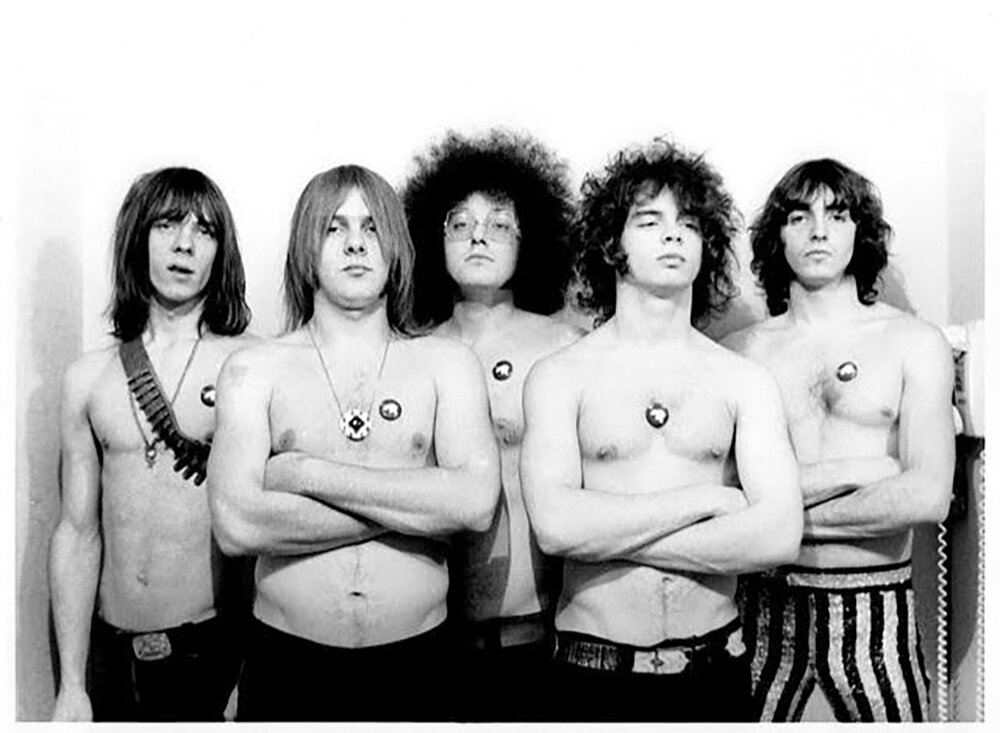
I don’t think I need to go too hard on the history of the MC5, it’s well documented and I can add nothing to it. By 1972 the band were on their last legs. It’s hard to imagine the now near mythical MC5 as not being popular but music history is a strange mistress (for example: read the positive reviews of the 1996 Sex Pistols reunion from the time and then how the shows came to be poorly regarded by much of the same press). Like a lot of bands from the USA who have a downturn in fortunes, they toured Europe so they could enjoy larger crowds and a few more pay days.

The proto punk that terrified the industry less than five years before were now on slightly less credible circuit. Hello York Rowing Club! Hello Epping! Hello Scarborough with late transport back to Hull!

(1972 UK Tour press cuttings)

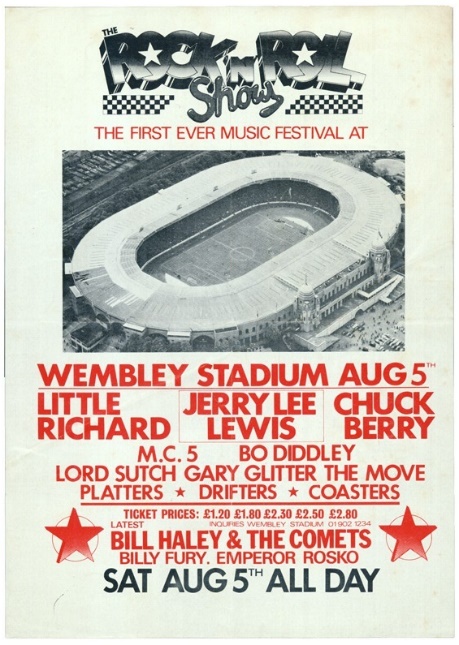
There was one ‘HELLO WEMBLEY” moment where the band appeared, somewhat curiously, on the a bill of 50s rock and roll stars at the old Twin Towers. The band made an ill-advised attempt at flirting with glitter rock, testing out a new sci-fi image. Their set was cut short after they were pelted with beer cans by the Teddy Boys in the audience.

(Poster for the Rock and Roll festival at Wembley Stadium.. there is a lot of crime on this bill)

During the tour, the group were reportedly in the process of making plans to relocate to mainland Europe and the UK. It was in the autumn when Rob Tyner and drummer Dennis Thompson and bass player Michael Davis decided to quit while Wayne Kramer and Fred Smith hired touring members to complete the remaining commitments.

The split meant that any hopes of the relocation and relaunch evaporated and by the end of the year, what remained of the group threw the towel in completely.

December 31st 1972 at the Grand Ballroom in Detroit the full line up of Tyner, Smith, Kramer, Thompson and Davis played together for a fee of $500. According to Splatt Gallery, the final gig went down like this;  there were only a couple hundred people in attendance. About twenty minutes into their set, Kramer told Smith he couldn’t play anymore, they’d been paid in advance so he had his money, he unplugged his guitar, jumped off the stage, and, in his own words, “drove over to the dope house”

And that was that. Let’s all enjoy the seminal work from a band no one ever heard of again.

mp3: MC5 – Kick Out The Jams

Except with all of these things, it absolutely wasn’t. In 1974 Kramer put a band together and called it the MC5. A line up of Mark Manko on rhythm guitar, Tim Schafe on bass, Bob Schultz on organ, and Frank Lowenberg on drums played gigs for drug money. The venue Humpin’ Hannah‘s in Milwaukee might sound like a redneck boob-bar but it’s still more rock’n’roll than the York Rowing Club (Rock’n’Row’l?).

Kramer’s time was up when he was busted for drugs and incarcerated until 1978.

When there is a dubious version of a band then the hardcore fans will often sway one of two ways… If it’s a later day member of the original group that keeps the band going then fandom with, with few exceptions, judge that member poorly. The previously mentioned Doug Yule copped a hell of a lot flack all through the 1980s and 1990s, before his side of events were truly told.

If it was a beloved member of the group that used the ‘New’ prefix then watch the fans scramble to justify or at least excuse the action. Read almost any Youtube comment section of The New MC5 from the late 1970s and you’ll see a load of comments about how the group was supposed to be billed as The Rob Tyner Band but in actual fact it was dishonest promoters who took advantage of Rob’s goodwill and billed the group as the New MC5. It sounds all very wholesome that Rob didn’t want to trade on his past and that it confirms all of our suspicions about the musicians we love being the good guys at odds with an industry that is trying to fuck them at every turn .

It’s also absolute bollocks.

“So first off this was not a MC5 tribute band it was never intended to be, Rob just decided to use the name New MC5. It was never once called the Rob Tyner band or ever billed as such”Ralph Serafino drummer. The New MC5. Via Email 2024.

Arguably the MC5 were the first punk band. The meshed garage rock with politics. Rob had spent years trying to gain a place for the band so when punk became a movement in the late 70s who could frankly blame him for reactivating a version of the band.  Blondie, The Ramones and all the other CBGBs movement were singing their praises… All of the bands that came after them made a dollar off the MC5s ground breaking work. Why shouldn’t Rob too?

It seems that it was no nostalgia show put together to please the safety pin set. Rod still had artistic dreams so the show featured only a few of what could be considered MC5 ‘classics’

“We only did three or four MC5 tunes in our set. We were a new original music band. We would generally open the show with 19th Nervous Breakdown by the Stones and end with Kick out the Jams, but we had a whole lot of new original music” Ralph Serafino drummer. The New MC5. Via Email 2024.

Incidentally there are a couple of MC5 bootleg live albums that have been released over the years that were actually recorded by the Tyner led group and erroneously marketed as the original group, If you have a live album with 19th Nervous Breakdown on then it’s almost certainly The New MC5 on the record.

Another piece of duplicity that seems to be norm in these circumstances is that local promoters would be selective on billing the band. Some would be happy to use the New MC5 but there are also records of The MC5 Featuring Rob Tyner, The MC5 Detroit and predictably, just The MC5.

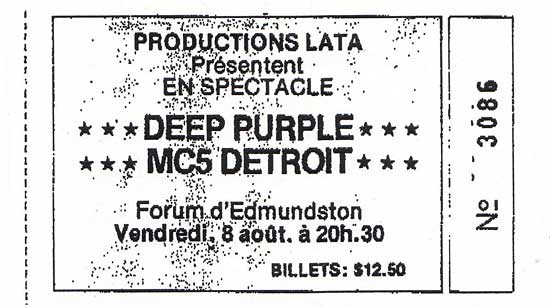
One notable gig in 1980 found them billed as The MC5 Detroit opening for Deep Purple (who themselves should have been billed as The New Deep Purple Featuring Rod Evans.) Rod Evans was the original Purple singer who had decided to chance his arm with a Deep Purple tour.

Money is often considered the motivation for such an enterprise in the industry. That may be true but not in the sense of ‘getting rich’ but more akin to the notion of ‘paying rent’.

The problem with touring a band with a name but without any record label support is that they have no other revenue streams other than live shows. They have all the expenses of popular outfit, including insurance and security and road crew. So the band without a label would likely have to play more gigs than a band with one, to make up the cash shortfall. Serafino’s memories of this time betray just how exhausting the constant touring was.

“(We) did some shows in Canada, but I really don’t recall playing with Deep Purple, but that’s not to say that we didn’t. We were doing a lot of gigs with different bands every night, so I wasn’t really paying a lot of mind to that at the time. I do remember one particular Canadian show, I believe it was a rock festival of sorts where we had to wait for hours to go on, it must have been running late or something, and that could have been the Deep Purple show.” Ralph Serafino, The New MC5 / MC5 Detroit.

Serafino paints a bleak picture of the slog a working band must undertake to make a living. Although anyone who attended that show had a great story to tell about two very unique line-ups of legendary bands.

The New MC5 toured for over three years, surviving on the continued interest from the new wave scene. They found themselves added to festivals and playing support to notable larger acts. Promoters shrewdly recognising that the MC5 name was of interest to the casual fan even if the hardcore had trouble with the billing.

“One night we opened for Blue Oyster cult, and they came to our dressing room to find out what the lyrics to Kick out the Jams because they covered it, I said to then you aren’t doing that tonight are you?” Ralph Serafino drummer. The New MC5. Via Email 2024.

BOC’s version of KOTJs was recorded in the late 1970s and finally released in 2024’s album Ghost Stories. It’s a decent but who out there thinks they can do this one better than the original?

mp3: Blue Oyster Cult – Kick Out The Jams

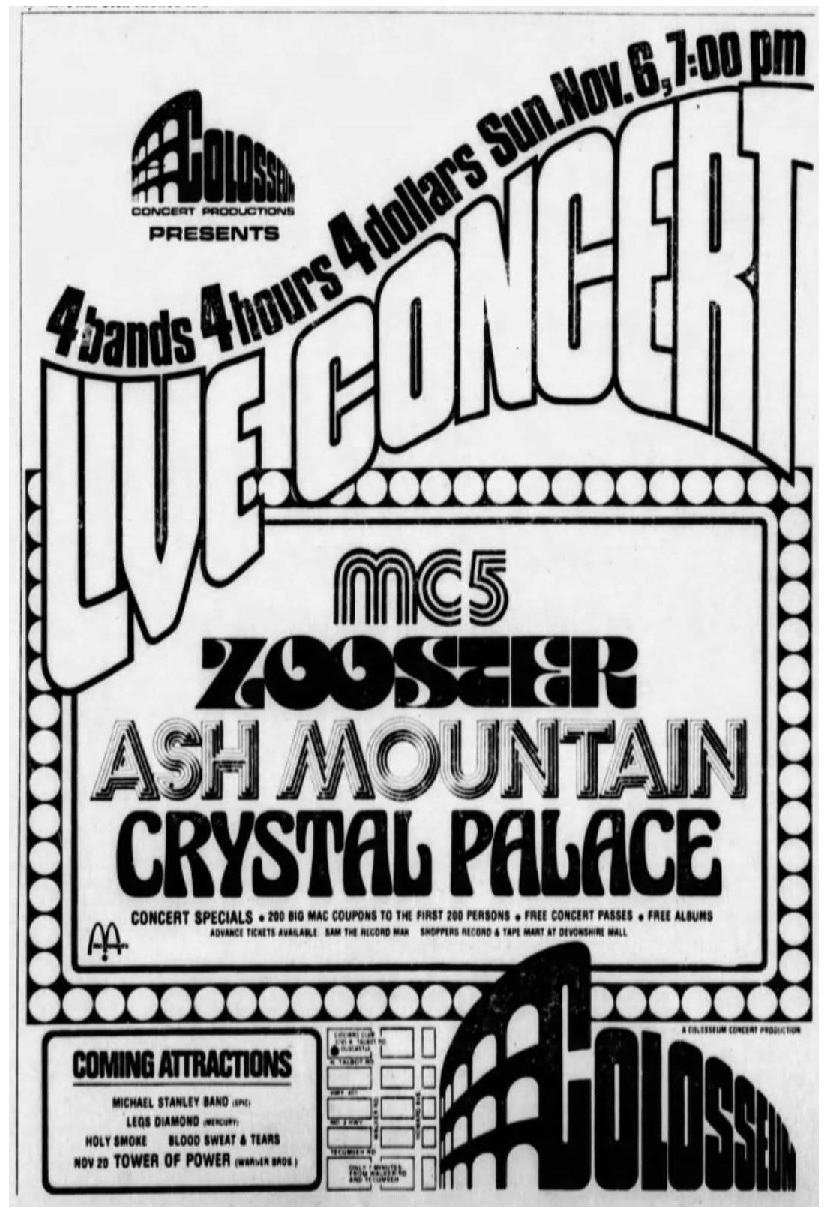
From the time the MC5 had broken up to the formation of the New MC5, the rock world had started to massively change, both morally and artistically. The new decade heralded a whole new world of merchandise and sponsorship. The music industry was increasingly less about music and more about industry. It would be interesting to hear what the counter-culture Rob Tyner of the late 1960s made of the early 80s Rob Tyner who headlined a festival sponsored by McDonalds..

(1980’s Music Festival Advert sponsored by McDonalds)

It’s fair to say that rock’n’roll is filled with duality, especially when people have bills to pay. Ritchie Blackmore of Deep Purple had a lot to say about Rod Evans reactivating the DP name in the 1980,

“I think it’s pretty disgusting that a band has to stoop this low and take somebody else’s name. It’s like a bunch of guys putting together a group and calling it Led Zeppelin. I don’t like this at all.” Ritchie Blackmore, Rolling Stone magazine, August 1980

But it seems he wasn’t so disconcerting when it came to the bands picked to support him.

“Also, we did do shows with Richie Blackmore’s Rainbow, those were killer shows.”Ralph Serafino drummer. The New MC5. Via Email 2024. 

One thing that has become evident to me as I delve into more of these stories; the clapback against the ‘New’ version of a band from the original members is often only really noticeable when others insist it should be. In other words when a fan-base or a body of journalists make enough noise about it. Most of the time the other members of the original group are happy just to live and let live, especially if they want to get on with their own thing. I’ll bet you Hugh Cornwell formerly of the Stranglers is actually pretty glad that there’s a band out there playing the Stranglers hits. It means he doesn’t have to.

Unlike with other ‘New’ acts, there’s no gory court case from the other original members of The MC5. There was no real muck slinging or public fall out. The band’s record label weren’t bothered since the back catalogue was rarely in print and if the other members were bothered by Tyner’s actions it was certainly not enough to spring for lawyers that they almost certainly couldn’t afford.

The New MC5 just kind of fizzled out in the early 1980s. Tyner later re-emerged during the decade in several outfits like “Rob Tyner & the National Rock Group” and “Stev Mantiev” a band who were comprised of Vietnam vets.

By end of the decade Rob and the band were being held in the mainstream esteem which they deserved. By 1990. it wasn’t just the cool hipsters that were name checking them as an influence but absolute raging gobshites like Bono were also singing their praises. The MC5 records were being reissued and he was in demand again.

Tyner passed away in 1991 of a heart attack that also killed off any hopes of a proper reunion.  The remaining four members played a tribute show to him in 1992. Fred Smith followed Rob to the afterlife in 1993.

They reunited as a trio in 2003 as DTK – MC5 playing with a revolving door of special guests before settling on a line up that including Gilby Clark of Guns’n’Roses and the ironically titled Handsome Dick Manitoba from the Dictators. They lasted until 2012 when Davis passed away. They were the most stable line up of the MC5.

In 2018 Kramer went out again this time as the MC50 to celebrate the 50th anniversary of the band.  It was really just Wayne Kramer and pals… Guests included Don Was of Was Not Was, Stephen Perkins of Jane’s Addiction and Billy Gould of Faith No More.  In 2024 he released an album called Heavy Lifting, it was a de facto Kramer solo album with star name guests like Slash and the guy from RATM that isn’t the shouting one. Thompson did play on a handful of the songs but his ‘featuring’ credit on the album tells a story.. Can’t Be Found has the most MC5 feel, albeit a sanitised version for the 2020s. It features Thomson and Vernon Reid from Living Colour.

mp3: MC5 – Can’t Be Found

Kramer didn’t live to see the album release, passing from cancer in February 2024 and Thompson joined him a few months later of a heart attack. We have no classic MC5 members left but every member of Mumford and Sons is still with us, which doesn’t seem fair.

As well as the live album mentioned above there have been multiple bootlegs of the Tyner’s new MC5. A good way to hear the band legally was on a release by the Japanese label ‘Captain Trip.’  In 2007 they released an album from the New MC5 under the title Rob Tyner Band. It was recorded in 1977 and he’s backed by Robert Gillespie lead guitar, Ralph Serafino drums, Mike Marshall bass and Billy Wimble guitar.  The sound quality is iffy but it’s great document of the time.

The show can also be found here https://www.youtube.com/watch?v=ejDUcBjPFeo

I’m going to pick a Tyner song to end the blog; in 1977 he recorded a single with the Hot Rods (without Eddie) called Till The Night Is Gone.

mp3 : Rob Tyner and The Hot Rods – Till The Night Is Gone

I’d like to thank Ralph Serafino for taking the time to answer my email.


STEVE McLEAN

ON THIS DAY : THE FALL’S PEEL SESSIONS #20

A series for 2025 in which this blog will dedicate a day to each of the twenty-four of the sessions The Fall recorded for the John Peel Show between 1978 and 2004.

Session #20 was broadcast on this day, 18 August 1996, having been recorded on 30 June 1996.

Marking the final appearance of Brix, the session is notable for an early run-through of ‘Spencer Must Die’ from ‘Levitate’ dominated by Julia Nagle’s keyboards.  There are extremely taut and economical versions of ‘Spinetrack’ and ‘D.I.Y. Meat’ from the recently released ‘The Light User Syndrome’ album.  If anyone has doubted Stephen Hanley’s bass prowess, just take a listen to his playing on ‘D.I.Y. Meat’. The standout of the session is undoubtedly Smith’s re-working of Captain Beefheart’s ‘Beatle Bones ‘N’ Smokin’ Stones’. The warped blues’n’poetry from the Captain’s 1968 ‘Strictly Personal’ album are strictly personalised by Smith.  It’s still quite a pleasure to hear Smith intone ‘Strawberry Fields Forever’.

DARYL EASLEA, 2005

mp3: The Fall – D.I.Y. Meat (Peel Session)
mp3: The Fall – Spinetrack (Peel Session)
mp3: The Fall – Spencer (Peel Session)
mp3: The Fall – Beatle Bones ‘N’ Smokin’ Stones (Peel Session)

Produced details unknown

Mark E Smith – vocals; Brix Smith – guitar, vocals; Steve Hanley – bass; Julia Nagle – keyboards; Simon Wolstencroft – drums; Karl Burns – drums; Lucy Rimmer – vocals

JC

AN IMAGINARY COMPILATION ALBUM : #392 : FRANCOIS KEVORKIAN

A guest posting by Martin Elliot (Our Swedish Correspondent)

Hi Jim,

I hope all is well at the Villain Towers!

When I today read your piece on the Francois K remix of This Charming Man an idea for an ICA flashed by since I’ve have this affection for him remixing European indie/alternative artists. Over the years, I have collected (quite) a few 12″ singles with such FK remixes. A quick look through my music library ended up with 20+ different songs remixed by Francois, not counting several versions (normally at least one dub version too) of the same track or the remixes of (mostly) black American disco/funk tracks.

Looking up the Wiki page over Francois reveals a French-born drummer who moved to New York in 1975, lack of success as a drummer moved him into DJing (I’m grateful for all the better drummers out there forcing this move to happen!) where he started fiddling with tape editing. Creating some buzz with his edits he was recruited to Prelude Records (a great dance music label by the way) where he did several successful remixes for US disco/funk artists.

For some reason unknown to me, he quickly became the go-to remixer for European artists wanting a club remix of their songs primarily for the US market, making remixes for just about everyone between The Cure and Kraftwerk. Some of the tracks included here were only released on the US version of the 12″, where the UK/European 12″ had a different remix. I omitted The Smiths as JC recently had it here on the blog, I also omitted Situation by Yazoo as I guess there are few living not aware of it.

Since it is a bit of a mixed bag of goodies it’s been a challenge to get a good album flow, but I hope you can enjoy this ICA as a showcase for a great remixer more than a consistent album.

Francois Kevorkian – The Indie 12 inch Dance Remix ICA

A1 Lloyd Cole & The Commotions – My Bag (US 12″ dancing remix)
A2 Echo & The Bunnymen – Lips Like Sugar (US 12″)
A3 Associates – Heart Of Glass (temperament mix)
A4 The Cure – Hot Hot Hot !!! (12″)
A5 Scritti Politti – Perfect Way (12″)

B1 Set The Tone – Dance Sucker (12″)
B2 The The – Gravitate To Me (dance mix)
B3 Yello – Call It Love (US 12″)
B4 Depeche Mode – Personal Jesus (holier than thou approach 12″)
B5 Kraftwerk – Radioactivity (1991 12″ remix)

Dance on!

Martin


SUPER FURRY SUNDAYS (aka The Singular Adventures of Super Furry Animals)

A guest series by The Robster

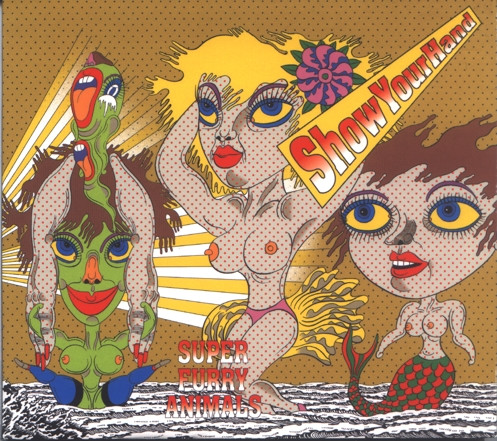
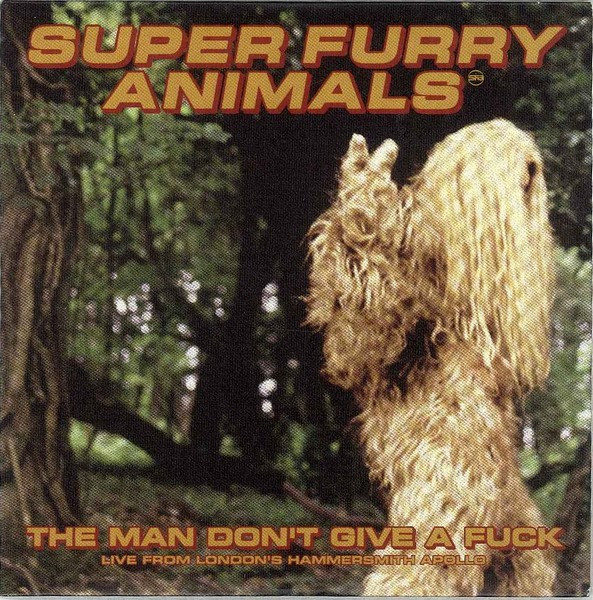
#25: Show Your Hand (2007, Rough Trade, RTRADS402)

For the first time since their very first release way back in 1995, a whole calendar year passed without a single Super Furry Animals release. Their contract with Sony was up, and so the band found themselves signing a new deal with legendary indie label Rough Trade. It would have been easy to call it a day, or take an extended break and concentrate on other projects (Gruff released his debut solo album ‘Yr Atal Genhedlaeth’ a few months before the Furries ’ last album ‘Love Kraft’ in 2005). Instead, the band headed back into the studio to record new material.

The approach was different to previous records. It was during the tour to promote ‘Love Kraft’ that the band realised there was a “very different atmosphere” in their audiences when the new songs were played. ‘Love Kraft’ wasn’t exactly full of rockers, most of the songs were mid-tempo, strings-laden and rather chilled. The crowds weren’t overly enthused by them in the live setting, so the decision was made to make the next album “a really abrasive, loud record”, according to Gruff. “It’s definitely the first time our audience has influenced our music in that sense.” In addition, label boss Geoff Travis also told the band he’d like “one of those pop records like you used to make”.

You could argue that the resulting album ‘Hey Venus!’ wasn’t that abrasive or loud, but it was undoubtedly more pop than its immediate predecessor, and a lot shorter. In fact, at just 36½ minutes in length, it remains the shortest album in the band’s catalogue. For the longer-term fans, it signalled a sort-of return to what the band did best – a quick blast of largely unadorned psyche-infused rock-pop songs with an occasional twist that marked them uniquely as the product of Super Furry Animals.

To announce the new record, Show Your Hand was released as a single on 16th July 2007, though initially only as a download – a sign of where the music industry was heading.

mp3: Show Your Hand

It was an interesting choice for the lead single, not least because it hadn’t been included in the band’s first tracklist draft as they felt it sounded “too generic”. Geoff Travis disagreed, insisting it could be a single with a little bit of work. The addition of a French Horn to the mix finally convinced the band to include ‘Show Your Hand’ on the album.

For me, it’s a decent song, something not unlike the ‘Rings…’-era, but I sometimes sway towards the band’s original thoughts of it being a bit… normal. It has some nice touches though – the harpsichord for starters, and I’m a sucker for a gorgeous French Horn (oi, quiet at the back!) The critics all seemed to love it, but once again couldn’t agree on who it sounded like – The Beach Boys, The Zombies and Burt Bacharach were all bandied around, as was the term “classic Furries”, which let’s face it, is a bit of a lazy cop out.

Four weeks after the digital release, two physical formats were put out. The following week, Show Your Hand entered the UK chart at #46 which is as high as it got. It was only the band’s second single in 10 years not to crack the Top 40 (the other was Ysbeidiau Huelog which was a weird Welsh song only released on vinyl in very limited quantities). In fairness, it was probably due to the fact that as it had already been downloadable for a month, maybe the fans weren’t going to rush out and buy something they were already familiar with.

More fool them (if that were the case) as they missed out on the b-sides. Both 7” picture disc and CD formats included this track, originally demoed a few years earlier:

mp3: Alluminium Illuminati

One of the band’s best b-sides since the ‘Rings Around The World’ era. This one really is “classic Furries”, harking back to the days when glam rock was still a big part of their sound. I do wonder why it never made it onto ‘Hey Venus!’. It certainly had room for one more song, and this one wouldn’t have been out of place. A really good tune.

The CD single also included this track:

mp3: Never More

Not a homage to Edgar Allan Poe, but another of those psychedelic glam rock stompers we used to enjoy on a SFA flipside. Not really one for the album this, but those loud guitars they alluded to are prominent. The drums right at the start gave a hint as to what the next single would sound like…

Now, as I mentioned last week, bonus tracks are not so easy to come by for this period of the band’s career, not at the moment, anyway. So I find myself digging a little deeper than normal. That said, I’ve got two that might constitute a bonus 7” for you. The first, a live version of Show Your Hand from 2007’s Glastonbury Festival, a couple of weeks before the single’s release.

mp3: Show Your Hand [live at Glastonbury]

And the fact that Alluminium Illuminati was originally demoed for ‘Phantom Power’ means it was included in that album’s 20th Anniversary Edition package. It’s the fully-formed song, but minus the loud guitars, more an acoustic version. I think I prefer the later b-side version, personally…

mp3: Alluminium Illuminati [2002 demo]

Next week, we go all Phil Spector on your super furry arses…


The Robster

SATURDAY’S SCOTTISH SONG : #466: FELIX D’ARCY

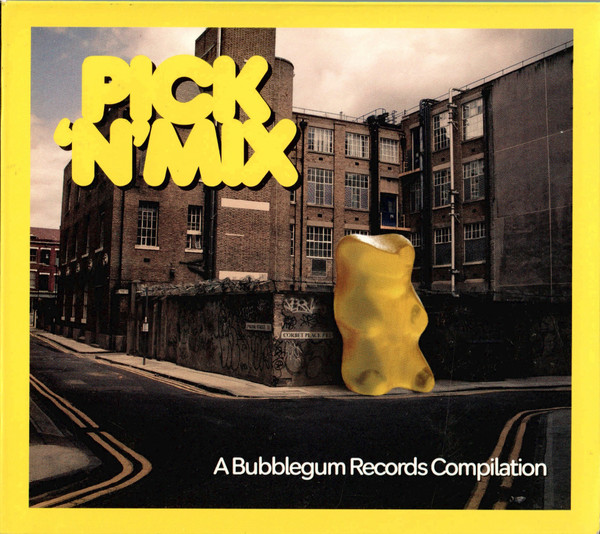
This isn’t the first time in this series that I’ve featured a track from Pick’n’ Mix, a compilation album issued by the Glasgow-based Bubblegum Records back in 2009.

This time round, you get to hear the contribution from Felix D’Arcy:-

mp3: Felix D’Arcy – Pictures From The Pavement

I’ve ascertained that Felix is from Glasgow, but there’s not a lot more info out there other than the name is taken after a character in the spy novels penned by John Le Carre.

The song is a bright sounding, catchy acoustic number, kind of perfect for sunny summer afternoons lounging in the park while emptying your cargo.  But the tune masks a lyric which isn’t all sweetness and light…..

I know that at least two of the people involved in Bubblegum Records meander to this blog on the odd occasion.  This one goes out to them with huge thanks for all they did then and what they’ve done since.

JC


WHEN THE CLOCKS STRUCK THIRTEEN (August)

29 July – 4 August

Two Tribes remains at #1 for an eighth successive week.  Careless Whisper would be the song that would eventually end its reign at the top, and it was the highest new entry this week, coming in at #12.  It would prove to be THE big song of August 1984, giving the Wham vocalist a #1 hit with his debut solo effort.

This particular chart does offer up plenty that you will still hear today on those sorts of radio shows where the adverts are for SAGA holidays, funeral plans and the like – at least it seems that way when I’m the passenger in a car being driven by someone who really doesn’t care about music, or worse, knows that I’m such a snob they deliberately tune into the stations most likely to wind me up.

Some sanity does come courtesy of an indie-type band from Norwich, but who were signed to EMI Records, offering up their take on what had been a Top 10 hit for Cliff Richard & The Shadows* back in 1966:-

mp3: The Farmer’s Boys – In The Country

In at #50, it would then spend the next three weeks in the mid-40s.

Coming in at #59, for what would be their only Top 75 entry in what, in a parallel universe, would be an illustrious career, were TVV favourites:-

mp3: Friends Again – Lullaby No 2 Love On Board

The lead track on The Friends Again EP, a five-track release issued on 2 x 7″ singles and 12″ single.  I still get pissed off thinking back to how badly Mercury Records mishandled the band.

*a second cover of a Cliff and The Shadows tune entered the charts this week.  The song was Summer Holiday (#1 in 1963) and the ‘singer’ was Kevin the Gerbil, a puppet character on a kid’s TV programme.  Kevin the Gerbil would eventually reach #50…..which, FFS, was higher than Friends Again managed.

5-11 August

Frankie Goes To Hollywood narrowly held off George Michael at the top of the charts, but we should be grateful for small mercies, as the horrific Agadoo by Black Lace would probably be #1 otherwise.

The highest new entry at #33 belonged to Howard Jones, who, along with Nik Kershaw, is a reminder of how synth-pop had been hijacked and turned into chart fodder by the major labels, as well as offering evidence that the mid-late 80s, for much of the time, was a really boring period for chart music.

There were loads of other new entries – Miami Sound Machine (#41), Dio (#42), The Pointer Sisters (#43), Break Machine (#51), Elton John (#52), Change (#53), Gary Moore (#55), Michael Jackson (#62) and Second Image (#68).  I take it, like me, you’ll be really struggling to remember anything about many of those acts, while the songs of those you’ve heard of were all, without fail, the ones you don’t most associate with them (e.g, Passengers by Reg Dwight and Girl, You’re So Together by the King of Pop).  Just as I was about to completely blank the entire Top 75, a little bit of salvation appears at #72:-

mp3: Paul Quinn & Edwyn Collins – Pale Blue Eyes

The mighty Quinn might have left Bourgie Bourgie floundering with his unexpected departure, but the results of his first solo effort, via the newly formed Swamplands Records, under the leadership of Alan Horne (Postcard Records) and funded by a major in the shape of London Records, offered up immense hope.  But as the saying goes, it’s the hope that kills you…………………………….

12-18 August

Between the slim pickings of July 1984 and the first two weeks of August 1984, I was dreading opening up the webpage for this and indeed the following week.  At long last Two Tribes was no longer #1, ending a nine-week stay, but such was its omnipresence that it would be a further 11 weeks before the sales were such that it dropped out of the Top 75.

Iron Maiden were the highest of the new entries, in at #27 with 2 Minutes To Midnight.  I’ve never thought of this lot being a singles band, but it turns out this was their ninth Top 40 hit, going back to February 1980, and there would be a further 26 singles to make the Top 40 up until January 2007.  I would probably recognise three of them at most…..

A couple of songs sneaked into the Top 40 this week, and while I’m familiar with the performers in both instances, I honestly couldn’t recall either single:-

mp3: David Sylvian – The Ink In The Well (#37)
mp3: Tears For Fears – Mother’s Talk (#38)

19-25 August

Another of the year’s massive songs made its first foray into the Top 75 this week.  Stevie Wonder might have been responsible for some of the greatest funk/soul/pop hits of the 70s, but the following decade saw him go dreadfully mainstream, and none more so than I Just Called To Say I Love You, in at #3 and soon to spend six weeks(!!!) at #1.

Some awful song by Spandau Ballet was next highest at #23.  It was called I’ll Fly For You, and it would eventually soar its way into the Top 10. I think it’s fair to say that Top of The Pops in the month of August 1984 was far from essential viewing.

The theme song from the film Ghostbusters entered at #56.  It was still in the Top 75 some 31 weeks later, in March 1985, having peaked at #2.  I wonder how much money Ray Parker Jr has made from said song over the decades, notwithstanding that some ten years later, he and his record company had to reach an out-of-court agreement with Huey Lewis who had sued on the grounds of plagiarism.

For the third week in four, some respite came from musicians with a Glasgow connection:-

mp3: Lloyd Cole & The Commotions – Forest Fire (#59)

The big ballad from the debut album.  I suspect Lloyd and the Polydor Records high heid-yins expected and hoped for better things than the #41 placing it eventually reached.  One of the most enduring songs of the entire year as far as I’m concerned, as it helped soundtrack many a romantic post-indie disco session in my student digs.

Two more worth mentioning sneaked into this particular chart:-

mp3: The Armoury Show – Castles In Spain (#69)
mp3: Elvis Costello & The Attractions – The Only Flame In Town (#71)

Richard Jobson‘s new band in the wake of the break-up of The Skids had, on paper, loads going for it what with Russell Webb also coming over from The Skids as well as John McGeogh and John Doyle having previously been part of Magazine, also in the line-up of The Armoury Show. Sadly, and maybe there was just too much in the way of expectation, the music never really hit the spot, and if they are remembered for anything (which I doubt), it will be for this debut single.

As for Elvis, this was the second single lifted from the rather underwhelming album, Goodbye Cruel World.  #71 was just about all it deserved.

26 August – 1 September

mp3: The Smiths – William, It Was Really Nothing (#23)

The a-side of what I still believe is the greatest 12″ single of all time, with Please Please Please Let Me Get What I Want and How Soon Is Now? as the b-sides.

William might only be 131 seconds in length, but not a single one of them is wasted.  The chart position led to what proved to be one of the band’s most memorable Top of the Pops appearances, with Johnny playing a guitar gifted to him by Elvis Costello and Morrissey stripping to the waist mid-song.  It all should have meant it went to #1 the following week, instead of #17, where is peaked.

A few more to see the month out….

mp3: Aztec Camera – All I Need Is Everything (#61)
mp3: The Bluebells – Cath (#65)
mp3: Marc Almond – You Have (#67)
mp3: Associates – Waiting For The Love Boat (#71)

Aztec Camera‘s advance 45 off their forthcoming second album was a bit of a letdown to those of us who thought the debut album High Land Hard Rain was as good as anything to ever come out of Scotland.  It felt like a real betrayal of the Postcard-era roots, and not simply because Mark Knopfler of Dire Straits was the producer, but there was also the nonsense of a Van Halen cover as its b-side. I was disgusted in 1984, and I’m still disgusted 41 years later….albeit All I Need Is Everything, it has to be admitted, is a fine pop single.

Cath was a remixed version of the song that had taken The Bluebells into the chart a year or so earlier, being an attempt to cash in on the success of Young At Heart a few months earlier. It would peak at #38 a few weeks later.

Marc Almond‘s second solo single would, like its predecessor The Boy Who Came Back, fail to break into the Top 50.  It would take quite a few years before any of the totally solo material would replicate the sales of the Soft Cell singles, and even then, it would require to be cover songs.

The Associates without Alan Rankine weren’t making the music that had been so successful back in 1982.  Billy Mackenzie‘s voice remained quite magical, but the tunes were, it could now be argued with hindsight, kind of Associates by Artificial Intelligence (not that such a thing existed back then).

And with that thought, I’ll call a halt to proceedings this month.

JC

ONE HUNDRED AND ELEVEN SINGLES : #104

aka The Vinyl Villain incorporating Sexy Loser

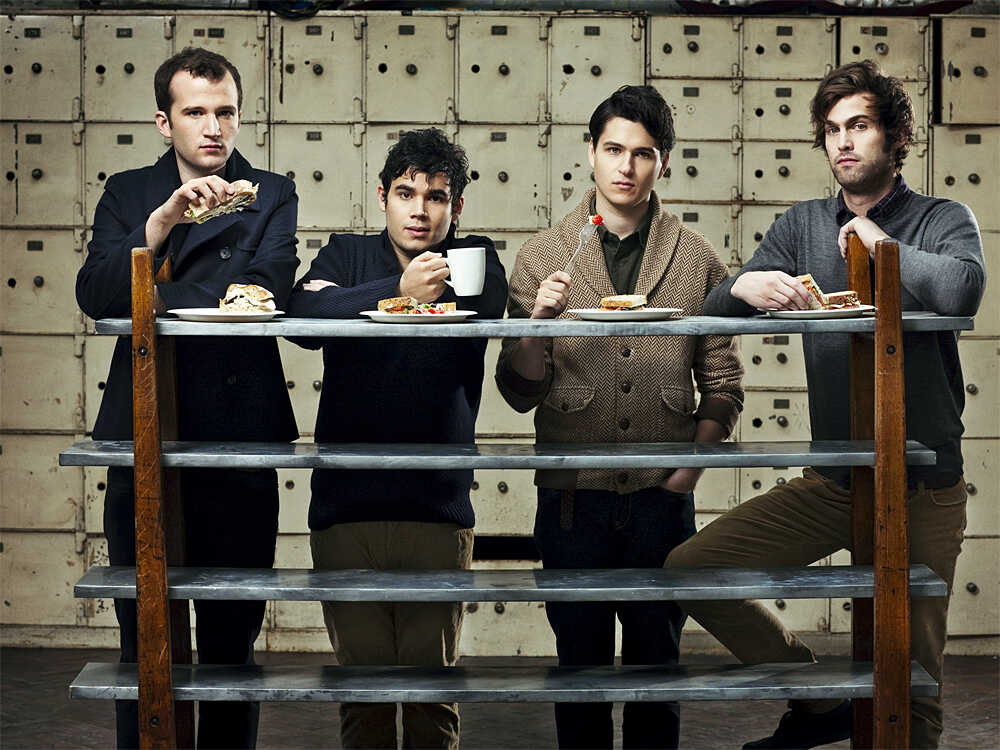
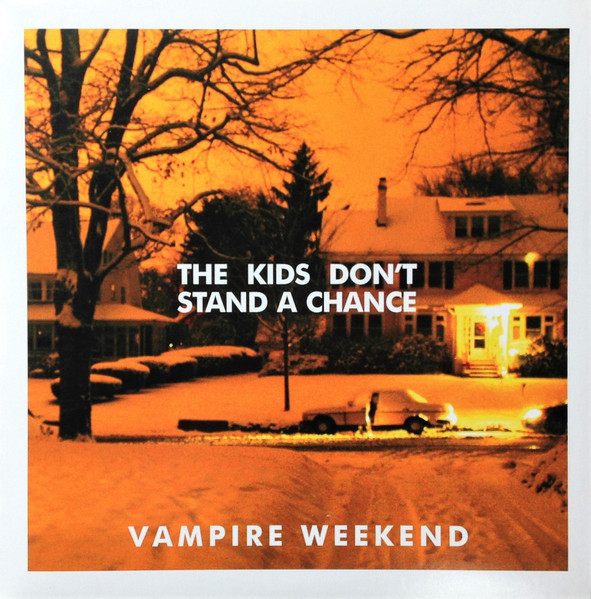
# 104: Vampire Weekend – ‘The Kids Don’t Stand A Chance’ (XL Recordings ’08)

Good morning friends,

just back from Turkey and I’m gorgeous golden-brown: if you could see me, I’m sure you wanted to dance around me! And for a change: chart band-sound for you today, and I bet you are as astonished as me! Vampire Weekend it is, and I must confess that I liked their early stuff quite a lot, but soon lost interest. Probably a huge mistake, but there you are.

If I remember correctly, Vampire Weekend first came to my attention via the “Contrast Podcast”, which was a fabulous little thing, hosted by the mighty Tim, who now lives right in the Swiss mountains. Tim would announce a theme, you see, and various folk from all around the world then had a week to record a little intro for a song which they thought would fit said theme somehow and Tim would put it all together. All styles were allowed, which made the podcast very interesting indeed. JC and me were regulars back then, so was Matthew from Song from Toad-fame. I do miss the Contrast Podcast, I must say!

Anyway, someone chose Vampire Weekend, until then unbeknownst to me – and they blew me away, you see, because what they did was really new, at least to my ears. I mean, doing style crossovers was a common thing to do for many artists since Stone Age of course, but the styles Vampire Weekend went for, or better: the combination thereof, were extraordinary indeed! Indiepop, Punk Rock, Chamber music (which I know nothing about, I must admit), soukous and Congolese rumba – and let’s be honest: who of you doesn’t like to dance to a good Congolese rumba at times, come on?!).

Now, normally you would think that such a mix is bound to fail, but as we all know the band became the hottest shit whatsoever in 2008, after the release of their debut album. Which had eleven tracks on it, five of which were released as singles in 2007 and 2008. I’m quite sure that even if you remember pretty much nothing else, ‘A-Punk’, ‘Cape Cod Kwassa Kwassa’, or ‘Oxford Comma’ will still ring a bell, right? All singles, great ones at that – but typically my favorite one is this, the lesser known of the lot:


mp3: Vampire Weekend – The Kids Don’t Stand A Chance

It was the album closer, which most of the time is not the preferred choice – but hey, I don’t care, I always loved this song. A catchy little tune – and even today I haven’t got a clue what it possibly might be about. Then again: do I want to know? No, because knowing would risk its beauty!

Enjoy,

Dirk


‘STEALING’. A FOUR-PART GUEST SERIES IN BOOK FORM : #2 THE VELVET UNDERGROUND

A guest series by Steve McLean

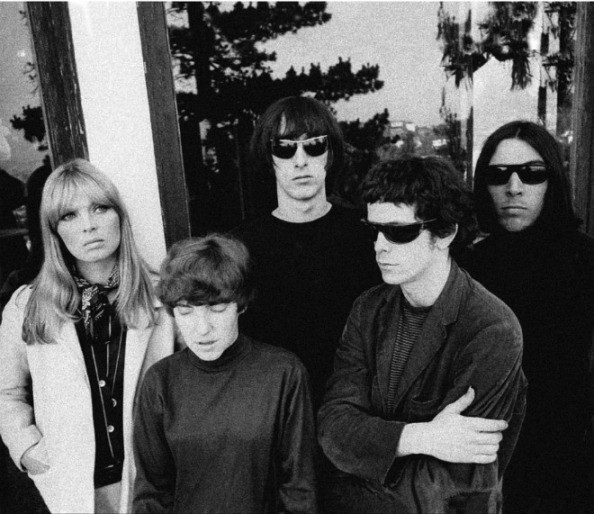
NOOOOOO! Not The Velvet Underground, NOOOOOO! They’re too cool. You expect bogus line ups of The Pacemakers or Herman’s Hermits or Ratt (spoiler; all line ups of Ratt are bogus). But not the Velvet Underground. You see it’s one thing when ‘naff’ bands like Amen Corner or The Sweet tour with multiple line ups and a scarcity of original members but when it’s a group of beloved untouchables, it becomes an outrage. Put your handbag away. (Also, fuck you, The Sweet were boss).

I’ve been looking forward to writing this. In our world of Mandela Effect false memories it’s worth keeping in mind that The Velvet Underground couldn’t get arrested when they existed. These days they are adored by thousands more people than ever saw them in their lifetime, but speak to just about every music fan from the time and they’ll swear blind they were huge fans all along; Like the three million people who attended Woodstock or the people who were definitely in the French Resistance or the people who always knew that the sexism in Britpop wasn’t ironic and didn’t like it, there’s way more of them now than were at the time.

Time has a habit of playing tricks on us when it comes to the zeitgeist. The Velvet Underground are fucking cool now, but when Lou Reed quit in 1970 they were just another band singing for their supper, albeit one who were doing a mammoth nine week residency at Max’s Kansas City (which sounds impressive but; capacity 200 with many tickets available on the door most nights)

During the run of Max’s gigs Lou Reed decided to quit with little or no warning. He just got up and fucked off on the band he formed. He had his reasons, mainly because he wanted a solo career and felt he was stagnating in the band who by this time were no longer the Warhol superstars that had been launched on the art world nearly four years earlier but also his manager was a slippery fucker and played the band off each other.

‘Basically he just didn’t show up one Tuesday night or whenever it was for the beginning of that week’s shows’ Doug Yule, Perfect Sound Forever 1995

With Lou gone, they should have broken up right? Yeah probably but the problem is when Lou left the band still had a stack of gigs at Max’s and other live commitments to complete. Plus they had an album that they were recording and was currently unfinished (to be titled Loaded).  Ultimately, the VU were a working band, they couldn’t sit back and live off record sales. Just because Lou doesn’t fancy it. that doesn’t mean everyone else suddenly has no rent to pay.

It was a band, not Lou and a backup band. We had commitments. We just kept going. I wasn’t in charge although I was singing most of the leads’ Doug Yule, Hound Dawg Magazine May 2010

Doug Yule had replaced John Cale in 1968, he was already presented the co-lead vocalist during the live shows, his boyish voice meant the band could play the Nico and the softer Lou Reed songs from earlier in their career. Creatively, the group were sharing the workload, while most of the songs being recorded are still being credited to Reed, it’s fair to say the majority were an effort between Reed’s writing and Yule’s arrangement. As distasteful as it might seem now to the hardcore, the band were desperate to buck the label of cult favourites

(We were) intent on one thing and that was to be successful and what you had to do to be successful in music, was you had to have a hit, and a hit had to be uptempo, short, and with no digressions, straight ahead basically’ Doug Yule, Perfect Sound Forever 1995

On August 24th, 1970 Yule took over frontman duties. His brother, Billy Yule, was already filling in for a pregnant Mo Tucker on drums which meant for the final week of the Max’s Kansas City dates there was only one original Velvet in the current band. Somehow, they scraped through the remainder of the residency.

“I don’t know if you’re familiar with the Beatles movie Help, in the last scene there was a guy running on the beach in crutches saying ‘I’m going to miss the sacrifice, I’m going to miss the sacrifice’ and he ends up being the sacrifice. Well that’s sort of my experience with the velvets.  The first time I heard them play was on stage at Max’s and I was playing with them. I was a 17 year old kid working for cab fare, movie tickets. That’s about what I got paid plus free beers and dinners”Billy Yule, Mojo Magazine Feb 2000

Contractually the remaining band were in a bind, they had to tour the upcoming record or they might find themselves in court against Atlantic Records. To promote the release of the record in November the band hired bass player Walter Powers from Yule’s old band The Grass Menagerie. Tucker returned to the drum stool and It’s fair to say the band of plodded along. Instead of residencies in cool NYC pre-punk hang outs, they found themselves headlining places like The Main Point in Pennsylvania, a small coffee house style venue (On a side note, the Main Point homed some shows by Bruce Springsteen and was scene of the first ever live performance of Thunder Road)

After almost a full year of post-Lou life original member Sterling Morrison quits. When the band gig in Texas, Sterling opts to remain in the Lone Star State. Around this time the band have been agreed to tour Europe. Loaded had done well in Amsterdam and the record label wanted to cash in. Europe had always loved the Velvets more than the States and a Lou-less line up could still be a big deal. Doug did a passable impression of Reed with his curly hair, so the stupid limeys probably wouldn’t even notice.

Willie Alexander was a keyboard player who had played with Powers and Yule in the Grass Menagerie. He was hired to fill Sterling’s boots. In November a line-up of Tucker, Yule, Powers and Alexander began a tour of Europe that took in Scotland, Wales, Holland, Belgium, Germany and dozens of shows at universities in England.

“I don’t remember much, I liked the fog and the Newcastle Brown Ale” Willie Alexander 2025 (Facebook Conversation)

With Alexander the band seemed to take on a new lease of life albeit after a few teething troubles. The success may be attributed to two things; Perhaps because the evolvement of the sound but also due to the lack of any Velvet Underground activity in Europe, even though the fans had always been more receptive to them than in their home country.

‘People were just happy to see any Velvet Underground it seemed. In one place in England someone thought I was John Cale. I had dreams about being in this ghost band. I was pretty buzzed most of the time’ Willie Alexander, Hound Dawg Magazine May 2010

This needs to be hammered home, in a pre-Transformer world, no one really cared that that the band didn’t contain Lou Reed or John Cale. Just like no one cared that the then current version of the Flying Burrito Bros didn’t contain Gram Parsons, or that Fleetwood Mac had no Peter Green. Regardless how history judges the band, in 1971 this was the Velvet Underground.

(Poster for a show at the London College of Printing)

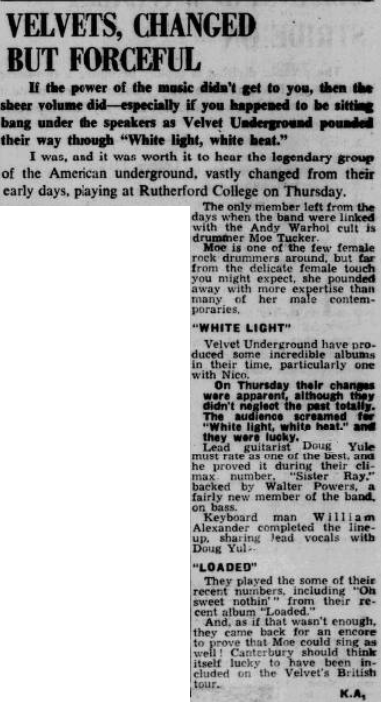
The Velvet Underground were taking the UK by storm, albeit medium-sized storm. I suppose I should acknowledge just how surreal it might be for the casual observer to see the band from Warhol’s factory, steeped in drug-counter-culture playing around rural England. While it’s understandable that that group would be booked around a multitude of universities and city locations like the Speakeasy or the Bumper Club, they look quite out of place on the South Peir Parade in Portsmouth or the Malvern Winter Gardens. Did you ever think you’d see a review of a Velvet Underground live show in the Whitstable and Herne Bay Herald? 

(Whitstable and Herne Bay Herald 11 November 1971)

Like the UK, the continental leg of the tour is nothing short of a success.  The jaunt found the band playing to double the size of the crowds that they were used to, and they even managed a TV appearance in Holland. The boxset Final V.U. released by Captain Trip in the early 2000s features a stellar version of What Goes On, recorded by a Dutch radio station and reimagined with a 1970s rock vibe that wouldn’t be out of place in a setlist by the aforementioned Flying Burrito Brothers.  Yes, that is Doug Yule shredding that guitar.

mp3 : The Velvet Underground – What Goes On (live, Holland 1971)

Ideally, this is where the Velvet Underground story should end. However, manager Steve Sesnick had other ideas and he might be described as of dubious character;

He was a manipulator, he’s a woman hater, which implies a self hater. He’s a very… He lies compulsively, his whole mentality is himself. To get over on everyone else and take care of himself.” Doug Yule, Perfect Sound Forever 1995

The group returned briefly to England,. While there, Steve Sesnick signed a recording deal with Polydor UK for a new album. The songs for record (to be titled Squeeze) were mostly written during the tour and premiered on the road. The idea was that the band would be able to record wellrehearsed songs quicker and cheaper than coming up with arrangements in the studio, like they did with Loaded.

What happens next is up for debate; it’s possible that the record was intended to be a Doug Yule solo record, it’s possible that Polydor always intended to release it as a VU album and it’s possible that both are have an element of truth.

Regardless. Tucker, Alexander and Powers were all sent back to the States and Yule was retained in the UK. Sesnick had a habit of misleading people. It as been implied that he told the rest of the band that they were sacked and he told Doug that they had all quit. Either way, Yule recorded Squeeze as the lone Velvet Underground member with session musicians filling in the studio. Deep Purple‘s Iain Paice is reportedly on drums, although Paice claims not to remember the sessions

“I heard the tape, I don’t think it actually sounds like me. I have no recollection of the session. I might have played on some of the tracks at some point. But it definitely doesn’t sound like me.” Ian Paice, Deep Purple. Mojo Feb 2000

Paice not remembering the sessions might seem a little strange. However, this is once more evidence that the Velvet Underground were not a band of high stature, regarded like they are today. Plus, it should be noted that Ian Paice recorded a lot of sessions in his time. However, Yule has confirmed that he did in fact work with Paice.

‘I was very much caught up in my own hubris at the time, I so full of ‘Ok, here I am, I’m in England, I’m recording, I’m working with Ian Paice of Deep Purple’. Doug Yule, Perfect Sound Forever 1995

The music itself has been derided over the years. In the last decade or so it has come to be viewed in a more favourable light. The accepted narrative will tell you that reviews panned Squeeze but once again the accepted narrative lies through its banana shaped arse.

I think most fans see the Powers / Alexander line up of the VU as a legitimate evolution of the group. They were certainly seen as legitimate enough to support the likes of Alice Cooper and Buddy Miles.  However once again Yule had a record to promote and now he didn’t even have a band. Here’s where the bones of contention mainly lie in the hardcore Velvet devotees. In 1972 Yule recruited Rob Norris, George Kay and Mark Nauseef (check out Nauseef’s career; an award winning percussionist and a sometime member of Thin Lizzy, Dio’s Elf and The Ian Gillan Band. He’s also recorded with Jack Bruce, Gary Moore, Andy Summers, Carlos Santana and a fuck ton of others. You could argue he has been creatively the most successful VU member outside of Reed and Cale and you’d be right).  In order to retain legitimacy, both Sterling in Moe were both offered places in the band by Sesnic but refused.

Sesnick took me aside and told me that Polydor wanted to release Doug’s record as the fifth Velvets album and would line up another European tour. The band would consist of Doug, Sterling, Mo and Me. Maureen came by a few times to jam and to visit with Steve and his wife Penny, but when it was learned that Sterling wasn’t interested in touring Mo changed her mind’ Rob Norris, I Was a Velveteen, Kicks Fanzine 1978

What is true is that the press of 1972 where pretty much on-board with this line up of The Velvet Underground. Copies of Squeeze were promoted in newspaper columns in reviews and offered up as competition prizes. The modern opinion is that the band and the album was instantly derided by the press and the public saw through it all as sham. This isn’t true. While most contemporaneous reviews of the album are mediocre, there is also the odd one that shines.

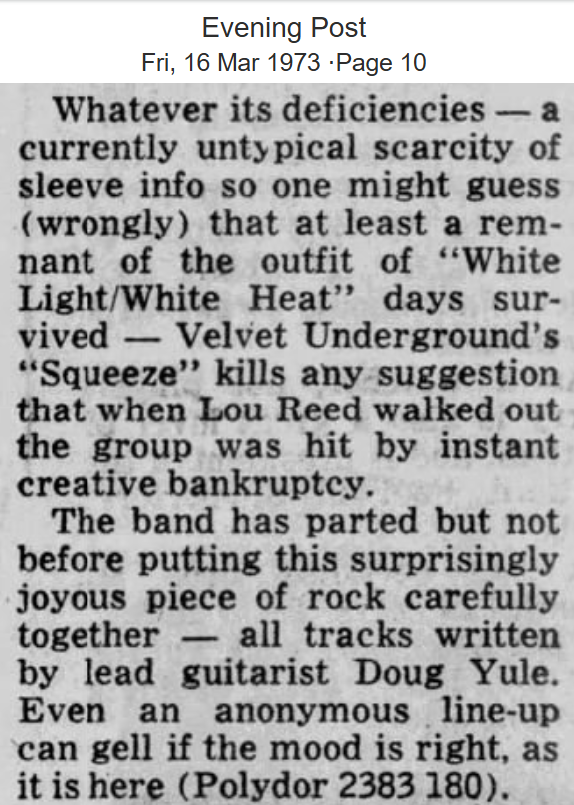
The Evening Post reviewed the record thusly; “Squeeze kills any suggestion that when Lou Reed walked out the group was hit by creative bankruptcy. The band has parted but not before putting this surprising joyous piece of rock carefully together”

There’s a couple of stand-out songs on Squeeze. Both Friends and Wordless would fit in nicely on Loaded.

mp3 : The Velvet Underground – Friends

mp3: The Velvet Underground – Wordless

I once asked John Cale what he thought of the fact that the band Squeeze who he produced was named after the Doug Yule album. He harrumphed and pretended I asked a different question about how good the musicians were. We’ve not spoken since.

According to Rob Norris, Sesnick was claiming that he owned the name of the Velvet Underground which is possible if he registered the trademark, since he also reportedly signed a publishing deal on Yule’s behalf, never told him about and pocketed the advance money. It’s also worth remembering that Sesnick was prone to bullshitting people. For Doug the tour was an easy choice.

I got a call from Sesnick who said ‘There’s some people who want to do a tour, do you want to go to England as the Velvet Underground?’ ‘Sure I’d love to’ I said, ‘I don’t want to be a carpenter, I want to be a musician!’. So we put together a band, that was the last one with Rob Norris, the drummer who’s name I can’t remember” Doug Yule, Perfect Sounds Forever 1995

Like his behaviour with skimming Yule’s publishing advance, it seems the tour was little more than a cash grab by Sesnick for the up-front money that promoters would pay. In blunt terms the Velvet Underground had been asset stripped.

“We went over there and we got into London, with the same people that we had worked with before, and as soon as we walked in (to the airport), there was nobody there to meet us. Sesnick didn’t turn up and we didn’t have any money or any hotel. So we were stranded in the middle of London” Doug Yule, Perfect Sounds Forever 1995

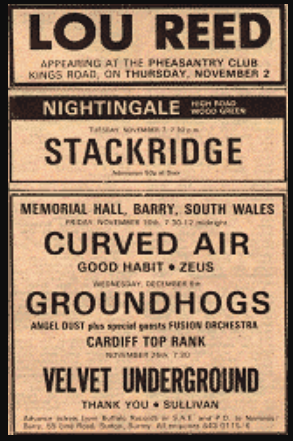
Striking a deal with a promoter for another advance, Yule’s Velvet Underground toured the UK for nine shows in 1972 playing such establishments as St David’s University in Lampeter, Wales and the Northamptonshire County Cricket Club (nothing says big time like County Cricket Club). A show at the Top Rank in Cardiff, Wales was featured on the same newspaper advert as a Lou Reed show.  This proved not to be the only notable thing about the gig in Wales;

We had one really rough time in Cardiff.  The club was supposed to pay us cash up front and they didn’t, and our road manager said, ‘Well, then they’re not going to play.’ We were in the dressing room and this real sleazy, low-brow guy with the club went on-stage and got these skinhead types all revved up, like ‘Well, they’re here but our money’s not good enough for them.’ They came after us and tried to bang down the door. It was George Kay who said, ‘Shit-ass punks aren’t gonna bother us, we’re gonna go out that door, we’re gonna get in the car and get out of here, and they’re not even gonna touch us”. We formed a ‘V’ with the guitar cases, burst the door down and moved through the crowd, and they didn’t bother us. But I was fearing for my life.” – Rob Norris Mojo, Feb 2000

(From Lou to the VU – Top Rank Cardiff show)

Trouble aside, this even more diluted line up of the Velvet Underground, who still weren’t seen as anything other than legitimate. Once again, the public wanted a Velvet Underground and they got one. Although it must have been quite jarring to find a Velvet Undergroud show advertised on the same page as a Lou Reed show in the Melody Maker, November 4, 1972

“I don’t know why people didn’t go ‘Where’s Lou’ or ‘Where’s Cale’ or ‘What is this’ but they didn’t. The shows were good” Rob Norris, Mojo Feb 2000

Although in more recent times, Doug Yule has been slightly more critical of his actions. Perhaps as his stock has increased with the fans, he’s allowed himself some realignment.

“The band (of 1972) was literally assembled in an afternoon. It was available. That’s one I consider a cash-in trip.” Doug Yule. Mojo, Feb 2000 

In 1973 Doug, George Kay, Billy Yule and a guitarist called Don Silverman found themselves playing around the New England area as The Velvet Underground. There’s an oft told tale that they were supposed to be billed as Doug Yule from The Velvet Underground but promoters would shorten the name. Sounds plausible but it’s interesting that in the recorded show that survives from Oliver’s Venue in Boston, Doug doesn’t correct the billing mistake from the stage.

The semi legal boxset ‘The Final VU’ documents the line ups of the band from 1971 until 1973. It shows several decent bands and when the Velvet Underground may have become had the Squeeze album been a success.

Thanks to Lou Reed’s success in the early 1970s, the Velvet Underground gained interest from a larger market. While Reed’s live versions of Velvet songs from Rock and Roll Animal and Lou Reed live are credited with bringing VU songs to a wider audience, it’s the success of Transformer that can be classed as the Year Zero of the re-appraisal of the Velvet Underground. Reed’s success also contributed to mythos of the Squeeze era band being a ‘rip off’

“From what I understand Lou Reed was not real happy about this because he was over there and we were kinda following in his footsteps. He was doing the Transformer tour, and I think he thought what we were doing was pretty much a bunch of bullshit. Which I think was kind of accurate from his perspective.”Rob Norris, Mojo Feb 2000

The point is, had Reed not become a massive 1970s star, the Velvet Underground would be loved today by about the same amount of people who loved them in 1970. Absolutely no one would care that Doug Yule toured with multiple musicians and recorded a solo record under their name. In fact, the fans of the VU would point to Fairport Convention, The Flying Burrito Brothers, Deep Purple, The Byrds and many others and say ‘Yup, that’s what bands did back then’

‘We toured all over England, played also in France, and places like that – and nobody ever said ‘hey, where’s everyone else? There was no complaining from anybody on the road, that this was not the real Velvet Underground. When we finished, we all counted ourselves lucky and went home. That was the last thing that the Velvet Underground officially did.” Doug Yule, Perfect Sound Forever 1995

Not only did the VU probably invent punk (sorry Stooges, MC5, NY Dolls. But they fucking did), but they were the very first of the bands that annoying hipsters could say ‘I liked them before they were cool’.

So, I put it to you had Squeeze been a success and Transformer not so much, then we would view Lou Reed the same way we look at Peter Green or Peter Gabriel.  Doug Yule is the Buckingham / Nicks line-up of the Velvet Underground that never quite happened.

Ron Norris’ account of his VU life can be found here https://planetwaves.net/pdf/velveteen-norris.pdf It sometimes contradicts the stories that have come out since but it is an interesting footnote of history.


STEVE McLEAN

ON THIS DAY : THE FALL’S PEEL SESSIONS #24

A series for 2025 in which this blog will dedicate a day to each of the twenty-four of the sessions The Fall recorded for the John Peel Show between 1978 and 2004.

Session #24 was broadcast on this day, 12 August 2004, having been recorded on 4 August 2004.

The Fall’s final ever Peel session.  The renaissance of the previous year’s workout is continued here with another crackling performance.  All of the tracks – apart from the addition of The Move’s ‘I Can Hear The Grass Grow’ to the revival of ‘Wrong Place. Right Time, appeared on the late 2004 album of demos and live tracks, ‘Interim’. The storming ‘Blindness’ here comes out as the clear winner, while ‘Clasp Hands’ provides another return to The Stooges’ sound. Eleanor Poulou, the third Mrs Smith, adds noteworthy keyboard texture to these fantastic tunes.

DARYL EASLEA, 2005

mp3: The Fall – Clasp Hands (Peel Session)
mp3: The Fall – Blindness (Peel Session)
mp3: The Fall – What About Us? (Peel Session)
mp3: The Fall – Wrong Place, Right Time – I Can Hear The Grass Grow (Peel Session)

Production details unknown

Mark E Smith – vocals; Ben Pritchard – guitar; Jim Watts – guitar; Steven Trafford – bass; Spencer Birtwistle – drums; Eleanor Poulou – keyboards; Ed Blaney – guitar, vocals

JC

THE 12″ LUCKY DIP (27): The Smiths – This Charming Man

From wiki:-

“The earliest version of This Charming Man was recorded on 14 September 1983, in Maida Vale Studio 4, for John Peel’s radio programme (first broadcast: 21 September 1983).  Produced by Roger Pusey, and assisted by Ted De Bono, this version of the song was first included on the 1984 compilation Hatful of Hollow. On 28 October 1983, the “Manchester” version was released in the UK in 7-inch and 12-inch formats, reaching number 25 in the UK charts

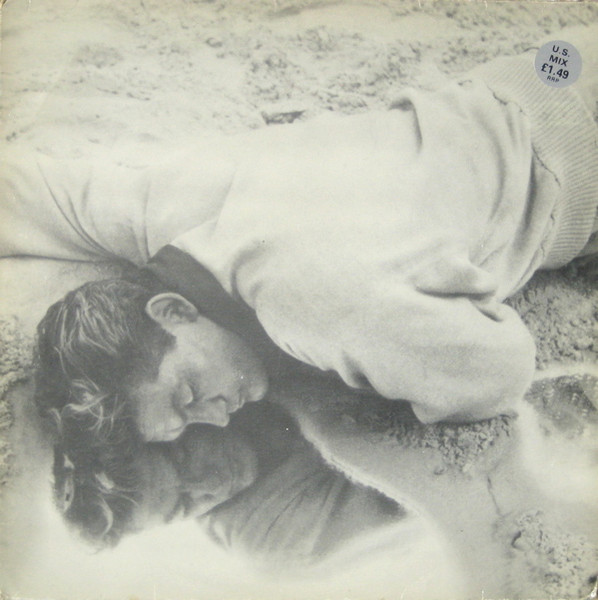
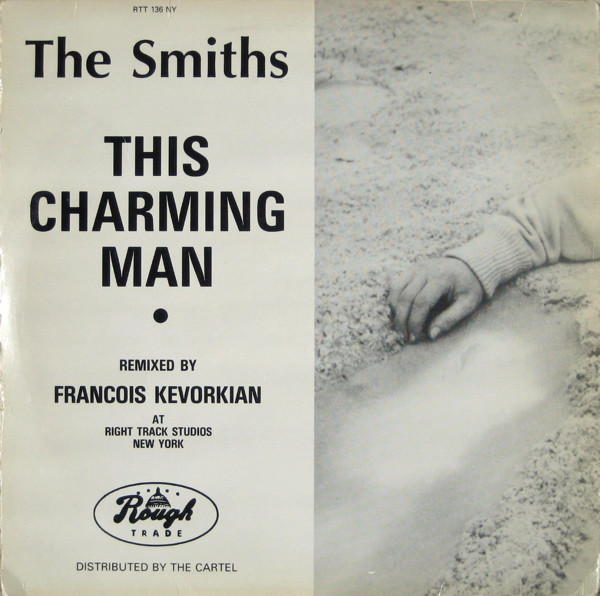
In December 1983, DJ François Kevorkian released a “New York” mix of the single on Megadisc records.  Kevorkian geared the song for nightclub dancefloors. The track was intended to be pressed in limited numbers for New York club DJs. However, Rough Trade boss Geoff Travis liked the mix and gave the release wide distribution in the UK.  Morrissey publicly disowned the mix, and urged fans not to purchase copies.  Travis later claimed, “It was my idea, but they agreed. They said ‘Go ahead’, then didn’t like it so it was withdrawn.” He also said, “Nothing that ever happened in the Smiths occurred without Morrissey’s guidance; there’s not one Smiths record that went out that Morrissey didn’t ask to do, so there’s nothing on my conscience.

Of course I rushed out and bought it!!!!  I loved the way the Rough Trade logo had been bastardised for the American market.

And, it goes without saying, that I loved this remix and the instrumental version on the b-side.

mp3 : The Smiths – This Charming Man (New York Vocal)
mp3 : The Smiths – This Charming Man (New York Instrumental)

JC

SUPER FURRY SUNDAYS (aka The Singular Adventures of Super Furry Animals)

A guest series by The Robster

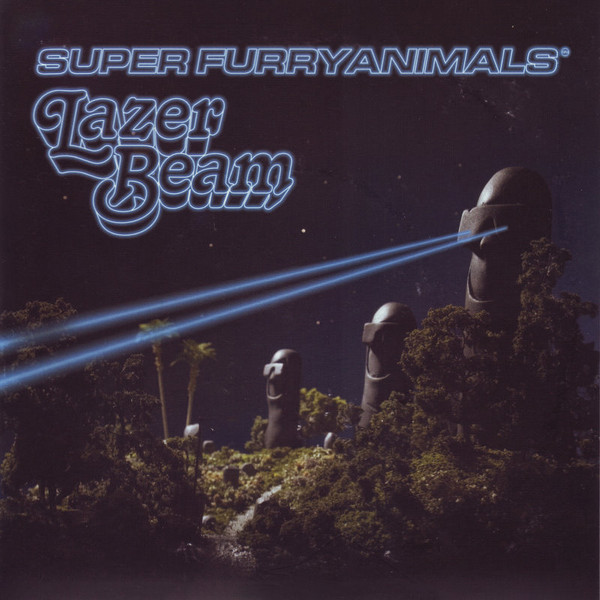
#24: Lazer Beam (2005, Epic, 676 011 7)

Ten years after Super Furry Animals released their first EP, they’d come a very long way. They had forged themselves a path that had put them at the very forefront of the Welsh music scene, had stomped a huge footprint in the overall music scene in the UK, and had carved a loyal following across Europe and the USA, and all while doing their own thing and refusing to follow trends, fashions and expectations.

But things were changing. Increased digitisation in the way people consumed music meant there were so many options and all of a sudden, you didn’t have to spend stupid amounts of cash and hours in record shops to find something different. All those obscure techno, psychedelic, indie, 70s rock records were available online without a great deal of effort. All of a sudden, Super Furry Animals were not sounding as “different” as they used to.

They still had plenty of magic mind, it’s just that some of the fanbase they picked up over the previous decade was moving on, and only the most loyal remained. Us faithful were going to be rewarded a few more times, and it started with a new single and album released in August 2005.

MP3: Laser Beam

I love this one. It’s so irresistibly catchy, and it has all those hallmarks of SFA that we love. It’s also a critique of the political and social state of the word at the time (and sadly, two further decades on, still is…) Gruff’s opening lines state:

“This song is daunted by a radical new vision, no more imperial colonial bastards, no more romantic comedies, this is a fanfare introduction to a high-powered, purposeful theme.”

The words “radical new vision”, as well as other phrases in the lyrics, refer to Tony Blair’s speech at the 2004 Labour Party Conference. “I’ve nicked that wholesale,” Gruff would explain. “But I am offering a radical new vision whereas he wasn’t.”

The song is further explained by Bunf thus:

“Today’s reality is insane so we may as well make our own. It’s about aliens coming down from space and zapping humans with amazing lazer beams that make them intelligent rather than being jerks. It’s obviously a highly unlikely scenario”.

Which is a shame, because the one thing our world needs right now is an alien invasion and intelligence. With our world so-called leaders intent on blowing each other up into oblivion (or rather, blowing us into oblivion while they’re safely tucked away in their underground nuclear bunkers safe from the chaos they’ve wreaked), and the ordinary people of the world becoming so disillusioned with it all they’d rather just soak up social media soundbites and bizarre conspiracy theories spouted by weirdos and billionaires (same thing?) rather than actually THINK about what is actually going on, the world is closer to being doomed than we ever thought possible when Laser Beam was released.

Anyway, the genesis of Lazer Beam lies way back during the ‘Guerrilla’ sessions when a track called John Spex was written, demoed and even mixed, but never actually finished. An attempt to revive it for ‘Rings Around The World’ failed to take it any further. But the band felt there was something in it that was worth persevering with, and it was finally reworked and transformed into the backing track for Lazer Beam.

It was the first – and as it turned out – only single from the band’s 7th studio album ‘Love Kraft’. It was also the last single they’d release with Epic/Sony, their contract ending with this album. Maybe that was why only the one track was put out as a single – Sony couldn’t be bothered to promote an act that was leaving them. Another shame, as there are some excellent tracks to be found on ‘Love Kraft’, even if it wasn’t as immediate, or even quite as enjoyable as its immediate two predecessors.

Laser Beam was also the last time the Super Furries would grace the Top 40 singles chart in the UK, peaking at #28 in its first week of release. There were plenty of critics who loved it, describing it as “an absolute powerhouse of a song”, “acid-carnivalesque” and “like a kids TV theme heard through an acid-pop filter”. One or two critics, however, defied the general consensus, but when you consider the NME called it “the worst Furries song ever” at a time when no one took the NME in the slightest bit seriously (and to be fair, no one has ever since), I think we can brush over the negatives. But, the fact that a band so universally loved was starting to attract some less than favourable reviews comes back to what I said at the start – things were beginning to change…

Lazer Beam was released on 7” and CD formats, both of which contained this upbeat little number:

MP3: Sunny Seville

I like this one a lot, but it is so unlike everything else on ‘Love Kraft’ it was always destined to be a b-side. It sounds like it’s a cover rather than an original, it’s so unlike a Super Furry Animals song. However, it might be a hint of what was to come…

The CD also contained this:

MP3: Colonise The Moon

An acoustic track with 60s psych infused into its DNA, and some birdsong. It’s a tad longer than it perhaps should be, but otherwise, both these tracks show an improvement in b-sides over the ‘Phantom Power’ period.

Now, bonus tracks. ‘Love Kraft’ celebrates its 20th birthday this year. At the point of writing, an anniversary edition has not been announced, but I’m keeping my fingers crossed. It means there’s not a huge amount of bonus material to share (something that’s going to become more and more noticeable as we enter the final six weeks of the series), but at least with this single, I can turn to the various promos and collect together some bits and pieces.

MP3: Lazer Beam [radio edit]
MP3: Lazer Beam [Danger Mouse remix]

The Danger Mouse remix offers a radically different interpretation of the song, but I happen to like it. It even plays around with Gruff’s melody in the chorus. In the US, this version (listed as Lazerbeam) was released on a split 7” with a Danger Mouse remix of Easy/Lucky/Free by Bright Eyes.

Two more remixes, neither of which do an awful lot for me, especially the latter which is just rubbish:

MP3: Lazer Beam [DJ Marlboro remix]
MP3: Lazer Beam [LFO remix]

And finally, here’s the song that dates back to the ‘Guerilla’ sessions that eventually became this fine single:

MP3: John Spex [unfinished rough mix]

Next week – the post-Sony years commence…


The Robster

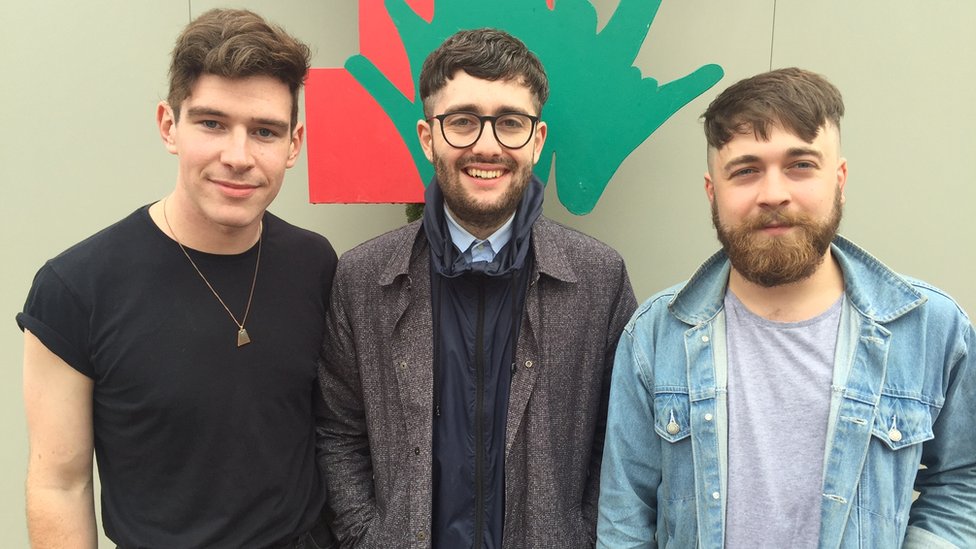
SATURDAY’S SCOTTISH SONG : #464: FATHERSON

Today’s featured band are well-loved by many in Scotland.

Fatherson hail from Kilmarnock, a blue-collar industrial town some 22 miles south-west of Glasgow.  They are, individually, Ross Leighton (guitar, lead vocals), Marc Strain (bass) and Greg Walkinshaw (drums) who came together along with a past band member Chris Beltran (guitar, keyboard and backing vocals in 2011.  The first singles between 2011 and 2013, a period in which the band toured extensively.

Debut album I Am An Island was released in 2014.  It has been followed by Open Book (2016), Sum Of All Your Parts (2018) and Normal Fears (2022) – only the debut album was as a four-piece as Chris Beltran left in 2015.

At this point, I have to confess that I own none of the albums, or indeed any of their singles or EPs. I just never took to the band, but that’s really a matter of my taste.  As I said, they are popular with many, and have won new audiences the old-fashioned way, through hard work in the studio and out on the road, where they have opened for many a big name including Biffy Clyro, Frightened Rabbit, Panic! at the Disco, Feeder, Twin Atlantic, Enter Shikari and Idlewild.

What I do have is their contribution to Whole Lotta Roadies, a charity digital album issued in 2020 with the aim of raising monies that could go members of live crews in Scotland who were facing the prospect of at least a year with no income as a result of shows being cancelled as the COVID pandemic took its ferocious grip on society.  The album featured 12 well-known Scottish bands, but with the twist that the crew members themselves would play on the songs – we’ve all been to enough gigs to know that roadies are often very talented and possibly frustrated musicians:

mp3 : Fatherson – Just Past The Point Of Breaking (Whole Lotta Roadies version)

The original version can be found on the Open Book album.

More info on Whole Lotta Roadies can be found here.

JC


SHOULD’VE BEEN A SINGLE ?(8)

The post-punk/new wave bands were never all that keen to lift too many album tracks as singles. Take The Jam, for example.

Many of their singles were stand-alone efforts – All Around The World, News Of The World, Strange Town, When You’re Young, Going Underground, Funeral Pyre, Absolute Beginners, The Bitterest Pill and Beat Surrender to be precise.

Most of their albums contained just one single – In The City, The Modern World, Setting Sons, Sound Affects and The Gift fall into this category, albeit the latter two did yield two further hits singles via imports.

Which leaves us with All Mod Cons.

It’s a real anomaly in that three of its songs – David Watts, A-Bomb In Wardour Street and Down In the Tube Station at Midnight, were already known to record-buyers prior to the album’s release in November 1978, thanks to the first two being on a double-A side and the latter being released as part of the efforts by Polydor to better market the band.

I recall Paul Weller, while being happy that the band was beginning to enjoy chart success, was miffed that fans were being asked to shell out for songs that were otherwise available.  So there was absolutely no way he would have agreed to this being released as a single:-

mp3: The Jam – Billy Hunt

One of the most immediate songs on All Mod Cons, I have no doubt that the record company execs would have wanted to put this into the shops on 7″ vinyl and relished it going at least Top 20, such was the popularity of the band and the way the song fitted in perfectly to the sounds of early 1979.

Should’ve been a single?   Well, let’s just say it merited such an accolade, but let’s be glad it never came to that.


JC

ONE HUNDRED AND ELEVEN SINGLES : #103

aka The Vinyl Villain incorporating Sexy Loser

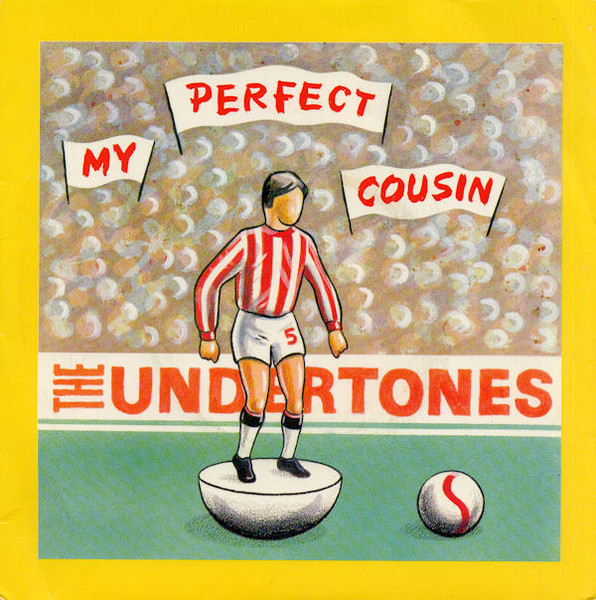
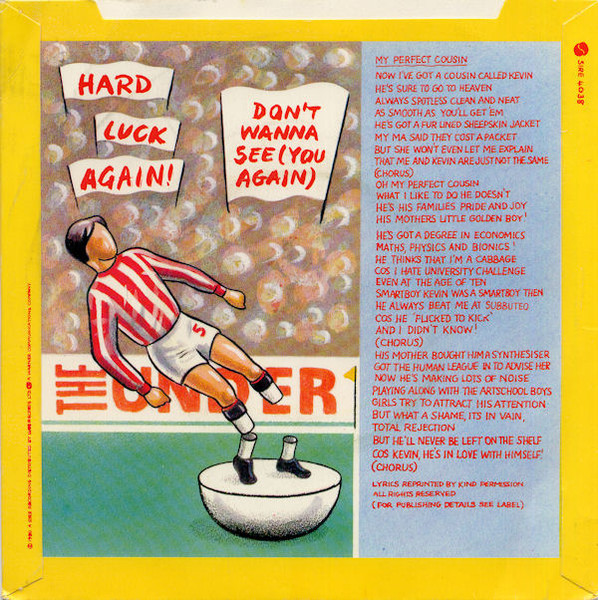
# 103: The Undertones – ‘My Perfect Cousin’ (Sire ’80)

Dear friends,

for me, The Undertones simply had to feature in this series. I have always loved them very much, and even today I’d rate them as being one of my Top Five bands. Although they grew up in the punk or post-punk era, they were never ‘punk’ to me, a fabulous mixture between punk, power-pop, new wave and rhythm. The debut album from 1979 is ace, all killers, no fillers – and the second one, from a year later, is absolutely great as well. If you never listened to it in its entirety, you should do so soon!

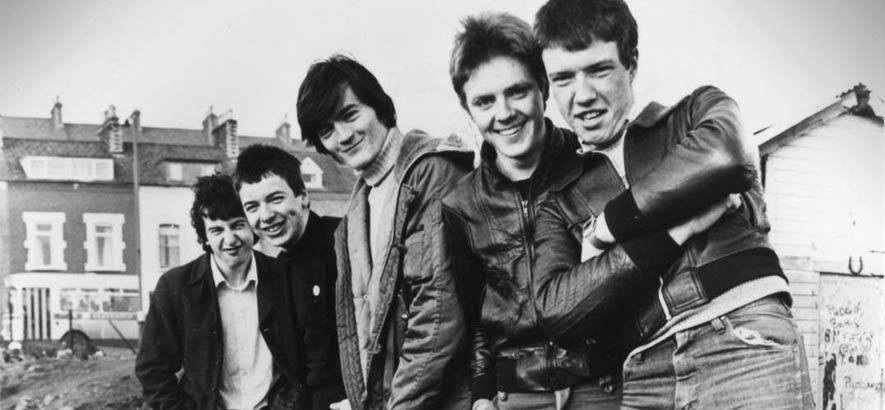
They are often referred to as “Derry’s finest”, I know too little about the late 70s Derry music scene to be able to confirm this, but for sure they must have been somewhat special. They got together in 1974 and from 1975 to 1983 there were no personnel changes: Feargal Sharkey (vocals), John O’Neill (rhythm guitar), his brother Damian (lead guitar), Michael Bradley (bass) and Billy Doherty (drums) . This may not sound very important, but do me a favor and try to remember what you were up to when you were that young: I’m willing to have small bet that you did not write, record and release an album as groundbreaking as The Undertones’ debut (from (January) 1979, as I said) when you, like them, were only 21 (Feargal + Billy), 22 (John) 18 (Damian) or 20 (Michael). An album, mind you, which included the classic ‘Teenage Kicks’ in all its greatness!

But I went for something different today, one which perfectly shows what made The Undertones so very special: they were more into teenage angst and heartbreak than into politics, you see. They came up with very clever lyrics most of the time, put into shape by Feargal’s distinctive voice. We have their sixth single today, and as far as I know it’s the one that charted the highest. But don’t let that put you off, I could have chosen any single preceding this one, this is no chart-pop nonsense, this is The Undertones in top form:

mp3: The Undertones – My Perfect Cousin

Enjoy,

Dirk


‘STEALING’. A FOUR-PART GUEST SERIES IN BOOK FORM : #1 FLEETWOOD MAC

A guest series by Steve McLean

First up…..the Prelude

In October last year, I sat down to write a blog for this site about the story of The New Deep Purple, a band that toured in 1980, causing much controversy with the fans.

As I pulled more at the thread of the story, it became apparent there were multiple tales like this dotted around the music world. “Oh great” I thought. I’ll do a series of blogs. I always wanted to do a series of blogs with a common theme.

I started finding all sorts of murky tales involving bands like The Zombies, Steppenwolf, Iron Butterfly and even Frankie Goes To Hollywood.

By the end of May..2025 I’d written about 80,000 words, but most of the story was about Deep Purple, I’d accidentally written a book*. Which is lovely, but I didn’t know what to with the rest of the work.

So I’ve decided to ask the lovely JC to carry the blogs as a series after all…what follows, across today and each of the next three Wednesdays, will be posts which are a lot longer than what you would normally find on TVV.

JC and I, very much, beg your indulgence…..

Stealing…. Fleetwood Mac

Most music fans are aware of the nostalgia circuit; One member of the Bill Haley’s Comets supported the Original Herman’s Hermits featuring the drummer with the show opened by one of The New Seekers billed as The New New Seakers . There has always been a market, not a massive one, but a market nonetheless for bands who will keep a name alive with only the flimsiest connection to the original group.

On paper, Fleetwood Mac are probably the biggest band ever to have the ‘New’ prefix. It’s worth keeping in mind though that Fleetwood Mac have been multiple different bands during their existence; The blues rock pioneers, cult favourites, the 1970s and 80s cocaine fuelled behemoth, the 90s Dave Mason led version that played Butlins (probably) and finally the We-Love-Money-More-Than-We-Hate-Each-Other festival headliners that featured Tim Finn of Crowded House. Tim Finn! Truly the glory years. On a side note, whenever Lindsey Buckingham has left Fleetwood Mac he’s been replaced by two people, make of that what you will.

In 1973 Mac fit very snuggly into the second category, attracting college students and die-hard blues fans who remembered the hits like Oh Well and Rattlesnake Shake. Christine McVie and Bruce Welch had done a lot to drag the band into the radio friendly mid-70s but it’s safe to say that most people didn’t care about Fleetwood Mac. That aside, the song Hypnotised from 1973 was something of a radio hit and might be considered the start of FM’s 1970s ascendancy.

mp3 : Fleetwood Mac – Hypnotised

The current Mac roster consisted of Mick Fleetwood, John McVie, Christine McVie plus Bob’s Weston and Welch. Weston was the relative newcomer. He’d replaced Danny Kirwan and had contributed to both albums they’d recorded in 1973, Penguin and Mystery to Me.  His most visible musical contribution was probably dueting with Christine on Did You Ever Love Me.

mp3 : Fleetwood Mac – Did You Ever Love Me

But his biggest contribution to the legacy of the band is without a doubt his shrewd career move to have an affair with Mick Fleetwood’s wife, Jenny Boyd.

“Bob Weston had an affair with Mick’s wife and Mick found about it and just left. He was absolutely distraught, their marriage wasn’t going very well. Mick was really in a bad way for a while” Christine McVie, Off The Record, 1986

Fleetwood and Boyd had been on and off childhood sweethearts for fifteen years and had been married since 1970 (they would divorce, re-marry and divorce a second time). In the 1980s she married King Crimson drummer Ian Wallace. Honestly, marrying one drummer can seem like a mistake but two? At some point you have to just assume the lady had a thing for mopping up drool.

Once Fleetwood found out about the affair the group soldiered on for a few weeks, but ultimately they fired Weston and went on hiatus. The band cancelled the rest of the dates and had binned the upcoming US tour in the new year.  Cliff Davis, Mac manager and former Brian Epstein apprentice went fucking nuts. He would be liable for a hefty legal bill, and his reputation would be in tatters with promoters.

“The manager said do you realise what you’ve done, “we’re gonna be sued for millions.” I mean we wouldn’t have been. The way Mick wasn’t it wouldn’t have been possible for him to play. He was really in a bad way. So we all went back home again”  Christine McVie, Off The Record, 1986

Cliff Davis decided that he alone owned the name to Fleetwood Mac and set about putting together a new band.

I want to get this out of the public’s mind as far as the band being Mick Fleetwood’s band, this band is my band. This band has always been my band.” Clifford Davis, manager of Fleetwood Mac. Fleetwood Mac Flak: Manager Takes Name, Not Members, On Tour, Rolling Stone February 28, 1974

While it’s true that Mick Fleetwood was the only remaining member of the band that recorded their first single as John McVie joined after their debut release, it was often assumed that the Fleetwood and the Mac in the band name was due to the ownership group. Not according to Davis;

A lot of people over the years have misconstrued the Fleetwood Mac as Fleetwood and McVie. ‘Fleetwood Mac’ was a song written by Peter Green when he was with John Mayall.” Clifford Davis, manager of Fleetwood Mac. Fleetwood Mac Flak: Manager Takes Name, Not Members, On Tour, Rolling Stone February 28, 1974

What happened next is where the tale gets murky, depending on who you talk to. Davis did this with Mick Fleetwood’s consent or Mick Fleetwood had absolutely no knowledge of this happening. Davis hired former Curved Air member Kirby Gregory and built a group around him and vocalist Elmer Gantry from Elmer Gantry’s Velvet Opera.

Both Kirby and Gantry (real name Dave Terry) had recently been in a band called Legs, their single So Many Faces is something of a lost freakbeat classic.

mp3: Legs – So Many Faces

According to the new members, the legalities of the band at this point were certain, Davis had the paperwork and the contracts and Fleetwood was on board. They were told that while Fleetwood wasn’t going to start the tour with them, he would join them partway through after he had rested.

I just decided it was time to change the band, certainly onstage, and that’s what I did. I’ve always been sort of the leader. I’ve always sort of picked who was going to be in it and who wasn’t. I decided to keep Mick.” Clifford Davis, manager of Fleetwood Mac. Fleetwood Mac Flak: Manager Takes Name, Not Members, On Tour, Rolling Stone February 28, 1974

The members of the new band all corroborate the story; they were told that Fleetwood would be in the band eventually, even claiming to have met them beforehand

“Mick Fleetwood came to our house and we talked through the new band, and it all seemed fine. Mick said, well, I can’t actually come and rehearse with you, it was fairly imminent going to America to tour, but if you get [a temporary] drummer, I’ll join you for the tour.” Elmer Gantry, The New Fleetwood Mac Member, BBC Radio  2017

As with a lot of these stories, multiple versions are told and there are various versions of truth, Legend has it that the band played poorly and the audience were upset with the shows, but this doesn’t quite line up with some first-hand accounts.

[The New Fleetwood Mac] were really good. I don’t know if the crowd was just really stoned or didn’t know what Fleetwood Mac looked like,” Rich Engler, Promoter ‘Behind the Stage Door,”

While you would expect such a quote from a show’s promoter, press reviews were mixed. Once again, the negative shows rise to the top. The band and their peers were happy with their output;

“Joe Walsh told me at one gig in Florida that despite Mick Fleetwood not being there, he thought we were rockin’ with the best of ’em. I don’t recall any major hostility towards us either. Elmer and I just thought: ‘We are stuck with this so let’s make the most of it’ – and we gave it all we had.”  Paul Martinez, The New Fleetwood Mac bass player, Classic rock Classic Rock 168, in March 2012.

When Davis’ Mac where on the road they were sometimes billed as The New Fleetwood Mac or Fleetwood Mac’s New Band but there’s a lot of evidence to suggest it wasn’t the con that history has declared it to be. A prefix of ‘THE NEW’ on a band poster rarely means original members but it doesn’t necessarily affect the quality of the performance. just ask the New Yardbirds. This isn’t the case for The New Kids on the Block, who were definitely shit. It should be noted that ‘THE NEW’ was doing some pretty covert work on some of the Fleetwood Mac posters
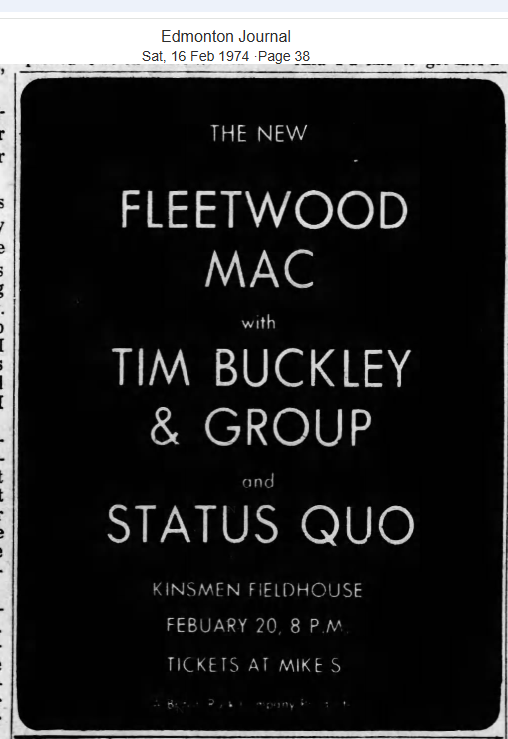
(Advert for The New Fleetwood Mac.. spot ‘The New’)

Eventually the tour starts to break down. As news of the stunt spreads around the music press, the shows suddenly start to suffer. In a self fulfilling prophecy, the band who were playing well, start playing badly when a crowd turns up and expects them to play badly.  That’s the problem with the court of public opinion, it rarely changes its mind after the initial decision.

At this point Mick Fleetwood starts to decry the actions of the Davis & Co, at least publicly. However, it was Bob Welch who took the lead and flew back to England to meet Fleetwood and the rest of the actual members.

“It is a rip-off. The manager put together a group real fast using the name Fleetwood Mac before we had a chance to do anything about it.” Bob Welch, Fleetwood Mac Member, Fleetwood Mac Flak: Manager Takes Name, Not Members, On Tour, Rolling Stone February 28, 1974

Welch stepping up to the plate is a weird move. He wasn’t an original member of the group and he was pretty burned out from the constant tour-album-tour regime. Could it be that Welch was the focal point for the legal action because he was the least informed member of Davis’ plans. Davis and The New Fleetwood Mac have always claimed that Mick knew and approved of his plans. It would be naïve to believe that at least the McVie’s didn’t also. According to Bob Brunning’s book Rumours and Lies, John McVie sent Clifford Davis a postcard from Haiti saying ‘Good luck with the new band’.

“I was making practical arrangements for auditions and rehearsals for the ‘New’ group in the middle of December 1973. I met John in a pub in Chelsea. John asked me whether or not Cliff would ‘get away with’ what he was doing. I asked him what he meant and he said ‘Putting completely different names on stage and calling them Fleetwood Mac’ I said I did not think he’d be wasting his time doing so if he thought it would not succeed’ Phil McDonnell, Bob Brunning, Rumours and Lies.

Regardless, if the band had agreed to the plan and then later changed their mind or if Davis was making a grab for the name, lawfully it was a murky water.

The problem for the group was the precedent set with multiple line-up changes plus Davis involvement in the band’s formation. He might actually have a legal case. The law generally considers a band as a company rather than a work of art and doesn’t care too much about who the founding members are or who has been in the band the longest. It tends to just notice who signed the contracts and who holds the purse strings. To make matters worse, it seemed that the band’s record label where none-the-wiser as to who exactly that it was that they had a record contact with; Fleetwood and McVie or Davis.

“I’m in the midst of trying to find out who has exclusivity on the name,” Don Schmitzerle, executive director, Warner Bros label management,

One major issue, when a band is treated as a brand or a franchise it that the Brand Manager could hire different musicians every single show and not care about the quality of the performance. They may not even be too concerned about the songs the outfit played or the style they are played in. In other words, the people who paid to see Fleetwood Mac may well end up seeing a Jazz Trio playing under the name Fleetwood Mac. That would be an issue for a court to consider. Welch summed it up neatly;

“To the band’s thinking that’s kind of beside the point. If he [Davis] has the rights to the band’s name, theoretically he can put anybody there. He can put four dogs barking on a leash and call it Fleetwood Mac. Basically what it boils down to is the manager flipped his lid. We’re going to take legal action as soon as we know where we can take it from.” Bob Welch, Fleetwood Mac Member, Fleetwood Mac Flak: Manager Takes Name, Not Members, On Tour, Rolling Stone February 28, 1974

To play devil’s advocate for Davis’ plans; he was seemingly convinced that the band were breaking up and not just going on hiatus. Christine McVie was starting a solo project, John McVie was making noises about going to LA and Fleetwood was making noises about moving to Kenya. Clifford had contracts that needed fulfilled before the band wound up, or the lot of them would be in financial ruin for years. As a reputation saving move, it would seem like an okay idea

The legally dubious point comes if the hypothetical Jazz Trio include a musician who is recognised to be Fleetwood Mac and has given their blessing. It appears the legal case against Davis hinged on whether or no Mick Fleetwood was actually involved in the project.

For a while we believed that Mick would show. However, when he never appeared and we were later branded in the press as imposters, I felt a rage towards him that has taken decades to subside – even slightly. We desperately wanted out, but we were convinced that we had to do the gigs or end up in court in the States, so we carried on.” Elmer Gantry, ‘The New Fleetwood Mac’  Classic Rock Magazine 168, in March 2012.

The closing bell tolled for The New Fleetwood Mac after only about 15 shows. The band were due to perform to the assembled press at Howard Stein’s Academy of Music. Stein had decided to offer refunds to anyone not satisfied with the show as long as they left within the first fifteen minutes. It was announced that Mick Fleetwood wouldn’t be there and the band would be playing an instrumental only set. It seems Elmer Gantry’s voice decided not to play ball that evening, so the band played a set full of vocal-free boogie-woogie numbers, much to the crowd’s annoyance.

The Welch led legal case proved fruitful. Eventually the high court in England found in favour of the Mick Fleetwood and co for an injunction, but not before Davis himself had pulled the plug on the tour. He couldn’t stop the avalanche of bad press, regardless if the band played well or not. Eventually Davis Vs Fleetwood Mac was settled out of court with neither side being too keen to comment on who got what and how much… and importantly it’s never been revealed as to who in the Fleetwood Mac camp knew what and when they knew it.

Davis split with the original band of course, and I believe an ‘accommodation’ was reached. Cliff certainly didn’t seem to be any poorer for the experience.”  Elmer Gantry, ‘The New Fleetwood Mac’  Classic Rock Magazine 168, in March 2012

It seems strange that Davis was keen to protect his reputation as a manager and music industry professional and yet would risk throwing it all away with a stunt like this. It could have been ego but it also could have been that he believed himself to be telling the truth. Certainly, Gantry is still convinced that the band had official blessing from Fleetwood;

If Mick had at any point said to us that he had changed his mind, or simply didn’t want to do it, we would never have gone to the States, I don’t know what his motives were and I’m not going to guess, but I can say, despite all the lurid claims, we never were required to go to court.” Elmer Gantry, ‘The New Fleetwood Mac’  Classic Rock Magazine 168, in March 2012

Gantry wasn’t alone in this assessment;

I think Mick Fleetwood, in a moment of despair over his wife’s infidelity, agreed to do something that he later regretted, and to save face with his fellow bandmates he denied having made any agreement. It’s regrettable that he was not man enough to admit his mistake and come clean with everyone. So as far as I am concerned, he not only lost his wife, he lost his honour too – not to mention his hair!”  Paul Martinez, The New Fleetwood Mac Bass Player, Classic Rock Magazine 168, in March 2012

The aftermath of the event was notable for both parties. The members of The New Fleetwood went on to form a funk rock band Stretch who hit the charts with the song ‘Why Did You Do It?’ reportedly about Mick Fleetwood agreeing to hire them.

mp3: Stretch – Why Did You Do It?

The line that says: ‘The only ones who know the truth/Man that’s him, me and you,’ was about the fact that me, Elmer and Mick sat in our Tooting flat and discussed the new Fleetwood Mac” Kirby Gregory , The New Fleetwood Mac, Classic Rock Magazine 168 in March 2012

While Mick Fleetwood’s stance has remained consistent and one of total denial;

To this day, I don’t know the names of the musicians involved and I don’t wanna know.”  Mick Fleetwood; in the book ‘Fleetwood’ (1990)

Which to anyone familiar with the Watergate story, it sounds a little like a ‘non-denial denial.’ Indeed it seems to be a tone that the whole band followed, a ‘party line’ as it were’;

Mick had no thought of going back to America with this whole bogus band” Christine McVie, Off The Record, 1986

The whole chapter could have been considered closed until in 2012 Classic Rock Magazine published an excerpt from the court case that seemed to imply that Fleetwood had at least met with Gantry and Kirby;

On 13 November, as the plaintiff’s own evidence discloses, the plaintiff Fleetwood alone went to see the third and fourth defendants [Gantry and Gregory] and discussed the position and did not object”Court Transcript

This comment has since been repeated by Gantry on the record;

“It wasn’t until about three years ago that somebody sent me anonymously some court papers where in court in the seventies Mick admitted he’d been to our house and discussed Fleetwood Mac” Elmer Gantry, The New Fleetwood Mac, BBC Johnny Walker’s Sounds of the Seventies 2017

The April 1974 confidential settlement that saw Davis relinquish his rights to his name may have actually been a canny bit of business, if you ignore what Fleetwood Mac would go on to become later in the decade.

In the early autumn of the same year, the band were back on tour. Listings found the line up Welch, McVie, McVie and Fleetwood listing them as ‘The Real Fleetwood Mac’
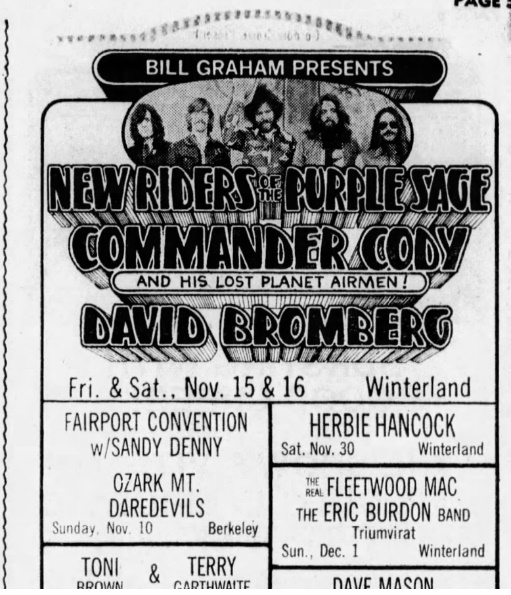
(Gig listings for The Real Fleetwood Mac)

Mick Fleetwood or any other member of Fleetwood Mac haven’t spoken about the event in years. Give the passage of time and the clouding of memories plus the fact that we all carve out our own reality from the truths we tell ourselves, who are the mere onlookers to call anyone a liar? But since no one from the official Fleetwood Mac camp seems to want to acknowledge the existence of The New Fleetwood Mac, it’s seems only fair to give the last word to Gantry;

“It’s not been contested because it’s absolutely true and it’s in court papers”Elmer Gantry, The New Fleetwood Mac, BBC Johnny Walker’s Sounds of the Seventies 2017

If taken on his word then it seems that Elmer and the rest of The New Fleetwood Mac were all victims, either of a duplicitous scam or a bad idea going wrong. However, Kirby and Gantry weren’t the only victims in this affair. The ripples of the venture touched a lot more people than just the main players. The band Silverhead supported The New Fleetwood Mac on a few dates before the ill-fated tour was brought to an early end.

“The gigs got pulled one by one. We had to go back to LA to regroup and find another tour maybe, but it was too late as everyone had schedules already out on the road. So, we sat in LA for weeks and all the money we earned was used up on fees and travel and we had to go home.” Pete Thompson, Drummer, Silverhead

Silverhead were signed in 1972 to the record label set up by Deep Purple called Purple Records. Unfortunately, the group weren’t just dropped from the tour though. Purple Records were desperate for the band to ‘break America’ and to do that they needed to be playing high profile shows. Since they were not able to promote their album via their Fleetwood Mac support slots, the label found it hard to bankroll them.

“(The tour collapsing) led to Purple records dropping us. Silverhead broke up soon after sadly and set me on the road to severe depression along with others in the band.” Pete Thompson, Drummer, Silverhead

Pete did eventually make a name for himself, becoming one of the most sought-after rock drummers around. He worked with (among others) Robert Plant and Robin Trower. His colleague Nigel Harrison would later join Blondie. Eventually, in Pete’s own words ‘It all worked out’.

For Fleetwood Mac, everything was set to go back to normal. Two albums a year and near constant gig schedule with respectable crowd numbers in the high hundreds and albums that straddle to US top 50. It was a very good living. Welch recorded one last album and performed one last tour. The Heroes Are Hard to Find album saw the band crawl ever closer to what they were about to become.

mp3: Fleetwood Mac – Heroes Are Hard To Find

As often the case, there was an unintended outcome to the event. Bob Welch, is often referred to as the man who saved Fleetwood Mac, found the whole affair incredibly draining and mentally taxing so he eventually quit the band. It had been one hurdle too many for a band that had been delivering on a punishing schedule of eight albums in five years and near-constant touring with only relative success to show for it. His marriage was breaking down and he was tired of essentially ‘running the band’. He managed to see out the rest of the year and jumped ship for a solo career at the end 1974.

The court case had been instrumental in convincing Fleetwood Mac that they needed to move to the USA (that and the fact they couldn’t get arrested in the UK). With Welch gone they needed a new guitarist and front person, so they turned to Lindsey Buckingham and Stevie Nicks. and superstardom was on the horizon.

It’s strange to think that that Bob Weston’s poor life choices would ultimately give the world some of the best rock music ever produced. In honour of that wonderous period of clouded judgement I’d like to close this blog with a salute to his solo career…… HAHAHAHA nope….

mp3: Fleetwood Mac – Monday Morning


I’d like to thank Pete Thompson for answering my emails.


STEVE McLEAN

* JC adds

Steve is far too modest to push his book on to you, but I’m more than happy to do so.  Click here to order.
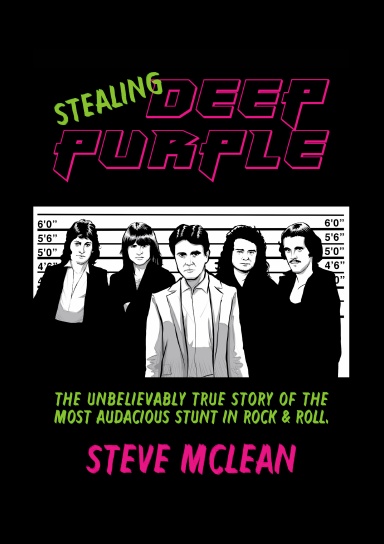
I’ll admit to not knowing the foggiest about Deep Purple, far less the tale of how there was a counterfeit band on the go for a bit, and so I’ve already put in my order.  Might end up being reviewed on the blog in due course….
BOOK OF THE MONTH : AUGUST 2025 : ‘YOU AND ME AGAINST THE WORLD : 2 WOMEN, 5 BANDS, ’80s EDINBURGH by SASKIA HOLLING

I don’t have too many regrets in life.  I’ve been incredibly lucky with every big decision I’ve ever had to make, personally and professionally, and as I move disgracefully into my 60s, I grow increasingly grateful for everything with each passing day.  But, as I turned the pages of this wonderfully written newly published book about the growth, development and the death of the indie-music scene in Edinburgh in the 80s, I did get the occasional pang of ‘what if?’

Please allow me to explain.  I moved to Edinburgh to live and work, at the age of 22, in the summer of 1985, eventually moving back to Glasgow in early 1990.  I arrived in the capital with a love of music that had been with me all my life, but really ignited by the arrival of post-punk and further nurtured by meeting like-minded souls throughout my university years.  I was convinced that Glasgow was still the place to be for music, particularly the live scene, and I spent many weekends travelling back west doing my best to keep up with things, but before too long, I got tired of this and looked around Edinburgh for things to get involved in.

In due course, I hooked up with some lovely people who were hoping to make a name for themselves in the creative arts through acting, dancing and stand-up comedy, and soon found myself immersed in the world of community theatre. It was great fun, and I can look back with pride on some of the shows I was involved, including being part of the Edinburgh Festival Fringe, and ‘acting’ alongside people who would in due course make a name for themselves in film, TV and professional theatre.

No regrets at all about how I spent my leisure time in my adopted city, but as You and Me Against The World details across more than 400 hugely enjoyable pages, my short time as a luvvie coincided with Edinburgh experiencing a vibrant music scene of the type that was really up my street, if only I’d been paying attention.  The ‘what if’ stems from wondering what might have happened if I’d met up socially with the musicians rather than the actors?

I’ve actually long been aware of what I missed out on, thanks in part to a friendship with Jacques the Kipper who, not long after we met in 1989, began to fill me in on what I’d been missing across the indie-scene in Scotland and further afield.  Gaps in my music collection were gradually filled in, but have been accelerated greatly in recent years from the release of a number of compilation albums and box-sets whose liner notes offer some excellent background.  The growth of the internet, and in particular blogs and fan-based sites, has also been a godsend.

There’s loads of info out there, and Saskia Holling has done a remarkable job in knitting this particular story together, and the book goes way beyond what it is suggested via its title.  I make no apologies now for pinching a few paras from Saskia’s introduction. as there’s no better way to explain her achievement:-

“So, here he have the story of five bands whose fates were reliant on each other: Rote Kapelle, the Shop Assistants, Jesse Garon & The Desperadoes, The Fizzbombs and The Motorcycle Boy. The story is told through Margarita Vazquez Porte and the late Alex Taylor, whose voice I have attempted to make heard via extracts from music papers and other media interviews. These two women were musically involved, sometimes only briefly, with four out of these five bands. Both dealt with the experiences that involvement brought in different ways.

“This book is also the story of Margarita and Alex’s bandmates: Ian Binns, Chris Henman, David Keegan, Malcolm Kergan, Michael Kerr, Katy Lironi, Angus McPake, Johnny Muir, Fran Schoppler and Andrew Tully, along with Janie Nicholl and Allison Young of another Edinburgh-based band alive for a short burst in the 80s, The Vultures. These stories take us on a journey from school days to post-punk teenage years, to people meeting and making music in a small local independent scene.  Along the way, we uncover the ‘shambling’, ‘anorak’, ‘cutie’ and ‘blonde’ representations of the national DIY independent music scene in the UK press and how that played into each band’s story”

The extent of Saskia’s research can be measured by her ‘References section’ with more than 100 articles from the contemporary music press quoted in some shape or form, and a further fifty online sources, including print, audio and visual, being sourced along the way.  Oh, and on top of that, there’s the extensive interviews she did with many of the protagonists.

The thing that comes across more than anything, certainly for me, is that across a discography of more than 30 singles or albums released during the decade, you could count on the fingers of one hand the number which were commercially successful.  All the bands at some point in their careers had their champions in the music press, albeit the same publications would, as happens with all singers and bands who are around for any length of time, come to disown or dismiss them as irrelevant, often on a whim.  The sinister thing that comes through, however, is how sexism and misogyny, particularly within the UK music press of the era, played a significant and horrific part in things; even worse, but unsurprisingly, is that record label moguls were equally guilty of such behaviours.

You and Me Against The World really did give me a great deal to think about, but at the same time, it made me want to put aside all other music playing here in Villain Towers and listen again to the bands and musicians whose stories are so well told. I’m not going to claim that every record was wonderful and should be in the collections of anyone serious about indie music, but there’s more than enough to warrant the sort of Imaginary Compilation Album with which this blog has been associated with for many years. But maybe for another day.  In the meantime, here’s a few singles:-


mp3: Rote Keppelle – These Animals Are Dangeroos (In Tape Records, 1986)
Andrew Tully (vocals), Margarita Vasquez-Ponte (vocals), Chris Henman (guitar), Ian Binns (keyboards), Malcolm Kergan (bass), Jonathan Muir (drums)

mp3: Shop Assistants – Safety Net (53rd & 3rd Records, 1987)
Alex Taylor (vocal), David Keegan (guitar), Sarah Kneale (bass), Ann Donald (drums), Laura McPhail (drums)

mp3: Jesse Garon & The Desperados – The Rain Fell Down (Narodnik Records, 1987)
Fran Schoppler (vocal), Andrew Tully (guitar/vocal), Kevin McMahon (guitar), Stuart Clarke (guitar), Angus McPake (bass), Margarita Vasquez-Ponte (drums)

mp3: The Fizzbombs – Sign On The Line (Narodnik Records, 1987)
Katy Lironi (vocal), Margarita Vasquez-Ponte (guitar/backing vocals), Ann Donald (bass), Angus McPake (drums)

mp3: The Motorcycle Boy – Big Rock Candy Mountain (Rough Trade, 1987)
Alex Taylor (vocals), Michael Kerr (guitar), Dave Scott (guitar), Eddie Connelly (bass), Paul McDermott (drums)


The book is available direct from Spinout Publications for £17.99 plus P&P.  Click here to do so.   Trust me, you’ll have a fine time, not just reading all that Saskia has to offer, but going down the inevitable rabbit holes listening to the music.


JC

THE CD SINGLE LUCKY DIP (25) : Fountains Of Wayne – Radiation Vibe

Most of the singles appearing as part of the CD Lucky Dip are from the mid-90s, with many of them being picked up long after the time of their release via bargain bins or as cheap second-hand offerings.   My copy of the debut single from Fountains Of Wayne has a 99p sticker on the front, but not from any easily identifiable shop or store, which means it was likely one of those found in Missing Records, a vast second-hand emporium in Glasgow whose location has shifted around a few times over the decades.  It’s a shop I used to love browsing in, but in recent years it has annoyed me more often than not thanks to its practice of charging silly money for a large part of its second-hand vinyl, taking advantage of the hipsters and younger consumers eager to get their hands on original copies of singles and albums.

But back in the late 90s, it was very much a shop stacked with CDs, a medium that has had far fewer examples of vastly inflated prices being attached to the stock, and it was good fun rifling through the shelves looking for things.

I remember seeing the video for Radiation Vibe on television one day, back when it had just been released in 1997.  I’m sure it was on one of the early editions of Top of The Pops 2, which went out on BBC2 and featured a mix of old performances from days gone by along with some promo videos from new singers and bands who were tipped to have some upcoming commercial success.  I remember quite liking the song, but not enough to rush out and buy it immediately for whatever silly price CD singles were going for in early 1997.  Handing over 99p a few months later was quite sufficient.

mp3; Fountains of Wayne – Radiation Vibe

There were three other songs on the CD.  I can say in all honesty that airing them in preparation for this post would be the first time they have been played in the best of 30 years and I had no idea what they would sound like:-

mp3 : Fountains of Wayne – Karpet King
mp3 : Fountains of Wayne – Janice’s Party
mp3 : Fountains of Wayne – Imperia

The first of them reminded me a bit of the mellow side of Teenage Fanclub in places.  The others merely annoyed me.

JC

SUPER FURRY SUNDAYS (aka The Singular Adventures of Super Furry Animals)

A guest series by The Robster

#23: The Man Don’t Give A Fuck – Live (2004, Epic, 675 304 6)

This week’s episode is short and sweet. Not because I’m getting bored, but because there’s not much to write about. The song in question was originally released in 1996 and thus has already been covered in this series back here, but here’s a version that was released as a single in September 2004:

MP3: The Man Don’t Give A Fuck [live at London’s Hammersmith Apollo]

I’m pretty sure that since 1995, there has not been a SFA live show where they haven’t performed this song. In fact, it became their de facto set closer. Essentially, the standard song would be played for around 5 minutes, before all but Cian would leave the stage. He would then continue the track in his own inimitable way with an extended electronic wig-out for as long as it took for the others to change into yeti costumes and bound back onto the stage to conclude the show for the final couple of minutes.

On this occasion at the Hammersmith Apollo (sorry, LONDON’s Hammersmith Apollo as it is stated on the sleeve, just to remind us what the most important musical city in the world is… Thanks BPI!), Cian’s solo part was extended even more than usual, the result being a version of The Man Don’t Give A Fuck lasting 20 minutes in length!

The original version set a chart record for the most number of f-bombs in a chart single. This was beaten a couple years later by Insane Clown Posse’s Fuck The World. The Furries’ title was reclaimed with this release, though I’m not sure how many times the word is used. Feel free to count them yourself and post in the comments if you have nowt better to do…

It was put out as a single to tie in with the impending release of ‘Super Furry Animals Songbook’, a compilation of the band’s singles a few weeks later. The studio version of The Man… was included on that album, not this live version, which itself was only produced in limited numbers. Only two formats were released in the UK, a 12” and a CD, both of which contained just the one track, no b-sides. Promo CDs, however, contained two edits – one with the swear words, and one, rather hilariously, without!

MP3: The Man Don’t Give A Fuck [live – edit]
MP3: The Man Don’t Give A Fuck [live – radio edit]

The lack of b-sides this week means I kind of feel like you’re being cheated, so I’ve dug out something from a bootleg I have. In 2004, Gruff and Bunf did some promotional performances while the band was on tour in the US. While in Denver, Colorado, they stopped by Twist & Shout Records to play an instore show. Included in their rather informal set was a song dating from the same period as The Man Don’t Give A Fuck, so I’ve decided to throw this one in today out of the kindness of my heart.

MP3: Gathering Moss [live in-store at Twist & Shout Records]

Next week, one of my faves.


The Robster

SATURDAY’S SCOTTISH SONG : #463: FATHER SCULPTOR

It really was careless of me to feature Father Sculptor just a few weeks ago, given that their turn to be part of the alphabetical run-through (second time around) of Scottish music on the hard drive happens to be today.

I won’t repeat what I said about this wonderful band who really should have been, and nor will I post any of the songs issued on their own physical release, the Faith & Violence EP.  The band hailed from the SoundCloud era, and many of their earliest material was made available, in digital form, over there, including the two songs which made up the debut single:-

mp3: Father Sculptor – Ember
mp3: Father Sculptor – Blue

From 2012, if my memory serves me correctly.

I had forgotten just how wonderfully derivative Blue is.  It’s so catchy and danceable.

JC