SHOULD’VE BEEN A SINGLE ?(8)

The post-punk/new wave bands were never all that keen to lift too many album tracks as singles. Take The Jam, for example.

Many of their singles were stand-alone efforts – All Around The World, News Of The World, Strange Town, When You’re Young, Going Underground, Funeral Pyre, Absolute Beginners, The Bitterest Pill and Beat Surrender to be precise.

Most of their albums contained just one single – In The City, The Modern World, Setting Sons, Sound Affects and The Gift fall into this category, albeit the latter two did yield two further hits singles via imports.

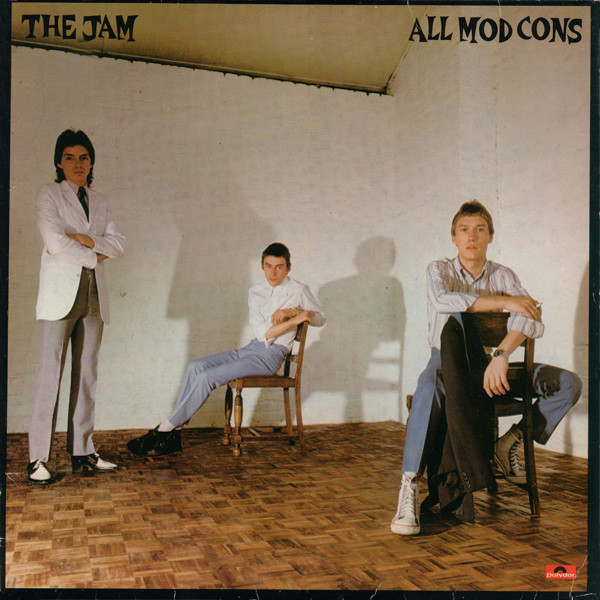
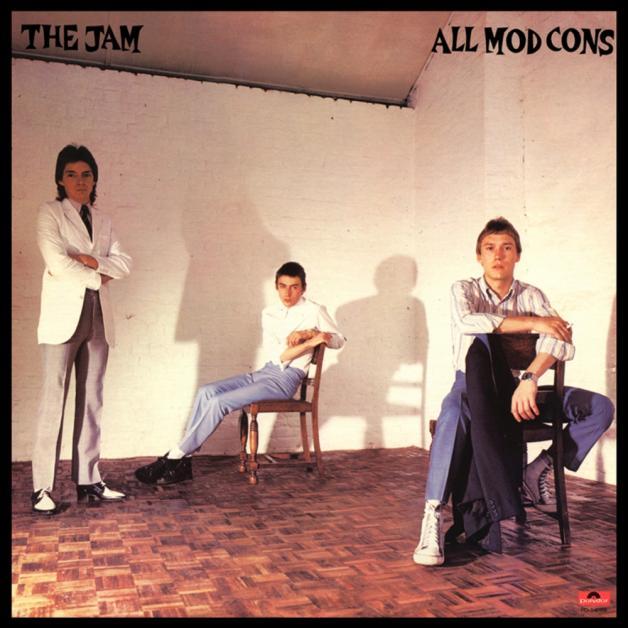
Which leaves us with All Mod Cons.

It’s a real anomaly in that three of its songs – David Watts, A-Bomb In Wardour Street and Down In the Tube Station at Midnight, were already known to record-buyers prior to the album’s release in November 1978, thanks to the first two being on a double-A side and the latter being released as part of the efforts by Polydor to better market the band.

I recall Paul Weller, while being happy that the band was beginning to enjoy chart success, was miffed that fans were being asked to shell out for songs that were otherwise available.  So there was absolutely no way he would have agreed to this being released as a single:-

mp3: The Jam – Billy Hunt

One of the most immediate songs on All Mod Cons, I have no doubt that the record company execs would have wanted to put this into the shops on 7″ vinyl and relished it going at least Top 20, such was the popularity of the band and the way the song fitted in perfectly to the sounds of early 1979.

Should’ve been a single?   Well, let’s just say it merited such an accolade, but let’s be glad it never came to that.


JC

HERE’S THAT RHYTHM AGAIN….

A guest posting by Fraser Pettigrew (aka our New Zealand correspondent)

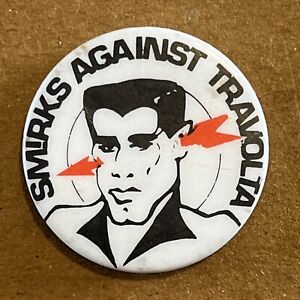
The Smirks were a short-lived band from Manchester whose chief contribution to posterity was as leaders, indeed sole proponents, of the parodic ‘Smirks Against Travolta’ movement. In 1978, I sent away for one of their badges which showed a cartoon of the iconic Saturday Night Fever star, his head impaled through the ears by a big red arrow in obvious homage to the Anti-Nazi League’s Rock Against Racism campaign materials. The Smirks’ campaign had a semi-serious intent to defend live music venues against the progressive dominance of discos and the formulaic dance music records that fuelled them. The punk era seemed like a propitious moment of revolt against the mainstream music industry, and disco music epitomised its commercialised, mass-produced product.

In 1977 and 1978 it seemed as though the early punk and new wave hits were but far-flung islands in an ocean of disco. Every other single featured on Top of the Pops seemed to bounce along four-to-the-floor on shimmering hi-hat ripples backed by scratchy wah-wah guitars and alternating octave bass lines. And it wasn’t just American R&B acts that were doing it. Old timers like The Bee Gees and even The Rolling Stones were doing it, Abba were doing it, Bowie was doing it. If somebody wasn’t doing it they soon would – I’m looking at you, Rod Stewart. It’s easy to see how The Smirks could view disco as a malignant algae slowly smothering every other lifeform in the sea.

In 1978, I didn’t like disco. Disco was the enemy, it was the commercial mainstream, it was the antithesis of punk and new wave. Disco music was not the music of teenage rebellion, it was the music of flare-wearing bubble-headed conformists, obsessed with superficial personal attractiveness. Disco kids were socially acquiescent good-timers, not uncompromising and intellectually fearless iconoclasts intent on remaking the culture in a constant cycle of destruction and renewal, like what I was.

Ironically, however, the ‘anything goes’ eclecticism unleashed by punk was already in the process of spawning music that blended new wave experimentalism with the stylised sounds of disco and its elder sibling funk. It wasn’t properly until 1979 that this seemingly taboo musical miscegenation was born, but the seeds were sown by the end of 1978. Ever the pioneer, John Lydon’s Public Image Ltd filled out the last eight minutes of their first album with the disco-loop time-waster Foederstompf. Despite its explicitly ‘contractual obligation’ nature (at one point Lydon sing-chants the line “how-to-finish-the-album-with-the-minimum-amount-of-effort-necessary…”), the track sets up a style marker that was picked up in startling fashion six months later on their second single Death Disco. Did exactly what it said on the tin. One of the strangest things ever to appear on Top of the Pops.

A month after PiL’s First Edition, in January 1979, New York punk scene graduates Blondie released Heart of Glass and within a week it was at number 1. It’s well known now that the song started life some three or four years earlier, and before it acquired its eventual form and title (when recorded in June 1978) it was referred to by the band as ‘the disco song’. Blondie had earlier included disco cover versions in their live set, including Donna Summer’s I Feel Love.

The single that Heart of Glass bumped off the top spot was Ian Dury and the Blockheads’ own disco classic, Hit Me With Your Rhythm Stick. In truth The Blockheads had always been a bit funky, and were never in any sense punk, but they surfed to prominence on the new wave, bearing an outsider affinity on account of Dury’s disabled skinhead Essex geezer persona and lyrical fondness for society’s nether parts.

Another of our favourite bands, Talking Heads, fellow alumni with Blondie of the CBGB school, had quite frankly been doing disco since day one. Talking Heads ’77 was a blueprint for blending slick, poppy dance rhythms with weirdo art-nerd lyrics, luring you onto the floor like the cutest boy in the class until you realised you were dancing with a bookworm, a civil servant, a psycho killer. More Songs About Buildings and Food delivered further explicitly disco tunes like The Girls Want to Be With The Girls, Stay Hungry and Found A Job, Frantz and Weymouth nailing the crisp tempos on hi-hat, snare and bouncing bass, Byrne and Harrison rubbing ‘chicken-scratch’ rhythm guitar straight out of KC and the Sunshine Band. There was a cover of an Al Green song.

The combined effect was to sand away the stigma associated with disco and funk. Did we disown Blondie? Had PiL sold out? No one complained, least of all me. Like everything else, my fearless iconoclasm was a pose, and though I genuinely didn’t like mainstream regurgitation, the appropriation and subversion of popular forms was obviously different, yeh? Also, music was supposed to be fun. Everyone wanted to party and the admission was grudgingly made that disco was 100% party music. Nobody was going to get up to The Bee Gees, but slap on Heart of Glass or Bowie’s Golden Years and we were on it. Something to do with the packaging.

Well away from the chart spotlight, other artists were taking funk and disco stylings and bolting them onto some distinctly uncommercial material. In The Smirks’ back yard, A Certain Ratio were beginning their rapid evolution towards icy, stripped down funk. In deepest darkest Bristol, The Pop Group compounded the irony of their name by confrontationally screaming agitprop over grooves that sounded like James Brown and George Clinton jamming in an abattoir.

So, in short order, my dislike of disco on purely aesthetic grounds vanished even faster than The Smirks. Just as well, since the following years saw a rapid diffusion of disco and funk throughout every level of post-punk music. You can hear it in the ‘Sound of Young Scotland’ in Orange Juice and Josef K, The Fire Engines, Boots For Dancing, in the Euro-disco of The Skids and Simple Minds, and in the warped pop of Associates.

New Order mashed up Kraftwerk and Giorgio Moroder to produce Everything’s Gone Green, following it up with Temptation, and eventually the monster techno-disco breakthrough of Blue Monday. The Pop Group never had a hit, assuredly for want of trying, but their former bassist Simon Underwood tasted success with Pigbag, whose James Brown-referencing Papa’s Got a Brand New Pigbag even inspired Paul Weller to jump on the bandwagon by ripping off the bass line for The Jam‘s disco song Precious.

By the beginning of the 80s, disco was as much part of the new wave as it was of the mainstream. And through the distinctive phenomenon that was Grace Jones, the new wave found itself infiltrating disco. In the late 1970s, the former fashion model had made a musical name for herself in the gay club scene with high-camp singles such as Do or Die and I Need a Man, but after teaming up with the Compass Point All Stars, her albums Warm Leatherette and Nightclubbing supplied a wider alternative club scene with some unexpected dance floor fillers. The former album’s title track could hardly be of more obscure origin, a cover of a proto-industrial synth pop single based on J.G. Ballard’s Crash, written and produced by The Normal, aka Daniel Miller, founder of Mute Records, the future home of all things alternative. Other covers followed, drawn from The Pretenders, The Police, Iggy Pop, Roxy Music and, most eyebrow-raising of all, Joy Division. When I occasionally frequented Edinburgh club JJ’s in the early 80s, Jones’s versions of She’s Lost Control and Warm Leatherette were staples, along with tracks like Bowie’s Stay, from Station to Station, and Material’s Bustin’ Out.

Bustin’ Out flags up another significant strand of alternative disco, the New York underground, propelled by experimentalists like Bill Laswell and Arthur Russell, ‘no-wave’ acts such as ESG, and the ZE Records stable that included Was (Not Was), Kid Creole and the Coconuts, Lizzy Mercier Descloux as well as Laswell’s Material. All of this fed alternative influences back into the disco club scene, ultimately influential in the metamorphosis of disco into house and techno in the late 1980s, a development further fuelled by post-punk electro-pioneers like Human League and Heaven 17, Depeche Mode, Throbbing Gristle and their offshoots Chris and Cosey, Yazoo and Erasure.

In parallel with all this painfully hip consumption, my musical tastes were being broadened to embrace some of the soul and funk originators like Sly and the Family Stone, Stevie Wonder, Isaac Hayes and Marvin Gaye. Several of my friends expressed healthy respect for the danceable end of soul music. One of them only ever wore white socks. Not long after it came out, I bought Off The Wall, easily one of the best pop/disco albums of all time. The barriers were down. I am now unashamed to reveal that my record collection holds prized items by such as Shalimar and the Detroit Spinners, and Brit-disco acts like Linx, Imagination and The Real Thing. Whisper it, I even have The Bee Gees’ Saturday Night Fever tracks on a CD, and they’re great. As Funkadelic so succinctly and eloquently phrased it, “Free your mind and your ass will follow.”

mp3: PiL – Death Disco
mp3: Talking Heads – Stay Hungry
mp3: The Pop Group – She is Beyond Good and Evil
mp3: The Jam – Precious
mp3: Material – Bustin’ Out (12” version)
mp3: Grace Jones – Warm Leatherette
mp3: David Bowie – Stay
mp3: Loose Joints – Is It All Over My Face? (Single female vocal version)
mp3: Heaven 17 –  I’m Your Money (12” version)
mp3: Linx – Wonder What You’re Doing Now


Fraser

AN IMAGINARY COMPILATION ALBUM : #386: TEN LOVELY TRACKS

A GUEST POSTING from STRANGEWAYS
Ten Lovely Tracks : An Imaginary Compilation Album

Welcome to a lovely Imaginary Compilation Album. That’s not me bigging-up this mix, but rather offering a literal description, for this is an ICA of songs deemed to be ‘lovely’ in nature. Immediately this business of a song being lovely is subjective of course. But the closest I got to a criterion was including tracks that, when you hear them, kind of wrap their arms around you.

It should be stated that this list is very, very far from exhaustive; the mountain of should-have-rans continues growing.

Side 1

1. The Ronettes: Walking in the Rain (single A-side, 1964, Philles)

I won’t attempt to add too much to the weight of words that must have been written about this song since The Ronettes released it in October 1964. I’m really not qualified, so to do so would be like writing about lofty cultural fixtures like the Mona Lisa or Ant & Dec’s Saturday Night Takeaway.

That said, a thunderclap kicks the track off and immediately we’re in a dreamland co-created of course by an ace Phil Spector production. With its references to shyness, its grown-up assertion that ‘sometimes we’ll fight’, its fondness for wishing on stars and of course its championing of rain over sun you could say that thematically Walking in the Rain gifted a bit of a blueprint to the indiepop genre that would emerge fifteen or so years later.

The track is just super, and so far as its inclusion here is concerned, its sheer loveliness fought off the likes of Past, Present and Future by the Shangri-Las, Thinkin’ ‘Bout You Baby by Sharon Marie and A Lover’s Concerto by The Toys.

Loveliest line: ‘Walking in the rain and wishing on the stars up above, and being so in love… ’

2. The Jam: Wasteland (Setting Sons LP track, 1979, Polydor)

I am really no Jam expert whatsoever. It’s daft, of course, that I haven’t explored beyond the singles and a couple of LPs. Moron. But the album I know best is Setting Sons. And the track I love most is Wasteland.

That Paul Weller was only, what, 21 max when he wrote the elegant words of Wasteland is astonishing to me. Listing the wasteland’s decorations – including punctured footballs, ragged dolls and rusting bicycles – he conjures up the grimy props of a world in which ‘to be caught smiling’s to acknowledge life’ as two lovers? Ex-lovers? Never-were lovers? Just friends? sit amid the trash and stoke over the past. Certainly if the theory that Setting Sons was intended – but not realised – as a concept album concerned with the lives of three childhood friends, the relationship could well be platonic. The reference to hand-holding though perhaps hints at something else.

Adding to the overall loveliness of this track are notes from a recorder – an instrument, in the UK at least, recalling tuneless school music classes. Here though, sounding not unlike the calls from a bird on high, it puffs out an innocent intro and pops up again at a key line.

Finally, that Weller gets so much detail of his wasteland – ‘meet me on the wastelands, the ones behind the old houses, the ones left standing pre-war, the ones overshadowed by the monolith monstrosities councils call homes’ – to even scan properly is remarkable.

Loveliest line: ‘Meet me later – but we’ll have to hold hands… ’

3. R.E.M.: At My Most Beautiful (Up LP track, 1998, Warner Bros.)

Of all the bands selected to populate this ICA, R.E.M. gave me the most trouble. In surveying the songs I know of them – and to be fair that although it’s not 100% knowledge it’s not by any stretch horrendous either – it rapidly became apparent that you could, before breakfast, create an ICA of ‘Lovely Songs Just by R.E.M.’.

So what to do?

That’s easy – choose a total slushfest, and from an unfancied LP, that will annoy the readers of this blog. So apologies to the exalted likes of Perfect Circle, Wendell Gee and The Flowers of Guatemala, plus Half A World Away, Nightswimming and Electrolite. Here instead is At My Most Beautiful, from 1998 album Up.

I seem to remember that at the time a common brickbat chucked at this song was that it was ‘R.E.M. trying to sound like The Beach Boys’. It is. And I further remember thinking ‘great’.

Sure, it’s kind of saccharine and soppy, but the overall result is lovely – which is of course what we’re after here. Added to this, the words of this big value track also provide…

The Grand Indie Boy or Girl’s Guide to Snagging a Partner

Three sure-fire ways to reverse the joy of solitude:

1. Read bad poetry into their machine (or, for the less ancient, their mobile phone)

2. Save their messages just to hear their voice – (perhaps keep this one to yourself)

3. Count their eyelashes, secretly (and for bonus points, with every one whisper ‘I love you’)

Loveliest line: You always listen carefully to awkward rhymes, you always say your name like I wouldn’t know it’s you, at your most beautiful.. ’

4. The Pogues: Lullaby of London (If I Should Fall From Grace With God LP track, 1987, WEA)

The Pogues are probably at their best when they’re rocking the furious likes of Boys From The County Hell and Sally MacLenanne, or Turkish Song of the Damned and Bottle of Smoke. But grand as these are, you could hardly call any of these breathless beauties lovely. That’s a job instead for Lullaby of London, from the revered 1987 album If I Should Fall From Grace With God.

Here, Shane MacGowan takes us on a kind of stroll located by a river and in the springtime. On this jaunt, in the main, his words are mystical and supernatural (ghosts and haunted graves and angels are present). But he ambles also in the urban: and despite noting the absence of a cry from a lonesome corncrake – any twitcher will tell you i) that’s a bird and ii) its binomial nomenclature is Crex crex – he seems satisfied enough with the sounds of cars and bars and laughter and fights.

This is a song that feels older than it is or, to put it more delicately, could be of another age. Were it not for that reference to motor cars, the whole expedition could be taking place a century-and-a-half ago. Remove the pubs and you spool back even further. Laughter and fights though have surely been with us since the first caveman cracked an off-colour joke and instigated a brawl.

Enough. All that’s left to say is that if the words to Lullaby of London are remarkable, the band is totally on point too, especially via the lilting mandolin that quietly matches the lyrics for sheer emotional punch.

It’s odd, but a speck of dust always lands in my eye whenever I hear this track.

Loveliest line:May the wind that blows from haunted graves never bring you misery, may the angels bright watch you tonight and keep you while you sleep… ’

5. The Primitives: We Found a Way to the Sun (Really Stupid 7” single B-side, 1986, Lazy Recordings)

Somewhat inevitably the band with the LP titled Lovely was always going to make it onto this ICA. And, also somewhat inevitably, the song selected here does not in fact feature on that album. Instead, it’s We Found a Way to the Sun – curiously styled, on the subsequent Lazy 86-88 compilation, and other anthologies that followed, as (We’ve) Found a Way (to the Sun).

Bracketed or not, it is just one of several absolutely killer formative Primitives B-sides. Delivered inside yet another early Prims sleeve to die for,
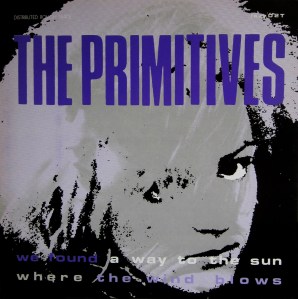
this smasher popped up in 1986 on the Really Stupid 7” single and, on 12”, alongside Where the Wind Blows. That gem of a fellow B-side, set at the witching hour and chockful of associated imagery, is the one I’d actually started writing about for this post. But that was before the handbrake turn you’re now reading.

Why the switch?

The truth is that either track could have made it, but the distorted, beautiful intro and subsequent melody of We Found a Way to the Sun just pipped Where the Wind Blows to the post. Add to these Tracy Tracy’s wide-eyed and hurt-sounding vocal, and we really do achieve Primitives perfection. Also, there’s a curiosity to celebrate: no chorus is offered – just one bewitching verse followed by repetition of the song’s title.

Loveliest line: ‘But it’s all too good to be true, I don’t know just what I should do, I love everything about you… ’

Side 2

1. Camera Obscura: My Maudlin Career (My Maudlin Career LP track, 2009, 4AD)

This title track to Camera Obscura’s fourth LP is both eminently huggable and a real bruiser. Its opening twenty-five seconds could be mistaken for a Wall of Sound production as keys and strings and brass add layer after layer of sock-knocking assault. And as the late Carey Lander’s incessant, trebly keys heroically wrangle it all into a followable structure, Tracyanne Campbell’s words speak of a relationship – the maudlin career of the title – going wrong (perhaps best distilled in the lines ‘we were love at first sight, now this crush is crushing’).

Despite the tale of a partnership on the skids, this is yet another lovely song from a band that specialises in them.

Loveliest line: ‘I’ll brace myself for the loneliness, say hello to feelings that I despise… ’

2. The Pipettes: A Winter’s Sky (We Are the Pipettes LP track, 2006, Memphis Industries)

Oh crumbs, not again. Look, I know I included this track on the Pipettes ICA I scribbled several years ago, but it’s just too lovely a fit not to revisit it. And what I wrote then remains, so I won’t deviate from it. The harmonies. The shimmer. The warm pootle of brass before the little Smithsy sound effect that chills the closing line ‘the last we saw of her, it came too soon’.

This is only ever played in our – that’s me and the furniture – house during winter (official three/four-month winter, I mean, not the Scottish one).

Loveliest line: ‘Underneath a winter’s sky, her eyes were bright, tonight he finds her underneath a winter’s moon… ’

3. Butcher Boy: I Could Be in Love With Anyone (Profit in Your Poetry LP track, 2007, How Does It Feel To Be Loved?)

A bit like R.E.M., there are loads of Butcher Boy songs you could tag as lovely. ‘Poetic’ is kind of a lazy descriptor for John Blain Hunt’s lyrics, but that doesn’t stop it being any less accurate. He’s a master of fastidious and forensic observation, and an expert in uplifting and championing the ordinary: pebbledash and paper chains, chimes and chewing gum.

Despite, or perhaps because of, the sheer quality that threads through Butcher Boy’s three LPs so far, this is a band that adheres stoically to a less-is-more philosophy. Releases are sporadic – bookended by years that meanwhile continue their business of totting up births and marriages and deaths. Gigs, at best, the same. World Cups occur more regularly. Plus, in spite of heavyweight patronage from names including Stuart Murdoch and John Niven, Ian Rankin and Peter Paphides (whose Needle Mythology label released the 2021 BB compilation You Had a Kind Face), there remains a Sundays-like reticence to seek the limelight. As listeners, we’re the losers in these arrangements of course. But you kind of wouldn’t really have it any other way.

To the song though. Winning out for this compilation is I Could Be in Love With Anyone, the fourth track on the first Butcher Boy LP Profit in Your Poetry.
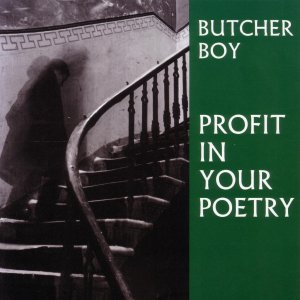
Lyrically there’s a little of the celestial in this tale of a character who visits in dreams and flies around the walls of a room. Amid some good intentions there seems to be selfishness too, characterised by a title that could be delivered with a shrug, and also by the delight taken in ‘breaking hearts for fun’. From hearing this treasure years ago I quickly, and surely wrongly, settled on the idea that the words are describing my own favourite antihero Peter Pan.

Loveliest line: I’m actually going to reproduce the song entire for this entry, and hope you agree that choosing just one lovely line would be something of a disservice.

Listen, please don’t close your eyes
I don’t know how I know what you’re thinking but I

I’ve never felt so far away
Blood is chiming bells through you

But listen, that’s OK ‘cos I’m frightened too

And tenderly I write today

That I could be in love with anyone

I’ve been breaking hearts for fun


Listen, tell me what’s gone wrong

And I will come in dreams and I’ll bleed into songs

So you can sing them back to me.
Sun suspends my days in dust

If my love made you lonely I’m sorry but

The feeling flowed so easily

But I could be in love with anyone

I’ve been breaking hearts for fun

Glass reflects my eyes and skin

But still my lips will crumble like ash when we kiss

So cynically I shift the blame
I could fall upon this house

Or fly across these walls with your heart in my mouth

But honey I would rather stay


Where I could be in love with anyone

I’ve been breaking hearts for fun

4. Ride: Vapour Trail (Nowhere LP track, 1990, Creation)

This is probably the song that inspired the whole ICA. I’ve always struggled to find a better word than ‘lovely’ to summarise the romantic Vapour Trail, the track that closes Ride’s debut LP Nowhere.
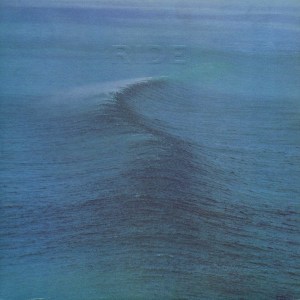
Vapour Trail is dreamy and delicate and from its wispy intro to its choppy string-laden exit lifts you into a whole other place. Best of all, the words – describing total adoration and beguilement – feel like they were scratched onto a jotter during double geography, a carefully crooked arm shielding them from the ridicule of the class bully.

Loveliest line: ‘You are a vapour trail in a deep blue sky… ‘

5. The Smiths: I Won’t Share You (Strangeways, Here We Come LP track, 1987, Rough Trade)

After – literally – decades of internal debate and agony I concluded some years ago that My Favourite Smiths Song is this: I Won’t Share You, the very last track on the very last LP.

I mention its placement on Strangeways, Here We Come deliberately as it is crucial to its victory. That’s thanks really to Simon Goddard’s 2002 book Songs That Saved Your Life (Reynolds & Hearn Ltd.) – a painstaking track-by-track analysis of the band’s discography (and so dippable it should be sold with a lollypop and inside a poke of sherbet). There, Goddard notes that I Won’t Share You melts out with the subtlest little breath of faded-out harmonica. It’s an addition so brief and gentle in fact that it’s essentially drowned at birth. But, and here’s the kicker, Goddard – who beautifully and correctly describes the song as ‘a deeply affecting lullaby’ – cleverly connects this sigh of a coda with the band’s first offering, the Hand in Glove single, which begins with, amazingly, a faded-in harmonica.

This, the writer states, returns The Smiths full circle, pinging them from 1987 back to 1983, and all without a DeLorean and flux capacitor in sight.

You can call this proposed loop a reach of course, and it’s an unashamedly romantic way to view the band’s birth and death (and perpetual rebirth-by-harmonica). Amid these gymnastics after all is the troubling and inconvenient fact that The Smiths’ actual last recordings occurred in May 1987, a month after Strangeways had wrapped. These were created at a B-side session whose content and atmosphere so browned-off the already irritated Johnny Marr that it’s not dramatic to state it contributed significantly to the band’s ending.

So for fans of Cluedo, you could say it was the Cilla Black cover, in the studio, with the microphone wot did it.

Even so, the harmonica yarn is a notion I utterly subscribe to and, throughout that years-long agitation across which any helpful criteria was welcome, it earned I Won’t Share You my top spot.

Prettifying the number even further there is of course the debate regarding its lyrics. Specifically, this is concerned with whether or not they constitute Morrissey’s farewell to Johnny Marr. The song would have been completed just a few months before the group dissolved, then released just weeks after the split. It’s widely thought the singer disliked the idea of the guitarist collaborating with others, or even getting close to essential associates like managers and producers. Against those assumptions it’s easy to make a case for the disputed possibility that I Won’t Share You is the sonic equivalent of a note left upon the kitchen table (or, for Smiths trainspotters, perhaps pinned beneath a windscreen wiper).

Whatever the truth, and whether or not you buy the Magic Harmonica Theory and/or the potential Dear Johnny nature of the lines, it’s a song that’s a worthy last word on both The Smiths – it was surely the only serious track ten candidate – and on this collection of lovely songs, which I hope you’ve enjoyed reading about and maybe visiting/revisiting.

Loveliest line: ‘I’ll see you somewhere, I’ll see you sometime, darling… ’

Thanks as ever to Jim for the space and opportunity, and to you for reading.


STRANGEWAYS

AN IMAGINARY COMPILATION ALBUM : #385 : THE JAM (3)

The relatively recent passing of Rick Buckler went unmentioned on the blog.  It wasn’t as much an oversight on my part as the fact that I really couldn’t find the right words to say at the time.  To be honest, I still really don’t think I can really add to the many hundreds of fine tributes that can be found out there across mainstream and social media outlets, other than to mention that I found it incredibly sad to realise that one of the first of my genuinely musical idols had died, at the all-too-young age of 69.

I was sure that I had written a review of That’s Entertainment : My Life In The Jam, the booked penned by Rick and published in 2017, but I can’t find it in the archives.  Maybe there was no review, and it was only it was mentioned in passing perhaps as a recommendation for adding to your Xmas lists.  Either way, I’m going to dig it out an re-read it, and this time pen something for the blog.

The Jam, as I’ve mentioned on so many occasions, were the first band I fell for in a very big way, and although it is now more than 40 years since they last made music together, I still find myself going back and playing the singles and albums on a frequent basis, never tiring of anything…well, almost anything as much of The Modern World album hasn’t aged well.

There’s been two previous ICA’s, the first being #52 back in December 2015 and the second being #152 in January 2018.

They were both a bit unusual in that neither featured any singles or b-sides.  The logic behind that was ICA 52 came almost immediately on the back of a long-running series on the band’s singles, while I self-imposed a rule for #152 that nothing on the previous ICA or any singles could be used.  But as my delayed tribute to Rick, I thought I’d try and come up with a definitive ICA.  I think it’s a more than decent selection, but there’s so many incredible tunes that I’ve had to leave off.  Many of the words in the description of each song have been lifted from previous postings.

SIDE A

1. Funeral Pyre (single, 1981)

One of the great things about The Jam is just how instantly recognisable so many of their tunes are, even after all these years.  The post-punk riff of In The City, the bass and organ which kick off A Town Called Malice, the acoustic strum of That’s Entertainment, the rat-a-tat first three notes of Going Underground….the list is endless.  Right up there among the best must be Funeral Pyre, which opens with a tour de force from the rhythm section before the lead/guitar and vocals come in.

There can be no better way to to acknowledge and appreciate Rick Buckler than to open the ICA with the one song on which his drumming prowess really stands out across the Jam’s entire output, and indeed the one song on which he was given a writing co-credit.  When I heard about Rick’s death, my mind went back to those amazing live shows at the Glasgow Apollo and how the lights shone directly on him as he smashed his way through the song’s final few seconds, inevitably and rightly leading to a huge roar from a very appreciative audience.

2. Strange Town (single, 1979)
3. The Butterfly Collector (b-side 1979)

All Mod Cons, released in November 1978, will, I suspect, be my all-time favourite album until my own dying day.  But just as I thought there was no way  The Jam could top its magnificence, they released an incredible new single and arguably an even better b-side in March 1979.

There surely can be no disputing that this remains an incredible record. The A-side is powerful and fast while the B-side is slow and haunting….but both contain really sad and moving lyrics. The A-side being the tale of someone lost, lonely and alienated having been lured to the capital by the bright lights and promises of streets paved with gold, while the B-side is a sorry and lurid tale of a groupie whose best days are behind her, but not that she has cottoned on. It’s worth remembering that back then, Paul Weller was a young musician very much in love with a long-term girlfriend, and this was his response to the sorts of offers which come the way of rock musicians while they are out on tour.

4. Saturday’s Kids (from the album Setting Sons, 1979)

As a 16-year-old who was becoming increasingly aware of politics and the difference between the ‘haves’ and ‘have-nots’, the sentiments of this lyric really hit home.  The fact it came accompanied by a killer, albeit atypical post-punk new wave tune, gave me a sense at the time that it was one of the greatest songs anyone had ever written and had recorded.  I’m old enough to know better, but I will never forget the euphoric feeling throughout my brain and body every time the needle hit the groove on this one.  The fact that Weller, Foxton and Buckler didn’t want the studio albums to be full of singles is the only reason this one never became a huge and memorable chart hit.

5. Town Called Malice (single, 1982)

One of the things I most loved about Town Called Malice was that it felt such a return to form after what, to me, had been the disappointing Absolute Beginners 45.   Looking back, I probably wasn’t alone in having such sentiments, given it came straight in at #1.

OK, there was the fact that, kind ahead of its time, Polydor Records indulged in a form of multi-formatting by releasing the studio version on 7″ and a live version on 12″ thereby just about guaranteeing it would go in at #1 given just how many fans that band had at the time.  The thing is, if Malice had been a bit of a duff number, then there’s every chance the 12″ version would have gathered loads of dust in record shops; after all, who would shell out for a live version of a song that was brand-new if it hadn’t been an instant classic? It could very well be argued that it has become the band’s best-known song, given it is very much a staple of the golden oldies slots on UK radio. And it still remains a belter to sway your hips to on the dance floor.

SIDE B

1. When You’re Young (single, 1979)

The anthem of my late(ish) teens.  The one which said it all, with a few, what felt like prophetic lines from the man who could do no wrong.

Life is timeless, days are long when you’re young
You used to fall in love with everyone

Life is new and there’s things to be done
You can’t wait to be grown up

but then there’s the words of warning, which really didn’t make sense at the time, but certainly did just a few years later after the halycon days of university were disappearing in the rearview mirror

And you find out life isn’t like that
It’s so hard to understand
Why the world is your oyster but your future’s a clam
It’s got you in its grip before you’re born
It’s done with the use of a dice and a board
And let you think you’re king but you’re really a pawn

I look back and there’s an increasing astonishment that Paul Weller, born in May 1958, wasn’t barely out his teens when he wrote so many of his greatest lyrics.

2. Going Underground (single, 1980)

In 1980, singles didn’t enter the charts at the #1 position. Instead, they came in somewhere in the 20s and that got you onto Top of the Pops. The single would sell well on the back of this TV appearance, would climb a few places and then again the following week into the Top 10. The second TOTP appearance would follow, and if it was different enough from the first one and Radio 1 was still playing it, then the Top 5 and a chance at #1 would follow. It was always a 3-4 week cycle to hit the top slot.

Going Underground broke all the rules of the game. It flew in at #1 and stayed there for three weeks, and in doing so, confirmed that my favourite band was also the biggest and best band of the time.

3. All Mod Cons
4. To Be Someone (Didn’t We Have A Nice Time)

OK….this means the ICA goes beyond the normal ten tunes, but I do find it hard to ever separate the opening two tracks which open up All Mod Cons…and besides with them having a combined running time of under four minutes, then it’s not as if I’m going to be accused of overcrowding this side of the vinyl.

It didn’t make too much sense to me at the time that there could actually be any downside to being famous and rich from being a footballer or a rock singer.  But then again, I never actually appreciated back in the day that, along with perhaps being a professional boxer, there were very few avenues open to working-class boys to really make it big.  Things might have been bad back in the late 70s when Weller offered up his cautionary words, but it surely was nothing in comparison to the horrific media frenzies which have become ubiquitous with celebrity life in subsequent decades, accelerated by the horrors of social media.

5. Thick As Thieves (from Settings Sons)

This is one of the key tracks from the band’s fourth and most ambitious album. There’s no doubt that in Weller was intending to go against the grain of the post-punk/new wave era by attempting to come up with a concept album telling the story of three childhood friends whose lives don’t go the way of their youngdreams with everything changing after them fighting, but surviving, a war.

The concept wasn’t fully realised, but then again to have taken on and complete such a task would probably have meant having to get off the treadmill when the band was at the height of its fame and popularity, and besides, the dangers of the fickle music media turning against Weller if he had realised such an audacious ambition were all too real.

6. Down In The Tube Station At Midnight (from All Mod Cons and also a single, 1978)

There are days when I think this may well be the greatest record of all time, especially with each passing year.  I almost always instantly offer up Temptation by New Order if asked the specific question, but depending on my mood, especially if I’m a bit more reflective than normal, then I could easily change my mind.

An incredible tune with an incredible lyric which, to a 15-year old who hadn’t yet set foot in London, was genuinely terrifying.  Not only did I never want to bump into the muggers but please don’t ever let me cross the path of the atheist nutter who sprays ‘Jesus Saves’ onto walls.  My first trip on the London Underground came in 1983. It happened to be on the Piccadilly line at King’s Cross, and I was genuinely intrigued at how deep down I had to go to get to the platform.

All the way down on the escalators I was quietly singing this song to myself, and to my amazement when I finally reached the end of the escalator ride down into the bowels of the city, I found I could indeed make out the distant echo of faraway voices boarding faraway trains.

Thankfully, I never met the atheist nutter, not knowingly at least.

The album version is closing out this ICA just as it did with the All Mod Cons album.  Where the single version fades out, the album version ends abruptly, followed by the  sound of a train departing the platform and a musical refrain of a guitar solo. It always felt as if this was the ‘real’ version of the song, with the horrific realisation that the victim of the mugging had in fact been murdered…….

I know it’s not the most upbeat of thoughts on which to end an ICA, but that’s entertainment.


JC

SHAKEDOWN, 1979 (November)

79

A slight deviation from the norm in that this instalment also happens to cover a few days from October 1979, with the first of the charts being recalled with much fondness today being that of 27 October – 3 November.  The first glance is enough to give anyone with good taste a bit of the dry boak as the Top 3 places really are easy listening hell with Lena Martell, Dr. Hook and Sad Cafe stinking the place out.  Thankfully, one of the year’s top songs did make its entry into the charts this week, coming in at #29.

mp3: The Jam – The Eton Rifles (7″ version)

The band’s third chart hit of 1979 following on from When You’re Young and Strange Town, both of which had been Top 20.  The Eton Rifles would take The Jam to the giddy heights of #3 in mid-November, confirmation that, for a certain age-group across Britain, they were becoming the biggest and most important band of their time.

Moving quickly on to the chart of 4-10 November, and it was still AOR hell across much of the Top 40.   I had to go a long way down to find something decent enough that was new this week:-

mp3: Madness – One Step Beyond

So, it’s now coming up for 45 years since those of us of a certain age, not only fell head-over heels for The Jam, but we all did the Chas Smash dance for the first time.  The Prince had been great fun to listen and dance to, but the band’s second 45 was truly something else.  In at #51, it would go on to enjoy a 14-week stay in the Top 75, not taking its leave until the end of February 1980.  The first Top of The Pop appearance for this one was memorable…..the audience had no idea what to make of it!!!

Sneaking in almost unnoticed at #75 was this:-

mp3: The Tourists – I Only Want To Be With You

As with The Jam, this was The Tourists third chart hit of 1979, and it would prove to be their biggest in their short existence. A cover of a Dusty Springfield hit from 1964, this would spend 7 weeks in the Top 10 throughout December and into the first few weeks of January 1980, thus gaining loads of sales in that crucial Christmas period.  It would peak at #4 which, coincidentally, was the same success that Dusty had enjoyed 15 years previously.

11-17 November was another that was short on quantity, but big on quality

mp3: Pretenders – Brass In Pocket (#57)

Another band enjoying a third chart hit of 1979, but where Stop Your Sobbing and Kid had barely dented the Top 40, Brass In Pocket was a different beast altogether. It’s one of those songs that gets lumped onto a fair number of ‘Alternative Hits of the 80s’ compilations, which is kind of understandable when you look at its chart trajectory.  In at #57….four weeks later in mid-December, it had crept up to #30.  Five weeks later, it reached #1 in mid-January, enjoying a two-week stay at the top, before eventually falling out of the Top 75 in March, a full 17 weeks after it had first come in.  A brilliant pop song that has aged superbly.

It was also a chart that delivered a cash-in.

mp3: The Police – Fall Out (#70)

The past 18 months had delivered worldwide pop success for The Police, but here was a reminder of their new wave roots.  The debut single, originally released in May 1977 on Illegal Records. It had been written by Stewart Copeland and the guitarist was Henry Padovani as Andy Summers had yet to join.  Sting‘s role was just to look pretty and sing.  Fall Out had flopped on its initial release, but the demand for product was such, and even though the band’s sound have move a long long way from new wave, that this would reach #47 in due course.

Moving swiftly on to 18-24 November, it proved to be a chart with some intriguing new entries.

Hands up if you can recall and then sing along to Gary Numan‘s follow-up single to Cars.   I thought so….very few of you

mp3: Gary Numan – Complex (#15)

Where Are Friends Electric and Cars had been upbeat and jaunty numbers and very much on the synth-pop side of things, this one is slow, meandering, serious and of the type that has listeners stroking their chins.  It takes almost 90 seconds, half the duration of the song, before the lyric begins.  I’ve a feeling that if Gary Numan hadn’t been such a phenomena back in 1979 that this would not have had much airplay on daytime radio.  It did, however, get A-listed and in due course would peak at #6 the following week.

I’ve mentioned a few bands for whom November 1979 brought a third chart hit across the calendar year.  It’s time to give praise to a band that was having its fourth hit of the year

mp3: The Skids – Working For The Yankee Dollar

It had all started with Into The Valley in February, followed by Animation and Charade.   There is no doubt that the band’s sound evolved and changed a huge deal across the year.  The first hit was new wave personified but the final hit, with all sorts of keyboards has more than a hint of prog.  What hadn’t changed, however, was the catchy sing-along nature of the verses and chorus, albeit it was till nigh-on impossible to get all the words right!   Working For The Yankee Dollar came in at #34 and nine weeks later it reached its peak of #20 after an incredibly slow rise to that position, going 34, 32, 28, 27, 24, 24, 23, 21, 20.

One place below The Skids in the new chart was a song from another band, enjoying a fourth hit single of the year

mp3: Blondie – Union City Blue

In at #35 and eventually peaking at #13.   A relative flop given that Heart of Glass, Sunday Girl and Dreaming had been #1 or #2.  A sign that the halcyon days of Blondie were over???  Don’t be silly……normal service would be resumed in February and April 1980 with two more #1s.  Union City Blue did, however, prove that the band were more likely to have hits with pop or disco orientated songs rather than rock-type efforts.

Coming in at #55, was someone on the comeback trail.

mp3: Marianne Faithfull – The Ballad Of Lucy Jordan

Back in 1979, I only knew of Marianne Faithfull through her acting and the fact she had been romantically involved with Mick Jagger. I had no idea that she had enjoyed a number of Top 10 hit singles back in 1965 and then a minor hit in 1967.  November 1979 had seen the release of an album, Broken English, with the music press and broadsheet newspapers in particular highlighting it was the work of someone coming back from a long period in the wilderness that had included periods of drug addiction, homelessness and anorexia, all of which had messed with her voice.  It’s an album that gained great critical acclaim on its release, and has done so ever since.  But sales wise, it didn’t initially do all that much, only reaching #57 in the UK, albeit it sold in better numbers across Europe.

In an effort to boost sales, a single was lifted from it.  It was one of a number of covers recorded for the album, of a tune originally recorded back in 1974 by Dr Hook & The Medicine Show. I really have to share the review that was printed in Smash Hits magazine, none of whose targetted readership would have had a clue about Marianne’s past history:-

“The Debbie Harry of the sixties returns to vinyl with an honestly outstanding offering, a version of an old Doctor Hook number related over a swimming synthesiser. If you can handle this, it sounds like Dolly Parton produced by Brian Eno. Only better.”

Absolute genius!!!!!!!!!

With that, it’s time to move on to the chart of 24 November – 1 December.  I wasn’t expecting much, given that this is when record company bosses put the emphasis on the festive or novelty songs that are likely to curry favour rather than promoting anything serious or worthwhile.

mp3: The Police – Walking On The Moon (7″)

A first in this series, with a band enjoying two new chart entries in the same month.  A&M Records weren’t happy with the Illegal Records re-release of Fall Out, but given the band weren’t involved in any way with its promotion, and the fact that the next ‘proper’ single would come in at #5, before hitting the #1 spot, demonstrated that no damage to the brand had been done.

And here’s some more proof of why 1979 was, without any question, the best-ever in terms of delivering chart success for great/memorable/important singles.

mp3: Sugarhill Gang – Rapper’s Delight

This would have been the first time I ever heard a rap song.  I’d be fibbing if I said I took to it instantly.  I did love the fact it made great use of Good Times by Chic, but the fast-flowing and difficult to decipher lyric was something I didn’t ‘get’.  Looking back on things, I am happy to acknowledge, and not for the first time, that my tastes in music had yet to fully form at the age of 16.  I had no immediate reference points for this type of music but over the next few years, thanks in part to The Clash and Blondie referencing rap music and incorporating it into their own songs, it began to make a great deal of sense.  By the time Grandmaster Flash appeared on the scene in 1982 with The Message, I was more than ready to embrace things, albeit I would still only dip my toes into the water for a few more years before fully immersing myself.

Rapper’s Delight came in at #38.  Within two weeks, it was at #3, and it wouldn’t leave the Top 75 until February 1980.  It’s far from the greatest rap song ever written and recorded, but it must be one of the most important as it was a game-changer.

I should mention in passing that this was the chart in which Pink Floyd, to the chagrin of their fans who saw the band as being an albums-only outfit, saw a single, Another Brick In The Wall, come in at #26.  It was their first Top 40 single since 1967 and would, in reaching #1 a couple of weeks later, become their best known song.  I thought of it back then as a novelty hit.  Still do.

It was also the chart in which Paul McCartney first got to tell us of his Wonderful Christmas Time, and he hasn’t stopped doing so since.  It came in at #61, and eventually reached #6.   It has subsequently featured in the Top 75 in 2007, 2011, 2012, 2015 and every year since 2017 since teh dawn of digital downloads counting towards chart positions.

Part 2 of this feature, with 45s from November 1979 that didn’t chart, will be with you in a couple of weeks.

JC

SONGS UNDER TWO MINUTES (5): IN THE STREET TODAY

The-2-Minute-Rule

There’s not too many out there, if indeed anyone, who’ll make the claim that The Modern World, the second studio album by The Jam, is their finest body of work.  

It was all a bit rushed, being released in November 1977, just five months after the debut, In The City.   Twelve songs, one of which was a cover, all crammed into under 32 minutes of music.   It does, however, contain this gem.

mp3: The Jam – In The Street Today

The song is credited to Paul Weller/Dave Waller.   The latter was a founding member of The Jam when they were all in their early teens, but he left well before any record deals were signed as he wanted to pursue his interest in poetry.  The two remained close friends and 1980 saw the publication of Notes From Hostile Street, a collection of poems written by Dave Waller and issued through Riot Stories, a publishing outlet owned by Paul Weller.

Dave Waller died of a heroin overdose in 1982.  Paul Weller would later write A Man Of Great Promise, a track on the album Our Favourite Shop, in tribute.

JC


SHAKEDOWN, 1979 (August)

79

The summer job lasted six weeks and all too soon I was back at school, entering 5th Year, but with the consolation that  lunchtimes and other short breaks could be spent sitting in a common room instead of outside in the inevitably pouring rain crowded underneath whatever shelter could be found.   Music was allowed in the common room….usually through listening to BBC Radio 1, although as the weeks and months passed and after someone had brought in a spare machine, home-made cassettes became the order of the day.

My introduction to many of the songs which entered the charts in August 1979 will straddle the last couple of weeks at Halford’s and the first couple of weeks spent learning and gearing up for the inevitable exams that would, hopefully, lead to being deemed smart enough to go the uni in due course.  Kind of makes this one appropriate

mp3: Ian Dury & The Blockheads – Reasons To Be Cheerful (Part 3)

A new entry, at #45,  into the chart of 29 July – 4 August 1979.  In some ways this demonstrates the differences in how differently music and musicians were marketed back then.   Hit Me With Your Rhythm Stick had gone to #1 in January 1979 but Stiff Records didn’t seek an immediate cash-in, waiting the best parts of six months to release the follow-up.  Nowadays, it’s more likely to be a gap of six days.  Reasons To Be Cheerful was great fun to listen to, and to try and decipher the lyrics.  I imagine it was difficult enough if you were from Ian Dury‘s neck of the woods, but it was near impossible a few hundred miles to the north.

I’m guessing this had something of a low-key release given it only came in at #45, but at the same time I think it’s fair to surmise there were all sorts of promotional activities happening as it charted, possibly involving TV appearances, as it jumped up all the way to #6 the following week, eventually peaking at #3. Not that any of us knew it, but it was the last time the band would make it into the Top 20.

A new group experienced their first taste of success, thanks to their debut single coming in at #58.

mp3: The Merton Parkas – You Need Wheels

A mod revival was just getting into full swing, and a number of groups with such leanings were snapped up by different labels keen to offer ways for impressionable teenagers to part with their pocket money.  Beggars Banquet signed The Merton Parkas, a four-piece from South London, two of whose members were brothers, Danny Talbot (vocals/guitars) and Mick Talbot (keyboards). Their debut single did go on to reach #40, but none of its follow-ups nor their debut album bothered the chart compilers. The band would break up in 1980, but Mick Talbot, after taking a phone call from Paul Weller a few years later, would become one of the most successful and recognisable pop starts of the early-mid 80s.

mp3: Joe Jackson – Is She Really Going Out With Him (#66)

Joe Jackson‘s debut single in late 1978 had flopped, much to the disappointment of all concerned at A&M Records who were convinced they had signed someone who was on a par, musically and lyrically, with Elvis Costello.  The debut album, released in March 1979,  had stalled while a further two singles had flopped miserably. Everyone involved was probably gearing up to cut their losses…..except that over in America, a few DJs and writers began to play and talk up Joe Jackson and his band as being worthy members of this emerging scene that had been dubbed ‘new wave’.  Back in those days, if America was bigging you up, then the UK media took a bit of notice and the musician’s profile began to grow.  The record label cashed in and re-released the flop debut single which this time round did chart.  It would eventually spend 13 weeks in the Top 75, peaking at #13, paving the way for Joe Jackson to enjoy a fruitful year in 1980 with his second album.  As it turned out, he never did shine quite as brightly as Costello, but he has more than maintained a successful career in music and composing for what isn’t now too far off 50 years.

I hope that this series is demonstrating that 1979 was a fabulous year for chart singles, but it shouldn’t be forgotten that these competing and being outsold by a lot of dreadful singles.  The top end of the charts in August was dominated by mainstays such Cliff Richard, Abba, Darts, Showaddydaddy and Boney M, which all too often got playted on Radio 1 – which is why the move to a cassette player in the 5th Year Common Room was inevitable.

Too much of the above and not enough of this new entry at #52:-

mp3 :The B52s – Rock Lobster

There was a small number of us in that common room who loved the sound of The B52s.  There was one girl who adored their look and quietly began to incorporate some of it into her everyday dress without getting into bother for flouting rules around school uniforms.  But given that the band, certainly for the early part of their career, rarely got above cult status, this was likely typical of how they were viewed across the country with very few people ‘getting’them. Rock Lobster eventually got to #37 in 1979.   It was re-released in 1986 and reached #12.

A couple other new entries from the 5-11 August chart worth mentioning in passing.

mp3: Roxy Music – Angel Eyes (#32)

The Roxy Music of the early 70s was certainly no more.  The glam/experimental nature of the early years was now being replaced by a more sophisticated disco-influenced sound, that it in turn would manifest into MOR.  The music was now less  of a ‘must have’ to the music snobs, but it was increasingly selling to the masses.  Angel Eyes was one of eight Top 20 hits between 1979 and 1982, of which six went Top 10. Bryan Ferry had achieved his ambition of being a bona fide pop star.

mp3: Sister Sledge – Lost In Music (#58)

One of a number of disco classics from 1979 that made Sister Sledge one of the year’s most popular and successful acts – they were in the singles chart for a total of 31 weeks while their debut album We Are Family peaked at #7 and spent 39 weeks in the chart.  Included in this feature as anyone suggesting that The Fall would one day record a cover version of Lost In Music would have been taken away and locked in a darkened room for their own safety.

The chart of 12-18 August wasn’t all that different from the one of the previous week in that nothing new came into the Top 75 any higher than #48.  But at least it was a good tune.

mp3: The Stranglers – Duchess

I know The Stranglers divide opinion.  They alwways have.  Back in the late 70s, there were many critics who accused them of being talentless bandwagon jumpers who were no more than grubby old pub rockers who had taken advantage of the emergence of punk to reinvent themselves.  They were rightly accused of being sexist and misogynist through many of their lyrics, while the use of strippers at live shows caused many an NME journalist to froth at the mouth.  But they were more than capbable of churning out the occasional pop/new wave classic.  Duchess is one of their finest moments, eventually reaching #14, one of the fifteen times they would crack the Top 30,  maling them regulars on Top of The Pops well into the 80s.

I’ll mention in passing some of the other acts who entered the Top 75 this week, again to help illustrate the mediocre and mundane nature of most chart singles. The Crusaders (#54),  Dollar (#59), Fat Larry’s Band (63) and Racey (#68). The new entry at #71 helped to make up for it

mp3: The Rezillos – I Can’t Stand My Baby

I’ll be honest and admit I had no idea that this, as part of a double-A side with a cover of I Wanna Be Your Man (a 19963 hit for The Rolling Stones that had been written by Lennon & McCartney), has sneaked into the chart for a 1-week stay in 1979.  It was a re-release of the band’s debut single that had flopped back in 1977, but of course they had enjoyed a couple of subsequent hits with Top of The Pops (#17 in August 1978)  and Destination Venus (#43 in November 1978).

Moving quickly along to the chart of 19-25 August.

The highest new entry this week coincided with my return to school.  The perfect anthem for any 16-year old desperate to take on the world and make an impression

mp3: The Jam – When You’re Young (#25)

There was now absolutely no doubt that I had a favourite band whose music was really consuming me.  Before the year was out, I’d get to see them at the Glasgow Apollo, the first of five such times at the famous old venue between 1979 and 1982.  I’d also travel a couple of times over to Edinburgh, and for many years, The Jam were the band I could claim I’d seen more than any other.     When You’re Young went onto reach #17.  It would be a few more months before The Jam really first experienced superstardom in terms of chart singles.

The next highest new entry at #43 is another, like The Rezillos from the previous week, seeing this when doing the research  caught me by surprise.  It was none other than the Spiral Scratch EP, the debut effort by Buzzcocks that I’d long forgotten had been given a reissue and re-release in 1979, with a slighly different sleeve and label to differtiate it from the January 1977 version. The sleeve attributed the songs to Buzzcocks with Howard Devoto.

mp3: Buzzcocks – Boredom

I know this wasn’t the lead track on the EP, but it’s my favourite of the four.  The re-release enjoyed a six-week stay in the charts, peaking at #31.  Worth mentioning that Harmony In My Head was still in the singles chart that same week, sitting at #60 for what would be the last week of a six-week stay in the Top 75.

The final chart of the month covers August 26 – September 1.

For the second week running, the highest new entry of them all was a belter of a tune.

mp3: Gary Numan – Cars (#20)

Technically, the follow-up to Are Friends Electric by the now disbanded Tubeway Army.  This was Gary Numan‘s debut under his own name and would prove to be his most successful, going all the way to #1 during what was an 11-week stay in the Top 75.  Say what you like about Gary Numan (and plenty of people have done so in a less than complimentary manner) but Cars still sounds fresh and invogorating 45 years after its initial hearing.

And finally for the month of August 1979.  A song creeping in at the foot of the singles almost unnoticed at #74.  It was the seven-piece band’s debut single.  It’s b-side was a cover version and had the same title as the name of the band.

mp3 : Madness – The Prince

Along with The Specials whose own debut single had charted just a few weeks earlier (and was sitting at #6 this very week, Madness be at the forefront of a reinvigoration of ska music. Nobody could probably have imagined it at the time that the band would still be going strong 45 years on, maybe not quite getting the chart success of olden days, but they continue to be a top draw when it comes to live shows.  National Treasures?   I think it’s fair to suggest they are.

JC

SHAKEDOWN, 1979 (March)

79

March 1979.  Four weeks of chart rundowns to look back over and determine whether any of the new entries are worth recalling as fab 45s from 45 years ago.  To be fair to the first chart of the month, some classics highlighted in earlier editions of this series were still selling steadily – Oliver’s Army (#2),  Heart Of Glass (#6), Into The Valley (#13), The Sound of The Suburbs (#16), English Civil War (#28) and Stop Your Sobbing (#37).  It just about compensated for a lot of the rubbish that was being inflicted on our ears – this was the time when Violinski, a spin-off from the Electric Light Orchestra, were enjoying what thankfully turned to be a one-hit wonder.

mp3: Buzzcocks – Everybody’s Happy Nowadays

In with a bang at #44, and in due course climbing to #29, this turned out to be the last time a Pete Shelley lead vocal for a new  Buzzcocks single would disturb the Top 50.  Not that any of us knew that was how things would turn out.

The new chart was also delighted to welcome someone else who was very much part of the thriving post-punk scene in Manchester:-

mp3: John Cooper Clarke – ¡ Gimmix ! Play Loud

The one and only time that JCC ever had a hit single.  This came in on 4 March at #51 and went up to #39 the following week.   Sadly, it didn’t lead to a Top of the Pops appearance.

Now here’s one that’s a perfect illustration of why I think 1979 wins any poll for the best year for new music:-

mp3: The Jam – Strange Town

A new song not included on any previous studio album, nor would it feature on any future studio album.  Came in at #30 on 11 March and stayed around for nine weeks, peaking at #15.  It also had a tremendous b-side in the shape of the haunting The Butterfly Collector.  Who’s up for a TOTP reminder of how cool Paul Weller was back then?

Oh, and you don’t have to be new wave/post-punk to be picked out for inclusion in this series:-

mp3: Kate Bush – Wow!

The success of this was probably a big relief to everyone who was involved in the career of Kate Bush.  Two big hits in the first-half of 1978 had been followed up with a disappointing effort from Hammer Horror, which failed to reach the Top 40.  The first new song of the year came in at a very modest #60 but, during what proved to be a ten-week stay in the charts, would peak at #15.

mp3: Giorgio Moroder – Chase

Midnight Express had been one of the biggest films of 1978, and its soundtrack would go on to win an Oscar the following year.   The one single that was lifted from the soundtrack album was a big hit in clubs and discos, particularly the full-length and extended 13-minute version.   The edited version for the 7″ release did make it into the charts, entering on 11 March at #65 and peaking at #48 two weeks later.

Squeeze are still going strong these days, selling out decent-sized venues all over the UK when they head out on tour.  They never quite enjoyed a #1 hit in their career, but the chart of 18 March saw a new entry from them at #33 which eventually peaked at #2 an 11-week stay:-

mp3: Squeeze – Cool For Cats

And finally for this month, here’s who were enjoying chart success in the final week of March 1979:-

mp3: Siouxsie and The Banshees – The Staircase (Mystery)

In at #33 and climbing in due course to #24, it was all anyone needed to hear to realise that Hong Kong Garden wasn’t going to be a one-and-bust effort for Ms Sioux and her gang.

Don’t get me wrong. There really was a lot of dreadful nonsense clogging up the charts in March 1979, particularly at the top end of things, and there were probably as many hit singles whose natural home was on the easy-listening station of Radio 2 than on the pop-orientated Radio 1.  But I think it’s fait to say that there were a few diamonds to be found amongst the dross.

Keep an eye out later this month for a look at some memorable 45s which were released in March 1979 but didn’t trouble the charts.  And I’ll be back in four or five weeks time with the next instalment of this particular series when we will spring into April.

JC

THE 12″ LUCKY DIP (2)

R-1268930-1667605890-5442

Another one that was picked up in Canada.

Absolute Beginners was only ever issued on 7″ in the UK. It was released in October 1981, and got to #4 in the singles chart.   The b-side, Tales From The Riverbank, is considered by quite a few fans to be the better song.  It’s certainly quite a contrasting effort, being a psychedelic-type of number where the a-side was a joyous and triumphant blast of soul/r’n’b.

I don’t know the exact date when this Canadian version was put into the shops.  It contains five tracks – the two sides of the UK single, along with two previous singles and one of the best-loved of the band’s b-sides.  All told, it would certainly make for a decent side of an ICA….

mp3: The Jam – Absolute Beginners
mp3: The Jam – Tales From The Riverbank
mp3: The Jam – When You’re Young
mp3: The Jam – Funeral Pyre
mp3: The Jam – Liza Radley

I’ve always loved the photo that was used for the picture sleeve of this single and wondered where it was taken.  There’s no info or credits offered up on either the UK or Canadian releases.

JC

ONE HUNDRED AND ELEVEN SINGLES : #038

aka The Vinyl Villain incorporating Sexy Loser

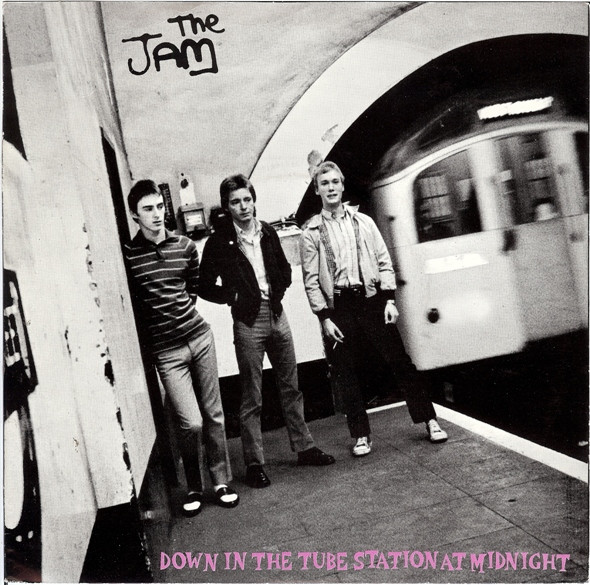
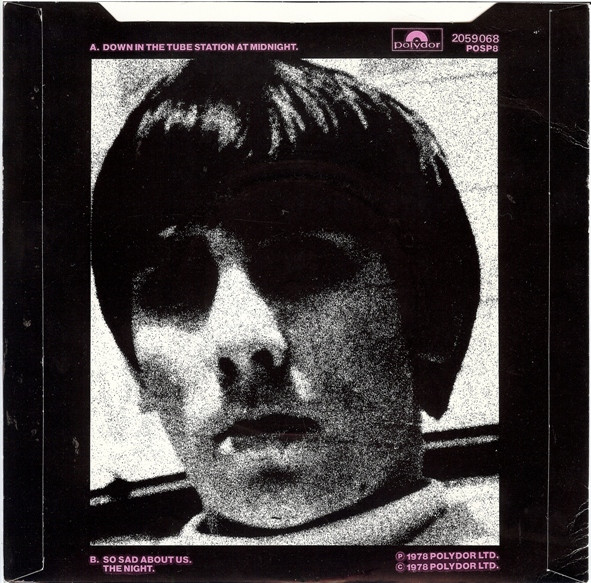
#038– The Jam– ‘Down In The Tube Station At Midnight’ (Polydor Records ’78)

thejam

Hello friends,

in the long run The Jam certainly were one of the most notable bands of all time. If you just consider the five years from ‘In The City’ to ‘The Gift’, there aren’t that many competitors who managed to keep up with such a level of constant brilliance. This makes it rather hard to pick just one single out of the big lot that the band had released within this period. So at the end of the day, basically it could have been any other one, but I went for their eighth 7”, ‘Down In The Tube Station At Midnight’, taken from their third album, from 1978.

Why this one? Well, just like The Clash, The Jam have always been a “lyrics band” for me. I well remember that once I finally had access to internet (when would that have been? 1995 or thereabouts?) I more or less immediately tried to get hold of free porn Jam lyrics, and when being successful, it was always a revelation for me, nearly for each and every tune of theirs. But I think finally being able to understand the full lyrics of ‘Tube Station’ stood out by quite some distance.

Of course I had already realized that Weller is not exactly singing about love, peace and harmony, no, the message seemed to be quite the opposite, in fact. But only after having access to the ‘missing parts’ – the bits I simply couldn’t translate, regardless how often I would play the record – the circle closed, and I loved the tune even more than I already had done before – a masterpiece, I thought: not only lyrically, but musically as well, obviously.

The funny thing is: Weller wasn’t at all fond of the song, so I learnt very much later. He even didn’t want to have it on the album. Apparently the producer, Vic Coppersmith-Heaven convinced him in the end: “I was insistent on him reviving it, and once the band got involved and we developed the sound it turned into an absolutely brilliant track, a classic. Maybe we would have come around to recording it later on in the project, but he’d just reached that point of ‘Oh bollocks, this isn’t working, it’s a load of crap.’”

In hindsight, it seems rather ludicrous that Paul Weller thought so bad about this song. But it is easily forgotten that Weller was only 20 years old in 1978. Me, I could barely write my bloody name when I was 20, let alone write three essential albums full of clever lyrics – which often tried to give the listener an understanding of the fucked up state of Britain’s politics, economy and society.

But the BBC, in their wisdom – instead of putting the single on heavy rotation in order to spread the word – subsequently banned it: in a time when racism was commonly accepted in British society, the song’s powerful message was not acceptable to play on the radio for the station apparently. To quote Tony Blackburn, BBC Top DJ at the time: “It’s disgusting the way punks sing about violence. Why can’t they sing about trees and flowers?”

These days a down-right ridiculous attitude of course, but as it seems at least a handful of young Britons were ahead of their time, because ‘Down In The Tube Station At Midnight’ became The Jam’s second Top 20 hit:

R-3876045-1347742040-2139

R-3876045-1347742077-3750

mp3: The Jam – Down In The Tube Station At Midnight

And finally, for fact-fans: the cover photo was shot on Bond Street tube station on the Central Line whereas the sound of an Underground train at the beginning of the song was recorded at St. John’s Wood Station.

Enjoy,

Dirk

60 ALBUMS @ 60 : #1

R-398719-1203291315

The Jam – All Mod Cons (1978)

It’s my 60th birthday today.  I’m gifting myself the words of Charles Shaar Murray from the NME of 22 October 1978.   I wish I was this talented.

—–

Third albums generally mean that it’s shut-up-or-get-cut-up time: when an act’s original momentum has drained away and they’ve got to cover the distance from a standing start, when you’ve got to cross “naive charm” off your list of assets.

For The Jam, it seemed as if the Third Album Syndrome hit with their second album. This Is The Modern World was dull and confused, lacking both the raging, one-dimensional attack of their first album and any kind of newly-won maturity. A couple of vaguely duff singles followed and, in the wake of a general disillusionment with the Brave New Wave World, it seemed as if Paul Weller and his team were about to be swept under the carpet.

Well, it just goes to show you never can tell. All Mod Cons is the third Jam album to be released (it’s actually the fourth Jam album to be recorded; the actual third Jam album was judged, found wanting and scrapped) and it’s not only several light years ahead of anything they’ve done before but also the album that’s going to catapult The Jam right into the front rank of international rock and roll; one of the handful of truly essential rock albums of the last few years.

The title is more than Grade B punning or a clever-clever linkup with the nostalgibuzz packaging (like the target design on the label, the Swinging London trinketry, the Lambretta diagram or the Immediate-style lettering); it’s a direct reference to both the broadening of musical idiom and Weller’s reaffirmation of a specific Mod consciousness.

Remember the Mod ideal: it was a lower-middle and working-class consciousness that stressed independence, fun and fashion without loss of integrity or descent into elitism or consumerism; unselfconscious solidarity and a dollop of non-sectarian concern for others. Weller has transcended his original naivety without becoming cynical about anything other than the music business.

Mod became hippies and we know that didn’t work; the more exploratory end of Mod rock became psychedelia. Just as Weller’s Mod ideal has abandoned the modern equivalent of beach-fighting and competitive posing, his Mod musical values have moved from ’65 to ’66: the intoxicating period between pilled-up guitar-strangling and Sergeant Pepper. Reference points: Rubber Soul and A Quick One rather than Small Faces and My Generation.

Still, though Weller’s blends of acoustic and electric 6 and 12-string guitars, sound effects, overdubs and more careful structuring and arranging of songs (not to mention a quantum leap in standard of composition) may cause frissons of delight over at the likes of Bomp, Trouser Press and other covens of aging Yankee Anglophiles, All Mod Cons is an album based firmly in 1978 and looking forward.

This is the modern world: ‘Down In The Tube Station At Midnight’ is a fair indication of what Weller’s up to on this album, as was ‘A-Bomb In Wardour Street’ (I can’t help thinking that he’s given more hard clear-eyed consideration to the implications of the Sham Army than Jimmy Pursey has), but they don’t remotely tell the whole story. For one thing, Weller has the almost unique ability to write love songs that convince the listener that the singer is really in love. Whether he’s describing an affair that’s going well or badly, he writes with a penetrating, committed insight that rings perfectly, utterly true.

Weller writes lovingly and (choke on it) sensitively, without ever descending to the patented sentimentality that is the stock-in-trade of the emotionally bankrupt. That sentimentality is but the reverse side of the macho coin, and both sides spell lovelessness. The inclusion of ‘English Rose’ (a one-man pick’n’croon acoustic number backed only by a tape of the sea) is both a musical and emotional finger in the eye for everyone who still clings to the old punk tough-guy stereotype and is prepared to call The Jam out for not doing likewise.

Weller is – like Bruce Springsteen – tough enough not to feel he needs to prove it any more, strong enough to break down his own defences, secure enough to make himself vulnerable. The consciousness of All Mod Cons is the most admirable in all of British rock and roll, and one that most of his one-time peers could do well to study.

Through the album, then: the brief, brusque title track and its immediate successor (‘To Be Someone’) examine the rock business first in a tart V-sign to some entrepreneurial type who wishes to squeeze the singer dry and then throw him away, and second in a cuttingly ironic track about a superstar who lost touch with the kids and blew his career. Weller is, by implication, assuring his listeners that no way is that going to happen to him: but the song is so well thought out and so convincing that it chokes back the instinctive “Oh yeah?” that a less honest song in the same vein would elicit from a less honest band.

From there we’re into ‘Mr Clean’, an attack on the complacent middle-aged “professional classes.” The extreme violence of its language (the nearest this album comes to an orthodox punk stance, in fact) is matched with music that combines delicacy and aggression with an astonishing command of dynamics. This is as good a place as any to point out that bassist Bruce Foxton and drummer Rick Buckler are more than equal to the new demands that Weller is making on them: the vitality, empathy and resourcefulness that they display throughout the album makes All Mod Cons a collective triumph for The Jam as well as a personal triumph for Weller.

‘David Watts’ follows (written by Ray Davies, sung by Foxton and a re-recorded improvement on the 45) with ‘English Rose’ in hot pursuit. The side ends with ‘In The Crowd’, which places Weller dazed and confused in the supermarket. It bears a superficial thematic resemblance to ‘The Combine’ (from the previous album) in that it places its protagonist in a crowd and examines his reactions to the situation, but its musical and lyrical sophistication smashes ‘The Combine’ straight back to the stone age. It ends with a lengthy, hallucinatory backward guitar solo which sounds as fresh and new as anything George Harrison or Pete Townshend did a dozen years ago, and a reference back to ‘Away From The Numbers’.

‘Billy Hunt’, whom we meet at the beginning of the second side, is not a visible envy-focus like Davies’ ‘David Watts’, but the protagonist’s faintly ludicrous all-powerful fantasy self: what he projects in the daydreams that see him through his crappy job. The deliberate naivety of this fantasy is caught and projected by Weller with a skill that is nothing short of marvellous.

A brace of love songs follow: ‘It’s Too Bad’ is a song of regret for a couple’s mutual inability to save a relationship which they both know is infinitely worth saving. Musically, it’s deliriously, wonderfully ’66 Beat Groupish in a way that represents exactly what all those tinpot powerpop bands were aiming for but couldn’t manage. Lyrically, even if this sort of song was Weller’s only lick, he’d still be giving Pete Shelley and all his New Romance fandangos a real run for his money.

‘Fly’ is an exquisite electric/acoustic construction, a real lovers’ song, but from there on in the mood changes for the “Doctor Marten’s Apocalypse” of ‘A-Bomb In Wardour Street’ and ‘Tube Station’. In both these songs, Weller depicts himself as the victim who doesn’t know why he’s getting trashed at the hands of people who don’t know why they feel they have to hand out the aggro.

We’ve heard a lot of stupid, destructive songs about the alleged joys of violence lately, and they all stink: if these songs are listened to in the spirit in which they were written then maybe we’ll see a few less pictures of kids getting carried off the terraces with darts in their skulls. And if these songs mean that one less meaningless street fight gets started, then we’ll all owe Paul Weller a favour.

The Jam brought us The Sound Of ’65 in 1976, and now in 1978 they bring us the sound of ’66. Again, they’ve done it such a way that even though you can still hear The Who here and there and a few distinct Beatleisms in those ornate decending 12-string chord sequences, it all sounds fresher and newer than anything else this year. All Mod Cons is the album that’ll make Bob Harris‘ ears bleed the next time he asks what has Britain produced lately; more important, it’ll be the album that makes The Jam real contenders for the crown.

Look out, all you rock and rollers: as of now, The Jam are the ones you have to beat.

—-

JC adds

Shaar Murray’s review just about captures everything I felt about this record back in the day, albeit I wasn’t fully up on his 60s era references, not being a fan of The Beatles or much that predated 1973.

I also remember reading this review thanks to the big brother of a friend who had heard me raving about ‘Tube Station’ and how it was by far the greatest song that anyone had ever written.  I didn’t buy the NME in 1978 – music was now an increasingly important part of my life, but it was still mainly football and my newly discovered hobby of golf, but being passed a copy of the paper specifically to read that review had a huge impact on the way I began to engage with and consume pop music.   I didn’t know it at the time, but I was just over six months away from seeing my first ever live gig, another seminal event in my development.

All Mod Cons is not the best album I have here in Villain Towers, but it is, and by some considerable distance, my all-time favourite.

And with that, the blog will return to the mundane and mediocre, beginning tomorrow. In the meantime, I’m off to find a bus driver to whom I can flash my newly acquired concessionary pass.

mp3:  The Jam – The Place I Love

Thanks for all your thoughts, views and opinions over the course of the rundown.

JC

The rundown in full:-

1. All Mod Cons – The Jam
2. After The Fact – Magazine

3. Sulk- Associates
4. The Midnight Organ Fight – Frightened Rabbit
5. Technique – New Order
6. The Orange Juice – Orange Juice
7. Closer – Joy Division
8. Fourteen Autumns and Fifteen Winters – The Twilight Sad
9. Hatful of Hollow – The Smiths
10. Songs To Remember – Scritti Politti
11. Mezzanine – Massive Attack
12. New Adventures In Hi-Fi – R.E.M.
13. Standing On A Beach – The Cure
14. Singles Going Steady – Buzzcocks
15. Seamonsters – The Wedding Present
16. Let Love In – Nick Cave & The Bad Seeds
17. Rattlesnakes – Lloyd Cole & The Commotions
18. London Calling – The Clash
19. Parallel Lines – Blondie
20. High Land, Hard Rain – Aztec Camera
21. Philophobia – Arab Strap
22. Death To The Pixies – Pixies
23. Non-Stop Erotic Cabaret – Soft Cell
24. Soul Mining – The The
25. Will I Ever Be Inside Of You? – Paul Quinn & The Independent Group
26. Different Class – Pulp
27. 30 Something – Carter the Unstoppable Sex Machine
28. Hypocrisy Is The Greatest Luxury – The Disposable Heroes of Hiphoprisy
29. Heaven Up Here – Echo and The Bunnymen
30. Tindersticks (II) – Tindersticks
31. Steve McQueen – Prefab Sprout
32. Head Over Heels – Cocteau Twins
33. Pop Art – Pet Shop Boys
34. Boat To Bolivia – Martin Stephenson & The Daintees
35. Empires and Dance – Simple Minds
36. DAMN – Kendrick Lamar
37. Before Hollywood – The Go-Betweens
38. Surrender – The Chemical Brothers
39. The Great Eastern – The Delgados
40. You Had A Kind Face – Butcher Boy
41. Shag Times – The Justified Ancients of Mu Mu
42. Whatever People Say I Am, That’s What I’m Not – Arctic Monkeys
43. Into The Woods – Malcom Middleton
44. Violent Femmes – Violent Femmes
45. Cafe Bleu – The Style Council
46. Trapped and Unwrapped – Friends Again
47. The Hurting – Tears For Fears
48. Debut – Bjork
49. Original Pirate Material – The Streets
50. Electronic – Electronic
51. Kilimanjiro – The Teardrop Explodes
52. A Certain Trigger – Maximo Park
53. Anthology : The Sounds of Science – Beastie Boys
54. Boxer – The National
55. Imaginary Walls Collapse – Adam Stafford
56. Beaucoup Fish – Underworld
57. Back In The D.H.S.S. – Half Man Half Biscuit
58. Love The Cup – Sons and Daughters
59. Talking With The Taxman About Poetry – Billy Bragg
60. A Secret Wish – Propaganda

(I’ve 51 of them on vinyl either as stand-alone LPs or as part of boxets.)

THE TVV 2022/2023 FESTIVE SERIES (Part 14)

198975

I bought a second-hand CD a long time ago, specifically for the purposes of having a bit of fun on the blog, and I’ve decided to use the normally quiet festive period, when the traffic and number of visitors drops quite dramatically, to go with it.

The CD was issued in 1996.  It is called Beat On The Brass, and it was recorded by The Nutley Brass, the brains of whom belong to New York musician Sam Elwitt.

The concept behind the album is simple. Take one bona-fide punk/post-punk/new wave classic and give it the easy listening treatment.

There are 18 tracks on the CD all told.  Some have to be heard to be believed.

Strap yourselves in.

mp3: The Nutley Brass – The Eton Rifles

And, just so you can appreciate the magnificence (or otherwise) of the renditions, you’ll also be able to listen to the original versions as we make our way through the CD in random order.

mp3: The Jam – The Eton Rifles

Released as a single in September 1979.

JC

SOME THINGS NEVER CHANGE

Before getting on to the main business of the day, just an update on the Bastard Virus here at Villain Towers.  I continue to feel very little in the way of symptoms and am hopeful that I’ll test negative tomorrow to get back on my feet and going about my business.  Rachel did, as anticipated, test positive the other day and looks set to be confined indoors till after Easter.

Oh, and if anyone is interested, there are two tickets still going free for Luke Haines + Peter Buck at Hebden Bridge Trade Club tomorrow night.

This post was originally scheduled for yesterday, but I’ve let if drift for 24 hours and, as it turns out, is something of a companion piece,

It’s almost 42 years since the release of Sound Affects, the fifth studio album by The Jam.

It followed All Mod Cons and Setting Sons, as well as being on the back of what the success of Going Underground, a non-album #1 single.

It proved not to be immediate as these previous releases, lacking the fast, angry, raucous anthems that had made the band such an attraction to us teenage adolescents, germ-free or otherwise.  It was, however, packed with different types of anthems, this time less frantic, with messages that the world was an unfair place, particularly if you were not from the landed gentry or the monied class, themes that would continue to be examined by Paul Weller in what time remained with his band and later with The Style Council.

The opening song on the album is proving to be timeless:-

mp3: The Jam – Pretty Green

Power is measured by the pound or the fist.

Aye…..Rishi Sunak and Vlad Putin will vouch for that.

Pretty Green reflected the existence of £1 notes as the main tender in circulation for most folk in 1980.  Just eight years later, the note was withdrawn by the Bank of England in favour of a coin, although Scottish banks continued to print their own version of the £1 note until 2001, a fact on its own which indicates we’ve never been as well-off as many of those who live in the south-east pocket of the UK.

I looked up the cost of a £1 note on eBay just now.  It’s fair to say it varies, from £3 to £10,000.  Do folk believe their eBay listing will attract such a stupid bid?

JC

ALL OUR YESTERDAYS : SETTING SONS

Album: Setting Sons* – The Jam
Review: Uncut, 12 December 2014
Author: Garry Mulholland

*the review is of the deluxe and super deluxe editions

Remastered with bonus tracks. Weller and co’s fourth album improves with age…

“There is still a widely-held perception that Jam albums follow a numerical pattern; an inverse of the Star Trek Movie Curse. That is, the odd-numbered Jam albums are excellent, while the even-numbered ones are… well… not.

This has always affected the reputation of The Jam’s fourth album, with its healthy sales and inclusion of breakthrough Top 3 single “The Eton Rifles” undercut by a half-finished concept and a dodgy cover version closer that inevitably leads to Setting Sons feeling rushed and inconclusive.

But comparing Setting Sons with, say, the frankly awful second album This Is The Modern World is pushing a nerdy fan theory way too far. The excellence of six of its ten songs, and the tougher, denser sound fashioned by loyal Jam producer Vic Coppersmith-Heaven, make Setting Sons the successful link between the creative breakthrough of 1978’s career-saving All Mod Cons and the February 1980 triumph of the “Going Underground” single, an anthem of nuclear panic and social alienation that revealed that The Jam had stealthily climbed to biggest-band-in-Britain status by becoming the first single to enter the UK charts at No.1 since 1973.

The bonus tracks added to this remastered version – the brilliant pre-album singles and B-sides, the work-in-progress Setting Sons demos including three previously unreleased songs, the final Peel sessions, and the vinyl-only “Live In Brighton 1979” set – give the Jam loyalist an overview of exactly how Paul Weller, Bruce Foxton and Rick Buckler made that creative leap at the end of a decade that had began with the Beatles’ split and ended with the anti-rock experiments of post-punk.

Setting Sons saw Weller basing more of his lyrics on his own poetry, and established his credentials as an ironic commentator on both the British class system and the fleeting bonds of childhood friendship. The typically tough-but-tuneful “Thick As Thieves” and “Burning Sky”, and the ambitious mini-rock operatic “Little Boy Soldiers” are the most explicit survivors of the original album concept (as revealed to NME’s Nick Kent in September), of three male friends torn apart by a British civil war who meet up again after the war’s conclusion.

But “Private Hell”, “Wasteland”, “Saturday’s Kids”, “The Eton Rifles” and the orchestral version of Bruce Foxton’s “Smithers-Jones” are all close relations; bitter reflections on ordinary English men and women – working-class and suburban middle-class – alienated and manipulated by corporate and military power.

Only the closing “Heatwave” – essentially a cover of The Who’s cover of the Martha Reeves And The Vandellas hit, featuring future Style Councillor Mick Talbot’s first keyboard work with Weller – and the hilarious, out-of-character opener “Girl On The Phone” break ranks. One of the most underrated Weller gems, the latter examines the power of an imaginary stalker who knows everything about our bemused boy wonder, even “the size of my cock!” It’s the first evidence of Weller’s dark humour.

The new remaster gives freer rein to the density of the sound Vic Smith gradually developed for The Jam, with Foxton’s bass punching through, revealing just how much space his busy, lyrical lines open up for Weller to use guitar as sound effect rather than straight rhythm and lead. And while the Brighton live show is inessential, two of the three newly unearthed songs, Weller’s “Simon” and “Along The Grove”, are stark, caustic and could have been contenders. Foxton’s “Best Of Both Worlds” may have been best left in the vaults.

But Setting Sons has improved with age. It reminds us that working class life was best captured, not by The Clash, nor PiL, nor even The Specials, but by the mock celebration of The Jam’s “Saturday’s Kids”, with its life of “insults”, beer and “half-time results”, and Weller’s recognition that we – and our parents, with their “wallpaper lives” – were “the real creatures that time has forgot”.

At the time we were stunned, and grateful, that any dapper young rock ‘n’ roll star had noticed. The insight and empathy shown here marked Weller out as the first pop hero of the coming decade.”

JC adds…….

I’ve said before that, if pushed, I’d name All Mod Cons as my all-time favourite album.  The follow-up album, Setting Sons was in the shops on 16 November 1979, just 378 days after the release of All Mod Cons, but that doesn’t come close to telling the story as The Jam had released three astonishing stand-alone singles and quality b-sides in Strange Town (April 1979), When You’re Young (August 1979) and The Eton Rifles (October 1979), albeit the latter was also included on the later album.

At sixteen years of age, music really was beginning to mean the entire world to me.  I was finally being allowed to go to live concerts and was feasting on all sorts of post-punk new wave bands who were calling in at the Glasgow Apollo on their tours.  But The Jam were my go-to band, the one for whom I would have given absolutely anything to have been able to share a stage with, even for just one song, not withstanding that I had no musical ability at all.  I’d have mimed just as they did on Top of The Pops.

Setting Sons was the first album by The Jam I actually bought on the day of release – All Mod Cons was one that had waited until I had plenty of spare money from the Christmas tips given to me by customers on my paper round.  Setting Sons was played to death back in 1979, along with all those singles and b-sides, to the extent it soon got all sorts of scratches and marks as typical 16-year-old boys really don’t know how to take care of their records.  The copy from back then is long gone, thrown out when it became unplayable maybe six years later, replaced by a copy picked up cheap but which turned out to be a different pressing with a standard Polydor Records label in the middle of the record rather than the rustic drawings that had been on the original.

At the time, I didn’t think it had any flaws, although it was clear that some of the songs weren’t as immediate or as strong as the intermediate singles from earlier in the year.  I even liked Heatwave, which I suppose came from my love of dancing rather than just being wedded to the idea of angry men playing angry songs via fast guitars, basses and drums.

I was becoming ever increasingly politically-conscious, aware now that young people, just like me, were seen as being unimportant and dispensable.  I had stayed on at school beyond the summer of 1979 but could see that some mates who I’d played football with for years were now pretty fed up, with very few having got the sort of trade or job they had hoped for and were being forced into something they didn’t want to do for not all that much more money than I could make from my six-nights a week evening paper round and the big shift delivering Sunday papers for three hours from 7am every week.  There were even a couple of boys who had signed up for the army, and I had it in my head that I’d soon be reading about them in those very same papers having been shot dead while doing service in Northern Ireland as we were very much at the height of the ‘troubles’ (or so it seemed).

Setting Sons spoke to me as I imagine it did to a lot of late-teens in the UK, and it was no surprise that by the time Going Underground came out just three months later,  it did the unthinkable and went straight in at #1, as Gary Mulholland points out above, the first single by any singer or band to do so in seven years.  This was our time and The Jam was our band.  Nobody who had come beforehand was relevant, and nobody who was to follow would be meaningful.

Nowadays, I can see some failings. Brilliant though it is, the concept of including the orchestral version of previous b-side Smithers Jones, as well including what I can now accept is a perfunctory cover of Heatwave, demonstrates that Setting Sons was a bit of a rush-release, timed to get out to coincide with the UK tour and in the shops so that lots of folk could get it as a Christmas present or, as in my case from the previous year, something to be bought with the tips from the paper round.

Three songs from Setting Sons made ICA 52 back in December 2015, itself an effort which precluded any single or b-side. I make no apologies for repeating those songs today, along with the words I wrote at the time

mp3: The Jam – Thick As Thieves

“It is astonishing to look back and realise that Weller was barely 21 years of age when he wrote the songs that made up Setting Sons, the band’s fourth and most ambitious album. There’s no doubt that in his head he wanted to pull together a concept album telling the story of three childhood friends whose lives don’t go the way of their youngdreams with everything changing after them fighting but surviving a war. The concept wasn’t fully realised, possibly being down to him deciding it was an ‘unpunk’ thing to do or perhaps it became just too big a challenge in too short a timescale.  It’s a real pity and begs the thought ‘if only….’ for the foundations that were laid down, as exemplified by Thick As Thieves, make you think that the result could well have been a record forever feted to be near the top of the all-time classic lists.”

mp3: The Jam – Little Boy Soldiers

“A song like no other in the history of the band and perhaps the new wave era’s equivalent of Bohemian Rhapsody – or at least that’s how I initially felt when listening to this as a 16-year old back in 1979. It was earnest and it was thought-provoking stuff but above else it was unsettling, thanks in part to its constant changes in pace and rhythm but also as a result of the doom and gloom nature of the lyric.

OK, I was sure that I was going to leave school, head off to university and find myself some sort of job  linked to whatever qualifications I manged to get but I knew quite a few folk who were hell-bent on joining the armed forces and seeing what happened from there….none of them of course even remotely considered that in doing so they were putting their young lives at risk. I wanted so much to give every one of them a cassette with this song on and ask them to have a serious think about things….”

mp3: The Jam – Saturday’s Kids

At 16, I had no idea what the line ‘stains on the seats – in the back of course’ was all about. Nor did I know who smoked Capstan Non-Filters (Embassy Regal? yup….that was my dad’s choice of habit) and for Selsey Bill and Bracklesam Bay you would have had to substitute places a little nearer home or insert Blackpool which around half of Glasgow seemed to migrate to in the last two weeks in July back in the mid-70s. Otherwise it was a song that resonated with me and even now I can recite every single word of the lyric. But I do accept that, with its descriptions of things that aren’t part of modern society then it’s a lyric very much of its time and so probably won’t resonate much with today’s kids….except perhaps the bit about hating the system. Some things just never change.

And finally, one that made a second ICA, #152, in January 2018.

mp3: The Jam – Private Hell

This tale of a lonely, depressed, drug-dependant and mentally ill housewife was scheduled to feature in the ‘songs as short stories series’ but it has rightly fought its way into inclusion on this ICA. I used to think the lyric was all a bit melodramatic as I honestly couldn’t think of any female relative or mother of any friends of mine whose behaviour was like this. Looking back, I was wrong…it was just that some folk were exceptional at keeping things well hidden….

I also can’t imagine, to this day, just how brilliantly and accurately a 21-year old working class lad was able to put himself in the shoes of a middle-aged, repressed woman.

JC

THE MONDAY MORNING HI-QUALITY VINYL RIP : Part Twenty : HAPPY TOGETHER

Taking my inspiration from The Robster‘s great new series on the imaginary 7″ singles from R.E.M albums, I’m offering up as today’s high quality vinyl rip what could have been a superb effort by The Jam almost forty years ago (!!!!), as a follow-up, or indeed alternative, double-A single to Town Called Malice/Precious which had provided what was then the UK’s biggest and most popular band with their third #1 hit in January 1982.

On one side would be the opening track from the album The Gift.  Here’s what I wrote back in December 2015 as part of The Jam ICA, itself an effort, consisting only on album tracks not issued as singles or b-sides:-

“Let’s get this party pumping. This is one where Bruce Foxton and Rick Buckler really come into their own, driving the song along at a tremendous pace and in the bass player’s instance adding an essential backing vocal. The ending where Paul Weller chants out NOW!!!!!!! Is one of my favourite moments on any Jam song – single, b-side or album track.”

It would have been a sure-fire #1, blasting out of the radios at all times of the day and night. Some folk would likely have bought it simply for the short spoken word intro and the heartfelt shout of ‘BAAAAAAAABBBBBBBBYYYYY’

mp3: The Jam – Happy Together

But what would have been the ideal flip-side?

The then 23-year-old Paul Weller was worshipped by a congregation of fans, most of whom were around blokes his age or marginally younger.  While each of us will spout many different reasons for such devotion, I can safely say that the late-teenage me truly believed he was the spokesman for my generation and I hung on to just about every word he said, especially when he got political in his song lyrics and during his interviews.

I hated the Tories, and in particular their leader and the divisive Prime Minister, Margaret Thatcher.  So, the b-side has to be one of his more subtle political lyrics, one which I’ll be honest I didn’t get right away, only picking it up a few months later during a drunken session in the student union. It was a much older and wiser person, who was at university as a mature student who pointed out that it was really all about the hated PM and her desire to destroy anybody and anything who got in her way; he also helpfully explained that the unsettling and, to me, confusing final lines about looking in a mirror and seeing greed fear and hate, was really a warning of what often happens as you age and move on in life away from your teenage ideologies.

mp3: The Jam – Carnation

And here was me thinking it was a love song written by a bastard…….

So there you have it.  Two tracks what the band’s final album, one which has many high points but a couple of tunes that didn’t quite work out as expected as the frontman tried to take the band in a new direction but at the same time came to the realisation that his hopes, dreams and ambitions could only be achieved by breaking up The Jam and starting all over again.  There really was irony in opening up this album with a track called Happy Together…….

JC

ALL OUR YESTERDAYS : (14/15) : THE GIFT

Album: The Gift – The Jam
Review: Uncut, 19 November 2012
Author: John Lewis

The Gift remains a mysteriously unloved part of The Jam canon. For many Jam loyalists it’s a record that’s tainted by Paul Weller’s decision to split the band at the height of their popularity, the headstone to a premature burial.

It’s also a record that, for many, strays a little too far out of The Jam’s comfort zone. While the introductory chimes of the opening track “Happy Together” recall the fractured post-punk of Sound Affects, we’re quickly into the Motown beats, the wah-wah guitars, the big horn sections: the birth of what sneerier commentators later dubbed “soulcialism”.

Lyrically, The Gift does not have the cohesiveness of the two Jam LPs generally regarded as classics – All Mod Cons and Sound Affects – but it certainly has at least as many great songs as either of them. There’s no arguing with the singles “Town Called Malice” (effectively “You Can’t Hurry Love” reimagined by Ken Loach) or “Precious” (hypnotically itchy punk-funk, with a nod to Beggar & Co), but, for all Weller’s professed “anti-rock” agenda of this period, there is plenty here to please any element of The Jam’s fanbase. You want Ray Davies-style kitchen-sink realism? Try the militant vaudevillian turn “Just Who Is The 5 O’Clock Hero”. You want a stunningly poetic ballad with heart-wrenching chord changes? Try “Carnation” (“I am the greed and fear/and every ounce of hate in you”). You want haunting and graceful post-punk? Listen to “Ghosts”, with its elegant horns, fluid bassline and uplifting lyric (“there’s more inside you that you won’t show”).

The first CD contains all 11 LP tracks, along with a further 10 singles, B-sides or covers from this period which didn’t make it onto the album. Weller has always upheld the uniqueness of the flipside (“I always felt the shackles were off,” he says. “You can experiment a bit”), and all of the supplementary tracks on CD1 share that same spirit of adventure, creating a secondary album that’s almost as good as the primary one. Even the covers, which were approached as enthusiastic recreations of the band’s new favourite songs, add a twist to the originals. “Move On Up” replaces Curtis Mayfield’s sweet-voiced earnestness with punky urgency; The Chi-Lites’ “Stoned Out Of My Mind” benefits from Rick Buckler’s heavily syncopated, Afro-Cuban rhythm track.

As well as a riotous live CD, and an excellent DVD of promos and Top Of The Pops appearances, there’s a CD that comprises demos of most of the album tracks and B-sides. It includes early versions of some contemporary sides not included on CD1, such as “Tales From The Riverbank” (here titled “We’ve Only Started”), “Absolute Beginners” (titled “Skirt”), and a Northern soul-style re-reading of the Small Faces “Get Yourself Together”. All of them are multi-tracked solely by Weller on guitars, bass, piano, keyboards and even drums. Unfashionable though it might be to point this kind of thing out, Weller really is an extraordinarily accomplished musician; even his drumming has a certain wonky, Stevie Wonder-ish flair. Some of the demos are virtually identical to the finished versions, only without the horns: a couple (“The Planner’s Dream…”, “Shopping”) sound better. One gets the impression that three or four Wellers might have made a great stadium rock band.

The Jam’s studio versions of “A Solid Bond In Your Heart” (separate mixes of which have previously appeared on The Sound Of The Jam and Direction Reaction Creation) are notably absent from CD1 of this package, although Weller’s drumless original demo does appear on CD2, with a piano-led arrangement that’s almost identical to the version later recorded by The Style Council. There are certainly premonitions of The Style Council all over The Gift, be it the heavy-duty funk workout of “Precious”, the militant call-to-arms of “‘Trans-Global Express’”, or the insistent Northern soul drumbeats on at least half the tracks. And, with veteran Trinidadian percussionist Russ Henderson playing steelpan, “The Planner’s Dream Goes Wrong” is an early example of the outsourcing philosophy that Weller and Mick Talbot would later adopt (the song also shares the same lyrical territory as “Come To Milton Keynes”).

In fact it’s the 10 extra tracks on CD1 that seem to prefigure The Style Council’s revolving door policy. Most of the singles of this period are dominated by hired hands, not least the backing vocals of Jennie McKeown from The Belle Stars (on “The Bitterest Pill”) or future Respond starlet Tracie (who almost steals the show on “Beat Surrender”). “Bitterest Pill”, “Beat Surrender” and “Malice” are all dominated by Peter Wilson’s piano or organ lines; while “Precious” and the three soul covers are dominated by the horns of Steve Nichol and Keith Thomas. Other tracks point out the limitations of the three-piece. A jazz-waltz like “Shopping”, or the off-kilter “The Great Depression” are the kind of beats that Style Council drummer Steve White would breeze through; likewise you could imagine an early incarnation of the Council transforming “Pity Poor Alfie” into a more limber soul gem. And that maybe explains why The Gift rankles a little for certain Jam loyalists: it’s a reminder that Weller really did need to break up the biggest British band since The Beatles to pursue his musical vision.

JC adds…….

The first time around for this festive mini-series back in 2019/20 kicked off with All Mod Cons and I would have finished 2020/21 off with The Gift except for tomorrow being a Saturday and thus set aside for an album from a Scottish singer/band.

The above review is a reminder why Paul Weller, wary of being labelled as one-dimensional, had little option but to kill off The Jam at a time when they were, unarguably, the most popular band in the UK, with the fanbase growing with each album and each tour.

I was gutted when it happened, but as soon as I heard the debut single by The Style Council, I was fully on board with the new direction, albeit it was one that had been well sign-posted. It was a very brave thing to do – he was just 24 years old at the time – and it was an era when he couldn’t have just turned back and asked Foxton and Buckler to get back together again. He was very much all-in.

I liked The Gift at the time, more so in the live setting around the tours in early 82 when the album came out and the farewell shows later that year.  Some of its songs perhaps don’t sound so great almost 40 years on, but it has its fair share of classics:-

mp3: The Jam – Happy Together
mp3: The Jam – Town Called Malice
mp3: The Jam – Ghosts
mp3: The Jam – The Gift


IT REALLY WAS A CRACKING DEBUT SINGLE (51)

Kind of beggars belief that it has taken this long to highlight such an outstanding debut single as part of this occasional series

mp3: The Jam – In The City

I’d be lying if I said I can remember this being released on 29 April 1977 and it reaching No. 40 on the UK Singles Chart in May 1977.  I can’t even recall seeing it on Top of The Pops on Thursday 19 May 1977 (when it aired despite being outside the Top 40, sitting that particular week at #45).

Yup…..feel free to cringe at David ‘Kid’ Jensen‘s awful shirt and his half-arsed effort at playing air guitar.

It would actually be a couple more years before I fully cottoned on to The Jam, but when I did, they quickly became my favourite group in my mid-late teenage years as my tastes shifted increasingly towards new wave/post-punk. In The City is a tremendously energetic and exciting debut.

I didn’t, even in 1979 as I became familiar with it, get the comparisons with The Who, a band I only knew from their rather dull mid-70s releases such as Substitute and Who Are You?, or from staple songs of ‘The Golden Hour’ such as My Generation and Pinball Wizard, none of which had the attitude or vibrancy of The Jam. But, in my defence, I had a lot of learning/catching-up to do in years to come.

mp3: The Who – In The City

The b-side of I’m A Boy, their #2 hit from 1966, that had never been included (at that point in time) on any album and despite its relative obscurity, was a track which Paul Weller was clearly very familiar with.

JC

SOME SONGS ARE GREAT SHORT STORIES (Chapter 38)

Here we go again, it’s Monday at last
He’s heading for the Waterloo line
To catch the 8 a.m. fast, it’s usually dead on time
Hope it isn’t late, got to be there by nine

Pinstripe suit, clean shirt and tie
Stops off at the corner shop, to buy The Times
‘Good Morning Smithers-Jones’
‘How’s the wife and home?’
‘Did you get the car you’ve been looking for?’

Let me get inside you, let me take control of you
We could have some good times
All this worry will get you down
I’ll give you a new meaning to life, I don’t think so

Sitting on the train, you’re nearly there
You’re a part of the production line
You’re the same as him, you’re like tin-sardines
Get out of the pack, before they peel you back

Arrive at the office, spot on time
The clock on the wall hasn’t yet struck nine
‘Good Morning Smithers-Jones’
‘The boss wants to see you alone’
‘I hope it’s the promotion you’ve been looking for’

‘Come in Smithers, old boy’
‘Take a seat, take the weight off your feet’
‘I’ve some news to tell you’
‘There’s no longer a position for you’
‘Sorry Smithers-Jones’

Put on the kettle and make some tea
It’s all a part of feeling groovy
Put on your slippers turn on the TV
It’s all a part of feeling groovy
It’s time to relax, now you’ve worked your arse off
But the only one smilin’ is the sun-tanned boss
Work and work you wanna work ’till you die
There’s plenty more fish in the sea to fry

mp3: The Jam – Smithers-Jones (single version)
mp3: The Jam – Smithers-Jones (album version)

Written by Bruce Foxton.  Originally released as the b-side to When You’re Young in August 1979.  Completely re-recorded for the album Setting Sons which was released three months later.

JC


ALL OUR YESTERDAYS (1/22)

I hate the idea of the blog completely closing down, but at the same time I recognise that the number of visitors drops off substantially at the end of December and beginning of January, so it’s something of a waste of time to churn out original stuff. Last year, I dug deep into the archives for the daily posting, but I want to do something different this time round. It’s kind of been inspired by what proved to be a short-lived series earlier this year when I posted a review of album from 1999 and then offered up my own thoughts on it from a current day perspective. But what I’m going to do is post an original review from back in the day of some albums that I’ve always had a lot of time for, playing them to death when they were first released and returning to them occasionally nowadays

Here’s the first of them:-

Album : All Mod Cons by The Jam
Review : NME, 28 October 1978
Author : Charles Shaar Murray

Third albums generally mean that it’s shut-up-or-get-cut-up time: when an act’s original momentum has drained away and they’ve got to cover the distance from a standing start, when you’ve got to cross “naive charm” off your list of assets.

For The Jam, it seemed as if the Third Album Syndrome hit with their second album. This Is The Modern World was dull and confused, lacking both the raging, one-dimensional attack of their first album and any kind of newly-won maturity. A couple of vaguely duff singles followed and, in the wake of a general disillusionment with the Brave New Wave World, it seemed as if Paul Weller and his team were about to be swept under the carpet.

Well, it just goes to show you never can tell. All Mod Cons is the third Jam album to be released (it’s actually the fourth Jam album to be recorded; the actual third Jam album was judged, found wanting and scrapped) and it’s not only several light years ahead of anything they’ve done before but also the album that’s going to catapult The Jam right into the front rank of international rock and roll; one of the handful of truly essential rock albums of the last few years.

The title is more than Grade B punning or a clever-clever linkup with the nostalgibuzz packaging (like the target design on the label, the Swinging London trinketry, the Lambretta diagram or the Immediate-style lettering); it’s a direct reference to both the broadening of musical idiom and Weller’s reaffirmation of a specific Mod consciousness.

Remember the Mod ideal: it was a lower-middle and working-class consciousness that stressed independence, fun and fashion without loss of integrity or descent into elitism or consumerism; unselfconscious solidarity and a dollop of non-sectarian concern for others. Weller has transcended his original naivety without becoming cynical about anything other than the music business.

Mod became hippies and we know that didn’t work; the more exploratory end of Mod rock became psychedelia. Just as Weller’s Mod ideal has abandoned the modern equivalent of beach-fighting and competitive posing, his Mod musical values have moved from ’65 to ’66: the intoxicating period between pilled-up guitar-strangling and Sergeant Pepper. Reference points: Rubber Soul and A Quick One rather than Small Faces and My Generation.

Still, though Weller’s blends of acoustic and electric 6 and 12-string guitars, sound effects, overdubs and more careful structuring and arranging of songs (not to mention a quantum leap in standard of composition) may cause frissons of delight over at the likes of Bomp, Trouser Press and other covens of aging Yankee Anglophiles, All Mod Cons is an album based firmly in 1978 and looking forward.

This is the modern world: ‘Down In The Tube Station At Midnight’ is a fair indication of what Weller’s up to on this album, as was ‘A-Bomb In Wardour Street’ (I can’t help thinking that he’s given more hard clear-eyed consideration to the implications of the Sham Army than Jimmy Pursey has), but they don’t remotely tell the whole story. For one thing, Weller has the almost unique ability to write love songs that convince the listener that the singer is really in love. Whether he’s describing an affair that’s going well or badly, he writes with a penetrating, committed insight that rings perfectly, utterly true.

Weller writes lovingly and (choke on it) sensitively without ever descending to the patented sentimentality that is the stock-in-trade of the emotionally bankrupt. That sentimentality is but the reverse side of the macho coin, and both sides spell lovelessness. The inclusion of ‘English Rose’ (a one-man pick’n’croon acoustic number backed only by a tape of the sea) is both a musical and emotional finger in the eye for everyone who still clings to the old punk tough-guy stereotype and is prepared to call The Jam out for not doing likewise.

Weller is – like Bruce Springsteen – tough enough not to feel he needs to prove it any more, strong enough to break down his own defences, secure enough to make himself vulnerable. The consciousness of All Mod Cons is the most admirable in all of British rock and roll, and one that most of his one-time peers could do well to study.

Through the album, then: the brief, brusque title track and its immediate successor (‘To Be Someone’) examine the rock business first in a tart V-sign to some entrepreneurial type who wishes to squeeze the singer dry and then throw him away, and second in a cuttingly ironic track about a superstar who lost touch with the kids and blew his career. Weller is, by implication, assuring his listeners that no way is that going to happen to him: but the song is so well thought out and so convincing that it chokes back the instinctive “Oh yeah?” that a less honest song in the same vein would elicit from a less honest band.

From there we’re into ‘Mr Clean’, an attack on the complacent middle-aged “professional classes.” The extreme violence of its language (the nearest this album comes to an orthodox punk stance, in fact) is matched with music that combines delicacy and aggression with an astonishing command of dynamics. This is as good a place as any to point out that bassist Bruce Foxton and drummer Rick Buckler are more than equal to the new demands that Weller is making on them: the vitality, empathy and resourcefulness that they display throughout the album makes All Mod Cons a collective triumph for The Jam as well as a personal triumph for Weller.

‘David Watts’ follows (written by Ray Davies, sung by Foxton and a re-recorded improvement on the 45) with ‘English Rose’ in hot pursuit. The side ends with ‘In The Crowd’, which places Weller dazed and confused in the supermarket. It bears a superficial thematic resemblance to ‘The Combine’ (from the previous album) in that it places its protagonist in a crowd and examines his reactions to the situation, but its musical and lyrical sophistication smashes ‘The Combine’ straight back to the stone age. It ends with a lengthy, hallucinatory backward guitar solo which sounds as fresh and new as anything George Harrison or Pete Townshend did a dozen years ago, and a reference back to ‘Away From The Numbers’.

‘Billy Hunt’, whom we meet at the beginning of the second side, is not a visible envy-focus like Davies’ ‘David Watts’, but the protagonist’s faintly ludicrous all-powerful fantasy self: what he projects in the day dreams that see him through his crappy job. The deliberate naivety of this fantasy is caught and projected by Weller with a skill that is nothing short of marvellous.

A brace of love songs follow: ‘It’s Too Bad’ is a song of regret for a couple’s mutual inability to save a relationship which they both know is infinitely worth saving. Musically, it’s deliriously, wonderfully ’66 Beat Groupish in a way that represents exactly what all those tinpot powerpop bands were aiming for but couldn’t manage. Lyrically, even if this sort of song was Weller’s only lick, he’d still be giving Pete Shelley and all his New Romance fandangos a real run for his money.

‘Fly’ is an exquisite electric/acoustic construction, a real lovers’ song, but from there on in the mood changes for the “Doctor Marten’s Apocalypse” of ‘A-Bomb In Wardour Street’ and ‘Tube Station’. In both these songs, Weller depicts himself as the victim who doesn’t know why he’s getting trashed at the hands of people who don’t know why they feel they have to hand out the aggro.

We’ve heard a lot of stupid, destructive songs about the alleged joys of violence lately and they all stink: if these songs are listened to in the spirit in which they were written then maybe we’ll see a few less pictures of kids getting carried off the terraces with darts in their skulls. And if these songs mean that one less meaningless street fight gets started then we’ll all owe Paul Weller a favour.

The Jam brought us The Sound Of ’65 in 1976, and now in 1978 they bring us the sound of ’66. Again, they’ve done it such a way that even though you can still hear The Who here and there and a few distinct Beatleisms in those ornate decending 12-string chord sequences, it all sounds fresher and newer than anything else this year. All Mod Cons is the album that’ll make Bob Harris‘ ears bleed the next time he asks what has Britain produced lately; more important, it’ll be the album that makes The Jam real contenders for the crown.

Look out, all you rock and rollers: as of now The Jam are the ones you have to beat.

mp3 : The Jam – All Mod Cons
mp3 : The Jam – In The Crowd
mp3 : The Jam – Fly
mp3 : The Jam – Down In The Tube Station at Midnight

JC adds : A review that captures exactly how I felt about this record back in 1978/79 and how I feel about now. I think that if pushed to name my all-time favourite album, it would be this one.

21 more old reviews to follow!

AN IMAGINARY COMPILATION ALBUM : #152 : THE JAM (2)

The posting on The Lambrettas got me all nostalgic and I shoved on The Jam for a bit. Had a look again at this ICA, which was #52 as it so happens, and thought I’d pull together a second volume of stuff, again on the basis that singles or original b-sides aren’t eligible for inclusion.

SIDE A

1. Pretty Green (from Sound Affects)

It’s quite astonishing to think that the band were so prolific they were able to write something as catchy and memorable as this, the opening track of their fifth album, and not spend too much time before deciding it wouldn’t be a 45. An ode to money and a celebration of what a succesful young man would and should do with. The title refers to the colour of the old £1 note which was withdrawn from circulation as long ago as 1988, which means there are tens of millions of young Britons who had no recollection of that particular piece of currency.

2. The Place I Love (from All Mod Cons)

All Mod Cons was the album that led to me giving the band my undivided and, at the time, uncritical attention. It was never off the turntable and I thought it was a flawless piece of work…well, apart from English Rose as the 14/15 year-old me didn’t do soppy ballads. This was a track that I liked rather than adored at the time, but over the years, as my listening habits have expanded and I’ve been able to realise that some of the best political songs aren’t always immediately obvious, this ode to England’s pleasant lands, green, grey or otherwise, has become a huge favourite.

3. Away From The Numbers (from In The City)

This song had been out for a few years before I picked up on it. The debut LP isn’t one, aside from maybe three or four songs, that has aged all that well, reflecting that Paul Weller was still learning on a daily basis how to improve on his songwriting. It’s genuinely astonishing to reflect on the fact that he was only 18 years of age when he penned this lyric that reflected on the necessity that to make a difference, you had to be different.

4. Private Hell (from Setting Sons)

This tale of a lonely, depressed, drug-dependant and mentally ill housewife was scheduled to feature in the ‘songs as short stories series’ but it has rightly fought its way into inclusion on this ICA. I used to think the lyric was all a bit melodramatic as I honestly couldn’t think of any female relative or mother of any friends of mine whose behaviour was like this. Looking back, I was wrong…it was just that some folk were exceptional at keeping things well hidden….

5. English Rose (from All Mod Cons)

In which the 54 year-old JC admits that the teenage JC got it badly wrong.

SIDE B

1. In The Street Today (from This Is The Modern World)

None of the tracks from the disappointing sophomore album made Volume 1 and this, 90-second blast of amphetamine-driven pop is the only one which makes the cut on Volume 2. One of the few songs that wouldn’t have sounded out-of-place on All Mod Cons. As The Lambrettas said the other day, just Da-a-a-ance.

2. Ghosts (from The Gift)

This almost made the cut on Volume 1. It’s something else to look back in time and realise that in just three short years after All Mod Cons in which I had been dismissive of the ballad, this song had the ability to knock me sideways. The crucial difference being that I had, by this time, fallen in love for the first but not the last time.

3. Wasteland (from Setting Sons)

Another one that I didn’t pay too much attention to back in the day as it seemed so light and inconsequential amidst the magnificent anthems that filled the album. Again, as I’ve matured, so has this grown on me and like the protagonist in this song, I find myself, with friends, reflecting on days of old, albeit its done in pubs and not sitting alongside a vacant and derelict space.

4. Set The House Ablaze (from Sound Affects)

This just seems to fit in perfectly onto an imaginary album right behind Wasteland. I use to think thought it was a bit of a clumsy number but I now acknowledge that this was down to the fact that it never really seemed to come across all that well when it was played in the live setting. One of only two songs by the band that clocked in at over 5 minutes (the other being In The Crowd – that is, if you don’t count the 12″ extended mix of Precious), this politically motivated song demonstrates just how the sound of The Jam really did rely on all three being on top of their game. Has La-la-la-la as a lyric ever sounded so desperately angry??

5. Move On Up (from Beat Surrender EP)

OK. It’s a fair cop. I’m breaking the rules. I’ve gone for a b-side to close things off, but in all honesty, I couldn’t think of a better fit given that I had already used The Gift to round off Volume 1. A joyous anthem…one that I refused at the time to believe was a cover version, such was the way The Jam had made it sound like one of their own.

So there you are, a second ICA for the band without whom I most likely would never really had a passion for, and devotion to,, music. Only think I can’t fathom is that I still haven’t been able to find a spot for Carnation

JC