
A guest series by Fraser Pettigrew (aka our New Zealand correspondent)
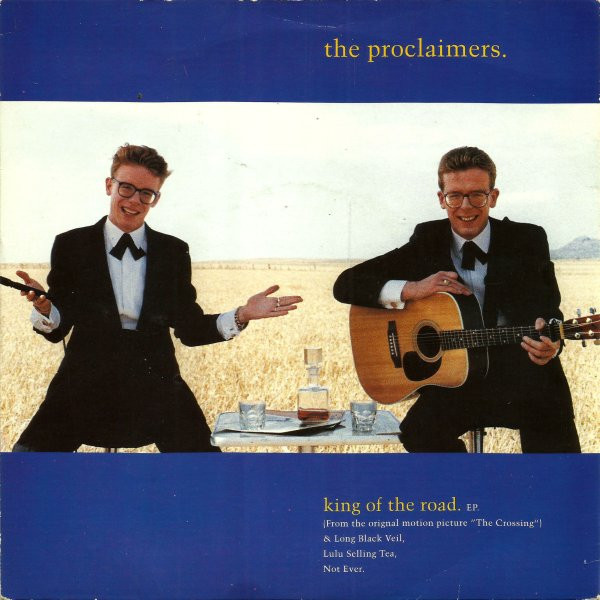
#14: The Proclaimers – King Of The Road (1990)
I’ve mentioned previously how my taste in music took a folky turn in the mid and late 80s as I disengaged from the fading post-punk scene. Among the beneficiaries of my attention-shift were The Proclaimers, whose first album This Is The Story sprang to prominence in 1987.
Much earlier, in Edinburgh sometime around 1981 I had actually once met Craig Reid (or was it Charlie? I guess they get that a lot…). A girl I knew at university who came from Cupar in Fife had been at Bell Baxter High School with the twins and one day as we walked along Lothian Road she spotted Craig (or Charlie) and we stopped to chat.
(JC interjects……..I once read that you could tell the difference by looking at their glasses. The frame of Craig’s was black while for the other brother it was Charlie brown)
My vague memory of the occasion left me with the impression that the brothers were at that time performing as a sort of electro post-punk act with a ropey synth. The idea now of The Proclaimers as Scotland’s answer to Suicide or Soft Cell seems more than faintly hilarious, and it was probably never so, but I’ll leave that image there for general amusement.
At any rate, when The Proclaimers did finally make their mark they were an entirely acoustic duo, no synths, no mirror shades, just six strings, vocal harmonies, handclaps and those square-rimmed specs. Indeed, it was the simplicity of the arrangement, or non-arrangement on that first album that was one of its chief appeals. The strength of songs like The First Attack, Over and Done With and Letter from America was allowed to shine through without unnecessary embellishment.
I tagged the style as ‘folk’ largely on account of the acoustic format, even though it plainly wasn’t Dick Gaughan or Boys of the Lough. It didn’t occur to me that there was anything country and western going on, largely on account of the brothers’ wholly unapologetic Scottish accents (the album’s opener Throw The R Away is not a song but a manifesto). Even the cover of the George Jones hit (I’m Gonna) Burn Your Playhouse Down wasn’t enough to alert my dull brain to the transatlantic influence.
To me, Scottish country and western was slavishly imitative yee-haw by the likes of Sydney Devine and Lena Martell. Even after a decade of rehabilitation by Elvis Costello, Squeeze and The Mekons, country music still seemed to demand that its performers conform to a certain stereotype. Sometime around 1990 I saw Hank Wangford supporting Billy Bragg at the Half Moon in Putney, and with his grisly, stubbled mug and cowboy hat he looked and sounded as though he’d teleported in from some West Virginia moonshine distillery rather than cabbed it from some West London gynaecology clinic where he worked his day job.
But the Proclaimers’ country connection could not be ignored once second album Sunshine on Leith came out in 1988. The addition of a full backing band foregrounded the arrangements that even included a steel guitar. Dead giveaway! Songs such as I’m On My Way and the version of Steve Earle’s My Old Friend The Blues exuded Americana much more than they might have done with the first album’s stripped back treatment.
I wasn’t a big fan of the multi-instrumental Proclaimers. Already the re-recording of Letter From America to make it more Top of the Pops friendly had seemed like typical music industry disdain for an artist’s vision and contempt for the listeners’ ability to appreciate something different. And it wasn’t the country influence I didn’t like – I’d enjoyed Almost Blue as much as the next young punk – but I just loved the directness and transparency of the un-arranged Proclaimers more.
Still, I stuck with them for one more release, today’s featured EP, King Of The Road, a bona-fide country and western song by Roger Miller that was a British number 1 in 1965. The Proclaimers’ version reached number 9 in 1990, their second-biggest UK hit until the Comic Relief version of I’m Gonna Be (500 Miles) topped the charts in 2007.
I was oblivious to the film The Crossing, starring Russell Crowe, on the soundtrack of which the lead song features, as announced on the gatefold sleeve. An American country song sung in Scottish accents in an Australian film? No doubt there are stranger connections. Either way, it’s a jolly little slice of hobo kitsch, a celebration of the unencumbered life of the itinerant. The back cover shot has Craig and Charlie dossing on the tail of a horse-drawn cart in some desert location, plainly a long way from Leith Links. On the front they are wearing suits and western bow ties like Colonel Sanders, flanking a table with a decanter of whisky, looking anything but itinerant hobos.
King of the Road is followed on side one of the EP by another country cover, Long Black Veil, first recorded by Lefty Frizzell in 1959, and subsequently covered by everyone from Johnny Cash to Joan Baez. It’s a morbid tale of American gothic, told from beyond the grave by a man who let himself be hung for murder rather than use his alibi that he was with his best friend’s wife at the time. Both songs are very straightforward, respectful renditions. Even the Scottish accents begin to crack into hints of Nashville now and then.
Side two features two Reid and Reid compositions, Lulu Selling Tea and Not Ever. The first of these is a decent piece of pop song, showing how the boys could still come up with a nice choon. Lyrically it’s a clever if sentimental look back at the 60s through the lens of childhood, name checking all the things I can remember myself from a similar upbringing in time and place (Daktari, Skippy, lucky bags, Bazooka Joes).
Not Ever is a quite different kettle of pancakes, a gospel-tinged vocal and piano arrangement, two and a half minutes of angelic harmonies telling a rather mysterious non-love story. Altogether it stands head and shoulders above the other tracks on the EP and interestingly (and deservedly) makes it onto The Proclaimers’ Finest compilation released in 2003.
There! I made it through a whole thousand words on The Proclaimers without once mentioning our shared devotion to Hibernian Football Club.
 THE NEW VINYL VILLAIN
I have it on good authority (Chaval) that all Scots have to like the Proclaimers. And no arrangement, instrumentation, choice of song, folk/country/Americana label would render them anything but Scots. A different kettle of pancakes…
“I saw Hank Wangford supporting Billy Bragg at the Half Moon in Putney, and with his grisly, stubbled mug and cowboy hat he looked and sounded as though he’d teleported in from some West Virginia moonshine distillery rather than cabbed it from some West London gynaecology clinic where he worked his day job.” I saw and heard Hank Wangford many times in the late 80’s and 90’s. Of course Robbie Valentino was his ultra-dapper Errol Flynn lookalikee fiddle-scraper on stage. I think you should hear Hank’s Gram Parsons story.