THE SINGULAR ADVENTURES OF R.E.M. (Part 31) : THE COMPANION PIECE

A GUEST POSTING FROM TWO MORE COOL DUDES IN CALIFORNIA

Jonny the Friendly Lawyer writes: – It was fun talking with Vincent Landay about his work on REM’s ‘Crush With Eyeliner’ video with Spike Jonze. I knew Spike was involved with the video for ‘Electrolite’, too, so I thought we’d give it another go. But when I asked Vince about it he said, “I had nothing to do with that one and Spike was only second camera. Peter Care directed that video.” Vince, being Vince, knows everyone in the business and connected me with Peter straightaway.

Vince described Peter as “a friendly and charming Brit—you’ll love him.” Of course, Vince was spot on. Peter and I chatted for nearly an hour and the interview went like this:

JTFL: How’d you first meet REM?

Peter: I’d done a number of music videos earlier in my career but had gone on to make tv commercials. I hit a brick wall with that and wanted to get back to more interesting work. I knew Warner Bros.’ video commissioner so I called to ask her if there were any bands I might work with. She suggested REM and, after some excruciating phone tag with Michael Stipe, we ended up working together on ‘Radio Song.’ It was a fantastic experience that began a long and rewarding friendship with the band.

J: What do you like about working with them?

P: REM have a certain sophistication about film-making and culture. They also always had a lot of ideas, or kernels of ideas to run with.

J: For example?

P: Doing a crowd surfing video for “Drive,” and doing “What’s the Frequency, Kenneth?” as a straight performance, things like that.

J: Is that different from the other acts you’ve worked with?

P: Every band is different. Some are just concerned about how much screen time they’re going to get. Or, they might come up with ideas that are so over budget there’d be no way to do them. Other bands were just not as interested in the craft of making videos. Then there are artists who know how to work with a director to get what’s best for the music. Tina Turner, for example, was a joy to work with.

REM are unique in that they’re highly professional about filmmaking and understood and enjoyed the process. Something really clicked between me and the band. We developed a sort of shorthand way of communicating and there was a lot of trust between us. We were comfortable critiquing each other’s ideas.


J: What was the thinking behind ‘Electrolite’?

P: We’d done a number of different things by that point. Highly stylized black and white videos like ‘Man on the Moon’ and so on. This time they just wanted to do something stupid. “Stupid” is the actual word we used.

J: Is that why there are several seemingly incongruous scenes?

P: No. The reason for that is I was a little off guard when Michael called me up about doing a new video. It was very bad timing because I had just finished a commercial shoot and was exhausted. So I proposed splitting the video up into four or five different pieces, each of which would be done by a different director, with no continuity between them. I was working with a production company called Satellite then, and asked if any of the people there were interested. In the end Spike agreed, so we did it together.

J: Where was it shot?

P: The opening scene was shot in the lobby and coffee shop of the Ambassador Hotel.

[Jonny notes: check out The Ambassador. A legendary LA hotel opened in 1921. Home of the famous Cocoanut Grove nightclub where Hollywood icons (Chaplin, Monroe, Fonda, Sinatra, Hepburn etc.) hung out. The Oscars were held there once. It featured in lots of big budget films, too (Forrest Gump, Almost Famous, The Italian Job, etc.). It was also where Robert Kennedy was assassinated in 1968. Sadly, it was demolished in 2005.]

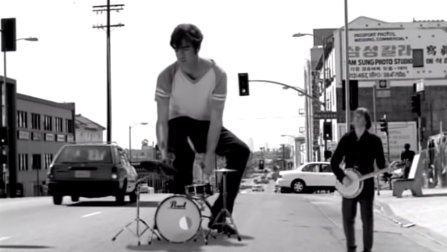
The other interiors were shot on a soundstage. The folks in chains were passersby we filmed in the street or wherever we found them. We shot the dune buggy scene out in the desert. Spike’s scene at the end, with all the special effects, was shot on a giant green screen and green floor in the parking lot of the Ambassador.

J: Spike’s scene?

P: Yes, that’s one of the most popular parts of the video and Spike did it. I’d asked him to get involved and I wanted to give him a lot of room to do what he wanted. So a lot of the budget was reserved for that part. That’s why it’s the one section that’s like its own little film. It has an independent structure within itself.

J: I thought Spike was “second camera” on the shoot.

P: No, he was the co-director and should be credited that way. It’s true that he and I did some of the ‘guerilla’ scenes of the people in chains, which were shot with 16mm cameras. But he directed the parking lot scene at the end.

J: Were any of the chained folks cast?

P: No. Our production assistant just asked whoever happened to be walking by if they’d like to be in an REM video, draped with chains. Completely random. Most people said yes, and that’s who’s in the video.

J: What else was “stupid” about the shoot?

P: Everything. Filming a scene upside down, rubber reindeer suspended from the ceiling. There’s a part where the band appear in silly outfits, as if they’re being interviewed. They weren’t—they were just gibbering on about nothing.

J: The costumes are excellent. Who did you work with?

P: A brilliant costumer called Debra LeClair. I worked with Debra on I can’t remember how many projects, but definitely some high profile ones. Videos for Tom Petty and Bruce Springsteen and several others.

J: Who else worked with you on the video?

P: The editor was Angus Wall, who was also brilliant. He totally understood what we were after. We deliberately set up ‘bad’ edits that were the complete opposite of what you’d do in a typical music video. So, for example, we keep recutting incongruously back to the same shot of Bill over and over at the beginning. It doesn’t fit the song at all.

J: Why have I heard of Angus Wall?

P: Because he went on to become a highly sought-after film editor. He worked a lot with David Fincher and won Oscars for his editing in The Social Network and The Girl With The Dragon Tattoo.

J: Oh, that Angus Wall.

P: Yes, that one.

J: I’ve read that the song is sort of an homage to Los Angeles, or to Michael Stipe’s experience of it. He mentions famous actors and Mulholland Drive in the lyrics. Did that have any influence on the video?

P: Not at all.

J: How long did it take to make it?

P: Oh, a couple of days talking with the band, 5-6 days to prep, 3 days of shooting with conventional cameras (and some more time for the handheld camera scenes), 4-5 days to edit. So, about three weeks?

J: What was most fun for you?

P: When I was a young filmmaker I had a fantasy of working with Roger Corman. I never got to do that but I did see some production stills from one of the last films he worked on. The images were of armored knights jousting on dune buggies in the desert. It was such a crazy idea, and that’s how we ended up with the dune buggy scene.

J: Who was in the suit of armor? It’s not one of the band.

P: The guy in the suit of armor was Bono.

J: Are you kidding? That was never Bono!

P: REM shoots always had major celebs visiting.

J: Wow. I wonder how he got the visor down over his shades!

P: *polite silence*

J: Er, lastly, one of the esteemed contributors to this venerable blog wrote about REM that “Mills is an okay bassist and a crap singer. Berry is at best a passable drummer.” Would you agr—

P: That is one of the stupidest things I’ve ever heard.

JC adds.…..This really is beyond any call of duty.  Jonny had no idea how much the song means to me, nor the fact I’ve always loved the video, so when he floated the idea of getting in touch with Peter, I was excited and hopeful in equal measures, but deep down I thought it was a long shot.  I’m still in shock and awe a few days after the email dropped into my inbox.

Peter Care is actually a legend when it comes to making music videos – as far back as 2005, he received a Lifetime Achievement Award for his work in the field from the Music Video Production Association. He got noticed primarily through his early pioneering work with Cabaret Voltaire and between 1983 and 2004, he worked with almost 30 different singers/bands, many of whom are no strangers to the pages of this little corner of t’internet. If you like these songs, then go and visit YouTube or the likes and have a look at Peter’s outstanding work

mp3: Cabaret Voltaire – Sensoria
mp3: It’s Immaterial – Ed’s Funky Diner
mp3: PiL – Rise
mp3: Bananarama – Venus
mp3: New Order – Regret
mp3: James – Say Something

As far as R.E.M. goes, Peter has directed seven music videos along with the excellent Road Movie, the 90-minute documentary/concert film recorded in Atlanta, Georgia in 1995 at the end of the band’s world-wide tour to promote Monster.

As I said, he’s a legend, so a huge thanks to Vince for helping out with the initial contact, and of course to Peter for being so generous with his time when Jonny connected with him.
JC

THE SINGULAR ADVENTURES OF R.E.M. (Part 31)

Up until now, both myself and The Robster have been pulling these pieces together weeks and sometimes months in advance. It’s been an absolute joy to have embarked on this particular adventure in hi-fi and having been lucky enough to read what’s coming up over the next few weeks, all lovingly composed by my better half, the quality is going to be maintained.

It would have been last October or November when I would have insisted that the look back at the 31st UK single from R.E.M. would be my responsibility. At which point I got writer’s block that I’ve only managed to overcome as a result of an impending deadline.

Cards on the table.

Electrolite is my favourite single of them all. Back in 2008, when I pulled together my 45 45s at 45 series, nothing from R.E.M. made the cut, but as a preface to the actual series I did say that the five songs which would have taken things up to #50 were, in alphabetical order, :-

Billy Bragg – Levi Stubbs’ Tears
Morrissey – November Spawned A Monster
REM – Electrolite
Stereolab – Ping Pong
Violent Femmes – Blister In The Sun

This was done to demonstrate just how hard it had been to come up with the final list of 45 singles, all bought at the time of their original release, with only one song per singer/band.

So why do I have such a love for Electrolite?

The writer’s block I feel is an illustration that I have a real difficulty putting it into words.

The first time I heard it was as the closing track to the album. I got a real sense of melancholy as the tune and lyrics just seemed to capture a frame of mind I was in…looking back it was a wee crisis of confidence more than anything, but for the first time in my life I actually felt I was about to take a mighty tumble, with hopes and aspirations for my career suffering a setback. There were also a few things going on with friends that were a bit of a concern, although thankfully Rachel (aka Mrs Villain) was proving to be a rock.

New Adventures In Hi-Fi helped me immensely at the tail end of 1996 – a sprawling, ambitious and hugely unexpected record requiring a high degree of dedication to be fully appreciated. Over an hour in length, it was a diverse and, at times, audacious listen, constantly shifting direction and pace. It was a demanding listen, best appreciated through a set of headphones, whether for the loud rock-out moments or the beauty of the quieter songs, some of which, if developed fully, could easily have delivered another hit as monster as Everybody Hurts.

By the time the album rolled around to track 14, the album closer, I’d often be exhausted and exhilarated in equal measures. And then the sound of what I later learned was a guiro would kick in and the song I cannot but think of as a companion piece to (Don’t Go Back To) Rockville would start to wash over me:-

mp3: R.E.M. – Electrolite

A few years short of the millennium and Stipe has composed his farewell to the 20th Century, name checking three of the coolest lead men in Hollywood history, backed mainly by a magnificent piece of piano magic from Mike Mills, but on which there is also the most perfect playing of a banjo, a violin and various pieces of percussion to be found on any CD/record that I’ve ever owned.

I think it’s fair to say that I immediately put this song on a pedestal. Any thoughts that it might ever be removed dissipated around a year later when Bill Berry announced he was leaving R.E.M., which means that this holds its special place in history as the last song on the last album recorded by the four-piece.

Here’s another thing I need to mention.

The series of ICAs that this blog has become ‘best known’ for has long given me a real sense of pride. I don’t know how the other composers go about their work, but with almost every ICA I’ve ever written, I think to myself ‘Is this as good a closer as Electrolite?’ Is it a song that makes me want to immediately go back and listen all the way through the album again?’

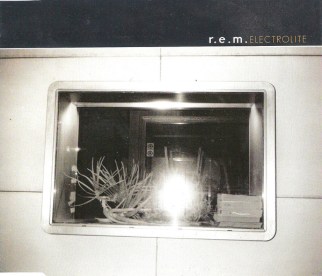
Electrolite, like the two other 45s taken from the album, came out in cassette form as well as a standard and ‘Collectors Edition’ CD (the only difference being the packaging) on which you could find two live tracks taken from a gig in Atlanta on 18 November 1995:-

mp3: R.E.M. – The Wake-Up Bomb (live)
mp3: R.E.M. – Binky The Doormat (live)

As The Robster mentioned last week, the former had been the song the record label most wanted as the follow-up to E-Bow The Letter and the live version does demonstrate both how well it would have sounded coming out of radios and how much it would likely appeal to those whose interest in the band was beginning to diminish.

The latter is one of those tracks on New Adventures that grew on me with each listen. I can give it no higher compliment than it wouldn’t have been out of place on Monster, and the live version captures the band at their best, albeit a long way removed from the Murmur/Reckoning/Fables era of less than 15 years previously.

The fourth track was a remix of one of my own favourites from Monster:-

mp3: R.E.M. – King Of Comedy (808 State Remix)

It was wholly unexpected to read of the collaboration on the sleeve notes of the CD single.  I went in with a bit of fear and expecting the worst, but came out with a smile on my face. As Bones might have said in the early days of Star Trek, ‘it’s R.E.M., but not as we know it, Jim.’

And in this case, that’s something to enjoy and appreciate.

Stats wise, Electrolite reached #29 in the UK singles chart in December 1996. It would be almost two full years before the next 45. The Robster will take your hand and guide you through it, as he will with all four singles from Up.

I’ll see you all again in due course. Thanks for your continued support, and hopefully enjoyment, of the series.

JC

SATURDAY’S SCOTTISH SONG : #246: PLASTIC ANIMALS

Plastic Animals are an Edinburgh-based band.  I use the present tense as I’m not sure if they are still on the go, but given that they haven’t ever been one for moving things quickly, then there’s every possibility they will record and release some music in the near or distant future.

Consisting of Mario Cruzado (guitar and vocals), Ben Slade (guitar), Jean Michel Morin (keyboards), Dave Wark (bass) and James Lynch (drums), they released an EP in each of 2011 and 2012 before signing up with Song, By Toad Records where they contributed two songs to a split 12″ EP in 2013 (four bands, eight tracks) before debut album Pictures From The Blackout was issued in 2016. While there has been no new material made commercially available since then, the band has played gigs in their home city in 2017 and 2018, but I can’t find anything more recent than that.

Which is something of a shame as Plastic Animals, in the live setting, were always great value and the material on Song, By Toad is quite decent, albeit without being ground-breaking. Most reviewers back in the day were content to describe the music as being flavoured with krautrock and shoegaze.

I thought I’d share one of the tracks from the album:-

mp3: Plastic Animals – Demmin

The early material is on their own bandcamp page while the album can be found at Song, By Toad.

JC


RIPPING BADGERS CDs (Part 4): ELLIOT SMITH

Ripping Badgers CDs
The nearly finished A to Z Charity Shop CD Challenge #4

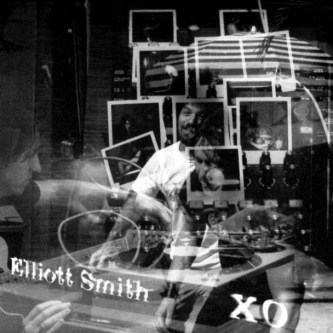
XO (1998, Dreamworks)
Bought from Oxfam, Teignmouth for £1.50

Before I start with my normal wittering on I want to say something that is connected to Elliot Smith, and it feels wrong of me to shove down at the bottom of this page, so I’m doing it at the top.

Tim Badger was introduced to the music of Elliot Smith by a friend of his who worked with a charity called CALM – The Campaign Against Living Miserably. It’s a charity who are leading the fight against suicide, particularly male suicide. It’s a charity that Tim supported wholeheartedly and one that I also support and promote wherever I can. Their website is below. If you do only one thing today, before you download the music or read the rest of this page please check out their website. Thank you.

https://www.thecalmzone.net/

(JC adds……I thought I’d lead by example and chip in a tenner.  Seems like an appropriate way to thank SWC and the late Tim for everything).

Trev is not happy. Trev is the captain of the 5 a side that I am part of and in less than 6 days we are taking part in a work tournament. The reason that Trev is not happy is that Tony has just withdrawn from the team. Tony was pretty much our best player, despite being in his late 40s (This is about fifteen years ago) he is fitter than the rest of us, stronger than the rest of us and has more footballing talent in his left leg than the rest of the team put together. If Tony plays we stood a chance of not being humiliated.

I ask Trev why Tony has withdrawn from the team.

“He’s Injured himself changing a lightbulb, silly twat”. Its fair to say that Trev is not sympathetic. It later transpires that Tony didn’t injure himself changing a lightbulb, he fell off a ladder and ruptured his bowel and needed emergency surgery and couldn’t, at the time of this conversation, actually walk. This would still make him a better player than Trev though.

I tell Trev that I’ll ask Badger to play. Badger is, I tell him, a decent footballer, has a fairly good right foot, is as strong as an ox and I tell him with a wink, “He’ll cheat like buggery”. It will be like having a sixth player. Trev nods and tells me to sort it. Some of that might have been a lie. Badger did indeed have a good right foot. He just couldn’t kick a football with it. He will cheat though.

Badger agrees to play. At a price. It costs me a bottle of rum. A good bottle at that and I have to promise Lorna that I will help him paint their front door, which is what he should have been doing on the day of the tournament.

The tournament is on Saturday and we all meet up in the car park and Trev hands out our kit. It is red. Badger immediately complains that Arsenal play in red and its pretty much against his religion to wear anything red (this is true, Badger refused to wear anything red, he also told me that he had it written into his marriage contract that if Lorna ever bought him anything relating to Arsenal he could divorce her. She on the other hand had it written into the same contract that he could ‘never ever, buy her a novel written by someone called ‘Danielle Steel’.)

We get changed into the kit, Badger begrudgingly agrees to only wear his red top when we are actually playing, and we traipse over to the pitches. We have been put into a group with three other teams, Badger tells me he is going to go and psych out the opposition and he wanders off.

Badger’s attempts at psyching out the opposition didn’t go very well, largely because he used it as an excuse to buy a pasty from the handily placed takeaway van at the side of the pitches. We lose our first match, although that was, I think more to do with our goalkeeper, Jason, not understanding the rules of five a side. Midway through the second half with the score 1 nil to us, he comes rushing out his area to boot the ball as hard as he can in the direction of the M5 motorway and concedes a penalty, which they score. Something they do again about thirty seconds later, on this occasion, Jason lets the ball slip out of his hands and it rolls asthmatically across the line, as he lies on the ground watching it. Badger is not happy with Jason, and I decide to not tell him that Jason is an Arsenal fan.

The second and third matches do not go very well either we draw one and lose the other, I say lose, we are thrashed in the third match. I touch the ball once in the whole game and that is when it bounces off my shin and past the hapless Jason in the goal. We are out and its not even lunch time. Badger smiles and says at least we can go to the pub early. This cheers me up, that is until Trev tells us that we are entered into the penalty shoot out contest. Trev failed to mention the penalty shoot out competition.

The penalty shoot contest consists of the team taking 20 penalties in no more than ten minutes, each player has to take 4 penalties each. The team that scores the most wins a prize. It turns out that they have roped in a former Plymouth Argyle goalkeeper to try and stop the goals. Like pretty much everything connected to Plymouth, he is useless.

Which might be why we turn out to be quite good at the penalty shoot out. Badger decides to adopt the same tactic for each of his kicks, this consists of him giving the keeper the skunk eye before belting the ball at the goal as hard as he can. I adopt a more thoughtful approach of trying to place the ball in the bottom right or left corner. Weirdly both are successful as neither of us have missed any of our kicks, although the goalie was about 60. Badger tells everyone who can be bothered to listen that he based his tactic on something he read in a Hotshot Hamish comic strip once and therefore knew it would work. For the record I based my tactic on another famous Scottish footballer – Ray Stewart of West Ham.

We end up scoring 16 as a team and finish up third in the contest. We win an amazing prize for coming third, a pair of football socks, which were red.

All of which Saint and Greavsie’s inspired activity bring us to the fourth CD in the Nearly Finished A to Z Charity Shop Challenge. It is ‘XO’, by Elliot Smith. I think of penalty kicks when I see X O written down, not sure why, but that’s why I went on about football.

Badger was a huge fan of Elliot Smith, far bigger than I am, although I have to say, I love this album, and have played it regularly since the CD was lifted from the box before Christmas. If like me, you’re not really familiar with his work, this is a great way to immerse yourself into his work, the whole album is stunning. Its full of wonderfully wry lyrics, clever one liners, cries of despair all laced together with some soft beautiful melodies, like these two for instance:-

mp3: Waltz #2
mp3: Baby Britain

‘XO’ is still a heartbreaking listen at times, roughly around the time of this release Smith struggled with depression and tried suicide at least once (he threw himself off a cliff whilst drunk and impaled himself on a tree). I’m not sure if this made worse by us all now knowing how things turned out for Elliot Smith, doesn’t matter I suppose. It’s a great album, I urge you all to take the time to listen to it.

mp3: Amity

SWC

AN IMAGINARY COMPILATION ALBUM : #276 : PAUL HAIG

“The more I think about it, the more I come to the conclusion that Paul Haig is just about the most important Scottish musician of my generation. He’s really proved to be our equivalent of Bowie, with his constant shifting of musical genres over a career that stretches back more than 40 years, albeit with a very small minuscule of commercial success in comparison

“I really must get round to finishing that long-delayed Paul Haig ICA.”

Those were my opening and closing paras last November when I featured him in the long-running Saturday Songs series. The reason it has been so long-delated is the amount of choice.  I’m not including any of the Josef K material, nor anything that he released alongside the late and great Billy Mackenzie, but I was still looking at a long list of more than 40 potential songs for inclusion.

It’s been a labour of love.  Again, I’m not going to argue these are the ten ‘best’ Paul Haig songs, but I do feel they hang together as a fine compilation album.

SIDE ONE

1) Heaven Sent (single, and opening track on Rhythm of Life, 1983)

A song dating from the Josef K days, and one which the band had performed in their trademark way, complete with angular, jarring guitars that meant a raincoat was essential if you really wanted to get on the floor and give it a dance.  This radical transformation, with production duties handled by Alex Sadkin, (a person mentioned in the Chris Frantz book I reviewed last week) who was probably best known for his work with Grace Jones, showed how much and how quickly Paul wanted to move on and do something totally different.  All of his early solo work formed part of the soundtrack to my student days, and I make no apologies that a few songs from that era will feature in this ICA.

2) I Believe In You (single, and opening track on Coincidence vs, Fate, 1993)

No matter how hard Paul Haig tried, he just couldn’t ever get that elusive hit single.  I Believe In You was his 14th go at things, and this marvellous, radio-friendly pop/dance effort, with more than a hint of house high up in the mix, was another instance when justice wasn’t done,  Talking of which….

3) Justice (single and track 8 on Rhythm of Life, 1983)

A version of Justice had been recorded in 1982, with the aim of having it issued as a single via Belgian label Les Disques du Crépuscule.   The big contract with Island Records put a spoke in that wheel, meaning that a track which sounded in many ways like the New Life/See You era of Depeche Mode, was given the Sadkin treatment, and became, arguably, the most instant and accessible of all the tracks on the debut album.  The label likely had high hopes for this to be a big single, ideally coming on the back of a previous hit, but given that the radio stations and the record-buying public were proving to be disinterested, it was given just a low-key release.  Another that should’ve been much better known…

4) Over Over (track 3 on Cinematique 3, 2003)

Cinematique 3 was the final in a series of three instrumental albums subtitled “Themes to Unknown Films”. The previous two volumes had been released in 1991 and 2001, the first on Les Disques du Crépuscule, but the final two volumes came out on Paul’s own label, Rhythm Of Life (which was, of course, the title of the debut album on Island Records back in 1983). RoL had actually been the name under which Paul had issued a number of side projects immediately after the break-up of Josef K, and such was his love of the name that he resurrected it at the tail end of the 20th Century and has used it for all his releases ever since.

5) Something Good (10″ version, 1989)

Lifted from a previous blog post:-

In 1988, Paul Haig took a very bold and brave step by fully financing the recording of his next album himself without the safety net of a guaranteed release. He again worked with Alan Rankine and thankfully for all concerned, it was picked up by Circa Records, an offshoot of Virgin. Hopes were high, particularly for the release of an outstanding and poptastic leadoff single, Something Good, which was released in 7″, 12″ and 12″ remix form and tailor-made for radio play and an appearance on Top of The Pops. But….once again, Paul was denied by the pop gods with him again being in the wrong place at the wrong time with Madchester all the rage and synth-pop well out of fashion. And yet, when you listen to Something Good, and indeed some of other tracks on parent album Chain, it’s not a million miles away from some of the less clubby tracks on Technique by New Order (e.g. Run).

SIDE TWO

1) Round and Round (track 6 on Relive, 2009)

Come the early years of the 21st Century, a few members of the emerging bands were making noises that Paul Haig had been something of an influence in their formative years.  This led to a bit more interest in the great man and he released two albums in quick succession – Go Out Tonight (2008) and Relive (2009) with the guitars more to the fore than recent years, albeit there remained a very healthy dose of keyboards/electronica.  He was also more than happy to go back to old material and give it a fresh update, such as this one, co-written with Malcolm Ross, his mate from the Josef K days, which had already seen light of day on one of Ross’s solo albums as far back as 1995.

2) Big Blue World (12″ single, 1984)

3) The Only Truth (single, 1984)

The cut-throat nature of the record industry meant that Island Records weren’t the slightest bit interested in Paul Haig after the debut album had stiffed.  Even when he came up with the very radio-friendly Big Blue World, on which he worked very closely with Alan Rankine not long after he had taken his leave of Associates, they turned it down which meant he was free to issue it as a 45 on Operation Afterglow, an offshoot of Les Disques du Crépuscule, but inevitably things were done on a shoestring budget and nobody got to hear it.  Mind you, the fact it came out on such small label did make it eligible for the indie charts and it managed to reach #19.

Work on the follow-up, The Only Truth, saw Bernard Sumner (New Order) and Donald Johnson (A Certain Ratio) take on joint production duties.  Sniffing a commercial opportunity, Island Records decided this one should go out on license, thus it was given an Island catalogue number, but the label in the middle of the record indicated it was another Les Disques du Crépuscule, albeit it was very much bankrolled by the major.  After it flopped, Island decided to drop Paul Haig and shelved the plans for a second album, much of which had already been recorded.

4) Chained (track 10 on Chain, 1989)

The first hook up with Billy Mackenzie came in the mid-80s, and was the kindling of a close friendship over many years until Billy’s sad demise.  They decided that each would write a song for the other’s next LP, and the quite majestuic Chained subsequently was included on Chain in 1989 – an album that just happened to be produced jointly by Paul Haig and Alan Rankine.

NB: Paul’s song for Billy was Reach The Top, which was recorded for the Associates album The Glamour Chase, due also for release in 1989 but shelved by the record label, and only given a posthumous release in 2003.

5) Chasing The Tail (opening track on The Wood, 2018)

This ICA closes off with some music from the most recent album.  His ability to still astound, astonish and delight can be evidenced by this review from Louder Than War:-

It’s a long time since Paul Haig split from Josef K. In the fact he’s been producing solo records since 1982, so perhaps it’s high time to put the post-punk spectre to one side and look at what is happening in the here and now because Paul’s new record shares next to nothing with that band. Maybe a similar spirit of adventure, but sonically a world away. The Wood finds Haig exploring samples, beats, electronics and ‘found sound’ to sculpt something that’s split into eight parts, but very much fit together as a whole. A soundscape of the strange and strangely danceable among the tranquillity in the forest, or of the mixed-up feelings of the soul, or both, well that’s what I think may be intended anyway.”

Whether that truly comes over is down to each individual listener to judge, but for me Haig has put together a work that’s in turns provocative, danceable, obscure, immediate and beguilingly rum, so I’m not sure it really matters. What The Wood actually consists of is eight pieces that mostly are dance/trance-orientated with repeated vocal motifs. The concept gives it an added edge and with a little imagination you can feel the eerie peace of the Forest and the skips and dips of the mind. Aside from the concept there is plenty to get one to, cough, ‘cut a rug’. But everything here fits and you have to admire Haig’s craftsmanship in the way it has been put together – producing a musical storybook without words in effect. Forty years into his recording career he’s still breaking new ground. Long may he strive for the outer reaches, because those who want to be challenged a little in their listening will lap this up.

BONUS 7″ SINGLE: THE COVERS

a) Ghost Rider

b) Atmosphere

The former was the b-side to Big Blue World back in 1985.  It’s a hugely enjoyable trashy, electro-rockabilly take on the Suicide song from 1977 (and which last featured on this blog as the b-side to Orange Crush by R.E.M.)

The latter is, indeed, the Joy Division song. It was recorded more than a decade ago by Outernationale, which is the name used by Scots-born Derek Miller, with Paul Haig adding his distinctive vocal. The track would later be given a release on Hacienda Records, the short-lived digital label run by Peter Hook.  It’s brilliantly different…..

JC

IT REALLY WAS A CRACKING DEBUT SINGLE (52)

I really didn’t mean for there to be a near four-months gap in this series, and so I’m returning with one which goes back to basics in that it’s a debut single which the band never topped at any time in the future.

Don’t Dictate was released in November 1977.  It was the work of Penetration, a band from Ferryhill, a small coal-mining town in the north-east of England, taking their name from an Iggy Pop song.   The line-up which recorded and released the debut single, on Virgin Records, consisted of Pauline Murray (vocals), Robert Blamire (bass), Gary Smallman (drums) and Gary Chaplin (guitar).

mp3: Penetration – Don’t Dictate

The single, and indeed its b-side, was credited to Chaplin/Murray, but just a few months later he left, to be replaced by Neale Lloyd and then Fred Purser was added as a second guitarist, seemingly at the insistence of the record company who wanted to flesh out the sound.

The line-up alterations fuelled a change in the group’s dynamics, and moved them away from what was a punk sound to one which was far rockier and harder in edge. Indeed, the all music review of Moving Targets, the debut album released in late 1978, states:-

In another lifetime, they could have given the likes of Led Zeppelin and Deep Purple a run for their money, at least in terms of demonstrating dexterity

The debut album did actually sell fairly well, reaching #22 in the charts, but the reviews of the live shows were increasingly highlighting the fact that many of the songs contained guitar solos, played by Purser with a high degree of skill and ability, to the extent that they bordered on metal and not punk. It was, admittedly, a fine line – I knew punk fans in Glasgow who loved Motorhead but who would scream blue murder if you played the classic rock stuff, so I guess it was down to just how fast a band played.

Anyways, Penetration’s popularity diminished very quickly and they broke-up soon after a second album, Coming Up For Air, was released in September 1979. Pauline Murray would later join up with The Invisible Girls, a group initially formed to provide a musical soundtrack to the poetry of John Cooper Clarke, recording a fabulous self-titled album in 1980.

Fun fact time. John Maher of Buzzcocks was the drummer on the Pauline Murray and The Invisible Girls album. When Penetration reformed in 2015, Maher could be found pounding the drums at the gigs and indeed in the studio as the band released a third album, Resolution, after a gap of 36 years.

Here’s the b-side of the debut 45, clocking in at just over 100 seconds in length:-

mp3: Penetration – Money Talks

Rather fabulous……..that’s if you want to my view on it.

JC

SOME SONGS ARE GREAT SHORT STORIES (Chapter 43)

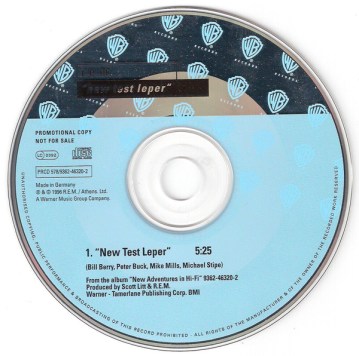
A couple of days ago, the latest instalment of the R.E.M. singles series made reference to the acoustic version of New Test Leper that had featured as one of the b-sides to Bittersweet Me.

I got thinking that perhaps not everyone will be familiar with the songs which appeared on New Adventures In Hi-Fi, and given that the original version of New Test Leper is such an outstanding piece of work, I’ve decided to feature it as part of this series:-

I can’t say that I love Jesus
That would be a hollow claim
He did make some observations
And I’m quoting them today
“Judge not, lest ye be judged”
What a beautiful refrain
The studio audience disagrees
Have his lambs all gone astray?

Call me a leper
Call me a leper
Call me a leper

“You are lost and disillusioned”
What an awful thing to say
I know this show doesn’t flatter
It means nothing to me
I thought I might help them understand
What an ugly thing to see
“I am not an animal”
Subtitled under the screen

Call me a leper
Call me a leper
Call me a leper

When I tried to tell my story
They cut me off to take a break
I sat silent five commercials
I had nothing left to say
The talk show host was index-carded
All organized and blank
The other guests were scared and hardened
What a sad parade
What a sad parade

Call me a leper
Call me a leper
Call me a leper
Mmmm
Mmmm

mp3: R.E.M. – New Test Leper

There’s a whole page on wiki devoted to the song:-

“It was recorded at Bad Animals Studio in Seattle, Washington, in March 1996, four months after R.E.M. completed their 1995 world tour in support of their previous album, Monster. On the track, Bill Berry plays drums and shaker; Peter Buck plays guitar; Mike Mills, bass and organ; and Michael Stipe provides the vocals, which were penned during moments of downtime at the studio.

The following month, on April 19, the band recorded an acoustic version of the song at the same location. That version was released as a B-side to the “Bittersweet Me” single. The video of the performance, directed by Lance Bangs, was used as the video to the album version of the song in the Bonus Videos section on the band’s In View DVD, released in 2003.

The first line of the song contains the lyrics “I can’t say that I love Jesus”, attracting some controversy. Peter Buck clarified the matter to Q magazine’s Tom Doyle in 1996: “It’s written from the perspective of a character that Michael saw on TV on a talk show. But are people going to think Michael’s talking about himself not liking Jesus? I don’t think that people will take us that seriously. It’s not like we’re tearing up a picture of the Pope on television.” He was referring to Sinéad O’Connor‘s 1992 Saturday Night Live incident.

“‘New Test Leper’ is something that we only played at soundcheck, like, twice,” Buck explained in another interview, this time to Addicted to Noise’s Michael Goldberg, also in 1996. “And for some reason, we just forgot about it and never really played it. I don’t know why. Michael just happened to luckily enough have it on tape. He says, ‘I’ve got this great stuff for that song and none of us even remember playing it.’ So we cut it here in Seattle when we did the record. I think it’s probably the most R.E.M.-ish sounding thing on the record. Literally, Michael was watching one of those talk shows and I think the subject was ‘People judge me by the way I look’ or something. Whereas I, when I have the misfortune to look for two minutes at one of those Oprah, Geraldo things, I just get revolted at everyone concerned: the audience, me. Michael actually looked at it and felt like, ‘Gosh, what if someone’s actually trying to communicate something to these people and this person who’s in this awful, tacky, degrading situation?’ So it’s written from that perspective. And I think probably having done press conferences in the past and being in those kinds of situations, there might be a little empathy from experience that we’ve had.”

According to Darryl White’s R.E.M. Timeline, “New Test Leper” received its first live airing on May 31, 1997, at the Variety Playhouse in Atlanta during the final show of The Magnificent 7 vs. The United States’ tour. The “Magnificent 7” was composed of Peter Buck, Mark Eitzel, Justin Harwood, Dan Pearson, Barrett Martin, Scott McCaughey and Skerik Walton, with other people performing occasionally. Buck’s R.E.M. bandmates were present, and the guitarist left Eitzel to perform the last encore to go backstage and talk with the trio. Berry, however, had already departed and was on his way home. “Bill phoned me after the show to tell me he’d loved it,” explained Buck. “But he had to leave halfway through because he was scared he’d be asked to play. It had taken him two hours to drive there; he stayed for forty minutes, and then drove home so he wouldn’t be asked to play one R.E.M. song.” The remaining threesome put together a short set and took to the stage.

During R.E.M.’s performance on VH1 Storytellers in 1998, Stipe explained the background of the song he described as his “crowning achievement”: how he initially (and, thankfully for him, erroneously) thought he’d stolen the song’s “biggest line” – What a sad parade – from his friend Vic Chesnutt; how he wanted to write a follow-up to the only other song he knew that contained the word Jesus in the first line – namely Patti Smith‘s re-working of Van Morrison‘s “Gloria” (“Jesus died for somebody’s sins but not mine”); how he “wanted to write a song that was in the 6/8 polka kind of thing, but wanted the vocal to be contrapuntal; and how he quoted his favorite movie in the second verse (“I am not an animal,” from The Elephant Man, a movie that Stipe says also inspired R.E.M.’s “Carnival of Sorts (Box Cars)”, amongst others).”

And, just to round things off……

I reckon this illustrates perfectly just what The Robster has been saying this past couple of weeks about how different NAiHF would have been regarded if certain other songs had been released as singles.

JC


THE BEST OF SWEDISH MUSIC IN 2020

A GUEST POSTING by MARTIN ELLIOT

(Our Swedish Correspondent)

Jim,

I guess this mail has become a bit of a tradition, that I summarize last year from a Swedish music POV. As we all know 2020 went down as a year we’d probably most want to forget as quick as possible, very true also for us. I started working at home from last week of February, returning from the Milan area the same night as the first reports came of COVID-19 cases found in 10 smaller towns south of Milan… Immediate quarantine, and then remote working since. Soon celebrating a full year at the dining table. Pros, it’s been many a good year since I played so many of my vinyl records, and I’ve been much more physical active than normal, not spending time commuting – lost 5 kg so far! Cons, well most of all a non existent social life and a limited variation in environment I see.

Musically it became a bit of an in-between year here on the Eastern front, a lot of things postponed, delayed or just taking forever to complete with artists isolated (and not all enjoying being locked down in solitude). I’ve managed to scramble out a couple of decent tracks though, well in my eyes at least, for an EP of the best Swedish music from 2020.

Without further ado, let’s go.

1. Pale Honey – Bad Thing.

Just before Christmas Pale Honey dropped their 3rd album, and what an album it turned out to be. Ten sparkling, raw and self assured tunes. Highly recommended!

2. Kite – Hand Out The Drugs.

The synth-duo Kite has a history of releasing 4 to 5 track EP’s, six so far, rather than full length albums but 2020 saw them release three 7″ singles instead. All of them very good, Hand Out The Drugs was the last of the three, with a title apt for a year needing escape.

3. Twice A Man – Rain Of Shame.

T A M has been active for about 40 years now, they started in the late 70’s as Cosmic Overdose and then became Twice A Man. They have shifted between more pop oriented electronic music to music for plays or art exhibitions. Last year saw them release the album On The Other Side Of The Mirror, a darker version of their more pop oriented side and to me one of their best releases so far.

4. Kapitalet – En Förlorad Värld (A Lost World).

In Swedish, won’t make much sense for most of the TVV readers (sorry), but over here it had importance – since it was the first (and so far only) new song written and performed by one of the forming members of Kent. Kent was the biggest band over here for several years (their 2nd album and ALL 9 following studio albums has been number 1 here, one of the albums stayed 85 (!!) weeks in the charts) and when they March 2016 in a brilliant way announced their last album and tour the same year people cried.

The track isn’t too far away from what Kent sounded like the last few years, lyrically a bit more political, but didn’t make even close the impact in the charts as Kent used to do.

5. ionnalee – Mouth’s Open Sea (Kronologi version).

Jonna Lee Nilsson celebrated 10 years as multimedia artist last year by releasing a collection of reworked or re-recorded songs from her ionnalee and iamamiwhoami aliases. (Some of you might remember she’s been included also earlier years.) Open Sea was originally on 2019’s Remember The Future, this is still trademark ionnalee electronics, but a darker, more focused and beat driven version than the original.

6. Kleerup – I Hang On To My Vertigo (featuring Freddie Wadling).

Yes, the old Ruper Hine classic, by the same Kleerup that made Robyn into an international star with the track With Every Heartbeat. Kleerup has had some tough years suffering from drug addictions but seems to be back in shape. Last year saw the release of his album “2”, working with artists like AlunaGeorge and Rebecca&Fiona – and dusting off an older recording with Swedish punk legend Freddie Wadling.

Freddie sadly died summer of 2016 after a hard and destructive life. Maybe contradictary to his destructive life he was musically very active, at one time he was member of 12 different bands at the same time giving room for his varied creative styles. He played with The Leather Nun, Cortex and Blue For Two to mention the potentially more known bands outside our borders.

Bonus track:

Pale Honey – Set Me Free. I add this as bonus track for mainly two reasons; firstly it’s against the laws of mixtapes to include more than one song of the same band and secondly this was actually released late 2019 even if the album came a full year later – but I just can’t not let you hear the best indie dance intro since Fools Gold

From the dining table, thanks for listening.

Martin

JC adds..…I always look forward to Martin’s end of year round-up as there’s inevitably something in there that grabs may attention, and this year is no different.  The two Pale Honey tracks are already on heavy rotation and I’m always grateful to hear more of ionnalee.