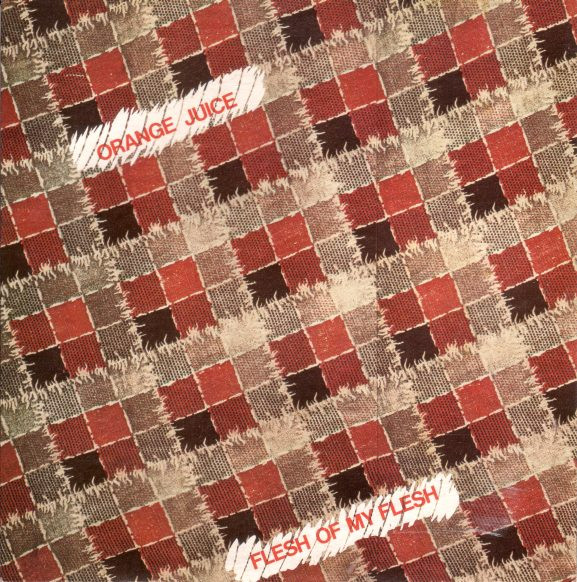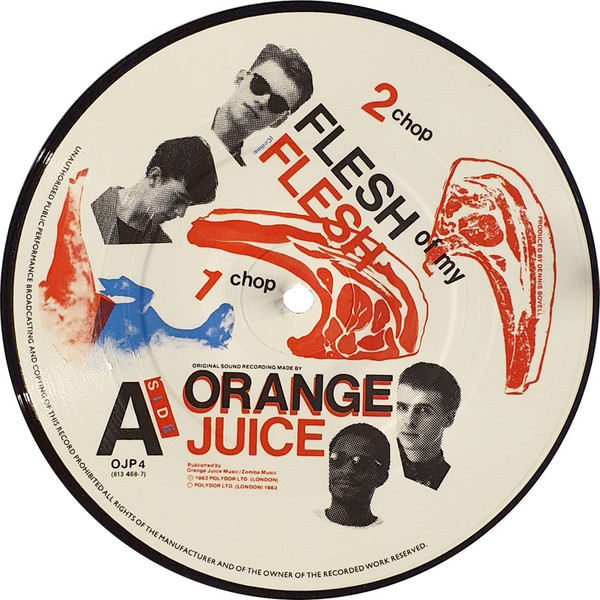
Bought on CD in 1995 and upgraded in October 2023 when 3000 copies were pressed onto white and black marbled vinyl as part of something called National Album Day.
I don’t have a huge amount of dance records across the collection, and what I do have tends to veer towards the commercial/popular aspect of the genre. My first exposure to Leftfield was hearing Open Up, the collaboration with John Lydon released as a single in late 1993. I was blown away bit it, thinking it was easily the best thing Lydon had done in the best part of a decade, certainly since the PiL album Happy? back in 1986 – it wasn’t that I had disliked any of the subsequent late 80s/early 90s material, but they kind of were Johnny’s take on what was contemporary sounding and for the first time he didn’t appear to be fussed about being cutting edge.
Open Up was one that made me sit up and pay attention. I think it is Lydon’s best delivery of a vocal across his entire career and back in 1995, I’d have been willing to say that the song was one of the greatest dance songs ever made. In 2008, as part of the 45 45s@45 series, I had this one at #19 in the rundown. If this year I were to do 62 45s@62 (which I won’t!!!!), it would still be in and around the Top 25.
My love for Open Up led me to buy the debut album Leftism the week it was released and discovering, to my great delight, that Toni Halliday of Curve was a guest vocalist. Her track, Original, very quickly became the highlight of the album – the only reason it wasn’t eligible for the 45s@45 series was I didn’t buy the actual single a few weeks later. Other than that, I found the album a bit difficult to get my teeth into, sort of confirming that I find it hard to take entire albums of dance music.
But that was 1995. As time has moved on, and I’ve been able, thanks to listening to things posted across other blogs (with a particular shout-out to Swiss Adam,Ctel and Khayem for their efforts at Bagging Area, Acid Ted and Dubhed), to better appreciate the genre. The CD purchase had been ideal in that the skip function could be utilised, but as the years passed, I was using it less and less. Now that vinyl is the preferred choice for listening purposes, I, will, without fail, listen to it in order across its four sides.
One of the interesting things for me is reading that Paul Daley and Neil Barnes were scathing about the album’s first take back in 1995. Daley said “It sounded shit […] It seemed to have no cohesion, the tracks just didn’t seem to hang well together” with Barnes adding “We did all the tracks, listened to them and decided it sounded a fucking mess […] we went back, messed around with the running order and chopped a lot of things out. Hopefully now it sounds complete, something that can be listened to in one go”
Whatever they did worked wonders, as fans and those paid to be critics responded positively. Leftism came in at #3 on the week of its release, spending 40 weeks in the Top 100 through to late November, and then returning for a further 38 weeks between January and September 1996, partly due to the success of later singles. It was nominated for the 1995 Mercury Music Prize and featured prominently in most end-of-year lists in music papers and magazines.
The former was the follow-up single to Original, and reached #22 in the charts in August 1995. It’s an example of a song that I just didn’t get 30 years ago, but I regard it as one of the highlights of the album.
The latter is some three minutes longer than the Vocal Edit single version, with its closing section offering a trippy, slowed-down take on things which, again, I’ve really only appreciated fully many years later.
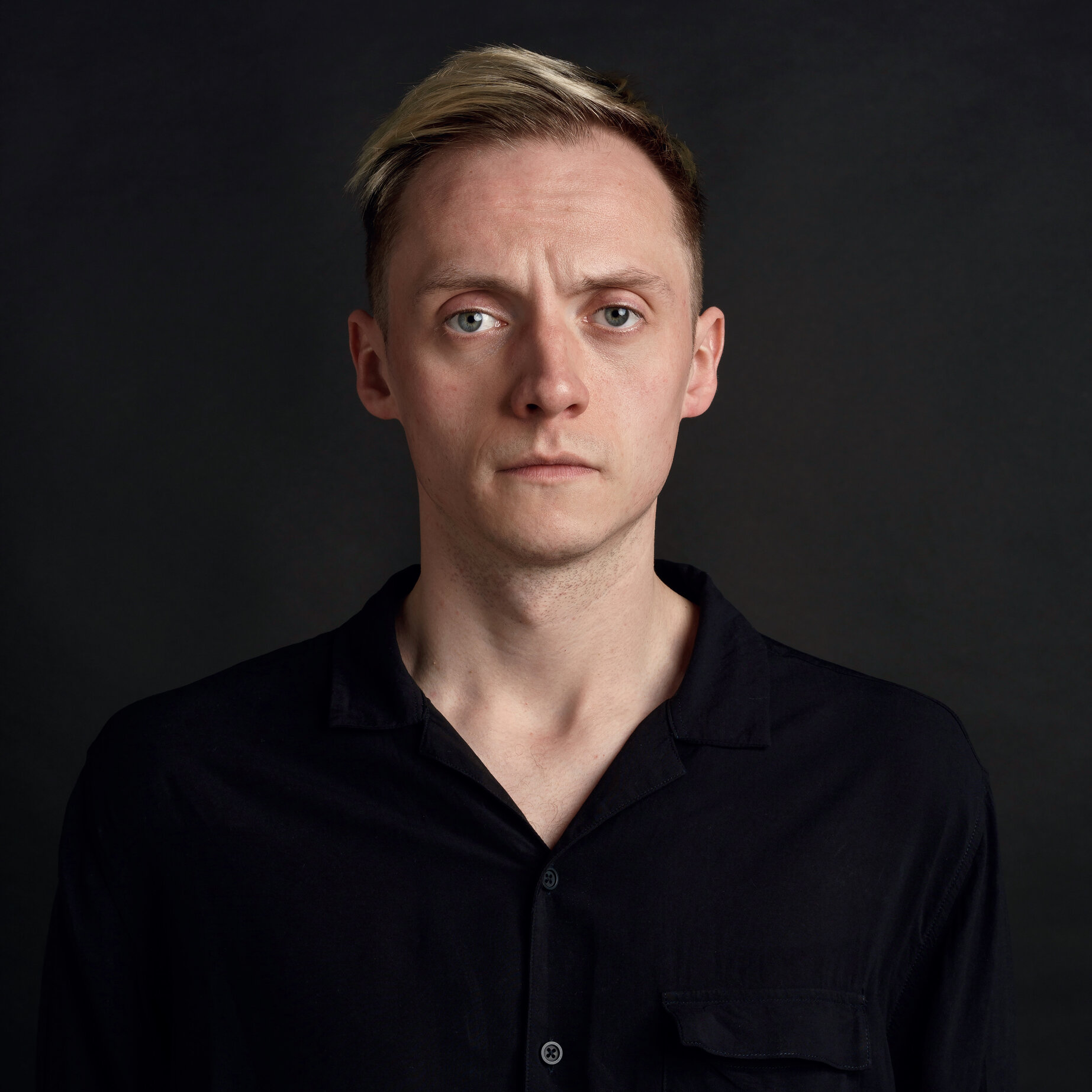
One third of that trio is in the above picture, playing acoustic guitar. He is Peter Morén, and together with Jonas Thorell on bass and Magnus Olsson on drums, they are The Swedish Band who have just played an 18-date European tour with Robert Forster which took in Stockholm, Copenhagen, Hamburg, Berlin, Dresden, Vienna, Linz, Landsberg, Frankfurt, Cologne, Brighton, Cardiff, London, Manchester, Dublin, Edinburgh, Glasgow and Leicester.
The Glasgow venue was St Luke’s, a converted church in the east end of the city which is now up there with the Barrowlands as my favourite location in my home city, and the gig took place last Saturday. And in a year when I’ve been at numerous live shows, with a few more lined up between now and the end of December, this will prove to be the most enjoyable and fun.
Fun? At a Robert Forster gig? Surely not, given this is a man who over the decades has regularly had the word ‘aloof’ used by numerous writers and journalists to describe his personality. I prefer to look on him as being an intellectual with a dry sense of humour that often borders on the deadpan to the extent that you can’t be sure if he is being serious or satirical, all of which was very much on display during a show that lasted not too far short of two hours.
Robert Forster is now 68 years old and has been making great music since 1978, when the members of his Swedish Band were either not born or were mere infants. The Australian is no stranger to Glasgow, having come here back in 1980 to stay for a short time and release a single with the Go-Betweens on Postcard Records, and he repeatedly expresses his love for the city. As such, he always seems to come here whenever he goes out on tour, whether he is playing solo, as a stripped down duo with his son Louis, or with a fully fledged band. And even though there was the occasional moment when the great man, who doesn’t use any sort of prompts, got a line or two wrong and, in one instance, forgot the lyric altogether, I will not hesitate in saying that this time round, it was as good as it’s ever been,
This is down to a couple of things. One being the quality of songs that were played and the other being how tight and talented the backing trio were.
The Swedish Band came together in 2017 when Peter, Jonas and Magnus played five shows, as Robert’s backing band, in Scandinavia, the idea having been hatched by Peter. The shows were a huge success, and Robert has since said that it gave him a whole new impetus for recording and touring in the future. Then came COVID….and then came the diagnosis of cancer for Robert’s wife, Karin Baumler. The cancer was beaten, and while Karin was recuperating, Robert wrote and recorded a new album, The Candle and The Flame (2023), with many of its songs reflecting on that difficult time for his family. As part of the tour for the album, Robert was looking to return to Stockholm in August 2023 for what would be a solo acoustic show. Peter got in touch and suggested that the 2017 band get together again as a one-off. The show proved to be such a success and such a memorable experience for Robert that he flew home to Australia with a new plan hatching away in his head.
In September 2024, he returned to Stockholm, this time to record a new album with The Swedish Band, and a handful of other locally based musicians on keyboards and wind instruments, while additional vocals would be added later by Karin Baumler in a studio in Brisbane.
The fruits of their labours were released as the album Strawberries earlier this year, with this September/October tour being part of its promotion. Robert had said prior to going on the road “I am enormously excited to be touring with a rock band again. The first time in six years. And not just any rock band – these are the genius Swedish players from my new album ‘Strawberries’, recorded in Stockholm. I love the album and I wanted to bring the group with me out on the rock and roll highway. We are wanting to impress.”
Well, Robert (not that you’ll be reading this!!), as a collective you most certainly did.
The set consisted of 21 songs, of which six can be found on the new album. Five others were from earlier solo albums, while the remaining ten came from the Go-Betweens era – four from 16 Lovers Lane (1988), one from Spring Hill Fair (1984), two from The Friends of Rachel Worth (2000), one from Liberty Belle and The Black Diamond Express (1986), one from Bright Yellow, Bright Orange (2003) before finishing the night off with a magnificent rendition of 1978 single, People Say.
It was everything that a long-time fan could ever have hoped for. The Swedish Band were, as you’d expect, magnificent on the songs you’ll find on Strawberries, but they more than did justice to the past members of The Go-Betweens throughout the night, as well as bringing a fresh energy and vibrancy to Robert’s other solo material. It all added up to a night that will live long in the memories of those of us lucky enough to have been there, including quite a few members of the Glasgow indie cognoscenti who came along to pay tribute to our rock and roll friend.
Highlights? All 21 songs. From the new album, there’s this near eight-minute opus, whose origins were revealed to be when Robert last came to Glasgow, arriving on a train from London….and then the next day finding himself in Edinburgh while an international rugby match was being played between Scotland and Ireland.
As for the ‘cover’ versions….an impossible task in many ways to narrow it down to one, but when I closed my eyes during this one, I could have sworn The Go-Betweens had, by way of a miracle, reformed for a few minutes.
I took my leave of the venue and offered up a silent prayer to a non-existent god that Robert Foster and His Swedish Band will be working together and touring again next year. Fingers and toes are crossed.
Quite often, when a band releases a song in two parts, it’s down to the fact that it is too long to fit onto one side of a 7″ single, and so as part one fades out, you have to flip the single over and part two usually fades in.
Not in this case.
Poor Old Soul is about two-and-a-half minutes in length. As is Poor Old Soul (Pt 2). It’s a tune propelled in the main by its bass line, albeit there’s the sort of guitar ‘solo’ that was beginning to be associated with the band. The ‘A’ side also has a wee bit of piano in the middle. The biggest difference however is that Edwyn Collins, having written the song, fancied contributing the bass line rather than rhythm guitar, and so he and David McClymont swapped instruments for the take which became Part 2, with the other more distinguishing factor being that inclusion of the chant ‘no more rock and roll for you’.
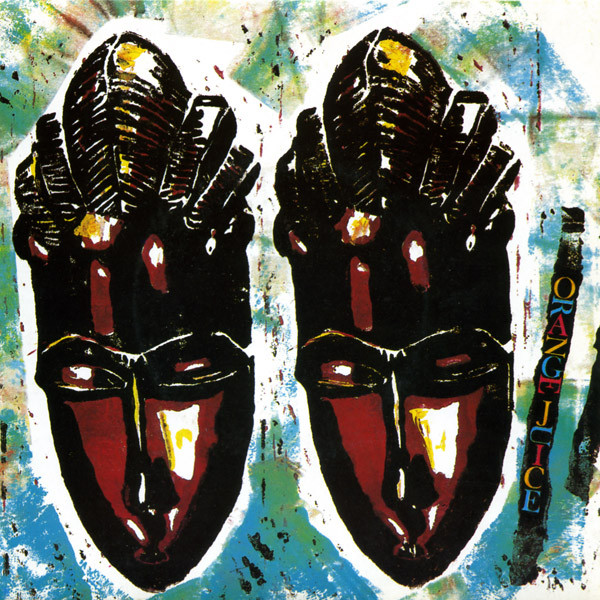
Did anyone feel cheated? I don’t think so, although it was unusual not to have a distinct b-side as opposed to a different take, recorded in the studio on the same day. It was released in February 1981, and included on the back of the newly designed company sleeve was info on the upcoming releases, which were set out as
81-3: Aztec Camera : Just Like Gold/We Could Send Letters 81-4: Josef K: Sorry For Laughing/Revelation (recorded in Bruxelles for Les Disques de Crepuscule (TWI 023) 81-5: Josef K Chance Meeting/Pictures of Cindy 81-6 : Orange Juice – Wan Light/You Old Eccentric
The first three would be issued, but before the summer was over, Orange Juice had signed to a major label, Polydor Records. The big-time beckoned…..or did it?
Tiny bit of a cheat this week, as all I have on The Girl Who Cried Wolf is are two digitals download, from all the way back in 2020, which I later picked from the vaults via my membership of Last Night From Glasgow.
The duo of Audrey Tait and Lauren Gilmour have been involved in the local music scene for many a year. I first became aware of Audrey when she was part of Hector Bizerk, a Glasgow-based hip-hop act whose debut Nobody Seen Nothing was shortlisted for the Scottish Album of the Year in 2014, although the record itself wasn’t one that appealed to me. She was later to become the drummer with Broken Chanter, playing on the first two albums and being part of the touring band between 2018 and early 2022. She took her leave of Broken Chanter when she was asked to become the new drummer for Franz Ferdinand, replacing the founding member of the band, Paul Thomson.
Lauren Gilmour is a singer-songwriter and producer who I first noticed when she was part of Broken Chanter’s six-piece touring band in 2021/22 for the album Catastrophe Hits. What I never knew until looking further into these downloads is that the two were The Girl Who Cried Wolf, whose intention in making music together was to ‘combine a love of fierce female vocalists and anthemic production to create their own brand of powerful alt pop.’
There were a number of digital releases in 2019 with this being the third single:-
I’m wondering if their plans, like those of many others, were affected by the COVID pandemic, as it would certainly have put an end any thoughts of live shows to promote the music. And with Audrey now ridiculously busy with FF, I’m guessing there is no time available to revisit things.
There’s been a few lengthy pieces these past few days…this series allows a bit of breathing space.
A great all-time song under two minutes in length has to be Career Opportunities, one of the many classics to be found on the debut album by The Clash. For a wee change, I thought I’d offer up the demo version, as included on the box set The Clash on Broadway
Back in the late 70s, there were far fewer places available to enable school-leavers to go into further or higher education. The offer of the office or the shop or factory was what came the way of most….the luckier ones may have got an apprenticeship. No wonder so many ‘kids’ of a certain age listened to this and came to the conclusion that The Clash ‘got it’.
A guest series by Fraser Pettigrew (aka our New Zealand correspondent)
#8: Spiral Scratch – Buzzcocks (1977)
While a series on EPs would not be complete without it, what can I possibly write about Spiral Scratch that hasn’t already been said? It is probably the subject of more column inches than any other EP in music history, weighted with significance that puts a price of more than £200 on some copies offered for sale. To those who still hold an original purchase from 1977 it is almost priceless.
I do not possess an original copy. Mine is the 1979 reissue, by which time the record had already acquired legendary status. Its reputation was built primarily on its self-published status: not the first punk single, but the first to be released on a newly-created, independent label with no distribution deal with a major company. It was seen to embody a quintessential DIY ethos in punk by rejecting conventional music industry pathways. The music seemed almost secondary.
To those of us who were Buzzcocks fans, however, the reissue was a worthwhile purchase because it was the band’s first release and the only record of Howard Devoto’s involvement as lead singer (apart from the similarly hard to find Time’s Up demo bootleg). By early ’79, Devoto had of course long-since departed the band and built his own place in the history of post-punk as the lead singer of Magazine, an altogether different project already onto its second album.
Buzzcocks without Devoto had also produced two albums by this time for major label United Artists, working in the studio with seasoned producer Martin Rushent, all a far cry from the circumstances in which Spiral Scratch was recorded. The Buzzcocks sound that I was familiar with was therefore rather different from that of Spiral Scratch which is understandably rougher and cruder than the albums.
I recently came across an article on the making of Spiral Scratch that, whilst it’s nearly ten years old, may be unfamiliar to some and is worth a read, even if you’re not a hardcore audio tech buff like the site’s primary readership. It’s also worth reading the brief memoir by engineer Phil Hampson on which the Sound on Sound article is based.
Hampson was the engineer at Indigo Studios in Manchester responsible for recording the epoch-defining EP on 28 December 1976. He is uncredited, while Martin Hannett (as ‘Martin Zero’) is listed as producer, but Hampson’s account makes clear that Hannett’s contribution was far from expert and more in keeping with the amateur DIY ethic that Spiral Scratch came to represent. Hannett’s experimental curiosity carried through into his subsequent production career, but it was more of a hindrance than a help in getting the Buzzcocks down on tape.
Hampson’s story reveals the tragi-comic fate of the master tape. The band couldn’t afford to buy it (and possibly didn’t appreciate its future worth) so it was simply put back in the rack to be re-used. Indigo Studios were directly across the road from the old Granada TV studios and were frequently used by various comedians and variety acts from Granada shows to record songs, skits and novelty tunes. Nobody knows who finally recorded over one of rock’s most famous master tapes, but Hampson offers up the prospect of Little and Large as the notional agents of bathos.
The other interesting viewpoint from Hampson is that the supposedly ground-breaking innovation of the EP’s independent release is somewhat overstated. Hampson says he himself worked on many self-published and pressed records in the years prior to Spiral Scratch and that the practice was not uncommon. I can see his point, but from his description it would seem that most of these ‘independent’ recordings were either private or vanity pressings and rarely if ever intended for commercial release and sale. Spiral Scratch was made to be sold like a ‘proper’ record, and it was the catalyst for dozens of similar ventures in the years that followed. In that respect its reputation is safe.
The enduring popularity of lo-fi indie guitar bands has helped to prevent Spiral Scratch sounding dated after nearly fifty years. The witty sophistication of Devoto’s lyrics contrasts with the stereotype of punk oafishness, and Pete Shelley’s enthusiasm for krautrock bands like Can and Neu married to The Ramones’ buzz-saw guitar sound undoubtedly helps the compositions avoid the clichés of fast and dirty rock’n’roll or the gormless crudity of many contemporaries.
Well, that’s another 700 words to add to the ledger. Time’s never up for this EP and people will still be writing about it in another fifty years’ time, but I won’t be around to read it.
In 1973, The Byrds broke up just so they could reform. The original line up of the Byrds were working together once again, all five founding members in the same studio for the first time since 1966. Gene Clark, Roger McGuinn, David Crosby, Chris Hillman and Michael Clarke. McGuinn had continued the band after all the other members had drifted away. No less than 11 full time musicians had passed through their ranks.
While the reunion was in the planning stages, a makeshift version of the band was finishing touring commitments. Consisting of McGuinn, Hillman (who had returned to replace bass player Skip Battin, who had replaced John York, who had originally replaced Hillman), guitarist Clarence White and session drummer Denis Dragon (Beach Boys alumni). The touring group had come to be known as The Colombia Byrds, which was the name of the record label to which they were signed. The reunion album was to be released on David Geffen’s Asylum Records who pulled an interesting copyright swerve by crediting the release to the individual members and was given the title ‘Byrds’ (clever work David).
Perhaps the last thing that the Colombia Byrds recorded in the studio was a track on Skip Battin’s solo record. Captain Video was actually a petulant swipe at Roger McGuinn, made even more cheeky by Battin asking McGuinn to play on it.
The song is a lovely slab of 1970s rock. During his time in the Byrds, Battin had taken a few lead vocals, if the record company had the foresight to market this as a Byrds song, it could have been a hit.
Imagine now that you’re watching a movie… It’s a sequel and at the start of that movie there’s a montage of everything that happened in the last film. Well, that montage goes like this; The reunion album flops, the band go their separate ways, Gene Clark records the finest Cosmic American Music album of all time called No Other. McGuinn pals around with Dylan, Crosby pals around with Stills and Nash and cocaine, Hillman thinks ‘I’ll have some of that’ and forms the Souther, Hillman and Furay band. When everyone stops laughing at Hillman he teams up with McGuinn and Clark for some live shows. The shows are well received, not least because promoters sometimes bill them as The Byrds or From The Byrds. This leads to McGuinn, Hillman and Clark recording a couple of records together….. The records aren’t amazing but do give us Gene Clark’s stellar Backstage Pass
Back to the montage; Clark’s drinking gets in the way of McGuinn and Hillman being average and after one record without Gene they all go back to middling solo careers. Gene Clark starts to see his name mentioned by the likes of the Bangles and other 80s jangle populists.
1985 finds Gene Clark a little washed out artistically. His latest album, Firebird had dubious re-recordings of two Byrds songs that even sound dated at the time of release. Although Blue Raven can’t be ruined by the ropey 80s production…
After the Byrds reunion, a stint in Firefall and then a temporary retirement, Michael Clarke found himself drumming in Gene Clark’s backing band. Billed as Gene Clark and the Firebyrds, they land a gig, supporting a reconstituted version of The Band.
It was during the Band tour that Clark and Clarke hit on the idea of putting the Byrds back together for a 20th Anniversary celebration.
McGuinn, Crosby and Hillman weren’t interested…. But do you know who was up for it? John York And Carlos Bernal! Bernal had replaced Hillman on tour before York joined full time. Why have one bass player when you can have two!
Joined by Rick Roberts, who was Gram Parson’s replacement in the Flying Burritos, Blondie Chapman, who had been in the Beach Boys and Rick Danko of the Band (that makes THREE BASS PLAYERS!), they went out billed as A 20th Anniversary Tribute to the Byrds.
Now, that might be a long title but promoters were honest and didn’t just shorten it to the Byrds and advertise it as a reunion. Jokes, of course that’s what they did. To be fair, the press and promoters didn’t always bother with the distinction between the Byrds and the McGuinn, Hillman and Clark band so why should this be any different?
Certainly this TV Telefon appearance doesn’t care to acknowledge them as anything other than the Byrds; The line up here is Clark, Clarke, York and Bernal with Billy Darnell on lead guitar.
Although it should be pointed out that some outlets did advertise the group correctly. Not that anyone cared….
(Poster for a show in 1985)
Regardless how they were billed, that’s a pretty stellar line up. Some nights Richard Manuel of the Band would also join in. When they were supported by the Flying Burrito Brothers there was a tendency for the gig to become a massive jam as Skip Battin, former Byrd and then current Burrito would play with both bands (FOUR BASS PLAYERS!)
For clarity, John York would play a 12 string Rickenbacker guitar… just for the sound recreation and definitely not to try to fool people into thinking that Roger McGuinn was on stage.
The group played multiple dates over the next year or so, with a fluctuating line up of everyone mentioned plus Gregg Harris (Burritos) Jim Goodall (Burritos) and Nicky Hopkins (Quicksilver Messenger Service)… Plus whoever else from the old scene who dropped by.
It seems the concerts would start with duos or trios of performers playing sets from their respective Beach Boys, Band, Burrito careers before finally swelling into a Byrdsian tribute that included a brief solo set by Gene. On paper that that sounds awesome, right? However, reviews were mixed and I don’t say that to be kind, some nights the band could be absolutely knock out and the next they were total dogshit. That’s what happens when you put alcoholics together; Poetry or Puking.
Since the project was a live tribute act there was never really any plans to record and album. However the nucleus of the band would record some demos together; Gene Clark along with York, Darnell, Hopkins and a chap called Pat Robinson went on to record together in an outfit called CRY. These songs were issued in 2001 as Under the Silvery Moon.
The pick of these tracks is probably the York penned (and co-vocal) You Just Love Cocaine
There’s a few live albums, bootlegs and such that have turned up on youtube over the years. A semi official DVD just credited to The Byrds; Never Forgotten was released. It seems the band were decent when they weren’t drunk.
The official word from McGuinn and Crosby was that they weren’t happy, however McGuinn was diplomatic saying ‘Gene has to earn his living as a musician.’ After a few more months of touring, Clark recorded the amazing So Rebellious a Lover with Carla Olson. Their take on John Fogerty‘s Almost Saturday Night is probably the definitive version. In spite of the cult success, he kept up the Byrds shows. By 1986 Mike Clarke had quit the group; his departing comment is noteworthy;
“We tried it for a year and it didn’t really ever approach the big time. It’s kind of a copy band. I think the band should be put to rest. I think Gene should do something else. He’s very talented, he deserves something of his own to be successful.” Michael Clarke 1986.
In 1988, Gene had to have surgery due to a serious ulcer issue, it was around this time that he stopped using the Byrds moniker for his shows. It was also around this time that Tom Petty covered “Feel A Whole Lot Better” on his 5x Platinum solo album Full Moon Fever. It’s probably a coincidence that the sudden increase in royalties coincided with Gene giving up the nostalgia circuit. Interestingly Clark was also rather despondent about using the name The Byrds for five years continuously.
“I really wasn’t comfortable having it be the Byrds. When I got things back on the road for my own solo career, I figured if the other guys don’t want me to use the name, then I don’t think it’s the right thing to do.” Gene Clark 1989.
A recuperated Clark went out on the road once more as Gene Clark and The Firebyrds, it seemed like the legacy of the ‘not really’ Byrds would come to an end.
Steve Green, of Artists International Management in Boca Raton is a name you’ll hear in connection of a lot of ‘New’ bands; including The New Steppenwolf and various line-ups of Iron Butterfly. Green and Michael Clarke became acquainted in early 1988 and by the summer The Byrds Featuring Michael Clarke were on the road (probably just a coincidence).
(Press shot for The Byrds Featuring Michael Clarke)
McGuinn’s patience was tested to the limit (although that’s some brass neck from the man that gave the world Moog Raga).
“First Gene went around with a very, very bad band, calling it the Byrds. Well, okay. Gene was one of the original writer/singer guys and I thought that, though the band was awful, he had as much right to claim the essential part of the Byrds as anybody else. But when it gets to be Michael Clarke the drummer who never wrote anything or sang anything, going out there with an even worse band, and claiming to be the Byrds, at times even advertising themselves as the ‘original’ Byrds, and they can’t play the stuff. What they were was a bunch of drunks out there trying to make enough money to get to the next bus stop. It was dragging the name in the dirt.” Roger McGuinn, Spin Magazine 1991
For the bloke who signed off on a cover version of ‘We’ll Meet Again’ he’s got a pretty strange take on dragging names in the dirt.
But Clarke couldn’t give much of a shit. Once again recruiting the likes of Skip Battin or Carlos Bernal or John York, they were titled many things including The Original Byrds; The Byrds, A Celebration or Michael Clarke’s Byrds. Newcomers Terry Jones Rogers and Jerry Sorn filled out the ranks.. Again, reviews were mixed. They did put on some very good shows. Sometimes local promoters would leave the E off of Clarke’s name to create confusion as to who was in the band.
In 1990, Do-It Records put out a live album in Germany called Eight Miles High, Live in Germany 1989. The record was simply titled The Byrds. Some versions had the 1970s line up on the sleeve. In later years the band dismissed it as a bootleg but the sound quality is above average for such a venture.
McGuinn, Hillman and Crosby tried to take matters to the court. A band-name trademark dispute is a hard one to win. A defendant would have to prove that punters didn’t know that they were buying tickets for Michael Clarke’s Byrds. Plus the law would need multiple examples not to consider any wrong billed shows as a ‘mistake’. Then they’d have to prove that the shows were so bad that they somehow damaged the trademark AND reputation. They’d also have to prove their rights to the trademark. Yikes!
Judges aren’t too good at recognising artistic arguments, they tend to see bands as a business partnership. Clarke’s legal defence was simple; He was a founder member who was hired to be a face in the band because he looked a little like Brian Jones of the Rolling Stones. When he left the band’s sales had dropped significantly (this is true since Sweetheart of the Rodeo bombed). McGuinn had used the name The Byrds for years long after the other original members departed and the name had been abandoned after the 1973 reunion.
Cruicially, Gene Clark (with Clarke) used the name with little or no detriment to the brand between 1984 and 1988. District Judge William Castagna didn’t take long to rule against the preliminary injunction that McGuinn and co sought mainly on that point. Namely, they couldn’t prove that Clarke’s actions would harm them artistically or financially.
The remaining Byrds concluded that it would be a large dollar outlay for a trial they couldn’t be sure they’d win. To make sure they had some legal rights to the name; McGuinn, Hillman and Crosby played some shows as ‘The Byrds’ and recorded some new stuff for a boxset while Michael Clarke registered various Byrds trademarks. All five members would appear together at the Rock and Roll Hall of Fame in 1991 and shortly after that Gene Clark passed away from ‘natural causes’ (throat cancer, drinking, drugs, bleeding ulcer… Take your pick)
Clark kept his version of the band on the road pretty much solidly for the next two years or so and then followed his old pal Gene into the afterlife due to liver problems from years of sustained alcohol abuse.
And here ends the tale.
JOKE! The Byrds became the brand that just wouldn’t die…. Like WH Smiths or Wimpey. In 1994 Skip Battin along with Terry Jones and Scott Nienhaus got back out there, now being billed as The Byrds Celebration. They licensed the name from Michael Clarke’s Estate and their press release rather ironically spoke about ‘Keeping Michael Clarke’s legacy alive’.
“We lost the legal rights to the band name about five years ago, when we sued Michael Clarke’s band, and the judge favored him because he was using it and we weren’t. Then he (Michael Clarke) died and left it to somebody. I don’t know who has got it now, but they have the legal name . . . which is, you know, stupid, but that’s the way it is. “ Roger McGuinn – Guitar News Weekly 2000
On the surface calling the band The Byrds Celebration absolutely makes it clear that this band was not the Byrds but a tribute to the band. However, promoters (and perhaps the band themselves) knew that this would be open to interpretation. If written in a specific way on a poster it could indeed look like it was The Byrds;
(Poster for The Byrds Celebration Tour… sneaky!)
The poster, which includes press materials provided by the band is at odds with the party line that was towed in interviews
“We just try to bring Byrds music to the people. We don’t pretend to be the original band.”Terry Rodgers, Full Circle Fanzine May 1996
According to an issue of Pollstar from 1998, Byrds Celebration were still being represented by Steve Green’s Artists International…. Gene Parsons, who was in the Byrds between 1968 and 1972 was a member of the Celebration for a while and adds a little more legitimacy to the group. They tour internationally, recording a decent sounding gig for Dutch cable TV. Click here for a link to an hour-long footage.
Before long Parsons was replaced by Vince Barranco. Once again the band would be erroneously billed as just The Byrds. Battin retired in 1997 but even then the remaining members carried on. In 2002 David Crosby, the Byrd member with the most money, purchased the legal rights from Clarke’s family and forbade the Byrds Celebration from using the name. Terry Jones and Scott Nienhaus saw the error of their ways…… For about a week and a half….. By 2001 they were touring a show called Younger Than Yesterday, Featuring former members of The Byrds. Their website prints this legend;
“Terry Jones Rogers was invited to join The Byrds when they reformed in 1988, by Michael Clarke, the original drummer. This led to a long association with The Byrds, as Terry fronted the group on its national and international tours.” Younger Than Yesterday Website
While it’s clearly bullshit it’s also not a lie. Language is weird. As of today, Rogers and Nienhaus still tour as YTY and once again it should be stated that they put on good shows. Probably better shows than they did with the unpredictable Michael Clarke on drums. Battin died in 2003, Crosby died in 2023. With Crosby’s passing, the rights to the Byrds name is reportedly in the hands of McGuinn.
There’s one last postscript to the stolen Byrds. Well actually, it’s a side script. In the mid 1990s there was a selection of budget CDs released as The New Byrds. It was mainly assumed that they were the product of the Byrds Celebration members but all things come out in the wash. Danny McCulloch was a member of Eric Burden’s Animals in the 1960s. In the 1980s he re-recorded Animals songs for the budget record label, K-Tel. Packaged under the name The Animals. It proved to be relatively lucrative. Then he offered the public an album of Mott The Hoople songs, claiming to be re-recorded versions by the original members. K-Tel supposedly paid 75k for the Mott album. He also did it with Steppenwolf and The Byrds. In the end K-Tel got done under the Trades Description Act but not before making a good few quid out of drunks who bought CDs from all-night-garage-windows at 4am in the morning. It’s literally what Half Man Half Biscuit were singing about.
K-Tel would reissue McCulloch’s Steppenwolf / Mott / Animals / Byrds songs as soundalike albums under the banner the Trybe. McCulloch would return to the Animals in the mid 2000s with John Steel’s band; Animals and Friends.
A lot of time has passed and the fans seem to be no longer in their entrenched camps of the Byrds vrs Byrds saga…… So much so, even the band of the 80s is now remembered with fondness (like those Rolling Stones fans who hanker for the glory of the Steel Wheels tour). Personally, I’d have loved to have seen Clark, Clarke, York, Bernal, Battin, Danko, Chaplin, Manuel and Roberts’ Byrds band. What a show!
As a peace-loving lefty, I’m a bit of a sucker for anti-war songs. However, I’ll always make an exception for this effort by Culture Club, which entered this week’s chart at #3.
There’s a quite hysterical fan review of this one out there on t’internet.
Jet Black doesn’t even play on this. No shit, you say. Only too aware – as you’ve always been – of that hideous midi drum sound, that cripplingly leaden and synthetically even rhythm section. Doesn’t even feel like JJ’s there either. And although Dave does fiddle and twiddle, all we’ve really got is a vehicle to resolve a massive cocaine tab run up in the preceding X number of years. Gross. Cornwell croons, crunes and krewnes away to himself about the lack of loyalty friends show us. For “friends” read “fans.” They were deserting the band by the thousands at this point. Not that it stopped them having some minor chart success, however. No – the damage was done elsewhere. At gigs, mainly. God they sucked ASS live at this juncture. Brass. Haha!! A fucking BRASS section though. GMAFB, asshats.
The other new entries this week belonged, among others whose names now mean nothing, to Paul McCartney, Bruce Springsteen, Meat Loaf and ZZ Top. Thankfully, Ben and Tracey, with a little help from Johnny, helped ease the pain
The duo’s third and best Top 75 single of 1984, but their poorest-performing in terms of sales.
7-13 October
Another week in which the highest new entry, Freedom by Wham!, came in at #3, which only goes to show how many people were still buying the truly atrocious I Just Called To Say I Love You which was spending a sixth week at #1.
Paul Weller had clearly decided, in terms of the way pop music was sounding in 1984, that if you can’t beat them, then join them.
I’ve always had a lot of time for The Style Council, and this anthemic, upbeat politically-charged number remains a favourite from the era.
The next highest new entry at #20 came from Paul Young, trying really hard to prove that his annus mirabilis of 1983 hadn’t been a fluke. I’m Gonna Tear Your Playhouse Down, whose title sounded like some sort of threat to Edinburgh’s premier concert venue of the era, was a cover of an early 70s soul song. It would peak at #9, which after the three Top 5 hits of the previous year, was an indication that his star was on the wane.
There genuinely is nothing elsewhere that was new in this week’s Top 75 worth mentioning.
14-20 October
Back in 1984, I didn’t mind the two highest entries this week, but time hadn’t been kind whatsoever to I Feel For You by Chaka Khan and Love’s Great Adventure by Ultravox, but both seem to remain staples of the type of radio stations specialising in the songs from yesteryear.
Spandau Ballet and Lionel Ritchie were the two other who cracked the Top 40. There really was a distinct lack of guitar-based pop songs. Thank gawd for the goths
This turned out to be the lead single from their debut album, First and Last and Always, albeit the LP didn’t hit the shops until five months later in March 1985.
21-27 October
I’m going to start at the bottom end of the chart this week as it feels appropriate
The farewell single. One that will be covered in due course as part of the new(ish) series on the singular adventures of Edwyn Collins. Elsewhere, the airwaves of the nation’s radio stations continued to pump out all sorts of aural pollution. I’ll make an exception for this new entry:-
mp3: Status Quo – The Wanderer (#23)
As if.
28 October – 3 November
The highest new entry came from Duran Duran whose Wild Boys tested the water at #5 when everyone involved with the band – musicians, management and record label alike – were very confident, thanks in part to the spectacular and expensive promo video, of it coming in at #1 and staying there. In the end, it stalled at #2, unable to shift Chaka Khan from the top spot in mid-November.
Iron Maiden had the next highest new entry with Aces High (#32). Not a song I have knowingly ever heard.
Don’t know about the rest of you, but it stunned me to realise that this new entry at #32 was the thirteenth Top 40 hit since 1979 for Gary Numan. When I looked at the chart rundown in preparing this post, I assumed it was some sort of comeback single after a few years away.
There was another Top 50 hit, their sixteenth all told, for Siouxsie & The Banshees when The Thorn EP came in at #47 in last week’s chart and found itself at #48 this week. It’s an EP I can’t recall from back in the day. Here’s wiki:-
The purpose of the EP was three-fold: Siouxsie stated that she wanted to induct new guitarist John Valentine Carruthers into the Banshees, to try out some string arrangements, and to simply re-record tracks that had evolved on tour. The Thorn features four of the band’s tracks recorded with orchestral instrumentation: “Overground” originally appeared on the Banshees’ debut album The Scream; “Placebo Effect” was a song from their second album Join Hands, while “Voices” and “Red Over White” were previously released as B-sides from the singles “Hong Kong Garden” and “Israel”, respectively.
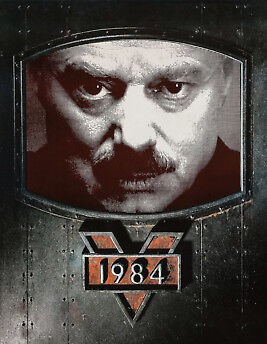
The logo for this series is taken from the film poster for the film of the George Orwell novel. The movie was released in October 1984, having been filmed in April-June 1984 which was the exact time that Orwell had set the story. Eurythmics, one of the biggest selling pop bands of the era, came on board to compose a soundtrack album for the film, totally against the wishes of the film’s director, Michael Radford who was keen to use the orchestral score that had already been written and recorded by Dominic Muldowney.
The dots are easy to join. The film was a Virgin Films production. Eurythmics were on Virgin Records (fake news!!!!…as Conrad points out, they were on RCA).
The duo of Annie Lennox and Dave Stewart were kind of caught in the cross fire of the subsequent row between the director and the production company. They had to issue a statement which said they had no knowledge of prior agreements between Virgin and Radford/Muldowney and that they had accepted the offer to compose music for the film in good faith. The soundtrack album (on Virgin, despite the dup being contracted to RCA) did go Top 30 and this single went all the way to #4.
I thought that with the most recent midweek posts having come from New Zealand, Germany and the USA, I better get my arse in motion and offer up something of my own. Been sitting on this one for a wee while, just waiting on an appropriate Monday morning to post it.
Sometimes an album is such a bona fide classic that the temptation is there for the artiste and record label to issue almost all the songs as singles. Michael Jackson and Epic Records never had any qualms – Off The Wall (1979) contains ten songs, of which seven were made available in the USA either as A or B sides of single releases, while its remaining three songs happened to be issues in the UK as A or B sides of singles; follow-up album Thriller (1982) had nine songs, with seven of them being issued as singles, all of them going Top 10 in the USA.
Fast-forward to 1995-96 and the era of Different Class, the fifth studio album from Pulp.
The band had taken a long time to get any sort of commercial success – the debut single dated from 1983 and it had been fully ten years before they had anything break into the Top 50 of a singles or albums chart. Things changed a bit with Lipgloss (#50), Do You Remember The First Time (#33) and the Babies EP (#19) along with His’n’Hers, an album which entered the charts at #9 in the first week after its release in April 1994,but in what would prove to be a 55-week stay in the charts would enjoy just one more week inside the Top 30.
Common People, released on 22 May 1995 was one of the things that took the band into a new stratosphere. It came in at #2, denied the top spot by Robson & Jerome‘s cover of Unchained Melody – another in a long line of examples of TV actors enjoying huge success when turning to music.
The other was on the evening of Saturday 24 June 1995 when Pulp headlined Glastonbury, having only been booked late on to replace Stone Roses who had to pull out when guitarist John Squire broke his collarbone in a cycling accident. Those at the festival, and the millions watching on BBC TV, saw a performance for the ages and after years of struggle, Jarvis Cocker et al. were an overnight success.
A double-A side follow-up, Sorted For E’s and Whizz/Mis-Shapes, released on 25 September 1995, also came in at #2, kept off the top by one of Simply Red‘s abominations. The album Different Class was in the shops in late October and the new chart in the first week of November 1995 saw it at #1, and it would spend the next 28 weeks in the Top 20.
Another of the album’s most popular songs, Disco 2000, was issued as a single in late November 1995 and reached #7. Four months later, in late March 1996, Something Changed became the fifth song from Different Class to be released as a single – and it was backed by a remix of F.E.E.L.I.N.G.C.A.L.L.E.D.L.O.V.E., yet another song to be found on an album that was now ten months old – and still it went to #10.
In an era of multi-formatting, with singles coming out on vinyl, cassette and at least 2 x CDs, of the twelve songs to be found on Different Class, seven could be found in some shape or form on a single (Underwear had been the b-side to Common People). But such was the popularity of Pulp in that era, that any of those five remaining songs would likely also have gone Top 10 if issued as a single, as none of them could be classed as ‘filler’. Especially the one that was packed with catchy moments and finished off with a dramatic crescendo:-
But with Jarvis increasingly unhappy with all the attention that was coming with this new-found fame, it’s not really a surprise that the tap was switched off after Something Changed, nor that there would be a dramatic switch of musical direction when the next single came out in November 1997.
#3: Simply Thrilled Honey : Orange Juice (Postcard 80-6, 1980)
Postcard Records had come a long way in a very short space of time. The first two Orange Juice singles had been critically acclaimed, likewise the two Josef K singles issued by the label and that of The Go-Betweens. By the time it came to issue the third OJ single, the numbers being pressed were significantly higher than before, with the first 5,000 coming in a sealable polythene bag with the double-sided insert as pictured above. A lot of the monies to support the expansion of the label’s activities came from a distribution arrangement with Rough Trade. And yes, the photo in the bottom right of the back of the sleeve is that of Jill Bryson, then a very close friend of the band but soon to find fame as one half of Strawberry Switchblade.
Once again, it was recorded at Castlesound Studios, but this time Malcolm Ross was on co-production duties alongside the band. I’m not going to suggest that Simply Thrilled Honey is a duff record, but there’s something about it that comes up short in comparison to Blue Boy and Lovesick. In later years, James Kirk (not the Star Trek character), would accept the single fell a bit below expectations, possibly down to the fact that it was one of the band’s oldest and most-played tunes and the studio recording didn’t find the same levels of energy and enthusiasm of the live takes.
It was released in December 1980 and would make the Top 5 of the newly created Indie Singles chart.
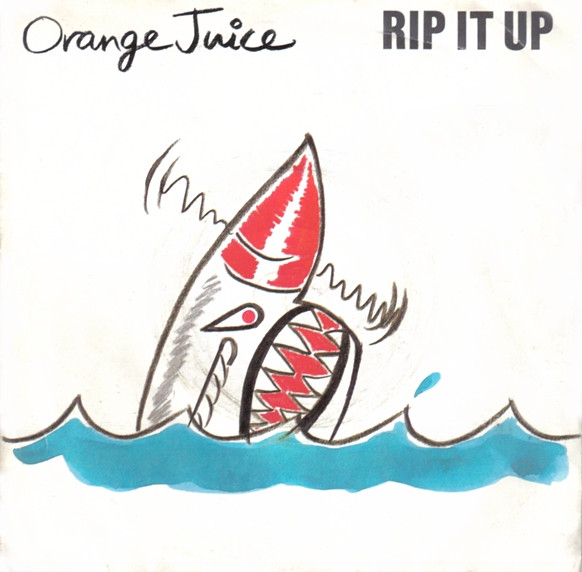
The b-side was a short and angular punky sounding effort, coming in at less than two minutes in length. It would later, in 1982, be substantially re-recorded with some additional and different lyrics and in a cod-reggae style for inclusion on the album Rip It Up, running to more than five minutes in length:-
Nobody knew it at the time, but there would be just one more single for Postcard Records.
JC
PS : AND A VERY LATE ONE AT THAT……
It’s nothing at all to do with music….but it is something that absolutely and simply thrills me. This particular post will appear as I set out on some travels again, and a trip that was arranged at extremely short notice. I’m off, again, to Toronto, for what will be a very short visit – arrive at Sunday lunchtime and fly back on Tuesday evening – for the sole purpose of attending a significant baseball match on Monday for which a ticket was only picked up last Friday night. It’s lucky I’m retired from work and can do things at the drop of the proverbial baseball cap, and also that I have a few pre-prepared posts to keep things ticking over for the next few days. Only downside is that I’m dreading what it’s all going to do to my body-clock…………..
Early 2012. Aidan Moffat of Arab Strap and James Graham of The Twilight Sad announce a collaboration. It’d be a bit of an understatement to say that I was excited by the prospect.
The announcement actually came a few months after the release of a single, Killing This Time, on Rock Action Records (owned and run by Mogwai), credited to James Graham and ‘someone else’, although the talk around the Glasgow music scene was that Aidan Moffat had supplied the music.
The album, These Actions Cannot Be Undone, was released in May 2022. Ten songs….nine of which James takes lead vocal and one on which Aidan does.
Maybe my expectations were far too much, but the album proved to be a bit of a letdown, albeit it has a few moments dotted throughout that act as a reminder of just how talented the duo are. Looking back, I maybe should have realised what was on offer thanks to this extract from an NME interview in advance of the album’s release:-
“I love being in The Twilight Sad, (said James). I’ll write with Andy [MacFarlane, Twilight Sad guitarist] for the rest of my life, but I wanted to see what else I could do, and push it as far as I possibly could, Then Aidan said: ‘Aye, I’ve got some stuff!’”
Moffat had recently finished work on Arab Strap’s most recent acclaimed album ‘As Days Get Dark’. “After a big album with a lot of words in it, I get sick of my own voice, so I tend to retreat a little bit and do instrumental stuff. It was pure serendipity that James was looking to do something that way.”
He began sending music to Graham for him to add vocals, with a focus on pushing boundaries. “We had an unspoken rule, that if we hadn’t done something before we should definitely try it, which is why James is trying all manner of vocal gymnastics”.
New single ‘Face To Fire (After Nyman)’ is based around a thumping dance beat. “It’s reflecting that we both tend to listen to pop music more than people would think,” Moffat revealed. “We have all these ideas that we probably couldn’t do with the other music we make.”
The track, like the rest of the album, constantly shifts in tone – taking in a wild opening riff that recalls AC/DC‘s ‘Thunderstruck’, and a middle section inspired by the minimalist composer Michael Nyman. “When I sent it over to James I thought he’d never go for it!” Moffat admitted. “Then by complete surprise he sent me back the perfect song. It’s always been my dream in life to do an AC/DC-Michael Nyman crossover song about mental health issues. It’s win win all round!”
Thankfully, Aidan returned to full form with Arab Strap’s eighth studio album, I’m Totally Fine With It Don’t Give A Fuck Anymore, released in May 2024 and one of my records of that year. Still waiting on The Twilight Sad issuing a follow-up to 2019’s It Won’t Be Like This All The Time.
a guest series, courtesy of a very friendly lawyer
I don’t know a more indulgent man than our good host. Over the years, JC has posted every random thing I sent him. A series about New York City songs. Another series called Charged Particles where all the song titles end with “ion.” Lots of nonsense about my tenure in a country band. Song Story entries. Interviews with guys who made REM videos. And while the faithful crowd submits lovingly curated imaginary compilation albums by their favorite bands, JC never once objected to my oddball ICAs about trumpets, side projects, days of the week, presidential elections (sob), stellar basslines, songs that bands took their names from, or unconventional instruments. Not to mention my chiming in every day with unsolicited opinions in the comments section.
But, being an incorrigible and pushy New Yorker, I thought, “why not shamelessly take advantage of Jim’s good graces and try to unload even more of my musical BS on him? He knows I’m too lazy to start my own blog–could I get away with hijacking even more of his web space?” I was facetiming with Jim when I threw the idea at him and he didn’t appear to choke on anything or swear at me, even under his breath. Instead, he greenlighted Fictive* Fridays, a platform for yet more of my, er, idiosyncratic musical observations.
So, here goes. Let’s revisit some themes I posted about before, and take a look at some new ones to expect, smorgasbord style:
Charged Particles: Annihilation by Wilco. This is from the band’s most recent release, an EP from 2024 titled Hot Sun Cool Shroud. Trademark Wilco everything: clever lyric, hummable melody, arty guitars, and Jeff Tweedy‘s relaxed, friendly croon over the top.
Trumpets:Burial Ground by The Decemberists. Lead single off the 12ths last album, As It Ever Was, So Will It Be Again. The trumpet arrives around the 2:43 mark, and that’s exactly how Victor Nash played it at LA’s Bellwether when I saw them tour the LP last summer. And, yes, that is the Shins’ James Mercer guesting on background vocals.
Basslines: B-Movie by Elvis Costello & The Attractions. I get that folks don’t care a lot about bassists, but if you’re ever going to pay attention to what’s happening on the low end, this song is as good as it gets. It’s only 2 minutes long, and Bruce Thomas plays about 2,000 notes. And not one is out of place, and nothing in the line is predictable. From the spectacular Get Happy!! album, recorded 45 years ago this month.
Everyone’s Your Friend in NYC: Rockaway Beach by the Ramones. EYFINYC was a series of reminiscences about Gotham co-written with long-time contributor Echorich. We had a fun time collaborating but stopped for reasons I can’t even remember. But I found what was to be another instalment, a bit about specific NYC neighborhoods. Rockaway Beach is part of a long spit of land enclosing Jamaica Bay in southwest Queens county, not too far from the Ramones’ home base of Forest Hills. (Echorich grew up in Queens and I was born there.) There was a wooden boardwalk along the beach that lasted nearly 100 years, until it was unceremoniously destroyed by Hurricane Sandy in 2012. Now the boardwalk is concrete. Some of my earliest memories are of Far Rockaway, where my great-grandma lived. Dee Dee was reportedly the only beachgoer in the band and he wrote the song. I love the couplet “Chewin’ out a rhythm on my bubble gum–the sun is out and I want some.” A banger from 1977’s Rocket to Russia.
What Is That Thing? (weird Instruments): No Surprises by Radiohead. That’s a glockenspiel Jonny Greenwood‘s playing here. Thom Yorke wanted the song to sound like a lullaby, and had Pet Sounds and Louis Armstrong‘s ‘Wonderful World’ in mind when he wrote it. You can YouTube our boy studiously malleting the thing on the Jools Holland show circa 1997.
DIY:Alone+Easy Target by Foo Fighters. DIY songs are–you guessed it–songs where the musician recorded everything by themselves. I’m not the biggest Foo Fighters fan, despite my (and JC’s) drummer Randy being a major fan, but I’m impressed that Dave Grohl wrote all the songs on the self-titled debut album and played all the instruments. This one sounds more like Nirvana to me anyway, which is a good thing.
Wiseguys:Tidal Wave by Apples in Stereo. “Smart people do a lot of things well,” the beautiful Goldie once told me. Robert Schneider founded the Elephant 6 record label, a collective of great American indie bands. In addition to the Apples, whom Schneider fronted, E6 released records by the Minders, Olivia Tremor Control, and Neutral Milk Hotel, whose classic In The Aeroplane Over The Sea Schneider produced. He’s also got a Ph.D. in mathematics and is now an assistant professor specializing in number theory and combinatorics. I met Schneider after a gig many years ago and asked about a song in the set that I didn’t recognize. It was their version of the Beach Boys‘ ‘Heroes and Villains,‘ which, he said, “is the greatest song ever written…yet.”
Who’s That Girl?:Yesterday Girl by The Smithereens. When I was in college I made a compilation tape called ‘Who’s That Girl’ which was a bunch of songs that were all titled “[something] Girl.” I ended up making quite a few of those. When my music collection was computerized I continued putting the songs in a playlist. I thought about doing an ICA, but I didn’t know where to start, since I’ve got literally hundreds of songs to choose from. But this one was an easy call–a straight up power pop classic from the Jersey boys and a favorite of my (and JC’s) lead guitarist Dr. Rigberg. Third single from the band’s 1989 LP, 11.
Jane Says:Captain Easychord by Stereolab. My daughter’s musical knowledge is astonishing. She started a Spotify playlist of songs she thinks I’d like that she adds to periodically. Artists on it include Fundkadelic, Kevin Ayers, Sonic Youth, Les Baxter, Pinback, Hole, Yusef Lateef, MF Doom, Nina Simone, David Byrne, Harry Nilsson, Kings of Convenience, Trembling Blue Stars, plus hundreds of others I’d never heard of. The playlist is about 24 hours long now. How does she know about all this music? I was an early fan of Stereolab but forgot about them until Jane dropped this into the list. From the 2005 compilation LP Oscillons from the Anti-Sun.
He Said She Said:Sometimes Always by The Jesus and Mary Chain. I was wondering how many songs I could think of where male and female singers trade verses. Not duets, mind you, but a straight up back and forth. Other folks think about the Gaza genocide or the Nazification of the US–but I wonder about things like this. I came up with quite a few, actually, but I picked this one–with Mazzy Star frontwoman/LA native Hope Sandoval singing along with the Glaswegians–in honor of my friendship with the Villain.
*JC asked me why I changed my handle from JTFL (Jonny the Friendly Lawyer) to Fiktiv. Not sure why anyone would care, but the answer is simple: I’m not that friendly and I pretty much stopped practicing law. Man, I hate lawyers.
Please stay tuned for more Friday fun.
FIKTIV
JC adds……..
Delighted to have Jonny on board, and despite his protestations, he is indeed a friendly guy, as I can very much readily testify to after he and his amazing wife Goldie hosted myself and Rachel, for more than a week, at their wonderful home in Santa Monica.
And just in case anyone doesn’t understand the references to Randy and Dr Rigberg, they are members of the Dial-Ups, a rather wonderful covers band from Santa Monica who were kind enough to have me become a temporary member one night when I joined them on stage and played cowbell…while I was wearing a Raith Rovers football jersey. A genuinely unforgettable experience.
Jonny, like anyone who wants to offer up a guest posting on TVV, is free to say go anywhere he likes. Strap yourselves in for what should be an epic ride.
# 111: Young Marble Giants – ‘Final Day’ (Rough Trade Records ’80)
Dear friends,
probably I shouldn’t even begin trying to explain the merits of Welsh outfit Young Marble Giants and/or how groundbreaking their only album, ‘Colossal Youth’, was for so many listeners back in 1980. Because, you see, for some it’s an absolute masterpiece, others will tell me to bugger off, as to them it’s just minimalistic nonsense with a severe lack of melody. I mean, those people do have a point: ‘Colossal Youth’ in its entirety certainly isn’t ‘easy listening’ and whether this chap out of Nirvana, Cobain, wasn’t pushing a bit too hard when constantly praising the album as the best thing since sliced bread, remains debatable.
In Germany we even had a band who named themselves after this album, ‘Kolossale Jugend’, pioneers of the Hamburger Schule in 1989 and led by the wonderful Kristof Schreuf, who, alas, died three years ago. Listen to their song ‘Bessere Zeiten’ and you have at least one thing to thank Young Marble Giants for!
But enough of the album, because today’s song isn’t even on it! It was a single, well, one song on a four-track-EP, also from 1980, but what the band managed to come up with within the 100 seconds the tune lasts, is remarkable! The combination of guitar and electronic rumble and Alison Statton’s (who later found fame with Working Week) naïve, genuinely artless vocals make the song so damned special. All of this, plus what she was singing about: ‘the final day’, as the title suggests. Applicable somehow, as this is the ultimate post in this series on TVV, but no, the lyrics were not written for this occasion nor are they about the end of a relationship: the end of the world they are about, not more, not less!
You see, in the early and mid-80s this was rather a hot topic – and back then I would never have thought that I’d have similar fears again some 40 years later. But to my great dismay this is the case: every morning in the bathroom when I open Google News on my mobile, I expect to be confronted with one – or both – of our two genius world leaders on either side of the Pacific having done something (to quote The Primitives) really stupid, something irreversible! Therefore I lately often find myself humming along to below song whilst shaving a few minutes later:
Now, when I started this nonsense (with the Akrylykz – in November ’22, remember?), I thought to myself: ‘well, let’s wait and see what people think, perhaps there will be one or two comments. If not, then you can decide whether to continue or not.’ Well, I continued, as you can tell, and this is purely because of you and your nice words. I enjoyed every single comment, regardless of their length: there were short ones, there were essays (this is to you, FFF!) – I was happy about each and every one, and this is what kept me going, by and large.
So please let me use this opportunity to say ‘thank you’ for everything you commented (I know I didn’t thank you for any comments at the time, deliberately so, I thought this would take things too far perhaps) from the bottom of my heart, friends – I mean it! In equal measure of course: thanks to our host JC for having given me the opportunity to occasionally ‘borrow’ TVV for this series: highly appreciated, mate – because I think we all know that I’d never had such a great audience over @ sexyloser, right?
And that’s it then, friends. Hope you enjoyed the majority of it, perhaps there even was someone who heard something new – and didn’t totally dislike it. As I said before: in this case I’d have fully accomplished my mission …
JC has asked me if I might contemplate to continue with something else, he says he would support it. In addition to this there are of course contractual obligations between him and me, and I think it’s fair to say that presumably you’d rather get out of the French Foreign Legion than out of this contract. So you wait and see, perhaps I’ll crop up again here in due course … I might even already have a clever idea, who knows?
Until then, take good care – and enjoy!
Peace,
Dirk
JC adds…………..
This series of 111 singles has been an absolute joy to post on the blog over the past two years. Dirk is one of my oldest ‘imaginary friends’ (as Rachel used to call the blogging fraternity) and who, through his determination a few years ago to meet up in the flesh, instigated a memorable weekend in Glasgow during which a number of imaginary friends became flesh and blood, and so I’ll always owe him a great deal.
He’s also, as this series has demonstrated, a very astute and knowledgeable purveyor of the music scene, with his tastes being as wide and diverse as anyone I know. He’s also a superbly entertaining writer, and given he does so in his second language, he puts many of us who rely solely on English very much to shame. I can’t thank him enough.
And, as ever, his timing is impeccable. The 111 singles series may have come to an end, but as it happens, a brand new occasional series is about to get underway immediately, courtesy of another long-standing friend of the blog, one that should be as enjoyable as that which has been delivered by Dirk. Hope to see you all again tomorrow.
A guest series by Fraser Pettigrew (aka our New Zealand correspondent)
#7: How Much Are They? – Jah Wobble/Holger Czukay/Jaki Liebezeit (1981)
A collaboration between two members of Can and the bass player for Public Image Ltd was bound to pique my interest in 1981, when this four-track 12” EP was released. Sometimes these kind of tie-ups fail to deliver on their promise, but on this occasion the results were highly satisfying and the EP has remained a favourite ever since.
Wobble and Czukay first met through journalist Angus Mackinnon, a friend of Wobble’s who mentioned to him during an interview that Czukay was in London at that time (late ’80 or early ’81) and arranged a meet up. Wobble had grown frustrated with PiL’s creative inertia. He had released his first solo album, The Legend Lives On… Jah Wobble in “Betrayal”, in May 1980, but his unauthorised use of recordings from the Metal Box sessions on that album ultimately led to his ejection from PiL in late 1980.
Funnily enough, it was John Lydon who was the better-known Can fan, praising them and playing the full 18 minutes of ‘Halleluwah’ during his appearance on Tommy Vance’s Capital Radio show in July 1977 at the height of the Sex Pistols’ infamy. Wobble also liked Can but as he explained, “I liked the groove stuff, I wasn’t mad on everything, but it was the stuff where Jaki got his thing going on those earlier albums that I liked.”
Wobble jumped at the chance to meet the Can bassist. Czukay hinted in a later interview that Lydon may also have been invited but passed, so it was Wobble alone who arrived at Mackinnon’s flat wielding a six-pack of beer. Given his reputation for alcohol abuse in those days, this didn’t bode well, especially since Czukay was in the surely tiny minority of German people who don’t like beer. In the end, however, only one can was consumed as the musical discussion took up all their attention.
The pair first worked together in a London studio where the track How Much Are They? was recorded. It’s the funkiest of the four tracks, and the only one that might induce you to try some restrained dance moves. Wobble then travelled to Can’s Inner Space studio near Cologne where the other three pieces were created. Wobble is also credited with the bass part on the final track of Czukay’s 1981 solo album On The Way To The Peak Of Normal, although whether this was before or after the EP recordings I can’t tell.
Despite Wobble’s admiration for Jaki Liebezeit’s phenomenal extended grooves on the early Can albums, the rhythms on this EP are driven much more by the Englishman’s characteristic reggae-influenced basslines. Jaki’s drumming is of course impeccable, but there is no reprise of ‘Mother Sky’ or ‘Halleluwah’ here. Czukay’s contribution, apart from his woozy French horn, is most prominent in the artful assemblage of the disparate parts into satisfying wholes. Long recognised as a master of pre-digital cut-and-paste tape editing, Czukay wields the scissors and Sellotape here with imperceptible precision and compositional skill. His guitar work also suggests he learnt how to play from Can’s Michael Karoli, though at times he also channels Keith Levene’s fractured and discordant PiL sound.
No one would ever mistake Jah Wobble for a gifted singer, something the critics of his “Betrayal” album homed in on. Punk and the new wave had long since abolished the idea that this mattered, however, and Wobble the singer delivers vocals for each track that sound like a drunk man making it up as he goes along, which is quite possibly an accurate summation of what happened. Or more likely, they showcase the spontaneity and willingness to give it a crack that were apparently shared points of musical approach with Holger Czukay.
‘Twilight World’ may be the title of just one of the four tracks, but it could almost serve as a description of the EP’s prevailing atmosphere. The combination of Wobble’s dubby basslines, wandering vocals, opaque lyrics and the fragmentary sounds flashing across the soundscape make for a surreal and psychedelic experience, like the kind of disorienting dream sequences in movies where our hero is waking up in a strange room after being captured and drugged by the baddies. Just my kind of scene, really.
The following year (1982) the four tracks were augmented by another two longer pieces, one called ‘Full Circle R.P.S. (No.7)’ and the other ‘Mystery R.P.S. (No. 8)’ and released as Czukay’s fourth solo album Full Circle. The two longer pieces are definitely from the same stable as the EP tracks, but feature more found sounds and radio samples typical of Czukay’s earlier album Movies (R.P.S. stands for ‘radio pictures series’). Both tracks could be described as less focused, and Full Circle has a jauntier mood that sets it a little apart.
Overall, I like to think that if you came across this music without knowing who or what it was, then you would have to describe it as sounding like a cross between Can and Metal Box, which probably accounts for its enduring appeal. Metal Box’s debt to Can did not go unnoticed at the time, even by callow youths like me, whose exposure to the German band in 1979 was limited to their first and last albums.
I didn’t notice that Wobble and Czukay collaborated again in 1983 with The Edge on a five-track EP called Snake Charmer, but having heard it recently I can tell you it’s nothing like this. It’s a very mixed bag, and with Francois Kevorkian twiddling knobs on a few of the tracks it has a much more notable dance stance. Czukay’s presence is negligible.
While I’ve enjoyed much of Czukay’s solo work I can’t say the same for Wobble’s. I heard some Invaders of the Heart and didn’t go for it, and then he disappeared from view. Recently I came across his Metal Box Rebuilt in Dub album and made the mistake of listening to it. As website The Vinyl District put it, this abomination “isn’t a reimagining of Metal Box, it’s a betrayal of the very spirit of Metal Box, and why anyone would listen to this perverse act of urban gentrification more than once is beyond me.”He is too generous. Even if you had never heard Metal Box it is still utter shit, and if you have, well it’s the musical equivalent of someone exhuming and desecrating the body of one of your loved ones. Metal Box has many fine legacies, amongst which is this excellent EP that Wobble made with Czukay and Liebezeit in its immediate aftermath. He should have left it at that.
A series for 2025 in which this blog will dedicate a day to each of the twenty-four of the sessions The Fall recorded for the John Peel Show between 1978 and 2004.
Session #9 was broadcast on this day, 7 October 1985, having been recorded on 29 September 1985.
As if to compensate for the previous year’s dry spell, The Fall returned to Maida Vale just four months after their last session. The best sessions were on the verge of something big; this one. on the eve of the release of ‘This Nation’s Saving Grace’ is another classic, with Smith’s introduction suggesting “Lloyd Cole’s brain and face is made out of cow-pat – we all know that and herewith is an instrumental track”. ‘L.A.’ , Brix’s signature tune, if you will, is served clean and crisp. The Fall’s occasional visits to old material in sessions is also a joy. ‘The Man Whose Head Expanded’, just two years old, felt like a rare trawl into the archive. After a vibrant ‘What You Need’, we have that special moment that only the Peel sessions could offer – work in progress. Here we have a try-out of the following year’s ‘DKTR Faustus’, then only catalogued as ‘Faust Banana’. One of Mark and Brix’s greatest joint moments, here it is much better than the muddy rendition on ‘Bend Sinister.’
“Paul Simpson is one of the great underappreciated and underrated figures from the late 70s post punk scene in Liverpool. I highly recommend his book Revolutionary Spirit to anyone curious about that unique and fertile time frame in music. It is a perfect companion read to Julian Cope’s Head On.”
The words of drskridlow last month when responding to Dirk‘s posting of the Wild Swans 45 from which the book takes its name. And while I agree that it is a perfect companion to the earlier autobiography by Julian Cope, it is a book that more than stands on its own merits. Indeed, I’d be happy enough to say that is one of the best of any rock autobiographies……but it’s a story that I was a bit wary of reviewing, as I’ll explain a bit later on.
In many ways and across many of its pages, Revolutionary Spirit is a love letter to Liverpool, and more specifically, to the Liverpool of the 1980s. And yet the book begins, rather unexpectedly, in Manila, the capital city of the Philippines, in September 2011 where Paul Simpson and one of the bands he played in, The Wild Swans, are feted as superstars. The band is on a nine-day trip and is due to appear on national television and play two gigs that, with the hoped for/anticipated accompanying merch sales, will finally give this impoverished musician a small degree of financial security. The only problem is that their arrival coincided with the city and country being hit by a massive cyclone, which throws everything into a state of chaos and uncertainty. It sets the scene perfectly for all that follows, as Paul takes us on an epic ride from his 60s’ childhood to the completion of the book in 2022.
There is a great deal of self-deprecating humour, much of it drawn from the fact that Paul in later years came to acknowledge just how ridiculous it was that he so often self-sabotaged his career:-
“I’d been living in a bubble for so long that I hadn’t realised that I had acquired a reputation. In 1979, I’d left the band most likely, The Teardrop Explodes, to work in a city-centre tearoom. In 1984, I’d walked out of Care, my collaboration with Ian Broudie, after a hit single. And as far as the world was concerned, The Wild Swans had had their moment and blown it. Twice. What I had viewed as perfectionism in myself was interpreted by the industry as a self-destructive streak.”
But there is also a huge amount of poignancy and pathos, which reveals itself early on when Paul writes about his family, and in particularly his fraught relationship with his father, which is more than compensated for through the love and encouragement offered by his mother. By his late teenage years, and having been friends from a very early age with Les Pattinson, he begins to meet those with whom he would later play such a significant role in the musical renaissance of his home city. Like so many other people, he begins to properly form emotionally and intellectually once he has left school and, in his case, gone to a Further Education college to ‘study’ advertising and exhibition design, and where he falls in love for the first, but not the last time, all the while becoming something of a music and clothes obsessive. All of this across what really is a rivetting 88 pages of prose taking us up to December 1976 and his first visit to Eric’s in Matthew Street, the venue making a name for itself as the place in the city for those with an interest in the emerging punk rock scene.
And from there the book rolls along at an incredible pace, with a cast of dozens, many of whom have been mentioned frequently and lovingly on this blog over the past 19 years. What is most striking is just how many people become close friends with Paul, which is a fair indication of how affable, amenable and approachable a person he genuinely comes across as. Or maybe the drugs that he and everyone indulged in had a lot to do with it…..
His recollections of his response to the news that his ex-flatmate Pete de Frietas had died in a motorcycle accident will resonate with anyone who has lost a dear friend unexpectedly and at a tragically young age. His tales of the way that Courtney Love caused absolute havoc when she arrived unannounced and unexpectedly in Liverpool will resonate with anyone who has been in the orbit of a disruptive force whose levels of self-awareness are next to non-existent. And maybe that’s what lies at the heart of why I really fell for the charms of this book – it is very much the tale of a man and his place in a musical scene of a city at a particular point in time, but there is much in his life that we can all relate to, no matter how seemingly mundane, dull or ordinary our own existence may appear on the surface.
Paul Simpson should have been a superstar in so many other places other than the Philippines. His book offers up explanations as to why it never came to pass, and at no point in time does he ask readers to feel sorry for him. This is a frank, honest and above else, hugely engaging autobiography.
From an appearance by Care on the BBC’s Oxford Road Show, which was broadcast direct from Manchester between 1981-1985. I’ve a copy of this on VHS tape somewhere, and a huge thanks to parkhill62 for taking the time to transfer his copy across to youtube.
Oh, and the reason I was wary or indeed reluctant to review the book stems from the fact that Adam, from Bagging Area, did so in September 2024, and I can only dream of matching his way with words. Adam called Revolutionary Spirit ‘a delight…..that he can’t recommend highly enough.’. I’m more than happy to echo those sentiments.
WITH THANKS TO MARK LEE, WHOSE PHOTO ABOVE I’VE ‘BORROWED’ FROM FACEBOOK
The newly arrived Sunday series has taken its name from the tour currently being undertaken by Edwyn Collins, his likely last lap before a well-deserved retirement.
The tour arrived in Glasgow one week yesterday, Saturday 28 September. I had a ticket, but for reasons that I won’t bore you with, I didn’t go along, and thus missed out on the partial reunion of Orange Juice Mk1, as James Kirk and Steven Daly played with the band on the final two songs of the encore. The only reason David McClymont couldn’t make it is all down to him now living and working in Australia.
While it was a sore one to take, I was more than consoled by the fact that two days later, Monday 30 September, I’d be seeing Edwyn and his band at Buxton Opera House, having secured just about the best seats possible (three rows from the front and in the centre), and there was the bonus of Rachel coming along with me as we made it an overnight stay in the Derbyshire market town. It also ticked off another from the bucket list, as the Opera House had long been on the list of places I’d wanted to see a gig.
This is a bonus post, so I won’t make it too lengthy. Buxton itself was a lovely place to visit, particularly the gardens and pavilions area on a pleasantly sunny autumnal afternoon. There should have been plenty of options for food and drink, but it seems to be a town where many of the restaurants are closed on Mondays, and just as we were beginning to panic as we hadn’t booked anywhere in advance, the good folk at Lubens, a small and independently owned bar not far from the Opera House came to the rescue with the offer of the last free table they had at 5pm. The establishment is named after its 30-something owners – Lucy and Ben – and proved to be the perfect way to get the evening underway. If any member of the TVV community ever happens to be in Buxton, you’re guaranteed great food, great drink and a ridiculously warm welcome at Lubens.
The 900-capacity Opera House itself more than lived up to expectations. Built in 1903, it may have undergone a number of refurbishments since 1979 but it retains all of its original class and charm – I think the word ‘delightful’ was invented just to describe the exterior and interior of the building.
The gig is one that will stay with me for a very long time. In many ways, it was simply a continuation of the sort of shows Edwyn has been putting on sporadically since returning from the debilitating stroke of 2005, with four of the five band members having both played and recorded with him for many years. The difference this time, for me certainly, was knowing this was going to be the last time I get to see the great man on stage, allied to the fact that it proved to be a setlist of dreams.
Being up so close to offered us a view of just how hard Edwyn has to work each night he takes to the stage. It remains something of a miracle that he is able to sing his songs fairly fluently when his speech is severely restricted. It has always been noticeable how occasionally, but briefly, he gets lost on stage, struggling perhaps with memory, and he gets flustered with his inability to articulate himself in the way he wants to. There will never be a perfect Edwyn Collins show nowadays – he admits there are notes he can longer reach and there are times when he will, in his own words, fuck up the lyrics, but the sheer bravery and determination on display will always more than compensate. I can’t have been the only one with tears in my eyes as he ended the show, as he often does, by standing up to lean on his cane during the final two numbers, only to find myself welling up again when he used his one working hand to pick up and play the harmonica during a song in the encore.
Twenty-two songs all told, of which twelve dated back to the Orange Juice era. Three of the four Postcard singles were aired. He also leaned heavily on his most successful solo album, Gorgeous George, with five of its tracks being performed. There was a duet with his son Will – and again being so close to the stage meant we could see just how much love and affection was on dad’s face as he watched his son give everything to his performance. It was a perfectly paced and perfectly judged set, one which reminded everyone just how many great songs Edwyn has written over the years.
But don’t just take my word for it.
Rachel has never really been a big fan of Orange Juice or the solo career, but she came along to the show knowing how much it was going to mean to me, as well as liking the idea of visiting Buxton as she had read it was a lovely town and the train journey went through nice scenery. She grabbed my hand as we left the Opera House and said, ‘that was very special.’
Quick and belated PS. Khayem over at Dubhed has written up a more detailed review of Edwyn’s show in Bath that took place the night after Buxton. As you’d expect, it’s an excellent read. Click here.
#2: Blue Boy/Lovesick : Orange Juice (Postcard 80-2, 1980)
Having been embittered a bit by the experience in the Strathaven studio with the debut, the band, in April 1980, headed east to Pencaitland, a village some 16 miles south-east of Edinburgh and home to Castlesound studios. This time, Alex Fergusson, who had been part of various bands from the mid-70s onwards, including punk act Alternative TV, was in the producer’s chair. The session delivered two songs for a double A sided effort, including what many consider to be Orange Juice‘s most enduring song:-
Released in September 1980, on the same day as Josef K‘s Radio Drill Time, which was just as well as the two singles shared doubled up picture sleeves. These were black and white, with the plan being to have them hand-coloured individually, using pencils. The members of Josef K were meticulous in their approach, carefully adding relevant colours to a pair of shoes and a pot plant.
Orange Juice did things a bit differently. The band, and a few of their friends held a ‘colouring-in party’ at 185 West Princes Street in Glasgow, home of Alan Horne and the de facto HQ of Postcard Records at which, having discovered that doing things carefully and properly would take an incredibly long time, they all just scribbled lines, shapes and the occasional words randomly, meaning that no two sleeves were the same. This Discogs page has a quite a few of the examples…just click the ‘More Images’ link.
In 1993, Postcard Records would be temporarily reactivated, and Blue Boy/Love sick was released as a CD single, along with a limited edition on 7″ vinyl (catalogue number DUBH 934), complete with a fully coloured sleeve:-
The CD would come with two additional and previously unreleased versions of Poor Old Soul, a single which will actually feature later on in this series:-
The worldwide lockdown in the wake of the outbreak of the COVID pandemic meant musicians had to be a lot more innovative in how they went about their business and tried to make a living.
Glasgow-based singer/songwriter Louise Quinn and producer/musician Bal Cooke, with the support of Creative Scotland’s Open Fund to sustain creativity during lockdown, teamed up remotely with producer/ DJ Scott Fraser (London), producer/ DJ Kid Loco (Paris) and film/art director Tim Saccenti (New York) to form Gates of Light for the release of an eponymous album of what was described as a psychedelic, dream-pop glitch landscape of future folk, and which was released on Shimmy Records, a New York label owned by Mark Kramer, a veteran of the music scene.
The experience proved to be an enjoyable one, and the idea behind Gates of Light continued into the post-pandemic age, with three digitally released EPs that were rooted in different cities – Glasgow, Paris and London – which were then collated and released as Gates of Light II by Last Night from Glasgow in February 2025.
# 110: Yazoo – ‘Nobody’s Diary’ (Mute Records ’83)
Dear friends,
synth-pop is a dangerous thing, I always thought. You see, your approval for it falls and stands with your age, more specifically: when you were 14, 15, 16, developing a serious interest for music – was it 1983 then or was it 1993? The point I’m trying to make is: in 1983, 1984, at least here in Germany, there was nothing else but synth-pop by and large, you were flooded with it everywhere: radio, TV, clubs (well, ‘clubs’ in a sense: we are talking rural village gatherings here, you see – those venues you could get into when you were an adolescent, a club bouncer in town would just laugh at you and send you away).
In addition to this the media was still desperately trying to reanimate the dead horse that was called „New (German) Wave“ over here, basically this was awful synth-pop, albeit sung in German. There were positive exceptions, but very limited ones, believe me, the vast majority was total crap.
So, the point I’m trying to make is: you were battered with new romantic synth-pop all day long, sung in English and sung in German – there was no escape! Please get me right: the new bands were not bad per se, 99% of their synth stuff was much more enjoyable than the 12-minute-guitar-solo-prog-rock-stuff we constantly had to listen to in the aforementioned “youth clubs“ before. Why? Well, because the DJs there were always either old hippies or hard rock fanatics, always much older than you … and you would not argue with them when you were 14, that’s why! But eventually they could not close their eyes any longer, the demand got too big, or the requests too many, I suppose – soon synth pop had found its way into those youth clubs as well.
Now, coming to the essence of all of this: you might already have gathered it, but of course only the mainstream stuff got played there, just like on the radio – Depeche Mode, Eurythmics, Heaven 17, Human League, Icehouse, Tears For Fears, you know the lot!
But there were quite some bands which flew below the radar, undeservedly so, because what they offered was superb: clever, thoughtful, special. Three totally underrated bands stood out here, one and two were – in my humble opinion – Blancmange and Soft Cell and the third was Yazoo. We can have endless discussions about which single to go for by Yazoo, ”Only You“, „Don’t Go“, „Situation“, „The Other Side Of Love“ – or my absolute favourite, this:
The tabloids back then were more uncertain than me, apparently:
Smash Hits: “Strong on emotion and weak on melody but the combination of ringing synths and bluesy singing is still a winner.”
Number One: “It sounds like all the rest, and yet, it doesn’t! Somehow they keep coming up with enough hit variations on their theme. Can’t fail.”
Melody Maker: “quite like[s]” the song, but would “like to hear a different kind of backing track” for Moyet’s “wonderful” vocals as Yazoo’s “synthesized sound doesn’t have very much depth”. Still it would be a big hit and that Moyet “sounds very different on this, a bit restrained, a bit deeper”.
Contrary to the music papers, there is nothing at all which I miss from or would add to this single – it’s just perfect the way it is!