A guest posting by Fraser Pettigrew
I hate to love you, love you all the same
I apologise for starting a second guest post with a reference to The Sparks Brothers documentary (it inspired the opening to my very first piece here), but in the roll call of tributes in the film from other bands acknowledging the formative influence of Sparks on their own work, one name seemed to me conspicuous by its absence – that of Switzerland’s finest musical export since the cuckoo clock, Yello.*
(* I have excluded Kleenex/Liliput from this evaluation for shameless rhetorical effect. Also, the cuckoo clock is not Swiss in origin. Orson Welles just made that up.)
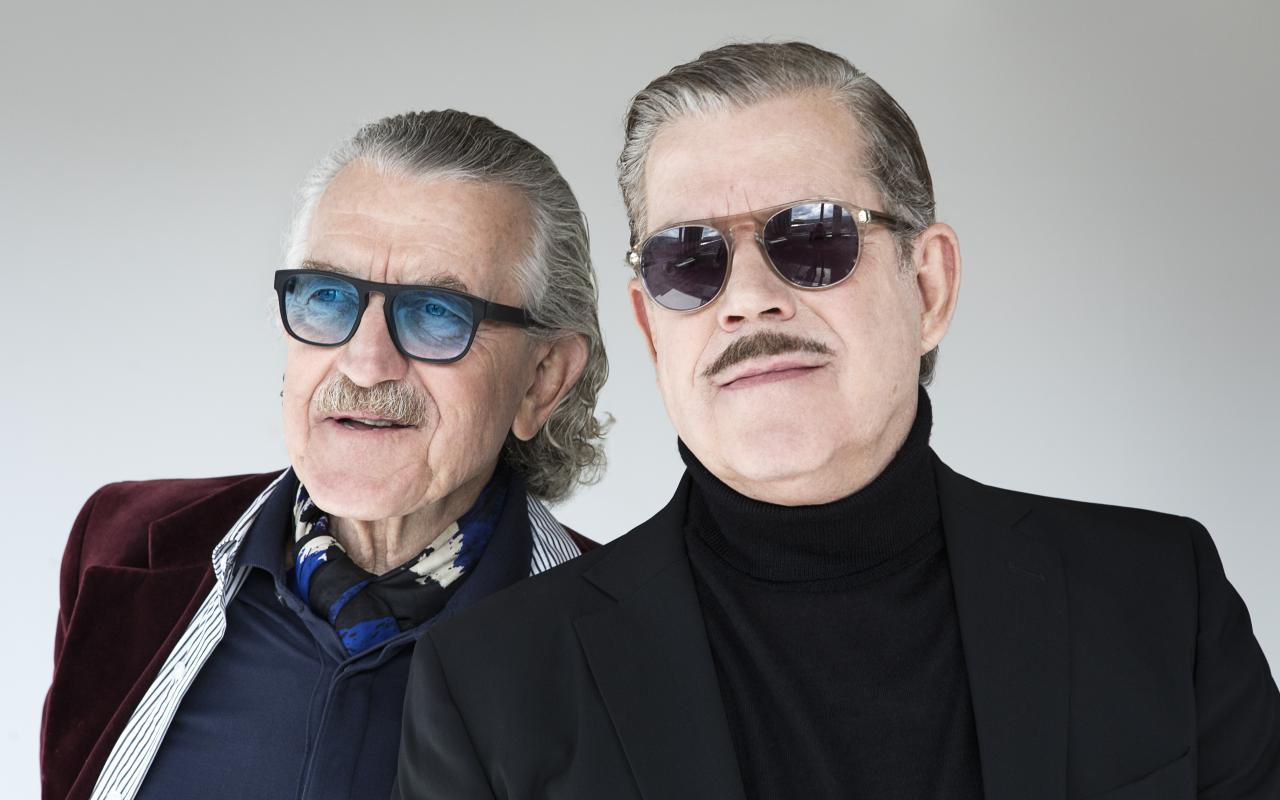
The similarities seem so numerous. Despite the presence of Carlos Peron on their early albums, Yello, like Sparks, are quintessentially a duo. They frequently compose in musical genres that don’t conform to mainstream rock and pop. They delight in ironic humour and bizarre lyrical narratives. They share an evident obsession with the movies. Several fruitful collaborations with other musicians punctuate their careers. They were never as commercially successful as they were critically revered. One of them looks like your creepy uncle, the other is a dandy spiv. They cultivate an enigmatic and inscrutable public persona without taking themselves at all seriously. Unfashionable moustaches. Perhaps it’s precisely because the similarities leap out at you that Yello chose to avoid close comparison with Russ and Ron, for fear of looking derivative.
A further similarity between Sparks and Yello is their somewhat patchy output. Diehard fans of both groups may fulminate at the mere suggestion, but not everything they committed to record is of consistently high quality. If pushed to name their best work, you would likely home in on Kimono My House and Number One in Heaven for Sparks, plus perhaps some other favourites from their extensive catalogue, but for Yello you would point mainly at two albums: You Gotta Say Yes To Another Excess and its follow-up Stella.
I remember the first time I saw Yello. It was 1983 and I was at someone’s house, half-watching late-night music show The Tube while an after-pub bottle of whisky vied for our attention. The corner of my alcoholically impaired vision tracked creepy uncle Dieter Meier as he stalked a glamorous woman around flashy but sterile city cocktail bars and plazas, and my ears pricked up at the electro film noir soundtrack over which Meier crooned in his weirdo Germanic accent.
I remember thinking instantly how SLEAZY it felt, and demanded to know who they were for future investigation. Meier clearly didn’t look much like your average pop star. He was too old (nearly 40!), and the slick suit and bushy tache made him look more like he’d just stepped out of some bank’s boardroom, which funnily enough he pretty well had, having briefly followed in his banker father’s footsteps before ‘working’ as a professional gambler for a while. He then became a conceptual artist and singer for Yello, neither of which roles seemed to require a change of wardrobe. Boris Blank, the musical half of the duo, went for the pencil-moustached stereotypical Latino gangster look. The music was like a soundtrack for Double Indemnity scored by Soft Cell and DAF. The whiff of secret perversion pervaded everything.
I didn’t immediately rush out to buy, but in due course a friend taped his copy of Excess for me, and then added Stella in a further act of music industry murder. Home taping is killing music! Don’t do it, kids!
A year or two later music was strangely still alive when I bought both albums on vinyl at a record fair in Cambridge, and followed that up by acquiring the first two releases, Solid Pleasure and Claro Que Si from an actual record shop, thus funding the poor beleaguered music industry which was at that time busy milking its back-catalogues with badly remastered overpriced CD reissues.
The first two albums are not bad, but where Excess and Stella tap in to the early 80s alternative club vibe with a bigger and bolder soundstage, the early stuff comes across as a little tinny. There is scant use of the electronically lowered pitch treatments on Meier’s rather weedy tenor vocals, a trick that would be used to greater effect later. The remix collection 1980-1985: The New Mix in One Go highlights what might have been in its beefier versions of ‘Bostich’ and ‘The Evening’s Young’ and the epically reshaped ‘Pinball Cha-Cha’ with its massive Tito Puente-esque timbales solo. Still, the key elements are all there. The spoken intro of ‘She’s Got A Gun’ could be Yello’s musical manifesto: “This is tonight and it rains like in a French black and white movie of the fifties…” Boris Blank’s masterfully moody cinematic instrumentals stand out, plus the exotic pseudo-Moroccan tone poems, so good you can taste the harissa and preserved lemons.
Irritatingly, my copy of Excess is the 1988 Mercury reissue, which substitutes the first release’s version of ‘I Love You’ for an inferior mix that lacks the original’s punchiness. Nevertheless, it’s a classic disc with multiple moments of delight, from the roiling synth sound and plangent minor key of ‘Lost Again’ with its tragic lost love movie plot, to the hysterical jungle adventure of ‘Great Mission’ with the deafening echoey belch of Father Excess.
Every bit the equal of Excess, Stella might even be said to improve on it in certain respects – the assuredness of the arrangements and the pace of the collection overall, the filmic atmospherics, and the use for the first time of guest vocalists to expand on the range of Dieter Meier’s mad professor/private dick schtick. Less clubby, more accessibly poppy perhaps, but both songs and instrumentals show off Boris Blank’s talents at their peak. Memorable are the two opening tracks, ‘Desire’ and ‘Vicious Games’, with shades of Propaganda infused with Chris Isaak-style twangy guitar, and side two’s booming opener ‘Domingo’, the ironic apotheosis of a man who convinced humanity of the non-existence of God outside of their own minds.
Come 1987 and fifth album One Second appeared, further threatening the mainstream pop charts with the participation of Billy McKenzie and the unimpeachable diva credentials of Shirley Bassey. Their collaboration on the single ‘The Rhythm Divine’ is exquisite, in an overblown camp Bond-theme sort of way, but only made it to number 54 in the UK singles chart, despite an appearance on Top of the Pops. The album didn’t do much better, though it charted higher than its predecessors, and perhaps softened up the public to future possibilities. It doesn’t have the raunch of Stella or Excess, nor sufficient pervy weirdness to satisfy the club crowd, and is memorable mainly for a more sedate atmosphere and the continued exploration of Latin and North African music. Listeners who had picked up on ‘Oh Yeah’, the Stella track featured in the film Ferris Bueller’s Day Off, may have been disappointed.
Thereafter, Yello’s creative genius entered a long decline in my opinion. Subsequent albums have their moments but it all feels like reploughing the same furrow with an increasingly blunt blade. I still have my copies of Flag and Baby that I bought on release and there is a handful of decent tracks between them. I also have a CD of Zebra, but it’s pretty near the top of the pile that might be moved on if I need the space. A couple of years ago I bought a vinyl copy of 2016’s Toy out of a bargain bin, but it wasn’t worth it at any price and I cashed it in not long afterwards.
There’s one final point of similarity with Sparks that I think is the key to both bands’ variable quality. You can listen to the entire output of Sparks and Yello and never will you hear a single moment of sincere emotional expression. Everything is wit, artifice, pastiche, the arch posing in fake movie scenes, the camp ballads, the pretendy sleaze, the jokey narratives of made-up lives. Humour in music is difficult to sustain for long and there’s a limit to how much you can take before you need a change of tune. Sparks and Yello are like the musical equivalent of a clever sketch show, in contrast to, say, Ian Dury‘s observational stand-up. Sparks and Yello are always in character, acting a scene. Dury was always himself, even when he was Billericay Dickie.
Yello have continued to collaborate with various vocalists that I’ve never heard of and have had the obligatory house/techno DJ remix treatment, but their later career seems less adventurous or wholehearted (and certainly less copious) than that of Sparks, whose combination with Franz Ferdinand seemed to reinvigorate them in an unexpected way. Sparks at least manage to keep producing new fictions, whereas with Yello the same stories keep coming round again, another film noir femme fatale, another song about driving…
All the same, Yello should be justly celebrated for that brief moment when it all came together, in the jungle of the Amazonas near Manaus full of piranhas, for the underground twist they gave to the early 80s club scene, the cinematic sweep, the pervy uncle vibe, the moustaches. Not many people have the balls and talent to carry that off for one second, and even fewer of them are from Switzerland.
JC has persuaded me to turn this piece into an ICA….so here’s the 10 tracks I’ve gone for.
- Pinball Cha Cha (New Mix In One Go Remix)
- Blue Green (from the album Solid Pleasure)
- Homer Hossa (from the album Claro Que Si)
- I Love You (from the album You Gotta Say Yes…)
- Lost Again (from the album You Gotta Say Yes..)
- Desire (from the album Stella)
- Domingo (from the album Stella)
- Sometimes (Dr Hirsch) (from the album Stella)
- The Rhythm Divine (from the album One Second)
- Blazing Saddles (from the album Flag)

 THE NEW VINYL VILLAIN