A guest posting by Khayem (Dubhead Blog)
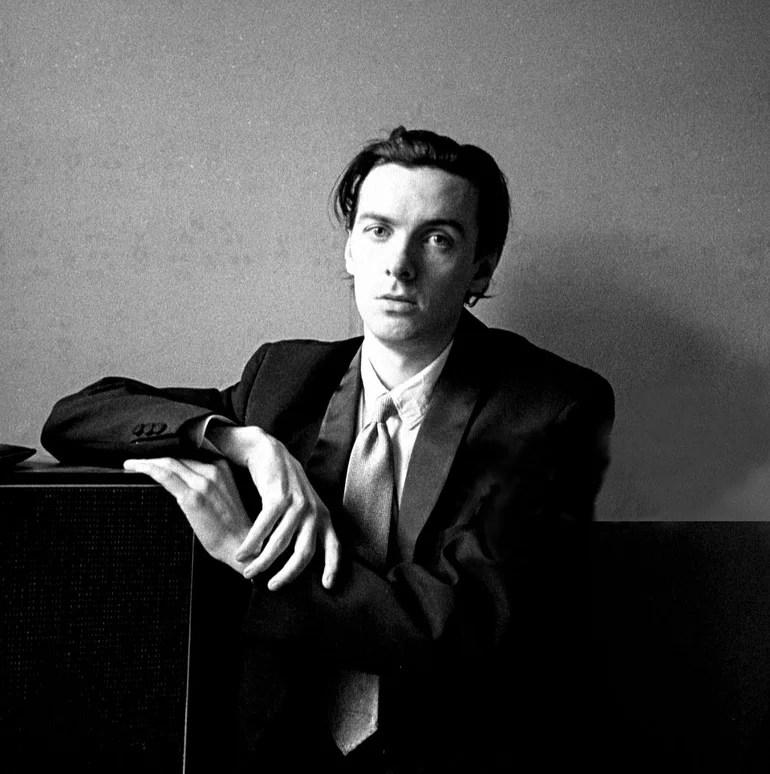
As Big As Life, As Small As Nothing: A Thomas Leer ICA
It’s 25th February 2023, and JC has posted #344 in the excellent (and still ongoing) Saturday’s Scottish Song series, featuring Thomas Leer.
The post prompted some enthusiastic responses, including one from me:
“I’ve got an ICA nearly finished and ready to send, but I’m now thinking of having a try with Thomas Leer next. I may be some time…!”
I wasn’t kidding! The ‘nearly finished’ ICA (ABC, #338, fact fans) saw the light of day in April 2023. It’s taken considerably longer for Thomas Leer’s turn to come, but here it is at last!
Some of the delay has been due to life stuff, but I also have to attribute much of it to the ‘rabbit hole’ factor that frequently affects the ideas that pop into my head.
When I posted the comment, I had enough material for an ICA, but then I discovered that Thomas had released an album in 2022 and I had to check it out. Thomas Leer’s Future Historic site on Bandcamp then revealed a load of unreleased albums and EPs that had been recorded, and I was literally lost in music. In fact, I was taking so long, that Thomas even recorded and released a brand new song in 2024! How on earth was I going to absorb all this and condense it into an ICA that would do him justice!
Yep, time for those self-imposed rules to help me out.
My first act of sacrilege was to rule out using 1979’s seminal experimental album The Bridge by Thomas and Robert Rental. Given that I had nearly five decades to cover, I didn’t want the ICA too heavily weighted towards his earliest recordings and already had a couple of songs from 1978 that I couldn’t exclude.
I also focused exclusively on songs featuring Thomas’ voice. He’s recorded a ton of instrumental music over the years, but that’s for a different time, a different compilation.
I guess that other connecting thread is that to these ears at least, the ICA collates some of Thomas Leer’s more accessible – I hesitate to say ‘pop’ moments – songs, even if they don’t necessarily confirm to the rigid rules about structure, running time, or being commercially appealing.
In his Saturday’s Scottish Song post in 2023, JC described the featured song (Don’t) as “a bit of a hidden gem” which I think sums up Thomas Leer pretty well.
I hope this ICA serves as a helpful summary and/or introduction and inspires you to dive deeper into his music.
Side One
Private Plane (single, 1978)
Leer’s self-financed debut (just 650 copies) and NME Single of the Week. The ‘DIY @ home’ feel is the real deal, but the Can-inspired motorik bass and plaintive vocals are compelling from start to finish. Like Cabaret Voltaire, if they were fronted by Matt Johnson.
Don’t (4 Movements EP, 1981)
Opener of the 4 Movements EP or, in other words, 4 off-kilter A-sides. I love the dynamics of this song, the stuttering synth bass, the tinkling chords, and repetitive riffs, at odds with and complementing one another simultaneously. The narrative sidesteps a chorus, building instead around the one word title to create structure.
Transition (The Scale Of Ten, 1984)
A more accessible, commercial sound on Leer’s debut album, and on a major label (Arista) too. Still left of centre but sailing close to the kind of music that was enjoying chart success from New Order to China Crisis, even Men Without Hats. This wasn’t a single, yet ticked all the right boxes to have been a contender.
Tonight (A Rose, 2009)
As far as official music releases are concerned, Thomas Leer was dormant throughout the 1990s. Collaborative ventures outside of his partnerships with Robert Rental and Claudia Brücken have also been few and far between. And yet… Unexpectedly, a co-write and a vocal on the penultimate song of Stefano Panunzi’s 2009 album A Rose and it was like Thomas had never been away. One of his most conventional – and beautiful – songs.
Death Of A Dream (single, 2024)
Thomas Leer’s Bandcamp site, Future Historic, has been a repository and treasure trove of recordings, rarities and works in progress never completed, as the name might suggest. Spanning 1979 to the present, including the aforementioned ‘lost’ 1990s, where Leer was in fact far from unproductive. Death Of A Dream is his most recent offering, an 8-minute epic from January 2024. This may be an older, ‘broken’ Thomas Leer, but the fire still burns brightly.
Side Two
Absolutely Immune (single, 1987)
From Death Of A Dream to Rebirth Of The Cool, at least according to ZTT in the late 1980s. Act – Thomas partnered with Claudia Brücken, freshly divorced from Propaganda – should have been huge and weren’t. From a vocal perspective, Act was mainly a showcase for Claudia, but on songs like Absolutely Immune and Snobbery & Decay, it’s clear that Thomas brought a quality beyond his songwriting and musicianship. A personal favourite from this short-lived duo, though I’m still not sure about Thomas singing, “I’m going to spray your empty face with flecks of ecstasy”!
The Devil In Me (Fairlight EP ’83, 2015)
From a 7-track EP of demos recorded during a 7-day Fairlight session in 1983, providing a missing link between Leer’s releases on Cherry Red and Arista and the move to a poppier, more chart-hungry sound. Considering some of the pop pap that was troubling the upper reaches of the UK singles chart at the time, it’s a shame that this song remained incomplete and unreleased for over thirty years.
Looks That Kill (Contradictions, 1982)
…Not that the previous year’s Contradictions EP/mini-album missed its own fair share of pop hooks. An insistent synth guitar strum and bubbling preset percussion underpin a persuasive and occasionally meandering vocal from Leer.
Touch My Screen (From Sci-Fi To Barfly, 2022)
Recorded in 2004, released in 2022, the brilliantly titled album From Sci-Fi To Barfly is self-described as “possibly (Thomas Leer’s) most disparate collection”. Maybe so, though Touch My Screen shows that Thomas’ continual crafting and honing of music at home still produced aurally stimulating and lyrically sharp songs.
Chasing The Dragon (No. 1 B-side, 1985)
Relegated to the B-side of the optimistically titled single No. 1 (it didn’t chart), possibly due to it being Leer’s “drug song”. An obvious (a little too obvious) Oriental music motif aside, Chasing The Dragon is a pretty good song and would undoubtedly have made the cut, if it had been recorded ten years earlier… or later.
WeatherBelle (Radio Cinéola Trilogy: Volume 4: The End Of The Day, 2017)
Thomas Leer’s association with Matt Johnson goes way back. The first time that I saw Leer’s name was in the credits for GIANT, the epic closing song of The The’s album Soul Mining in 1983. Although Thomas has recorded very few cover versions in his career (and mostly as Act, with Claudia Brücken singing), it was perhaps inevitable that he would one day get the nod from Matt.
In 2000, The The released the album NakedSelf, with the idea that the companion EPs would feature covers of The The songs by hand-picked artists. Record label shenanigans meant that this never got past the first single, ShrunkenMan. However, various versions by the likes of Elbow, Ergo Phizmiz and Anna Domino have popped up here and there over the years.
Thomas’ cover of WeatherBelle from NakedSelf appeared on the Radio Cinéola Trilogy box set in 2017 and it’s brilliant. As a listener, you can feel as well as hear Leer’s cracked, aged voice stretching to breaking point, lyrical lines like the proverbial torture rack, yet losing none of the emotional impact of Matt Johnson’s original work. Astonishing.
International (single, 1978)
And the ICA comes full circle, ending where it began with Thomas Leer’s debut double A-side single. Leer obviously had a thing for the title/word, as a completely unrelated song called International appeared on debut album Scale Of Ten in 1984 and was also a (flop) single.
The post-punk, synth pop International from 1978 is the one to go for, though. Again, the appeal is all in the lo-fi, home recording, scuzzy riffs, and surfing vocals. Compare this with 2024’s Death Of A Dream, and you’ll see how far Thomas Leer’s music has travelled, yet how connected the timeline is. Future Historic, indeed.
Khayem

 THE NEW VINYL VILLAIN