Breaking up the run of slightly longer posts these past few days…..
This isn’t a rare or unknown clip as it’s all over YouTube as well as being a staple of whenever BBC TV puts together programmes looking back at the music of the punk/post-punk/new wave era.
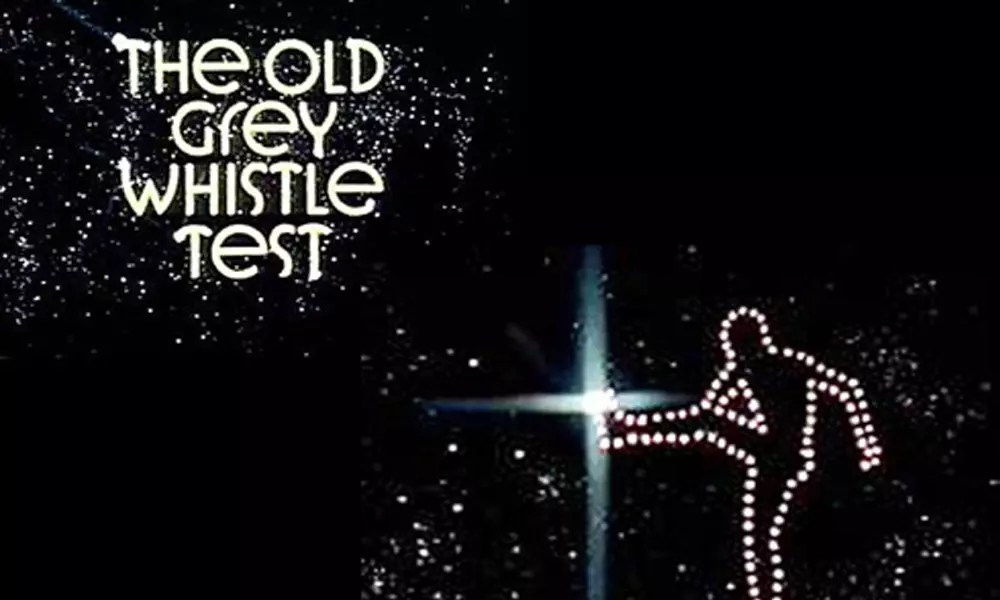
The Old Grey Whistle Test was a music show broadcast on BBC2 between 1971 and 1988, albeit its name was shortened to Whistle Test from 1983 onwards. It was most often a mix of live performances, interviews, features and promo videos (which in the early years were often just the song over old film archive, often of long-lost cartoons put together by staff at the BBC). The live performances were always the highlight……
31 January 1978. The band had earlier opened the show with Don’t Worry About The Government, which was most likely the way most UK music lovers came to be introduced to Talking Heads.
Turning again to the big red book to see if anything half-decent was released in December 1984.
Last month’s edition of this series opened up with a solo single from Pete Shelley. As for this month….
mp3: Flag of Convenience – Change
The group had formed in 1982, with Steve Diggle and John Maher of Buzzcocks very much to the fore. There had been a debut single, Life On The Telephone in September 1982, but it took more than two years before a follow-up was recorded. This proved to be Maher’s last involvement with Flags of Convenience, with the group then going through a series of further personnel changes through their eventual break-up in 1989.
mp3: Talking Heads – Girlfriend Is Better (live)
The film, Stop Making Sense, and the live album of the same name had been released to huge critical acclaim in October 1984, but I hadn’t realised until browsing through the big red book that a single had been lifted and released at the beginning of December. It failed to chart, and with it selling in such small numbers, now attracts a wee bit more on the second-hand market than many other Talking Heads 45s.
mp3: Sonic Youth & Lydia Lunch – Death Valley ’69
I wouldn’t normally include an American-only release in this series, but given there’s so little to highlight from this particular month…..
This came out on 12″ on the Los Angeles indie-label Iridescence Records. It proved to be the demo version of a track that was later re-recorded for inclusion on the 1985 album, Bad Moon Rising.
And that’s it…….most indie labels kept their powder dry until the early months of 1985. But that’s not a year I intend to devote any sort of lengthy series to.
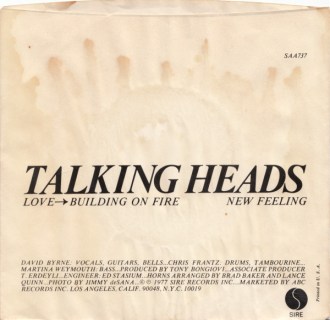
# 100: Talking Heads – ‘Love → Building On Fire’ (Sire Records ’77)
Dear friends,
whenever you read something about New York’s famous CBGB club around 1975/’76, you can rest assured that four bands are always being cited: Television, Ramones, Blondie …. and Talking Heads. Now, the first three of those don’t come in as too much of a surprise, I’d reckon, but in the back of my mind I always wondered about the latter – I mean, Talking Heads don’t seem to have fitted in there, did they, bearing in mind that everyone was trying to re-invent the New York Dolls without sounding and/or looking like the New York Dolls (I know this is vast generalization, but it’s not too far away from the truth).
Probably this doubt derives from the fact that when you think about Talking Heads, your brain automatically pictures David Byrne in this overblown suit, being all arty and stuff, which was of course much later in their career. But perhaps this is just one of those psychological things your brain cannot fully cope with, like when I look you straight into the eye and ask you a) to concentrate on me and b) to quickly say for 20 times or so „white – white – white – white – white – white – white – white – white – white – white – white“ until I suddenly interrupt you with the question „what do cows drink?!”. Knowing you, most of you will have answered “milk”, you see, which cows don’t drink, at least not over here in Germany. Byrne’s suit is the same thing, of course – and I know because I was an Air Force medic when I was in the army, decades before I got employed to work for some obscure Scottish blogger on all too low wages!
But I digress, again: in their beginnings though, it was all much less grandiose, in CBGB and elsewhere Talking Heads entered the stage in the clothes they had worn all day, they did not try to look any special at all, the same is true for their performance: they just left the stage lights on and started. Also they were just a three-piece then, David Byrne, Chris Frantz and Tina Weymouth – something which you will of course already have noticed when looking at the sleeve below – and quite often they opened the night for the Ramones. On one of those occasions, in 1975, Seymour Stein from Sire Records was in the audience, and apparently he was so fond of what he heard that he offered the band a contract – which they declined for a while, because they thought they weren’t yet good enough, that they still had to work on themselves. This apparently was achieved when Jerry Harrison from Jonathan Richman & The Modern Lovers was recruited for lead guitar, but before this happened, they changed their minds, signed with Sire and the first single was recorded – without Jerry Harrison.
Now, all of this boring stuff is important here, because this record presents Talking Heads in quite a different form. Just compare this version of ‘Love → Building On Fire’ (which is supposed to mean ‘Love Goes To Building On Fire’, don’t ask me why) to the one on the most fabulous ‘The Name Of This Band Is Talking Heads’ live album: you’ll clearly see (or hear rather) the difference, exploding guitars live whereas here Byrne has a more minimalistic/robotic approach. This, to make that clear, does not mean that I dislike what the band did after this record, not at all. Nor do I prefer this one, or this version rather, in fact the live album was on constant play when I first got my hands upon it in the mid-80s: outstanding, as I said!
mp3: Talking Heads – ‘Love → Building On Fire’
The debut album was released half a year later, and ‘Love → Building On Fire’ was not on it. What was on it though was ‘Psycho Killer’, a song well known to everyone and also a good example to show what would make Talking Heads so very special throughout their career.
But either way, I always liked the very first single very much – in my book, it is well deserved to be included in the singles box.
A guest posting by Fraser Pettigrew (aka our New Zealand correspondent)
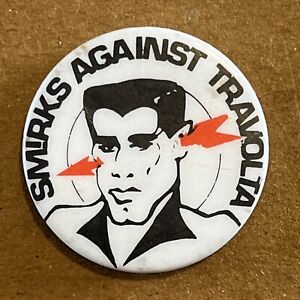
The Smirks were a short-lived band from Manchester whose chief contribution to posterity was as leaders, indeed sole proponents, of the parodic ‘Smirks Against Travolta’movement. In 1978, I sent away for one of their badges which showed a cartoon of the iconic Saturday Night Fever star, his head impaled through the ears by a big red arrow in obvious homage to the Anti-Nazi League’s Rock Against Racism campaign materials. The Smirks’ campaign had a semi-serious intent to defend live music venues against the progressive dominance of discos and the formulaic dance music records that fuelled them. The punk era seemed like a propitious moment of revolt against the mainstream music industry, and disco music epitomised its commercialised, mass-produced product.
In 1977 and 1978 it seemed as though the early punk and new wave hits were but far-flung islands in an ocean of disco. Every other single featured on Top of the Pops seemed to bounce along four-to-the-floor on shimmering hi-hat ripples backed by scratchy wah-wah guitars and alternating octave bass lines. And it wasn’t just American R&B acts that were doing it. Old timers like The Bee Gees and even The Rolling Stones were doing it, Abba were doing it, Bowie was doing it. If somebody wasn’t doing it they soon would – I’m looking at you, Rod Stewart. It’s easy to see how The Smirks could view disco as a malignant algae slowly smothering every other lifeform in the sea.
In 1978, I didn’t like disco. Disco was the enemy, it was the commercial mainstream, it was the antithesis of punk and new wave. Disco music was not the music of teenage rebellion, it was the music of flare-wearing bubble-headed conformists, obsessed with superficial personal attractiveness. Disco kids were socially acquiescent good-timers, not uncompromising and intellectually fearless iconoclasts intent on remaking the culture in a constant cycle of destruction and renewal, like what I was.
Ironically, however, the ‘anything goes’ eclecticism unleashed by punk was already in the process of spawning music that blended new wave experimentalism with the stylised sounds of disco and its elder sibling funk. It wasn’t properly until 1979 that this seemingly taboo musical miscegenation was born, but the seeds were sown by the end of 1978. Ever the pioneer, John Lydon’s Public Image Ltd filled out the last eight minutes of their first album with the disco-loop time-waster Foederstompf. Despite its explicitly ‘contractual obligation’ nature (at one point Lydon sing-chants the line “how-to-finish-the-album-with-the-minimum-amount-of-effort-necessary…”), the track sets up a style marker that was picked up in startling fashion six months later on their second single Death Disco. Did exactly what it said on the tin. One of the strangest things ever to appear on Top of the Pops.
A month after PiL’s First Edition, in January 1979, New York punk scene graduates Blondie released Heart of Glass and within a week it was at number 1. It’s well known now that the song started life some three or four years earlier, and before it acquired its eventual form and title (when recorded in June 1978) it was referred to by the band as ‘the disco song’. Blondie had earlier included disco cover versions in their live set, including Donna Summer’s I Feel Love.
The single that Heart of Glass bumped off the top spot was Ian Dury and the Blockheads’ own disco classic, Hit Me With Your Rhythm Stick. In truth The Blockheads had always been a bit funky, and were never in any sense punk, but they surfed to prominence on the new wave, bearing an outsider affinity on account of Dury’s disabled skinhead Essex geezer persona and lyrical fondness for society’s nether parts.
Another of our favourite bands, Talking Heads, fellow alumni with Blondie of the CBGB school, had quite frankly been doing disco since day one. Talking Heads ’77 was a blueprint for blending slick, poppy dance rhythms with weirdo art-nerd lyrics, luring you onto the floor like the cutest boy in the class until you realised you were dancing with a bookworm, a civil servant, a psycho killer. More Songs About Buildings and Food delivered further explicitly disco tunes like The Girls Want to Be With The Girls, Stay Hungry and Found A Job, Frantz and Weymouth nailing the crisp tempos on hi-hat, snare and bouncing bass, Byrne and Harrison rubbing ‘chicken-scratch’ rhythm guitar straight out of KC and the Sunshine Band. There was a cover of an Al Green song.
The combined effect was to sand away the stigma associated with disco and funk. Did we disown Blondie? Had PiL sold out? No one complained, least of all me. Like everything else, my fearless iconoclasm was a pose, and though I genuinely didn’t like mainstream regurgitation, the appropriation and subversion of popular forms was obviously different, yeh? Also, music was supposed to be fun. Everyone wanted to party and the admission was grudgingly made that disco was 100% party music. Nobody was going to get up to The Bee Gees, but slap on Heart of Glass or Bowie’s Golden Years and we were on it. Something to do with the packaging.
Well away from the chart spotlight, other artists were taking funk and disco stylings and bolting them onto some distinctly uncommercial material. In The Smirks’ back yard, A Certain Ratio were beginning their rapid evolution towards icy, stripped down funk. In deepest darkest Bristol, The Pop Group compounded the irony of their name by confrontationally screaming agitprop over grooves that sounded like James Brown and George Clinton jamming in an abattoir.
So, in short order, my dislike of disco on purely aesthetic grounds vanished even faster than The Smirks. Just as well, since the following years saw a rapid diffusion of disco and funk throughout every level of post-punk music. You can hear it in the ‘Sound of Young Scotland’ in Orange Juice and Josef K, The Fire Engines, Boots For Dancing, in the Euro-disco of The Skids and Simple Minds, and in the warped pop of Associates.
New Order mashed up Kraftwerk and Giorgio Moroder to produce Everything’s Gone Green, following it up with Temptation, and eventually the monster techno-disco breakthrough of Blue Monday. The Pop Group never had a hit, assuredly for want of trying, but their former bassist Simon Underwood tasted success with Pigbag, whose James Brown-referencing Papa’s Got a Brand New Pigbag even inspired Paul Weller to jump on the bandwagon by ripping off the bass line for The Jam‘s disco song Precious.
By the beginning of the 80s, disco was as much part of the new wave as it was of the mainstream. And through the distinctive phenomenon that was Grace Jones, the new wave found itself infiltrating disco. In the late 1970s, the former fashion model had made a musical name for herself in the gay club scene with high-camp singles such as Do or Die and I Need a Man, but after teaming up with the Compass Point All Stars, her albums Warm Leatherette and Nightclubbing supplied a wider alternative club scene with some unexpected dance floor fillers. The former album’s title track could hardly be of more obscure origin, a cover of a proto-industrial synth pop single based on J.G. Ballard’s Crash, written and produced by The Normal, aka Daniel Miller, founder of Mute Records, the future home of all things alternative. Other covers followed, drawn from The Pretenders, The Police, Iggy Pop, Roxy Music and, most eyebrow-raising of all, Joy Division. When I occasionally frequented Edinburgh club JJ’s in the early 80s, Jones’s versions of She’s Lost Control and Warm Leatherette were staples, along with tracks like Bowie’s Stay, from Station to Station, and Material’s Bustin’ Out.
Bustin’ Out flags up another significant strand of alternative disco, the New York underground, propelled by experimentalists like Bill Laswell and Arthur Russell, ‘no-wave’ acts such as ESG, and the ZE Records stable that included Was (Not Was), Kid Creole and the Coconuts, Lizzy Mercier Descloux as well as Laswell’s Material. All of this fed alternative influences back into the disco club scene, ultimately influential in the metamorphosis of disco into house and techno in the late 1980s, a development further fuelled by post-punk electro-pioneers like Human League and Heaven 17, Depeche Mode, Throbbing Gristle and their offshoots Chris and Cosey, Yazoo and Erasure.
In parallel with all this painfully hip consumption, my musical tastes were being broadened to embrace some of the soul and funk originators like Sly and the Family Stone, Stevie Wonder, Isaac Hayes and Marvin Gaye. Several of my friends expressed healthy respect for the danceable end of soul music. One of them only ever wore white socks. Not long after it came out, I bought Off The Wall, easily one of the best pop/disco albums of all time. The barriers were down. I am now unashamed to reveal that my record collection holds prized items by such as Shalimar and the Detroit Spinners, and Brit-disco acts like Linx, Imagination and The Real Thing. Whisper it, I even have The Bee Gees’ Saturday Night Fever tracks on a CD, and they’re great. As Funkadelic so succinctly and eloquently phrased it, “Free your mind and your ass will follow.”
mp3: PiL – Death Disco
mp3: Talking Heads – Stay Hungry
mp3: The Pop Group – She is Beyond Good and Evil
mp3: The Jam – Precious
mp3: Material – Bustin’ Out (12” version)
mp3: Grace Jones – Warm Leatherette
mp3: David Bowie – Stay
mp3: Loose Joints – Is It All Over My Face? (Single female vocal version)
mp3: Heaven 17 – I’m Your Money (12” version)
mp3: Linx – Wonder What You’re Doing Now
The 1979 series was so well-received that I felt there really should be some sort of follow-up.
The 1979 series went into great detail, partly as I wanted to demonstrate just how magnificent a year it had been for singles. The spotlight on 1984 won’t quite be as intense, but I still intend to pick out quite a few tunes that have stood the test of time.
The year began with the #1 slot being occupied by a novelty song in the shape of The Flying Pickets acappella cover of Only You. The rest of the Top 20 was equally gruesome, with the likes of Slade, Billy Joel, Status Quo, Paul Young, Cliff Richard and Paul McCartney all vying with Roland Rat Superstar for the right to be exchanged for the record tokens that had been left under the Xmas tree. There were a few decent enough tunes from the likes of The Smiths, The Style Council, Aztec Camera, The Cure and Blancmange in the lower end of the charts that had been released towards the tail end of 1983 to make things slightly bearable. But in terms of new entries in the chart of 1-7 January 1984, there was nothing to write home about.
Fast-forward a week, and The Police had the highest new entry, at #32, with the distinctly underwhelming King of Pain, the fourth single to be lifted from the album Synchronicity. Just a few places below that was the fifth chart 45 from one of the many bands to emerge out of the Liverpool area in the early part of the decade:-
mp3: China Crisis – Wishful Thinking
In at #36, this was given a wonderful retrospective write-up by Post Punk Monk back in October 2011, and I’m sure he won’t mind me quoting him:-
“This single is one of my all time favorites by the group in that the A-side is sweetly melancholic and unapologetically gorgeous, with a wonderfully played synthetic string section sweeping the tune along. Other tracks on the album this single is from have live strings, but I guess the recording budget didn’t extend that far. The synth strings still sound rather good and more importantly, the addition of oboe and fretless bass, two of my favorite instruments, on this track lends it a gentle nobility that carries it far above the sound of the crowd in the charts at the time of its release.”
Loads of folk in the UK clearly agreed with him, as Wishful Thinking would eventually climb all the way to #9 and prove to be the band’s best charting single.
This week’s chart also saw the debut of someone who would, in quite a short period of time, become, arguably, the biggest pop icon of the late 20th century. It’s a tune that was later given this accolade many years later on one of the biggest digital sites out there:-
“A song as utterly ’80s as Rick Astley or the Pet Shop Boys, it is also surely the most evocative theme tune ever created when it comes to packing a suitcase and jetting off for beach cocktails […] A feel-good pop giant with an infectious chorus – and the closest thing we have to bottled sunshine”.
mp3: Madonna – Holiday
In at #53, it would reach #6 in mid-February, the first of what thus far have been 64 Top Ten hits in the UK for Madonna, of which 13 have reached #1.
The third of the new entries into the Top 75 being highlighted this time around turned out to be one which became a big hit six years down the line:-
mp3: Talk Talk – It’s My Life
The lead single from the band’s forthcoming second studio album came in at #67, and two weeks later peaked at #46. It was then re-released in May 1990 to support a Greatest Hits package, at which time it reached #13.
Scrolling down now to the chart of 15-21 January.
mp3: Big Country – Wonderland (#13)
mp3: Thomas Dolby – Hyperactive (#45)
mp3: The Colour Field – The Colour Field (#53)
mp3: Spear of Destiny – Prisoner of Love (#60)
mp3: Talking Heads – This Must Be The Place (#61)
I’m not going to argue that all of the above have aged well, but they provide a fine snapshot of the variety that was on offer to anyone seeking to expand their 7″ or 12″ vinyl collection. I certainly bought all five back in the day.
22-28 January. Have a look at what hit #1
mp3: Frankie Goes To Hollywood – Relax
Even back then, in an era when it was possible for a slow-burner to reach #1, it was almost unheard of for it to take 12 weeks. But that’s what happened with Relax. Released in late October 1983, it had spent two months very much at the lower end of the chart, reaching #46 in the final chart of that year, and reaching #35 in the first chart of 1984, which earned Frankie Goes To Hollywood an invitation onto Top of The Pops for the show broadcast on 5 January.
The following week it climbed to #6, at which point Mike Read Reid, one of the highest-profile DJs on BBC Radio 1, publicly expressed his disdain for the single and said he wouldn’t be playing it on any of his shows, leading to a chain of events where the single was banned right across the BBC on radio and television. None of which stopped it being played on independent radio stations, or indeed on The Tube TV show which aired on Channel 4; Relax would spend five weeks at #1, and indeed would go on to spend a total of 48 weeks in the Top 75, not dropping out until the chart of 14-20 October.
All of which kind of overshadowed these new entries that week:-
mp3: Echo and The Bunnymen – The Killing Moon (#17)
mp3: Simple Minds – Speed Your Love To Me (#20)
mp3: The Smiths – What Difference Does It Make (#26)
mp3: Prefab Sprout – Don’t Sing (#62)
Looking back at things, the singles charts of January 1984 weren’t too shabby, were they?
As with the 1979 series, I’ll be consulting my big red book of indie singles to identify those 45s that didn’t bother the mainstream charts, but were well worth forking out some money for. It should be with you in the next week or so.
JC
PS : Total coincidence that thirteen songs feature in this post…….or is it?????
As with last month, I’ve given this one a bit of a build-up, one that I am sure will live fully up to its billing. It’s a bumper edition, with ten tracks in all, beginning with the single that I listed at #6 in my 45 45s @ 45 series back in 2008 over at the old blog.
mp3: Joy Division – Transmission
Released on 7 October 1979. The first time that many of us had heard it would have been a few weeks previously on the BBC2 programme, Something Else. It would be the only time the band appeared on a TV programme that was broadcast across the entire nation – everything else was via Granada TV and only available in north-west England.
mp3: John Cooper Clarke – Twat!
One of JCC‘s best-known and most-loved poems. Just in case anyone not from the UK doesn’t know, twat is vulgar slang for a vagina, as well as being the perfect word to describe a stupid, obnoxious and unpleasant person, for example D Trump or N Farage.
mp3: The Cure – Jumping Someone Else’s Train
Their third single of 1979 that failed to get anywhere other than the indie charts. The good news is that the next single, A Forest, released in March 1980, would reach the destination of the mainstream chart.
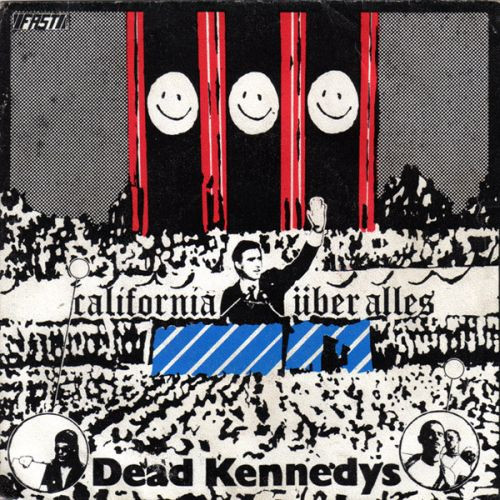
mp3: Dead Kennedys – California Uber Alles
The name of the band led to hostility from the outset, even over here in the UK. The music papers weren’t really sure how to handle them, and there was certainly no chance of the major labels offering them a deal. There were a few writers who mentioned, based on their debut single that had been released In America, on their own label, back in June 1979 that there was a bit of musical merit to pay attention to. Bob Last, the entrepreneur behind the Edinburgh-based Fast Product label, managed to secure the license for a UK pressing. I don’t ever remember hearing it on the radio back in 1979, but I do know a few of the independent record shops proudly had the distinctive sleeve on display.
Eddie, the bona-fide punk in our school, of course bought a copy and brought a tape in so we would listen to it in the common room. Let’s say it divided opinion. I liked it, but I didn’t go out and buy it for fear that the name of the band might cause offence to my parents.
The song was re-recorded the following year for inclusion the band’s debut album Fresh Fruit For Rotting Vegetables.
mp3: Martha & The Muffins – Insect Love
There’s a misconception that Echo Beach, the Top 10 single for the Canadian band, was the debut. It charted in March 1980, but their little-known debut single dated back to October 1979. One of the reasons it is forgotten about is that it was left off the debut album.
mp3: Talking Heads – Life During Wartime
The press may have been positive, particularly around how good they were as a live act, and the album Fear of Music, released in August 1979, may have gone into the charts at #33 the previous month, but the search for a hit 45 went on. And would continue to do so until February 1981.
mp3: Wire – Map Ref. 41˚N 93˚W
The third single from Wire in 1979. Lifted from the album 154, which had been released a few weeks previously, it proved to be their last involvement with the folk at Harvest Records, whose bungling back in March 1979 had caused the band to miss out on a Top of The Pops appearance when Outdoor Miner was on the threshold of becoming a Top 40 hit.
Finally, for this month, three cult bands whose names begin with the letter P.
mp3 : The Passage – 16 Hours
One of four tracks from the About Time EP, released on the Manchester-based indie, Object Records.
The Passage were from the city and at the time consisted of Dick Witts, Tony Friel and Lorraine Hilton. Witts was a multi-instrumentalist who spent time as a percussionist with a symphony orchestra, while Friel was the bassist with The Fall.
mp3: Pere Ubu – The Fabulous Sequel (Have Shoes Will Walk)
From Cleveland, Ohio. I own nothing by the band, and indeed they have always been an act that I don’t get the appeal of. They had already been on the go for some four years by this point in time and inked a deal with a major label, as this one came out on Chrysalis Records. But as you’ll have noticed last week, Dirk is very fond of an earlier single.
mp3: The Pop Group – We Are All Prostitutes
The Bristol-based post-punk group were much feted in the UK music papers back in the late 70s. Indeed, they have always been very revered with an article in The Guardian in 2015 declaring that “they – ahead of Gang of Four, PiL, A Certain Ratio and the rest – steered punk towards a radical, politicised mash-up of dub, funk, free jazz and the avant-garde.”
Rough Trade Records had signed them in the summer of 1979, and this 45, a critique of consumerism, was their first release for the label.
I think this edition of TVV has something that would meet the tastes of just about everyone who drops by today.
The chart hit single in June had some quality, but not much in the way of quantity. What about the 45s that didn’t make it as far as the Top 75?
mp3: Adam and The Ants – Zerox
Prior to becoming a pop icon in the early 80s, Adam Ant had been part of the punk scene in London. He had a role in Derek Jarman‘s 1978 film Jubilee, while Adam and the Ants were filmed performing the Plastic Surgery (the song, that is….not the procedure!!). This led to a deal for a one-off single with Decca Records, but Young Parisians failed to gain traction. London-based Do It Records signed the band, and Zerox was the first offering. It did well enough in the Independent Chart, but didn’t sell enough copies to trouble the Official Chart, at least not in June 1979. It was re-released in January 1981 on the back of the initial burst of Ant-mania and made it to #45.
mp3: The Adverts – My Place
The Adverts had been one of the first of the punk bands to enjoy chart success, with Gary Gilmore’s Eyes hitting #118 in September 1977. By the following year, they were on RCA Records and began making music that had more of a pop feel to them. Critically, they were still being championed in some music papers, but none of the three singles nor the one album they made while at RCA made the charts – and, of course, they weren’t eligible for the indie charts.
mp3: Cabaret Voltaire – Nag Nag Nag
Having turned down an offer from Factory Records, the Sheffield-based Cabaret Voltaire signed with Rough Trade, with their debut EP being released in late 1978. The first actual 45 was released in June 1979, and has since been acknowledged as one of the most pioneering 45s of the era, but back then it was largely dismissed as being too arty and weird.
mp3: The Cramps – Human Fly
London-based Illegal Records, founded by Miles Copeland III, issued Gravest Hits, a 12″ EP bringing together tracks that had featured on the first two singles released by The Cramps back in 1978. The other songs on the EP were The Way I Walk, Domino, Surfin’Bird, and Lonesome Town. It would take a further 11 years before The Cramps ever made it into the UK singles chart, by which time Miles Copeland III was enjoying the riches from the success of his next label, I.R.S. Records, home to early R.E.M. among others (including, for a short time, The Cramps).
mp3: Devo – The Day My Baby Gave Me A Surprise
The men from Akron, Ohio continued their run of failure. Come Back Jonee had flopped back in January, and while the album Duty Now For The Future did chart at #49, its lead-off single did nothing
mp3: Simple Minds – Chelsea Girl
There were really high hopes among the band for the follow-up to Life In A Day which had sneaked into the lower echelons of the chart. Such hopes were dashed…..the harpsichord-like sound produced by Mick MacNeil on keyboards failed to capture the attention of the radio pluggers, and the 45 disappeared without a trace.
mp3: Swell Maps – Real Shocks
The second single from Swell Maps issued by Rough Trade in 1979. I didn’t know about this back when I was 16 years of age. If I had, I’d most likely have bought it and driven my parents crazy.
mp3: Talking Heads – Take Me To The River
Talking Heads were, pardon the pun, much talked about in 1979. The previous year, they had enjoyed a hit album with More Songs About Buildings and Food, and there was near universal acclaim for their live shows. Fellow New Yorkers Blondie were flying high, and it really only seemed a matter of time before The Heads were equally popular. As we know, they did eventually become a household name, but in June 1979 the record label was reduced to releasing a single from the previous album as their way of trying to get a cash-in on a prestigious gig that month in London. The cover of the Al Green number was issued as a 2 x 7″ release (for the price of a standard 7″) along with art work in the shape of a Talking Heads family tree as designed and drawn by Pete Frame. It didn’t chart.
mp3: Wire – A Question Of Degree
The story of how Outdoor Miner had been a minor hit, but should have been a major hit, was told a few months back. Harvest Records, keen to atone for the errors made with the previous single, threw their weight behind another track lifted from the 1978 album Chairs Missing, but nobody was interested…which is a shame, as It’s a belter of a single
mp3: Toyah – Victims Of The Riddle
This piece started with a member of the punk scene who appeared in Jubilee, and now finds itself ending the same way. Toyah Wilcox‘s first foray into the performing arts was as an actor, but with a number of her early parts involving singing, it led to her wanting to have a parallel career in music. She ended up fronting a five-piece band – all the other musicians were male – with everyone content that it take its name from the lead singer, given how unusual it was. London-based Safari Records signed the band, and Victims of The Riddle was the debut. The band would remain with Safari over the next six years, going on to enjoy more than a fair degree of chart success.
I bought a second-hand CD a long time ago, specifically for the purposes of having a bit of fun on the blog, and I’ve decided to use the normally quiet festive period, when the traffic and number of visitors drops quite dramatically, to go with it.
The CD was issued in 1996. It is called Beat On The Brass, and it was recorded by The Nutley Brass, the brains of whom belong to New York musician Sam Elwitt.
The concept behind the album is simple. Take one bona-fide punk/post-punk/new wave classic and give it the easy listening treatment.
There are 18 tracks on the CD all told. Some have to be heard to be believed.
Strap yourselves in.
mp3: The Nutley Brass – Psycho Killer
And, just so you can appreciate the magnificence (or otherwise) of the renditions, you’ll also be able to listen to the original versions as we make our way through the CD in random order.
mp3: Talking Heads – Psycho Killer
From the album Talking Heads : 77
Part 13 of this series will be posted up next Monday.
Having reached #66 in this fairly regular series, my mind turned to songs with the word ‘road’ in the title. I would have considered ‘route’ if it wasn’t for the fact that I only have four songs on the hard drive with that particular word in the title…..(and I’ll wager a very decent bottle of wine that none of you out there could get all four at the first attempt).
My mind didn’t go into any sort of overdrive to come up with today’s offering:-
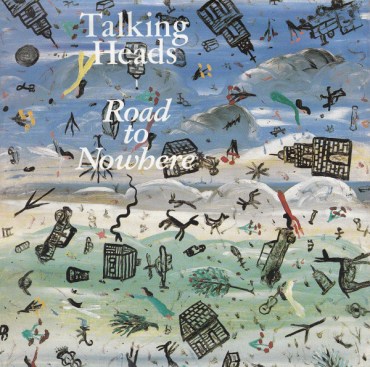
mp3: Talking Heads – Road To Nowhere
Road To Nowhere can boast of being the most successful 45 in the UK for Talking Heads, reaching #6 in October 1985. Indeed, it was the band’s first chart hit over here in four years, as every single released after Once In A Lifetime had stalled a fair distance outside the Top 40. The version on offer today is lifted from the vinyl copy of Little Creatures, the first Talking Heads album to go Top 10 in the UK, which it did on its first week of release in June 1985.
It’s probably no coincidence that Little Creatures was the first new material released by the band on the back of the previous year’s screening of Stop Making Sense, a genuinely ground-breaking concert film that did so much to bring Talking Heads to the attention of a wider audience than ever before, Equally, the fact that Road To Nowhere was supported by a fairly innovative and memorable promo video was also a factor in helping it achieve sales well beyond that of any previous single.
Here’s the thing. I’m not all that fond of it as a piece of music.
Sure, it’s catchy and does do that earworm thing anytime you hear it coming out of the radio on some sort of oldies station. But, in the grand scheme of things, it’s really a novelty song more than anything else and isn’t remotely representative of the band’s output elsewhere (see also, The Lovecats by The Cure). I’ve long been tickled by the notion that folk getting turned onto Talking Heads for the first time in 1985 going out and buying the back catalogue only to be completely bemused by what they were listening to.
The band were never the same after this period in their history, and there’s a great deal of bitterness about it all within the pages of Chris Frantz‘s autobiography, albeit it has to be said that his book is bitter throughout when it comes to most things to do with David Byrne.
Having said all that, giving Road to Nowhere a spin on a turntable for the first time in decades did allow me to pick up just how well it had been recorded, produced and engineered. Oh, and no matter that I’m not a huge fan of it, I’m a bit of a sucker for the way the accordion is used throughout.
Just in case you need reminding, the 2022 edition of the ICA World Cup is now well underway, with the Sunday editions of TVV being devoted entirely to the tournament over the next few months.
I thought it would be worth looking back to the very first tie played in the 2018 edition, as it proved to be a real thriller.
2018 was based entirely on knock-out, unlike this time round where there is an initial group stage. There were 129 ICAs eligible in 2018, which meant two had to go head-to-head in a preliminary round to get the number down to a figure where there could then follow five knock-out rounds in advance of the final.
Here’s what happened…..
#115 : Talking Heads v #93 : Close Lobsters
A transatlantic clash between two of the dark horses for the tournament. The tracks were selected by a combination of coin toss (‘Heads’ for Side A and ‘Tails’ for Side B) and a dice (the number rolled landed on the song. prospect.
Born Under Punches (from the LP ‘Remain In Light’ 1980)
v
Let’s Make Some Plans (single, 1987)
The match report the following week revealed how it all unfolded.
The 12 noon kick off on Wednesday clearly suited the American art rockers as they raced into a 10-6 lead following the opening exchanges over the first four hours. The Scots beat combo fought back tenaciously, and shortly after 8pm they took the lead for the first time when DG’s contribution made it 15-14. This only seemed to rile the fans of Byrne & co and by half-time, at 6pm on Thursday, they had opened up a substantial lead with the score being 27-20 in their favour.
The Heads came out after the break looking to kill things off and scored the next three goals; the difference was now 10 and seemed unassailable. The Lobsters, however, came back under the cover of darkness with five unanswered goals between 11pm and 4am – the gap was down to five with only the final third of the game left to play.
The boys from the small town a few miles south-west of Glasgow set about their task and momentum seemed to be on their side and three Friday night goals saw the margin down to just one as we entered the final 60 minutes…..during which, incredibly, nobody added to their tally.
The final whistle brought an enthralling and exciting match to a close, with the scoreboard showing :-
Talking Heads 31 Close Lobsters 30
The New Yorkers, despite scoring only one goal in that final third, had managed to hold on. The decisive intervention came at 6.37 pm, with Ian saying ‘Talking Heads. Back of the Net.’
Talking Heads would go on to defeat Massive Attack in Round 1 and Kitchens of Distinction in Round 2 before losing out to The Housemartins in Round 3.
Video may have, allegedly, killed the radio star, but it was video that really made a star out of David Byrne, and by extension, Talking Heads, here in the UK.
The album Remain In Light had featured highly in the end of year round-ups, including #6 with NME and, #1 in Melody Maker. The critics’ soft spot could, in an era of real snobbery about music, be attributed partly to the fact that no singles had been lifted from it. Sire Records took the unusual decision to issue a single more than three months after the parent album had been released. It turned out to be an edited version of one of the upbeat and most accessible tracks from Remain In Light
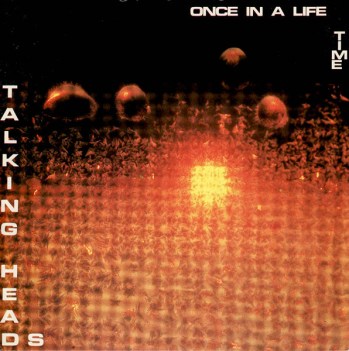
mp3: Talking Heads – Once In A Lifetime
I can’t honestly remember when I first saw the promotional video. I know that I tuned it one Thursday evening to Top of The Pops in the hope of seeing it when the single was riding reasonably high in the charts, only to be bemused by the fact that resident dance troupe Legs & Co were offering their interpretation on things. But it must have been shown at least once on the BBC’s flagship show, or perhaps it was aired over on ITV, possibly as a segment on Kenny Everett‘s show which blended music and comedy sketches. It certainly wasn’t on Channel 4 as it hadn’t yet begun to air, and the Old Grey Whistle Test in 1981 on BBC2 wasn’t known for airing promos, preferring live appearances, failing which the song being played to old cartoon silent films from the black and white era.
Whatever and whenever it was, the video got folk talking up and down the country, in schools, colleges and workplaces. It was, back in the day, truly ground-breaking and hugely innovative. The sight of a bespectacled man throwing weird shapes as he worked himself into a sweaty, frenzied trance as he sang the song, made for unforgettable and compelling viewing.
Once In A Lifetime was a slow burner over here. It came in at #63 in the first week of February 1981 on the back of some radio play. I’m guessing that some TV show aired the video that same week, as it climbed 25 places into the Top 40. It then didn’t do all that much for the next two weeks, before it catapulted up to #14, five weeks after its release. It hung around the Top 20 for three weeks, before drifting out of the charts after a near three-month stay.
Remain In Light, despite the love and praise showered on it by the critics, had spent just four weeks on the album chart in November 1980. The success of the single led to a re-entry on the album charts in February 1981, and a thirteen-week stay, which was well beyond any previous amount of success.
There are many instances where the debut single has proven to be the defining moment of a band or singer’s career but more often than not it simply lays down a marker for bigger and better things further down the line. Many years later, said band or singer, having enjoyed an extended career, undergoes an extensive critical reassessment, part of which usually involves a fresh consideration of that crucial debut. I think Talking Heads are a great illustration of what I am getting at.
It was away back in February 1977 that the then trio released Love → Building on Fire as a single. It predated their debut album by more than six months and indeed was already considered such an ‘old’ song that it was left off said debut, albeit it seemed to be part of the regular set list for many years thereafter. The debut LP was the piece of plastic that took a by now four-piece Talking Heads to an audience well beyond the confines of NYC, with songs like Uh-Oh Love Comes To Town, The Book I Read, Don’t Worry About The Government and, above all else, Psycho Killer, making a huge and immediate impact. Most polls which look back at, and list, great debut albums usually have Talking Heads : 77 mentioned somewhere in the piece.
All of which somehow makes Love → Building on Fire (or Love Goes to Building on Fire which has always been easier to type) something of an afterthought when looking back at the band’s career. I first noticed increasing mentions of the debut 45 once it became clear that the band, having broken up, had no intention of ever reforming. It was almost as if those who were penning the valedictory pieces wanted their readers to think or believe that the writer had been ahead of the curve back in 1977 and had predicted or expected greatness and longevity on the back of the first few minutes of music that Talking Heads had ever released. And yes, there were some who argued that the debut was the watershed for the band on the basis that they lost something once they moved out of CBGBs.
It’s all, of course, utter nonsense.
Yes, Love → Building on Fire is a wonderful way to announce your arrival; it’s an entertaining and cracking three minutes of music, which is why I’m featuring it in this series; but Talking Heads would deliver so many better moments over the ensuing years.
mp3 : Talking Heads – Love → Building on Fire
mp3 : Talking Heads – New Feeling
It was a few months ago that Echorich supplied this blog with a very classy ICA on Talking Heads; it was one that concentrated on the band’s first four albums from the debut in 1977 through to Remain In Light in 1980. It was hard to argue with his selections but what was noticeable is that he omitted the single that really brought the band to attention here in the UK thanks to it reaching #14 in the charts in March 1981, some six months after the album had been released.
mp3 : Talking Heads – Once In A Lifetime
It’s a great and memorable pop song but there’s no doubt its sales were boosted by the promo video – one that back in 1981 seemed so clever, stylish and futuristic as well as containing a quirky but memorable performance from David Byrne.
I had always assumed that the 45 had been massive in America but was astonished to learn that it didn’t dent the Top 100. A short time later it might have been different in that MTV launched in August 1981 and the promo for Once In A Lifetime was on very heavy rotation; but by then the single wasn’t available in the shops albeit it did help the sales of the parent LP. It also set the band up nicely for mainstream success in their home country by the time the follow-up Speaking In Tongues was released in 1983.
To show how unprepared the band and Sire Records were for a hit single in the UK, it was only made available in the 7″ format (with an edited version that was tailor-made for radio) with its b-side also lifted from Remain In Light and thus not really providing an incentive for fans who already owned the album to shell out for the 45:-
mp3 : Talking Heads – Seen And Not Seen
Both sides still sound pretty sensational, modern and vibrant 37 years after they were recorded.
TALKING HEADS ICA – OR THE BAND THAT FELL FROM GRACE WITH THE POP SEA….
Talking Heads are a true foundation of my musical experience.
Growing up in the late 70s NYC, Talking Heads held a certain aura and mystique and offered a true alternative to what was then mainstream Pop and Rock.
David Byrne sang of real dislocation from the expected and “normal” emotions and feelings of society. The band, from the outset was made up of musicians that, to this day, can inspire awe. Byrne’s guitar work is masterful and new, Tina Weymouth’s bass is strong and expansive in its range. Jerry Harrison’s keyboards were often subtle, giving Byrne’s sharp angles some rounder edges and the Chris Frantz percussion was far more than just a metronome to pace their songs.
Their debut, 77 was one of the albums that developed my appreciation for music in ways I find it hard to describe. It opened popular music’s possibilities for me, showing me a band didn’t just have to have one sound, or make records that flowed with a concept cobbled from another art form to be relevant and moving.
Their first 4 albums are very different and equally important in the development of “alternative” pop and rock music entering into the 8os. But then something happened to Talking Heads for me.
By 1980 they were at risk of becoming too big an entity – both in the size of the recording and touring band and in their search for the next sound. Heavy touring from 1979 to 1982 left a band in need of a rethink. What came next, Speaking In Tongues, sounded too much to me like an attempt to be popular. Burning Down The House, while no chart burner, became a radio friendly song that overexposed the band in my eyes. Some of this can certainly be described as sour grapes from a fan who wasn’t ready to share such a closely loved band with the masses, but I think there were also obvious tensions building in the band that would play out over their last four albums. I would find songs on these records I liked, but none mattered in the way the songs on the first four albums did.
Here is my TALKING HEADS ICA built around those first four albums:
Side A:
The Good Thing – More Songs About Buildings And Food
Many have written of David Byrne’s dissociative tendencies. Some have said it was likely Asperger’s Syndrome, some just say he’s just “a prick.” I think it more a case of his wanting to express his fears, concerns, dreams in the most real way he knew. The Good Thing begins benignly and builds into a defiant growler of a song, laying out a path of life and success that will not be deviated from.
New Feeling – 77
Here we have Byrne in “out of step with everyone and everything” mode. The warped guitar work and wobbly bass are perfect foils to this bit of pop mania.
Paper – Fear Of Music
With each album, the sound of Talking Heads grew and grew. Lots of people want to credit the influence of Brian Eno in these leaps forward, but I think Eno was a real fan and had a lighter touch than many give him credit for. Paper is a monster of political and social paranoia. The musical unit is so tight, it feels like it might break before the first verse of the song is even complete.
Artists Only – More Songs About Buildings And Food
Jerry Harrison is the star of this track, building it out with psychedelic organ that is dark and trippy. Byrne sings as if the mescaline he took has given his entire body an uncontrollable, nervous tick. Tina’s bass and Chris’ drums provide the high speed velocity.
Psycho Killer – 77
The bass line of God. Psycho Killer is a song that I hold close to my heart. It was less than a year since the killing spree of the Son of Sam killer, David Berkowitz when Psycho Killer came out. I lived not 4 blocks from the next to last of his killing scenes at local discoteque, Elephas, in Bayside, Queens. The events of that killing changed my neighborhood for years. Psycho Killer was the darkest song I had ever heard. The motorik influence of the song brings out the detached nature of the song. Its darkness is still powerful 40 years on.
Side B:
Life During Wartime – Fear Of Music
Fear Of Music deals with many dystopian issues of society and politics. No song more so than Life During Wartime. It’s a song with lyrics from the margins, underground and clandestine. The urgency of the newly presented Punk/Funk was what got people up on their feet and moving to it. The jam session origins of the song are translated on record into a cohesive, massive sound with the early hints of things to come in one year’s time.
Born Under Punches – Remain In Light
If life was lived in a carnival funhouse maze, then Born Under Punches would be the soundtrack playing over and over as we spent our lives walking into walls and mirrors while we dreamt of our own perfect world. Much of the beauty and complexity to this song and Remain In Light as a whole comes from the likemindedness of Chris and Tina and Brian Eno. They all agreed that the band should make a more democratically structured album and they were all interested in other rhythms and sounds. What came from this and the sessions that followed was a real attempt to fuse Western African Music, Funk and Post Punk – World Music. To this day Born Under Punches manages to raise the hairs on the back of my neck.
The Book I Read – 77
Back to the beginning. I feel side two of 77 is a perfect album side, one of the two best perfect album sides in my mind (ok, side two of Ocean Rain by The Bunnymen is the other). The song that anchor’s that special quintet of songs is The Book I Read. It’s a song about the euphoria of love or the realization of love’s affect. Byrne breaks free of his self imposed emotional boundaries and proclaims to the world, or is it all just in his own mind, what love has done for him.
Found A Job – More Songs About Buildings And Food
Where Talking Heads record their own take on a kitchen sink drama. It may be a commentary on modern culture, modern artists or just a narrative about the creative process, but Found A Job is a massive song. Byrne’s frantic guitar is a thing of beauty, Harrison’s electronic marimba is soothing and Chris and Tina bash out a rhythm to keep up perfectly with Byrnes guitar.
The Great Curve – Remain In Light
Sure, I could have given this ICA a real ender of a song – maybe The Overload, where Talking Heads show their appreciation of A Certain Ratio and Joy Division (no one will ever dissuade me of this opinion), or Pulled Up where 77 ends with a feeling of promise and ecstasy, or maybe Heaven – a song that puts Byrnes lyrics on a par with Leonard Cohen. But I’ve chose to end my picks with some New Wave Gospel. The Great Curve has the energy and trance-like abandon of a Gospel Church service. The expanded Talking Heads is taken full advantage here. Adrian Belew’s treated guitar is stand out and Nona Hendryx adds body to the choral portions of the song. Jon Hassell’s horns are tortured and twisted. The song relies on the different lyrical codas being sung as a round and this vocal layering along with the polyrhythms of the music.
Grim and pale with (heavy) head in hands, I sat in Dan Van Samaritan’s apartment in Utrecht, central Holland on the Monday morning. It was 08.30 and I was due at work in south west England … hundreds of miles away.
Before I’d been shooed away at midnight by the be-whiskered Amsterdam Police; through a fug of tasty smoke, they’d given me the phone number of the British Consulate in The Hague. I pulled the scrap of paper from my pocket. “Right” thought I. “These Union Flag-flying fuckers will sort me out. No problem. That’s what they do, isn’t it?”
I called their number on Dan’s phone. No answer. The Consulate staff weren’t there. My life was already a Dutch Breakfast so I could well do without those lazy sods still nibbling on Gouda and pumpernickel reading their morning Expatica Express.
“Get thyselves sat beneath a portrait of The Queen and help this beleaguered countryman, you work-shy mandarin bastards” I chuntered to myself. I lit a Peter Stuyvesant and tried the number again. Still nothing. Perhaps they were out last night dressed in orange celebrating the first herring of the year, or something?
Half an hour later, I finally extracted a gruff ‘Hullo’ from a she-male voice at the other end.
‘Geertruyd here’.
It was the cleaner!
It transpired that Her Majesty’s Ambassador and all his merry civil service men were not in the office that morning due to what she called ‘a Training Day’. I vented my spleen toward the damduster-wielding dutchwoman. I was beside myself. (In-cand-escent and in-de-shit). She sympathised with my plight; understanding my acute frustration and desperation, but unable to offer any advice other than, ‘Continue to the port sir, and hope that your passport is there waiting’.
OK. South I go to bloody Belgium then. It can’t be that far from here can it?
By the way, the coach I had missed in Amsterdam had long since arrived in England. Unbeknownst to me however, my friend had been given a hard time by UK Customs at Passport Control. “And which one are we today then sir?” he’d been asked as he wielded 2 passports and a likely story.
Anyway, I got on a local bus full of Holland’s finest old cloggy women and headed towards the nearest motorway junction.
mp3 : Talking Heads – Road To Nowhere
Back on the main Highway, out came my map, anorak, thumb, and my metaphorical Hitchhiker’s Guide to the Benelux Blues. The drizzle lowered in the Lowlands. After half an hour, a car pulled over. It was clearly an ‘Ok ya, company car’. An unwashed black Audi with 4 tell-tale ironed shirts hanging in the back.
Herman the Sales Rep listened to my tale of woe. He was heading to Eindhoven for a Plastics Convention. A city I knew only as the home of a football team called PSV and the Philips Lighting Company. Herman seemed friendly enough. (But then, Jack The Ripper was probably a right charmer on first meeting). We chatted over the next hour or so and I told him my tale. He shook his head in disbelief.
I mentioned the beer, and the cold, the lack of ID and money, Amsterdam, and the missed coach home. I told him that I was serving in the Air Force and that my bollocks would be lightly poached as I was late back on duty.
mp3 : XTC – The Ballad Of Peter Pumpkinhead
Then, in a truly bizarre coincidence, as we passed Eindhoven, he had the most wonderful lightbulb moment!
The nearest RAF Station was not far across the Dutch/West German border.
“That’s it. That’s where we can go!” declared Herman.
In 1984, RAF Brüggen was a major NATO base in a Cold War world – where a certain apocalyptic Nuclear War was just around the next bunker. Two Tribes, Greenham Common, Threads, Reagan, Thatcher, CND, Protect and Survive, Cruise and Pershing missiles. Why, even painting the windows white and sitting under the kitchen table wouldn’t save you.
This Mutually Assured Destruction (MAD) meant we were doomed – the lot of us. In fact, the only undecided thing was how you were gonna spend your final 4 minutes; prior to kissing your ass goodbye.
Aaah, happy days!
Anyway, I digress. Herman agreed to take me across the border into Germany and onto the RAF base. As a Sales Executive, he knew the way like the back of his leather-bound filofax.
‘If you don’t get home safely, I’m a Dutchman’ he vehemently declared.
“Aren’t you the funny fucker?” says I.
We crossed the manned National Border, with him flashing Fritz a Buisiness card and me a crazed inane grin – with thumbs up like Selwyn Froggitt. On a road through a forest, we approached the sprawling air base, negotiating speed-calming barbed wire chicanes flanked by armed guards. We could see the Hardened Aircraft Shelters. Fierce German Shepherds prowled the perimeter fence. How ridiculous they looked with their crooks, dressed in their woolly waistcoats and leather shorts. (Only joking, I mean Alsatian-type dogs really).
At the RAF Brüggen main gate, Herman came into his own with sales waffle a-gogo. Thankfully, the airman on guard duty wasn’t the pointiest bullet in the magazine. His tin hat was on the wrong way round. (‘Must be a chef in his day job’ I thought). For all he knew, I could have been a Yorkshire-based Soviet Stasi SuperSpy. (I had no ID and he had no idea). With a salute from him and a weary wave from me, we were in. A high security top-secret base with the largest Tornado aircraft force in NATO had been infiltrated by a Dutchman saying, “I have come to check the vending machines in the NAAFI” and me – a scruffy youth in a borrowed lime green anorak.
By the way, This ‘oops’ moment had happened at RAF Brüggen earlier that year.
And so, now on the Camp, and en route to Station HQ, it was then very strangely that my ears began to bleed. Herman pointed it out to me as he parked up. It had bever happened before (or since). Dan Van Samaratin’s rain jacket would never be the same again and my white ‘Tube Station’ T-shirt sported fresh claret blobs. Herman passed me a wet wipe with ‘Currywurst’ printed on it. With ears dribbling, I tried to compose myself and rehearsed my story in my fat head.
I introduced myself to a clot of a Corporal in Personnel Services. Seeing the blood, he quickly realised it was above his pay level and found me a Warrant Officer. And, if Rottweillers had hats then he’d be one. At this point, Herman motioned that it was time for him to leave. I thanked him – woefully insufficiently – and he was gone. Rotty with a blue beret took me to a room where I regaled him with bumbling tales of lager and London and Leeds United. Throughout my desperate report, I remember how he took phone calls about bonfires and sausages and fireworks. (It was the 5th of November). Here I was, at my tether’s end, whilst he considered the merits of a good Catherine Wheel.
So here’s the plan: Issued with a Temporary ID card and an Advance of Pay to cover costs home, I take a lift to Mönchengladbach in a mini-bus full of bonfire-going kids. There I catch a train through what’s left of Germany and across The Netherlands to the Hook of Holland. Overnight Ferry to Harwich. Train to Waterloo. Train to Salisbury. Taxi home. Bollocking from work. Re-union shag with girlfriend. Phone call to relieved mother. Two-way tales with passport-holding mate. Food. Sleep.
Through the damp suib of a German Bonfire Night, I hurries to the train station for the 19.30 Deutsche Bahn (that’s German for ‘a big train’), relieved that I had escaped the jaunty jabberings of a dozen excited under-10s eating sausages. (Bratwursts/Worstbrats).
I’d been given an advance of pay in cash. Exactly 138 Deutsche Mark – to cover the whole fare from Monchengladbach to Salisbury.
I asked for a ticket and the frau behind the counter told me the price …
“That is 143 Marks please”.
“Surely some mistake?” I argued.
“Nein. The price it has risen last veek”.
“Shit. Bollocks. Fuck”. A queue built up behind me.
“Can I leave you my name and address? I twitched. Can you take my watch instead?”
Sensing my desperation (along with the fact that if I were to throw myself under the train there would be an interminable delay – even by über-efficient German suicide-mopping-up standards), the woman behind me in the queue stepped forward and offered to pay the 5 DM difference.
“Oh, thank you. Danke, muchos” I babbled, as I went to hug her … but as she recoiled, I thought better of it!
I made it onto the train and felt like Richard Attenborough in The Great Escape. All I needed was the Trilby hat and a pair of specs made from old German milk bottles. The ‘funny look’ from the Guard as he checked my ticket added to the ‘squeeky bum’ moment. We shake, rattle and rolled all the way to the west coast port of Hoek van Holland
(Cue ‘Homeward Bound’ by Paul Simon you may be thinking? Too obvious, dear reader. We don’t just throw this blog together you know).
Unsurprisingly, I puked all the way across The Channel. So much so that I expected any chewy bit to be my own anus. The sea was as rough as an unkempt bear’s arse. (Is there anything worse than not having a cabin and clutching a pissy public porcelain pot for hours and hours?)
Anyway, I can see you glazing over at the back dear reader. Suffice to say, I continued across Britain in shabby vagrant style and arrived home to my accommodation block on the Tuesday afternoon in one piece.
Many were relieved to see me. (‘Cept the bloke next door who’d had his eye on my portable TV). Why, I even went on to marry the girl waiting for me. Aaaah!
mp3 : Paul Weller – In Amsterdam (By a strange twist of fate, this is from his new album!)
Dick Van Dyke, 16 May 2010
JC adds…
Almost four years on and I still can’t believe nobody has snapped up the film-rights to this tale.
Over the years I’ve asked DvD to consider becoming a regular contributor to the blog(s). Hopefully one day….
David comes out on bare stage with acoustic guitar and portable cassette player which provides rhythm. During ending, David does spastic dance which uses the whole empty stage. Tina’s bass rider is wheeled out. Stage crew are all black overalls. Drum riser is wheeled out…
Chris joins at drums. Jerry joins playing guitar. A keyboard riser is wheeled out. Ednah and Lynn sing backing vocals. Steve comes out….plays bongos. David does a ‘duck’ dance. Percussion riser wheels out. Alex joins playing guitar. Rear projection screen comes down very slowly. Bernie comes out. David does knock-knee dance at end.
Second keyboard riser has been wheeled out. Bernie begins song. ‘Jogging’ dance and #Indian-snake’ dance. David runs around the stage at the end of this song. Red slides with words…..
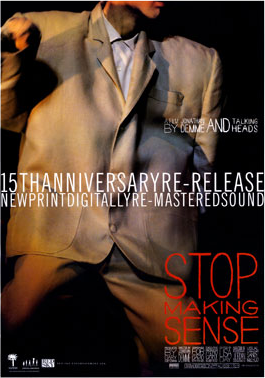
That’s the description to the opening sections of the movie Stop Making Sense provided within the booklet which accompanied the 1999 CD re-release. It remains the only concert-movie that I’ve ever made an effort to go and see at the time of release, doing so at the Edinburgh Film Theatre in 1984….why I chose to see it in Edinburgh rather than Glasgow I can’t remember. What I do know is that I was so mesmerised by it that I went back to see it again the next night in my home city.
It was a concert film unlike any other. No close-up shots of the audience nor of the musicians playing solos. No attempt to hide the fact that the road crew were an important an integral part of the show. The band re-arranged a number of the songs and in doing so turned them into what many Talking Heads fans consider to be the derivative versions.
One unforseen outcome however, was the attention focussed on the parts played by David Byrne at the expense of those other long-standing members, a situation that was to lead to ever-increasing friction and the effective break up of the band within five years.
Thirty years on from its filming in Los Angeles in December 1983, Stop Making Sense remains a highly impressive piece of work. And some of soundtrack still hold up well today:-








 THE NEW VINYL VILLAIN