A guest posting by Steve McLean
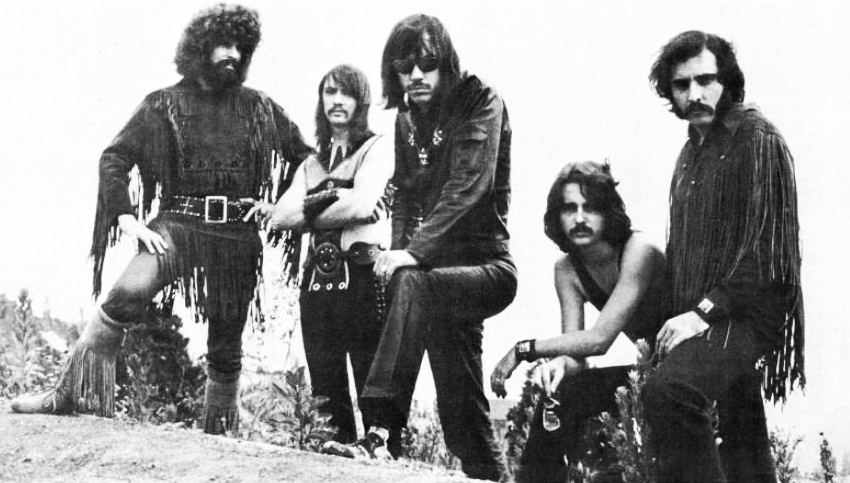
I’ve been having trouble deciding whether or not I should write this blog. The tale forms a large part of the back story for my book Stealing Deep Purple (DeepPurpleBook.com).
The problem is when I started the book I was so much more certain of the Steppenwolf story than I am now. I have spent months researching things like tour dates, gig guides and reviews. The more I find out, the less I know.
The many members of The New Steppenwolf band(s) seemed to increase every time I turned on my laptop or another story would emerge often contradicting the previous narratives… so I’ll try to be brief.
When Steppenwolf broke up in 1976 they had been reduced to two original members with various hired guns making up the numbers. Singer John Kay and drummer Jerry Edmonton were the last men standing.
In late 1976, founding member and Keyboardist Goldy McJohn reached out to his former bandmate, Nick St. Nicholas, to tell him that that a promoter had expressed an interest in putting together a new line up of the mighty ‘Wolf. Steve Green of Advent Talent Associates out of Phoenix, Arizona was a promoter who specialised in band reunions. The acts on his roster were often only loosely connected to the actual bands they purported to be. Green hatched the idea to ‘reform’ a Steppenwolf band with as many original members as he could.
“It was Green who got the idea to reunite a Steppenwolf band. Steve contacted Kent Henry first, then Nick St. Nicholas and Goldy McJohn…Steve essentially formed a Wolf revival band around me. Kent, Nick and Goldy had never met Steve Green.” Tom Pagan, Wolf Sightings Website
McJohn and St Nicholas would join up with Tom Pagan and Kent Henry, the former Blues Image member who had been in Steppenwolf for one album in 1971 (For Ladies Only) The band would be filled out by Jamie James on Guitar, Tony DeSanti on drums.
“I got this flurry of calls from Steve Green, promoters, attorneys. (They said) ‘Nick you gotta do this thing, it’s legit. We’re in touch with John and Jerry. What are you waiting for?” Nick St Nicholas, Magic Carpet Ride: The Autobiography Of John Kay And Steppenwolf by John Kay and John Einarson (Quarry Press, 1994)
By the start of 1977 the Steppenwolf ‘reunion’ tour was on the road. Green and Goldy figured they had at least partial rights to the name and the inclusion of Henry and St Nicholas would only consolidate that. John Kay did not agree.
Kay consulted legal advice but despite selling a shit load of records in the 1960s, he wasn’t exactly a rich man. John Kay didn’t have the money for legal action;
” They (lawyers) said we’d be well served by listening to what they wanted, which was to use the name and be left alone. We reluctantly allowed Goldy and Nick to lease the use of the name from us for a percentage of their gross earning, payable at regular intervals. (Steve) Green had apparently convinced Nick and Goldy that they were going to make millions. It was a small price to pay, they figured.” John Kay, Magic Carpet Ride: The Autobiography Of John Kay And Steppenwolf by John Kay and John Einarson (Quarry Press, 1994)
Also in the contract that Kay presented to McJohn and St Nicholas was the clause that they’d lose the rights to their royalties if they should default on the agreement. A contract like that in 2025 might well be illegal but they both happily signed it. This might seem like an inept move, but with the promise of majority percentage of the profits in an arena-headlining act with the possibility of a new recording deal, it’s easy to see how McJohn and St Nicholas were persuaded to continue.
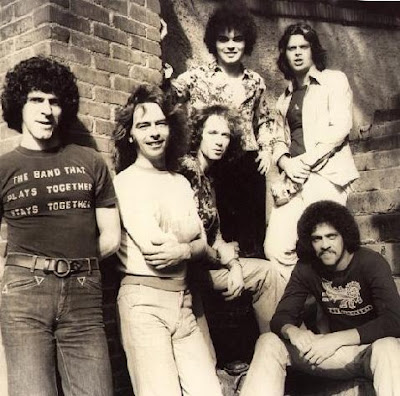
(The New Steppenwolf 1977 L – R : Goldy McJohn, Kent Henry, Nick St Nicholas, Jamie James, Tony DeSanti, Tom Pagan)
The agreement gave the reconstituted band a certain amount of confidence, they were supposed to be billed as The New Steppenwolf but often the ‘New’ prefix would be ignored. On occasion they’d be called the Original Steppenwolf.
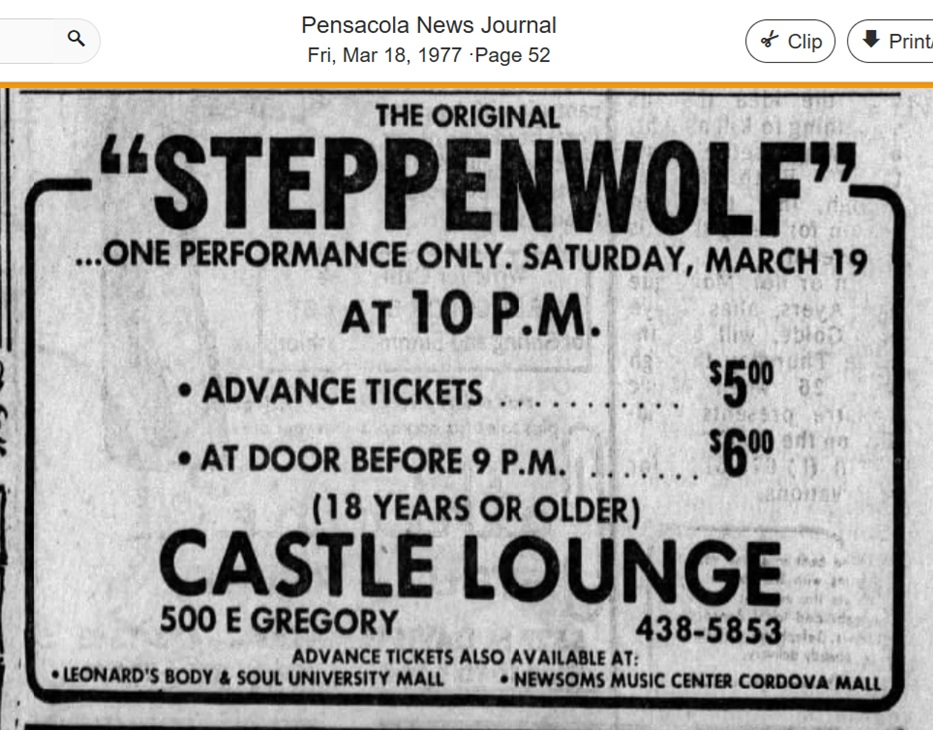
(The “Original” Steppenwolf)
It wasn’t too long before Henry “quit” the group and was replaced by Tony Flynn. Over the next few months there’d be multiple comings and goings, with Henry and Goldy both in and out of the band. Both would perform with backing groups billed as Steppenwolf.
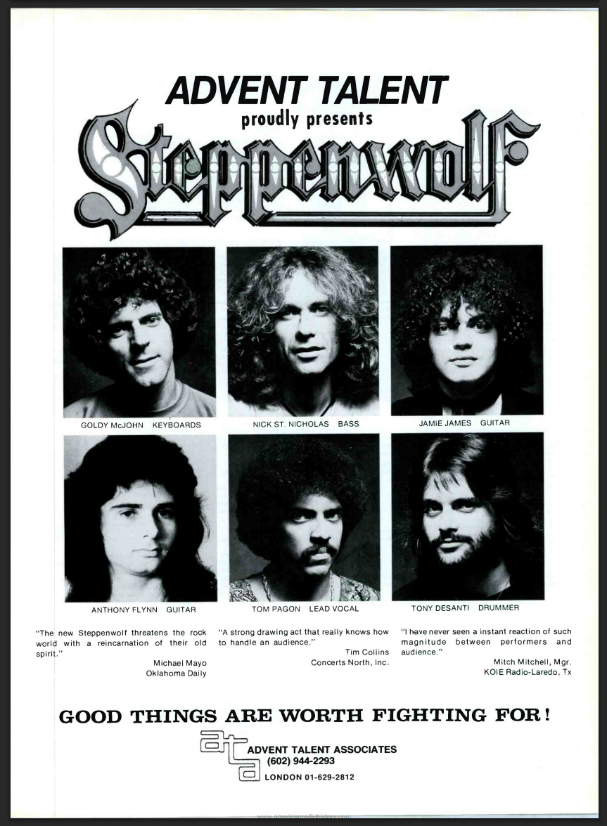
(Advert in Cashbox September 1977 – Enter Tony Flynn)
I’ve documented multiple instances of two Steppenwolf bands performing at the same time.. There have also been multiple stories about the members of The New Steppenwolf eventually fracturing and taking their own versions of the band out on tour. It seems this practice was in place pretty much from the start. An advert for a Kent Henry led Wolf band was posted as early as Spring 1977
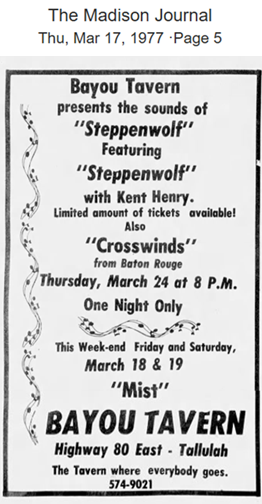
(Steppenwolf Featuring Kent Henry)
Given that Henry’s involvement for the proper Steppenwolf lasted for only around a year, the brass neck involved in this is shinier than Donald Trump‘s ring piece after an interview with Piers Morgan.
What I can’t work out is how much of the multiple bands were part of the plan and how much of it was the individual members, who had signed Kay’s contract, thinking that they had open season on the name Steppenwolf.
It’s probably safe to say that the various McJohn and St Nicholas’ versions of Steppenwolf were operating in cahoots. The Kent Henry version of the band was perhaps more of a rogue element, although they seemed to be also promoted by Green.
However, they never seemed to stumble over each other, playing shows in different parts of the states, even if at the same time. A combination of the band’s profile and the state of the mass media in the US at the time meant that a Steppenwolf band could comfortably play in two states at the same time with little in the way of news of either show leaving their respective towns of the gig. When Steppenwolf were booked to play shows in Germany they were also booked to be playing shows in Canada.
The best I can make out is that there would be at least one version of the band on the road at all times with another version ready to pick up the touring commitments when the first one was knackered. Add into that I think there was also a ‘pool’ of Steppenwolf musicians who would play ‘one-off’ type shows at festivals or tour different countries (usually Canada but sometimes Mexico). A 1996 interview with Steve Green in the Kokomo Tribune has him refer to these kind of shows as ‘soft seaters’, they were characterised as “fairs, festivals, rib fests, car shows’.
Then there were ‘the big shows’. Steppenwolf’s back catalogue would mean that they could still be a popular draw with the right branding. So, it wouldn’t be uncommon to see them on a ‘package’ bill with other Steve Green bands like Iron Butterfly or Cactus. The right concert line up could sell enough tickets to fill up three quarters of a 5,000 capacity arena, either in a remote location or on a party day like Labor Day or New Years Eve. People love a ‘Greatest Hits’ band on the right day of the year. I think these ‘big’ shows were reserved for the ‘main’ band whoever that might be at the time.
“I was in the band from the winter of late ’77 (tour in Europe), through New Years Eve at the Orlando Sports Arena, through the beginning of ’78 when Goldy took out a new band for Steve Green. Our Nick St Nicolas/Kent Henry version resumed touring in the summer of ’78 with Jim Hunter on drums, when I originally joined the previous fall I replaced Goldy” Evan Smith, Wolfsighting Website 2011
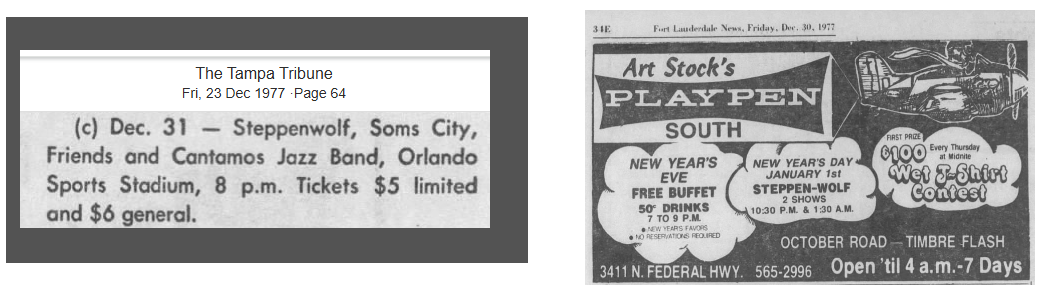
(The plight of a reconstituted band. One night you’re headlining 5000 capacity sports stadium
and the next you’re playing second fiddle to a buffet and wet t-shirt contest)
On one hand it makes perfect sense. Assuming most members apart from McJohn, St Nicholas and maybe Henry were on wages, leaving the licensee holders on profit share, then booking more than one group at once would maximise the amount of money the core members would receive.
As mentioned above, It was possible to do because news travels slowly in the 1970s small town America. Most newspapers have syndicated showbiz stories and it wasn’t uncommon for a music related article that ran in say a December issue of a Florida newspaper to be still running in a Californian publication by March. Gig reviews didn’t tend to travel. If a punter had heard of a Steppenwolf reunion and then Steppenwolf Featuring Kent Henry shows up at their local venue, they’d almost certainly assume that both were the same product. The dedicated music press like Rolling Stone magazine didn’t really care about Steppenwolf in the late 1970s and this worked to the band’s advantage.
By 1978, the pretence of a reunion tour had faded. Steppenwolf were now being booked like a bar band. If they have a booking for New York one evening and then the next they’re supposed to be in Texas, so be it. This is where the multiple versions of the band comes in handy…. And adds substance to my theory that it was less of a band and more of a franchise.
From 1977 until mid 1980, there was a band called Steppenwolf on the road somewhere in the world. Germany, Holland, Canada, Mexico and of course, the USA. I count over two dozen members to have appeared in the line ups over the course of three years. One Henry-led band also featured original Steppenwolf bass player Rushton Moreve. There were four members of Steppenwolf spread out over many different groupings.
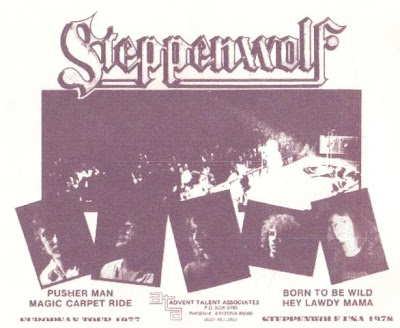
(Rushton Moreve, Bob Simpson, Kent Henry, drummer Jerry Posin and keyboard player John Hall.)
In 1979 there was at least one version of a Steppenwolf band with absolutely no members who had been in the group during their original run. Tony Flynn and Geoff Emery had found themselves with the name and some tour commitments to fulfil between 1979 and 1980. The problem of no original members was only a problem if the audience knew about it.
“One night Flynn even introduced himself on stage as Michael Monarch (the original Steppenwolf guitarist). Each night they’d say, ‘Who’s gonna play the original member this time?’ ” Lor Kane, Steppenwolf lead singer, Los Angeles Times, August, 1980
In 1979 John Kay had had enough. His patience for the various Steppenwolf’s ran out around about the time the band had stopped sending his licence fees, make of that what you will. The bad press reports of a name that he was associated with were mounting up. I should take this time to point out that not every show that the New Steppenwolf played were poor. As with all of these stories, history has a habit of deciding one thing or another. There are plenty of great reviews for Steppenwolf between 1977 and 1980, including an excellent one for a Kent Henry led version in Anchorage in January, 1980.
When the actual Steppenwolf broke up in 1976 they were still big enough to headline festivals and play small arenas. By mid-1979 they were reduced to dive bars and small theatres (albeit venues that held around 800 people). One of Kay’s main bugbears was the damage being done to Steppenwolf’s name.
The various versions of the band would turn up in various states of sobriety and play to various levels of ability. Steppenwolf’s reputation was in the toilet. It may have taken a couple of years, but the public were now asking questions about the membership.
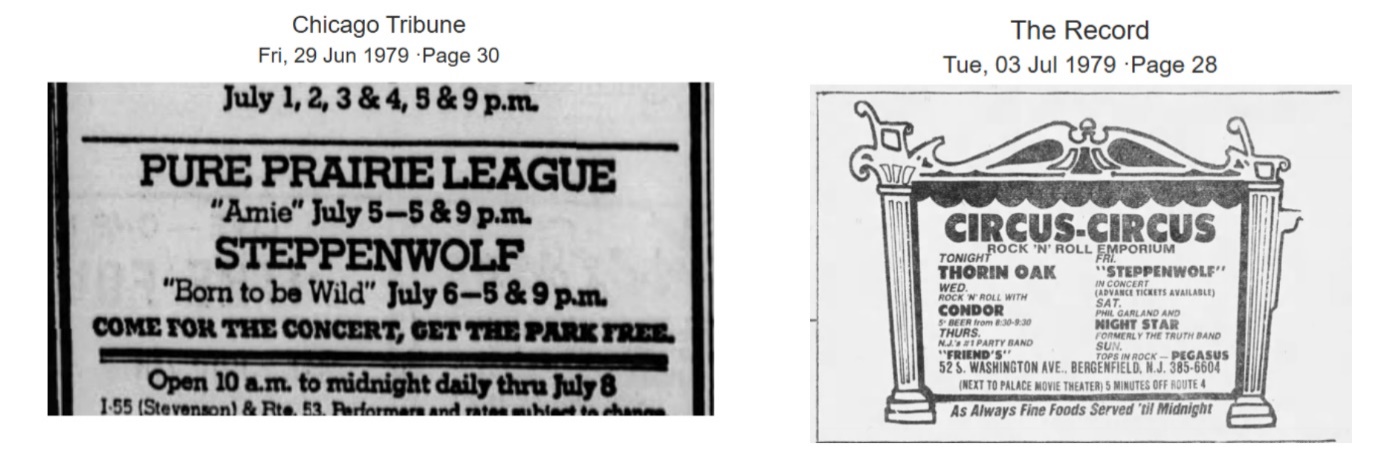
(Adverts for two Steppenwolf shows on Friday July 6th 1979, one in Chicago and one in New Jersey. A 12 hour drive away from each other)
Before Max Allen Collins wrote Road To Perdition he was a member of a bar band called Cruisin in the Iowa area, playing the same venues at the same time to that of the various Steppenwolfs. In an email to me he was able to shed some light on the kind of venue The New Steppenwolf had found themselves playing. He remembers The Moody Blue in Iowa.
“(It’s) Hard for me to believe Steppenwolf would play such a medium-size club/bar. The Moody Blue was on the grungy side, if I recall correctly, two adjacent rooms open to each other, with one that had a fairly high stage and the other was (I believe) the bar area. So you could dance in one area and drink in the other. There was an upstairs with dressing rooms, again grungy, and a large parking lot.” Max Allen Collins, Cruisin Member Via Email, 2025
For a band that reportedly commanded a $100,000 per show at their peak, this was a hell of a comedown.
Kay’s lawyers started to pursue the various ‘Wolfs for their failure to uphold their contractual obligations. In retrospect it’s hard to tell if Kay’s licensing contract was all part of a cunning plan or just a lucky stroke. Certainly, Kay will claim he was playing a long game because he knew that a contract dispute was a shorter and cheaper court case than a trademark dispute.
“(We) assumed correctly that Nick, Goldy and Steve would inevitably have a falling out. There were certain people involved in this scam who, by reputation, were questionable at best.” John Kay, Magic Carpet Ride: The Autobiography of John Kay and Steppenwolf by John Kay and John Einarson (Quarry Press, 1994)
If it was all a long-game then it wouldn’t be hyperbole to suggest that Kay’s contract amounted to a very clever honey trap. If there’s a written agreement to pay a regular percentage and that payment stops at any point, it that can be easily proved. Bank statements are simple things to produce.
“At some point cracks would start to show, and when that occurred, they would be in default. Then we would have them by the balls. Failure to live up to the conditions of the agreement would result in complete forfeiture of the name forever and continued use would be illegal.” John Kay, Magic Carpet Ride: The Autobiography Of John Kay And Steppenwolf by John Kay and John Einarson (Quarry Press, 1994)
The problem for McJohn and St Nicholas was that ultimately they were the ones left holding the baby. While there were many members of their Steppenwolf bands, it was their name on the licensing agreement.
“The guys behind the whole thing were heavy duty. They screwed me so hard and fast that I didn’t know where I was coming from. But once I signed off on the whole thing, I thought I’d get my royalties back.” Nick St Nicholas, Magic Carpet Ride book
While Goldy shouldered much of the burden of the legal case, Henry and St Nicholas may be seen as hapless fall guys or they could be viewed as wilful collaborators. What can’t be denied is that they were both adults in full control of their faculties who made the decision to align themselves to this project.
According to Kay’s biography, due to the frequent actions that were deemed to go against the signed contract, Kay and his legal team sent licensee holders notification of a breach and when there was no response or action with a specific amount of time, he sued for an injunction on the basis of a failure to meet contractual obligations. A judge ruled in Kay’s favour and as a result the other members had to give up their claims to the band name. As per the contract, Goldy McJohn and Nick St Nicholas also lost their royalty payments for previous work. A harsh punishment, perhaps.
“They knew what they were signing. We gambled that they would default and that sooner or later they would turn on each other, they did not disappoint.” John Kay, Magic Carpet Ride: The Autobiography of John Kay and Steppenwolf by John Kay and John Einarson (Quarry Press, 1994)
In late 1979 John Kay took the name back and spent the next decade returning to the venues that the New Steppenwolf had played, eventually returning them to an arena band under the name John Kay and Steppenwolf.
For a while this would mean yet another version of Steppenwolf were on the road and sometimes Kay’s band would just be billed without his moniker at the start.
From the 1980s onward Goldy, Nick and to a lesser extent Kent Henry would find themselves in various bands with names like The Wolf or Starwolf or Magic Carpet Ride or a multitude of other bands that gained their passage under the Steppenwolf banner.
Kent Henry passed away in 2009. He had a lifetime of drug issues and in the 1990s started to suffer from seizures and developed the early stages of Alzheimer’s disease shortly before his death. During the late 1970s into the 80s he fronted a new version of the Blues Image.
Goldy passed away in 2017 of a heart attack. After a stint in the reformed Humble Pie he went on to front Goldy and Friendz, which was a de-facto New Steppenwolf band and they became The Magic Carpet Ride.
Nick St Nicholas is still alive as of September 2025. He’s involved in a ‘supergroup’ that play Las Vegas called The World Class Rockers that feature the likes of Aynsley Dunbar (Journey, Whitesnake), Greg Walker (Santana), Michael Monach (Steppenwolf) Randall Hall (Lynard Skynyrd, but the 90s Skynyrd) and Fran Cosmo (….nope, me neither).. Playing if fast and loose with the word ‘supergroup’…. They’re probably okay if you need a break from the cocaine and gambling.
In 2018 John Kay decided to retire Steppenwolf. He still plays the occasional solo blues shows.
As late as 2024 the Steppenwolf name was still being misused. A tribute show called “Revisit Steppenwolf” claimed to feature some people who’d been in Goldy McJohn’s band ‘Goldy and Friendz’ plus members of The New Steppenwolf and John Kay and Steppenwolf. It’s not entirely clear how much of this is true since an advert for the show also promoted the fact that Kent Henry was in the band…. Kent died 10 years before the advert was placed.
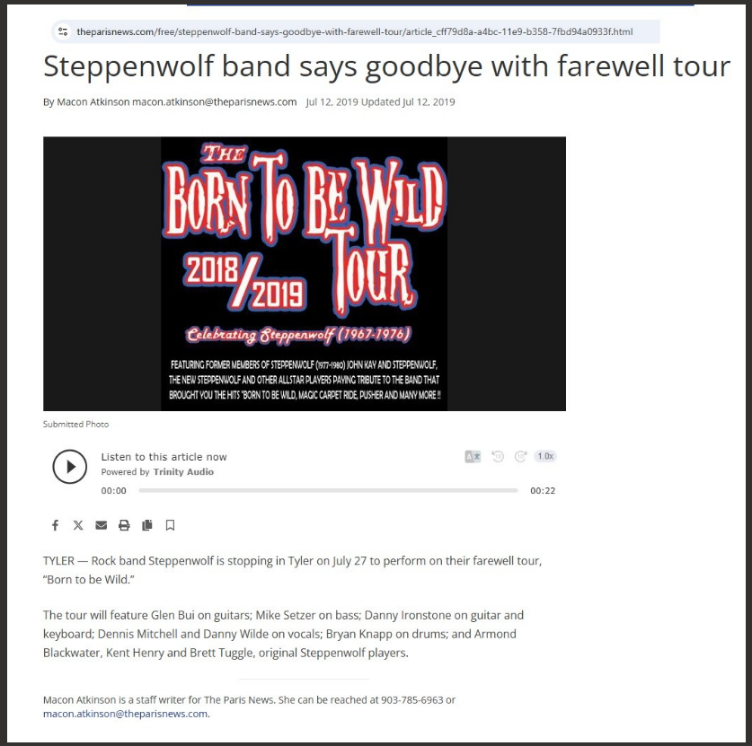
(Revisit Steppenwolf; Born To Be Wild tour – who says an intern can’t design a good logo)
The singer is a chap called Danny Wilde who was apparently a survivor of the 1980s LA Rock scene. In 2019 Revisit Steppenwolf (which at times found itself just billed as Steppenwolf) announced a final tour. One pandemic and four years later and Danny Wilde is advertising himself as the “Former frontman for multi platinum selling band Steppenwolf”.
This info was posted in Steppenwolf Facebook fan group and it was countered with the fact that John Kay’s manager monitors the group for such things and it will now get ‘sorted out’. Although at this point it feels like two bald men fighting over a comb (to Scottish football fans this is also known as The Old Firm Derby).
Following this up was a post from someone who had briefly been in the original Steppenwolf, The New Steppenwolf and was a performer on the Steppenwolf Revisited tour. It seems that the threat of Kay’s manager might carry some weight.
“I played keys with many variations of Wolf since I replaced Goldy after John fired him in 1975. Glen Bui’s Steppenwolf Revisited was the last iteration I played in. Fans would ask and Glen Bui (Former Goldy and Friendz member) would launch into a long history lesson on band mates, court actions and Federal judge rulings. I wound up regarding Goldy as a dear friend through a series of conversations we shared until his untimely death. Goldy was one of my greatest influences on Hammond organ. I loved his crunchy sound and his percussive Jon Lord approach. We had many lead singers over the years but the only Danny I’ve ever heard of was my B3 brother Danny Ironstone.” Armond Blackwater, Steppenwolf Member 1975, New Steppenwolf Member 1978 speaking in the Friends of Steppenwolf Facebook Group 2025.
This could well be true, everything was such a long time ago and certainly any show advertising a deceased guitarist can’t be trusted. However a musician that Armond tagged in his post, Glen Bui, had previously tagged Danny Wilde and Armond in some gigs together.
It seems that nearly fifty years after John Kay first chose to franchise the band, that there’s still call for a group called Steppenwolf. In a perverse way, that’s not actually too bad of a legacy.
Thanks for reading this. The problem with this story is that the devil is in the detail. Once I’ve managed to document all of the band members that I can, I’ll start work on making sense of the whole shebang. There’s a book in this, or at least several other blogs.
I’ve not picked any songs to go along with this blog as I didn’t want to interrupt the flow of an already condensed story. But it’s well worth recognising that Steppenwolf did produce some killer heavy rock. Born to be Wild is the obvious call but I think it has been overplayed. Magic Carpet Ride is still an absolute classic.
mp3: Steppenwolf – Magic Carpet Ride
From the mid 1970s, John Kay had a strong desire to be recognised as a solo artist but it sadly never really happened for him. All of his most successful work was done between 1967 and 1972. He did have a great career, headlining arenas up until his retirement. It seems fitting to enjoy a lost John Kay classic; The minor hit, Moonshine (Friend of Mine) is from his 1973 album My Sporting Life (Steppenwolf were on their first break at the time)
mp3: John Kay – Moonshine (Friend Of Mine)
I’ll repeat here in closing; I think that the New Steppenwolf needs to be seen as less of a band and more of a team orchestrated by the promoter and the main-men of the group. Like a musical version of Mission: Impossible where the leader chooses who’s right for the gig and by right I mean who’s available and who’s cheapest. “Jim, we need two teams (bands) to do two separate missions (gigs)? Did I say two? I meant four”
Incidentally, three of the musicians in the New Steppenwolf, Tony Flynn, Geoff Emery and Dick Jurgens (who sounds like an STD) went on to be involved in The New Deep Purple…. But that’s another story.
I’d like to thank Max Allen Collins for answering my email.
 THE NEW VINYL VILLAIN