A guest series by Fraser Pettigrew (aka our New Zealand correspondent)
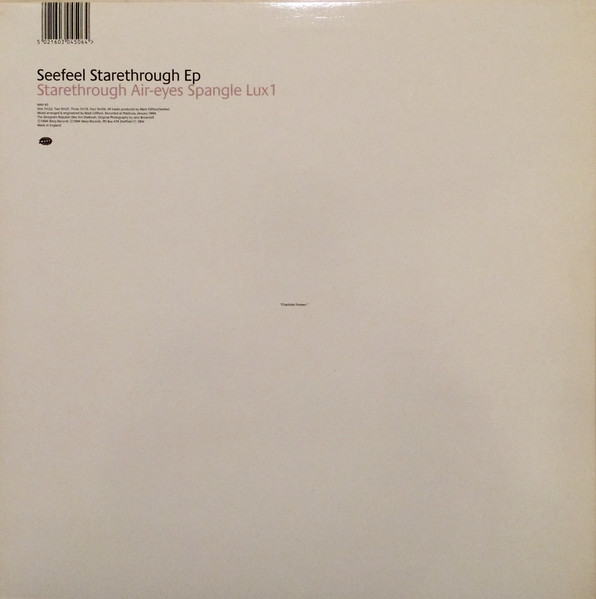
#6: Starethrough – Seefeel (1994)
I can’t now remember how Seefeel became known to me. Perhaps it was a magazine review, but at any rate I picked up the Pure, Impure CD around the middle of 1993 and took an immediate liking to it. Initially I thought it was their first LP, but later realised that it was merely the Plainsong 3-track EP bundled together with two Aphex Twin remixes of the track Time to Find Me from their earlier debut EP More Like Space, and rounded off with an unreleased remix of Plainsong.
In the Autumn of 1993 Seefeel released their first album proper, Quique, which enjoyed frequent spins on my Ariston Q-deck over the following months. In February of 1994 I then got the chance to see them live when they came to the Cambridge Corn Exchange as support to The Cocteau Twins. I went along specifically to hear Seefeel rather than The Cocteau Twins, in whom I wasn’t particularly interested. I can hear your eyes swivelling in your heads all the way down here in NZ.
I seem to recall some comment about Seefeel, perhaps from the theoretical magazine review, that described them as a guitar band that didn’t sound like a guitar band, and that was borne out by their live performance that night. They certainly looked like a guitar band, taking the stage with a standard drum kit, a bass player, and at least one guitar, as well as a small bank of electronics.
Once they started playing, however, it was clearly the electronics that were creating all the surface texture and atmosphere to the music. The crisply rhythmic drums and dub-heavy bass set up an unchanging foundation, but the guitar was fed through some kind of sampling and looping process that created multi-layered washes of sound that grew and changed as each piece developed.
In retrospect, it appears that the Seefeel method was an early use of the kind of technology that is now commonly at the fingertips (or toes) of many musicians. A few years ago I saw ex- Mutton Bird Don McGlashan here in Wellington, performing solo but using a foot pedal sample and loop set-up to build up a backing accompaniment that created the effect of a small ensemble rather than one bloke with a guitar (and a French horn to recreate the signature motif from The Mutton Birds’ ‘Dominion Road’).
The nearest point of reference I had to Seefeel’s music was Fripp and Eno’s mid-70s collaboration on No Pussyfooting and Evening Star, and in fact the technique is not dissimilar. Eno used two reel-to-reel tape recorders with a continuous loop of tape strung between the two, the first one recording Fripp’s guitar figure and then the second one playing it back while the first was still recording, adding layer upon layer of sound to create a great pulsating tide of music. Seefeel’s technology was digital rather than analogue, but the principle was pretty much the same.
The difference was that Fripp and Eno used no percussion, where Seefeel’s sound was pleasantly propulsive, an original and fortuitous blending of indie and dance music that didn’t just re-hash Screamadelica.
A couple of months later, the Starethrough EP came out. It was recognisably Seefeel, but things had obviously changed a little. Perhaps it was the new label. The first singles and album had all been released on Too Pure, the indie label that had first introduced PJ Harvey and Stereolab to the world, along with several other largely rock-oriented artists. While Seefeel may have looked the part in photos, their sound was perhaps not comfortable in such company. Starethrough came out on Warp, which should give you a better idea of what you’re about to hear.
The dreamy blend of dub and shoegaze that characterises Quique is still there to a large extent. The track titles share the faintly romantic connotations of the first album. Air-eyes, Spangle and Lux1 complete the quartet of pieces, evoking similar feelings to Quique track names like Charlotte’s Mouth, Climactic Phase #1, Polyfusion.
Musically, the title track is in a similar groove to much of Quique, with a deep, dubby bass line, ethereal, wordless vocals from Sarah Peacock and looping, overlapping glissando guitar. The percussion, however, forsakes the conventional rock kit for a more or less uniform synthetic timbales sound throughout. Air-eyes sounds as it reads with no bass or drums, just dreamy electronic wash. Spangle picks up the metallic drum sound again but rhythmically none of this can be construed as dance music, unlike most of Quique. It’s well into ambient territory and the drums frequently sound more like bumps in the road rather than smooth rails helping the music along.
The follow-up single in September 1994, a neat little 10” disc titled Fractured, previewed the second album Succour which came out the following March. In both look and sound, the single and album present a quintessential Warp Records experience of abrasive, abstract electronica wrapped up in austere, typographically smart-arsed packaging, with track titles like pseudo-classical sci-fi planet names: Gatha, Ruby-Ha, Tempean. None of these track titles are actually printed in full on the sleeve, instead abbreviated to look like fictional elements in the periodic table: Ga05, RuH06, Tempean not even abbreviated, just listed by the superscript 11.
The music is equally inaccessible. Emotionally, if we are on one of those sci-fi planets, it’s a cold, industrial one, on which we find ourselves trapped in lightless mineshafts rather than tripping through sunlit meadows. See? Feel? With Succour I am blind, groping my way across wet, hard metal. If you are a fan of things like Aphex Twin’s Selected Ambient Works Vol 2 you might enjoy some of the ferocious sonic textures there. Unfortunately, I’m not, so at this point, Seefeel and I parted company. I was completely oblivious to the 1996 release of a mini-album (Ch-Vox) which I’ve still never heard, and with track titles like E-hix² I’m not that bothered. By all accounts it was a close cousin of Succour.
And that was that for Seefeel for the next fourteen years until out of the blue appeared the self-titled Seefeel album in 2010. I’ve listened to it online a couple of times and it’s something of a return to the lighter textures of their early work, but doesn’t rekindle the fire all the same. Last year saw two releases, another couple of mini-albums called Everything Squared and Squared Roots. I haven’t heard either of them, but the latter appears to be remixes of material from the former, although so different you’d never know, according to one review. The urge to seek them out is not terribly strong as I suspect none of it will approach the pleasures of their earliest work which I was lucky enough to catch at the time, with Starethrough the closing act of that phase.
Starethrough
Air-eyes
Spangle
Lux1
 THE NEW VINYL VILLAIN