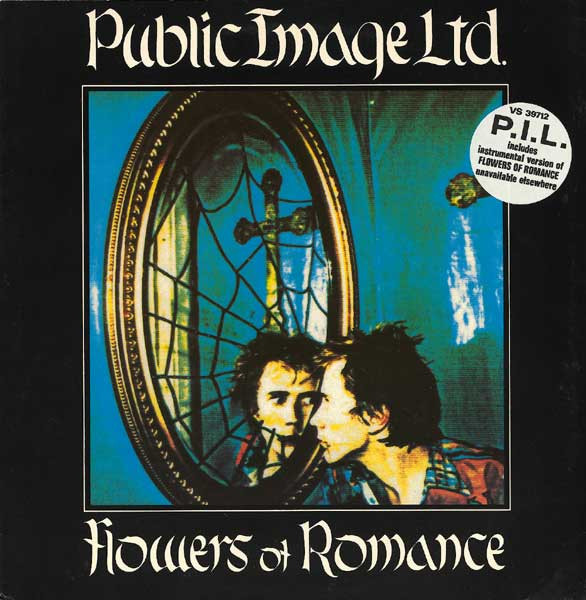
THE 12″ LUCKY DIP (30): Public Image Limited – The Flowers of Romance

Let’s begin with a contemporary review:-

SINGLE OF THE WEEK

Sheer deloight! – As the fellow himself might say. This is the first PiL single in well over a year, and however dubious their excuses might sound, ‘Flowers’ is at least fair compensation for all the waiting around.

As title-track, it augurs well for the LP to follow. One of the starkest, most single-minded pieces they’ve ever done – on first hearing it seems all thudding drum and piercing Lydon whine – ‘Flowers’ stands supreme this week; one of that tiny handful of records cable of provoking some emotional response in the listener.

Take the time to get to know it, the hypnotic beat, those uniquely chilling vocals – a relentless montone – and the eerie, vaguely Eastern drone at the music’s core. On the face of it, ‘Flowers of Romance’ is hardly a song at all, but on the inside it’s really much, much more. Let’s have more!

That’s from the NME of 28 March 1981.

I’ll agree with one part of the review, namely that it was one of the starkest, most single-minded pieces they’ve ever done.  It’s as strange and disturbing as earlier single Death Disco, and let’s not forget that it had been written by John Lydon for his dead mother in response to her wish that he come up with a disco song for her funeral.

Public Image Limited had more or less disintegrated during 1980, being basically a duo of Lydon and Keith Levene, and the latter was no longer interested in playing guitar.  No attempt was made to bring in a replacement bassist for Jah Wobble, while the drums were entrusted to Martin Atkins, and it’s his playing which sort of dominates the single.

mp3: Public Image Limited – Flowers Of Romance (extended version)

‘Sort of’ in that you can’t ignore Lydon’s relentless painful sounding vocal, nor Levene’s contribution via a Stroh Violin.

One thing to mention is that the extended version on the 12″ is a bit of a con as it is actually just the 7″ version with the instrumental version added on with just the tiniest of gaps at 2:47.

The b-side is an old track, in that the songwriting credits list the four band members who played on the 1978 album, Public Image : First Issue.  Possibly an outake?

mp3: Public Image Limited – Home Is Where The Heart Is

All in all, it really did make it a very unlikely chart hit, which it was, as it peaked at #24.  I can’t recall ever hearing it on the radio at the time – I certainly didn’t buy it in 1981, and this was another picked up second-hand many decades later.

JC

WHEN THE CLOCKS STRUCK THIRTEEN (May)

The month of April hadn’t been too shabby, and indeed the first of the charts being looked at this time around (29 April – 5 May 1984) kind of illustrates this, with OMD, Blancmange, The Bluebells and New Order all sitting in the Top 20, where they were joined by another synth band with this week’s highest new entry at #19:-

mp3: The Human League – The Lebanon

It was their first new music in over a year, and was on the back of their past six singles all being Top 10 hits, including a #1 and two #2s.  What only became clear a short time later, when the album Hysteria was finally released in mid-May, a full two-and-a-half years since Dare, was just how less immediate and pop-orientated the band had become during what had turned out to be fraught times in the studio. My memories of this one still centre around the incredibly negative press reaction to the song, much of which centred on the seemingly trite lyrics.  It has to be said, it sounded back in 1984, and it hasn’t really aged well.

6 May – 12 May

The first thing I noticed about this chart was that nine of the Top 10 from the previous week were still up there in the higher echelons.  Duran Duran, Phil Collins, Queen, Pointer Sisters, OMD, Bob Marley & the Wailers, The Flying Pickets, Blancmange and Lionel Ritchie were keeping their major labels feeling good about life.  It must have meant the Top of the Pop programmes around this time were very much on the repetitive side.

Looking further down, it was a good week for lovers of dance-pop, or disco-lite, as I used to refer to it.  Somebody Else’s Guy by Jocelyn Brown, Let’s Hear It For The Boy by Deniece Williams, Ain’t Nobody by Rufus and Chaka Khan and Just Be Good To Me by the SOS Band, were all in the Top 20 and to do this day can still be heard regularly what now pass as the easy listening/nostalgia radio stations.  I can’t deny that I would have danced to these when they aired in the student union discos….iy wasn’t all Bunnymac and flailing raincoats y’know.

Highest new entry this week belonged to Marillion, in at #23 with Assassing, which is one that I genuinely cannot recall in any shape or form. Unlike the song which came in at #49:-

mp3 : Everything But The Girl – Each and Everyone

Tracey and Ben‘s first chart hit.  It would reach #28 later in the month.  But it wasn’t the best song to break into the Top 75 this week….

mp3: Orange Juice – What Presence?!

By now, the band had been reduced to a rump of Edwyn and Zeke, augmented by Clare Kenny on bass and Dennis Bovell on keyboards and production duties.  The record label had given up on them but in the midst of it all, they not came up with this memorable 45 but a ten-song album filled with brilliant moments.  What Presence?! eventually claimed to #47 when it deserved so much more.

13-19 May

The inertia at the top end of the charts was maintained, with yet again nine of the previous week’s Top 10 staying up there.  The highest new entry was at #29, and belonged to Ultravox whose Dancing With Tears In My Eyes made it eleven hit singles in a row stretching back to 1981. By contrast, the song coming in at #60 meant a debut hit for a group signed to one of the best independent labels in the UK at the time:-

mp3: The Kane Gang – Small Town Creed

This would be as good as it got for Small Town Creed, but Martin Brammer, Paul Woods and Dave Brewis and Kitchenware Records would enjoy bigger successes before the year was out, so stay tuned.

One more 45…..

mp3 : Public Image Ltd – Bad Life

I’ve always thought of this as the ‘forgotten’ PiL single.  For one, it was a flop, with its #71 placing this week being its peak, and secondly, it was later left off The Greatest Hits, So Far, which was supposed to have compiled all the band’s singles from 1978 to 1990 along with a new track, Don’t Ask Me.  It’s not the most obvious of memorable of the PiL songs, and it suffers from a typically OTT 80s style production, but there’s a fair bit of interesting bass slapping along with Gary Barnacle‘s contribution on sax to make it worth a listen.

20-26 May

I’m not a music snob.   Well, that’s a bit of a lie.  A bit of a big lie.  But sometimes a song so catchy and poppy and ultimately timeless, that it has to be given due recognition on the blog.  And so it is with the highest new entry this week, in at #4, eventually going on to spend two weeks at #1 and selling umpteen millions.

Just kidding.  And apologies for those of you desperate to hear Wake Me Up Before You Go-Go by Wham!

Not too far lower down was the new entry at #11, and that rare thing of a double-A sided single:-

mp3: The Style Council – You’re The Best Thing
mp3: The Style Council – The Big Boss Groove

The ballad had been one of the most well-received songs on the debut album Cafe Bleu, and for its release as a 45, a saxophone solo was added.  The more upbeat number was a brand-new composition, and one of the more obviously political numbers of the early TSC era.  Funny enough, the radio stations rarely played The Big Boss Groove, while You’re The Best Thing was omnipresent.

I’ve written before that Best Thing, without fail, takes me back to what was a very happy time, travelling with my girlfriend across Europe on cheap student railcards visiting cities that previously had only been figments of our imagination.  This was very much ‘our song’.  The relationship was a very happy one for a decent enough time but sadly it turned sour before 1985 was over.  I’ve always associated Best Thing was all about that particular relationship and so even when I’ve tried to woo subsequent girlfriends with the help of with compilation cassettes which showed off my musical tastes, I never once included this absolute classic on any of them.

It climbed to #5 the following week, which proved to be its peak position.

Passing mention of a few other new entries this week, most of whom are still going strong today (and I’ll leave that to you to judge if it’s a good thing or not).  Bruce Springsteen, Rod Stewart and Elton John with Dancing In The Dark, Infatuation and Sad Songs (Say So Much).  A slightly longer mention of the new entry at #71:-

mp3: Lloyd Cole & The Commotions – Perfect Skin

The debut single.  Perfect Skin was a genuine slow-burner.  It actually fell out of the Top 75 the week after making its initial entry, but then went on to enjoy placings of 54, 45, 40, 30, 26, 32, 44 and 57, thus ensuring it is another that I very much associate with the wonderfully romantic summer of 1984.

27 May-2 June

The chart which crosses over into the month in which I celebrated by 21st birthday.  In at #19 was a song I very much associate with the day and night of that event.

mp3: The Smiths – Girl Afraid

OK…..this didn’t actually chart, but Dirk just last week featured Heaven Knows I’m Miserable Now, so please indulge me as I recall and feature what I feel is that the far superior and danceable b-side.  A song that was very drunkenly played very loudly on repeat back in the flat after a few too many had been had while out in Glasgow.  Lots of hugging, lots of dancing etc, etc.

mp3: David Sylvian – Red Guitar (#21)

Not so much frantic dancing to this one, for the first solo hit single from the former frontman of Japan – his previous 45s had been collaborations with Riuichi Sakamoto – but there was a fair bit of posing to it down to the student union, which by now was incredibly quiet with so many folk returning home for the summer. It was just the diehards hanging around, especially on Thursdays, but that meant all requests tended to get played.  More happy memories.

This week’s chart also saw the appearance of what I have long believed to be one of the most important 45s of all time:-

mp3: Bronski Beat – Smalltown Boy (#35)

I again make no apologies for repeating myself. It is all too easy to forget, from the distance of more than 40 years, of the extent of the bravery of Jimmy Somerville and his bandmates for being so open about their way of life and their views. Their records, and those of such as Pet Shop Boys and Frankie Goes To Hollywood took the celebration of queer culture into the mainstream, and made many people realise, probably for the first time, that homophobia was every bit as distasteful as racism and apartheid.   A genuine came-changer in terms of altering a lot of attitudes, Smalltown Boy would reach #3 during what turned out to be a thirteen-week stay in the Top 75.

Two more before I sign off.

mp3: Siouxsie & The Banshees – Dazzle (#38)
mp3: Marc Almond – The Boy Who Came Back (#63)

A couple of ‘blink and you might miss them’ hits.  Dazzle was the fifteenth chart hit for The Banshees, but its stay in the charts was a mere three weeks.

Just three months after the final Soft Cell single, Marc Almond released his first solo effort.  With a lyric that possibly hinted at his thinking for wanting to leave Soft Cell behind him, the tune was less immediate and struggled for radio airplay, a big factor in it spending five weeks in the lower end of the hit parade – 63, 59, 54, 52 and 70.  Nobody knew it, but that would more or less be the story of the solo career until Marc went down the route of collaborations or cover versions.

Couple of things to mention. This morning sees me off on my travels again, back one more time to see some friends in the Greater Toronto area.  While I’ll do my best to drop in over the next week or so, there’s every chance the comments section in particular will get a bit messy with loads of anonymous/unattributed contributions that I’ll tidy up as best I can as and when I’m able.

And of course, Part 2 of the May edition of When The Clocks Struck Thirteen will be offered up over the next couple of weeks.


JC
HERE’S THAT RHYTHM AGAIN….

A guest posting by Fraser Pettigrew (aka our New Zealand correspondent)

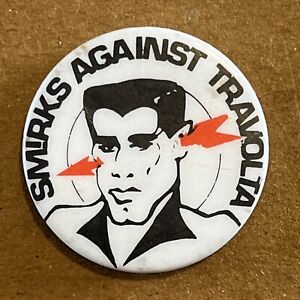
The Smirks were a short-lived band from Manchester whose chief contribution to posterity was as leaders, indeed sole proponents, of the parodic ‘Smirks Against Travolta’ movement. In 1978, I sent away for one of their badges which showed a cartoon of the iconic Saturday Night Fever star, his head impaled through the ears by a big red arrow in obvious homage to the Anti-Nazi League’s Rock Against Racism campaign materials. The Smirks’ campaign had a semi-serious intent to defend live music venues against the progressive dominance of discos and the formulaic dance music records that fuelled them. The punk era seemed like a propitious moment of revolt against the mainstream music industry, and disco music epitomised its commercialised, mass-produced product.

In 1977 and 1978 it seemed as though the early punk and new wave hits were but far-flung islands in an ocean of disco. Every other single featured on Top of the Pops seemed to bounce along four-to-the-floor on shimmering hi-hat ripples backed by scratchy wah-wah guitars and alternating octave bass lines. And it wasn’t just American R&B acts that were doing it. Old timers like The Bee Gees and even The Rolling Stones were doing it, Abba were doing it, Bowie was doing it. If somebody wasn’t doing it they soon would – I’m looking at you, Rod Stewart. It’s easy to see how The Smirks could view disco as a malignant algae slowly smothering every other lifeform in the sea.

In 1978, I didn’t like disco. Disco was the enemy, it was the commercial mainstream, it was the antithesis of punk and new wave. Disco music was not the music of teenage rebellion, it was the music of flare-wearing bubble-headed conformists, obsessed with superficial personal attractiveness. Disco kids were socially acquiescent good-timers, not uncompromising and intellectually fearless iconoclasts intent on remaking the culture in a constant cycle of destruction and renewal, like what I was.

Ironically, however, the ‘anything goes’ eclecticism unleashed by punk was already in the process of spawning music that blended new wave experimentalism with the stylised sounds of disco and its elder sibling funk. It wasn’t properly until 1979 that this seemingly taboo musical miscegenation was born, but the seeds were sown by the end of 1978. Ever the pioneer, John Lydon’s Public Image Ltd filled out the last eight minutes of their first album with the disco-loop time-waster Foederstompf. Despite its explicitly ‘contractual obligation’ nature (at one point Lydon sing-chants the line “how-to-finish-the-album-with-the-minimum-amount-of-effort-necessary…”), the track sets up a style marker that was picked up in startling fashion six months later on their second single Death Disco. Did exactly what it said on the tin. One of the strangest things ever to appear on Top of the Pops.

A month after PiL’s First Edition, in January 1979, New York punk scene graduates Blondie released Heart of Glass and within a week it was at number 1. It’s well known now that the song started life some three or four years earlier, and before it acquired its eventual form and title (when recorded in June 1978) it was referred to by the band as ‘the disco song’. Blondie had earlier included disco cover versions in their live set, including Donna Summer’s I Feel Love.

The single that Heart of Glass bumped off the top spot was Ian Dury and the Blockheads’ own disco classic, Hit Me With Your Rhythm Stick. In truth The Blockheads had always been a bit funky, and were never in any sense punk, but they surfed to prominence on the new wave, bearing an outsider affinity on account of Dury’s disabled skinhead Essex geezer persona and lyrical fondness for society’s nether parts.

Another of our favourite bands, Talking Heads, fellow alumni with Blondie of the CBGB school, had quite frankly been doing disco since day one. Talking Heads ’77 was a blueprint for blending slick, poppy dance rhythms with weirdo art-nerd lyrics, luring you onto the floor like the cutest boy in the class until you realised you were dancing with a bookworm, a civil servant, a psycho killer. More Songs About Buildings and Food delivered further explicitly disco tunes like The Girls Want to Be With The Girls, Stay Hungry and Found A Job, Frantz and Weymouth nailing the crisp tempos on hi-hat, snare and bouncing bass, Byrne and Harrison rubbing ‘chicken-scratch’ rhythm guitar straight out of KC and the Sunshine Band. There was a cover of an Al Green song.

The combined effect was to sand away the stigma associated with disco and funk. Did we disown Blondie? Had PiL sold out? No one complained, least of all me. Like everything else, my fearless iconoclasm was a pose, and though I genuinely didn’t like mainstream regurgitation, the appropriation and subversion of popular forms was obviously different, yeh? Also, music was supposed to be fun. Everyone wanted to party and the admission was grudgingly made that disco was 100% party music. Nobody was going to get up to The Bee Gees, but slap on Heart of Glass or Bowie’s Golden Years and we were on it. Something to do with the packaging.

Well away from the chart spotlight, other artists were taking funk and disco stylings and bolting them onto some distinctly uncommercial material. In The Smirks’ back yard, A Certain Ratio were beginning their rapid evolution towards icy, stripped down funk. In deepest darkest Bristol, The Pop Group compounded the irony of their name by confrontationally screaming agitprop over grooves that sounded like James Brown and George Clinton jamming in an abattoir.

So, in short order, my dislike of disco on purely aesthetic grounds vanished even faster than The Smirks. Just as well, since the following years saw a rapid diffusion of disco and funk throughout every level of post-punk music. You can hear it in the ‘Sound of Young Scotland’ in Orange Juice and Josef K, The Fire Engines, Boots For Dancing, in the Euro-disco of The Skids and Simple Minds, and in the warped pop of Associates.

New Order mashed up Kraftwerk and Giorgio Moroder to produce Everything’s Gone Green, following it up with Temptation, and eventually the monster techno-disco breakthrough of Blue Monday. The Pop Group never had a hit, assuredly for want of trying, but their former bassist Simon Underwood tasted success with Pigbag, whose James Brown-referencing Papa’s Got a Brand New Pigbag even inspired Paul Weller to jump on the bandwagon by ripping off the bass line for The Jam‘s disco song Precious.

By the beginning of the 80s, disco was as much part of the new wave as it was of the mainstream. And through the distinctive phenomenon that was Grace Jones, the new wave found itself infiltrating disco. In the late 1970s, the former fashion model had made a musical name for herself in the gay club scene with high-camp singles such as Do or Die and I Need a Man, but after teaming up with the Compass Point All Stars, her albums Warm Leatherette and Nightclubbing supplied a wider alternative club scene with some unexpected dance floor fillers. The former album’s title track could hardly be of more obscure origin, a cover of a proto-industrial synth pop single based on J.G. Ballard’s Crash, written and produced by The Normal, aka Daniel Miller, founder of Mute Records, the future home of all things alternative. Other covers followed, drawn from The Pretenders, The Police, Iggy Pop, Roxy Music and, most eyebrow-raising of all, Joy Division. When I occasionally frequented Edinburgh club JJ’s in the early 80s, Jones’s versions of She’s Lost Control and Warm Leatherette were staples, along with tracks like Bowie’s Stay, from Station to Station, and Material’s Bustin’ Out.

Bustin’ Out flags up another significant strand of alternative disco, the New York underground, propelled by experimentalists like Bill Laswell and Arthur Russell, ‘no-wave’ acts such as ESG, and the ZE Records stable that included Was (Not Was), Kid Creole and the Coconuts, Lizzy Mercier Descloux as well as Laswell’s Material. All of this fed alternative influences back into the disco club scene, ultimately influential in the metamorphosis of disco into house and techno in the late 1980s, a development further fuelled by post-punk electro-pioneers like Human League and Heaven 17, Depeche Mode, Throbbing Gristle and their offshoots Chris and Cosey, Yazoo and Erasure.

In parallel with all this painfully hip consumption, my musical tastes were being broadened to embrace some of the soul and funk originators like Sly and the Family Stone, Stevie Wonder, Isaac Hayes and Marvin Gaye. Several of my friends expressed healthy respect for the danceable end of soul music. One of them only ever wore white socks. Not long after it came out, I bought Off The Wall, easily one of the best pop/disco albums of all time. The barriers were down. I am now unashamed to reveal that my record collection holds prized items by such as Shalimar and the Detroit Spinners, and Brit-disco acts like Linx, Imagination and The Real Thing. Whisper it, I even have The Bee Gees’ Saturday Night Fever tracks on a CD, and they’re great. As Funkadelic so succinctly and eloquently phrased it, “Free your mind and your ass will follow.”

mp3: PiL – Death Disco
mp3: Talking Heads – Stay Hungry
mp3: The Pop Group – She is Beyond Good and Evil
mp3: The Jam – Precious
mp3: Material – Bustin’ Out (12” version)
mp3: Grace Jones – Warm Leatherette
mp3: David Bowie – Stay
mp3: Loose Joints – Is It All Over My Face? (Single female vocal version)
mp3: Heaven 17 –  I’m Your Money (12” version)
mp3: Linx – Wonder What You’re Doing Now


Fraser

SHAKEDOWN, 1979 (October)

79

The first of the singles charts to be looked back at this time around covers 30 September–6 October.  The Top 3 positions were taken by The Police, Blondie and Gary Numan.  Quite a few of those mentioned over the past two editions of this series were still showing up well in the Top 50 – Buggles, Michael Jackson, Secret Affair, Madness, Squeeze, The Jags, The Skids, Roxy Music, XTC, The Stranglers, The Specials, Stiff Little Fingers and Siouxsie & The Banshees.

I’m mentioning all of this as it was a chart when the dull and boring started to fight back. There were 10 new entries in the Top 75, the highest of which came in at #51.  None of them (IMHO) are worth posting – The Nolans, Fleetwood Mac, The Chords, Viola Wills, Gloria Gaynor, Earth Wind & Fire, Cats U.K., New Musik, The Addrisi Brothers and Diana Ross.

I’m aware that some of you might be thinking that New Musik were seen as part of the growing new wave scene back in 1979.  I suppose it’s a matter of taste, but I thought they were awful.  It was the single Straight Lines that brought them into the chart in October 1979.  It entered at #70 and peaked at #53.  But they were another whose presence on a major label led to an invitation to appear on Top of the Pops.

Let’s quickly move on to 7-13 October.

The highest new entry, at #36, this week belonged to Sex Pistols with what felt like the 758th single lifted from the soundtrack to the film The Great Rock’n’Roll Swindle.  I won’t waste your time by linking anything.

Scrolling my way down through the chart proved to be a depressing experience.  There was a decent disco number courtesy of Chic in at #51, but My Forbidden Lover isn’t up there as one of their classics.  Just as I was thinking it was going to be two duffs week in a row, the new entries at #60 and #64 saved the day.

mp3: The Slits – Typical Girls
mp3: The Selecter – On My Radio

Debut singles for both bands…although some may disagree with that!

The Slits, as I mentioned in a posting back in June 2021, were an act that the 16-year old me didn’t get, and so I totally ignored this and indeed their debut album, Cut.  As I grew older, and my musical tastes developed/matured, I was able to see  them as truly astonishing and ground-breaking as nobody was making music like them back in the day. They were true punk/new wave pioneers.  Typical Girls was the only single of theirs to ever bother the chart compilers. It came in at #60 and then dropped out altogether within two weeks.

As this is the first time The Selecter have really been featured on the blog, please allow me to give a potted history.

It could be argued that On My Radio is not the debut single by The Selecter.  The evidence would be that the b-side to Gangsters, the debut hit by The Specials, was credited to The Selecter.

But my take on things is that particular b-side is the work of a precursor to the band we would come to recognise as The Selecter.  It was an instrumental, written by Neol Davies and John Bradbury that was originally called Kingston Affair.  It was re-titled The Selecter and credited to an act of the same name.  Its success led to Neol Davies wanting to put a new band together to capitalise on things (and who could blame him?), which he did by bringing together musicians who had long been part of the scene in Coventry and recruiting an unknown female singer.  The singer’s name was Belinda Magnus, and she worked as a radiographer in a Coventry hospital.  She wasn’t keen on her employer learning that she was getting involved in the music scene, and so she adopted the stage name of Pauline Black. She has enjoyed a long and successful career as a musician and actor, and is still going strong at the age of 70.

On My Radio, which in due course climbed all the way to #8, was the first of four hit singles in a 12-month period for The Selecter, while their 1980 debut album went Top 5.  That initial burst of success, however, wasn’t maintained and by 1981 they had disbanded.  There were various reunions from the early 90s onwards,  but as often is the case with such things, there were disagreements and more splits, leading in due course to there being two versions of the band on the go, one led by Neol Davies and the other by Pauline Black.

I think it’s time to move on and look at the charts for the rest of October 1979.

New singles from Abba and Queen entered the Top 40 on 14 October 1979 and both would still be hanging around when the new decade came around.  The third-highest new entry was one that came in at #40 proved to have no such longevity.

mp3: The Stranglers – Nuclear Device (The Wizard Of Aus)

Duchess had only dropped out of the Top 75 the previous week, and so this was something of a fast cash-in to maintain momentum.  I don’t think, despite having a sing-a-long chorus (of sorts) that it was an obvious choice as a single, which is maybe illustrated by it getting no higher than #36 and dropping out altogether after four weeks.

Now on to one that should have been a bigger hit than it turned out.

mp3: The Damned – Smash It Up

Some might have thought of them as cartoon punks, but I thought they were great, and this is their finest 45.  In at #43, but it only got as high as #35.

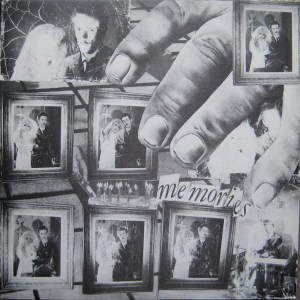
mp3: Public Image Ltd – Memories (#60)

PiL‘s first two singles had both gone Top 20.  John Lydon obviously decided this was unacceptable, and so the band’s third 45 was one that daytime radio wouldn’t go near.  Memories proved to be a great indicator of the direction the group was heading with their impending album, Metal Box that was released in mid-November.

mp3: The Undertones – You’ve Got My Number (Why Don’t You Use It) (#64)

This proved to be the second mid-position hit for The Undertones in 1979, reaching #32, which was two places higher than Here Comes The Summer.   The following year would see better returns for them, with My Perfect Cousin providing them with their only Top 10 hit, and it’s follow-up, Wednesday Week, reaching #11.

The chart of 21-27 October didn’t have any new entries at all in The Top 40, which probably made for a rather dull or least repetitive edition of Top of The Pops.  But this one came close.

mp3: The Specials – A Message To You Rudy

The fact that The Specials second 45, a double-A side effort, turned out to be a hit was further proof that the Two-Tone movement was of some significance, culturally and musically.  A Message To You Rudy was a cover version of a 1967 tune written and recorded by Dandy Livingstone, but the other A-side was an original.

mp3: The Specials – Nite Klub

Fun facts.  Both sides of the single were produced by Elvis Costello while Chrissie Hynde of The Pretenders offered a backing vocal on Nite Klub.  It would spend 14 weeks in the charts, peaking at #10.

mp3: Sparks – Tryouts For The Human Race (#74)

A third hit of the year for the brothers Mael, aided and abetted by Giorgio Moroder.  I remember one of the writers in one of the music papers being apoplectic with rage that a third single had been lifted from an album, No.1 In Heaven, that had just six tracks on it.  Tryouts…. would spend five weeks in the chart and reach #45.  And while Sparks would continue to release albums on a very regular basis throughout the 80s, they wouldn’t enjoy another hit single until 1994.

A bit of a mixed bag then, hits wise, for October 1979.  But if you care to come back in a couple of weeks time for Part 2 when I look at singles that weren’t hits, there will be a few of real interest.

JC

SHAKEDOWN, 1979 (July)

79

My summer of ’79 saw me enter the big bad world of paid employment.  I actually told a few lies to land the job, the vacancy for which had been advertised in the local job centre.

I was legally able to leave school, but I was always planning to return after the summer holidays to go into 5th year to sit the exams that would count towards university admission.  But I wanted to earn a bit of money, and so I applied for, and landed, a job in the city centre branch of Halford’s, the UK’s biggest retailer of cycling and motor products.  I told the store bosses that I had no intention of returning to school, no matter how good the results of my O-Grades, and, yes, I did see myself as being very interested if the chance arose to train as a store manager once I turned 18 in a couple of years time.

I started the job a couple of days after my 16th birthday, and so the month of July was when I really settled into it.  It was a shop where the radio played in the background all day long, and with most of the staff being lads aged in their late teens/early 20s, the station of choice was BBC Radio 1, which means my ears were exposed to a lot of what was in the charts.

As you’d expect, there was a fair bit of rubbish regularly aired, but then again Tubeway Army, Squeeze, Blondie, The Ruts and The Skids were all still in the Top 40, while some cracking disco/soul classics from Earth Wind & Fire/The Emotions, McFadden & Whitehead, and Chic were also capable of putting a smile on my face.  The highest new entry in the chart in the first week of July is not one I can recall hearing on Radio 1:-

mp3: Public Image Limited – Death Disco (#34)

Jaysus, this was really weird sounding.  The 16-year-old me had a difficulty with it.  I bought it, but I can’t say I particularly liked listening to it.  So much so, that I gave it away to someone who handed me two of the early Jam singles in exchange (Eddie didn’t like that they were a pop band nowadays). It took me a few years to really appreciate Death Disco… till 1990 in fact, when I bought a CD copy of a Public Image Limited singles compilation.  As I wrote on this blog previously, by this point in my life I knew that great songs didn’t need hooks or memorable, hummable tunes, and that a cauldron of noise in which a screaming vocal fights for your attention alongside screeching guitars over a bass/drum delivery that on its own would have you dancing like a madman under the flashing lights could be a work of genius.  This spent seven weeks in the Top 75, peaking at #20.

While researching this piece, I discovered, to my shock/delight, that Death Disco had appeared on a Top of The Pops budget compilation – these albums featured uncredited session musicians/singers replicating the sound of current chart hits. I think there were about 100 or so of them released between 1968 and 1982, and they were stupidly cheap in comparison to a proper studio album, and from memory weren’t all that more expensive than a couple of singles.  This is really strange:-

mp3: Top Of The Pops – Death Disco

I’m thinking that John Lydon pissed himself laughing at the very idea of this, and as such was more than happy to give his blessing to it.

The next one of interest in the chart of 1-7 July is another I can’t recall hearing in Halford’s

mp3: Siouxsie & The Banshees – Playground Twist (#47)

The third of the S&TB singles wasn’t a commercial offering by any stretch of the imagination, but it did sell enough copies to reach #28 in a six-week stay.

Coming in a bit further down the chart was one that I recall hearing loads of times in the shop:-

mp3: The Police – Can’t Stand Losing You (#60)

This had been a near smash-hit in late 1978, spending five weeks in the charts and reaching #42.  The Police had gone massive in the first half of ’79, and it was easy enough for A&M Records to press up more copies of the old singles to meet the new demand.  Where Roxanne had taken the band into the Top 20, this was the one that sealed the deal, getting all the way to #2 in mid-August.

The second singles chart of July ’79 was a strange one.  No ‘big’ entries, with the highest coming in at at #48, courtesy of Abba.  Many of other newbies are names I am struggling to recall – Chantal Curtis, Stonebridge McGuiness, Judie Tzuke, Vladimir Cosma, and Light of The World.  There was, however, one truly outstanding song which came in at #62:-

mp3: The Pretenders – Kid

It remains my favourite 45 of all that Chrissie & co ever put down on vinyl. Indeed, it is one of THE great records in what was, as this series is demonstrating, a great year for music; it spent seven weeks on the chart in July and August 1979, peaking at #33. Should have got to #1….but that feat for The Pretenders was just around the corner.

The third week of July saw an unusual song as its highest new entry at #15:-

mp3: The Boomtown Rats – I Don’t Like Mondays

Here’s the thing.  I more than liked the Boomtown Rats and owned copies of their first two albums.  I wasn’t at prepared for the new single…..it was all over the radio before it was actually released, and looking back at things now, it must be one of the first examples of a viral marketing campaign based on artificially creating a reaction to something that some folk declared to be ‘shocking’.  I can’t say that I cared much for the song, and it was conspicuous by its absence when I pulled together a Rats ICA back in October 2022.  The week after entering at #15, I Don’t Like Mondays went to #1, where it stayed for four weeks, and then another two weeks at #2. All told, it sold over 500,000 copies and was the 4th biggest selling single of 1979.

mp3: David Bowie – D.J.

Bowie followed up the success of Boys Keep Swinging with a second single from the album Lodger. This would have been heard in Halford’s but not all that often given that it came in at #29 in the third week of July but immediately dropped down the following week, and Radio 1 daytime DJs usually only gave spins to records that were on the up.

mp3: Sparks – Beat The Clock

This was very much all over the workplace radio….the sort of song that sounded great over the airwaves and made the individual DJs feel as if they were being a bit edgy.  A fantastic piece of disco-pop, thanks to the efforts of the brothers Mael and Giorgio Moroder.  A nine-week stay in the charts was the reward, with a best placing of #10.

mp3: The Undertones – Here Comes The Summer

Yup….July ’79 was the release date for this one.  Really doesn’t seem like 45 years ago, but there you have the facts presented before you, so there’s no denying it.  The other thing I’d have said about this was that it must have been a Top 20 hit, given how often I recall hearing it and that it lodged so easily into my brain.  But nope, in at #63 and peaking a couple of weeks later at #34, which was kind of a similar trajectory to this one:-

mp3: Buzzcocks – Harmony In My Head

The first 45 not to feature a lead vocal from Pete Shelley, the delivery from Steve Diggle made this just a little bit rougher round the edges than previous Buzzcocks singles.  But it was, and still is, a great listen.  In at #67 and peaking at #32…..and I’d have lost any bet offered on whether this or Here Comes The Summer had peaked highest.

And so, to the final singles chart of July 1979.

As with a couple of weeks previous, nothing came in fresh at any high position. #50 was the best on offer, and it was from Showaddyfuckingwaddy.  So no chance of it featuring here.

I was scrolling all the way through the Top 75 of 22-27 July, and just as I was concluding there wouldn’t be anything worth featuring, i noticed this was a new entry at #74:-

mp3: The Specials – Gangsters

One that I don’t so much associate with July 1979 and more about a period after I had finished at Halford’s and returned to school where I would take my first ever foray into DJ’ing.  It’s a tale I told when I wrote about Gangsters in the Great Debut Singles series:-

“1979/80 marked my first forays into DJing, if playing records on a single deck at a youth night in the school could be regarded as DJing. The senior pupils were encouraged to help the teachers at these nights, which were basically an effort to provide bored 12-15 year olds with something to do instead of hanging around street corners and picking up bad habits. There were three of us who brought along our own 45s to play while everyone ran around making lots of noise burning up all that excess energy. Very gradually over a matter of weeks, our little corner of the hall began to get a dedicated audience, and it was all driven by the fact they loved to do the Madness dance(s). In two hours of music, you could bet that more than half came through records on the 2-Tone label or its offshoots. And these kids were of an age when playing the same song two or three times in a night didn’t matter.”

Happy days indeed. Gangsters went on to spend 12 weeks in the charts, peaking at #6.

JC

DON’T LOOK BACK IN ANGER (9)

11092687_0

Let’s travel back in time to see what 45s were being most bought in UK record shops in September 1983

Chart dates 28 August – 3 September

Oh my.  For once, the highest new entry had some merit. But the question really has to be…..How did Factory Records organise itself enough to get copies out and distributed into the shops?

mp3: New Order – Confusion (#17)

Released only on 12″ in the UK, it came with four different mixes.  There was no way the radio stations would have played the full eight-plus minutes, and indeed promo discs were sent out with an edit, which was, many years later, made available on one of the numerous New Order compilations.   Confusion would go up five places to #12 before slowly drifting out of the Top 75 over the following six weeks.  Worth mentioning that in the same week Confusion entered the charts, Blue Monday was spending its 25th week in the Top 75 – and indeed was just about to gain a second wind and climb back up the way, peaking at #10 in mid-October.

Just slightly lower in the rundown was this.

mp3: Freeez – I.O.U. (#25)

I’ve deliberately kept I.O.U. away from this series until today.  It had already been in the singles chart for twelve weeks, spending three weeks at #2, and kept off the top spot by Paul Young wailing about his hat.  The sleeve for this single gives much prominence to the fact it was produced by Arthur Baker.   I think it’s fair to say he got two-for-one out of this tune.

Much lower down the chart, entering at #64, and only ever getting up to #60, was a 45 with a message:-

mp3: The Special AKA – Racist Friend (#64)

Chart dates 4-10 September

Not a good week for new entries, with Status Quo (#24) and Paul Young (#27) being the highest, with both of Ol’ Rag Blues and Come Back And Stay annoyingly hanging around for a few more weeks to make the Top 10.  Just below those was a little bit of agit-synth:-

mp3: Heaven 17 – Crushed By The Wheels Of Industry (#28)

The fourth and final chart hit lifted from the album The Luxury Gap, it went on to reach #17.

Chart dates 11-17 September

I’m not a fan of the tune, so I won’t share any mp3, but this was the week when Boy George really made the crossover into pop stardom, as Karma Chameleon entered the singles chart at #3.  It went onto to sell 1.6 million copies in the UK, as 1 million in the USA and some 7 million all told across the world.  That’s a lot of plastic……

It was also the first week that Howard Jones hit the charts.  He’s another from that era I have no time for at all, but I was clearly in a minority.  New Song came in at #51.  It would go onto spend 12 weeks in the Top 75, reaching #2.  He would follow that up with eight more Top 20 singles through to March 1986, and it seemed he was on Top of The Pops every other week.

Among the mediocre and mundane, there were a few gems

You’ve got to go a long way down to find a couple more excellent new singles:-

mp3: PiL – This Is Not A Love Song (#47)

The first new single in two-and-a-half years, it would go on to spend 10 weeks on the singles chart and get all the way to #5, easily the best performance by any of PiL‘s 45’s released between 1979 and 1992.

mp3: Elvis Costello & The Attractions – Let Them All Talk (#59)

A rather disappointing outcome for the second and final single from the album, Punch The Clock, as this was as high as it got.   At least there was the consolation of the album reaching #3.

mp3: The The – This Is The Day (#71)

I placed this at #4 in my 45 45s @ 45 rundown.  It’s very obviously one of my favourite songs of all time.  It is criminal that it only ever got to #71 in the UK singles chart.  It would take  until 1989 before a single by The The cracked the Top 20.

Chart dates 18-24 September

Karma Chamaleon was at #1.  It would stay there for six weeks. The one small consolation was that it kept David Bowie‘s awful new single off the top.  Modern Love came in this week at #8 and would more than likely reached #1 is it hadn’t been for Culture Club.

Coming in at #21 was a synth duo who some had written off:-

mp3 : Soft Cell – Soul Inside (#21)

It reached #16 the following week, a welcome return to pop stardom after Where The Heart Is and Numbers had both peaked outside the Top 20 after the first five singles had been Top 5.

There will be some of you out there who are fond of Toyah Wilcox, so here’s a reminder of what she inflicted upon us in 1983:-

mp3: Toyah – Rebel Run (#29)

This one got to #24 the following week and then, thankfully, disappeared.

If you look closely at the bottom of the page:-

mp3: Tracey Ullman – They Don’t Know (#69)

One of the UK’s most popular actress/comediennes had embarked on a singing career.  Having already enjoyed a Top 3 hit with Breakaway in which she had covered a 60s song, she turned to the back catalogue of Kirsty MacColl for her next venture, offering her take on a 1979 flop single.  This one went all the way to #2, spending almost the rest of 1983 in the Top 75, and bringing some well-deserved royalties to Kirsty.

Chart dates 25 September – 1 October

A cover version was the highest new entry this week.  And a good one too….

mp3: Siouxsie & The Banshees – Dear Prudence (#17)

Siouxsie  and Budgie had been enjoying chart success with The Creatures.  Robert Smith was often on Top of The Pops in 1983 with The Cure.  Here they all were together on one gloriously psychedelic offering of a song originally found on The White Album, released by The Beatles in 1968.

I think that’s just about enough for this edition of nostalgia central.  I’ll be back in about four weeks time.

JC

THE INSANE COST OF SECOND HAND VINYL? (Issue #4)

A GUEST POST by FRASER PETTIGREW

Phoenix-records

The Price of Vinyl

(In which the author shamelessly recycles part of his comment on JC’s original post)

Back in 1980 when I was a student with grant money in my pocket (ah, those were the days), a new release LP would cost between £3 and £4 from boutiques such as Phoenix on Edinburgh’s High Street, or the small Virgin shop on Frederick Street. I still treasure my copies of Siouxsie and the BansheesThe Scream and Joy Division’s Closer, snapped up on release day for the same amount of money as a paperback novel or a couple of pints of beer.

Second-hand rummaging in Greyfriars Market on Forrest Road could net you some classic back catalogue for around £2 a pop. Amongst the bargain gems I unearthed there are four early Can LPs on their original United Artists labels and a 1969 US copy of The Stooges’ first. I recall that Emerson, Lake and Palmer’s Pictures at an Exhibition was competitively priced at just £1, or better still, 6 copies for a fiver. My brother took his copy in to flog, and the guy just pulled open a massive drawer full of them and rolled his eyes.

Today, once I’d managed to find ye olde recorde shoppe somewhere, I wouldn’t be able to walk out of it with a new release vinyl LP until I’d left at least £25 on the counter, or probably more. In relative terms, that’s up to twice as much as I should be paying if the price of LPs had gone up by the average amount of most other consumer goods since 1980. Depending on whose calculator you choose, you should need about £4 to £4.50 today to buy what £1 would have got you 40 years ago.

Those days are gone now, and in the past they must remain (That’s enough of The Corries – Ed), for nowadays, vinyl is a niche product whose pricing dynamics are very different from the good old days. In 1980 vinyl was effectively the only way anyone could buy music, except for cassettes, which everyone knew were shit and strictly for home-taping. Even though sales of vinyl recently exceeded CDs for the first time since 1986, the actual numbers underline how nobody really buys music in physical formats anymore, and that the economies of scale in the record manufacturing business in 1980 most certainly do not apply today. Globally, some 19 million vinyl LPs were sold in the first half of 2021, pipping the 18 million CDs sold, but in 1981 consumers bought more than 1 billion vinyl LPs as well as half a billion singles.

In strict cost and profit margin terms, that still shouldn’t account for the hyper-inflation of vinyl prices today, but the niche product effect means that customers are prepared to pay a premium for the retro cachet of the plastic disc. A large part of the niche is also driven by a collector mentality. Much new vinyl is of ‘special editions’ and colour pressings. Some store owners report that if there are both black and colour versions of the same LP, the colour versions will sell out long before the black ones. Some also blame Record Store Day for fuelling this tendency, as they witness people paying stupid money for some frankly shit music purely because of the limited nature of the release.

These pumped-up prices for new discs have an inflationary effect on second-hand vinyl. Many of the buyers are the same collector/hipster buyers of new vinyl, and at the same time the supply of good used vinyl has shrunk in proportion to the decline of physical music media in general. Edinburgh has very few used vinyl shops any more. Here in New Zealand where I live now it’s the same, and the supply of genuinely worthwhile purchases is limited to say the least. That’s not to say bargains can’t be found – not so long ago I found a factory-sealed original pressing of Simple MindsEmpires and Dance to replace my discarded scratched copy for a mere $20 (£10). You cannot, however, walk into a used record shop these days and find yourself wishing you had more cash.

Record fairs are a different matter, and this is where I think the best shopping can be done. Although the sellers are often wise to the value of their merchandise, they are rarely too greedy and value for money can be had. The selections on offer are also more appealing to the ‘Serious Music Enthusiast’, bypassing the sort of badly mauled pop crud that is largely banished to charity shops. At Wellington’s last record fair I scored the expanded version of Stereolab‘s Margerine Eclipse (three discs) for $30, two Style Council LPs for a combined $35, and a mint copy of Nino Rota‘s Concerto per archi (bear with me, I’m a Serious Music Enthusiast) for just $10. For the first time in years, I am in need of larger record shelving.

I foresee the day when, in my old age, I will liquidate a large part of my collection to fund new hearing aids, or at least when we have to downsize to a small unit in a retirement village that definitely doesn’t have room for a thousand LPs as well as all my books and a commode. I see that some people are currently asking over $500 for that Stooges LP, and Can’s Tago Mago in the daft envelope sleeve might net me $300. PiL’s Metal Box, which I hardly ever play because it’s such a pain to get out of that bloody film can, is good for another $200. Even at a modest estimate, I could easily generate $10,000 from my collection and still keep a sentimental hold on some of my most precious darlings, those records of my youth that I saved lunch money to buy because I just had to make them part of my life. Even though I can listen to it all on Spotify, there’s a tactile and talismanic magic to some of those 12-inch plastic discs that will never be lost to music lovers of my generation.

mp3: The Stooges – 1969
mp3: Can – Paperhouse
mp3: PiL – Albatross

Those of us old enough to have fallen in love with records before the digital era have to acknowledge our own part in creating the collectability of vinyl, but it’s still an irritation that prices have been driven skywards by beardy hipsters in pursuit of the same bogus ‘authenticity’ that they seek in vinegary ‘natural’ wines or fermenting the fuck out of everything they eat. But one day, ONE DAY, by God I’ll make the bastards pay.

Fraser

NOISE ANNOYS?

The question posed by the title of the posting relates to the b-side of the 45 I’m having a look today:-

mp3: Public Image Ltd – The Cowboy Song

It borders on unlistenable, but then again, I’m assuming that was the whole point of it.  Julian Cope, over at Head Heritage, provides as perfect a description as there is:-

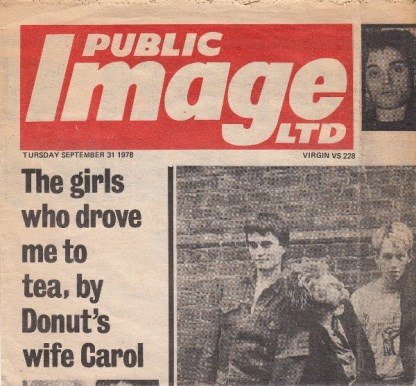
“The Cowboy Song”is a throwaway single that sounds like it was ALREADY tossed into the bin: the screech of a needle being ripped and torn back and forth across the surface of a record cuts in as the single begins. Then you hear Lydon in the studio tell the producer it’s so loud, they can’t hear the backing track. Ha; like they fucking even needed to, as they are preparing to scream and toss tambourines in the studio over a towering bass drive and general overall mayhem. The ludicrous “Thick As A Brick”-styled newspaper parody this single originally came wrapped in details the ‘lyrics’ (16 lines of “clipy ty clop/clipy ty clop/clipy ty clop”) but they do not appear on the single. Or if they do, they are drowned out by a deafening racket of multi-tracked screaming, talking and general pandemonium. The only distinct sound is that of the bass guitar of John Wardle (aka Jah Wobble) although it’s oddly un-dub and pre-set to ultra-strum. The lyrics should’ve been “Make it stop/make it stop/Make it stop” so that everybody who bought this single in 1978 could sing along. There’s also further stylus-scratching effects just to drive the rest of us up the wall. When the noise finally subsists, only Lydon’s coughing and sputtering of amphetamine-loosened phlegm can be heard — right before the record picks up after being trapped in the locked-groove for a revolution and a half.

I don’t have the single, but I do have a vinyl copy of Public Image : First Issue, the debut album, on which it is included:-

mp3: Public Image Limited – Public Image

Issued in October 1978, meaning it’s not that long until it turns 44 years of age.  I think it’s fair to say that the tune, and in particular, that killer bass line, have aged spectacularly well. For those who like the technical side of things, (hi JTFL!!!!) it seems it was Wardle’s/Wobble first bass line that he presented to the rest of the group, Keith Levene‘s guitars were double-tracked on the back of a live take and Lydon’s vocals went through a Space-Echo (aka Roland RE-201), a bit of kit which produced delay and reverb effects.

Me?  I just love dancing to it.

JC

AND NICELY FOLLOWING ON FROM THE PREVIOUS TWO POSTS

Yesterday was Malcolm McLaren and two days ago was Cabaret Voltaire with me admitting that my 16-year old self struggled to enjoy Nag Nag Nag, a situation that hasn’t changed in 2017.

Back in 1979 I also struggled to understand and appreciate much of the output of Public Image Ltd, albeit I adored debut single Public Image. The follow-up Death Disco freaked me out and went way over my head as indeed did the next single Memories.

The difference, however, is that today I can listen to early PIL and really enjoy what I’m hearing with probably no better example than said third single:-

mp3 : Public Image Ltd – Memories (12″ mix)

I think it was being exposed to the emerging Associates and listening out more for bands who sounded similar to Joy Division that made me come to fully appreciate PIL. I had actually forgotten that the single version of Memories, was a totally different mix from that which appeared on Metal Box. It’s about a minute or so shorter in length as well. I feel it’s the superior version as Jah Wobble‘s bass playing is much more to the fore and John Lydon‘s vocal feels more focussed and angry as he rants about how nostalgia for the old days of punk is a waste of time and energy.

mp3 : Public Image Ltd – Memories (album mix)

Here’s the b-side of the single:-

mp3 : Public Image Ltd – Another

Those of you familiar with Metal Box will have spotted that this is a version of an instrumental track from that LP – Graveyard – but with vocals and a bit more bass action.

JC

TRIPLY DISAPPOINTED

disap

Three different songs that share the same title:-

mp3 : Electronic – Disappointed
mp3 : Morrissey – Disappointed (live)
mp3 : P.I.L. – Disappointed

The first of these the biggest ever hit single for the supergroup, reaching #6 in 1992. The middle track was originally the b-side to Everyday Is Like Sunday but- the live version I’ve shoved up today is from the flip of the 12″ of Pregnant For The Last Time. The final track is the 12″ version of a 1989 single that barely scraped the Top 40.

The Three Johns (Lydon, Marr and McGeogh) along with Moz, Barney and Neil in one posting? Now THAT’S what I call music…..

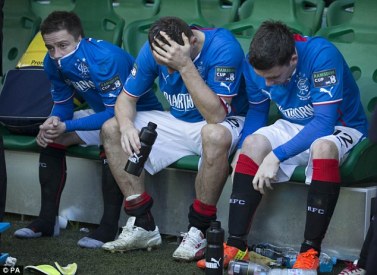
Oh and the photo used to illustrate the posting was taken moments after my team, Raith Rovers, had won a cup final with a goal two minutes from the end of extra time back in 2014. The look of disappointment and indeed despair on the faces of the opposition players is quite plain to see…..


VERY MUCH A LOVED SONG

R-2719015-1317952443.jpeg

From December 2007:-

Yet another of the vinyl treasures that I found during my extended stay in Toronto.

A mint-condition copy of the 12″ of This Is Not A Love Song by P.I.L. For a bargain $10.

But I refuse to believe that the song dates back to 1983. That’s nearly 25 years ago for fuck sake. (WITH THIS UPDATE IT IS NOW 32 YEARS FUXXXACHE!!!).  I’m not ready to accept that I’m getting that old that quickly. Time for the botox and liposuction.

I’ve long owned a copy of this record, but (a) I wore it out through constant playing, and (b) the whiter-than white sleeve was grubby and torn. I’m delighted to have at long last replaced it.

There are four songs on this magnificent piece of plastic – including an original and remix version of the single.

The remix is quite different from the original. Wobble’s bass lines and Lydon’s vocals are identical but the keyboards are far more prominent while the guitar is further back in the mix.

It’s probably a bit more poppy than the actual single, and while it’s pretty impressive in its own right, it just doesn’t have the same impact as what remains one of my all time favourite records.

A few years later, P.I.L. released a greatest hits compilation, which included yet a further remix of TINALS – and one that was completely different. A re-recorded vocal and a horn section that I just wan’t prepared for at the time. For years it was a version that I hated, but I have grown more fond of it in recent times. You can make your own minds up:-

mp3 : P.I.L. – This Is Not A Love Song (original 12″ version)
mp3 : P.I.L. – This Is Not A Love Song (re-mixed version)
mp3 : P.I.L. – This Is Not A Love Song (re-recorded version)

Enjoy.

SOMETIMES IT TAKES YEARS TO APPRECIATE SOMETHING

R-284469-1166965460

1979 was the year that the Sex Pistols enjoyed the most success in terms of the singles charts with three Top 10 hits. But by then they were a parody of a band – after all it was two Eddie Cochran numbers covered by Sid Vicious plus a Steve Jones rocker that we’re talking about.

The spin-off however was that John Lydon could do no wrong, and even some of his strangest recordings were huge hits.

Like this:-

mp3 : Public Image Ltd – Death Disco

There’s probably never been any better description of this record than that penned by Gary Mulholland in his brilliant book This Is Uncool – The 500 Greatest Singles Since Punk & Disco.

Despite turning his back on the Sex Pistols’ audience, John Lydon could’ve farted into a paper bag and made the British charts in 1979. The more he told us to fuck off, the more we loved him, at least, for a while longer anyway. So he pushed it as far as it would go.

This record did just about everything a punk rocker was not supposed to, It was long, It had no shoutalong choruses. It has a disco beat, of a sort (the NME originally announced that it was called ‘Death to Disco’, in a air of punk-reactionary wishful thinking). It was based on a diseased Arabic mutation of Tchaikovsky’s ‘The Dying Swan’ from Swan Lake. And it was about his mother, who was dying of cancer. The result was disturbing, blackly comic, moving, profound and so far removed from anything resembling punk, pop or anything else that it had the desired effect – it got rid of the punks.

Oh, how I struggled with this when I was 16 years old. So much so, that it is one of the few records I bought and then gave away to someone else.  I got two old singles by The Jam in exchange, which at the time felt like a bargain.

Fast forward to 1990 and my purchase of a CD copy of the P.I.L. greatest hits compilation and me listening to Death Disco again for the first time in eleven years. By now I knew that great songs didn’t need hooks or memorable, hummable tunes, and that a cauldron of noise in which a screaming vocal fights for your attention alongside screeching guitars over a bass/drum delivery that on its own would have you dancing like a madman under the flashing lights could be a work of genius. I was now able to appreciate Death Disco…..

It is astonishing to realise that this song spent 5 weeks in the charts in the summer of 79, entering at #34 on 7th July, and then taking the #32, #20, #26 and #28 positions thereafter, which means it got at least five plays on Radio 1 (but I’d place a bet there weren’t many more than that unless John Peel gave it a spin).

Mulholland was right. Thanks to Death Disco and follow-up 45 Memories, the punks truly  denounced Lydon as an art-rocker. But then again, if the punks had paid closer attention to what he was always saying about his main musical influences, the early P.I.L. material shouldn’t have come as a big surprise.

Here’s yer  b-side:-

mp3 : Public Image Limited – No Birds Do Sing

Enjoy!!!!