FOUR TRACK MIND : A RANDOM SERIES OF EXTENDED PLAY SINGLES

A guest series by Fraser Pettigrew (aka our New Zealand correspondent)
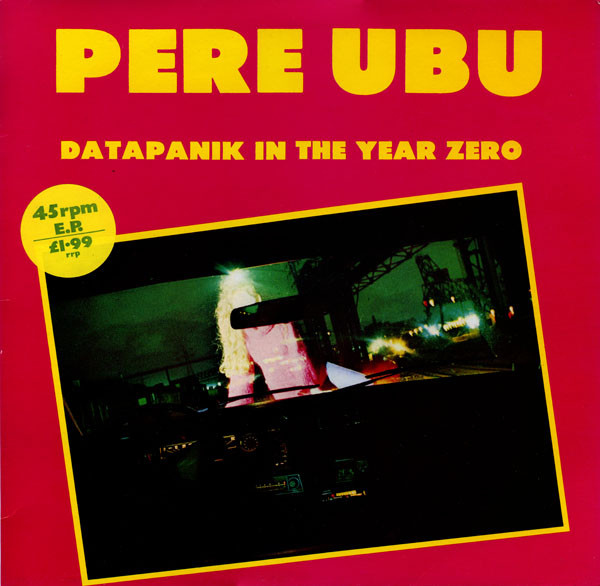
#3: Datapanik in the Year Zero – Pere Ubu (1978)

As a genre label, ‘post-punk’ implies some sort of influence and progression from punk, when in fact it was more like the way that natural selection operates in the biological world. Evolution is often misrepresented as an active, conscious process when it is really the accidental combination of random mutation and environment. Pere Ubu was one of many musical mutations taking place in the mid-70s and punk was the environment that enabled them to flourish.

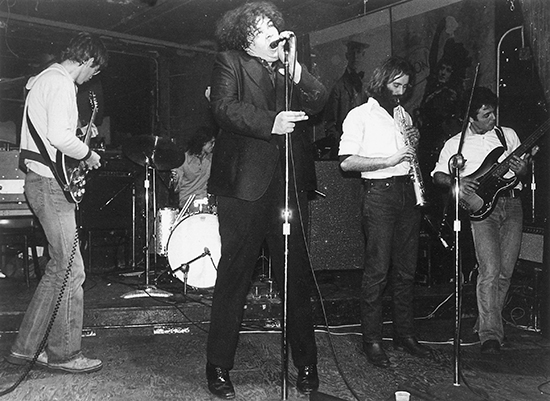
Whatever the definition or consciousness of ‘punk rock’ was in Cleveland, Ohio in 1975, Pere Ubu were unquestionably distant from any mainstream music scene. Formed by two ex-members of recently disintegrated Cleveland band Rocket From The Tombs, singer David Thomas and guitarist Peter Laughner, Pere Ubu tagged themselves as ‘avant-garage’, a neat and clever coinage that indicated a different direction from their erstwhile bandmates Cheetah Chrome and Johnny Blitz who went on to form the very definitely punk Dead Boys.

Ubu’s music was an unsettling hybrid of mid-70s rock and weirdo gothic psycho-horror, and frontman Thomas wasn’t likely to soften the appeal. Always a big lad, usually dressed in an ill-fitting suit, there was no mistaking him for David Cassidy in the visual charisma stakes and his vocal style ranged from depressive mumble to disgruntled adenoidal bleat. Keyboard player Alan Ravenstine rarely played a chord, preferring to smother the music with harsh electronic noise that evoked the declining industrial landscape of rust-belt Cleveland. Altogether, you can see how the eclectic experimental non-conformism of post-punk drew Pere Ubu into the fold.

Datapanik in the Year Zero is a bit of an outlier in this EP series since it is a compilation drawn from three of the band’s first four singles rather than an original release of new material. As a compilation it’s a bit odd too because it contains only one a-side from those three, all three b-sides and a different unreleased version of one of the other a-sides.

The 12” EP was released in the UK early in 1978 in a one-off deal with Radar Records, to coincide with Mercury’s UK release of first album The Modern Dance. The singles had never been released outside America, having appeared only in limited numbers on Pere Ubu’s own Hearthan label. The name Hearthan became ‘Hearpen’ because it comes from the Anglo-Saxon for ‘harp’ and uses the ‘thorn’ character Þ which looks like a ‘p’ but sounds like ‘th’. As Thomas explained on his Crocus Behemoth website, “Confusion was the foundation on which the business grew”. So, not a slick marketing campaign and world-leading brand strategy, then?

Datapanik covers a two-year period from 1975 to 1977. The first side is a grim affair, containing both sides of the debut single, but opening with b-side Heart of Darkness. Not Joseph Conrad’s story but a similar nightmare of emotional dysfunction. A-side 30 Seconds Over Tokyo is about the 1941 Dolittle Raid on Japan, America’s first retaliation after Pearl Harbour, imagined from the perspective of one of the pilots, “never coming back from a suicide ride”. All six minutes and 20 seconds of it.

Dark stuff, and clearly not a serious bid for global rock stardom. But if you’re going to name yourself after an absurdist literary character, you might at least confound expectations. 30 Seconds was a reworking of a Rocket From The Tombs number, co-credited to Gene O’Connor (Cheetah Chrome), while Heart of Darkness was a Pere Ubu composition, but stylistically very much from the same crypt.

Second single Final Solution is another Rocket song, comparably morbid in title and sound, based on a heavy guitar lick that might have been plucked from The Stooges or MC5, with bleak lyrics of romantic rejection and existential despair. However, Final Solution is not included on Datapanik. The modern perspective assumes the reason is good taste, but the song is not about the Nazi final solution any more than Heart of Darkness is about colonialism in the Congo, and people weren’t so nervous about that sort of ambivalence in 1978 when this EP was released.

Whatever, the b-side Cloud 149 is the first track on side two of the EP, and it’s a distinct contrast to side one. It’s like the sun has come out and big Dave has suddenly, unexpectedly found love with the simple flip of a 7” slice of vinyl. The song bounces into life on overlapping layers of rhythm, settling into a briskly chugging syncopation with the kind of musical ingenuity that leaves you wondering where exactly the first beat in the bar is until the vocals nail it down. “Here she comes/She’s ok/I can tell/She’s ok…” From the lyrics it could be The Undertones or The Beach Boys, and it really doesn’t feel ironic. No idea what Cloud 149 means, unless it’s simply 140 clouds higher than cloud nine.

Third single Street Waves is completely absent along with its b-side My Dark Ages. The obvious rationale is that the same version of the a-side can be found on The Modern Dance album where it is one of the highlights of side one, a great little chunk of 70s rock’n’roll, though it has always sounded structurally weird to me, like the second half of a song rather than the whole thing. The explanation for the b-side’s omission may simply be that it’s not that great, certainly the least appealing of these early single tracks.

Fourth single The Modern Dance is sort of here, but in a different version from either the original a-side or the album version. Those two versions are exactly the same cut except that on the album the instrumental backing is accentuated by a metallic percussive clink, but on the single this rhythmic highlight is provided by that common musical instrument, a squeaky toy. The ‘Untitled’ version on Datapanik has neither clink nor eek, nor the call-and-response backing vocal that I used to think said ‘mantra mantra’ but I have since discovered is actually ‘merdre merdre’. All you Alfred Jarry fans will of course be keenly aware that ‘Merdre!’ is the opening line of the play Ubu Roi, a technical provocation to the French censor of 1896, usually translated into English as the definitely not sweary-word ‘Shrit!’

Final track Heaven was the b-side of The Modern Dance and is another little ray of melodic and lyrical sunshine: “A mid-summer’s night on a magic beach/The dreams that come to me, they don’t look out of reach… C’mon, darlin! It feels like heaven”.

The singles sampled on Datapanik, and the first two albums The Modern Dance and Dub Housing are, for me, the essential moments of Pere Ubu’s career. Focus and inspiration began to drift on New Picnic Time and The Art of Walking and weren’t recaptured after their subsequent split and reformation, nor were they evident to me on what I heard of David Thomas’s solo work. Too much formless electronic noise collage and weird yelping, not enough of the delicious punchy rock knocked slightly off kilter by the unique vocals and synth terror.

They were still impressive when I saw them supporting Gang of Four in 1981, when there was little indulgence of the shuffling sounds of the sands, but on record the appeal had faded. The self-defined avant-garage was something more accessible than avant garde and less ragged and more taut than garage, but rather too soon it became too much of one and not enough of the other.

Heart of Darkness

30 Seconds Over Tokyo

Cloud 149

Untitled

Heaven


Fraser

SHAKEDOWN, 1979 (October, part two)

79

As with last month, I’ve given this one a bit of a build-up, one that I am sure will live fully up to its billing.  It’s a bumper edition, with ten tracks in all, beginning with the single that I listed at #6 in my 45 45s @ 45 series back in 2008 over at the old blog.

mp3: Joy Division – Transmission

Released on 7 October 1979.   The first time that many of us had heard it would have been a few weeks previously on the BBC2 programme, Something Else.  It would be the only time the band appeared on a TV programme that was broadcast across the entire nation – everything else was via Granada TV and only available in north-west England.

mp3: John Cooper Clarke – Twat!

One of JCC‘s best-known and most-loved poems.  Just in case anyone not from the UK doesn’t know, twat is vulgar slang for a vagina, as well as being the perfect word to describe a stupid, obnoxious and unpleasant person, for example D Trump or N Farage.

mp3: The Cure – Jumping Someone Else’s Train

Their third single of 1979 that failed to get anywhere other than the indie charts.  The good news is that the next single, A Forest, released in March 1980, would reach the destination of the mainstream chart.

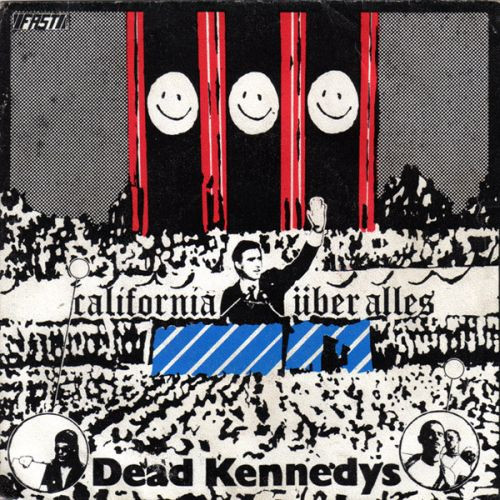
mp3: Dead Kennedys – California Uber Alles

The name of the band led to hostility from the outset, even over here in the UK.  The music papers weren’t really sure how to handle them, and there was certainly no chance of the major labels offering them a deal.   There were a few writers who mentioned, based on their debut single that had been released In America, on their own label, back in June 1979 that there was a bit of musical merit to pay attention to.  Bob Last, the entrepreneur behind the Edinburgh-based Fast Product label, managed to secure the license for a UK pressing.   I don’t ever remember hearing it on the radio back in 1979, but I do know a few of the independent record shops proudly had the distinctive sleeve on display.

R-2363126-1308993821

Eddie, the bona-fide punk in our school, of course bought a copy and brought a tape in so we would listen to it in the common room.  Let’s say it divided opinion.  I liked it, but I didn’t go out and buy it for fear that the name of the band might cause offence to my parents.

The song was re-recorded the following year for inclusion the band’s debut album Fresh Fruit For Rotting Vegetables.

mp3: Martha & The Muffins – Insect Love

There’s a misconception that Echo Beach, the Top 10 single for the Canadian band, was the debut.  It charted in March 1980, but their little-known debut single dated back to October 1979.   One of the reasons it is forgotten about is that it was left off the debut album.

mp3: Talking Heads – Life During Wartime

The press may have been positive, particularly around how good they were as a live act, and the album Fear of Music, released in August 1979, may have gone into the charts at #33 the previous month, but the search for a hit 45 went on.  And would continue to do so until February 1981.

mp3: Wire – Map Ref. 41˚N 93˚W

The third single from Wire in 1979. Lifted from the album 154, which had been released a few weeks previously, it proved to be their last involvement with the folk at Harvest Records, whose bungling back in March 1979 had caused the band to miss out on a Top of The Pops appearance when Outdoor Miner was on the threshold of becoming a Top 40 hit.

Finally, for this month, three cult bands whose names begin with the letter P.

mp3 : The Passage – 16 Hours

One of four tracks from the About Time EP, released on the Manchester-based indie, Object Records.

The Passage were from the city and at the time consisted of Dick Witts, Tony Friel and Lorraine Hilton.  Witts was a multi-instrumentalist who spent time as a percussionist with a symphony orchestra, while Friel was the bassist with The Fall.

mp3: Pere Ubu – The Fabulous Sequel (Have Shoes Will Walk)

From Cleveland, Ohio.  I own nothing by the band, and indeed they have always been an act that I don’t get the appeal of.  They had already been on the go for some four years by this point in time and inked a deal with a major label, as this one came out on Chrysalis Records.  But as you’ll have noticed last week, Dirk is very fond of an earlier single.

mp3: The Pop Group – We Are All Prostitutes

The Bristol-based post-punk group were much feted in the UK music papers back in the late 70s.  Indeed, they have always been very revered with an article in The Guardian in 2015 declaring that “they – ahead of Gang of Four, PiL, A Certain Ratio and the rest – steered punk towards a radical, politicised mash-up of dub, funk, free jazz and the avant-garde.”

Rough Trade Records had signed them in the summer of 1979, and this 45, a critique of consumerism, was their first release for the label.

I think this edition of TVV has something that would meet the tastes of just about everyone who drops by today.

JC

ONE HUNDRED AND ELEVEN SINGLES : #071

aka The Vinyl Villain incorporating Sexy Loser

#071: Pere Ubu – ‘Final Solution’ (Hearthan Records ’76

Hello friends,

the more ingenious of you will have realized that the singles in this series are featured in strictly alphabetical order. And therefore today’s tune should of course be ‘Box Elder’ by Pavement – which is one of the five finest songs in the history of the whole world ever, if you ask me. One copy of ‘Slay Tracks: 1933 – 1969’, the 7“ which contains the tune, is available on discogs. Now, I always said I gave away my beautiful daughters for a copy if one would ever become available. Now, at the time of writing this, one has become available, the thing is: the owner wants $ 700,- for it, which is okay, I suppose, but I don’t have any beautiful daughters to give away instead. To be precise: I don’t have any daughters (to give away), as opposed to: not just hideous ones!

So instead I have a record for you today which is important mainly for two reasons. I mean, all of the singles in this series are simply awesome, of course: if they weren’t, they wouldn’t be in my box, right? So quality isn’t one of the reasons, no, we’re on the educational path again, I’m afraid. Let me explain:

I may be wrong, but I can imagine that today’s tune isn’t as commonly known to you as many of the previous singles have been. Which is great, because it might give you the chance to experience something new. So don’t skip the tune, listen to it instead, please: it really is worth the effort, believe me! So, getting to know something new may – or may not – be the first educational effect for today, the second one is: this song was recorded in 1975, released in April one year later (although I only have a re-release from 2018 on Fire Records)! ‘So what?’, you might be thinking! Well, no one back then was making music that sounded even vaguely like this, and therefore this record is so groundbreaking, that’s why!

Pere Ubu (the group’s name is a reference to Ubu Roi, an avant-garde play by French writer Alfred Jarry) come from Cleveland, Ohio and when I say ‘come’ and not ‘came’, then it’s not me being stupid again, no: they are still performing today, although David Thomas, the singer, is the only original member left. ‘Final Solution’ was the band’s second single, ’30 Seconds Over Tokyo’ being the first, and it is highly recommendable as well. Pere Ubu coined the term avant-garage to reflect interest in both experimental avant-garde music (especially musique concrète (a type of music composition that utilizes recorded sounds as raw material. Sounds are often modified through the application of audio signal processing and tape music techniques)) and raw, direct blues-influenced garage rock.

But now, to the song: recorded in just three hours at the Suma studio, it’s a bleak and morbid worldview, still, despite the title, “Final Solution” was never intended to evoke memories of the Holocaust; it was actually Thomas’ play on a Sherlock Holmes story called “The Final Problem”. When some later punk bands employed Nazi imagery for shock value, Pere Ubu dropped the number from their repertoire to avoid any confusion.

I simply love everything this song offers; the bass guitar it begins with and the solid tempo it keeps throughout all of the song, the drums and the complex lead guitar, the hammering industrial synthesizer: great stuff! But then the solo ends and the singer enters: his voice is raucous, growly, squeaky, he is like no-one you’ve heard before: “the girls won’t touch me”, he protests, but you can’t be certain if it’s because he’s got a misdirection or a missed erection:

mp3: Pere Ubu – Final Solution

A real treat, I’m sure you agree – even more so when you played it good and loud! And especially when bearing in mind when this was written: post-punk before there was even punk to be post!

Enjoy,

Dirk