
A guest posting by Steve McLean
Ba nap NA-NAAAAAA!
I know these blogs are supposed to be about music, but this story is a fucking doozie. My name is Fleming, Ian Fleming and I got caught ripping off my mates….
Cast your mind back to 1983 and the summer of the ‘Battle of the Bond Films’ – Octopussy versus Never Say Never Again.
Octopussy was the ‘official’ Bond film (official because it was produced the Bond rights holders EON). Never Say Never Again was produced by Jack Schwartzmann and saw Sean Connery return to the role he originated for the big screen.
Octopussy gets a bit of stick for Roger Moore being old enough to be the creepy grandfather of some of the supporting cast, but generally it’s an okay film with Steven Berkoff over-egging the pudding for maximum results. The film is based on a Fleming short story of the same name which serves as background to film’s narrative. While Rita Coolidge delivers up a cracking Bond theme (All Time High) via John Barry and Tim Rice (check out the Pulp cover version too).
mp3: Rita Coolidge – All Time High
mp3: Pulp – All Time High
Never Say Never Again is actually a remake of Thunderball (1965) and is a great lesson in not nicking the work of others or (depending on your point of view) not allowing others any kind of claim on original work.
In 1957, long before Bond was officially adapted to the big screen Fleming started work on some scripts with film maker Kevin McClory (working titles include SPECTRE and James Bond of the Secret Service).
By 1959 Fleming was beginning to lose interest in the project since it had no real backing and McClory’s current film ‘The Boy and Bridge’ had flopped at film festivals. McClory was tenacious if nothing else and took the rough drafts to Ealing Studios writer Jack Whittingham. Together they crafted a script based on McClory and Fleming’s ideas and presented it back to Fleming with the working title of ‘Longitude 78 West’.
Fleming reportedly said the work was ‘very good’ and did very little re-writes himself, save from retitling the work ‘Thunderball’. As negotiations with MCA were ongoing to produce the movie, Fleming began work on the novelisation of the script which he decided he was taking full credit for. McClory and Whittingham thought ‘fuck no’ and went to the high court. Whitingham had already sold his rights to McClory and so only served as a ‘principle’ witness’
Fleming and McClory ultimately settled out of court, the result was McClory was given screen rights to the film and Fleming could publish the book under his name with the caveat of “based on a screen treatment by Kevin McClory, Jack Whittingham and the Author” McClory was also credited to co-authorship of ideas and characters; Spectre and Ernst Stavro Blofeld.
In the official EON produced documentary ‘Everything or Nothing’ there is some staunch defence of Ian Fleming’s behaviour. The talking heads take great care to mention the alcohol consumed by Fleming and McClory during their writing sessions and how ‘no one could be sure who came up with what characters’ and other hazy comments. It’s all very partisan and perhaps rightfully so. One thing the film heavily implies (through talking heads) is that the court case against McClory was the thing that caused Fleming’s fatal heart attack. This claim would carry more weight if didn’t come a few minutes after a segment that documented his heavy problem drinking and his 70-a-day cigarette habit.
Fast forward to 1964, when the production company EON had the James Bond license and delivered three hit films through the studio MGM. Thunderball had been a massively popular book, so EON struck a deal with McClory to adapt it into a film that allowed him to act as producer and with the rights returning to him after a decade.
Before the franchise launched it was apparently intended to be the first movie of the series. EON producers were so confident in the story that they commissioned a script to be authored long before they spoke to McClory. They even used the script to lure Connery into the role;
“The first James Bond film which I was hired for was Thunderball, for United Artists… The first script I was given to read by Broccoli and Saltzman’s company was Thunderball” Sean Connery, Undated Letter from the EON Archives
The film version of Thunderball was massive, it earned $141m worldwide on a $9m budget (times it by 10 for the 2025 value). The theme tune was originally supposed to be Mr Kiss Kiss Bang Bang by Shirley Bassey who had scored a massive hit with the title song to the previous film, Goldfinger.
After recording, the track was found not to be long enough for the opening credits so was re-recorded. Unfortunately, Bassey wasn’t available for the second session so Dionne Warwick was tasked with delivering a version. Ultimately the producers wanted a song with the film name in the title and given that neither Warwick or Bassey were available, they went with the next best thing, which was clearly Tom Jones.
mp3: Shirley Bassey – Mr Kiss Kiss Bang Bang
mp3: Dionne Warwick – Mr Kiss Kiss Bang Bang
mp3: Tom Jones – Thunderball
As popular as James Bond was, no one would have predicted the decades long British institution it would have become, even in 1965. The McClory deal, on paper, seemed like a good one for Fleming. Ten-year franchises didn’t really exist outside of Hammer Horror films and Sherlock Holmes. Who would be interested in a Bond film in 1975?
Even as late as 1969, many industry people thought the Bond bubble would eventually burst. George Lazenby was advised not to sign a seven-picture deal because he was told that the arse would drop out of cold war spy films in the hip 1970s.
“I had advice that James Bond was over anyway. It was Sean Connery’s gig and, being in the ’60s, it was love, not war. You know, hippy time. And I bought into that,” George Lazenby, The Guardian 2017.
Shrewd.
By 1974 McClory announced a film called ‘James Bond of the Secret Service‘ while Cubby Broccoli and EON were struggling with the critical flop of The Man with the Golden Gun;
“Amid the general lack of gumption, Roger Moore’s large rigid figure appears to be wheeled about on tiny casters” The Times, December 19, 1974
In order not to have their product damaged any further, they hit McClory with a massive lawsuit. Realising that he doesn’t have the financial clout to counter the MGM backed producer, McClory backs down…… for now.
As the late 1970s approach and McClory now has the rights to ten unfinished Bond scripts that he had worked out with Fleming, and he has the backing of Paramount pictures. Once again there’s legal action to stop or delay him but this time it’s less successful. By 1981 Paramount Pictures have backed out but Warner Bros via Jack Schwartzmann (an entertainment attorney and Mr Talia Shire) are on board. Schwartzmann licenced the rights from McClory and set about producing his first film.
In the early 1980s, Sean Connery was not exactly a massive box office draw, in fact he had spent a decade trying to get away from the Bond image. Unfortunately, he’s also been in a fair few flops (including Zardoz which is a science fiction head fuck about a society that worships the Wizard of Oz and finds Sir Sean in knee high fuck-me boots and a red bikini combo; Objectification isn’t so sexy now is it? How do you like it, Sean? Eh?… seriously though, you would)
Earlier McClory had pulled off a genius move; Connery had previously said he’d never play Bond again. Playing on the actor’s ego McClory brought him on board to help with the script re-drafting and as a consultant, in fact a de-facto co-producer.
Schwartzmann kept that deal going and he also involved him in casting choices making sure that he saw a lot of below-par actors for the role. Ultimately this led to Sir Sean being swayed towards the part.
“(Kevin McClory) knew I wasn’t interested in playing the part but would I consider writing a screenplay with Len Deighton. I worked with Len… six months nearly and the script was coming on rather well and I was discussing it with my wife and she said ‘well if it’s going so well why don’t you play the part’ Sean Connery, Film ’83 with Barry Norman
Maybe Connery was duped or manoeuvred into the role but personally I think Schwartzmann gave him a reason that he could use to publicly change his mind after so many years of saying he’d never do it again.
With the help of re-writes from Dick Clement and Ian La Frenais (The Likely Lads, Porridge and Auf Wiedersein, Pet!) the film was ready to go by 1983. For all intents and purposes, it was a Bond film. It had great set piece stunts, gadgets, half naked ladies and not one but two (!) Johnny Foreigner bad guys.
MGM then try to tie up McClory in more legal trouble but this eventually worked in his favour with EON having to remove elements of Spectre and Blofeld from any upcoming films, but the flip side of the court ruling was that any film McClory made couldn’t deviate from the Thunderball template.
“Because of the threat of litigation they were told at some point ‘you can only use original dialogue from the book’ it’s impossible to write a screen play where you only use dialogue from a book. Everything had to be checked by the producer, the director, by Sean and then by the insurance company who were insuring the company against litigation. There were four sets of people checking everything we wrote which was extraordinary” Dick Clement – uncredited writer Never Say Never Again. The Big Gamble; The Making of Never Say Never Again 2009
As for the cast; Edward Fox adds a star to the ratings as an excellent middle-management version of ‘M’, Barbara Carrera massively upstages Kim Basinger as Fatima Bush. Rowan Atkinson plays every Rowan Atkinson character that isn’t Blackadder or Mr Bean and Pat Roach rocks up as a baddie (that’s living alright).
Peter Hunt, who directed On Her Majesty’s Secret Service (and had been an editor on many other Bond films) was offered the chair but turned it down;
“I would have offended Cubby if I had done it. That whole situation was very poor in their thinking, and I think if I had done it, they would have thought that I was a traitor. We had talks about it, but I wouldn’t have taken it for that reason” Peter Hunt, Retrovision 1998
After shopping the job around for a few months, Irwin Kirschner eventually accepted the job. Kirschner had recently smashed Empire Strikes Back out of the park then turned down Return of the Jedi to work on this film….. and that’s why we have Ewoks. Plank.
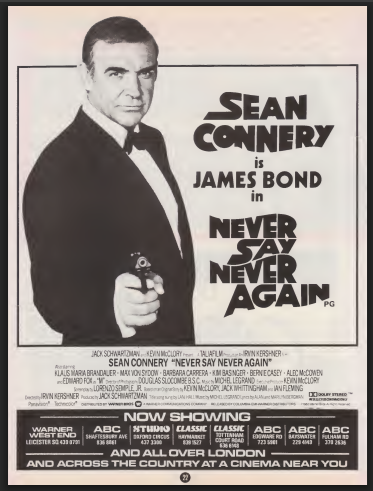
(Advert from Smash Hits January 1984)
The film was released to a massive fanfare, mainly that of ‘Sean is BACK!’ and it should be taken literally when I say reviews were ‘mixed’. As in some found it to be amazing and other found it to be amazingly average. The headline from the Chicago Tribune seems to be a tad too inflated for what they themselves say is a 3.5 star film, Be consistent, guys! (Since writing this I’ve been informed that the Tribune’s reviews are actually out of four stars. I’m not fucking changing what I’ve written, even though it’s now wrong. Four stars? Who the fuck does that? The phrase FIVE STAR REVIEW is there for a reason you fucking bellends)
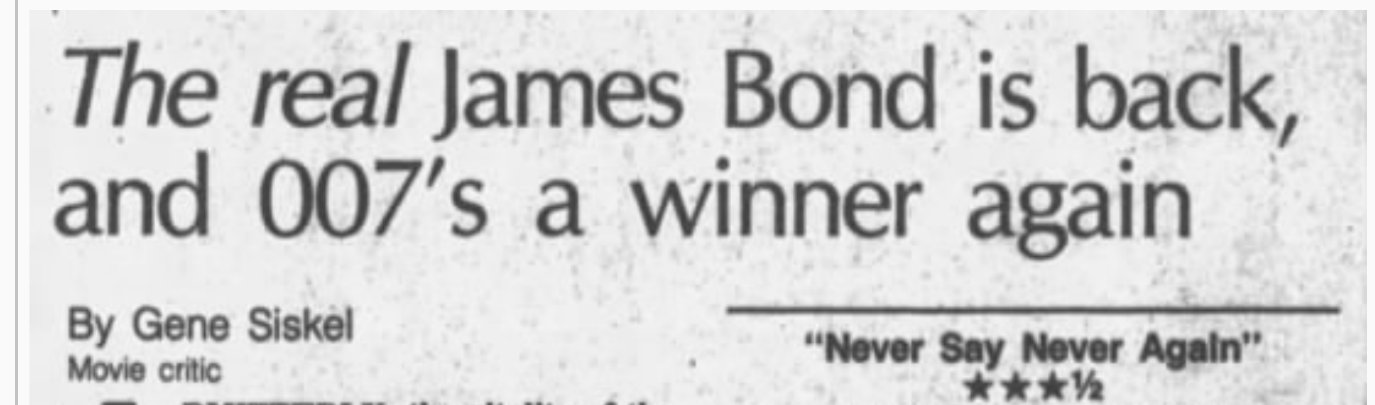
Success is relative. A multitude of middling 6 or 7 out of 10 reviews ignore the fact that the film is highly watchable and fun against all odds.
The film essentially had three producers all of whom had different ideas on what the film should look like. As well as Warner Bros management, there was Jack Schwartzmann, Sean Connery and Kevin McClory who all had something to say. Plus there were lawyers all over the place, making sure the Thunderball scripts were being stuck to. The multiple checks and balances each script and shoot went through left a bitter taste in the director’s mouth. The script changes required multiple re-shoots to make up for cut dialogue;
“We had some pick up shots in the caves. I was bored with shooting this kind of thing….I never had a moment of pleasure after that. I was tired of the way the picture had to be made, in pieces with different writers, with holes in the script that had to be filled on the set” Irwin Kirschner, The Big Gamble; The Making of Never Say Never Again 2009
There are multiple stories of Connery not liking Jack Schwartzmann to the point that Schwartzmann would leave the room if Connery entered. Clement later claimed that Schwartzmann was scared of Connery.
“Sean and the producer just didn’t get along at all. They hated each other.” Barbara Carrera, 007 Magazine, 2007.
In Schwartzmann’s defence he was spending a lot of time in court and had no time for the job of actual producer. He was the man doing everything and nothing himself.
The soundtrack is a big part of any Bond film and unfortunately Never Say Never Again film had no access to any of John Barry’s previous work. Like most Bond soundtracks, the production has two vocal songs among the instrumental music. Never Say Never Again by Lani Hall starts with the hallmarks of a Bond theme but then just sorted fizzles out. Like they got the introduction and thought ‘that’ll do, that’s Bond enough’. Slightly better is the song Une Chanson D’Amour by Sophie Della but even then it’s only good by comparison,
mp3: Lani Hall – Never Say Never Again
mp3: Sophie Della – Une Chanson D’Amour
Ultimately both sound like an A.I. was asked to write an 80s James Bond tune and the AI said ‘Do I have to? For fuck’s sake, will this do?’
According to Bonnie Tyler, she was approached to sing the theme but took a hard pass
“They just asked me. Would I like to do a song? And they sent me the song. “Never Say Never (again)” and I listened to it, and I thought, “Ugh! Shit! I don’t like it.” I had to turn it down. Now how many people turn down a Bond song? I don’t know. But I turned it down because I didn’t like it. And I was proved right. Because I think out of all the songs… I can’t even remember it.” Bonnie Tyler, The Bat Segundo Show 2008.
A song that was too shit for someone who once recorded a duet with Shakin’ Stevens. Blimey.
The soundtrack does have some gems of music though. Most of the great tunes in a Bond film are hidden in the incidental music and Never Say Never Again is no different. Michel Legrand who composed the score delivers this beauty;
mp3: Michel Legrand – Felix and James Exit
It’s s a nice piece of 80s cop funk that wouldn’t be out of place on Miami Vice.
Apparently it was Connery himself that enticed Legrand to work on the film.
“Sean’s warmth and enthusiasm persuaded me,” Michel Legrand, Jon Burlingame’s The Music of James Bond
As with most Bond films there’s a passed over tune that didn’t make it ( among others; Johnny Cash turned in a tune for Thunderball, Blondie had a stab at For Your Eyes Only and Alice Cooper composed The Man With The Golden Gun… honestly that’s a different blog for another day; Run, James, Run by Brian Wilson deserves a whole page to itself…..
‘Never Say Never Again’ By Phyllis Hyman could have done wonders for the film’s press.
In the battle of the Bond soundtrack, Octopussy wins hands down. When it comes to the reception of the films, it’s probably a tie. Never Say Never Again was generally well received. Both are three out of five 80s action mehhhs. I think the best description of the work lies in the title of the reformed New York Dolls album; ‘One Day It Will Please Us to Remember Even This’
For Connery it would be the last time he would play Bond. The film drained him to the point that he was happy to complain about it publicly.
“It should have been a great deal more pleasure than it was. What I’m thrilled about is the huge success that it’s had…But it’s unfortunate that yet again one has had to carry someone incompetent” Sean Connery, Film ’83 With Barry Norman
He was a few years away from the massive success of Highlander, The Untouchables, The Hunt for Red October and many others as his career got a second wind.
McClory ended up trying to cash in on the Bond resurgence of the mid 1990s; he’d hawk a script around Hollywood called Warhead 2000 which again was another remake of Thunderball. Timothy Dalton. Liam Neeson and Sean Connery were all attached to the role of Bond at some point. Sony took the plunge and in 1997 they released this press statement
“Columbia Pictures, a Sony Pictures Entertainment Company (SPE), today announced a new association with producer/director Kevin McClory and his company Spectre Associates Inc. to make a series of new James Bond feature films. These movies will be based on original works created by McClory, James Bond novelist Ian Fleming and Jack Whittingham” Sony Press Release Oct 1997
MGM said nope. They sued and Sony counter sued, and in 1998 a court ordered the production of the film halted until it could be sorted out. Ultimately both sides came to a settlement. And by that I mean Sony probably ran the numbers and found that the court case would triple the budget of the film, and they had no idea if that film would even recoup its costs let alone that of the legal trial. They didn’t want to be into the third sequel before they made a profit.
In 2001 McClory had one last stab at some Bondage. He claimed he had a portion of the ownership rights of the character since so many of his idea were adopted into the franchise. The 9th Circuit Court that oversaw the case said he’d left too long to make that charge and was he out of his fucking mind? Okay they didn’t say the second bit.
Eventually Sony obtained MGM as a company and with it was able to merge the Bond franchise with their rights to Casino Royale and Never Say Never Again (and supporting creative works), which is why we eventually got a proper Casino Royale and a return of Blofeld.
I feel we should take a moment here to adore the glorious Burt Bacharach soundtrack to the 1960s Casino Royale;
mp3: Dusty Springfield – The Look Of Love
mp3: Burt Bacharach – Hi There, Miss Goodthighs
mp3: Burt Bacharach – The Big Cowboy and Indian Fight at Casino Royale
Since the MGM acquisition the Bond community are still split on the film. Some even sent hate mail to McClory when he was alive. There are multiple fan edits of the film including this on which adds a ‘Gun Barrel’ intro and includes John Barry music
Hardcore Bond fans still argue over whether Never Say Never Again should now considered an official film in the series but those arguments will almost certainly stop once they find someone who will fuck them.
BA NAP NAH NAHHHHHHH!
 THE NEW VINYL VILLAIN