A guest series by Fraser Pettigrew (aka our New Zealand correspondent)
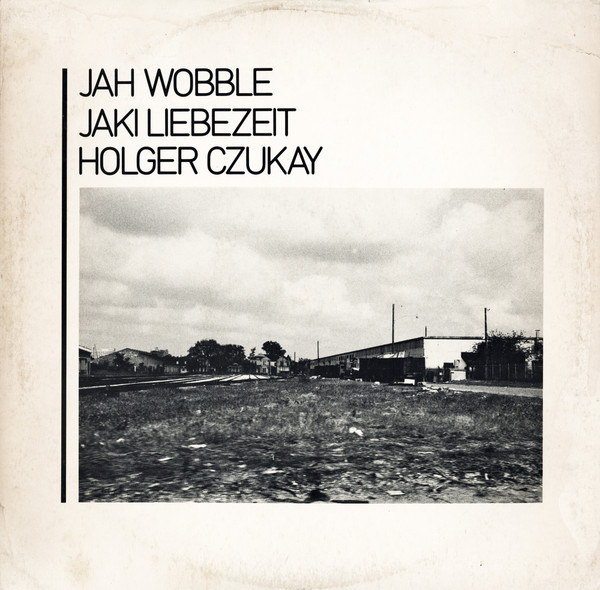
#7: How Much Are They? – Jah Wobble/Holger Czukay/Jaki Liebezeit (1981)
A collaboration between two members of Can and the bass player for Public Image Ltd was bound to pique my interest in 1981, when this four-track 12” EP was released. Sometimes these kind of tie-ups fail to deliver on their promise, but on this occasion the results were highly satisfying and the EP has remained a favourite ever since.
Wobble and Czukay first met through journalist Angus Mackinnon, a friend of Wobble’s who mentioned to him during an interview that Czukay was in London at that time (late ’80 or early ’81) and arranged a meet up. Wobble had grown frustrated with PiL’s creative inertia. He had released his first solo album, The Legend Lives On… Jah Wobble in “Betrayal”, in May 1980, but his unauthorised use of recordings from the Metal Box sessions on that album ultimately led to his ejection from PiL in late 1980.
Funnily enough, it was John Lydon who was the better-known Can fan, praising them and playing the full 18 minutes of ‘Halleluwah’ during his appearance on Tommy Vance’s Capital Radio show in July 1977 at the height of the Sex Pistols’ infamy. Wobble also liked Can but as he explained, “I liked the groove stuff, I wasn’t mad on everything, but it was the stuff where Jaki got his thing going on those earlier albums that I liked.”
Wobble jumped at the chance to meet the Can bassist. Czukay hinted in a later interview that Lydon may also have been invited but passed, so it was Wobble alone who arrived at Mackinnon’s flat wielding a six-pack of beer. Given his reputation for alcohol abuse in those days, this didn’t bode well, especially since Czukay was in the surely tiny minority of German people who don’t like beer. In the end, however, only one can was consumed as the musical discussion took up all their attention.
The pair first worked together in a London studio where the track How Much Are They? was recorded. It’s the funkiest of the four tracks, and the only one that might induce you to try some restrained dance moves. Wobble then travelled to Can’s Inner Space studio near Cologne where the other three pieces were created. Wobble is also credited with the bass part on the final track of Czukay’s 1981 solo album On The Way To The Peak Of Normal, although whether this was before or after the EP recordings I can’t tell.
Despite Wobble’s admiration for Jaki Liebezeit’s phenomenal extended grooves on the early Can albums, the rhythms on this EP are driven much more by the Englishman’s characteristic reggae-influenced basslines. Jaki’s drumming is of course impeccable, but there is no reprise of ‘Mother Sky’ or ‘Halleluwah’ here. Czukay’s contribution, apart from his woozy French horn, is most prominent in the artful assemblage of the disparate parts into satisfying wholes. Long recognised as a master of pre-digital cut-and-paste tape editing, Czukay wields the scissors and Sellotape here with imperceptible precision and compositional skill. His guitar work also suggests he learnt how to play from Can’s Michael Karoli, though at times he also channels Keith Levene’s fractured and discordant PiL sound.
No one would ever mistake Jah Wobble for a gifted singer, something the critics of his “Betrayal” album homed in on. Punk and the new wave had long since abolished the idea that this mattered, however, and Wobble the singer delivers vocals for each track that sound like a drunk man making it up as he goes along, which is quite possibly an accurate summation of what happened. Or more likely, they showcase the spontaneity and willingness to give it a crack that were apparently shared points of musical approach with Holger Czukay.
‘Twilight World’ may be the title of just one of the four tracks, but it could almost serve as a description of the EP’s prevailing atmosphere. The combination of Wobble’s dubby basslines, wandering vocals, opaque lyrics and the fragmentary sounds flashing across the soundscape make for a surreal and psychedelic experience, like the kind of disorienting dream sequences in movies where our hero is waking up in a strange room after being captured and drugged by the baddies. Just my kind of scene, really.
The following year (1982) the four tracks were augmented by another two longer pieces, one called ‘Full Circle R.P.S. (No.7)’ and the other ‘Mystery R.P.S. (No. 8)’ and released as Czukay’s fourth solo album Full Circle. The two longer pieces are definitely from the same stable as the EP tracks, but feature more found sounds and radio samples typical of Czukay’s earlier album Movies (R.P.S. stands for ‘radio pictures series’). Both tracks could be described as less focused, and Full Circle has a jauntier mood that sets it a little apart.
Overall, I like to think that if you came across this music without knowing who or what it was, then you would have to describe it as sounding like a cross between Can and Metal Box, which probably accounts for its enduring appeal. Metal Box’s debt to Can did not go unnoticed at the time, even by callow youths like me, whose exposure to the German band in 1979 was limited to their first and last albums.
I didn’t notice that Wobble and Czukay collaborated again in 1983 with The Edge on a five-track EP called Snake Charmer, but having heard it recently I can tell you it’s nothing like this. It’s a very mixed bag, and with Francois Kevorkian twiddling knobs on a few of the tracks it has a much more notable dance stance. Czukay’s presence is negligible.
While I’ve enjoyed much of Czukay’s solo work I can’t say the same for Wobble’s. I heard some Invaders of the Heart and didn’t go for it, and then he disappeared from view. Recently I came across his Metal Box Rebuilt in Dub album and made the mistake of listening to it. As website The Vinyl District put it, this abomination “isn’t a reimagining of Metal Box, it’s a betrayal of the very spirit of Metal Box, and why anyone would listen to this perverse act of urban gentrification more than once is beyond me.” He is too generous. Even if you had never heard Metal Box it is still utter shit, and if you have, well it’s the musical equivalent of someone exhuming and desecrating the body of one of your loved ones. Metal Box has many fine legacies, amongst which is this excellent EP that Wobble made with Czukay and Liebezeit in its immediate aftermath. He should have left it at that.
How Much Are They?
Where’s the Money?
Trench Warfare
Twilight World
 THE NEW VINYL VILLAIN