SHAKEDOWN, 1979 (March)

79

March 1979.  Four weeks of chart rundowns to look back over and determine whether any of the new entries are worth recalling as fab 45s from 45 years ago.  To be fair to the first chart of the month, some classics highlighted in earlier editions of this series were still selling steadily – Oliver’s Army (#2),  Heart Of Glass (#6), Into The Valley (#13), The Sound of The Suburbs (#16), English Civil War (#28) and Stop Your Sobbing (#37).  It just about compensated for a lot of the rubbish that was being inflicted on our ears – this was the time when Violinski, a spin-off from the Electric Light Orchestra, were enjoying what thankfully turned to be a one-hit wonder.

mp3: Buzzcocks – Everybody’s Happy Nowadays

In with a bang at #44, and in due course climbing to #29, this turned out to be the last time a Pete Shelley lead vocal for a new  Buzzcocks single would disturb the Top 50.  Not that any of us knew that was how things would turn out.

The new chart was also delighted to welcome someone else who was very much part of the thriving post-punk scene in Manchester:-

mp3: John Cooper Clarke – ¡ Gimmix ! Play Loud

The one and only time that JCC ever had a hit single.  This came in on 4 March at #51 and went up to #39 the following week.   Sadly, it didn’t lead to a Top of the Pops appearance.

Now here’s one that’s a perfect illustration of why I think 1979 wins any poll for the best year for new music:-

mp3: The Jam – Strange Town

A new song not included on any previous studio album, nor would it feature on any future studio album.  Came in at #30 on 11 March and stayed around for nine weeks, peaking at #15.  It also had a tremendous b-side in the shape of the haunting The Butterfly Collector.  Who’s up for a TOTP reminder of how cool Paul Weller was back then?

Oh, and you don’t have to be new wave/post-punk to be picked out for inclusion in this series:-

mp3: Kate Bush – Wow!

The success of this was probably a big relief to everyone who was involved in the career of Kate Bush.  Two big hits in the first-half of 1978 had been followed up with a disappointing effort from Hammer Horror, which failed to reach the Top 40.  The first new song of the year came in at a very modest #60 but, during what proved to be a ten-week stay in the charts, would peak at #15.

mp3: Giorgio Moroder – Chase

Midnight Express had been one of the biggest films of 1978, and its soundtrack would go on to win an Oscar the following year.   The one single that was lifted from the soundtrack album was a big hit in clubs and discos, particularly the full-length and extended 13-minute version.   The edited version for the 7″ release did make it into the charts, entering on 11 March at #65 and peaking at #48 two weeks later.

Squeeze are still going strong these days, selling out decent-sized venues all over the UK when they head out on tour.  They never quite enjoyed a #1 hit in their career, but the chart of 18 March saw a new entry from them at #33 which eventually peaked at #2 an 11-week stay:-

mp3: Squeeze – Cool For Cats

And finally for this month, here’s who were enjoying chart success in the final week of March 1979:-

mp3: Siouxsie and The Banshees – The Staircase (Mystery)

In at #33 and climbing in due course to #24, it was all anyone needed to hear to realise that Hong Kong Garden wasn’t going to be a one-and-bust effort for Ms Sioux and her gang.

Don’t get me wrong. There really was a lot of dreadful nonsense clogging up the charts in March 1979, particularly at the top end of things, and there were probably as many hit singles whose natural home was on the easy-listening station of Radio 2 than on the pop-orientated Radio 1.  But I think it’s fait to say that there were a few diamonds to be found amongst the dross.

Keep an eye out later this month for a look at some memorable 45s which were released in March 1979 but didn’t trouble the charts.  And I’ll be back in four or five weeks time with the next instalment of this particular series when we will spring into April.

JC

AN IMAGINARY COMPILATION ALBUM : #358: GIORGIO MORODER (1984)

A guest posting by Leon MacDuff

thumbnail_giorgio moroder 1984 ica

Around this time last year, I offered up an ICA looking at what Giorgio Moroder had got up to in 1983. And I ended with a bit of a tease regarding what was to come in 1984, so it’s time to deliver, right? I wouldn’t say the quality or musical diversity of this ICA necessarily matches the 1983 selection, but I think there is still a lost gem or two, a story or several you may not have heard before, and maybe the odd song that may not be what you’d expect from the people involved. And the opening track is a solid gold classic…

Side One

(1) Giorgio Moroder & Philip Oakey: Together In Electric Dreams

Plot summary of the movie Electric Dreams: Young architect Miles buys a home computer to help him in designing an earthquake-resistant brick. You want to see this movie already, don’t you? But wait, there’s more! Hooking it up to his employers’ database and attempting to download “everything”, Miles causes the computer to overheat and in a panic tries to cool it down by pouring champagne on it. Good job this guy’s an architect and not an electrician. Or a sommelier. Naturally there’s sparks and smoke but the computer is not dead, quite the opposite in fact as it has somehow become sentient… and then the next hour follows a love triangle between Madeline the cellist who lives downstairs, Miles, and the computer, but to cut a long story short, after much hijinks and cyberjealousy, eventually the computer sacrifices itself to give Miles a chance of happiness with Madeline. Before it gets destroyed by a massively improbable plot device, the computer reveals its name as Edgar, and it having a name was obviously meant to be a tear-jerking revelation but the publicity people clearly didn’t understand narrative structure and put the big reveal on the poster, so everybody knew already. The main thing is, it does come up with a design for the earthquake-resistant brick, so it’s a happy ending really. Well, assuming you’re really into earthquake-resistant bricks, but then again, who isn’t? No, it is actually better than I’m making it sound. Weirdly, there’s been serious talk lately about a remake, though I can’t see it working now. In a world with AI everywhere, Edgar would have to be less intelligent than the average computer – though admittedly if you pour champagne over the motherboard, that is actually a more realistic outcome.

But back to 1984. And back to relevance. The whole concept of Electric Dreams was that it would be a musical, but – like Flashdance the previous year – rather than having the characters themselves burst into song, the action would be shot like music videos accompanying the songs on the soundtrack. Writer-producer Rusty Lemorande (great name) wanted no more than two songs from any given artist – though he did briefly consider taking Jeff Lynne up on his offer to do the whole thing. Arguably the headline act is Culture Club, who offer a pair of ballads (if you look up Love Is Love online you’ll find loads of people commenting on how beautiful it is, which is pretty hilarious considering that in the context of the film it’s explicitly a bunch of cliches put together by a computer struggling with the concept of human emotion… I mean, it’s essentially “ChatGPT, write me a love song”). P.P. Arnold gets the opening title song, although in the movie you only hear the chorus because the verses give away the plot (“He was a boy who bought a computer… taking over was its only crime!” Yeah, quite a biggie though, wasn’t it?). Jeff Lynne gets two songs, of which Video is especially of-its-time. Heaven 17 supply a driving synth instrumental, Chase Runner – and while Moroder wasn’t involved there, it’s pretty much a straight homage to him, even to the point of having a title that combines two of his!

And as for Giorgio himself, despite the supposed two-track maximum, he actually manages to have a hand in no fewer than four: two instrumentals credited to him alone (an underscore piece called Madeline’s Theme, and The Duel, which we’ll get to later), an upbeat number called Now You’re Mine, sung by “fifth Culture Clubber” Helen Terry, and of course this classic from the movie’s finale, when Edgar – who has somehow transferred his consciousness to what we’d now call “the cloud” – bids farewell to Miles and Madeline by making this song play on every radio in California. (Moroder himself has a fleeting and funny cameo as a radio producer wondering what the hell is going on.)

And the single… you know the single. A compendium of fantastic moments: that shimmering intro, the “however far it SEEMS!” in the chorus, Elizabeth Daily‘s “Love ne-ver ends!” and Richie Zito’s crunchy guitar solo… it doesn’t try to be clever-clever, it’s just brilliantly put together. Maybe it’s become over-familiar – it’s certainly one of the media’s go-to tracks for evoking the era – but genuinely, it’s just great, isn’t it?

(2) Berlin: Dancing In Berlin

The name alone was a clue that Los Angeles new wavers Berlin looked to Europe for their inspiration, and when you actually heard them, it wasn’t hard to spot the influence of electronic pioneers like Kraftwerk and Giorgio Moroder. So a collaboration was an obvious move, and for the group’s third album Love Life, they managed to book some time out of Moroder’s busy schedule to lay down a couple of tracks. (OMD producer Mike Howlett handled the remainder.) On this occasion Moroder was not called upon to write anything but just to produce. And the band – and Geffen Records – were obviously very pleased with the results, since those two songs also became the album’s singles. No More Words was probably the more popular, but I’m sharing Dancing In Berlin as it feels like more of a classic Moroder production.

Of course it also led to Berlin getting the call two years later to record Take My Breath Away for the Top Gun soundtrack, one of Moroder’s biggest hits but so far from Berlin’s previous sound that it ended up causing massive disagreements over their future direction, resulting in them splitting up and only talking to each other through lawyers for ages. They’re all friends again now, though.

(3) Janet Jackson with Cliff Richard: Two To The Power Of Love

Janet Jackson seemed to burst onto the scene with her style fully-formed on 1986’s “Control”, but before that, she recorded two albums that even her fans never really talk about. The second of these was 1984’s Dream Street, for which Moroder produced five tracks including this one. Now, I’m not going to pretend this is a lost classic. It’s better than you’d expect, but nevertheless, it’s as good an example as you could wish for to explain why nobody ever talks about the early Janet Jackson LPs.

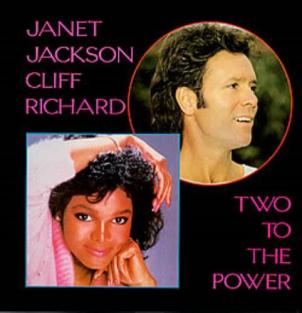
I’m including it for two reasons: firstly, because the fact that Janet Jackson recorded a love duet with Cliff Richard, and Giorgio Moroder produced it, is so bizarre that unless presented with the evidence, nobody would ever believe it. And secondly… look, I know this is a wild idea, but you know how David Hasselhoff goes on about how his song Looking For Freedom helped to bring about the fall of the Berlin Wall – and how, much as everyone mocks him for it, the really weird thing is that he may actually have a point? Well, I’ve never noticed any of the people involved in this record claiming that it helped, even in the tiniest way, to bring about the end of apartheid, but the one place it actually became a top ten hit was South Africa, where the front cover looked like this:
thumbnail_Outlook-g2j1xs2s

Terrible design (it doesn’t even get the full title on!), but also a harbinger of change? I know it’s a hell of a stretch, but little things do feed into bigger things and, well, I’m just putting the hypothesis out there… I do so wish it had been a better song, though.

(4) Freddie Mercury: Love Kills

When Moroder was working with David Bowie on the title song for the 1982 remake of classic 40s horror Cat People, talk naturally turned to the pair’s common love of European expressionist cinema. Both men harboured an ambition to find a suitable old silent film and put a modern soundtrack to it, and at this stage Bowie had been trying to get the rights to one film for years. Moroder’s project was already more advanced: he had, he enthused, found and acquired the rights to a movie nobody had heard of but which was ideal for his purpose: a 1927 dystopian epic called Metropolis. Bowie was a bit taken aback, but didn’t let on that this was the very same film he’d had his eye on. Maybe if he had mentioned it, there could have been a collaboration: Moroder and Bowie doing a full film score together, now there’s a dream team.

Moroder ploughed money into having the film restored, tinted, and re-edited to make sense (necessary because at the time large parts of it were still missing). And he wrote a full score with songs performed by some big names: Bonnie Tyler and Adam Ant were pretty big catches, as was Jon Anderson (coming off the back of Yes‘s US number one Owner of A Lonely Heart) but the biggest coup of all was getting Freddie Mercury, who brought with him a song idea he’d been kicking around for a few years, initially as a ballad before Moroder reworked it into the pulsating electropop groove heard here.

While most of the backing is played by session keyboardist Fred Mandel, many years later it emerged that all of the other members of Queen made contributions as well. This wasn’t entirely surprising and many people had already surmised as much, considering that it was taped during sessions for Queen’s own 1984 album The Works, which was recorded – as the last couple of Queen albums had been – at Moroder’s Munich studio Musicland with in-house producer Reinhold Mack. (Mandel is on The Works too – most memorably providing the wah-wah laden not-a-guitar solo on I Want To Break Free.)

Love Kills was the lead single from the soundtrack, a pretty substantial hit, a barnstorming club monster, and it goes down in history as Freddie Mercury’s first ever solo single – as long as you ignore the Larry Lurex episode, which luckily everyone does.

(5) Giorgio Moroder: The Duel

This one’s just plain fun. We’re back to Electric Dreams and one of the movie’s highlights. The first demonstration of Edgar’s newfound sentience comes when Miles goes out, the cello player downstairs starts practising – and Edgar joins in. So this is their duet, or duel. A word of warning: this track has full stereo separation with the cello in the left channel and the computer on the right. So you really do need to be listening in stereo for this one. If you’re on a single speaker / earbud / whatever, you’ll be missing half the duet and all of the point.

Side Two

(1) Giorgio Moroder and Paul Engemann: Reach Out

On my first Giorgio Moroder ICA, side two opened with a cheesy but suprisingly popular song performed by Paul Engemann. So with that precedent in mind, it was obvious what had to fill the spot this time.

If you give the Olympic Games to Los Angeles, you can hardly be surprised if they make it a bit showbiz. The LA Games arguably invented the even-more-modern-than-the-Modern Olympic Games, for which part of the masterplan was bringing music into the presentation – and with the world’s top film composers right there on their doorstep, naturally the Games were going to be scored like an action blockbuster. The likes of John Williams, Christopher Cross, recent Oscar winner Bill Conti, Philip Glass and Herbie Hancock all supplied pieces to the soundtrack, as of course did Giorgio Moroder, whose “Reach Out” was designated the “Track Theme” although it wound up as arguably the most-recognised sonic signature of the games, alongside John Williams’ “Olympic Fanfare and Theme” (the latter remains well-known in the US as it’s been NBC’s theme for its Olympics coverage ever since).

Is Reach Out a great song outside of that context? I wouldn’t say so, no, mainly because Tom Whitlock‘s “inspirational” lyric just grates too much. But it’s absolutely spot-on for that moment, in the same way that Together In Electric Dreams is exactly right for the climax of its movie. So much so, that it wouldn’t be the last time Moroder and Whitlock were commissioned to write the theme for a sporting event: they would also go on to write songs for the 1988 Seoul Olympics (Hand in Hand) and the 1990 FIFA World Cup (To Be Number One). Those are pretty cheesy too – but they certainly did the job.

(2) Melissa Manchester: Thief of Hearts

From the list of people involved in the Thief of Hearts soundtrack, you could be forgiven for thinking it must be another Moroder score: among the contributors were his frequent backing singers Beth Andersen, Elizabeth Daily, Joe Esposito and Joe Pizzulo, guitarist Richie Zito, lyricist Keith Forsey and programmer Brian Reeves. It was basically Moroder’s entire regular crew, and even recorded at his Beverley Hills studio, Oasis, but actually the man in charge was another recurring Moroder collaborator, his sometime protégé Harold Faltermeyer, who considers it the start of his own career in soundtracks. Moroder’s one contribution was writing the title song, and though he got a production credit as well, it seems he wasn’t exactly hands-on.

From Faltermeyer’s autobiography Where’s the Orchestra?:-

“Although Giorgio declined to score it, because he was busy with various projects, he agreed to contribute at least one song to the project. He quickly came up with a song called Thief of Hearts, and we needed to find a singer. We were lucky to sign Melissa Manchester for this […] I got busy working on a demo, which we sent over to Melissa. She was quite happy with it, so we were rockin’ and rollin’. Under one condition: Giorgio had to be present for the vocal session, because who was Harold Faltermeyer? Giorgio’s appearance was limited to a “Good morning boys”, or in this case: “Here she is!” With this he disappeared, and we did the rest. Once I got famous, her management asked me to produce her, typical Hollywood but at that point I didn’t even consider it!”

This particular version is the remix by John “Jellybean” Benitez, who at this point seemed to be the “soundtrack doctor”, sprinkling his remixing magic on movies like Breakdance, Footloose and… The Muppets Take Manhattan?! Yes, really. Variety is the spice of life!

(3) Giorgio Moroder: Rotwang’s Party (Robot Dance)

As well as the ten tracks featured on the Metropolis soundtrack album, there were further instrumentals hidden away on the B sides of the three singles. Bonnie Tyler‘s “Here She Comes” shares its vinyl with a confused slow-fast-slow piece called Obsession that I don’t rate all that highly; Jon Anderson‘s Cage Of Freedom has Workers’ Dance which lacks a real hook but would have made a decent theme for a TV technology show (and might still do even now); but the pick of the bunch is this one from the Love Kills single. The influence on known fans Daft Punk is evident particularly toward the end, and paired with Love Kills it made for a good value package.

(4) Limahl: L’Histoire Sans Fin

Although Giorgio Moroder is fluent in five languages, he tends not to write lyrics in any of them, preferring to pen the melodies and leave the actual words to his collaborators – if he’s working with a big name artist then they’ll often provide their own lyrics, while the rest of the time it falls to one of his regulars such as Pete Bellotte, Keith Forsey or the now late Tom Whitlock. Sure, he cares about the quality of the lyrics, but basically, the words in a Moroder song are first and foremost a medium for melodies. And that, combined with the notion that maybe it would be nice to offer something a bit less familiar, is my excuse for including this oddity on the ICA.

Of course in its English version (words by Forsey), The NeverEnding Story is one of Moroder’s biggest and most familiar hits. Since The NeverEnding Story was a German film – still the highest-grossing German film of all time, as it happens – it would make sense for the title song to also have a version in German, but actually the German version of the film didn’t use the song at all. It didn’t even use Moroder’s music – Moroder and Klaus Doldinger each wrote scores and the international release has a pick’n’mix from both, but the German cut went with Doldinger alone.

The French and Canadian single releases did however feature – as a B side – this version en Français, with a loose translation by prolific Francophone songwriter Pierre-André Dousset, and original co-lead vocalist Beth Andersen replaced by Parisienne A-list session singer Ann Calvert. To be honest, I rather miss “Show no fear / Or she may fade away…” and I’m so used to Andersen’s wailing before the instrumental break that Calvert’s imitation just doesn’t sound right. But the tune’s still hard to resist. I just wonder what this would have sounded like in German?

(5) Pat Benatar: Here’s My Heart

A lighters-in-the-air moment to finish. To my mind, this should have been the big breakout hit from Metropolis. It pops up twice in the movie and a third time as a triumphant reprise over the credits, but the version released on the soundtrack album is a weirdly stodgy remake with different lyrics. Which then wasn’t even issued as a single, so it wound up as a bit of a lost song, never performed live and not featured on a Pat Benatar album until it popped up many years later as the conclusion of her otherwise chronologically-sequenced career retrospective Synchronistic Wanderings.

However the actual movie version is much stronger, and it’s easy enough to find the full film score online, so a bit of fiddling about in Audacity et voila! You can find videos on YouTube where people have just run the three original variations together, resulting in an awkwardly-structured song that runs nearly eight minutes, but I’ve gone for a tighter edit that is pretty much the same length as the album version, give or take a few seconds, and I think could have worked as a single too. This could so easily have been a karaoke standard – it’s got the kind of chorus people would find it hard to resist having a go at. I don’t think many people could do it quite this well, though: I have to admit, basically only knowing Benatar from her growly rock hits, I hadn’t realised quite what a strong melodic vocalist she actually is.

So that’s Moroder’s 1984. I don’t think there will be a 1985 ICA because he just didn’t do all that much in ’85: apart from a dashed-off Giorgio Moroder & Philip Oakey album (which neither man rates highly, though I think it’s actually pretty good), his only other significant release was the odds-and-ends collection Innovisions, which I remember being a staple of the reduced-price racks for a very long time afterwards. And after that, well, there are stories later on but I’m not sure the music itself is quite so interesting. But of course Moroder’s career goes back in time from here as well as forward, so… watch this space!

Leon

AN IMAGINARY COMPILATION ALBUM : #330: GIORGIO MORODER (1983)

A guest posting by Leon MacDuff

thumbnail_giorgio moroder romance 83

Romance ’83: A Giorgio Moroder ICA

1983 was a good year for Giorgio Moroder. It certainly wasn’t his first annus mirabilis – after all you can’t dismiss 1979, when he resurrected the careers of Sparks and the Three Degrees (don’t be put off by the sappy ballad “Woman In Love”, there’s disco gold in them there elpees), pausing just long enough to pick up the first of his three Academy Awards. Or 1977, the year he changed the course of popular music forever, armed only with a single kick drum and a borrowed Moog (and, to be fair, a Donna Summer, which always helps). Nevertheless, 1983 was a good’un.

Now well established in L.A., he was in demand as a soundtrack composer as well as a record producer. And while especially during his Hollywood years (of which 1983 is slap bang in the middle) he may not have been averse to the odd bit of musical cheese, on the whole he was doing good work which doesn’t get the attention that his disco era productions do. Sure, there may be nothing as groundbreaking here as “Chase” or “I Feel Love” but nevertheless 1983 saw Moroder very much in his pomp. Trevor Horn has been described as the man who invented the 80s, but Giorgio Moroder is surely a strong contender too, so here’s forty minutes of the great man at work.

Side One

(1)  Nina Hagen – Zarah

I feel like I should be more familiar with Nina Hagen. From what I’ve heard of her usual material, she’s a highly idiosyncratic performer with a remarkable voice, and she has had a pretty colourful life which you can read about elsewhere. But actually I mostly know her for her Moroder-produced album “Fearless” (and its German-language version “Angstlos” which also has a couple of different songs). You don’t have to tell me it’s not representative of her career as a whole, I do know! I really like the album though, not least because Moroder throws everything at it.

The single Zarah is a part-translated version ofIch weiß, es wird einmal ein Wunder gescheh’n”, a signature song of Swedish actress Zarah Leander who introduced it in the 1942 film “Die große Liebe” (according to Wikipedia, “the most commercially successful film in the history of the Third Reich”, which is quite the double-edged sword). Leander herself had rather an interesting life too, with her career in Germany leading to (probably incorrect) accusations of collaboration with the Nazis… but again, there are other places you can read about that. I’m really supplying the rabbit holes today, aren’t I? Anyhow, it’s a strong opening, and to answer your inevitable question: one minute and 28 seconds, that’s how long it goes on like that for. It’s worth sticking with…

(2) Irene Cara: Flashdance… What A Feeling!

I could hardly ignore this, Moroder’s biggest hit of the year, and one of his biggest ever. The Flashdance soundtrack was mostly split between Moroder and Phil Ramone, but it was Moroder who got the title track. The lyrics were written by Irene Cara and regular Moroder collaborator Keith Forsey in the taxi on the way to the studio, and the song won the three of them an Oscar – Moroder’s second following a Best Original Score prize for the Midnight Express soundtrack six years earlier.

In the film, the song is used in an audition scene, the triumphant feel-good nature of which is slightly undercut by the obvious-once-you-spot-them switches between multiple body doubles… and something not entirely dissimilar happens with the song’s standard commercial release, which suffers several clumsy edits (to pick just two, listen out for the clunky cut-and-shut at 0.54 and Cara’s held note being suddenly cut off at 3.14) and for good measure is also saddled with a guitar solo that isn’t even trying. Still, you’d have to admit it’s pretty iconic for anyone who grew up in the 1980s, which is probably most of us, yes?

(3) Debbie Harry: Rush Rush

Movie soundtracks are to a large extent hostages to the fortunes of their parent films. You can pour heart and soul into a great soundtrack but if nobody likes the movie, your work’s just not going to get noticed. In all honesty I’m not sure Moroder’s song score for Scarface is really that much better than his work on D.C. Cab or Superman III, but it hit the jackpot in terms of being attached to a movie that garnered both critical plaudits and popular success. And it IS a good collection with a decent spread of pop styles, albeit somewhat lacking in star power – aside from Debbie Harry of course. You’ll remember that Giorgio and Debbie already had some history, Blondie’s Moroder-produced “Call Me (Theme From American Gigolo)” being a massive hit back in 1980. I’ll be honest, “Rush Rush” isn’t in the same league, but it does seem a shame that they didn’t work together more. Rush Rush itself also got a bit overlooked; I’d got the impression that Harry was in a bit of a career slump at the time but checking it out, I see her solo album Koo Koo had actually done pretty decent business so it’s surprising this didn’t get a bit more attention.

(4) France Joli: Blue Eyed Technology (dance mix)

If you watch those TV shows where they try to prove an old painting is by a recognised artist (and therefore worth squillions) then you’ll know where I’m coming from when I suggest this one may really be more “studio of Moroder” than “by Moroder”. France Joli’s album “Attitude” has Giorgio credited as executive producer, but reading between the lines, it would appear that regular collaborators Pete Bellotte and Richie Zito were the ones actually putting in the studio hours (and Moroder has no writing credits either – this one’s by Bellotte/Zito but the album draws on a large pool of contributors, including former Jo Jo Gunne frontman Jay Ferguson and hi-NRG star Hazell Dean). But Moroder and Bellotte are credited for this 12” remix so I’ll give him the benefit of the doubt, I guess.

Quebecois singer France Joli scored a disco classic right out of the gate with 1979’s “Come To Me” but never quite managed to repeat the trick. “Attitude” is a good try, though – both this and the album’s other single “Girl In The 80s” sound like they have real hit potential (and they really do showcase the classic Moroder sound, even if they were put together by his understudies), but ultimately failed to make much of a splash.

(5) Irene Cara: Romance ‘83

The success of “Flashdance… What a Feelingled to Moroder being commissioned to do a full album – What A Feelin’ – for Irene Cara, and shocker: it’s rather good! Cara, who’d self-composed most of her previous album, was keen to emphasise that it was really more of a Moroder project, though her lyrics – which occasionally slip into the blandly motivational but are more usually engaging and even witty – hint at the potential of an ongoing creative partnership which sadly never came to be. Cara might not have appreciated the comparison, but to my mind What a Feelin’ gives an idea of what a Donna Summer album might have sounded like in 1983 had Geffen allowed her partnership with Moroder and Bellotte to continue. It’s certainly a stronger collection of songs than Summer’s own album that year, “She Works Hard For The Money” which has the title track and maybe a couple of other decent numbers but falls back on a lot of filler.

As for this track… a good old Giorgio Moroder synthpop special which despite the of-its-time sound (and title) is really rather prescient, what with the isolating effects of technology being an even bigger issue now then they were forty years ago. And of course it gives its name to this ICA, because it was just too good a title to pass up!

Side Two

(1) Paul Engemann: Scarface (Push it to The Limit)

The Scarface soundtrack offered a moment in the spotlight to several of Moroder’s regular backing singers including Beth Andersen (who you’ll have heard duetting with Limahl on The NeverEnding Story – though you’re unlikely to have seen her doing it as Limahl’s associate Mandy Newton lip-synced the part for the video and promotional appearances) and E.G. (Elizabeth) Daily, who went on to do her best “girls from The Human League” impression on Together In Electric Dreams before becoming a successful voice actor. Also getting his turn up front was Paul Engemann, who briefly became a bankable star off the back of this track, and got himself featured on several subsequent Moroder soundtracks – as well as on “Reach Out”, a cheesily “motivational” commission for the 1984 Los Angeles Olympic Games. Truthfully, I think this one’s a bit cheesy as well, but apparently quite popular at the time, especially stateside.

(2) Chaka Khan: No See No Cry

I think it’s fair to say that Superman III does not have a good reputation. It did well at the box office (by this stage the Superman name pretty much guaranteed a good return), but was savaged for its incoherent plot and excessive emphasis on comedy. Giorgio Moroder had a different reason to feel disappointed, as he’d been commissioned to write a suite of original songs only for them to be barely used in the actual film. We did at least get to hear them via the soundtrack LP, which featured Moroder’s songs on one side and selections from Ken Thorne’s orchestral score on the other. I’m not entirely sure that No See No Cry actually appeared in the film at all but Chaka gives it her usual class, even if the song sounds more suited to Shalamar… who we’ll hear in about 11 minutes’ time.

(3)    Nina Hagen: Flying Saucers

One thing I do know about Nina Hagen is that UFOs are one of her recurring obsessions (supposedly she saw one while pregnant and it blew her mind, or something). Hence this endearingly daft bit of breezy synthpop from the Fearless album. That’s all I’ve got on this. Just listen and enjoy…

(4) Giorgio Moroder and Joe Esposito: A Love Affair (12″ remix)

In the midst of all the soundtrack commissions and reinventions for other artists, arguably the least interesting album Moroder was involved with in 1983 was his own. Solitary Men, on which he formed an ad hoc duo with former Brooklyn Dreams frontman Joe Esposito, is itself a reinvention, of sorts, but sadly it’s the reinvention of a pioneering dance producer as a purveyor of rather undistinguished synth-based soft rock. The album’s main selling point was the inclusion of the duo’s AOR ballad from Flashdance, Lady Lady Lady, and if you enjoyed that one then there was plenty more like it, including a cover of Nights In White Satin with, alas, none of the iconoclastic disco sheen Moroder had previously brought to his 1976 version. The best track, and really the only one that approaches the energy he was putting into his work for others, is this one. And I suppose Moroder knew it, since it was also the album’s single and was (in Germany and Italy anyway) favoured with this slightly more exciting 12” mix. All in all though, if you want to explore Moroder’s catalogue then I strongly suggest that Solitary Men is not the place to start.

(5) Shalamar: Deadline USA

Toward the end of ‘83, Moroder had no fewer than four new albums issued in the space of a month, as Fearless, What A Feeling and Scarface were joined by the rush release of the soundtrack to minor comedy D.C. Cab. The unexpected addition of the album to the Christmas release list was due to the film itself being brought forward: new drama The A Team had been the smash hit of US TV’s Fall season and as its breakout star Mr T also had a prominent role in D.C. Cab, distributors were understandably keen to strike while the iron was hot.

Unfortunately the film itself was nothing special, and it just ended up getting lost in the Christmas rush – as did the soundtrack album, which is a shame because it’s really not bad at all. As with Flashdance, a couple of tracks were farmed out to Phil Ramone, but the majority is Moroder’s work and showed he could work in what might nowadays be termed an “urban” style. It also offers up more name recognition than either Flashdance or Scarface had: DeBarge, Peabo Bryson, Stephanie Mills and even veteran rock’n’roller Gary “U.S.” Bonds were all involved, along with Irene Cara, whose opening song The Dream is weirdly addictive despite being a pretty blatant (and even more platitudinous) retread of the Flashdance… What A Feeling formula.

I’m not entirely sure of this, but I think Deadline U.S.A. is pretty much a solo track by Howard Hewett, the only original member of Shalamar left following the recent departure of Jody Watley and Jeffrey Daniel. The depleted Shalamar were probably still the biggest name act on the soundtrack, and got its biggest chorus, but it didn’t do much to halt the band’s commercial decline.

Moroder, on the other hand, emerged from 1983 with his reputation further enhanced. Sadly, other than his existing regulars, he never really worked with the headline stars of his 1983 output again, apart from a remix credit for Blondie’s single “Bad Girl” twenty years later. Nevertheless there were plenty of triumphs yet to come: ‘84 alone gave us Together In Electric Dreams, The NeverEnding Story, a commission for the Olympics, a divisive restoration of silent movie classic Metropolis complete with all-star soundtrack, and, bizarrely, a duet between Janet Jackson and Cliff Richard. Alright, maybe that last one wasn’t quite so much of a triumph. But all that is for another time, maybe…

Leon

AND HERE WAS ME THINKING IT WAS ACTUALLY A CHART HIT….

R-99486-1290715495.jpeg

If you thought yesterday’s ten minutes plus was an epic, you ain’t seen (or heard) nothing yet.

Unlike Marquee Moon, I can clearly recall hearing Chase by Giorgio Moroder getting played on Radio 1 back in 1979. It was, again, something quite distinctive and catchy, and seemed to be a very strange choice of music for a film theme which, to mt ears back in those days, seemed to be the reserve of classical composers only.

Giorgio Moroder had come to the attention of the wider public over the previous year thanks to his collaborations with Donna Summer who had taken the unofficial title of Queen of Disco thanks to string of hits, the best known of which was I Feel Love. It was something akin to that very track that Alan Parker, the director of Midnight Express, wanted to have appear throughout the film, and so he approached Moroder to ask if he’d compose something for him. And while most of us had the Italian pigeon-holed as a disco hit maker, those in the know were aware that he’d been making music since as far back as 1965 and was a real talent capable of turning his hand to most things.

The piece of music composed in line with Parker’s wishes was, to give its full title, Chase (Theme From Midnight Express), released as a single in  early 1979 on the back of the popular and critical response to the film which picked up a number of awards across the world, despite some saying that the portrayal of Turkey and the people who lived there bordered on racism.

Chase was released in 7″ and 12″ format and played at 45 rpm.  The former lasted 3:30 while the latter lasted 8:26 and was identical to the LP version.  However, a later single-sided version was issued to play at 33 1/3 rpm, which allowed the music to stretch out to a shade over 13 minutes.

Now as the title of the post indicates, I was sure this was a chart hit but it peaked at just #48 in March 1979.  It certainly got a lot of air play at the time but this didn’t lead to any huge amount of sales.  Here’s the full monty:-

mp3 : Giorgio Moroder – Chase

Enjoy