
A new guest series by Fraser Pettigrew (aka our New Zealand correspondent)
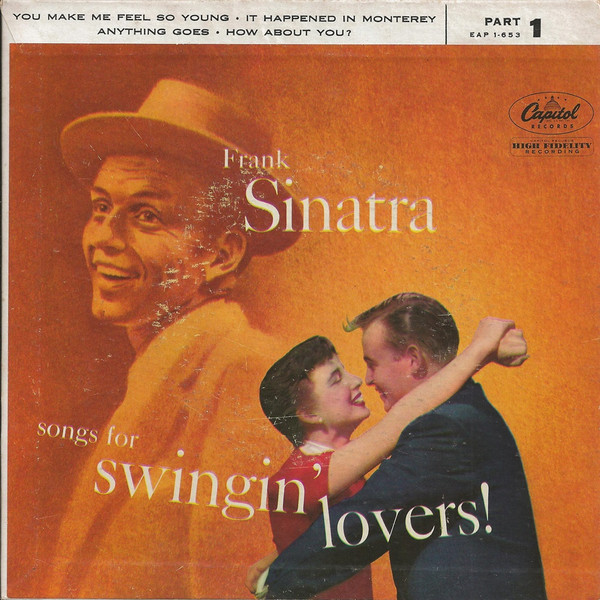
#1: Songs For Swinging Lovers – Frank Sinatra (1956)
Is there a definition for an EP? Extended play is what the letters stand for and were originally used to denote 7” 45rpm vinyl records that had more than one track on each side, a feature made possible by the advent of microgroove pressings in the early 1950s. Wikipedia offers a rather broad definition, including anything that’s ‘more than a single but less than an album’, without defining either of those parameters. Where in that scheme does ‘mini album’ fit, I demand to know.
I only ask by way of setting a limit on this series of articles on EPs from my own vinyl collection, which otherwise could become rather lengthy and include some pretty unremarkable records. Of course, I can write about whatever the hell I like, but it’s nice to have some spurious hook to hang it on. Otherwise, it just looks self-indulgent…
So I say, for the purposes of this series, an EP has got at least four tracks, because there are quite a few singles that have two tracks on the B-side, such as The Jam’s News of the World and Down in the Tube Station at Midnight. That means I have to exclude XTC’s so-called ‘3D EP’ and Gang of Four’s Damaged Goods, which is sometimes referred to as an EP. In one case there are five tracks, but the majority have just four.
I’m not precious about 7” or 12” even though the larger disc enables longer running times than the classic single-sized EP, and I include a few 10” as well. Nor am I picky about playing speed – one of the 7-inchers runs at 33, but the rest are 45s. I have, however, drawn the line at multi-track singles or EPs of the house and techno era onwards, either because their running time can be almost traditional album length, or because they consist largely of multiple remixes of the same track. Things could get very silly, like some of the remixes.
Unsurprisingly to those of you familiar with my previous gibberings, this means that the majority of the discs I’m going to write about come from the late 70s and early 80s – so much for my claims of seeking out the new and not dwelling in the past, eh? I seem to be constantly ploughing a deep furrow of nostalgia, but hey ho… write about what you know, don’t they say?
Having said that, I’m going to kick off the series with something a little leftfield even for me and this blog: Frank Sinatra’s Songs For Swingin’ Lovers Part 1. Aha, you think, this must have been bought during the early 80s fad for old pop-jazz crooning, exemplified by Vic Godard’s Songs For Sale and Alison Moyet’s That Ole’ Devil Called Love amongst others. But no, in fact I never cared too much for that moment, even though I acquired an early liking for Nat King Cole and Duke Ellington.
In fact, this EP only came into my possession a couple of years ago after my mum died, and I found it in the old stereogram at her home near Edinburgh where it had undoubtedly lain for the duration of my whole life. I say that with confidence because the stereogram is now here with me in NZ and an old geezer who did a repair on it recognised the serial number on the speaker cones as 1963 manufacture, the year of my birth.
The EP however was first released in 1956, one instalment of the LP of the same name. It’s part two of four because in those days record companies had discovered the EP as a way of selling LPs in multiple parts to the significant number of people who didn’t own record players that could play 12” LPs. As I mentioned in my earlier piece about the evolution of vinyl, 33s and 45s were initially developed as competing formats, and many people only had players dedicated to one or other speed.
The presence of this EP in my parents’ collection is a bit of a mystery, since they didn’t really like Frank Sinatra. My dad was more into classical music and older trad jazz and my mum liked pure, clean, archetypal 60s voices like Judy Collins and Judith Durham of The Seekers. I think they found Sinatra’s persona unappealing as well, too much the louche American fly-guy, and his swinging musical style altogether too loose for them.
That, of course, is one of the things that made him great, that ability to sing so effortlessly outside the rhythm with absolute confidence, commanding even the most mediocre musical material. Van Morrison was moved to pay tribute, penning the lines: “Ain’t that some inspiration, When Sinatra sings against Nelson Riddle strings,” in his song Hard Nose the Highway.
Nelson Riddle was the bandleader and arranger behind what many regard as Sinatra’s finest recordings. But it wasn’t all Nelson Riddle – Sinatra had plenty of input as you can see in various films of the pair rehearsing (and also with other arrangers such as Quincy Jones). Sinatra is fully involved and shows absolute understanding of how the arrangement is working, how his phrasing fits, where the emotion comes from. He’s a man in virtuoso control of his instrument and how it blends into the ensemble.
Songs For Swingin’ Lovers was conceived as a change in mood from Sinatra’s previous album In The Wee Small Hours, a carefully constructed exercise in romantic melancholy. Swingin’ lovers, in contrast, wanted upbeat tunes to celebrate their wonderful lives, so Sinatra and Riddle delivered fifteen classic cuts with suitable modern verve, even if some of the songs, like Anything Goes, were already 20 years old and built in an entirely different era of foxtrots and quicksteps. But here it is, transported into fabulous 50s swing-time without wrecking the masterful interplay of Cole Porter’s brilliantly interlocking words and music.
You Make Me Feel So Young is probably the outstanding track here, approaching the heights of Sinatra’s best work where he inhabits a simple pop song with complete conviction. If you have ever had the misfortune to see one of those goddawful Simon Cowell talent shows, you will have immediately understood that many people have great voices, but most of them never become great singers. This is the sound of a great singer.
Sinatra didn’t feature heavily in my musical youth, despite my sometimes perverse eclecticism. Knocking around one student flat there was a copy of Strangers in the Night, the greatest celebration of casual sex in the history of popular music, and boy are there a few contenders for that title. It found its way onto several party tapes, more tongue in cheek (nudge wink) than genuine admiration, but my feelings have swung around in later years. I’m not a big Sinatra fan all the same, but unlike my parents I have come to appreciate what it was that made him a great pop singer. Everyone should have a little bit of Ole Blue Eyes in their collection, and this family heirloom EP is mine.
You Make Me Feel So Young
It Happened in Monterey
Anything Goes
How About You?
 THE NEW VINYL VILLAIN