
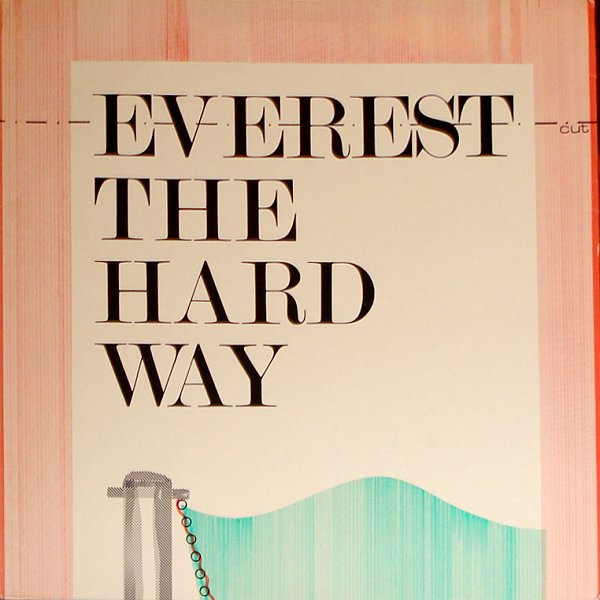
There’s so little info out there – not even any sort of band photo can be found – that I originally felt I had no option but to do an edited cut’n’paste from the last time they were featured on the blog. But then, Fraser emailed me from New Zealand, with details of a proposed new series which actually got underway earlier this week with Frank Sintara. He also had all of this to say……..
“It was while googling for information about Everest the Hard Way that I first discovered The New Vinyl Villain, thanks to JC’s previous posting of this EP. Hopefully my recollections and researches add something to that piece.
When I applied for a university place in the summer of 1980 my choices were driven not by academic considerations but by where I would be able to see the best selection of bands on a regular basis. Consequently, I slapped down three London colleges and Edinburgh on the form. You had to enter five choices, but I knew I would get into Edinburgh at the very least, so the fifth line was a pointless toss-up between Glasgow and Aberdeen. Aberdeen won, but I never had any intention of going there in a million years. Fortunately, the two London colleges that interviewed me turned me down – I was young for my cohort, only just 17, hopelessly immature in many ways, and it would have been a disaster. So, Edinburgh it was, my hometown uni.
Home, however, was seven miles out of town in Dalkeith, and restrictive bus timetables and parental oversight were going to be incompatible with night club gig timings, not to mention my cold, premeditated intention to drink as much alcohol as I could afford. So I engineered a room in digs for myself while my parents were away on holiday and unable to object, and thereby spent a productive freshers’ week bonding with my new roommate, a fellow English Lit student. He was the son of a Church of Scotland minister from Ayrshire, and like all good sons of the manse liked nothing better than getting utterly pished, and so we spent that first week of our academic lives drinking ourselves under the tables of each student union bar in turn.
Gary’s taste in music was unfortunately dreadful (he wore cowboy boots) so he didn’t accompany me on my frequent outings to see local new wave bands in the same union bars and at the Nite Club above the Playhouse Theatre. It was in the latter club that I first saw Everest the Hard Way. Someone had told me they were good and I went to see them one night on a double bill with another Edinburgh band called New Apartment. I bumped into a girl from my year at school, whom I never took for much of a new wave fan. It turned out that she was a big fan of New Apartment’s bass player and singer, and he was a big fan of hers, if you get my drift. Looking at them both I could see why, and also why I had no fan club of my own, unfortunately.
New Apartment were a three-piece and I liked their fashionably funky post-punk music. The guitarist was a big guy called Mani Shoniwa, and in his massive hands his Rickenbacker guitar looked like a ukulele. Readers may recognise the name from his reappearance in the almost successful band Win, several years after New Apartment vanished with nothing but a solitary Demon single to their name, Them and Us/Catch 22.
Everest the Hard Way’s music I liked very much too. Less funk, more Berlin-Bowie disco or somewhere along the Bunnymen/Wake/Sound/Comsat Angels axis. They were a quartet who took their name from mountaineer Chris Bonnington’s book on the first successful ascent of the world’s highest peak by its stupidly difficult south-west face. Being also a fan of mountains, I’d actually read the book a few years earlier, so that probably helped to cement them in my affections, but their tight, intense performance that night was mainly what did it. I saw them another twice and they were always tight and intense, so it was no fluke.
The intensity came mainly from guitarist and singer David Service whose grizzled appearance and eyes screwed, tightly wound delivery was like David Byrne circa Fear of Music. He chopped out chords on his guitar as though he was desperately suppressing the urge to slash it to pieces like some demented hybrid of Pete Townshend and Wilko Johnson.
The tightness came from the rhythm section of Ian Stoddart on drums and Mike Peden on bass. Stoddart is another name that Win fans will recognise. Later, he also played for Scottish band Aberfeldy through their first few years including on their first album, Young Forever. And he is co-credited with the composition of both sides of that New Apartment single above. Somewhat improbably, Stoddy also found himself in 2000, somewhere in France, playing alongside Josef K’s Malcolm Ross as part of a ‘gypsy’ band led by Hollywood A-lister and celebrity perfume salesman Johnny Depp in the unaccountably Oscar-nominated rom-com Chocolat. For some reason I have a VHS copy of the movie and was going to toss it because it’s crap, until I discovered that a former member of Everest the Hard Way was in it. Now I’m stuck with it. You can watch the main scene with Stoddy, Ross and Depp on YouTube.
(Skip forward to 1.15 if you can’t stand the whole thing…).
Sadly, Stoddart died of cancer in 2020.
It was Mike Peden who caught my eye, or ear, for the most part when watching ETHW. It’s not difficult to see why he drew comparisons with Derek Forbes of Simple Minds. He was always playing rapid, intricate lines, melodic runs rather than anchoring notes, but I would say his technical ability surpassed Forbes and he has made a long career for himself as a session player and producer. His name crops up in production credits for a wide range of pop acts through the 1990s and 2000s, including Paul Haig, Shara Nelson (the voice on Massive Attack’s Unfinished Sympathy), YoYoHoney (that Mani Shoniwa again), Mica Paris, Darryl Hall and even Gareth Gates. He also had another more successful crack at performing as a member of short-lived early 90s soul-dance trio The Chimes.
The quartet was completed by keyboardist Jim Telford who added accents and body to the sound with a string synth, but his parts were not elaborate and didn’t dominate. All I can find about him outside ETHW is as contributor to a 1980 single by The Liberators (along with Robin Guthrie and Will Heggie before they formed the Cocteau Twins), and that he worked closely with Richard Strange through the 1980s after guesting on his 1981 LP The Phenomenal Rise of... becoming part of his backing band The Engine Room under the modified pseudonym of James T. Ford. Strange’s website also mentions that while working with Telford he signed a management deal with Max Tregoning who had previously managed Adam and the Ants and… Everest the Hard Way.
Tightrope came out in 1982 on Do It Records, run by Tregoning and his brother, and publishers of Adam and the Ants’ first album Dirk Wears White Sox and a few singles by Yello. The label folded later in ‘82, so ETHW were never going to get much of a boost from this release and they disappeared at much the same time. The production is rather average – credited partly to the band themselves – and doesn’t do justice to their live energy. Mike Peden obviously learned a lot about production in subsequent years, but I guess you have to start somewhere.
The title track is undoubtedly the stand-out of the four on the 12” EP (it was the A-side of the 7” single version), and comes closest to capturing the band as I remember them. You can hear the Simple Minds parallels as Peden and Stoddart drive the rolling Euro-dance rhythm, like a rough-cut of Love Song. When You’re Young is a bit more Bunnymen, and Take the Strain finds Service channelling Talking Heads’ Drugs or Electric Guitar into a more sparse arrangement, showcasing Mike Peden’s nimble fingers once again. Quarter to Six is the weakest piece, running over the rather well-worn theme of current-affairs media (cf Gang of Four‘s 5:45 – quarter to six used to be the time of the BBC’s main evening news bulletin). Through all the songs the subject matter is social rather than romantic, and you can hear the tension in the titles and lyrics as much as the delivery, and certainly more than in the production.
So Tightrope is not a great lost classic of the era, but to me it’s a fondly held memento of a time and place and a band that didn’t want for talent but lacked a crucial creative edge and that lucky break. It brings back memories of the Nite Club’s sticky floor, the pokey downstairs bar in Chambers Street student union, and a boozy night at Teviot Row also featuring the ramshackle talents of Boots For Dancing. When you’re young…
Tightrope
When You’re Young
Take the Strain
Quarter to Six
Fraser
 THE NEW VINYL VILLAIN