THE TESTIMONIAL TOUR OF 45s (aka The Singular Adventures of Edwyn Collins)

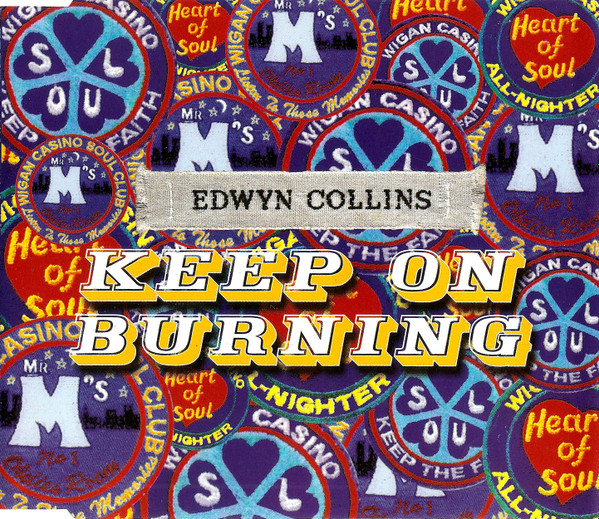
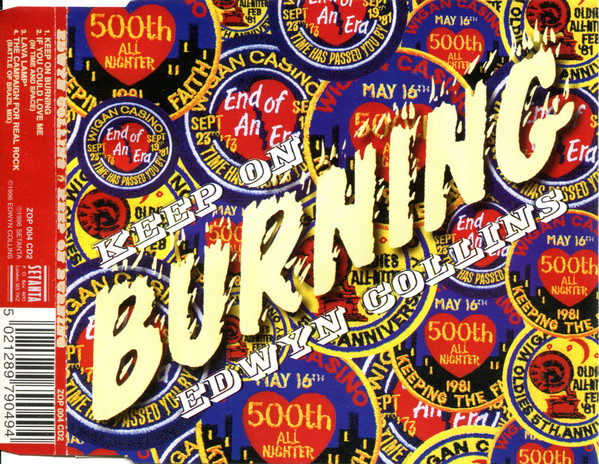
#23: Keep On Burning : Edwyn Collins (Setanta Records, ZOP 004, 1996)

There was no attempt to cash-in on the belated success of A Girl Like You.  There had been a renewed amount of media interest in Edwyn Collins and he modestly accepted things for the way they were, happy that the money earned from the big single could be re-invested in expanding and improving his own studio as well as enabling a larger recording budget for his next album for Setanta Records.

Said album would take until late 1997 to reach the shops, and when it did, what could have been a stand-alone single from the previous year was included on it.

Keep on Burning is another glorious piece of pop music, Edwyn’s one-man tribute to the Northern Soul scene, and in particular the all-night events that had been the mainstay of the Wigan Casino, the legendary nightclub which existed between 1965 and 1981, as particularly evidenced by the promo video:-

It was released at the end of February 1996 on 2 x CDs and 7″ vinyl.

CD1

mp3: Edwyn Collins – Keep On Burning
mp3: Edwyn Collins – Won’t Turn Back
mp3: Edwyn Collins – You’ve Grown A Beard
mp3: Edwyn Collins and Bernard Butler – A Girl Like You (live)

CD2

mp3: Edwyn Collins – Keep On Burning
mp3: Edwyn Collins – If You Could Love Me (In Time and In Space)
mp3: Edwyn Collins – Lava Lamp
mp3: Edwyn Collins – The Campaign For Real Rock (Battle Of Brazil Mix)

Seven songs all told, of which one was a cover and three were part of the Gorgeous George album.

Of the two new bits of music, You’ve Grown A Beard is a fast folksy-type song with a lyrical dig at the way some contemporary musicians were re-inventing themselves (it’s important to note that Edwyn has always been clean-shaven!!) while Lava Lamp is a strange two-minute electronic instrumental on which Edwyn had collaborated with Sebastian Lewsley.  The latter truly is only one for the completists.

A Girl Like You was recorded for the Channel 4 TV show The White Room, broadcast on 31 March 1995, which is when Edwyn and Bernard had been working together in a studio, and shortly before Edwyn was the special guest as the opening act to some live shows by McAlmont and Butler.

By my reckoning, this is the third time If You Could Love Me has appeared in some shape or form on a single.  In this instance it has been remixed by Jackson Gold’s Disco Demand, and given that there is no other known recording by said mixer, I think it’s fair to say its Edwyn himself just having a bit of fun with a version that is speeded-up and given a few disco-style noises, including the electronic tom-tom drum sound.

The Campaign For Real Rock was the six-minutes-plus opener on Gorgeous George, and is a caustic attack on the grunge scene and American rock music in the wider sense.  This remix is the work of Hidetsugo Ito, a sometimes musician/producer and sometimes music journalist who worked closely with Edwyn on various releases for the Japanese market. As someone who is a big fan of the original version, this remix gets on my nerves.

Which leaves us with the cover version, which was the track selected as the b-side to the 7″ single.  It’s a Vic Godard song, a musician with whom Edwyn had a long link, going back to the Orange Juice days when the band covered Holiday Hymn.  Vic had been away from the music industry for the best part of a decade, but then was persuaded to sign to Postcard Records after Alan Horne had resuscitated the label in 1993, primarily as a way to give a home to Paul Quinn & The Independent Group.

Vic’s comeback album, The End of The Surrey People, had been produced by Edwyn Collins.  Its lead single had been Won’t Turn Back, a song Edwyn was particularly taken by, and so he recorded his own version, with Vic offering himself as a backing vocalist.  It’s a wonderful piece of music, and with Edwyn mentioning in interviews that Vic was going to be involved with his next album, it kind of got the pulses raising.

Keep On Burning should have been a hit, but instead it came in at #45 and that was as good as it got.

JC

THE TESTIMONIAL TOUR OF 45s (aka The Singular Adventures of Edwyn Collins)

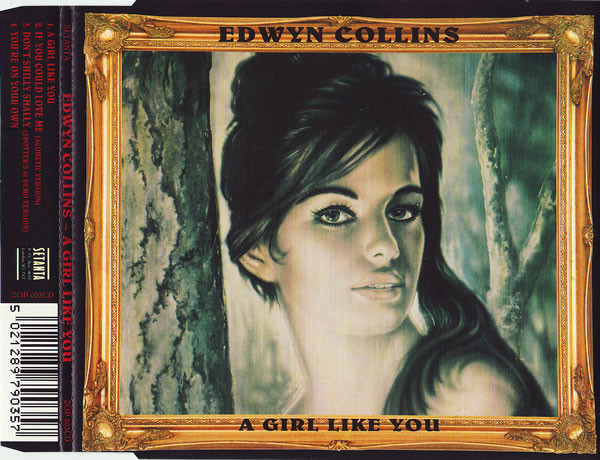
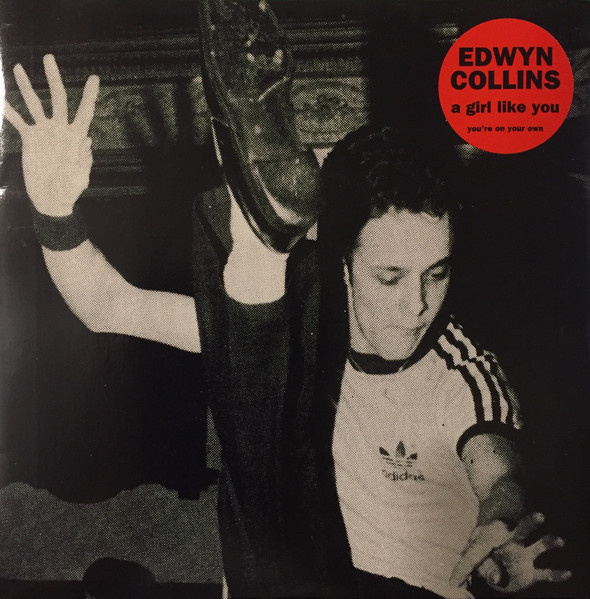
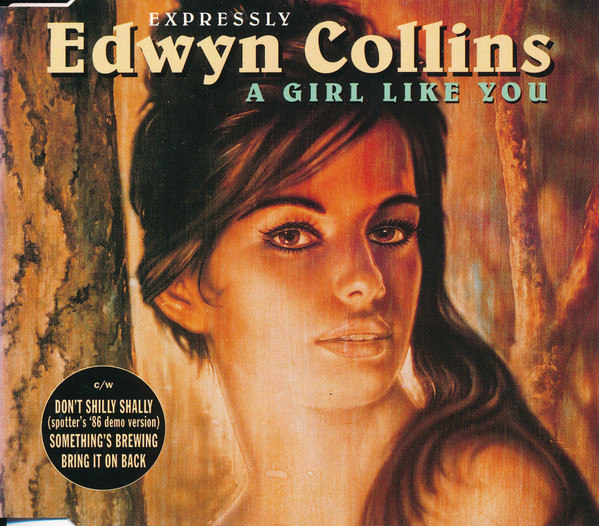
#22: A Girl Like You : Edwyn Collins (Setanta Records, ZOP 003, 1995)

A Girl Like You had been a hit all over Europe in late 94/early 95, but as was mentioned two weeks ago in this series, it had stalled at #42 in the UK in November 1994.

Sometimes, a bit of good fortune can make all the difference, and for Edwyn Collins it came, unwittingly, in the shape of Chris Evans, a UK TV presenter who, in April 1995, returned to his first love, being a Radio DJ, when he was given the job of helming the UK’s most listened to programme, the BBC Radio 1 Breakfast Show.

There’s a lot of people who severely dislike Evans, and with good reason.  But one of the things he did on his return to radio was insist that he be given a free rein on the show, including playing songs that were among his favourites and weren’t necessarily chart hits.  He loved A Girl Like You, and it was played on his show a few times from the outset.  It created a new level of interest but some six months after its initial release via the Expressly Yours EP, it wasn’t all that easy to find as the EP had already gone through the bargain bucket stage and was now, almost literally, indie landfill.

Setanta did what any sensible record company would, and reissued it, this time on one CD and as a 7″ single.  On 11 June 1995, A Girl Like You entered the UK singles charts at #13.  It would remain in the Top 75 for 17 weeks, all the way through to late September, peaking at #4 in mid-July.  It was, without question, one of the defining songs of the summer and seemed to be blaring out of radios on a constant basis. Out of the blue, Edwyn had become an overnight star, with many of those who were buying the single quite, if not totally, unaware of his past career as a member of Orange Juice.

Remember that so-called ban from Top of The Pops that had seemingly been imposed after the second Rip It Up performance in 1985?  Ha, ha……

Even better was that Setanta gave a second push to its parent album, and on 22 July 1995, as A Girl Like You was sitting in the Top 5, Gorgeous George came in at #8, and went on to steadily sell enough copies to hang around the album chart for nine weeks.

The only thing is that all the available songs for b-sides had been used up on the EP back in November 1994, and with the 2 x CDs that had formed If You Could Love Me.  The only ‘new’ bit of music came via track two on the CD:-

mp3: Edwyn Collins – If You Could Love Me (acoustic version)

Quite a bit shorter than the studio version, it is very much the Unplugged version.  Or a busker’s version if you prefer.  Edwyn and his acoustic guitar…and it’s rather lovely.

JC

THE TESTIMONIAL TOUR OF 45s (aka The Singular Adventures of Edwyn Collins)

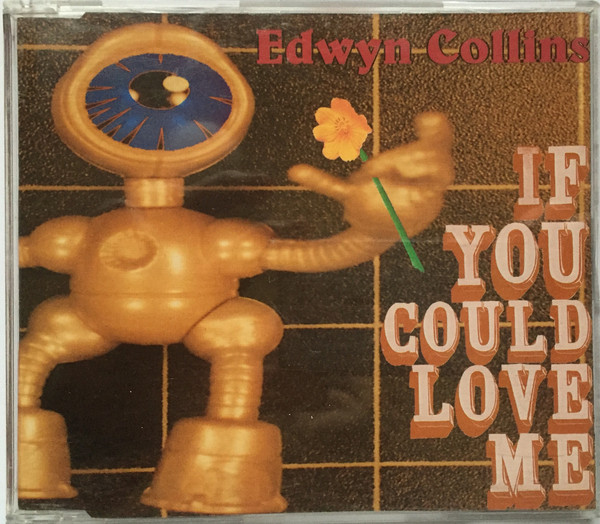
#21: If You Could Love Me : Edwyn Collins (Setanta Records, ZOP 002, 1995)

“The thing is.  If this had been released as a single by someone like Robbie Williams, it would have been a huge hit and made Edwyn a lot of money.”

The thoughts of my old friend Jacques the Kipper as we chatted about and rued the fact that If You Could Love Me had been a total flop.  It hit the shops in March 1996, once again on 2 x CDs and 12″ vinyl

CD1

mp3: Edwyn Collins – If You Could Love Me (radio edit)
mp3: Edwyn Collins – In A Broken Dream
mp3: Edwyn Collins – Hope and Despair
mp3: Edwyn Collins – Insider Dealing

CD2

mp3: Edwyn Collins – If You Could Love Me (radio edit)
mp3: Edwyn Collins – If Ever You’re Ready
mp3: Edwyn Collins – Come To Your Senses
mp3: Edwyn Collins – A Girl Like You (Victorian Spaceman Mix)

JtK was bang on the money.  If You Could Love Me is an unashamedly pop song, and if any of the pop world’s male vocalists had taken into the studios with no expense spared (just imagine it having an orchestral backing!!), then it would by now be a ballad that we would be utterly sick of hearing all these years later!  But #98 in the expanded Top 100 was all that it managed with Edwyn’s vocal. Incidentally, the radio edit is just six seconds shorter than the album version, with a slightly different opening which doesn’t fade-in.

The two CDs offered up b-sides, mostly from the post-Gorgeous George period.  Edwyn had become good friends with Bernard Butler, who, in a move that had stunned the world of indie music, quit Suede in 1994 with the band seemingly at their creative peak, not to mention enjoying substantial commercial success.  Edwyn liked to self-produce his songs, but he took up Bernard’s offer to come into a studio to work together, with Bernard taking on production duties.  The results can be heard on some of the tracks which came out on these two CDs.

In A Broken Dream was a cover version, one recorded in the late 60s by Australian rock band Python Lee Jackson,  but only became a hit in 1972 thanks to the fact that the unknown session singer they had used, Rod Stewart, was riding very high both as a solo star and the frontman of The Faces.

Hope and Despair is a new recording of the title track of Edwyn’s 1989 album – very much a case of duelling guitars, acoustic and electric.

Insider Dealing is the curveball, extending to more than 8 minutes and being a song co-written by Collins/Butler. It’s a very understated ballad, possibly a little bit self-indulgent at times, as it feels as if Bernard is trying different production techniques as they could best apply to a very slow song.  But as bonus songs on CD singles so, it was more than fine.

If Ever You’re Ready was one of Edwyn’s oldest songs, appearing initially as a b-side to debut single Don’t Shilly Shally and then being re-recorded for his debut album Hope and Despair.  Five years on and the duo’s take on it is rather sublime, one that feels as if it should run over the credits of a film where the hero has met an unexpected end and the fade to black out has seen his wife/girlfriend/partner in tears.

Come To Your Senses gives a production credit to Dave Anderson, and with Discogs indicating that he often worked at Power Plant studios, where Edwyn had recorded his 1990 album Hellbent on Compromise, I’m wondering if this was a song dating back to those sessions. There’s no info within the liner notes and it is pure speculation on my part.

The Victorian Spaceman Remix of A Girl Like You had actually been included on the 12″ vinyl of the Expressly Yours EP (see last week).  It was the work of a then mostly unheralded producer/engineer named Sebastian Lewsley who would, over the next 20 years, become one of Edwyn’s most trusted collaborators. This remix is over six minutes long and contains all sorts of elements of studio trickery, turning it into a near instrumental that I suspect will delight or annoy in equal measures.

The 12″ vinyl release of the single also contained an otherwise unavailable mix:-

mp3: Edwyn Collins – If You Could Love Me (M.C. Esher Mix)

A different mix altogether, with the fabulous guitar riffs to the fore.  I’ve no idea who M.C. Esher is, but I’m guessing it might be a pseudonym used by Edwyn.

JC

THE TESTIMONIAL TOUR OF 45s (aka The Singular Adventures of Edwyn Collins)

#20: Expressly EP : Edwyn Collins (Setanta Records, ZOP 001, 1994)

I’ll need to ask for your patience over the next three Sundays as the series goes back and forth, thanks to a series of releases and re-releases just a matter of months apart.  There will also be loads of music to take on board as it was the era of the CD single across multi-formats.

But firstly, we need to take a quick step back in time.

The commercial failure of Hope and Despair in 1989 hadn’t put Demon Records off Edwyn Collins, and they provided funding for his second solo album, which was released as Hellbent on Compromise in October 1990.  It was a more expensive production, recorded at the Power Plant studios in London, with a cast of no fewer than 14 other musicians credited across its eleven songs, two of which were covers.  It proved to be a mis-step, and while there are some decent moments on the album, it suffers from overly-fussy production and a lack of cohesion to make it a fully enjoyable listen.  Nor did it have, certainly in the minds of those at the record label, any potential singles on it.  It sold very poorly, and not long afterwards, Demon told Edwyn he was being dropped.

It would be another four years before he released any new music.  Between 1990 and 1994, he found work as a producer, and in particular for a number of bands from Ireland such as A House and The Frank and Walters who were on Setanta Records, a London-based independent label.  He also used this enforced period of absence from making his own records to build a studio in his London home.

The latest set of demos, allied to him just more or less being the label’s in-house producer, led Setanta to offer a deal for a new album.  Gorgeous George was self-produced by Edwyn and utilised the talents of Paul Cook, formerly with the Sex Pistols on drums and Claire Kenny, formerly with Amazulu, as the bassist.  The album was released on 5 September 1994, with little fanfare and consequently met with a number of really poor reviews.  Sian Pattenden in giving it 2/5 in Select  wrote ‘inimitable note-battling singing….all that engages is the hit! hit! hit! that is ‘If You Could Love Me which is more Orange Juice than Orange Juice.’   The Guardian newspaper was worse – 1 star and the advice to Edwyn that he should give up music.    The album did not make the Top 100 in 1994.

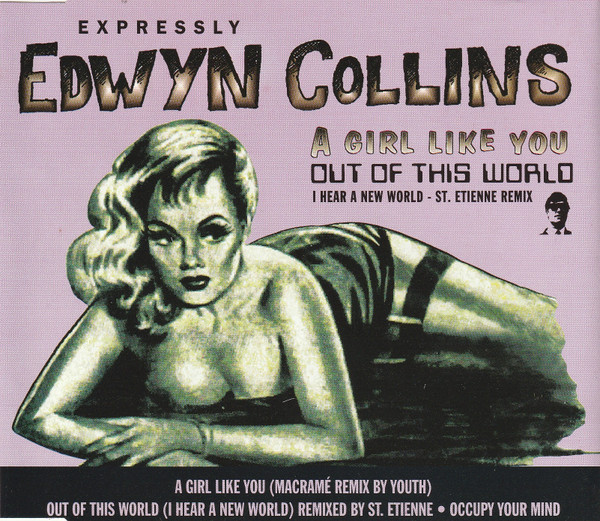
A couple of months later, Setanta decided to issue the Expressly EP, largely on the basis that its lead track had been picking up a fair amount of airtime on radio stations across mainland Europe.  The EP was issued on 2 x CDs, and on 12″ vinyl (copies of which now go for silly money on the second hand market).

CD1

mp3: Edwyn Collins – A Girl Like You
mp3: Edwyn Collins – A Girl Like You (Macramé Remix By Youth)
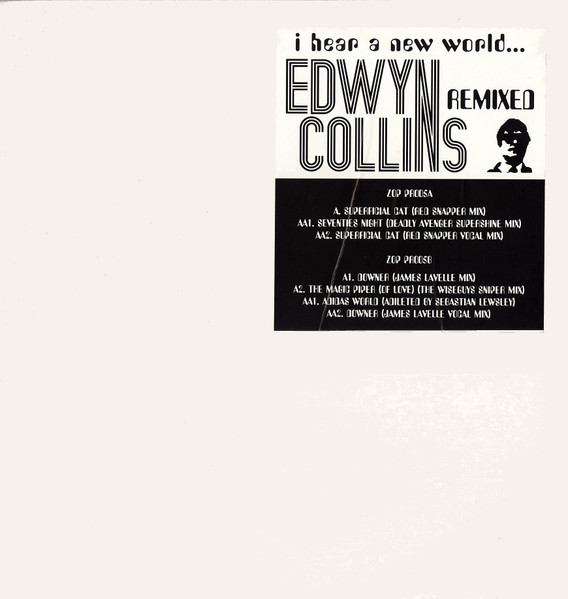
mp3: Edwyn Collins – Out Of This World (I Hear A New World) (remixed by St.Etienne)
mp3: Edwyn Collins – Occupy Your Mind

CD2

mp3: Edwyn Collins – A Girl Like You
mp3: Edwyn Collins – Don’t Shilly Shally (Spotter’s ’86 Demo Version)
mp3: Edwyn Collins – Something’s Brewing
mp3: Edwyn Collins – Bring It On Back

The EP entered the UK charts at #42 on 13 November 1994, dropping to #48 and then #64 before disappearing.  It was a different story on the continent, with A Girl Like You hitting many Top 10s and being #1 in Belgium.

I’ll return to A Girl Like You in due course, as it’s no secret it became a massive hit second time around.  The additional tracks across the 2 CDs actually made them worthwhile purchases, albeit not everything works, not least Youth‘s take on the lead song which drops Edwyn’s vocal a long way back in the mix and gives it a sort of electronic feel.

The St Etienne mix of one of the Gorgeous George album tracks is rather lovely to begin with as there’s a very extended instrumental opening of 1:45 during which it wouldn’t have been a surprise if Sarah Cracknell had started singing. The latter half of the tune contains a lot of studio trickery which takes the tune in all sorts of strange directions, and Edwyn’s vocal often seems to be on the verge of breaking.  But as remixes go, it’s a decent listen.

It was also an enjoyable experience to hear the studio demo of Don’t Shilly Shally, the debut solo single from back in 1986. This, if you recall, was one in which the final mix came via a Robin Guthrie (Cocteau Twins) production, and as you might expect the demo version is very much simpler and very much the way Edwyn would play it in the live setting.

Occupy Your Mind, Something’s Brewing and Bring It On Back were three new songs.  There’s no info offered within the liner notes of either CD, but it can be assumed these were worked up at the same time as the tracks that eventually made the cut for the Gorgeous George album.  They are decent enough to satisfy the completists among us without being essential.

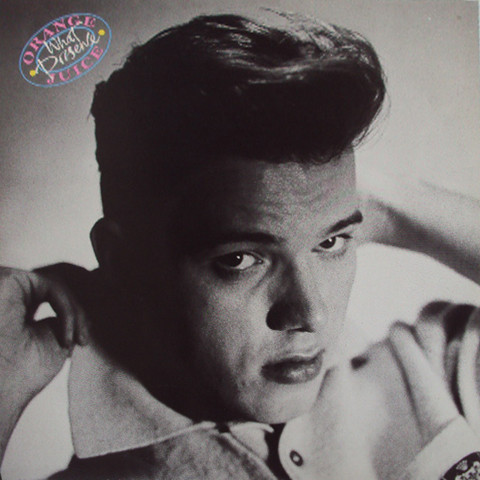
#42 might not have been all that great, but it was the first time Edwyn had made the Top 50 since What Presence?! more than ten years previously.  The time soon beckoned to offer the public an opportunity to offer its opinion on the song that Sian Pattenden had described as ‘hit!, hit!, hit!’.

JC

THE TESTIMONIAL TOUR OF 45s (aka The Singular Adventures of Edwyn Collins)

#19: 50 Shades of Blue : Edwyn Collins (Demon Records, D1064 T, 1989)

There’s not much background to add, as it was mostly offered up last week with the look at Coffee Table Song and the release of the album, Hope and Despair.

In October 1989, a few months after the album had hit the shops, a second single was lifted from it.  Last week, I included the Record Mirror review of the album, but I deliberately left out one key sentence, in which the author suggested that 50 Shades of Blue was ‘probably the most blatantly poppy record Edwyn has ever made’.

It offered one last try at drawing attention to the album some six months after it had been released, as well the opportunity to make available other songs that had been recorded in Köln but hadn’t yet seen the light of day.

mp3: Edwyn Collins – 50 Shades of Blue

Phil Thornalley gave the album version a slight remix, adding even more poptastic fairy dust to the production, but ultimately to no avail.

It was released on Demon Records, on 7″ and 12″ vinyl, and in a sign of the times, became the first CD single to which Edwyn’s name was attached.

Some of you may have picked up from an earlier part of this series that 50 Shades of Blue was actually a song from a few years back, with an acoustic version appearing as a b-side to My Beloved Girl, the second of the two singles that had been released on Elevation Records back in 1987.

The 7″, as well as being a remix, is also about 20 seconds shorter than the album version.  The 12″, thanks to an extended outro, was about 40 seconds longer than the album version:-

mp3: Edwyn Collins – 50 Shades of Blue (extended version)

The 7″ carried an exclusive b-side, which turned out to be the song’s second appearance in such a guise:-

mp3: Edwyn Collins – If Ever You’re Ready

The original version had been the b-side to Don’t Shilly Shally, the debut solo single on Elevation Records.  It had been revisited and re-recorded in Köln with the new version featuring Roddy Frame and Dennis Bovell on backing vocals. It was, however, not included on the vinyl edition of Hope and Despair, although it could be found on the CD edition.

Three more previously unreleased tracks were on the 12″ release:-

mp3: Edwyn Collins – Kindred Spirit
mp3: Edwyn Collins – Just Call Her Name
mp3: Edwyn Collins – Ain’t That Always The Way

The first is a country rock sort of song that must have just missed the cut for Hope and Despair.  The second, to be quite frank, is not very good and was surely always going to exist only as a b-side, at best.  The third is Edwyn’s own take on the song he had written a few years previously that had been Paul Quinn‘s ‘solo’ single on Swamplands Records; it’s a take I really like, but unsurprisingly, it doesn’t match the majesty of Paul’s version….and I’m sure Edwyn knew this from the outset, or he’d likely have included it on his debut album.

As for the CD single, it included Kindred Spirit and Just Call Her Name, but not Ain’t That Always The Way.  In its place was Judas In Blue Jeans, but it was the very same version as had been the extra song on the b-side of the 12″ of Coffee Table Song.  To quote the tagline of the late 70s comedy show Soap,

‘Confused? You Will Be’

And that brings an end to the 80s output of Edwyn Collins.  With either his band or as a solo artist, eighteen singles and five albums all told, and more than likely most people could only have named Rip It Up in response to his name being mentioned.

The 90s would, eventually, change all that.  Stay tuned.

JC

THE TESTIMONIAL TOUR OF 45s (aka The Singular Adventures of Edwyn Collins)

#18: Coffee Table Song : Edwyn Collins (Demon Records, D1064 T, 1989)

The collapse of Elevation Records saw Alan McGee retreat back to Creation, and in doing so he provided a new home for two out of the three acts, Primal Scream and The Weather Prophets.  It’s been suggested in some quarters that the reason Edwyn Collins wasn’t offered a similar deal by McGee was that the two had a serious falling-out. Whatever the reason, it meant our hero was in a state of purgatory, with no label and no sign of interest in the UK.

Enter Tom Dokoupil, a Czech-born artist and musician who had been part of the German new wave scene in the early 80s and who later opened Whitehouse Studios in Köln and founded the record label Werk.  A long-time fan of Orange Juice, he invited Edwyn to his studio to record some songs, which is why he, and a number of his closest acquaintances including Roddy Frame and Dennis Bovell (among others), could be found in Germany at different times between February and April 1989.

There was more than enough material for an album as well as b-sides for any potential singles.   Tom Dokopuil had always been happy to have Werk Records become Edwyn’s new label, but was pragmatic enough when those who were running Demon Records, the London-based label founded back in 1980 by Jake Riviera, Elvis Costello and Nick Lowe, got in touch to say they were also interested, to come to a mutually beneficial arrangement.

It meant that Edwyn’s debut album, Hope and Despair, was released at the end of May 1989 in Germany on Werk and in the UK, under license, on Demon.  It was largely ignored, but that wasn’t too big a surprise given that, in the eyes of almost all the music media, be that the print press or those running radio stations, Edwyn was already the day before yesterday’s man.

The exception was Tim Nicholson, writing in Record Mirror, (the smallest of the four weekly UK music papers in the late 80s), who was happy to give it a four-star review:-

“Ridiculous as it may seem, Hope and Despair is Edwyn’s first solo album. More than four years after Orange Juice dried up, the shakiest voice in pop has done a few stretching exercises.  

Seven of the 14 songs on show have been sitting around for three years waiting recorded, but they sound no less fresh for their long shelf life. 

Country rock is the home base for the majority of the LP, Edwyn’s preoccupation for the melancholy tales of the hopeless male having difficulty in winning back the indifferent female suiting the style perfectly. The tunes (which is exactly what these are; real tunes) go immediately for familiarity, grabbing a catchy hook and tugging at it constantly.

More important than anything is that Edwyn makes a fab pop star and nothing could be nicer than seeing his sardonic comments back in the pages of Record Mirror. ‘Hope And Despair’ is a much better LP than could have been expected and will, in one fell swoop, put ‘Corny’ Collins back on the map.  All hope and no despair.”

The album didn’t make it into the Top 100 in the UK or Germany.  A couple of months later, the two labels decided to issue a single, but surprisingly went for a downbeat number, almost five minutes in length and with a waltz-like tempo.

mp3: Edwyn Collins – Coffee Table Song

Werk issued it as a 7″ in Germany, while Demon went for a 12″ only release.

Coffee Table Song was the opening track on the album, so perhaps that was part of the logic.  Or maybe it was the one song Edwyn really wanted out there given that the lyric captures him in a reflective mood, perhaps pondering the events of the past couple of years and his continued misfortunes with the record industry:-

What is your number? My number is zero
And what is your colour? My colour is blue
What is your secret? Why that would be telling
Well what is your problem? My problem is you

I’ll turn my back on it all
I’ll stand, and I’ll face
My living room wall
Well that’s really something, that’s really something

What is your star sign? You’ve got to be kidding
Well what is the answer? I wish I knew
What is the time? It’s time I was leaving
Why what is your problem? My problem is you

I’ll turn my back on it all
I’ll stand, and I’ll face
My living room wall
Well that’s really something, that’s really something

Tell me something that I don’t know
Make it brief, to the point, like a fatal blow
Since time out of mind I have loved you so
There’s a place I know where we both could go
I would swim the seven seas
I would crawl upon my knees
Just to get there
I would swim the seven seas
I would crawl upon my knees
Just to get there or be there, somewhere out there
Like a fatal blow, like an open sore
Like a heart that’s torn in two
That’s really something

There were two bits of music on the b-side of the 12″

mp3: Edwyn Collins – Judas In Blue Jeans
mp3: Edwyn Collins – Out There

The first of them, which was also on the 7″, is a very upbeat number.  I think the few loyal fans who were buying things at this time, would have been surprised to hear a song that really should have made the cut for the album.  The latter is just 57 seconds in length, and it’s Edwyn just playing his guitar. I’ve never regarded it as a song, more a possible idea for working up into something else.

No shock that Coffee Table Song didn’t chart.


JC

THE TESTIMONIAL TOUR OF 45s (aka The Singular Adventures of Edwyn Collins)

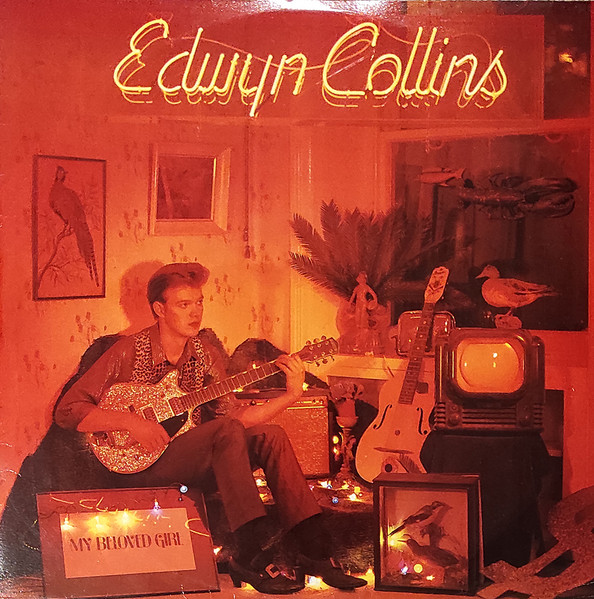
#17: My Beloved Girl : Edwyn Collins (Elevation Records, ACID 6/WEA 248 138-7, 1987)

The second and what proved to be the final single for Elevation Records was released in the last week of October 1987.

Although not similar in sound, it was a single on which the team involved in What Presence?! were reunited as Phil Thornalley was brought in as producer.  There’s also other musicians credited, including Dave Ruffy (ex Aztec Camera) on drums, Tim Holmes on sax and Dave Clayton (who much later in 2003 would join Simply Red) on synth.

mp3: Edwyn Collins – My Beloved Girl

My Beloved Girl is an out-and-out pop song, very much of its time and place, as evidenced by the use of backing singers George Chandler, Jimmy Chambers and Lee Vanderbilt. It’s all a bit ‘meh’ in the wider context of what had come before and what would come in later years, but given that WEA were, by now, desperate for Elevation Record to deliver some sort of big hit single, it’s no real surprise this was the road which everyone chose to go down.

The b-side is another which has a real 80s feel in terms of production, but with it never being remotely considered as a possible single, there’s a little more of Edwyn’s vocal being straightforward, and he gets to play his guitar solo in the style to what we had become accustomed.

mp3: Edwyn Collins – Clouds (Fogging Up My Mind)

As usual, there was a 12″ release as well as a 7″.  The larger disc offered the same version of My Beloved Girl along with extended versions of both sides of the 7″:-

mp3: Edwyn Collins – My (Long Time) Beloved Girl
mp3: Edwyn Collins – Clouds (Fogging Up My Mind) – Cumulonimbus Version

Years ago, I had to look up ‘Cumulonimbus’ as I had no idea how it fitted into this single – turns out they are the types of clouds that can lead to thunderstorms and tornadoes.  Every day is a school day……

The extended version of My Beloved Girl is a bit of a chore while the extended version of Clouds, which stretches to over seven minutes in length, feels as if Edwyn and Phil just wanted to experiment a bit in the studio, and given WEA were bankrolling it, why not?

There was a bit of a marketing push on this one, and a week or so after the initial release, a box version was issued.  This contained a 7″ EP, with the two sides of the single alongside two previously unreleased songs, and three postcards, all of which had a photo of Edwyn on one side while the other sides had the lyrics or the forthcoming dates for a UK tour in November/December 1987 dates or was left blank.

mp3: Edwyn Collins – 50 Shades of Blue (acoustic version)
mp3: Edwyn Collins – What’s The Big Idea?

The former is a guitar/harmonica/bass guitar rendition of a tune that would later get a full band treatment and be released as a single in 1989, and also included on the album Hope and Despair (watch this space).  The latter would be re-recorded a few years later and included on the 1990 album, Hellbent on Compromise…..you can see that Edwyn has long had an interesting way of naming his albums to reflect his differing states of mind.

My Beloved Girl did a bit better than Don’t Shilly Shally, in that it charted (as such) for three weeks at #87, #84 and #99.


JC

THE TESTIMONIAL TOUR OF 45s (aka The Singular Adventures of Edwyn Collins)

#16:Don’t Shilly Shally : Edwyn Collins (Elevation Records, ACID 4/WEA 248273-7, 1987)

Alan McGee had co-founded Creation Records in 1983.  As indie-labels go, it had been a relative success, but there was an element of frustration that the limitations of the typical set-up of indies, particularly around distribution and finance, prevented singers and bands crossing over into at least part of the mainstream and enjoying greater rewards from their endeavours.

McGee approached WEA records, the biggest of them all, and suggested a joint venture whereby some Creation acts would benefit from the way the major label operated in the market.  This new hybrid label was called Elevation Records, and it was set to go from March 1987. McGee brought Creation signings The Weather Prophets and Primal Scream to the label, along with Edwyn Collins who, at long last, would be recording as a solo artist, with his debut single enjoying a release in July 1987.

It proved to be a song that wasn’t a million miles away from the sort which appeared on The Orange Juice LP back in 1984.  There are no musicians credited on the single, but there’s a very interesting producer on board – Robin Guthrie of the Cocteau Twins.  He was responsible for all three songs which appeared on the single, but there was possibly a hint of dissatisfaction with the production as Edwyn’s old friend and trusted ally, Dennis Bovell, was later brought into to remix the A-side

mp3: Edwyn Collins – Don’t Shilly Shally

Here’s the two other songs from the session:-

mp3: Edwyn Collins – If Ever You’re Ready
mp3: Edwyn Collins – Queer Fish

The first of these was included on the 7″and 12″ releases, and makes for an interesting listen as there’s the occasional hint of the sort of guitar playing you’d pick up listening very closely to the Cocteau Twins.  It’s proved to be a song that Edwyn is very fond of it, as he would later re-record it on two occasions, the first being for his 1989 album Hope and Despair, and the second being as a b-side to a single in 1995 (watch this space!!!).

The second of the songs was only on the 12″, and in terms of what Edwyn had released up to this point, was quite experimental with a more electronic sound rather than relying on guitars.  It’s not one I go back to all that often.

None of the early singles on Elevation had been hits.  Don’t Shilly Shally was no different.  In an era when the singles chart went all the way to a Top 100, it came in, for one week, at #93.

JC

THE TESTIMONIAL TOUR OF 45s (aka The Singular Adventures of Edwyn Collins)

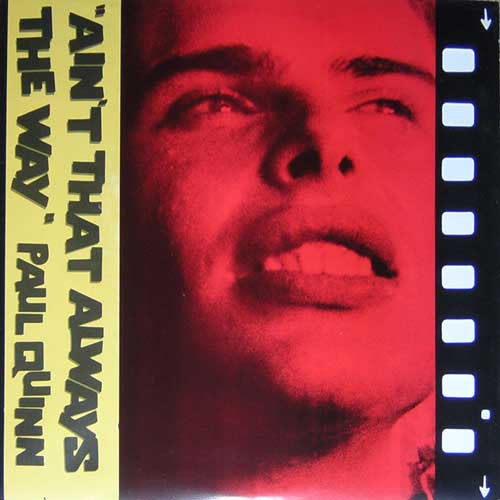
#15:Ain’t That Always The Way : Paul Quinn (Swamplands, SWP6, 1985)

March 1985.  The latest single to come out on Swamplands Records.

mp3: Paul Quinn – Ain’t That Always The Way

It’s a song written by Edwyn Collins.  It’s a song co-produced by Edwyn Collins.  It’s a song on which Edwyn Collins definitely plays guitar, but isn’t credited as doing so.  It should be a song attributed to Paul Quinn & Edwyn Collins but couldn’t be for contractual reasons.

Last time out, I mentioned that the sleeve notes attached to Pale Blue Eyes advised that Paul Quinn appeared courtesy of MCA Records and Edwyn Collins appeared courtesy of Polydor Records. This time round, MCA isn’t mentioned at all, which would suggest Paul had extricated himself from the contract.  Edwyn was still attached to Polydor, and while there was no indication that funding was going to be given for any new recordings, there was an insistence that he couldn’t be on anything Alan Horne was issuing via Swamplands.

But let’s not worry too much about the legalities – this may well be a 45 on which Edwyn Collins’ name might not appear, but I’m firmly of the view that it belongs in this particular series. Besides, it’s again an ‘Original Sound Recording by Alan Horne from the soundtrack of Punk Rock Hotel’ which really does give the game away, as does the b-side:-

mp3: Paul Quinn – Punk Rock Hotel (closing time)

An instrumental on which Paul Quinn doesn’t appear. An instrumental written by Edwyn Collins and Paul Heard, who you may recall was part of the final live line-up of Orange Juice.

There was a 12″ version issued, but in this instance there is no difference in the length or mixes of the A-side and b-side of the 7″.  The bonus track was this:-

mp3: Paul Quinn – Corrina Corinna

A song first recorded in 1928 by Bo Carter, an American blues musician, but had earlier roots going back to 1918.  Like so many songs of that era, no writer is given clear acknowledgement, and so the credit on this single goes to ‘Trad’, just as it did when Bob Dylan recorded it in 1963 for The Freewheelin’ Bob Dylan LP.

Ain’t That Always The Way failed to chart.  Indeed, none of the six of the singles released on Swamplands became hits, and unsurprisingly, in the cut-throat music industry, London Records stopped its funding and closed it down.  It’s more than likely that Edwyn thought he might end up on Swamplands after eventually freeing himself from Polydor, but kind of ironically, he instead would end up on a label whose arrangements weren’t too dissimilar to the way Swamplands had been set up.


JC

THE TESTIMONIAL TOUR OF 45s (aka The Singular Adventures of Edwyn Collins)

#14: Pale Blue Eyes : Paul Quinn & Edwyn Collins (Swamplands, SWP1, 1984)

I mentioned last time out that Edwyn Collins likely knew the contract with Polydor wouldn’t be renewed, and I speculated that he was likely to receive offers from elsewhere.  My speculation was, based on events in 1984, fairly well-founded as Alan Horne, the man behind Postcard Records was very much back on the scene.

The first suggestion of them working together again can be gleaned from the sleeve of the Orange Juice single What Presence?!, released in March 1984, as the images of Edwyn and Zeke which adorned the sleeve are credited to Alan Horne.  Around the same time, Horne had been approached by London Records to ‘come out of retirement’ and run a new independent style label as an offshoot, with no strings attached as to who he could sign.  His first move was to name his label Swamplands and his second was to approach Paul Quinn, the vocalist who had quit Bourgie Bourgie just as that band were preparing to begin work on a debut album for MCA Records.

It has often been said, but I’m not sure if it’s true or not, that Alan Horne’s favourite song of all time was Pale Blue Eyes by The Velvet Underground.  If so, the fact that he was able to have a cover version released as the very first single on Swamplands, and that the two musicians involved were, in August 1984, technically, still the property of two other major record labels, is something of a coup.  Indeed, the credits on the single indicate that Paul Quinn appears courtesy of MCA Records and Edwyn Collins appears courtesy of Polydor Records.

mp3: Paul Quinn & Edwyn Collins – Pale Blue Eyes (7″ edit)

The single was produced by Edwyn but there is also a line within the centre labels stating ‘Original Sound Recording by Alan Horne from the soundtrack of Punk Rock Hotel’.  Said soundtrack was, more than likely, the intended debut album from the duo.

mp3: Paul Quinn & Edwyn Collins – Burro

This was the b-side. It’s less than a minute and a half in length, and is an instrumental credited solely to Edwyn Collins, and again it has been lifted from the soundtrack to the Punk Rock Hotel.

The 12″ version of the single included Burro as well as a fuller-length take on Pale Blue Eyes along with an alternative mix.

mp3: Paul Quinn & Edwyn Collins – Pale Blue Eyes
mp3: Paul Quinn & Edwyn Collins – Pale Blue Eyes (Western)

It’s a stunning cover version that should have been a huge hit.  But 1984 was a year when Lou Reed‘s stock was low and the ‘rediscovery’ of The Velvet Underground was still a few years away. It reached #72.  Just typing those three words make me want to weep.


JC

THE TESTIMONIAL TOUR OF 45s (aka The Singular Adventures of Edwyn Collins)

#13: Lean Period : Orange Juice (Polydor, OJ7, 1984)

The summer of 1984 saw the recording of what would be the third and final Orange Juice album, The Orange Juice, seemingly named that way as a nod to The Velvet Underground whose third album was an eponymous release.

Edwyn knew, in his heart of hearts, that the end was nigh and that Polydor wouldn’t be extending any contracts.  I don’t know if he was quite content with his lot knowing he was likely to receive offers from elsewhere, or extremely hacked off with how Polydor had mishandled things on so many occasions.  There were quite a few barbed quips in many of the new song titles and lyrics, but listening to the tunes, it kind of felt they were being sung by someone who felt he was going to have the last laugh.

What Presence?! was included on the album, but the remaining nine tracks were worked on with two different producers – Will Gosling and Dennis Bovell  – while Claire Kenny continued her studio involvement with the band, playing bass on all but one of the songs, with five other musicians, one of whom was Bovell, being credited in some shape or form.

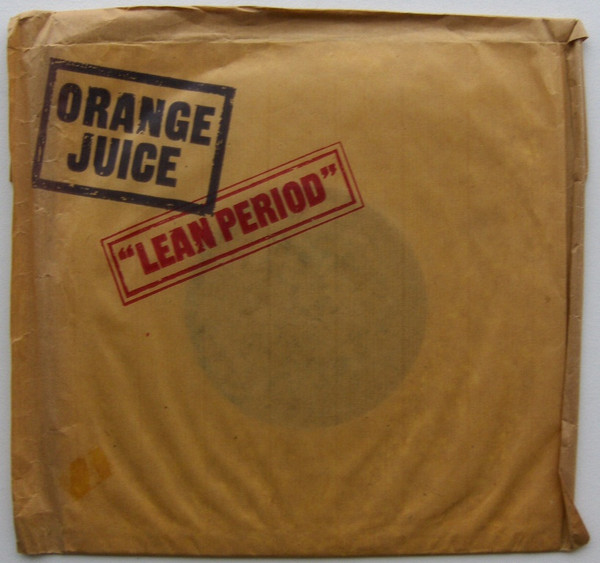
Lean Period was chosen as the advance single, released in the first week of October, with the album scheduled for a month later.  In an ideal world, the single would have gone into the charts and still been there when the album hit the shops.  The packaging for Lean Period is one example of Edwyn still calling the shots, arranging to have it released in a brown paper bag rather than a normal sleeve…and this was the case for the 7″ and 12″ versions.

I want to testify, my love is bona-fide
This is the real thing, not just a casual fling
But please don’t expect consistency from me
I’ve been maimed and I’ve been chained before you see

But right now I’m
Going through a lean period
A decidedly mean period

Let’s talk things over in the ‘Old Rover’
Let’s drown our sorrows like there’s no more tomorrows
All those words that I have wasted in haste
Have left such a bitter aftertaste

The reason being I’m
Going through a lean period
A decidedly mean period

This joke I’ve made at my own expense
Has long since worn thin
And yet by way of recompense
You respond with a wink and a knowing grin

Going through a lean period
A decidedly mean period

The lyrics might look quite acidic, but the tune is upbeat and joyful, with Dennis Bovell bringing some keyboards on board to sound as if there’s a horn section involved, as well as adding his booming voice alongside Edwyn’s as the chorus is sung.

mp3: Orange Juice – Lean Period

A real toe-tapper and radio friendly as fuck!  #74 was a travesty…….but then again, the same could be said for almost all the OJ singles over the years.

The b-side was a track that had been recorded during the sessions with Will Gosling:-

mp3: Orange Juice – Bury My Head In My Hands

It feels as if it is still in the demo stages of development, and given it is quite different sounding from the other tracks, it is no real surprise that it didn’t make the cut for the album.

As usual, there was an extended version put on the 12″ vinyl:-

mp3: Orange Juice – Lean Period (12″ dub version)

The use of the keyboards to make it sound as if a steel drum band were playing is one of the big differences, along with the extra minute or so of music.  There’s a fair bit of studio gimmickry which ends up making it quite different from the 7″ version while many of the lyrics are omitted.

But wait……there’s one final thing to offer up before the series switches to the collaborative and solo years.

Some copies of the 7″ single came with a flexi disc offering up two live tracks that were, according to the info provided, were taken from ‘Soundtrack of the forthcoming Polygram video Orange Juice – dAdA With Juice’.  This turned out to be a VHS tape featuring 45 minutes worth of live footage that had been recorded at the Hammersmith Palais in June 1984.  Edwyn and Zeke were joined by Johnny Britton (guitar) and Paul Heard (bass), both of whom had been involved at different stages in the recording of The Orange Juice.

mp3: Orange Juice – Rip It Up (Live)
mp3: Orange Juice – What Presence?! (Live)

And that, brings an end to the first chapter of the Singular Adventures of Edwyn Collins.  The next chapter begins in seven days time.


JC

THE TESTIMONIAL TOUR OF 45s (aka The Singular Adventures of Edwyn Collins)

#12: What Presence?! : Orange Juice (Polydor, OJ6, 1984)
The one thing that has really hit me in pulling the first part of this series together is just how hard Edwyn Collins was working back in the early-mid 80s.

The Texas Fever mini-album had come out on in March 1984, recorded by a line-up that was no more.  Less than two months later, a new single was released, with the personnel consisting of Edwyn, Zeke Manyika, and a guest bass player in Claire Kenny, who was part of the reggae/ska band, Amazulu.

mp3: Orange Juice – What Presence?!

A personal favourite of mine – far removed from the sound of the Postcard era, but which felt totally different to what anyone else was doing in 1984.  It also seemed that Edwyn, at long last, had found a sound to best suit his voice, one in which louder guitars were to the fore and the solos were more than just the two-finger style that had been his calling card for much of his career – maybe the time spent hanging around with Malcolm Ross had seen things rub off on him in a very positive way.  The studio wizardry on the single was deftly handled by Phil Thornally, who at the time was producing The Cure as well as being part of their touring band.

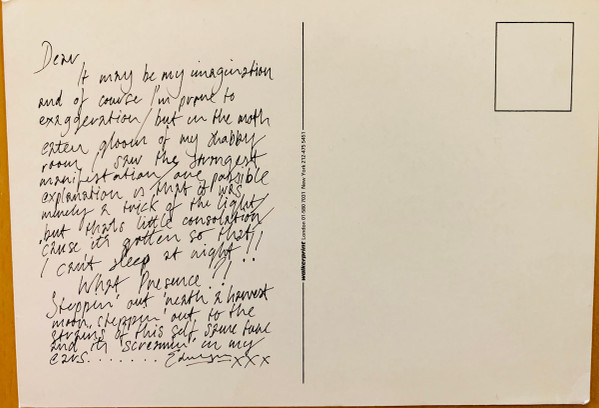
Lyrically, Edwyn was going down a different road again, confident enough in his own abilities to share his wordsmith skills with the listening public, as the postcard which came with the 7″ copy of the single was able to demonstrate:-

There was some airplay, but most radio stations simply wanted a retread of Rip It Up and not this new, harder edged version of the band, and criminally, What Prescence?! only reached #47 in what was a four-week stay in the singles chart.

The b-side dated from the Texas Fever sessions, but this particular take saw Dennis Bovell bring his particular talents to the party:-

mp3: Orange Juice – A Place In My Heart (dub version)

There was also a 12″ release, on which there was an extended version of the A-side:-

mp3: Orange Juice – What Presence?! (extended version)

The thing is, it is only some eight seconds longer than the 7″, but the mix has a significant difference in that the section with the harmonica on the standard version which comes in around the 2:10 mark is replaced an extended guitar solo…and that’s precisely what accounts for the extra eight seconds!

The 12″ extra track is this:-

mp3: Orange Juice – What Presence?! (BBC session)

As recorded for the David Jensen show on 22 February 1984.  The producer was John Porter who, just two days previously, would have enjoyed the fact that an album he had worked on the previous year had finally reached the shops and had been well received in most of the music press…and that being the eponymous debut by The Smiths.

There is one final Orange Juice single left to cover, and as I’m not closing the blog down over this upcoming Festive period, it’ll be posted next Sunday.


JC

THE TESTIMONIAL TOUR OF 45s (aka The Singular Adventures of Edwyn Collins)

#11: Bridge : Orange Juice (Polydor, OJ5, 1984)
Before we get onto the next Orange Juice single, here’s some TV footage which is needed as part of the backstory.

It’s taken from a show called Switch, which aired on Channel 4 on Friday evenings between 25 March and 2 September 1983, filling in the gap between the first two series of The Tube. I can’t give you the precise date of the Orange Juice appearance, but you can see it is the Collins/McClymont/Ross/Manyika line-up playing the big hit and a new song, albeit it had been made available on flexidisc to readers of Melody Maker earlier in the year.

All appears well in the clip, but this masked reality

The band were working again with Dennis Bovell in the studio on the third album.  Plans were in hand to release A Place In My Heart as its lead single in October 1983, with the album to come out the following month, positioning itself well for the pre-Xmas market.  Out of the blue, David McClymont and Malcolm Ross decided to leave the band, citing ‘musical differences’.  The album was only half-finished……

A salvage job was put into operation.   A six-track mini-LP, Texas Fever was scheduled for release in March 1984, with things rounded off, appropriately given the circumstances, with the inclusion of A Sad Lament, the b-side a year earlier to Rip It Up.   The advance single was changed from A Place In My Heart to this:-

mp3: Orange Juice – Bridge

Given the band were somewhat at odds with one another during the recording process, it really is quite something that they delivered such a great sounding single, albeit Bridge was a song that had been part of their live sets for a while, with Malcolm Ross playing keyboards.  It was something new and different from what had come before, and I’ll happily admit that I really enjoyed this harder-sounding version of Orange Juice, and Bridge had a groove and rhythm that was infectious, not least the handclaps that made listeners (well, me at least) want to replicate if it ever got played on the disco floor. Not that the chance ever came, as DJs and indeed radio stations shunned it, leading to an undeserved #67 flop.

The b-side was another new, frantically paced number, one that wasn’t included on Texas Fever (but would subsequently be recorded in a much slower form and slotted into the final OJ album almost a year later).

mp3: Orange Juice – Out For The Count (single version)

Polydor‘s marketing people did their best.  A 12″ version was released, as was a limited edition 7″ version which came with an additional flexi disc.  The 12″ didn’t feature an extended version of Bridge, but it did add in a band-produced take on things, one that in effect was the demo provided to Dennis Bovell; please don’t be fooled by the crowd noise at the beginning and the end…this is a decades-old version of ‘Fake News’ as these were added to give the impression it was a concert recording….the rapturous applause at the end clearly gives the game away as Orange Juice gigs never got that sort of reaction!.

mp3: Orange Juice – Bridge (Summer 83 version)

The flexi disc claimed to be a live recording of a Postcard-era single when in fact it was a new studio recording, produced by Dennis Bovell.

mp3: Orange Juice – Poor Old Soul (flexidisc version)

The Polydor contract had been signed when the band consisted of Edwyn Collins, James Kirk, David McClymont and Steven Daly.  Only Edwyn remained, and there was just one other official band member in Zeke Manyika.  There was still belief that hit singles would come along, and rather than cutting their losses, funding was made available to have the duo, with guest musicians, go back into the studio.  The songs to emerge from those sessions proved to be among the best of Edwyn’s entire career…..

JC

THE TESTIMONIAL TOUR OF 45s (aka The Singular Adventures of Edwyn Collins)

#10: Flesh Of My Flesh : Orange Juice (Polydor, OJ4, 1983)

Let me begin this week by trying to explain why the first single under which Orange Juice has its own specific catalogue number, offered up by Polydor, carries OJ4.

OJ1 had been a 12″ promo featuring two non-singles, A Million Pleading Faces and Breakfast Time, given to DJs as a way of further plugging the Rip It Up LP.  OJ2 had been the number attached to the bonus disc included as part of the 2 x 7″ release of Rip It Up, while OJ3 had been a flexidisc of a previously unreleased song, The Day I Went Down To Texas, that was given away with copies of Melody Maker, one of the four weekly UK music papers, in March 1983.

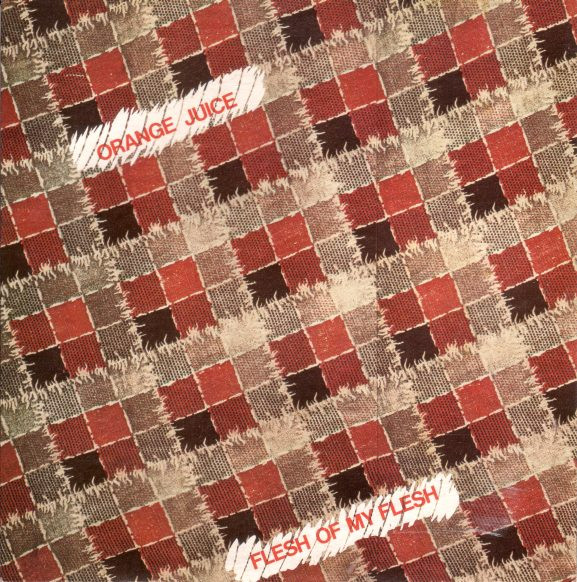
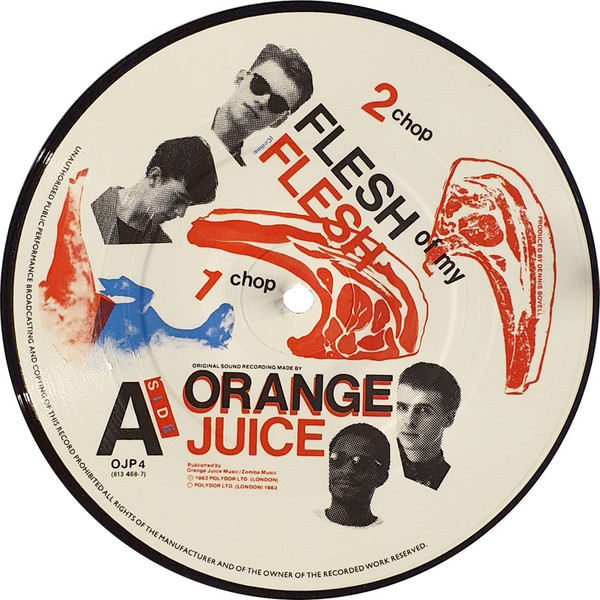
OJ4 was released in June 1983.  A full eight months after Flesh of My Flesh had first been heard as an album track, the decision was taken to issue it as a single.  In order to tempt fans to buy it, a completely new mix was issued on 7″ (and also available as a picture disc), with production duties handled by legendary reggae and dub musician/producer, Dennis Bovell.

mp3: Orange Juice – Flesh of My Flesh (7″ version)

A decent enough pop effort, but it wasn’t one to get the sort of attention of the big hit a few months earlier, and despite a six-week stay in the singles chart, it peaked at #41 which, going by history, seemed to be the natural position for Orange Juice singles.

The fact that the band was struggling a bit for material can be seen from the b-side offering:-

mp3: Orange Juice – Lord John White and The Bottleneck Train

The writing credits are attributed to Manyika/McClymont/Ross.  It is a rollicking but strange almost surreal sort of tune in which Zeke tells the story of a train journey in Zimbabwe, but if you pay close attention, you can also make out a sort of wailing sound courtesy of Edwyn which turns out to be the vocal to Flesh of My Flesh played backwards.  Quite clearly, the band and Dennis Bovell were intent on having a bit of fun in the studio.

The 12″ version of the single added various studio effects to Flesh of My Flesh.  It is, in my view, a bit on the self-indulgent side, and does the song no favours at all.

mp3: Orange Juice – Flesh of My Flesh (12″ version)

One other thing to add…the picture disc version of the single for some reason had an edited version, by about 90 seconds, of Lord John White. So, for completeness:-

mp3: Orange Juice – Lord John White and The Bottleneck Train (edit)

What we didn’t know was that the band were already back in the studio, working on new material for a third album, and that the next single was at an advanced stage of planning.  But those of you who have been following the story of Orange Juice via this series will be well aware that things rarely go smoothly or as planned.


JC

THE TESTIMONIAL TOUR OF 45s (aka The Singular Adventures of Edwyn Collins)

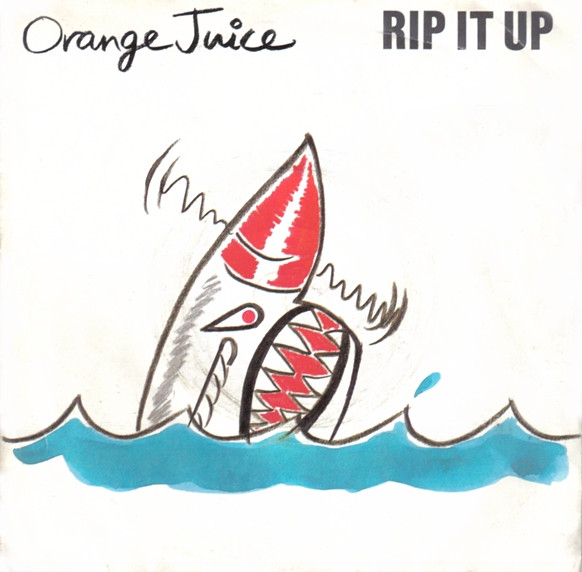
#9: Rip It Up : Orange Juice (Polydor, POSP 547, 1983)

There’s still a part of me in disbelief that Orange Juice actually enjoyed a Top 10 single back in the early months of 1983.

The second album, Rip It Up, had been released in November 1982, a mere eight months after the debut.  The weekly music papers more or less gave it an absolute pasting, with many writers expressing sorrow that the once darlings, and indeed possible founders, of post-punk indie-pop had released such a hotchpotch of tunes, all of which had been subject to the production styles and values of the day.  There was one exception….Neil Tennant, a writer with Smash Hits (whose aim was very much at the pop side of music and a younger audience) awarded the 8 out of 10 and said “no one can accuse them of being twee anymore … a big step forward which they can be proud of and you can enjoy.”

While I wasn’t overly impressed with it on first hearings, there were a few moments worth listening to, including the opening track, after which the album had taken its name.  Rip It Up, certainly in the eyes of a major label, been a commercial failure, spending just two weeks in the chart and doing no better than its first week showing of #39.  Probably more in hope than expectation, the lead track was chosen to be the band’s new single, and given a release in the first week of February 1983.

mp3: Orange Juice – Rip It Up

There was probably some minor celebration in Polydor HQ when the single was listed for daytime play by Radio 1 which helped it enter the chart at #50.  When it climbed the following week to #42, the same position as that when I Can’t Help Myself hit its peak, everyone probably expected it to then fall away.  But the listening public had taken to the song, and by now it was being heard not just on Radio 1 but on the local BBC stations as well as the many commercial stations across the UK. It made its way up to #31.  And still it continued to sell….#22 the following week, which led to a Top of The Pops appearance in which Edwyn, David, Malcolm and Zeke did their best to enjoy their miming experience.

There were many viewers who, having just had their introduction to Orange Juice, went out and the 45 as it climbed to #10 the following week, and then up to #9.  This led to a second invite to Top of The Pops, one in which they would be introduced by none other than John Peel who had championed them in the Postcard days but had no love for the current music.  This appearance would subsequently go down in legend. Partly because Edwyn managed to get his good friend Jim Thirwell, who recorded under the name of Foetus, and was never a candidate to have a chart single, on to the show to mime the sax solo, but mainly for David’s antics.   The bass player had got shit-faced in the Green Room beforehand, upset and angered by the fact the producers were going to have dancers alongside the band tearing up bits of paper as they mimed away.

It might have been a performance that had the middle-classes tut-tutting in their living rooms, but it did lead to the single going up the charts yet again, just the one place to #8 which is where it peaked.  The story goes that the TOTP producers were so annoyed by the antics of the band that Polydor Records were called up and told Orange Juice were never be invited back onto the show.  Without giving away any spoilers, the chart performances of all their future singles never threatened to call anyone’s bluff.

Rip It Up was released in the usual 7″ and 12″ formats.  The 7″ version (which is near the top of this post) was an edited version of that which opened the album, about 1:40 shorter all told.  The annoying thing is that the single fades out much quicker than the album version, meaning the Paul Quinn backing vocal is very truncated.

The 12″ didn’t simply offer up the album version, however, being a different mix altogether:-

mp3: Orange Juice – Rip It Up (Punk Club Version)

The b-side to the 7″ was written by Malcolm Ross who also took the lead vocal:-

mp3: Orange Juice – Snake Charmer

The b-side to the 12″ was an Edwyn Collins song:-

mp3: Orange Juice – A Sad Lament

Neither track has the pop majesty of the A-side, and were so different from the polished sounds of the songs on the album that their inevitable fates were as b-sides, although A Sad Lament would later be one of the nine tracks to appear on the mini-album Texas Fever (which I’ll come back to in due course).

As part of the marketing efforts by Polydor as the single made its way up the charts, a ‘limited edition’ 2 x 7″ version was pressed up, complete with a glossy poster.  The bonus disc offered a shorter version of A Sad Lament, along with what was described as a live version of earlier Postcard era single Lovesick:-

mp3: Orange Juice – A Sad Lament (edited version)
mp3: Orange Juice – Lovesick (live version)

There was nothing live about Lovesick – it was simply a newly recorded and far more polished version featuring the current Orange Juice line-up. But it’s a decent enough listen and on its own made the purchase of the 2 x 7″ offering worthwhile.

The dilemma for the record label was how best to follow up the hit single and seek to maintain the momentum.


JC

THE TESTIMONIAL TOUR OF 45s (aka The Singular Adventures of Edwyn Collins)

#8:I Can’t Help Myself  : Orange Juice (Polydor, POSP 522, 1982)

The next single was another that had been debuted on the David Jensen Radio 1 show back in April 1982:-

mp3: Orange Juice – I Can’t Help Myself (Radio 1 session)

I had access to the four songs played at this session, courtesy of a hissy C90 cassette with a far from ideal sound quality, and I have to admit to being surprised when I read that I Can’t Help Myself had been slated as the next single as it had come across as a bit uneven and disjointed.

Thankfully, the time in the studio, along with the band becoming more familiar with the song, meant that the recorded version (jointly written by Edwyn Collins and David McClymont) proved to be something quite joyous, one which appealed immensely to the dance-side of this particular indie kid:

mp3: Orange Juice – I Can’t Help Myself

The funky/soulful nature of the song, combined with what is a very happy sounding and joyously delivered vocal makes for damn fine, near perfect for daytime radio pop single.  It surely had chart hit written all over it, but to everyone’s immense disappointment, it stalled at #42 in October ’82, meaning that the often-dreamt of appearance on Top of The Pops would have to be delayed till another time.

The writing credits on the b-side introduced a new name.  Collins/McClymont/Manyika/Quinn.    At this point in time, I knew of Paul Quinn having seen him perform with the French Impressionists and Jazzateers, and would fall deeply for his charms and talents in later years when Bourgie Bourgie formed.  This was, thinking back, the first of his vocal performances that I ever bought:-

mp3: Orange Juice – Tongues Begin To Wag

Four minutes and fifteen seconds of sonic magnificence, which is very much down to the singing as it has to be admitted that the 80s production style and value, particularly around the jarring synth, has dated things quite a bit.

The 12″ release of the single had an extended version of I Can’t Help Myself, with the extra two minutes being taken up by a sax solo to fade-out, all of which just adds an extra layer of funk to the song.

mp3: Orange Juice – I Can’t Help Myself (12″ version)

There was also an additional song on the b-side:

mp3: Orange Juice – Barbeque

A strange but not entirely unpleasant near five minutes of music, attributed to Collins/McClymont/Manyika/Ross.  It sounds like a jam in the studio, to which Edwyn has added a few lyrics recalling events at an actual barbeque in someone’s garden.   OK, it wasn’t Falling and Laughing or Blue Boy, but there was the consolation that it wasn’t Two Hearts Together.  Maybe there was some hope after all for the new album.

JC

THE TESTIMONIAL TOUR OF 45s (aka The Singular Adventures of Edwyn Collins)

#7:Two Hearts Together/Hokoyo : Orange Juice (Polydor, POSP 470, 1982)

I really don’t want to spend any more time than I need to on this one as it’s quite simply the worst 45 ever released by Orange Juice, and quite possibly the worst ever by Edwyn Collins including his solo career.

Malcolm Ross had joined the band and after a number of auditions, Zeke Manyika, a Zimbabwean who had lived in the UK for most of his life, was recruited as the new drummer.  Edwyn, in press interviews, was indicating that the band would be moving in a different direction, and that all four members, including David McClymont, would be involved in the songwriting process.

In April 1982, fans and the wider listening public were given the opportunity to hear this new brand of Orange Juice, with four songs debuted in a BBC Radio 1 session for the mid-evening David ‘Kid’ Jensen show.  One of the new songs was this:-

mp3: Orange Juice – In Spite Of It All

Fast-forward four months and the release of the band’s seventh single, their third on Polydor and their first without James Kirk or Steven Daly.

mp3: Orange Juice – Two Hearts Together

Turns out, In Spite Of It All had undergone a name change between the Jensen session and its recording as what turned out to be a stand-alone single as it was subsequently left off the sophomore album.   The photo of Edwyn and David, with Malcolm and Zeke in shadow, on the front of the sleeve, is perhaps as good an indication as any that this was very much aimed at the pop market and not the indie kids who had been the band’s mainstay up until now.  Indeed, it was very much a sign of the band jumping on the bandwagon of what would, in time, be called ‘sophisti-pop’ which was all the rage.

I hated it. Really, really hated it.  And feared that Orange Juice were a busted flush.  Turns out that Edwyn also accepts it was a misstep:-

“Two Hearts Together’ is the worst thing we’ve ever done. I really regret that now. We thought we were missing out on all this New Pop, we’d better get in on this.  It was staying in the same hotels as a lot of other rock groups like ABC.  You get to thinking, ‘well, maybe Orange Juice are reactionary old has-beens. We ought to get hip.’ So you start trying to do something that’s really current. I regret that.”

There were enough sales to take it into the UK charts at #60.

The double-A side on this occasion was a track written by all four members of the band, along with Zop Cormorant (someone whose name would later be credited as drumming on one of Edwyn’s solo albums but of whom I know nothing!).

mp3: Orange Juice – Hokoyo

If Two Hearts Together was in the vein of sophisti-pop, Hokoyo is bang in the middle of a world music track, with Zeke taking the lead vocal in his native Shona language prior to Edwyn joining in a bit later on.  It was very unexpected.  I’ll leave it at that.

The single was released on 7″ and 10″ vinyl, with both songs being extended a bit on the larger format.

mp3: Orange Juice – Two Hearts Together (10″ version)
mp3: Orange Juice – Hokoyo (10″ version)

Next week sees the lead-off single for the second album.

JC

THE TESTIMONIAL TOUR OF 45s (aka The Singular Adventures of Edwyn Collins)

#6:Felicity/In A Nutshell : Orange Juice (Polydor, POSP 386, 1982)

Possibly the only man who had any involvement with Orange Juice who was really smiling when 1982 rolled out was Geoff Travis of Rough Trade.  He had been conned out of the band’s debut album when they had taken the tapes he had funded to a major label, only for half of the band  – James Kirk and Steven Daly – to then abruptly quit just as the first single on Polydor was released and the marketing plans for the album were beginning to get into full flow.

The live shows were turning into a shambles, with most of the songs on which James Kirk took lead vocal being left off the set lists. The release date for the album, to be called You Can’t Hide Your Love Forever, was announced as mid-February 1982.  A second Polydor single was chosen, and released some four weeks in advance of the album.  There’s no doubting that it made for a great 45, being one of the band’s best songs of all, but the fact it had been written by James Kirk, (albeit one sung by Edwyn Collins) makes it a bit of a strange decision, almost as if everyone was in denial.

mp3: Orange Juice – Felicity

In at #63, and that was as good as it got, sliding down to #68 and #73 over the next two weeks.  There must have been a sharp intake of breath as the debut album hit the shops, but it came in at #21, reflecting perhaps that fans were really keen after such a long time to finally have an album’s worth of material, and it probably helped that the band had re-recorded Falling and Laughing for inclusion as its opening track.

But back, briefly, to Felicity.

No images of the band were used on the sleeve…no real surprise, given the fact the Orange Juice of January 1982 was not the Orange Juice that had recorded the single.  It also meant that what what should have been the b-side, an Edwyn Collins song, was promoted to function as a double-A side:-

mp3: Orange Juice – In A Nutshell

The two different aspects of the band are very apparent.  Felicity, one of their very oldest songs, has the rougher new wave feeling and energy.  In A Nutshell is a more polished offering with backing singers very much to the fore. In later years, a demo version of In A Nutshell would emerge, and other than the use of the backing vocalists, it wasn’t too different, so perhaps there were early indications that Edwyn, if not necessarily the rest of the band, was prepared to smooth out any rough edges.

The 12″ came with an extra song.

mp3: Orange Juice – You Old Eccentric

Not just another of the James Kirk songs dating back to the old days (and seemingly a piss take of their manager Alan Horne), but it also has James on lead vocal. Totally wasted as a b-side……but for me, the definitve version dates back to December 1980 with this highly energetic take was recorded for a Peel Session.

mp3: Orange Juice – You Old Eccentric (Peel Session)

All of what I’ve written above is very much with the aid of hindsight and the emergence of what was going on behind the scenes.  The 18-year old me just simply thought Felicity was one of the best records I’d heard in my then young(ish) life, and it’s an opinion I hold to this day.

JC

THE TESTIMONIAL TOUR OF 45s (aka The Singular Adventures of Edwyn Collins)

#5:L.O.V.E. Love : Orange Juice (Polydor, POSP 357, 1981)

As featured just a few months ago on the blog as part of the random 7″ singles feature….and prior to me coming up with the idea of this particular series.

The summer of ’81 and the news that Orange Juice had signed to Polydor.

They had actually, with the connivance of manager Alan Horne, who had a long-time dislike of Geoff Travis of Rough Trade, taken an advance from Travis to fund recording sessions in London in the summer of 1981, working with Adam Kidron who had also been producing Scritti Politti‘s debut album. The plan, as far as Rough Trade knew, was for the Orange Juice album to be distributed by them but to appear as if it was a Postcard album with full control being given to the band.

Instead, in what wasn’t the nicest of moves, Orange Juice took the tapes to Polydor, and the bosses at the major label made them an offer that couldn’t be turned down, even if it came with the loss of overall control that the indie label was proposing.

The last week of October 1981 saw the debut 45 for the major.

mp3: Orange Juice – L.O.V.E. Love

A cover of an Al Green song.

The 7″ single came with a fantastic b-side:-

mp3: Orange Juice – Intuition Told Me

Both had been recorded with Adam Kidron, but the wish of the label, backed by Edwyn Collins, to go with the cover as the new single was the final straw for James Kirk and Steven Daly as they had grown increasingly disillusioned with life in the band, notwithstanding they had been fully involved in the forthcoming debut album.

One of the decisions that had caused ructions was Edwyn Collins’ wish to recruit Malcolm Ross into the band.  You’ll hopefully recall from previous parts of this series that Malcolm had been involved in production duties with some early singles, and now that his band Josef K had come to an end, he was on the lookout for something new to get involved on.  It led to Edwyn and Malcolm, along with bassist David McClymont, undertaking tours in late 1981, with stand-in drummers to support the release of the debut single for Polydor and to showcase the album. By all accounts, the shows were shambolic……

Taking into account that copies of Falling and Laughing were already beginning to shift for considerable sums on the second-hand market, the decision was made to add its b-side Moscow as the extra track on the 12″ release of L.O.V.E. Love, albeit really is Moscow Olympics in a cleaned up and more polished version:-

mp3: Orange Juice – Moscow (alt version)

L.O.V.E, Love entered the charts at a rather underwhelming #68, climbing three places the following week before dropping out of the Top 75 altogether.

JC

THE TESTIMONIAL TOUR OF 45s (aka The Singular Adventures of Edwyn Collins)

#4: Poor Old Soul : Orange Juice (Postcard 81-2, 1981)

mp3 : Orange Juice – Poor Old Soul
mp3 : Orange Juice – Poor Old Soul (Pt 2)

Quite often, when a band releases a song in two parts, it’s down to the fact that it is too long to fit onto one side of a 7″ single, and so as part one fades out, you have to flip the single over and part two usually fades in.

Not in this case.

Poor Old Soul is about two-and-a-half minutes in length.  As is Poor Old Soul (Pt 2).   It’s a tune propelled in the main by its bass line, albeit there’s the sort of guitar ‘solo’ that was beginning to be associated with the band.  The ‘A’ side also has a wee bit of piano in the middle.  The biggest difference however is that Edwyn Collins, having written the song, fancied contributing the bass line rather than rhythm guitar, and so he and David McClymont swapped instruments for the take which became Part 2, with the other more distinguishing factor being that inclusion of the chant ‘no more rock and roll for you’. 

Did anyone feel cheated?  I don’t think so, although it was unusual not to have a distinct b-side as opposed to a different take, recorded in the studio on the same day.  It was released in February 1981, and included on the back of the newly designed company sleeve was info on the upcoming releases, which were set out as

81-3:  Aztec Camera : Just Like Gold/We Could Send Letters
81-4:  Josef K: Sorry For Laughing/Revelation (recorded in Bruxelles for Les Disques de Crepuscule (TWI 023) 
81-5:  Josef K  Chance Meeting/Pictures of Cindy 
81-6 : Orange Juice – Wan Light/You Old Eccentric

The first three would be issued, but before the summer was over, Orange Juice had signed to a major label, Polydor Records.  The big-time beckoned…..or did it?


JC