A guest posting by Dirk
Dear friends,
Yes, I know – it’s a bit like one of those old jokes, you know: „three guys walk into a bar …“, but here it is, for once, not a priest, a Rabbi and an Imam – it’s a drummer and two guitarists, in fact.
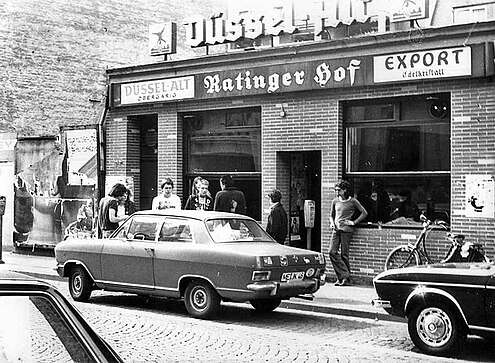
The bar is the Ratinger Hof, Ratinger Strasse 10 in Düsseldorf. We are talking very early 70’s here when the Ratinger Hof still was a cosy pub, you see – with a starry sky painted onto the ceiling, little carpets on the desks, a jukebox – and mainly Hippie students and local wannabe artists went there. Not a place you’d like to be in today, I assume, but this venue’s importance cannot be highlighted enough. Why? Well, two of the guests, above drummer and above guitarist # 1 in fact, one fine day came to the conclusion to co-found a band: you might have heard from them perhaps, Kraftwerk. And this is where it all starts, at least the first part of of our journey does:
Kraftwerk – ‘Kometenmelodie 2’ (’74)
Of course all of you know Kraftwerk and their importance for modern music, there isn’t pretty much I can add to that. By all accounts the two ‘main’ members, Hütter and Schneider, were not the easiest chaps to work with, so after a short while Rother and Dinger left and formed Neu!. Now, like Kraftwerk, Neu! are regularly being cited when it comes to innovation within German music of the time, Krautrock, Kosmische – you name it. Dinger invented the ‘motorik’ beat, which quickly became a trademark for the music of the time:
Neu – ‘Für Immer’ (’73)
Neu! split in 1975 and Dinger formed La Düsseldorf – again this was a band which is always being mentioned as having been highly influential for many artists, even today.
Now, back to our cosy pub and fast forward a few years, to 1976. The ‘Hof’, as it’s by now being referred to, has new owners, Ingrid Kohlhöfer and Carmen Knoebel, wife of Imi Knoebel, a minimalistic painter and sculptor. Imi remodelled the cosy pub radically, all walls were white and there were neon lights all over – the change was too much for the old Rockers and the Hippies, so they stayed away – but the Hof quickly attracted other guests, their musical tastes were a bit different though. One thing led to another and fairly soon local punk bands were given the opportunity by Carmen Knoebel to rehearse in the Hof’s beer cellar at daytime, whereas in the evenings bands like 999, Wire, XTC, Pere Ubu and Dexys Midnight Runners would perform there, plus by and large all of the local punk bands.
You see, people always talk about the famous Sex Pistols gig in the Lesser Free Trade Hall in 1976: basically everybody who was there formed a band, it’s always said. It’s questionable whether this is true or not, but as for the Ratinger Hof, 1971’s Dinger/Rother-history repeated itself in 1977 in the form of Franz Bielmeyer, aka Mary Lou Monroe – our second guitarist mentioned in the beginning. And this is where the second part of the journey begins:
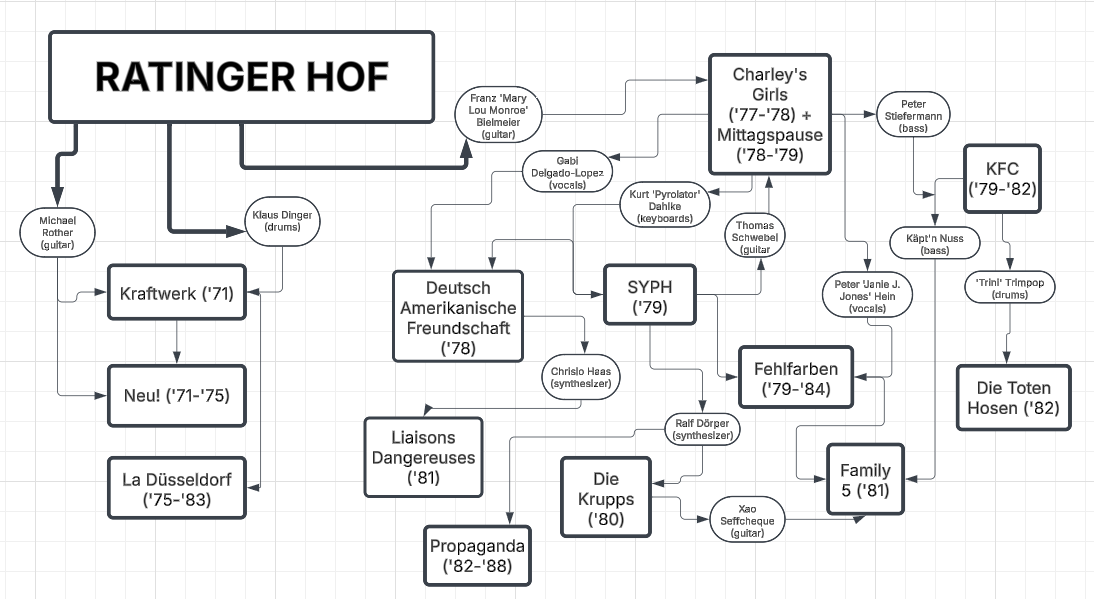
Bielmeyer founded Charley’s Girls (and I always thought this was a clever take on Charles Manson‘s female killer gang, but in fact it’s just connected to a Lou Reed tune, I mean: how boring is this?). Anyway, as my little diagram above shows, it’s fair to say that hadn’t Franz Bielmeyer started Charley’s Girls, Düsseldorf’s – and Germany’s – music scene would have turned out to be much poorer indeed! Let’s prove this, shall we?
Probably Bielmeyer’s masterpiece was to recruit the mighty Peter Hein, aka Janie J. Jones, who quickly changed from bass to vocals. Two or three of Charley’s Girls’ recordings exist, but of poor sound quality, so let’s proceed with what became of Charley’s Girls one year later, Mittagspause:
Mittagspause – ‘Herrenreiter’ (’79)
Peter Hein is no Pavarotti, I think we can agree on this. But then again, nor is Billy Bragg. And even if you don’t understand a single word of Hein’s lyrics, believe me: he is one of the great German wordsmiths. So you better get used to his singing, because after Mittagspause he invented Fehlfarben, who issued their debut album in 1980, ‘Monarchie und Alltag’. You may believe I am exaggerating again, but this record changed everything over here! I don’t think there is anyone who would not regard it as t.h.e. influential German album. Eleven songs, and not a bad one on it, for sure. Consequently I could have chosen any of them, but I went for this:
Fehlfarben – ‘Ein Jahr (Es Geht Voran)’ (’80)
I’m willing to have small bet that both Walter and [sk] are right now shaking their heads in disbelief as on why I picked exactly this song. The thing is, you see, their record company took it and released it as a single in 1982, unbeknownst to the band, in order to jump onto the Neue Deutsche Welle-train, where almost everything sung in German apart from Schlager was labelled young, stylish and cool, regardless of the songs’ intentions. Also it became a hymn for German squatters, something Hein always strongly objected to, because what he wanted to express in the song was the mood in Germany in the late 70’s: terrorism, recession, cold war. Even today this song is constantly being played on daytime radio and therefore there is a chance that even some of you non-German readers may have heard it somewhere. If not, give it a go, if you want to do yourself a favour!
Let’s continue with Peter Hein, after Fehlfarben came, in ’81, Family 5, equally brilliant, surely because of the genius that was Xao Seffcheque on guitar. Their first proper album did not come before ’85 though, ‘Resistance’. Some described it as „the better ‘Monarchie und Alltag’“ at the time, I’m not quite sure about this though …
Family 5 – ‘Du Wärst So Gern Dabei’
So, finally enough of Peter Hein’s remarkable voice for you – although he returned to Fehlfarben in 1991 and they are still going strong: in fact they are playing a venue near my village next Saturday, but a) I’m already attending another gig in Aachen and b) nearly € 40,- is a bit steep, I thought.
Right, back to Mittagspause then. They wouldn’t have been complete without Thomas Schwebel on guitar, he left S.Y.P.H. for Mittagspause and, in fact, Fehlfarben, and for Kurt Dahlke, who left Mittagspause for S.Y.P.H.
As complicated as all of this might possibly be, again we are talking about a band which was highly praised in and around Düsseldorf: S.Y.P.H. Their early 80s punk stuff made them well known in the region, but I always thought this from a few years later was their absolute highlight:
S.Y.P.H. – ‘Der Letzte Held’ (’85)
And with Dahlke (aka Pyrolator) we have the next important figure within the Düsseldorf scene, because before S.Y.P.H. he was a founding member of DAF, or, if you’d rather, Deutsch Amerikanische Freundschaft … the name might ring a bell … the grandfathers of Techno, anyone? ‘Der Mussolini’? Ah, just listen to them, you youngsters, but make sure to turn it up good and loud:
Deutsch Amerikanische Freundschaft – ‘Verschwende Deine Jugend’ (’81)
I’m sure you have already looked it up above, the road from DAF leads us to the next awesome Düsseldorf combo, and our driver is DAF’s keyboarder, Chrislo Haas. He and Beate Bartel (out of Mania D) became Liaisons Dangereuses, you’ll surely can sing along to their outstandingly brilliant ‘Los Ninos Del Parque’. And because you already know it by heart, I’ll have something else from them now, not too shabby either, I would have thought:
Liaisons Dangereuses – ‘Etre Assis Ou Danser’ (’81)
If you are still reading this nonsense, we might as well return to S.Y.P.H. briefly, because they had a guy on the synthezisers called Ralf Dörper – who found, after joining Die Krupps (with Xao Seffcheque) fame and fortune by founding Propaganda – you’ll remember Susanne Freytag and Claudia Brücken, if you remember nothing else:
Propaganda – ‘Jewel (Cut Rough)’ (’85)
If you haven’t fallen asleep by now, you may or may not remember that you learnt about Charley’s Girls an hour so ago. Charley’s Girls’ bassist was Peter Stiefermann and in 1978 he gave a party, among the guests were Thomas Peters (aka Tommi Stumpff) and Klaus-Peter ‘Trini’ Trimpop. The two of them founded KFC, another punk band of quite some importance. KFC carried on for quite some time, in 1979 they recruited the 16-year-old bassist Ferdinand Mackenthum (aka Käpt’n Nuss) – who later went to play for Family 5!
So, Käpt’n Nuss joined the band- and Trini Trimpop left it. What did become of him, you are asking? Well, he became the drummer for Die Toten Hosen, and later their manager – which a) probably made him a multi-millionaire and b) finally, you’ll be relieved to hear, closes a long and probably very boring circle!
I have on various occasions expressed my disinclination for Die Toten Hosen, or rather what became of them. But to be fair, their very first records were really good, especially this one, their second single:
Die Toten Hosen – ‘Reisefieber’ (’82)
Let’s return to where we came from, to the Ratinger Hof: in the spring of 1981 a big German magazine, the Stern, had an article about the venue in which it was advertised as ‘a secret spot for all things punk’, this happened at about the same time when the aforementioned Neue Deutsche Welle began to mutate into a huge Tsunami – which very quickly flushed everything away in an immense vortex: you could no longer tell which band was still good (as in: true to their roots) and which one was crap.
Now, I assume you can imagine what happened then: the Hof was soon flooded with tourists who wanted to see those oh so dangerous punks and listen to some of their strange music. Of course it all went downhill from then on and the Hof closed a few years later …
So, that’s Düsseldorf for you, friends – a city to listen to, for sure … but not necessarily one to visit, if you ask me: some say that the best thing in Düsseldorf is the motorway to Aachen.
Well, I cannot disagree …
Enjoy,
 THE NEW VINYL VILLAIN