
A guest posting by Marc Goldstein
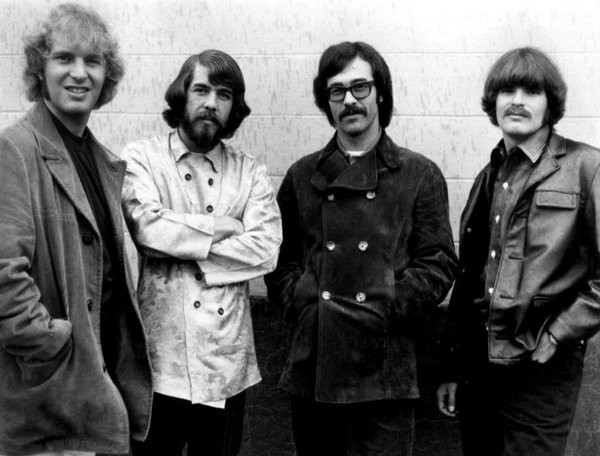
Creedence Clearwater Revival released seven studio albums in less than four years, including three in 1969 alone. For a brief, shining moment they were the biggest band in America, before flaming out due to burnout, infighting, and a terrible record deal. The bad blood has continued ever since, and has kept them from ever doing a reunion tour. But their songs have never stopped getting played on the radio, and their records keep selling more than 50 years after they broke up.
A casual listener would likely assume CCR were from the American South, given that they sang about riverboats and cotton fields and being “Born on the Bayou.” But they actually hailed from El Cerrito, California, across the bay from San Francisco. (That’s OK – Johnny Cash didn’t really shoot band members – guitarists John and Tom Fogerty, bassist Stu Cook and drummer Doug Clifford – got together as teenagers, and had some local success as a garage band with the extremely unfortunate name (forced on them by their record label) of the Golliwogs, before adopting the name Creedence Clearwater Revival and releasing their first album under that name not a man in Reno either. It’s just artistic license.)
In fact, despite playing the major San Francisco venues, and recording for a label in nearby Berkeley, CCR weren’t fully part of the San Francisco scene, either musically or culturally: lead singer/songwriter John Fogerty was a clean-shaven, flannel-wearing, married army veteran who avoided drugs, while the band’s fusion of blues and rock and country made them something of a precursor of Americana, even though no one used that term to describe a musical genre while CCR was around then back in 1968.
Throughout their career, the band mixed original compositions with covers of everyone from Leadbelly to Ricky Nelson. Their covers were hit-or-miss – I don’t think “Suzie Q” benefits from being slowed down and dragged out to 8 ½ minutes – so I’m going to mostly focus on their originals. However, I’ll make an exception for this, the opening track to their debut album.
mp3: Creedence Clearwater Revival – I Put A Spell On You
CCR wisely chose not to try to copy the inimitable Screamin’ Jay Hawkins original, and instead made the song their own. It’s a masterful performance and one of my favorite CCR tracks.
When it comes to the band’s own compositions – which are really John Fogerty’s compositions – what’s perhaps most striking is the breadth of topics they wrote about, and how few of their songs are about love or sex or relationships. They wrote songs about playing music, and the life of a gigging musician, including this country-tinged offering:-
mp3: Creedence Clearwater Revival – Lodi
and the impossibly catchy:-
mp3: Creedence Clearwater Revival – Down On The Corner
They flirted a bit with “back to the land” hippie pastoralism:-
mp3: Creedence Clearwater Revival – Up Around the Bend (“Hitch a ride to the end of the highway/where the neon turns to wood.”)
And they occasionally veered into social commentary – most notably on this:-
mp3: Creedence Clearwater Revival – Fortunate Son
(which is sadly every bit as relevant today as it was in 1969), and more indirectly on
mp3: Creedence Clearwater Revival – Who’ll Stop the Rain
But the theme that most sets them apart is dread, foreboding, bad omens, nightmares.
mp3: Creedence Clearwater Revival – Bad Moon Rising
This is probably the best-known example, despite the obvious tension between the lyrics and the upbeat melody and arrangement, but they also sang about tombstone shadows, sinister purposes, rain coming down on sunny days. Perhaps more than any of their contemporaries, CCR captured the zeitgeist of an America beset by war, assassinations, violent protests and violent crackdowns. They were masters at creating an atmosphere with music, lyrics and the vocal performance. One of the best of these songs of foreboding is a deep track that hasn’t lost any of its power through overfamiliarity.
mp3: Creedence Clearwater Revival – Effigy
But having said that, this – despite being played countless times on the radio and in movie soundtracks – still packs a punch as well.
mp3: Creedence Clearwater Revival – Run Through The Jungle
(I highly recommend listening to it through good headphones, not tinny computer speakers.) Although Fogerty claims to have written it about gun violence in America, the song has become inextricably linked to a grunt’s-eye view of Vietnam.
Tom Fogerty left the band in 1971, frustrated at the complete control wielded by his younger brother. The remaining members continued as a trio for a while, and put out one last album in 1972. The story that’s usually told is that Cook and Clifford wanted to try their hands at songwriting, and asked (John) Fogerty for some help. But instead, Fogerty insisted that each member would provide a third of the songs for the album, and that he wasn’t going to help the others with writing or vocals. Cook and Clifford partially dispute this, saying they never wanted to be songwriters and that Fogerty forced them to do it. Either way, the resulting album was predictably a disaster, though partly redeemed by
mp3: Creedence Clearwater Revival – Someday Never Comes
A lovely offering, about sons repeating the mistakes of their fathers – one of those songs that hits much harder for me now that I have a son of my own.
Refusing to help with his bandmates’ not-ready-for-prime-time songs was unfortunately not the only self-sabotaging decision Fogerty made. The group performed at Woodstock, but Fogerty didn’t allow the performance to be shown in the movie or included on the soundtrack album. (The full set was eventually released in 2019.) His inclusion of two diss tracks on his solo comeback album that were aimed at the head of his former record label, ended up tying him up in litigation for years. And his absolute refusal to play with Cook and Clifford again, over decades-old grudges, has translated to a lot of money left on the table. Of course, the reason that’s the case is that a lot of people still love those old Creedence songs. If this ICA turns anyone into a fan, I will consider it a success.
Bonus Track:
The best-known of their pre-CCR recordings.
Marc
 THE NEW VINYL VILLAIN