A guest series by Fraser Pettigrew (aka our New Zealand correspondent)
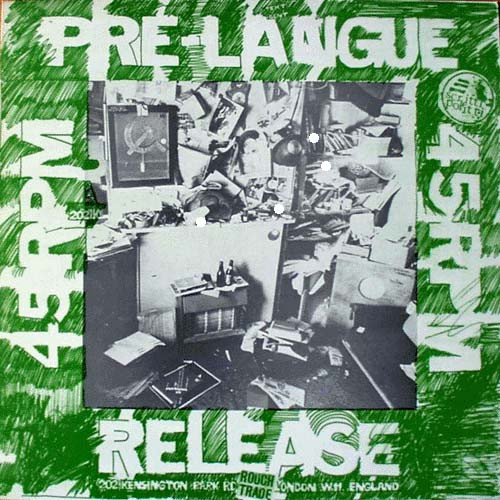
#12: Scritti Politti – 4 ‘A’ Sides (1979)
It goes without saying that you have to like the sound of your favourite pieces of music. It’s kind of the whole point. But do you have to like the meaning of it too? Or even just understand it? I’m talking here about lyrical content rather than any abstract musical meaning. Can you truly like a song without knowing the words and having a sense of what the artist is on about?
There are lines written by the likes of Howard Devoto, Paul Weller, Elvis Costello, Lou Reed, Iggy Pop, Billy McKenzie or Morrissey even that cut to the core of my being every time I hear them. They’re essential parts of the beauty and significance of the art that illuminates my life.
Equally, there are swathes of my record collection that I love dearly and are just as essential to me but whose verbal content remains a mystery to me, either because the words are an inaudible blur, or even when I can hear them, or they are helpfully transcribed on the sleeve they remain utterly incomprehensible.
Take Stereolab for example. One of my favourite bands ever. Could I sing along with many of their songs? Could I tell you what any of them are about? I’m afraid not. Even when I’ve read a lyric sheet, the meaning of the song remains stubbornly obscure. I get that it’s political, philosophical, social, existential, but you know, whatever… It sounds great, just let me at it.
Thus, it is with Scritti Politti. When I first heard 4 A-Sides in 1979 I just loved the sound of it. I knew there was something terribly meaningful going on in it too. There were mutterings of trendy Marxist theory. I made out the words ‘means of production’ – whoah, right on! I couldn’t make out much else, and to this day I still can’t.
But who cares? It sounded clever. The words were obviously clever, whatever they were, and the music was clever too. Fiddly guitar, mobile bass, complicated drum patterns. I liked clever, still do. Stupid was ok so long as it was ironic and kitschy like The Ramones or The Rezillos. Authentic stupid was out. We don’t need any more stupid. I mean, look at the world around us right now. That’s what stupid has brought us.
I can’t even say what kind of music 4 A-Sides is. You can’t say it’s jazzy, or reggae-influenced or that it sounds like Captain Beefheart, or Karlheinz Stockhausen playing zydeco. It just sounds like early Scritti Politti. To say it’s post-punk doesn’t help, because that’s not a genre you can define with musical characteristics like a fondness for diminished seventh chords, syncopated 4/3 rhythms and electric tuba improvisations. Post-punk is a bomb exploding in your previously narrow expectations of rock and pop music. How do you like the sound of that?
It’s not that I find words difficult. Back in those days I was giving up many hours of my precious youth to studying the words of Shakespeare, TS Eliot, WB Yeats and James Joyce. The words of Green Gartside however were informed by critical theory, semiotics, structuralism and dialectical materialism. That stuff wasn’t on my curriculum, although some of my friends dived into it, and perhaps they came to a deeper understanding of Doubt Beat and Bibbly-o-Tek than I did.
At any rate, my shallower understanding didn’t seem to impair my profound enjoyment of the music, and this carried through to Scritti’s first album, Songs to Remember. The music was less fiddly, more open to genre stylings, and the lyrics were more audible. They’re still impenetrable, however. Look, there’s old Jacques Derrida having his name dropped on a song so we could nod knowingly even if we couldn’t glean much sense from it.
Later still, when Scritti Politti hit it big with Wood Beez and Absolute, I tried to disillusion my spotty flatmate’s wee sister, who declared she was in love with Green, by telling her he was a revolutionary communist trying to smash capitalism by singing about the commodification of romance (I made that up, but he probably was). Quite rightly, she could not have given less of a shit and waltzed on through her teenybopper world where Green was just David Cassidy for the 1980s. So much for Lacanian psychoanalysis and the deconstruction of language and power.
Green may by then have acknowledged, in his own words, a ‘bankruptcy in Marxism’, but he couldn’t stop being clever, and the songs were still dense with double meanings and intellectual references. At least it stopped the slick soul-pop succumbing to cliché, but the fiendish wordplay didn’t mean you couldn’t just enjoy the slick soul-pop for just that. If you signed up for the semiotics, then the subversion of conventional norms would have made for heady satisfaction. It’s what the mid-80s were all about, the charts stalked by people like ABC and the Associates, subverting like the coolest college professors ever.
In 1979 however we were only just beginning to dabble in phrases such as ‘post-modern irony’, and the chief appeal of 4 A-Sides was its sheer difference. I was a nerdy 16-year-old, doing what 16-year-olds do to this day, desperately trying to assert my unique individualism while simultaneously submitting to the membership requirements of a tribe. The inherent contradiction in that behaviour didn’t bother us. I think maybe it was just living the dialectics or something. That was a convenient explanation if challenged, safe in the knowledge that the accuser wouldn’t understand what it meant either.
I still love 4 A-Sides. It still sounds different, unattached to anything else. I still get the warm sense of sophistication and cleverness that I adored as a teenager, undiminished by Green’s later declaration that he “was bored shitless with the noise we were making” by the time he collapsed from a panic attack after a gig in January 1980. The length of the EP makes for the perfect amount of cleverness in one dose before you get sick of it and metaphorically want to slap the smart-arsed twat and reach for The Undertones instead.
I still don’t know what it all means either, and probably never will. Does it matter? Am I bothered? (Here the author adopts an expression of stony indifference while gesturing at his own face with a gently circulating finger, flicks the turntable to 45rpm, and drops the needle.)
 THE NEW VINYL VILLAIN
What a wonderful piece of writing. Well done, Fraser. I’m thankful for every era of Scritti Politti.
Once sat on a train opposite a member of the literature faculty at plucky lower-division strugglers Queen Margaret University, who knew Green vaguely and agued in an impenetrably obscure way that his interpretation of Derrida’s ideas was flawed. Like Fraser I just liked the music (but was perplexed when Green started to look a bit like Princess Diana). In the end you can take the quotation marks on ‘The Sweetest Girl’ or leave them.
I always enjoy this blog, but that was a terrific read – informed, witty and entirely relatable to my own experience at the time. Without Wikipedia, and as an engineering student, I asked a philosophy student who the hell Derrida was and didn’t really understand the answer. Great tune, though.
Lovely writing, Fraser. Bonus as this EP is totally new to me and there’s a lot to like.
I’m delighted that this one has gone down well.
Fraser fired it over just before Xmas. My thank-you reply included these words:-.
” It will be up there (IMHO) as one of the best thought out and presented pieces that TVV will ever have hosted.
“It’s a genuinely fabulous read which resonated perfectly with me….it might not have the same impact on other readers who are maybe a bit younger or are from other parts of the planet, but you’ve captured perfectly the thoughts of many a left-leaning and hipster youth of the late 70s and early 80s. Wonderful stuff. “
Fantastic piece of writing. Love Scritti and Green and all the philosophy and thought that came with him/ them. Love the Princess Diana in a Nike Windrunner jacket image.
Humble thanks for the kind compliments as ever. When I sat down to start this one I thought, “Shit, I’m going to have to work out what the hell this stuff is all about now!” But then I thought no, honesty is the best policy, even if it means the title of my autobiography will be “I Was A Teenage Poseur”.