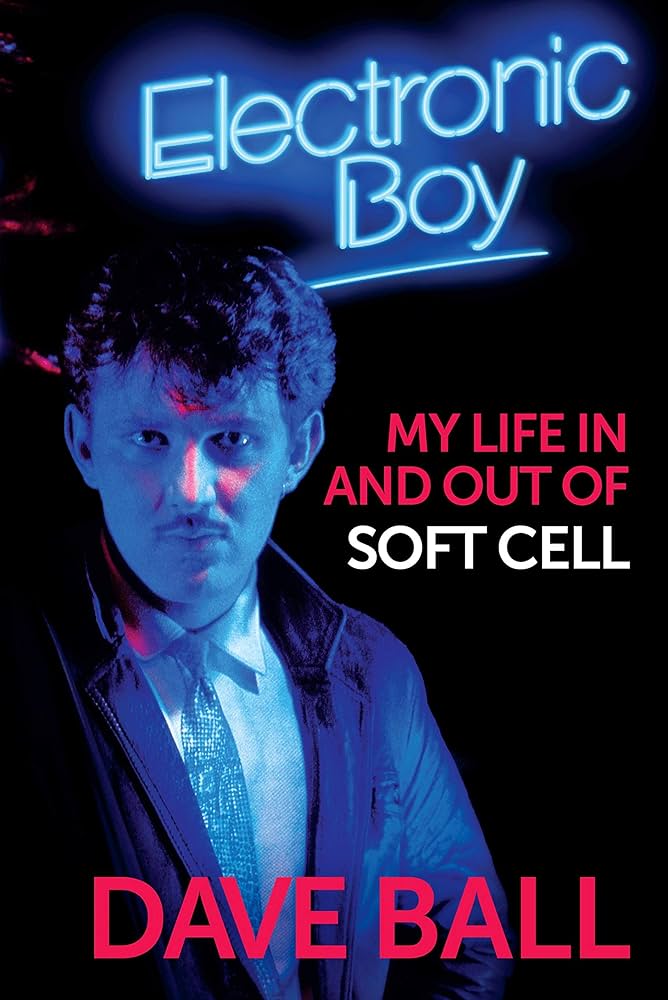
A book published in June 2020, but that I only got round to buying late last year after the death of its author. Sorry, Dave.
Dave Ball was always portrayed as the quiet and unflamboyant half of Soft Cell, but there are plenty of anecdotes in his autobiography which will leave any reader in no doubt that he was often as much the party animal and hedonist as Marc Almond. It really is quite the story, from his adoption at the age of 18 months by a childless couple from Blackpool (who would later adopt a second child and provide Dave with a sister), through to his 60th birthday celebrations in May 2019. It’s quite unlike most autobiographies in that all bar one of its 52 chapters are in bite-size chunks, making it a very easy read from start to end in that you can pick it up whenever you’ve only a few minutes spare knowing that the tale will have moved along a bit further, not necessarily in time, but at least there will have been another enjoyable or enlightening snippet from Dave’s life.
I don’t think this is one of those occasions when the tale has been told with the aid of a ghostwriter. The language throughout is consistently simple and unpretentious, written in a way as if Dave was sitting next to you in a bar or a coffee house or perhaps on a train, engaging in gentle conversation. The only time that your eyes perhaps might glaze over is when he gets technical about the type of equipment used at a particular recording session or during a gig, but these are very few and far between – and besides, while that kind of thing does wash easily over me, I do realise there will be loads of folk genuinely interested in that sort of detail.
Dave’s upbringing was modest but not impoverished, and the early chapters of his childhood and early adolescence will, I reckon, strike a chord with many who had a similar upbringing in the 60s and 70s. His love of music takes off through listening to the radio, and attending underage discos during weekend afternoons at many of the famous clubs that Blackpool was home to during those decades when it was the summer holiday destination of choice for working-class families. He was one of those whose tastes in music were constantly evolving from an early age, none of which he ever totally discarded and all of which would come to play some part or other in his career.
Like many of that generation, Dave took the opportunity on leaving school to embrace further education, heading to Leeds Polytechnic to study Fine Art, which is where he met and befriended Marc Almond. Both of them enjoyed life to the full, finding they had a great deal in common, and deciding, in 1979, to form an electronic band, just at the perfect time in pop music history. Soft Cell never started out as an act that had an eye on the pop charts, as can be evidenced by some of the early recordings. But Dave Ball just happened to be one of those people who had a gift for making all sorts of music, adapting very quickly to the technological advances of the day, while Marc just had the self-belief that he’d be a star in some shape or form.
Marc was 24 and David was 22 when their lives changed forever in 1981 through their take on Tainted Love, an up till then fairly obscure Northern Soul record. The pace of life proved to be exhausting, and by 1984 it was seemingly all over. The book goes on to describe 1984-1988 as ‘The Wilderness Years’, but the chapter is in fact one of the most enlightening and provides a great context as to how Dave Ball was always destined to make music, most often in partnership with others. His later collaboration with Richard Norris as The Grid is well-told, and leads nicely into the period when David found a new lease of life on the production side of things.
The Soft Cell reunions and comebacks (2000-2004 and then 2018 up until the book’s publication) are the basis for the closing chapters, with it ending on a very optimistic note given that the duo were writing songs again and a new album was in the works, albeit it took until May 2022 before it was released. Prior to this, in late 2021, there has been a triumphant and sold-out tour across the UK, during which many of these new songs were aired alongside all the hits and everything recorded for Non-Stop Erotic Cabaret as the tour was commemorating that album’s 40th anniversary.
Dave Ball didn’t enjoy great health in his later years, but it was still a shock hearing that he passed away, at the age of 66, last October, shortly after work had been completed on another Soft Cell album, which will be called Danceteria, due for release later in 2026. The good people involved with Soft Cell have also indicated that work is underway on an update of Electronic Boy, drawing on Dave’s notes over six years since it was first published and featuring new interviews and contributions from many who he worked with across what was a fabulous career. It’s one to look forward to.
mp3: Soft Cell – Memorobilia (Ecstatic Version)
Track 1 of Non-Stop Ecstatic Dancing, the June 1982 mini-album release consisting mainly of remixes of songs from Non-Stop Erotic Cabaret. Contains a rap from Cindy Ecstacy, the New York party girl whom Marc and David befriended and who later sang on the single Torch, as well as appearing in the video.
 THE NEW VINYL VILLAIN