
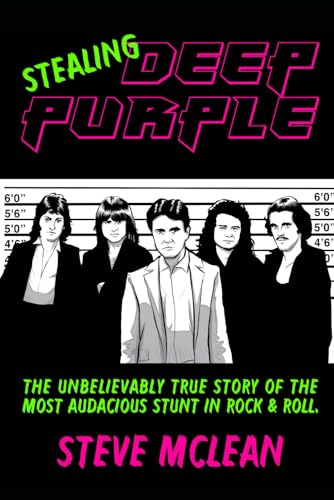
The past four Wednesdays on the blog have been given over to Steve McLean during which he has informed and educated many of us (and probably all of us!!), on how each of Fleetwood Mac, The Velvet Underground, MC5 and Cactus had occasions when their identities were not all that they seemed to be. All four pieces were spin-offs from a book that Steve has written, ‘Stealing Deep Purple : The Unbelievably True Story of The Most Audacious Stunt in Rock & Roll’.
I’ll be the first to hold my hand up and say that for most of my life, I’d struggle to name any Deep Purple song other than Smoke On The Water. Actually, I don’t even know that song…..I’m aware of the riff! The Britpop era introduced me to a second of their songs, Hush, when it was covered by Kula Shaker and taken to #2 in the singles chart in 1997. Now, I have to say that I thought it was a Kula Shaker original given it sounded just like the rest of their output, and I had was a sort of ‘rubs eyes in disbelief’ moment when learning it had been a 1968 Top 5 hit single in America for the hard rock giants, and indeed that the Deep Purple version itself was a cover as the song had been written by Joe South and recorded in 1967 by his fellow American, Billy Joe Royal.
It was the very success of Hush that ultimately led to a chain of events in the late 70s/early 80s into which Steve delves and picks through in forensic detail, thanks to what must have been many hundreds, if not thousands of hours of research as well as seeking out and getting responses from some who were in and around the periphery of said events.
The crux of the tale centres around Rod Evans, the original singer of Deep Purple, and whose vocal is on their version of Hush. Evans recorded three studio albums with the band before being fired in 1969. The other members of the band – Ritchie Blackmore (guitars), Jon Lord (keyboards) and Ian Paice (drums) – felt Evans’ largely pop/mod vocal style wasn’t compatible with the sort of music they were increasingly wanting to make, and he was replaced by Ian Gillan. It wasn’t just Evans who was booted out of Deep Purple MkI, as bassist Nick Simper was replaced by Roger Glover.
Deep Purple MkII lasted till 1973 when Gillan and Glover were removed to be replaced by David Coverdale and Glenn Hughes. Two years later, Blackmore quit to pursue what was going to be a solo career, but which ultimately became the band Rainbow. This meant we were onto Mk IV of Deep Purple, with Tommy Bolin being hired as Blackmore’s replacement, but by 1976, the band had torn itself asunder, albeit a number of them would end up working together in Whitesnake.
Rod Evans had long drifted out of the music industry and by the end of the 70s was working in medicine at a hospital in California, which is the point in time where the book really begins. An idea was hatched to relaunch Deep Purple and undertake a tour of America. Mexico and Canada, and possibly further afield, depending on the success or otherwise of the initial venture. Rod Evans would front the band, but the other musicians in this version of Deep Purple would have had would have had no prior involvement in any of the Mks I-IV line-ups.
The question of who owned the actual name ‘Deep Purple’ wasn’t seen as an important issue; and, if you recall Steve’s blog posts on other bands over the past few weeks, this was an era when quite a few bands went out on the road caring little about legacies or who had the actual right to claim the rights to a name. Indeed, in this instance, there is some suggestion that Rod Evans may have had grounds to believe that the other members of Deep Purple weren’t too fussed about it all, especially as they were at the height of their fames with new bands, and that it would all go smoothly. Others in and around Deep Purple, and in particular the management side of things, believed very differently……
The tour did go ahead. Some shows went well, but most didn’t, with underwhelming performances and poor sound quality leaving some fans feeling incredibly short-changed and/or cheated. Some shows ended in riots, and others ended with the band members fighting among themselves. Inevitably, the whole thing ended up in court.
As I said, I know next to nothing about Deep Purple. I also have a loathing for heavy metal bands such as Rainbow, Whitesnake etc, and as such this book should have been of little appeal to me.
But the book isn’t really anything to do with the actual music, as it’s more about the machinations of the industry. Steve’s style of writing is akin to it being the script for a six-part documentary on the events of 1979/80. He keeps his own personal opinions out of proceedings, and early on he accepts that, despite his very best efforts involving more than 200 printed sources (many of them contemporary and long-forgotten) as well as dozens of interviews he carried out himself, the book is, essentially, an incomplete jigsaw puzzle.
Hardcore Deep Purple fans, the ultras if you like, quite a few of whom weren’t around when these events took place, will argue vigorously that Rod Evans stole the name of the band, took a second-rate group of musicians out on the road and knowingly acted out a massive fraud on the paying public. In short, a scam of the highest order.
There are others, the miniscule minority view if you like, who feel Evans didn’t steal the name as he was an original member and in 1979/80, Deep Purple didn’t exist as a recording or touring band; he simply took something out on the road that didn’t meet people’s expectations leading to a horrible backlash that shouldn’t have been on him alone.
The book does offer a great deal of context to events, particularly through what press coverage there was back in the day. It also, towards the end, goes into some depth about the eventual court case, and while this does briefly threaten to take the prose into dry legal-speak, Steve, to his huge credit, finds a way to make it all understandable to those of us without a law degree to our name.
Stealing Deep Purple isn’t available (as far as I know) in the shops, and the publisher, Lulu Books, is involved in printing ‘on-demand’. In other words, if you fancy reading this in full, and I really do recommend it very highly, then you use this link and let the publisher do the rest.
mp3: Deep Purple – Hush
I’ve known Steve McLean for quite a few years now, but our friendship has nothing to do with my take on this book. If it had been poorly written, or been boring or had in any shape or form failed to hold my attention, then this post would not have been pieced together.
JC
PS : Steve has fired over a few more of his theft essays, and I’m delighted to say that these will feature, probably on a monthly basis for at least the rest of 2025. Keep your eyes peeled.
 THE NEW VINYL VILLAIN
I don’t know shit about Deep Purple, but ‘Hush’ is great. More psych rock than hard rock, I guess. I’ve heard seconds 15 to 25 before in Beck’s ‘Black Tambourine’.
One very cold day in December 2003 I found myself in the basement conference room of a hotel in Manchester, UK, taking the deposition of Barry Whitwam. Barry was the original drummer of Herman’s Hermits and the only member of the band still gigging under that name at the time–he might still be for all I know. I was there representing Peter Noone (ostensibly Herman), who had long since moved to beautiful Santa Barbara, CA, and who performed under the name Peter Noone and Herman’s Hermits. Peter and Barry sued each other over the right to the name, and it was resolved by the pair dividing their respective performance territories to the States (Peter) and the UK (Barry), where each could use the band name. It was kind of a boring case, to be honest, although I did get a look at Manchester for the first time. But this post reminded me of the countless examples of once successful bands that have split over the years and regrouped with only one or two original members. Or, like the Sex Pistols, without their legendary front man. Man, I do NOT miss being a litigator.
I’m looking forward to reading more of Steve’s work! I used to look down on meathead hard rock bands, but I’ve gotten less judgmental as I get older and I’ve found I actually like some of the classic Deep Purple stuff, like Highway Star and Fireball. Hush is still my favorite DP song, though.
Marc
@fiktiv There were a couple of bogus version of the Hermits operating in the States in the late 70s and early 80s. It might have even been one run by Barry. They may have appeared on bills with a The New Deep Purple.
I think they were connected to the promoter Steve Green, whose name often comes up with regard to the New Deep Purple. Outside of circumstantial evidence, I couldn’t find any link to him. Did you ever cross paths with him?
Hi Steve,
bought and read the book. Great in dept research, and a few inaccuracies…
Please contact me for additional info, perhaps for a second edition of Stealing Deep Purple.
Best regards
Hartmut Kreckel