
A guest series by Fraser Pettigrew (aka our New Zealand correspondent)
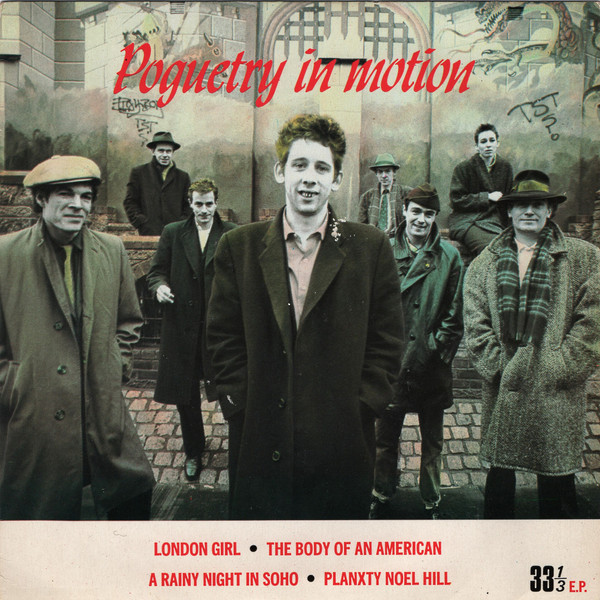
#5: Poguetry in Motion – The Pogues (1986)
In the mid to late 1980s, as I’ve mentioned before, my taste in music took a folky turn as I drifted away from a rock and pop scene that for me had lost its post-punk vibrancy. Through listening to John Peel since the late 70s I had come to share his enjoyment of traditional Irish folk music like The Chieftains, whom he played regularly, alongside occasional outbursts of Shetland fiddle orchestras, and I was also drawn to folk-influenced acts like The Proclaimers.
The Pogues had erupted on the scene in 1984, puncturing the façade of New Romanticism, an irrepressible pimple forcing its ruddy irritation through pop’s inch-thick mask of foundation and blusher. Punk’s spirit of anarchy was tossed into a barrel with the elemental appeal of traditional Irish music, given a good shake and poured onto the stage like a farmer’s protest on the town hall steps. ‘Genuine’ folk fans were appalled and revolted, rebels looking for a cause mobbed the mosh pit and drank it down by the pint.
Frontman Shane MacGowan snarled his songs from a mouth like a vandalised graveyard. An unlikely looking pop star, his features were already familiar to punk fans from a series of infamous photos taken at a Clash concert in 1976 where he was seen splattered in blood (from his own ripped earlobe, it turned out, rudely relieved of its safety-pin earring by the bass player of The Modettes).
Not just a pretty face, however, MacGowan rapidly gathered accolades for his songwriting after The Pogues’ second album Rum, Sodomy and the Lash provoked positive reviews in August 1985. Their first album, Red Roses for Me, had also been greeted as welcome refreshment, but it had passed me by, I confess. The second album slightly dialled down the frantic, showing that The Pogues weren’t just cracking a joke by playing folk tunes at Ramones tempo. Songs like The Old Main Drag and A Pair of Brown Eyes were an authentically original take on the Irish exile experience, and to close the album The Pogues wrung every last drop of bitter pathos out of Eric Bogle’s classic And the Band Played Waltzing Mathilda.
The Poguetry in Motion EP was released in late February 1986 on Stiff Records, the first new material after Rum, Sodomy and the Lash. Three singles from that album, the aforementioned Pair of Brown Eyes, Sally MacLennane and a cover of Ewan MacColl’s Dirty Old Town, had all failed to reach the UK top 40, but Poguetry finally cracked it, peaking at 29. If this was on the merits of the opening track London Girl I’d be surprised as it’s not especially good. It feels like rather a conventional pop song draped in Pogue-like stylings, but it’s neither a ripping Irish tune nor a winning pop hit. MacGowan’s lyrics are fine, with some characteristic poetic touches, but the arrangement races through them with hardly time to breathe.
The second song, Rainy Night In Soho, however, is undoubtedly the lead track on the EP (there’s a video for it), an all-time Pogues classic, and one of MacGowan’s most poignant ballads, confirming him as rock’s most romantic, sentimental old drunk. Lines that might sound hopelessly cliched on anyone else’s lips become scenes from a lover’s tender dream in his gruffly slurred melancholic reverie. Strings and brass elevate the song to a stirring conclusion, the repetitive refrain anchoring it in a century-old Irish popular tradition.
The string and brass conclusion, however, ultimately proved the catalyst for The Pogues and their producer Elvis Costello to part ways. Two versions were recorded, one with a flugelhorn solo over the finale, one with an oboe. Costello insisted on the oboe, but MacGowan was prepared to die in a ditch for the flugelhorn. MacGowan got his way on this, the UK version, the oboe had its day on the Canadian and US releases.
Fans of David Simon’s HBO police series The Wire will be well familiar with the first track on the flip side, The Body of an American, which features at several wakes for deceased officers in the Sidebar Tavern, the Irish bar near the Baltimore police HQ. Even without this immortalisation, it’s another Pogues classic, formed in the mould that made The Sick Bed of Cuchullain.
A slow intro in 3/4 time sets the scene of small boys hanging around the wake for big Jim Dwyer, a ‘Yank’ deceased in some Irish location. Then suddenly the tempo doubles into a rollicking jig with the memorable verse: “But 15 minutes later we had our first taste of whiskey / There was uncles giving lectures on ancient Irish history / The men all started telling jokes and the women, they got frisky / By five o’clock in the evening every bastard there was piskey”. The chorus refrain of “I’m a free-born man of the USA” ensured the song’s instant appeal to the Irish-American diaspora, fictionally in The Wire, for real in every St Paddy’s Day party ever since. The final chorus gives way to a long and delicious fade-out led by guest musician Tommy Keane’s irresistible uileann pipes.
I always took the final track, Planxty Noel Hill, as some sort of tribute to the folk group of that name, assuming Hill to have been one of its members. He was, very briefly, as a stand-in, but the gesture to him is of the two-fingered variety as it turns out. ‘Planxty’ apparently means something like ‘cheers’ in Irish, so has nothing directly to do with the group, and Hill made a bit of a tit of himself by very publicly denouncing The Pogues’ music as a “terrible abortion” on Irish radio. In an Irish context you can imagine how language like that went down. Jem Finer’s lively, cheeky instrumental was The Pogues’ musical flick of the Vs in Hill’s general direction.
My copy of Poguetry in Motion is the 7” 33rpm version. The 12” version has exactly the same tracks but plays at 45, of course.
London Girl
Rainy Night in Soho
The Body of an American
Planxty Noel Hill
 THE NEW VINYL VILLAIN
My love for this EP was tempered slightly by the fact that cramming all that music onto a 7″ meant my copy was very prone to skipping. London Girl is a strange bit of mod-pop, not very Pogues-like, but Body Of An American is the classic, and, as Fraser mentions, perfect for the (spoiler alert) ‘McNulty resurrection’ scene in The Wire.
Oh how I love this record.
Body Of An American and Rainy Night In Soho- 2 of the best songs by the band… by anybody in fact
“Not just a pretty face…”
Really enjoyable read – not familiar with a couple of these Pogues tracks, so will give them a spin.