A guest series by Fraser Pettigrew (aka our New Zealand correspondent)
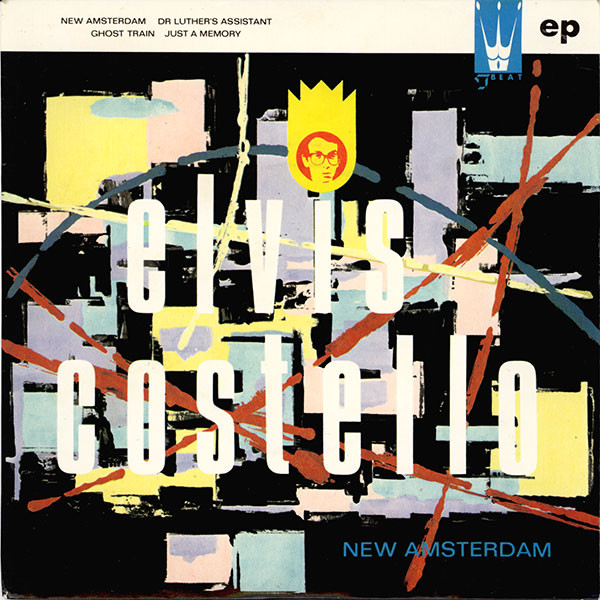
#4: New Amsterdam – Elvis Costello (1980)
New Amsterdam was technically the third single taken from Elvis Costello’s fourth album, Get Happy! (1980) but with the inclusion of three other non-album songs the EP feels as though it inhabits its own little space in the Costello canon, separate from what came before and after. Stylistically, none of the songs, including New Amsterdam, have much in common with the rest of Get Happy! and they don’t signal a shift towards either the expansive sophistication of Trust or the country and western detour of Almost Blue that appeared the following year.
At the time Get Happy! came out, the story went around (and was subsequently confirmed) that Costello had written most of the material in a compositional binge assisted by a crate of old Stax and Atlantic soul singles that he had bought in bulk from a couple of London record shops. Song after song was absorbed, analysed, deconstructed and reassembled into original material, distilling the hooks and hit factory tricks into new songs. As well as the obviously soul-styled songs like Love For Tender, High Fidelity, 5ive Gears in Reverse and Beaten to the Punch, there are two cover versions, I Stand Accused and the lead single I Can’t Stand Up For Falling Down, all of which imbue the album with a 1960s r’n’b vibe. A further cover of Van McCoy’s Getting Mighty Crowded appears on the B-side of second album single High Fidelity to amplify the effect.
Get Happy! is much more than an edition of Soul Train, however. There are several songs that flaunt different roots, such as the ska-styled B-Movie and Human Touch, torch-song crooner Motel Matches and the closer Riot Act, which could have been written and arranged in the same session as Party Girl from Armed Forces. New Amsterdam is likewise of a different kind.
For a start it’s in 3/4 time. This wasn’t entirely new for Costello – Little Triggers from This Year’s Model and Sunday’s Best on Armed Forces both employ waltz rhythms. Sunday’s Best also fades out with a musical quotation from the 1950s Danny Kaye hit Wonderful Copenhagen, betraying Costello’s familiarity with old-time schmaltz, no doubt inherited from his band-leader father. To my mind, Costello employed the crate-of-singles deconstruction method for New Amsterdam, but rather than some old soul banger, the inspiration came from the unlikely source of Tulips From Amsterdam, a big hit in 1958 for Max Bygraves. A double A-side in fact, with You Need Hands. Maybe a copy got mixed up in a Sam and Dave sleeve by mistake.
Tulips From Amsterdam was originally a German song written in the ‘schlager’ or ‘hit song’ tradition, a particularly Germanic style of cheesey, simplistic, sentimental pop born out of folk tunes and operetta. The English lyrics were provided in 1957 by Marcel Stellman, a Belgian-Scottish producer and lyricist, and Max Bygraves never looked back. Listening to Costello’s New Amsterdam it’s not difficult to hear a slight tonal shift that would produce an altogether more naïve version, oom-pahed out to an audience of swaying grannies and children before the tubas and accordions segue slickly into The Birdie Song.
Costello’s lyrics wouldn’t work in that schlager version though. Apart from the wilful perversity of using Rotherhithe as a rhyme, and the difficulty of ever working out exactly what he’s talking about, the song finds its composer overwhelmed and disappointed by the city of New York (New Amsterdam prior to 1667) and closes with a withering judgement on the “transparent people who live on the other side / Living a life that is almost like suicide.” Not quite the stuff to get the grannies rocking in their seats.
Another thing that sets the New Amsterdam EP aside is that none of the tracks are credited to Costello and the Attractions. It was released under Costello’s name alone because he provides almost all the accompaniment himself, except for Pete Thomas adding drums to Dr Luther’s Assistant and Steve Nieve the keys on Just a Memory. New Amsterdam itself was played and recorded entirely by Costello some time in 1979 in a “fifteen-quid an hour demo studio” in London using the drums, fretless bass, vibes and “a very nasty synth” that he found there. Another version was attempted with The Attractions, but ultimately rejected in favour of the original demo. The group version eventually appeared on the 2003 reissue of Get Happy!
Dr Luther’s Assistant is a song left over from the writing of This Year’s Model in 1977-78 and it’s easy to see why it was left off that album. Not because it’s bad, but because it just doesn’t fit. It’s a sordid tale of an imaginary but all too believable sexual creep, voyeur and pornographer, set to a slightly plodding Paul McCartney-esque arrangement and a verse melody that somehow puts me in mind of The Beatles’ She’s Leaving Home.
Ghost Train is one of those Costello songs that sit almost entirely within quite traditional genres and could just about pass for an old standard were it not for the rather bleak portrayal of social and romantic relationships. Maureen and Stan are a couple of aspiring performers (“She plays the queen of the fleapit / He plays a Spanish guitar”) thwarted by their lack of good looks (“Step right up and show your face / We only want the pretty ones”). The failure of their careers is soon mirrored in their personal relationship: “While they make believe it’s just another holiday / They turn on each other when they hear that joker say… / Roll up for the ghost train …” The style is 50s/60s cocktail bar jazz-pop, a few years before The Style Council and Everything But The Girl got with it. Young Marble Giants were about the only other people in 1980 getting away with this kind of cool.
Finally, Just A Memory is a tender tragedy of love lost, a relationship falling victim to incompatibility, his inability to see what’s important to her. Brief and to the point in two verses, Costello pulling a poignant melody over Steve Nieve’s piano. It’s the kind of musical and lyrical material that Costello would frequently overwork in years to come, striving for that big Burt Bacharach complexity, but here he keeps it simple, and the result is a sparkling little teardrop of a song. As postpunkmonk has detailed (The Great B-Sides: Elvis Costello – Just A Memory | Post-Punk Monk ) the song was originally written for and eventually recorded by Dusty Springfield.
The whole package is housed in a beautiful laminated sleeve designed by Barney Bubbles to look a bit like a classic 50s or 60s jazz record with a very mid-century painting credited as “Jazz City Opus 1958 by Sal Forlenza” on the front, tying in with the New York theme of the title track. Sal Forlenza was a pseudonym used by Barney Bubbles, also to be found on the cover art for Imperial Bedroom.
New Amsterdam
Dr Luther’s Assistant
Ghost Train
Just a Memory
 THE NEW VINYL VILLAIN
Thank you for this. I didn’t expect to learn so much about an EP I bought on release so many years ago.
Really enjoyed reading this
Great read .
SC
Wow
I remember buying this on a 7″ picture disc back in the day.
Title track remains excellent, the other three I can take or leave.
@Richard – I never knew about the picture disc, but I’ve just looked it up and there’s Elvis, embracing a big bunch of tulips. See? Max Bygraves! I KNEW IT!!!