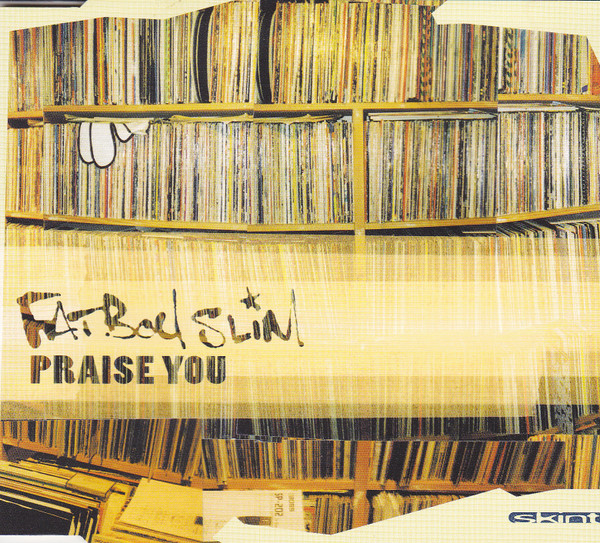
THE CD SINGLE LUCKY DIP (19) : Fatboy Slim – Praise You

Praise You proved to be the only #1 hit for Fatboy Slim.   I could have sworn there were a couple of others, but The Rockafeller Skank peaked at #6 while Right Here, Right Now, despite coming into the chart in April 1999 at #2, never managed to dislodge one of Westlife‘s forgettable numbers from the top.

It’s a single which cannot be unbuckled from its accompanying video, one I’m sure everyone of a certain age has seen loads of times, in which Spike Jonze and the fictional Torrance Dance Group deliver a guerilla-style flash-mob performance outside a cinema in Los Angeles, much to the bemusement of the members of the public queuing to get into the screening of whatever film they had bought tickets for. The whole thing is brilliantly captured, with quite a few of those watching-on clearly enjoying what they were seeing, and there’s some gentle booing when a member of staff, in an attempt to end the performance, switches-off the portable cassette player, the source of the music for the dance.

I’d like to think Praise You was good enough to find favour with the general public and would have been a huge hit even without the water cooler moments created by the promo.

mp3: Fatboy Slim – Praise You

There were two additional tracks on the CD single.  The first was otherwise unavailable, while the other was a remix of an earlier hit.

mp3 : Fatboy Slim – Sho Nuff
mp3 : Fatboy Slim – The Rockafella Skank (Mulder’s Urban Takeover Mix)

The former has a sample from one of those annoying one-hit singles that I can recall from my very early teen years. What I didn’t know until looking it up while writing this post was that the writer of Jeans On is actually a member of the British aristocracy.  Seriously!!!!

JC

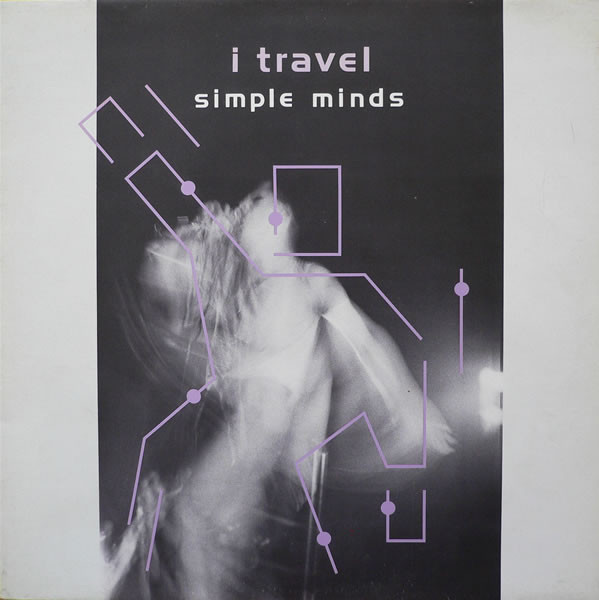
THE 12″ LUCKY DIP (21): Simple Minds – I Travel

R-51248-1214583426

Today’s 12″ offering is from 1983, and it features the re-release of a song that hadn’t charted as a single on two previous occasions, in 1980 and 1982.  It’s also kind of appropriate as I’m actually out and about just now, hitting Manchester for a couple of days, during which time I’ll have the privilege of hooking up with Swiss Adam for a long-overdue catch-up.

mp3: Simple Minds – I Travel

The 1980 release was on 7″ only, and was an edited version (about a minute or so shorter) of that which was on Empires and Dance, the album released In September 1980.  It was the band’s final album for the Arista label.  It was the failure of both the single and album that led to the end of the relationship with the label, and the move to Virgin Records for all releases of new music up until 1998.

The long-awaited chart success for Simple Minds after the move to Virgin led to the folk at Arista feeling they had a chance to cash-in, which is why the compilation album, Celebration, containing ten tracks from the first three albums, appeared in February 1982.  I Travel was also reissued as a single, this time on both 7″ and 12″, with the latter being a magnificently extended version.  The single didn’t bother the chart compilers, but the compilation album did reach #45 during a six-week stay.

This irked the folk at Virgin, and their response was to acquire the entire back catalogue and take control of all future releases.  It meant that the Arista pressings of Real to Real Cacophony, Life In A Day and Empires and Dance, as well as Celebration, were withdrawn and replaced in the shops in 1983 by pressings on Virgin Records.  And as part of the marketing campaign, I Travel was given a third release as a single, but this time on 12″ only.

The b-side to the 1983 re-release was this:-

mp3: Simple Minds – Film Theme

An instrumental that had originally been included on Real to Real Cacophony. It gives a great insight to how much the band’s sound had evolved in such a short period of time.


JC

AN IMAGINARY COMPILATION ALBUM : #387: DUSSELDORF

A guest posting by Dirk

Dear friends,

Yes, I know – it’s a bit like one of those old jokes, you know: „three guys walk into a bar …“, but here it is, for once, not a priest, a Rabbi and an Imam – it’s a drummer and two guitarists, in fact.

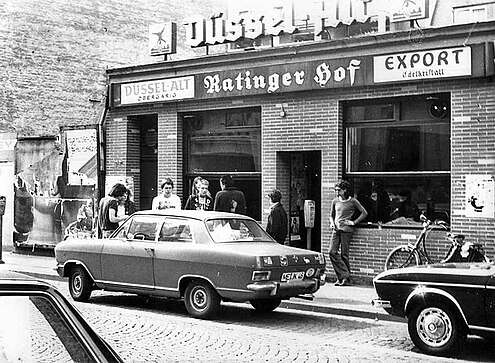
The bar is the Ratinger Hof, Ratinger Strasse 10 in Düsseldorf. We are talking very early 70’s here when the Ratinger Hof still was a cosy pub, you see – with a starry sky painted onto the ceiling, little carpets on the desks, a jukebox – and mainly Hippie students and local wannabe artists went there. Not a place you’d like to be in today, I assume, but this venue’s importance cannot be highlighted enough. Why? Well, two of the guests, above drummer and above guitarist # 1 in fact, one fine day came to the conclusion to co-found a band: you might have heard from them perhaps, Kraftwerk. And this is where it all starts, at least the first part of of our journey does:

Kraftwerk – ‘Kometenmelodie 2’ (’74)

Of course all of you know Kraftwerk and their importance for modern music, there isn’t pretty much I can add to that. By all accounts the two ‘main’ members, Hütter and Schneider, were not the easiest chaps to work with, so after a short while Rother and Dinger left and formed Neu!. Now, like Kraftwerk, Neu! are regularly being cited when it comes to innovation within German music of the time, Krautrock, Kosmische – you name it. Dinger invented the ‘motorik’ beat, which quickly became a trademark for the music of the time:

Neu – ‘Für Immer’ (’73)

Neu! split in 1975 and Dinger formed La Düsseldorf – again this was a band which is always being mentioned as having been highly influential for many artists, even today.

Now, back to our cosy pub and fast forward a few years, to 1976. The ‘Hof’, as it’s by now being referred to, has new owners, Ingrid Kohlhöfer and Carmen Knoebel, wife of Imi Knoebel, a minimalistic painter and sculptor. Imi remodelled the cosy pub radically, all walls were white and there were neon lights all over – the change was too much for the old Rockers and the Hippies, so they stayed away – but the Hof quickly attracted other guests, their musical tastes were a bit different though. One thing led to another and fairly soon local punk bands were given the opportunity by Carmen Knoebel to rehearse in the Hof’s beer cellar at daytime, whereas in the evenings bands like 999, Wire, XTC, Pere Ubu and Dexys Midnight Runners would perform there, plus by and large all of the local punk bands.

You see, people always talk about the famous Sex Pistols gig in the Lesser Free Trade Hall in 1976: basically everybody who was there formed a band, it’s always said. It’s questionable whether this is true or not, but as for the Ratinger Hof, 1971’s Dinger/Rother-history repeated itself in 1977 in the form of Franz Bielmeyer, aka Mary Lou Monroe – our second guitarist mentioned in the beginning. And this is where the second part of the journey begins:

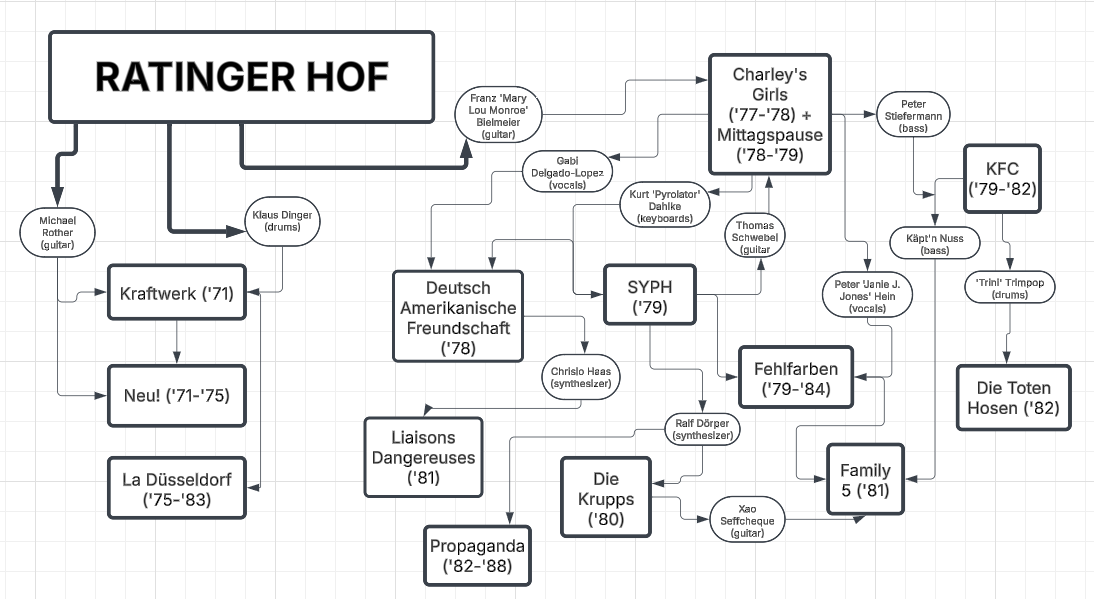
Bielmeyer founded Charley’s Girls (and I always thought this was a clever take on Charles Manson‘s female killer gang, but in fact it’s just connected to a Lou Reed tune, I mean: how boring is this?). Anyway, as my little diagram above shows, it’s fair to say that hadn’t Franz Bielmeyer started Charley’s Girls, Düsseldorf’s – and Germany’s – music scene would have turned out to be much poorer indeed! Let’s prove this, shall we?

Probably Bielmeyer’s masterpiece was to recruit the mighty Peter Hein, aka Janie J. Jones, who quickly changed from bass to vocals. Two or three of Charley’s Girls’ recordings exist, but of poor sound quality, so let’s proceed with what became of Charley’s Girls one year later, Mittagspause:

Mittagspause – ‘Herrenreiter’ (’79)

Peter Hein is no Pavarotti, I think we can agree on this. But then again, nor is Billy Bragg. And even if you don’t understand a single word of Hein’s lyrics, believe me: he is one of the great German wordsmiths. So you better get used to his singing, because after Mittagspause he invented Fehlfarben, who issued their debut album in 1980, ‘Monarchie und Alltag’. You may believe I am exaggerating again, but this record changed everything over here! I don’t think there is anyone who would not regard it as t.h.e. influential German album. Eleven songs, and not a bad one on it, for sure. Consequently I could have chosen any of them, but I went for this:

Fehlfarben – ‘Ein Jahr (Es Geht Voran)’ (’80)

I’m willing to have small bet that both Walter and [sk] are right now shaking their heads in disbelief as on why I picked exactly this song. The thing is, you see, their record company took it and released it as a single in 1982, unbeknownst to the band, in order to jump onto the Neue Deutsche Welle-train, where almost everything sung in German apart from Schlager was labelled young, stylish and cool, regardless of the songs’ intentions. Also it became a hymn for German squatters, something Hein always strongly objected to, because what he wanted to express in the song was the mood in Germany in the late 70’s: terrorism, recession, cold war. Even today this song is constantly being played on daytime radio and therefore there is a chance that even some of you non-German readers may have heard it somewhere. If not, give it a go, if you want to do yourself a favour!

Let’s continue with Peter Hein, after Fehlfarben came, in ’81, Family 5, equally brilliant, surely because of the genius that was Xao Seffcheque on guitar. Their first proper album did not come before ’85 though, ‘Resistance’. Some described it as „the better ‘Monarchie und Alltag’“ at the time, I’m not quite sure about this though …

Family 5 – ‘Du Wärst So Gern Dabei’

So, finally enough of Peter Hein’s remarkable voice for you – although he returned to Fehlfarben in 1991 and they are still going strong: in fact they are playing a venue near my village next Saturday, but a) I’m already attending another gig in Aachen and b) nearly € 40,- is a bit steep, I thought.

Right, back to Mittagspause then. They wouldn’t have been complete without Thomas Schwebel on guitar, he left S.Y.P.H. for Mittagspause and, in fact, Fehlfarben, and for Kurt Dahlke, who left Mittagspause for S.Y.P.H.

As complicated as all of this might possibly be, again we are talking about a band which was highly praised in and around Düsseldorf: S.Y.P.H. Their early 80s punk stuff made them well known in the region, but I always thought this from a few years later was their absolute highlight:

S.Y.P.H. – ‘Der Letzte Held’ (’85)

And with Dahlke (aka Pyrolator) we have the next important figure within the Düsseldorf scene, because before S.Y.P.H. he was a founding member of DAF, or, if you’d rather, Deutsch Amerikanische Freundschaft … the name might ring a bell … the grandfathers of Techno, anyone? ‘Der Mussolini’? Ah, just listen to them, you youngsters, but make sure to turn it up good and loud:

Deutsch Amerikanische Freundschaft – ‘Verschwende Deine Jugend’ (’81)

I’m sure you have already looked it up above, the road from DAF leads us to the next awesome Düsseldorf combo, and our driver is DAF’s keyboarder, Chrislo Haas. He and Beate Bartel (out of Mania D) became Liaisons Dangereuses, you’ll surely can sing along to their outstandingly brilliant ‘Los Ninos Del Parque’. And because you already know it by heart, I’ll have something else from them now, not too shabby either, I would have thought:

Liaisons Dangereuses – ‘Etre Assis Ou Danser’ (’81)

If you are still reading this nonsense, we might as well return to S.Y.P.H. briefly, because they had a guy on the synthezisers called Ralf Dörper – who found, after joining Die Krupps (with Xao Seffcheque) fame and fortune by founding Propaganda – you’ll remember Susanne Freytag and Claudia Brücken, if you remember nothing else:

Propaganda – ‘Jewel (Cut Rough)’ (’85)

If you haven’t fallen asleep by now, you may or may not remember that you learnt about Charley’s Girls an hour so ago. Charley’s Girls’ bassist was Peter Stiefermann and in 1978 he gave a party, among the guests were Thomas Peters (aka Tommi Stumpff) and Klaus-Peter ‘Trini’ Trimpop. The two of them founded KFC, another punk band of quite some importance. KFC carried on for quite some time, in 1979 they recruited the 16-year-old bassist Ferdinand Mackenthum (aka Käpt’n Nuss) – who later went to play for Family 5!

So, Käpt’n Nuss joined the band- and Trini Trimpop left it. What did become of him, you are asking? Well, he became the drummer for Die Toten Hosen, and later their manager – which a) probably made him a multi-millionaire and b) finally, you’ll be relieved to hear, closes a long and probably very boring circle!

I have on various occasions expressed my disinclination for Die Toten Hosen, or rather what became of them. But to be fair, their very first records were really good, especially this one, their second single:

Die Toten Hosen – ‘Reisefieber’ (’82)

Let’s return to where we came from, to the Ratinger Hof: in the spring of 1981 a big German magazine, the Stern, had an article about the venue in which it was advertised as ‘a secret spot for all things punk’, this happened at about the same time when the aforementioned Neue Deutsche Welle began to mutate into a huge Tsunami – which very quickly flushed everything away in an immense vortex: you could no longer tell which band was still good (as in: true to their roots) and which one was crap.

Now, I assume you can imagine what happened then: the Hof was soon flooded with tourists who wanted to see those oh so dangerous punks and listen to some of their strange music. Of course it all went downhill from then on and the Hof closed a few years later …

So, that’s Düsseldorf for you, friends – a city to listen to, for sure … but not necessarily one to visit, if you ask me: some say that the best thing in Düsseldorf is the motorway to Aachen.

Well, I cannot disagree …

Enjoy,


Dirk

ONE HUNDRED AND ELEVEN SINGLES : #089

aka The Vinyl Villain incorporating Sexy Loser

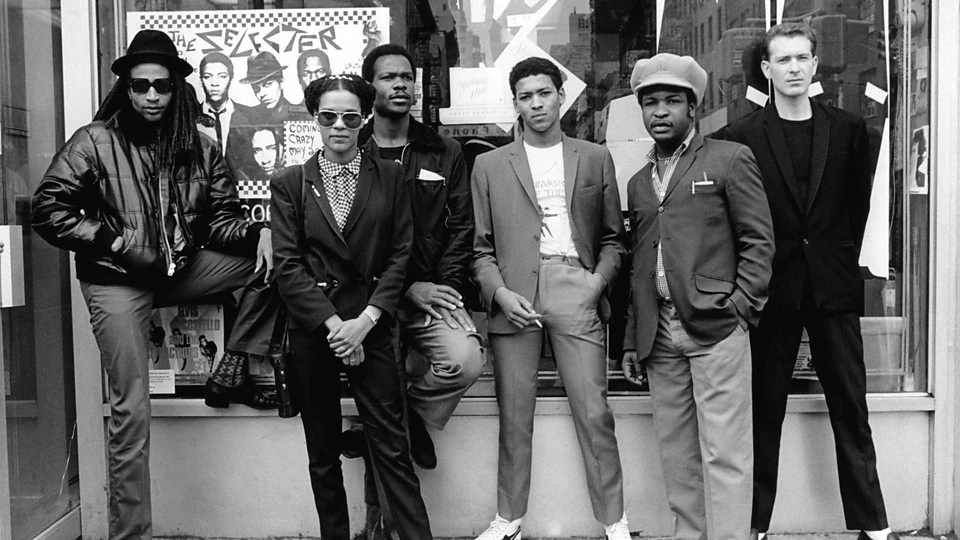
#089: The Selecter – ‘Too Much Pressure’ (Chrysalis Records ’79)

Dear friends,

yes, it’s Ska-time again, whether you like it or not. Then again: what’s not to like about Ska, right? I mean, how can anyone resist, I think it’s fair to ask.

Probably not only to me, three bands were really important when it comes to British Ska in 1979, The Beat, The Specials and …. not Madness. It may be a bit unfair, but poor Madness never really counted somehow, did they? They were quickly being put into the more funny corner of the genre, whether this was the right thing to do or not remains questionable. No, the third important band were of course The Selecter! Led by the wonderful Belinda Magnus, or, as you and I know her better, Pauline Black. It’s often the case that a frontman/frontwoman overshadows the band, and most of the time it’s unjustified, still it happens to be the case – and perhaps The Selecter were a prime example for this.

But I think it must have been very hard at a Selecter live show back then not to concentrate on Pauline, but on other members of the band. Quite obviously this lady delivered a presence that is hard to beat, even these days. I am too young to have witnessed The Selecter when they were still going, but I once attended a Ska-allnighter with Pauline Black on the bill in the late 80s: an awesome experience, I can tell you!

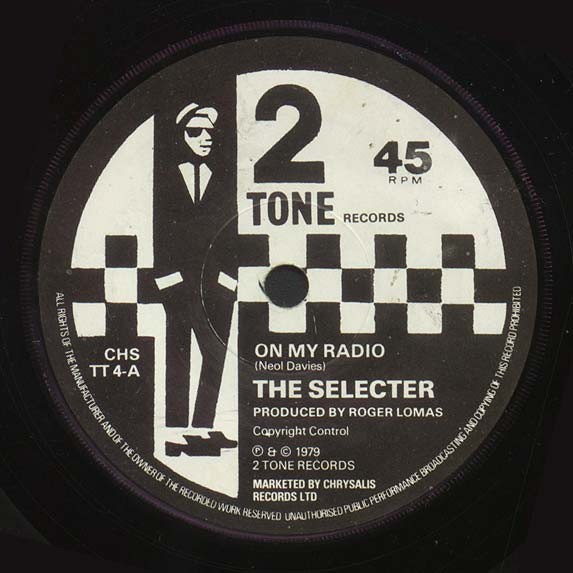
The Selecter fought hard to gain success, they played their hearts out in small clubs – at a time ABBA were the big thing, mind you. By and large there wasn’t any success before the release of the first single on the famous Two-Tone label, ‘On My Radio’, in 1979. The debut album followed a year later – and if you’re new to Ska or contemplate getting into it, this one is a must-have for you, for sure.

After said debut and its success the band signed with Chrysalis – but only one year later it was all over already, The Selecter disbanded. I think a major reason for this was that the music scene changed so damned quickly 45 years ago: what was big big big in 1979 (Punkrock, Ska, Disco, Funk) was already totally obsolete in 1981, fully being replaced by electronic stuff, Synthpop and New Wave … a tough surrounding for a band like The Selecter, too tough in fact, apparently.

So, what remains is, as I said, a fantastic debut album, which sounds as fresh as it did upon its release and a handful of wonderful singles. Today’s tune is the flipside of the very first one (although my copy is a French Chrysalis-pressing):


mp3: The Selecter – Too Much Pressure

Now, you might be wondering why I praised Pauline Black’s greatness all the time above … and then chose a song sung by Arthur ‘Gaps’ Hendrickson.

Well, first it’s bloody brilliant, that’s why – and secondly, as ace as ‘On My Radio’ is, I think you hear it everywhere, constantly. Nothing wrong with this, but I always thought ‘Too Much Pressure’ deserved more attention.

So enjoy,

Dirk


JC adds……..

A very important heads-up…..this is the first of two successive days on which the blog will be handed over to Dirk.

You may recall that a few weeks ago, there was a suggestion that he might want to offer up a Düsseldorf ICA for our collective enjoyment.

Well, I’m delighted to say that the fruits of his labour will be posted tomorrow, and I really hope everyone will have a read and offer up their thoughts as our great friend really has surpassed himself by combining a ten-song ICA with an informative and entertaining piece of writing offering up a short history of Düsseldorf music from 1973 to 1989.

I really do think it’s one of the best things ever written for this blog, going all the way back to 2006.

SUPER FURRY SUNDAYS (aka The Singular Adventures of Super Furry Animals)

A guest series by The Robster

#6: If You Don’t Want Me To Destroy You (1996, Creation Records, CRE243)

As was the way back then, some months after an album was released, singles continued to be churned out from it. A fourth single from ‘Fuzzy Logic’ was put out in September 1996, and it’s fair to say it was probably the weakest of the lot. I’ve never been overly fussed about If You Don’t Want Me To Destroy You. I can’t say why for sure – it’s pleasant enough in many respects, a nice tune, a string section, it kind of ticked a lot of Britpop boxes. Maybe that was the reason – it was all a bit ordinary, and the one thing Super Furry Animals never were was ordinary.

mp3: If You Don’t Want Me To Destroy You

It also bugs me how, as the song reaches its natural conclusion, it actually starts to fade out. In fact, you can hear the actual ending before the fade finishes. I never saw the point of that.

Released in the usual three formats, it equalled their top chart position to date – number 18, the same as its predecessor. The picture on the sleeve tells a story. As Wikipedia puts it:

“The band spent their promotional budget for this single on a tank. [They] had the tank painted bright blue and used it to arrive at music festivals. A photograph of the tank is featured on the cover of this single, with the title painted on the tank gun barrel. The tank was later sold to Don Henley.”

Super Furry Animals selling a tank to an Eagle! That’s not a transaction you’ll come across on any wildlife documentary, I can tell you. Another quick tank fact – painted across the front of the gun turret was the phrase “A oes heddwch?” which means “Is there peace?” Anyway – the b-sides. All formats contained this raucous little number:

mp3: Guacamole

“I need a revolution because I can’t afford the price of cake” is one of the best lines ever written, don’t you agree? I love this one, it’s a lot of fun. Thing is, Guacamole nearly didn’t see the light of day – it wasn’t the original planned b-side. Early CD and cassette promos featured a different track that had to be replaced at the last minute. We pick that story up next week… The CD single also included a third track:

mp3: (Nid) Hon Yw’r Gân Sy’n Mynd I Achub Yr Iaith

This one was penned for a free single-sided 7” given away at a benefit gig in North Wales for the Welsh Language Society. The title translates as This Is (Not) The Song That Will Save The Language. Thing is, while they may be right about that, the Furries, along with some of their Welsh compatriots riding the crest of the Cool Cymru wave, probably did more for the advancement of the Welsh language than any political campaign achieved in decades. It took the language out of the province and into the consciousness of music fans across the UK, many of whom probably didn’t even realise Wales had its own language (like someone – a grown adult, no less – I once actually knew…)

For my money, both b-sides beat the a-side hands down. You are free to disagree, of course. If you do, then you’ll enjoy this week’s bonus track – it’s the demo of the title track, recorded in October 1995. Note the alternative (better?) lyrics in the chorus…

mp3: If You Don’t Want Me To Destroy To You [demo]

Next week, that discarded b-side I mentioned above finally makes its appearance.

The Robster

SATURDAY’S SCOTTISH SONG : #446: DANCER

A short while back, myself and Aldo headed along to catch The Bug Club play a gig in Glasgow.  One of the support acts on the night was Dancer, a band that had been picking up a great deal of positive press round these parts, not least for being included in the list of Top 20 best albums of 2024 as chosen by highly influential and important record-shop, Monorail.

For a short while, Dancer felt like our city’s own little secret. The group, made up of Glasgow DIY mainstays (from the likes of Current Affairs and Order of the Toad), released only a few singles but gigged often at Bloc and the Old Hairdressers before their debut full length 10 Songs I Hate About You. The 10 songs in question are a sonic mash-up of melodic warmth and perfectly crafted pop songs with crunch. There’s a similarity to Life Without Buildings in Gemma’s vocal delivery and Chris’ erratic-slash-melodic guitar work, but there’s also, at times, a more chaotic and experimental storm brewing under the surface. A record which takes left turns into new territory every so often when it’s least expected; Gemma cackles, Gavin’s hi-hat taps out a new rhythm, Dancer is no longer a secret. I couldn’t be more glad”

They proved to be an excellent watch and listen in the live setting, and I subsequently went out and bought the debut album, which was released back in March 2024.  It was preceded by a couple of EPs and has been followed by a couple of split releases, an EP with Portland-based Whisper Hiss and a 7″ single with R.Aggs, who is better known perhaps as being one half of Glasgow’s Sacred Paws, whose debut release Strike A Match, was given the accolade, and associated prize-money, for being named Scottish Album of the Year in 2017.

The band members are Gemma Fleet (vocals), Chris Taylor (guitar), Andrew Doig (bass) and Gavin Murdoch (drums)

mp3: Dancer – Bluetooth Hell

The opening track on 10 Songs I Hate About You.


JC

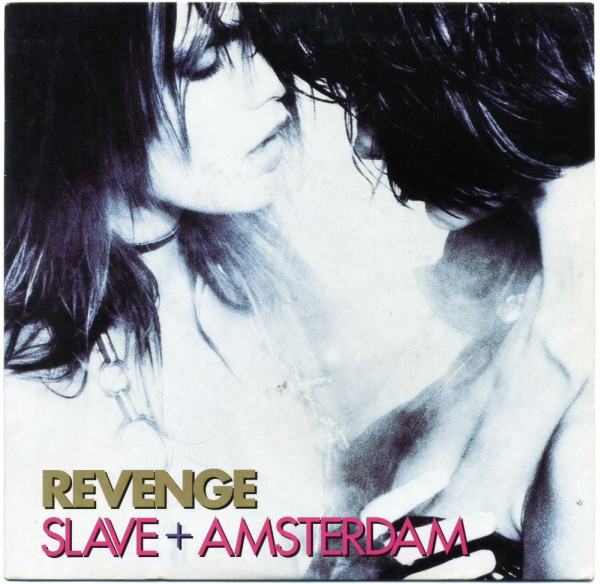
THE 7″ LUCKY DIP (31) : Revenge – Slave

By the time New Order were celebrating the success of #1 single World In Motion in the summer of 1990, the various members were already working on or planning various side projects – Gillian and Stephen were The Other Two, Bernard had teamed up with a few superstars to form Electronic, while Hooky chose to form Revenge.

Initially, it was a trio with Hooky (vocals, bass, keyboards) being joined by Davyth Hicks (guitar and vocals) and Chris Jones (keyboards).  The debut single, 7 Reasons, was released, on Factory Records in 1989, and the following year saw an album One True Passion, from which the singles Pineapple Face and Slave were lifted.  I’ve copies of all three singles on either 7″ or 12″ vinyl, all bought many years after the event for not a great deal of money.  They might all be on a cult label, and feature a member of one of the most influential and important bands of the late 20th Century, but that doesn’t mean there’s ever been much demand across the second-hand market.

There’s a straightforward explanation as to why this is the case – Revenge aren’t all that good.  Here’s the third and final single lifted from the album:-

mp3: Revenge – Slave

It sounds like a minor hit for New Order as imagined on one of those cheap Top of The Pops albums where session musicians did their best to mimic the stars and hitmakers of the day.

The b-side was a cover.  A very obscure cover, with the original being found on John Cale‘s 1970 album, Vintage Violence.

mp3: Revenge – Amsterdam

Revenge did tour the debut album across Europe, America and Japan, and for the live shows, they were supplemented by David Potts (bass and guitar) and Ashley Taylor (drums).  Shortly after returning from Japan, Hicks quit, citing the perennial ‘musical differences’.  There would be one further EP in 1992, Gun World Porn, after which Hooky returned to New Order for the recording and promotion of Republic, released in 1993.


JC

ANOTHER SLICE OF LOVELINESS

Inspired by yesterday’s remarkable ICA from strangeways, I thought it was time, again, to offer up what I think is one of the loveliest tracks of all time.

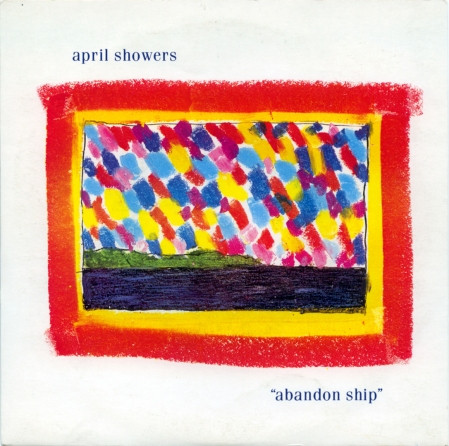
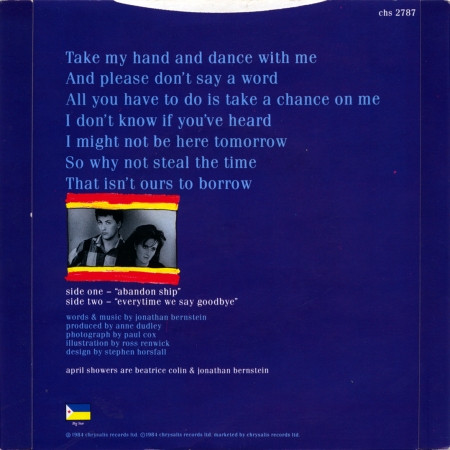
I’ve written about Abandon Ship a couple of times before.  It was the only single ever released by April Showers – and yes, the turning of the calendar into a new month got me thinking about things, too.  A Glaswegian pop duo comprising Jonathan Bernstein and Beatrice Colin who had met and formed the group while at Glasgow University. Jonathan has subsequently forged a career for himself in recent years over in his native America as an author and screenwriter. Beatrice, sadly, passed away from cancer in 2019 at the age of 55, having led a full life in the creative arts, working in radio production and then journalism, before becoming an award-winning author and playwright, as well as a lecturer in creative writing at the University of Strathclyde.

It’s a single I regret not buying back in the day, relying instead on listening to it from the collection belonging to a flatmate.  In due course, I was able to add the song to my own collection thanks to its inclusion on the compilation CD, 10 Years Of Marina Records, released in 2004.

Now, at long last, I have a copy on vinyl after Pete Paphides included it on the superlative Sensitive pop anthology recently released on his Needle Mythology label.  It’s not only a beautifully and lovingly compiled collection, but it comes with extensive sleeve notes courtesy of Pete, which alone are worth the cost of the double album.  Here’s some of what he has written about Abandon Sip:-

Prior to Beatrice’s arrival, Jonathan hadn’t been able to interest any labels in his demos. That changed when she sang ‘Abandon Ship’ and Chrysalis heard the result. Enter Anne Dudley. This being 1984 – the year in which she arranged strings for Frankie Goes To Hollywood and Lloyd Cole And The Commotions – it’s not as though Dudley could have sone with the extra work, but she clearly heard something here that left her powerless to refuse.

If you’re an arranger listening to a song for the first time, you’re also listening to the beginnings of your own arrangement for it. To hear those strings rush in to help launch that first chorus skywards is like experiencing an early version of augmented reality.  And while none of this was possible without an achingly pretty song at the centre of it. Imagine ‘Abandon Ship’ without those strings and what’s left is a bittersweet song of resignation, from a protagonist who can no longer pretend that life hasn’t overwhelmed them.  Those strings give Beatrice’s vocal an added shot of energy : ‘Why don’t you come on in?/The water’s lovely!

mp3 : April Showers – Abandon Ship

At long last, a vinyl rip.


JC

AN IMAGINARY COMPILATION ALBUM : #386: TEN LOVELY TRACKS

A GUEST POSTING from STRANGEWAYS
Ten Lovely Tracks : An Imaginary Compilation Album

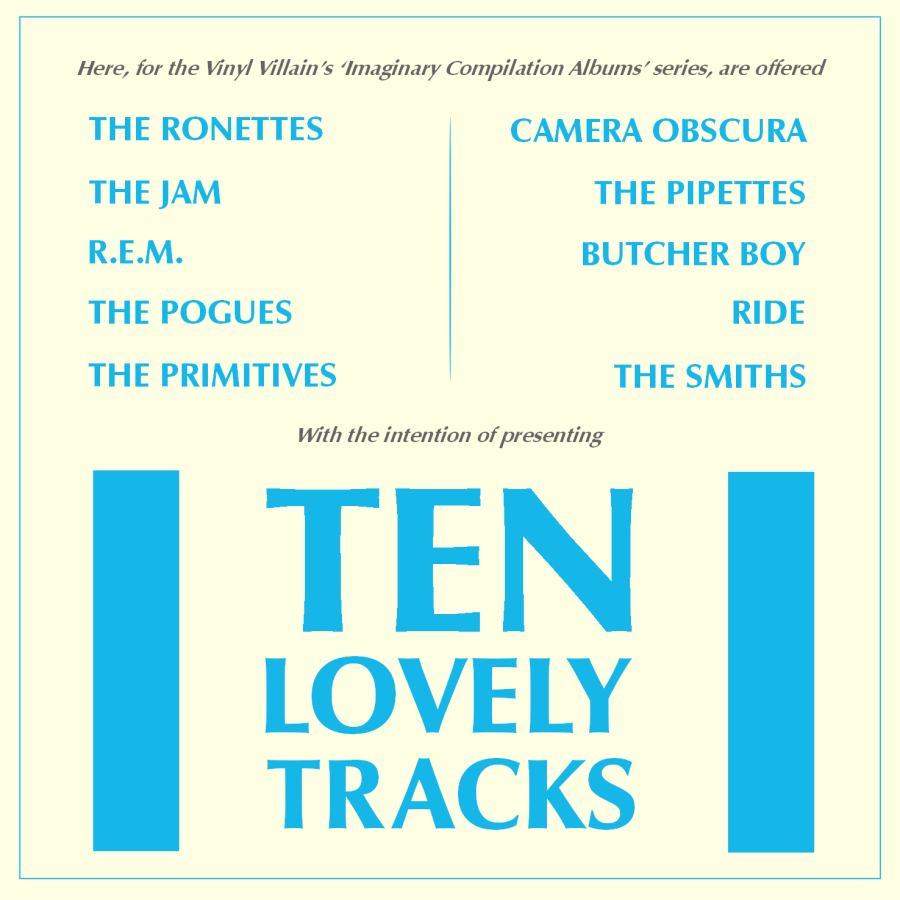
Welcome to a lovely Imaginary Compilation Album. That’s not me bigging-up this mix, but rather offering a literal description, for this is an ICA of songs deemed to be ‘lovely’ in nature. Immediately this business of a song being lovely is subjective of course. But the closest I got to a criterion was including tracks that, when you hear them, kind of wrap their arms around you.

It should be stated that this list is very, very far from exhaustive; the mountain of should-have-rans continues growing.

Side 1

1. The Ronettes: Walking in the Rain (single A-side, 1964, Philles)

I won’t attempt to add too much to the weight of words that must have been written about this song since The Ronettes released it in October 1964. I’m really not qualified, so to do so would be like writing about lofty cultural fixtures like the Mona Lisa or Ant & Dec’s Saturday Night Takeaway.

That said, a thunderclap kicks the track off and immediately we’re in a dreamland co-created of course by an ace Phil Spector production. With its references to shyness, its grown-up assertion that ‘sometimes we’ll fight’, its fondness for wishing on stars and of course its championing of rain over sun you could say that thematically Walking in the Rain gifted a bit of a blueprint to the indiepop genre that would emerge fifteen or so years later.

The track is just super, and so far as its inclusion here is concerned, its sheer loveliness fought off the likes of Past, Present and Future by the Shangri-Las, Thinkin’ ‘Bout You Baby by Sharon Marie and A Lover’s Concerto by The Toys.

Loveliest line: ‘Walking in the rain and wishing on the stars up above, and being so in love… ’

2. The Jam: Wasteland (Setting Sons LP track, 1979, Polydor)

I am really no Jam expert whatsoever. It’s daft, of course, that I haven’t explored beyond the singles and a couple of LPs. Moron. But the album I know best is Setting Sons. And the track I love most is Wasteland.

That Paul Weller was only, what, 21 max when he wrote the elegant words of Wasteland is astonishing to me. Listing the wasteland’s decorations – including punctured footballs, ragged dolls and rusting bicycles – he conjures up the grimy props of a world in which ‘to be caught smiling’s to acknowledge life’ as two lovers? Ex-lovers? Never-were lovers? Just friends? sit amid the trash and stoke over the past. Certainly if the theory that Setting Sons was intended – but not realised – as a concept album concerned with the lives of three childhood friends, the relationship could well be platonic. The reference to hand-holding though perhaps hints at something else.

Adding to the overall loveliness of this track are notes from a recorder – an instrument, in the UK at least, recalling tuneless school music classes. Here though, sounding not unlike the calls from a bird on high, it puffs out an innocent intro and pops up again at a key line.

Finally, that Weller gets so much detail of his wasteland – ‘meet me on the wastelands, the ones behind the old houses, the ones left standing pre-war, the ones overshadowed by the monolith monstrosities councils call homes’ – to even scan properly is remarkable.

Loveliest line: ‘Meet me later – but we’ll have to hold hands… ’

3. R.E.M.: At My Most Beautiful (Up LP track, 1998, Warner Bros.)

Of all the bands selected to populate this ICA, R.E.M. gave me the most trouble. In surveying the songs I know of them – and to be fair that although it’s not 100% knowledge it’s not by any stretch horrendous either – it rapidly became apparent that you could, before breakfast, create an ICA of ‘Lovely Songs Just by R.E.M.’.

So what to do?

That’s easy – choose a total slushfest, and from an unfancied LP, that will annoy the readers of this blog. So apologies to the exalted likes of Perfect Circle, Wendell Gee and The Flowers of Guatemala, plus Half A World Away, Nightswimming and Electrolite. Here instead is At My Most Beautiful, from 1998 album Up.

I seem to remember that at the time a common brickbat chucked at this song was that it was ‘R.E.M. trying to sound like The Beach Boys’. It is. And I further remember thinking ‘great’.

Sure, it’s kind of saccharine and soppy, but the overall result is lovely – which is of course what we’re after here. Added to this, the words of this big value track also provide…

The Grand Indie Boy or Girl’s Guide to Snagging a Partner

Three sure-fire ways to reverse the joy of solitude:

1. Read bad poetry into their machine (or, for the less ancient, their mobile phone)

2. Save their messages just to hear their voice – (perhaps keep this one to yourself)

3. Count their eyelashes, secretly (and for bonus points, with every one whisper ‘I love you’)

Loveliest line: You always listen carefully to awkward rhymes, you always say your name like I wouldn’t know it’s you, at your most beautiful.. ’

4. The Pogues: Lullaby of London (If I Should Fall From Grace With God LP track, 1987, WEA)

The Pogues are probably at their best when they’re rocking the furious likes of Boys From The County Hell and Sally MacLenanne, or Turkish Song of the Damned and Bottle of Smoke. But grand as these are, you could hardly call any of these breathless beauties lovely. That’s a job instead for Lullaby of London, from the revered 1987 album If I Should Fall From Grace With God.

Here, Shane MacGowan takes us on a kind of stroll located by a river and in the springtime. On this jaunt, in the main, his words are mystical and supernatural (ghosts and haunted graves and angels are present). But he ambles also in the urban: and despite noting the absence of a cry from a lonesome corncrake – any twitcher will tell you i) that’s a bird and ii) its binomial nomenclature is Crex crex – he seems satisfied enough with the sounds of cars and bars and laughter and fights.

This is a song that feels older than it is or, to put it more delicately, could be of another age. Were it not for that reference to motor cars, the whole expedition could be taking place a century-and-a-half ago. Remove the pubs and you spool back even further. Laughter and fights though have surely been with us since the first caveman cracked an off-colour joke and instigated a brawl.

Enough. All that’s left to say is that if the words to Lullaby of London are remarkable, the band is totally on point too, especially via the lilting mandolin that quietly matches the lyrics for sheer emotional punch.

It’s odd, but a speck of dust always lands in my eye whenever I hear this track.

Loveliest line:May the wind that blows from haunted graves never bring you misery, may the angels bright watch you tonight and keep you while you sleep… ’

5. The Primitives: We Found a Way to the Sun (Really Stupid 7” single B-side, 1986, Lazy Recordings)

Somewhat inevitably the band with the LP titled Lovely was always going to make it onto this ICA. And, also somewhat inevitably, the song selected here does not in fact feature on that album. Instead, it’s We Found a Way to the Sun – curiously styled, on the subsequent Lazy 86-88 compilation, and other anthologies that followed, as (We’ve) Found a Way (to the Sun).

Bracketed or not, it is just one of several absolutely killer formative Primitives B-sides. Delivered inside yet another early Prims sleeve to die for,
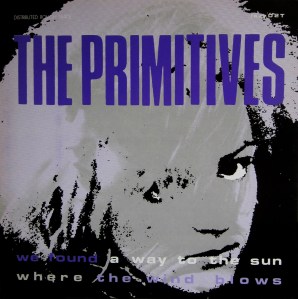
this smasher popped up in 1986 on the Really Stupid 7” single and, on 12”, alongside Where the Wind Blows. That gem of a fellow B-side, set at the witching hour and chockful of associated imagery, is the one I’d actually started writing about for this post. But that was before the handbrake turn you’re now reading.

Why the switch?

The truth is that either track could have made it, but the distorted, beautiful intro and subsequent melody of We Found a Way to the Sun just pipped Where the Wind Blows to the post. Add to these Tracy Tracy’s wide-eyed and hurt-sounding vocal, and we really do achieve Primitives perfection. Also, there’s a curiosity to celebrate: no chorus is offered – just one bewitching verse followed by repetition of the song’s title.

Loveliest line: ‘But it’s all too good to be true, I don’t know just what I should do, I love everything about you… ’

Side 2

1. Camera Obscura: My Maudlin Career (My Maudlin Career LP track, 2009, 4AD)

This title track to Camera Obscura’s fourth LP is both eminently huggable and a real bruiser. Its opening twenty-five seconds could be mistaken for a Wall of Sound production as keys and strings and brass add layer after layer of sock-knocking assault. And as the late Carey Lander’s incessant, trebly keys heroically wrangle it all into a followable structure, Tracyanne Campbell’s words speak of a relationship – the maudlin career of the title – going wrong (perhaps best distilled in the lines ‘we were love at first sight, now this crush is crushing’).

Despite the tale of a partnership on the skids, this is yet another lovely song from a band that specialises in them.

Loveliest line: ‘I’ll brace myself for the loneliness, say hello to feelings that I despise… ’

2. The Pipettes: A Winter’s Sky (We Are the Pipettes LP track, 2006, Memphis Industries)

Oh crumbs, not again. Look, I know I included this track on the Pipettes ICA I scribbled several years ago, but it’s just too lovely a fit not to revisit it. And what I wrote then remains, so I won’t deviate from it. The harmonies. The shimmer. The warm pootle of brass before the little Smithsy sound effect that chills the closing line ‘the last we saw of her, it came too soon’.

This is only ever played in our – that’s me and the furniture – house during winter (official three/four-month winter, I mean, not the Scottish one).

Loveliest line: ‘Underneath a winter’s sky, her eyes were bright, tonight he finds her underneath a winter’s moon… ’

3. Butcher Boy: I Could Be in Love With Anyone (Profit in Your Poetry LP track, 2007, How Does It Feel To Be Loved?)

A bit like R.E.M., there are loads of Butcher Boy songs you could tag as lovely. ‘Poetic’ is kind of a lazy descriptor for John Blain Hunt’s lyrics, but that doesn’t stop it being any less accurate. He’s a master of fastidious and forensic observation, and an expert in uplifting and championing the ordinary: pebbledash and paper chains, chimes and chewing gum.

Despite, or perhaps because of, the sheer quality that threads through Butcher Boy’s three LPs so far, this is a band that adheres stoically to a less-is-more philosophy. Releases are sporadic – bookended by years that meanwhile continue their business of totting up births and marriages and deaths. Gigs, at best, the same. World Cups occur more regularly. Plus, in spite of heavyweight patronage from names including Stuart Murdoch and John Niven, Ian Rankin and Peter Paphides (whose Needle Mythology label released the 2021 BB compilation You Had a Kind Face), there remains a Sundays-like reticence to seek the limelight. As listeners, we’re the losers in these arrangements of course. But you kind of wouldn’t really have it any other way.

To the song though. Winning out for this compilation is I Could Be in Love With Anyone, the fourth track on the first Butcher Boy LP Profit in Your Poetry.
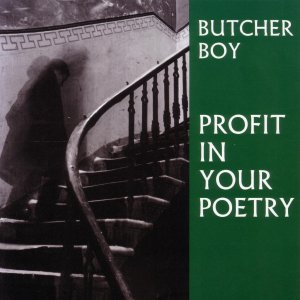
Lyrically there’s a little of the celestial in this tale of a character who visits in dreams and flies around the walls of a room. Amid some good intentions there seems to be selfishness too, characterised by a title that could be delivered with a shrug, and also by the delight taken in ‘breaking hearts for fun’. From hearing this treasure years ago I quickly, and surely wrongly, settled on the idea that the words are describing my own favourite antihero Peter Pan.

Loveliest line: I’m actually going to reproduce the song entire for this entry, and hope you agree that choosing just one lovely line would be something of a disservice.

Listen, please don’t close your eyes
I don’t know how I know what you’re thinking but I

I’ve never felt so far away
Blood is chiming bells through you

But listen, that’s OK ‘cos I’m frightened too

And tenderly I write today

That I could be in love with anyone

I’ve been breaking hearts for fun


Listen, tell me what’s gone wrong

And I will come in dreams and I’ll bleed into songs

So you can sing them back to me.
Sun suspends my days in dust

If my love made you lonely I’m sorry but

The feeling flowed so easily

But I could be in love with anyone

I’ve been breaking hearts for fun

Glass reflects my eyes and skin

But still my lips will crumble like ash when we kiss

So cynically I shift the blame
I could fall upon this house

Or fly across these walls with your heart in my mouth

But honey I would rather stay


Where I could be in love with anyone

I’ve been breaking hearts for fun

4. Ride: Vapour Trail (Nowhere LP track, 1990, Creation)

This is probably the song that inspired the whole ICA. I’ve always struggled to find a better word than ‘lovely’ to summarise the romantic Vapour Trail, the track that closes Ride’s debut LP Nowhere.
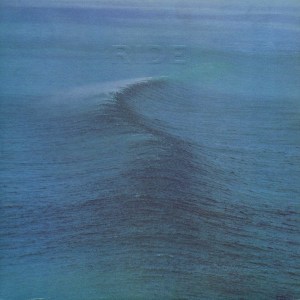
Vapour Trail is dreamy and delicate and from its wispy intro to its choppy string-laden exit lifts you into a whole other place. Best of all, the words – describing total adoration and beguilement – feel like they were scratched onto a jotter during double geography, a carefully crooked arm shielding them from the ridicule of the class bully.

Loveliest line: ‘You are a vapour trail in a deep blue sky… ‘

5. The Smiths: I Won’t Share You (Strangeways, Here We Come LP track, 1987, Rough Trade)

After – literally – decades of internal debate and agony I concluded some years ago that My Favourite Smiths Song is this: I Won’t Share You, the very last track on the very last LP.

I mention its placement on Strangeways, Here We Come deliberately as it is crucial to its victory. That’s thanks really to Simon Goddard’s 2002 book Songs That Saved Your Life (Reynolds & Hearn Ltd.) – a painstaking track-by-track analysis of the band’s discography (and so dippable it should be sold with a lollypop and inside a poke of sherbet). There, Goddard notes that I Won’t Share You melts out with the subtlest little breath of faded-out harmonica. It’s an addition so brief and gentle in fact that it’s essentially drowned at birth. But, and here’s the kicker, Goddard – who beautifully and correctly describes the song as ‘a deeply affecting lullaby’ – cleverly connects this sigh of a coda with the band’s first offering, the Hand in Glove single, which begins with, amazingly, a faded-in harmonica.

This, the writer states, returns The Smiths full circle, pinging them from 1987 back to 1983, and all without a DeLorean and flux capacitor in sight.

You can call this proposed loop a reach of course, and it’s an unashamedly romantic way to view the band’s birth and death (and perpetual rebirth-by-harmonica). Amid these gymnastics after all is the troubling and inconvenient fact that The Smiths’ actual last recordings occurred in May 1987, a month after Strangeways had wrapped. These were created at a B-side session whose content and atmosphere so browned-off the already irritated Johnny Marr that it’s not dramatic to state it contributed significantly to the band’s ending.

So for fans of Cluedo, you could say it was the Cilla Black cover, in the studio, with the microphone wot did it.

Even so, the harmonica yarn is a notion I utterly subscribe to and, throughout that years-long agitation across which any helpful criteria was welcome, it earned I Won’t Share You my top spot.

Prettifying the number even further there is of course the debate regarding its lyrics. Specifically, this is concerned with whether or not they constitute Morrissey’s farewell to Johnny Marr. The song would have been completed just a few months before the group dissolved, then released just weeks after the split. It’s widely thought the singer disliked the idea of the guitarist collaborating with others, or even getting close to essential associates like managers and producers. Against those assumptions it’s easy to make a case for the disputed possibility that I Won’t Share You is the sonic equivalent of a note left upon the kitchen table (or, for Smiths trainspotters, perhaps pinned beneath a windscreen wiper).

Whatever the truth, and whether or not you buy the Magic Harmonica Theory and/or the potential Dear Johnny nature of the lines, it’s a song that’s a worthy last word on both The Smiths – it was surely the only serious track ten candidate – and on this collection of lovely songs, which I hope you’ve enjoyed reading about and maybe visiting/revisiting.

Loveliest line: ‘I’ll see you somewhere, I’ll see you sometime, darling… ’

Thanks as ever to Jim for the space and opportunity, and to you for reading.


STRANGEWAYS

ANOTHER VOLUME OF UNRECONSTRUCTURED RUBBISH

First midweek day in April.   What else could I do?*

mp3: Various – Another Volume of Unreconstructed Rubbish

The Jesus and Mary Chain – April Skies
Lloyd Cole – Fool You Are
Pet Shop Boys – I Started A Joke
Everything But The Girl – Laugh You Out The House
The Smiths – The Headmaster Ritual
The Bug Club – Pop Single
Felt – Penelope Tree
Nick Cave & The Bad Seeds – We Call Upon The Author
Siouxsie and The Banshees – Metal Postcard
Massive Attack – Blue Lines
The Prodigy – Firestarter
The Big Moon – Trouble
Soulwax – NY Excuse
Billy Reeves – Never Cross
The Frank and Walters – Fashion Crisis Hits New York
Say Sue Me – B Lover
The Clash – 1977

* I did think about re-posting this previous offering from the date of 1 April in which a bit of fun was had.  I try not to take things too seriously too often on the blog.

JC