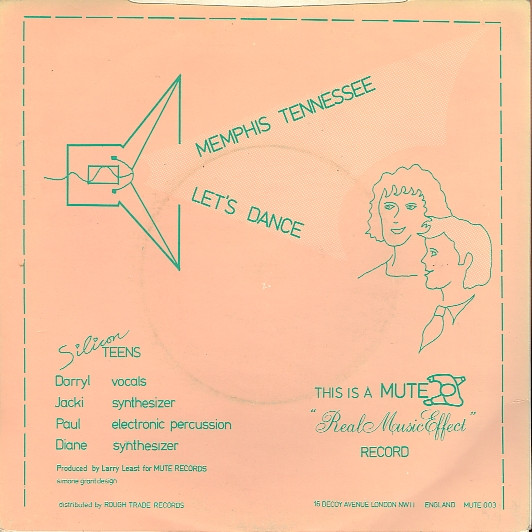
#091: Silicon Teens – ‘Memphis Tennessee’ (Mute Records ’79)
Dear friends,
back to 1979 we go – that golden year – and I have Silicon Teens for you today: Darryl, Jacki, Paul and Diane, a brainchild of producer Larry Least. They certainly were ahead of their time both in concept and sound, but unfortunately they only released one longplayer, ‘Music for Parties’, an album which consisted of re-imagined rock n roll classics like ‘Let’s Dance’ and ‘You Really Got Me’, amongst others. Following the release, musical differences drove the band apart, but their profile was raised when John Hughes used the track ‘Red River Rock’ prominently in his film ‘Planes, Trains and Automobiles’. Said album is from 1980 and was released by the independent record label Mute, Daniel Miller‘s successful company which he launched with his own single under the moniker The Normal.
So that’s how the Silicon Teens’ story goes – but the true story was a little bit different: in fact you could well argue that The Silicon Teens were the world’s first manufactured electronic pop band, some 20 years before Gorillaz!
In reality, the whole band was just Mute Records’ Daniel Miller on his own, he did all the music plus all the singing. The Teens’ members – Paul (percussion), Diane (synthesizer), Jacki (synthesizer) and Daryl (vocals) – were purely fictional, so was their backstory for the press release: „they’re all teenagers and childhood friends in Liverpool. Inspired by the punk movement and subsequent post-punk bands like The Normal and Throbbing Gristle, they used a synthesizer owned by Jacki’s older brother Kevin to create their songs.“.
Miller carried things really far, it must be said: the band was portrayed by actors in interviews, press photos, and in the music video for their first single. Musician Frank Tovey, aka Fad Gadget, portrayed Darryl, whereas Miller himself portrayed Paul. „Larry Least, producer“, was also Miller – his take on Mickie Most, a very well-known UK producer at the time.
The whole swindle was uncovered by the music press only a year or so later, but until this happened, records were made: three singles, all not too successful, plus one album, which, to be frank, is quite hard to listen to in its entirety, especially these days.
So, why does the band feature here, then? Well, the first single is simply outstanding – I love it without any limits – and so should you:
mp3: Silicon Teens – Memphis Tennessee
The definitive reading of the old Cuck Berry favourite, this, you will doubtlessly agree. If you don’t, I suspect you should seek medical help at your earliest convenience!
Another one grabbed from the archives and edited down a bit. Given it was January 2014, there’s a chance a few of you won’t have seen it before.
As my dear friend Jacques the Kipper will testify, I have long been an advocate of the talent of probably the most famous Australian on the planet. So much so, that back in the early 1990s when a music magazine (I think it may well have been the long-defunct Select) printed a photo of Kylie cavorting on a bed with Bobby Gillespie, JtK got a t-shirt made with my head superimposed on the body on Mr G, with the words ‘I Should Be So Lucky’ printed underneath…..
And I know that I’m not the only long-time indie-disco or other genres of music freak who hasn’t fallen for her charms over the years (hiya Adam!!!!)
Of course, there’s been a lot of stuff she has recorded and released that has been unlistenable. But overall, the magnificent easily outnumber the mundane, while there have been more sublime 45s than shite 45s.
And among all the great acts that I’ve seen live over the years, I’ve rarely been so well entertained as when Mrs V took me along as a surprise to catch Kylie perform in March 2005 at the SECC in Glasgow.
A few years back, I had the pleasure of finding a 12″ promo copy of some dance mixes disc of one of my favourite Kylie singles for just £1, so I’m sticking to my principles by offering these rips from vinyl:-
mp3 : Kylie Minogue – Confide In Me (Master Mix)
mp3 : Kylie Minogue – Confide In Me (The Truth Mix)
mp3 : Kylie Minogue – Confide In Me (Big Brothers Mix)
A guest posting by J.C. Brouchard (our French Correspondent)
TAXI GIRL : Nous Sommes Jeunes, Nous Sommes Fiers, an Imaginary Compilation Album
Taxi Girl started in Paris in 1978 and went on to be one of the best French New Wave bands.
The band that released its first single in 1980 (Mannequin, produced by Kraftwerk friend and collaborator Maxime Schmitt) was made up of Daniel Darc (Vocals), Stéphane Erard (Bass), Laurent Sinclair (Keyboards), Mirwais Stass (Guitar) and Pierre Wolfsohn (Drums).
By the time the band split up in 1986, it had been reduced to a duo of Darc and Stass, after Erard was kicked out in 1980, Wolfsohn died of a drug overdose in 1981 and Sinclair was also asked to leave in 1983.
The band’s biggest hit was their second single, Cherchez Le Garçon, a synth pop classic.
Their only full length album is Seppuku (1982), produced by Jean-Jacques Burnel of The Stranglers, with drummer Jet Black standing in for the recently deceased Wolfsohn. It was a strong, compact and very dark record, which failed to repeat the band’s previous success. It was released in 1983 in the UK with vocals
adapted into English.
Over the next four years, the band released one mini-album and three great singles, which were more and more confident.
After the split, Daniel Darc embarked on a solo career. He died in 2013 at 53.
Mirwais Stass released two albums with the band Juliette Et Les Indépendants, and a low-key solo mini-lp in 1990. His second solo album Music (2000) was a worldwide hit and led to him producing several records for Madonna.
Laurent Sinclair relased one solo single and collaborated with many artists. He died in 2019 at 58.
I have been a big fan of the band all along and I hope this cross-section of their discography will make you want to hear more of them. Unfortunately, due to legal disputes, their catalogue has not been properly reissued. The title of the compilation stems from one of the band’s singles, Dites-Le Fort (Say It Loud :
We’re Young, We’re Proud).
Side 1
1. Find The Boy (1982)
This is the hit Cherchez Le Garçon, with film noir referencing lyrics. I never realized it at the time, but the keyboard intro was strongly ‘inspired by’ the intro to the Magazine song, Definitive Gaze !
The single was released in French by Virgin in the UK in 1980. It did nothing. To ease up comprehension for international Vinyl Villain readers, I’ve selected the English language version that was added as a bonus to the UK release of Seppuku.
2. Quelqu’un Comme Toi (1983)
The title track of their 1983 mini-lp, their first release as a duo. There’s flute-like synth and a jaunty rhythm, but the atmosphere is still sombre (« Night is closing in, hell is ours »).
3. Mannequin (1980)
There’s obviously a strong Kraftwerk influence (the Trans Europe Express song known in English as Showroom Dummies was recorded for the French issue as Les Mannequins), but it’s lively and with live drums. You must realize that, when this was released, the first Depeche Mode single was at least one year away.
4. On Any Evening (1982)
The band’s punk roots surface a little on N’Importe Quel Soir, and even more so in a 1979 live version available on the Quelque Part Dans Paris album. This is the English version from Seppuku.
5. Aussi Belle Qu’une Balle (Special Club Remix) (1986)
Mirwais’ skills for electronic music show up in this New Order-worthy 12 inch remix of their final single.
Side 2
1. Jardin Chinois (Nouvelle Version) (1981)
Originally the B side to Cherchez Le Garçon, Jardin Chinois was given its own single release a few months later, in a new, slightly faster version. It’s one of my favourite songs by the band, with strong lyrics (« I will kill you, I will kill you slowly. Your body is so soft to tear up »).
2. La Femme Écarlate (1982)
Another instance of Daniel Darc’s interest in all things Asian. This rather poppy Seppuku track was released as the second single from the album, in the same version, I think, but with a great cover drawn by artist Denis Sire.
3. Je Rêve Encore De Toi (Stephanie Says) (1985)
Taxi Girl took part in 1985 in the Virgin Records-curated tribute Les Enfants Du Velvet. They chose to cover the 1968 song Stephanie Says, which had only recently been made officially available on the V.U. album. Their contribution is a master stroke, if only for the original (not translated) French lyrics.
4. Thirteenth Section (1982)
The lyrics to Thirteenth Section read like an Ed McBain 87th Precinct novel. I even seem to remember an early bootleg version featured Inspector Meyer Meyer. He was replaced by Al Grundy in the album version.
5. V2 Sur Mes Souvenirs (1980)
It’s not a coincidence if I’ve included here all three tracks from Taxi Girl’s second release, Cherchez Le Garçon, a perfect EP. To round off the compilation, here’s this great song, propelled by Pierre Wolfsohn’s energetic drumming and Laurent Sinclair’s Dave Greenfield-inspired keyboards.
#9: The International Language Of Screaming (1997, Creation Records, CRE269)
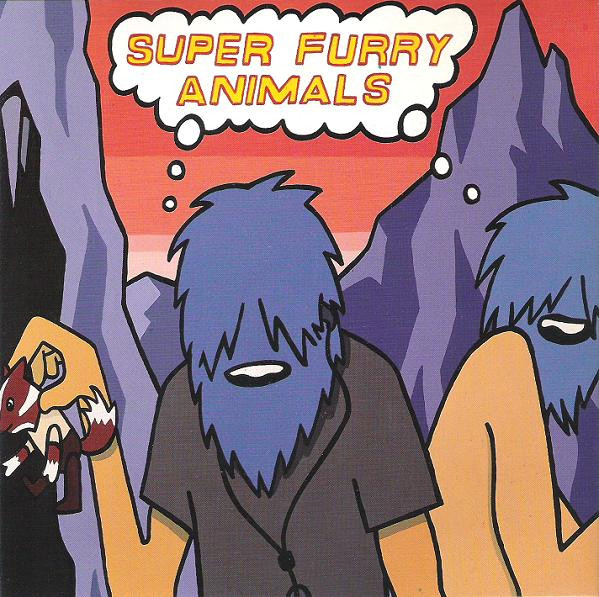
A month before the second Super Furry Animals album hit the shelves, a second single from it was released. It has the longest title of any of the band’s singles (excluding the debut EP, of course), yet it is the third-shortest single in the band’s catalogue. That’s not significant at all, I just thought it was interesting. Sorry.
mp3: The International Language Of Screaming
This was more like we’d expect a single to sound like, following its rather odd predecessor. Short and snappy, with a proper earworm of a tune, lots of la-la-las and a wooo or two thrown in for good measure. And that’s not to mention the actual screaming towards the end. The line“If I scream it, I mean it, I hope you will understand me” is one I think everyone can relate to, regardless of the language you speak. Releasing a scream is an expression of passion that everyone has done at some point in their lives. Screaming is an international language, in that sense.
It was released the week of my 26th birthday in July 1997. Despite the obviously singleworthy nature of the song, it only reached number 24 in the UK charts, confirming that, while Britpop was still all over the place and making guitars more prominent in the hit parade for the first time in many years, Super Furry Animals perhaps didn’t quite fit with the pervading trends. I’m OK with that, and I don’t think they will have lost a lot of sleep over it either – if they wanted a number 1 single, it’s likely their music would have suffered greatly.
The b-side of the 7” and cassette single boasted another big tune, but it was so very different to the a-side, both in sound and style. A bit of Welsh glam rock, I suggest.
mp3: Wrap It Up
The CD single added two other decent tracks.
mp3: Foxy Music
mp3: nO.K.
Foxy Music is a lot of fun, Gruff tells a story about how a ginger-haired friend was once mistaken for a fox by a farmer and got shot! It’s awfully silly, and who knows if there is any truth to the story (I very much doubt there is…). The closing track is also a bit daft – essentially the English and Welsh alphabets being recited over an acoustic version of the title track, along with some bom-bom-boms and coughing.
All in all, The International Language Of Screaming is probably the most fun single in the Furries’ catalogue. To wrap it up this week (see what I did there?), here’s this week’s bonus demo, recorded in Cardiff in 1996:
mp3: The International Language Of Screaming [demo]
August 1997 would not only bring me a new Super Furry Animals album, but also my first child. Two hugely significant events, I still can’t decide which one was the most important…
Deer Leader, via their bandcamp page, describe themselves as “three multi instrumentalist producers from Glasgow who like a bit of noise.”
Heading over to the Last Night From Glasgow website, the label on which their debut album was released:-
“….it is the moniker used by Stuart McQuarrie, Ross Prentice and Robin Pringle – three multi-instrumentalists who produce introspective soundscapes that marry up loud guitars, spliced up beats, vocal samples and warm layers of reverb.
Initially a purely instrumental outfit, the group have previously released a double A-side single “Know Everything, Know Everyone/Last Acts of a Desperate Man”, which received attention from a few US blog sites and favourable reviews from the local music press.
However, the group has spent the last few years reworking their sound with revered producer Andy Miller (Mogwai, Arab Strap, Life Without Buildings); recording their debut, ‘We’ve Met Before Haven’t We?’ which was finished early 2019. The record moves away from their instrumental beginnings and presents songs that offer a sense of duality in both their musical and lyrical content; part dreamscape, part nightmare.
mp3: Deer Leader – Crocodile
It’s one of those albums that has a great deal to offer if you’re prepared to give it a bit of time and a few listens. It’s not the most commercial of albums, but Deer Leader is very much the sort of band/act that LNFG was set up to provide a platform for.
This is the occasional series in which I feature the one song on the hard drive that I have by a singer or band. Most of the time, I’ve given the song in question a listen and thought to myself that it night be worth going down some sort of internet rabbit hole.
There are other times when I listen and think, WTF?, questioning just how a singer or band landed a record deal. When this happens, I really don’t want to share things with you – just because my senses have been offended doesn’t mean I should run the risk of doing likewise to you.
I say all this while remembering my mantra that ‘there’s no such thing as bad music, but there’s a lot of music out there that is of no appeal to me, whatsoever’
With that in mind, I offer up
mp3:The Star Spangles – I Live For Speed
This came on a compilation album, released via EMI in 2004, called The Alternative Album. The front cover proclaimed it contained ’20 full on guitar tracks from the best guitar bands around.’
If I tell that it contains Pyramid Song by Radiohead, a song where the guitars are almost incidental, then you can see that there’s a lot of lies hype involved. Coldplay are on it….indeed they open the compilation before handing over to Radiohead who in turn are followed by Black Rebel Motorcycle Club, Placebo and Blur, who are represented by We’ve Got A File on You, one of their least essential tracks, from the album Think Tank. But at least it’s all over and done with in 62 seconds.
As for The Star Spangles…..here’s wiki:-
The Star Spangles are a four-piece punk band from Manhattan, led by vocalist Ian Wilson. Formed in 1998, they released a single on Spain’s Muenster Records in 2000 followed by an album called Bazooka!!! in 2003, which includes the single “Which of the Two of Us is Gonna Burn This House Down?”.
After a falling-out with Capitol Records, followed by a line-up change in 2006; the Spangles released their follow up album, Dirty Bomb, in 2007.
The group dissolved in early 2008, but started playing live again in 2015.
I Live For Speed is the opening track on Bazooka!!! (and yup, the album title does make use of three exclamation marks).
Think about it….they were signed to Capital Records. One of the biggest and most famous imprints of them all. Sometimes, I don’t get it.
PS: You can sort of blame Dirk for this…..today had been set aside for the latest offering in his continually brilliant One Hundred and Eleven Singles series, but he’s been so busy at work that he didn’t get anything over to me this week.
A bumper fifteen songs were featured in the chart edition of this series a week or so ago. Time now to look at the 45s that weren’t commercial hits.
Let’s start with some noise
mp3 : bIG*fLAME – Sink
Named after a revolutionary socialist feminist grouping that had formed in 1970, this Manchester-based trio were incredibly different from most. Their debut EP was released in April 1984 on their own Laughing Gun label, after which they became part of Ron Johnson Records (you’ll note that I didn’t use the word signed as I don’t think that would have been part of the band’s manifesto). There would be just the four 7″ singles, one 10″ EP and one 12″ compilation issued between 1985 and 1987 before the end of biG*FlaME.
mp3: The Blue Nile – Stay
Cards on table. I’m not a fan of The Blue Nile, but I’m aware that a few readers/visitors to this little corner of t’internet are. There had been a single back in 1981 just after they had formed, but it was really their signing to an unusual record contract with Linn, a Scottish-based and emerging top-end manufacturer of hi-fi products, which got them on the map. This was the first ever 45 issued on Linn Records.
mp3: The Farmer’s Boys – Apparently
The subject of a guest co-ICA back in January 2016, courtesy of Strictly Rockers; the ICA was The Sound of Young Norwich and also featured The Higsons. As it turned out, The Farmer’s Boys would, later in 1984, enjoy a chart hit (and I’ll get there in due course) but April saw the release of Apparently, described in the ICA by SR as The highly polished sound of the major label FB’s with their own horn section and ‘real’ drummer. Reached a staggering #98 in the charts!
mp3: Husker Du – Eight Miles High
More cards on table. I’m not a fan of Husker Du, but I’m aware that a few readers/visitors to this little corner of t’internet are. Indeed, they were the subject of a much-commented guest ICA, composed by Swiss Adam of Bagging Area, back in August 2016. He included this one on his ICA with a very strong recommendation.
“….a cover of 60s group The Byrds, this is essential Husker Du. A searing acid-punk guitar tour de force, Bob (Mould) tears ferociously through the chords and vocals, Greg (Norton) and Grant (Hart) blasting their way through the rhythm. The breakdown section alone is worth the price of entry. This is the cover version against which all other covers must be judged.”
mp3: Bourgie Bourgie – Careless
As mentioned earlier in the series, debut single Breaking Point had been a minor hit, and hopes were high for the follow-up, along with what would be a subsequent debut album. Sadly, after just one session recording said debut album, lead singer Paul Quinn quit and the band subsequently split up. Quinn was soon working again, signed by Alan Horne (ex Postcard Records) to his newly formed Swamplands label, and recording alongside his old pal Edwyn Collins, whose band Orange Juice were in the process of breaking up.
mp3: Red Guitars – Good Technology
As recently featured here in Dirk‘s long-running and outstanding 111 singles series.
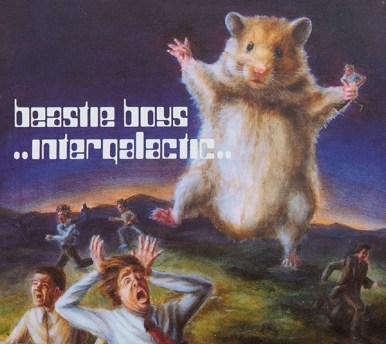
Intergalactic is probably the answer most folk would give to the question, ‘Name a hit single by the Beastie Boys’
It’s likely got as much to do with the memorable video, conceived and directed by Nathaniel Hornblower (aka Adam Yauch aka MCA), in which the trio, dressed as construction workers, are filmed in and around Tokyo while a dancing giant robot (which doubles as a spaceship) fights a deranged giant octopus armed with a trident.
But it turns out that Intergalactic was indeed the biggest hit they enjoyed in the UK, reaching #5 in July 1998.
mp3: Beastie Boys – Intergalactic
I didn’t buy Intergalactic at the time, saving my cash to pick up a copy of Hello Nasty, which provided them with their first, and as it tuned out, only, #1 album in the UK. It would have been a few years later that I grabbed a copy of the single in Missing Records as part of a wider haul of second-hand CD singles and albums.
Turns out it was released in 2xCD formats, and the version I have is CD1, which came with three other tracks.
mp3: Beastie Boys – Hail Sagan (Special K)
mp3: Beastie Boys – Intergalactic (Prisoners of Technology/TMS 1 Re-Mix)
mp3: Beastie Boys – Intergalactic (Fuzzy Logic Re-Mix)
The first of these is a strange and hugely uncommercial instrumental, which I assume is a tribute to the astronomer and scientist Carl Sagan who had passed away in late 1996 just a few months prior to work beginning on Hello Nasty.
The others are exactly as they say on the tin.
The first of them could be described as Beastie Boys meeting Drum’n’Bass, thanks to the contribution of a London-based producer and DJ whose output around the turn of the century and into the 00s was quite extensive.
The second is a bit more straightforward and is the work of Sam Sever and Jonathan Hoffman under the name of Fuzzy Logic which was the name given to their studio and production company.
A guest posting by Fraser Pettigrew (aka our New Zealand correspondent)
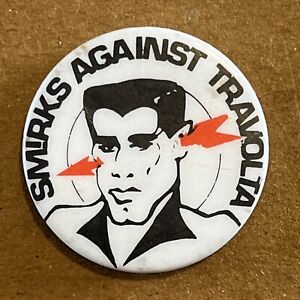
The Smirks were a short-lived band from Manchester whose chief contribution to posterity was as leaders, indeed sole proponents, of the parodic ‘Smirks Against Travolta’movement. In 1978, I sent away for one of their badges which showed a cartoon of the iconic Saturday Night Fever star, his head impaled through the ears by a big red arrow in obvious homage to the Anti-Nazi League’s Rock Against Racism campaign materials. The Smirks’ campaign had a semi-serious intent to defend live music venues against the progressive dominance of discos and the formulaic dance music records that fuelled them. The punk era seemed like a propitious moment of revolt against the mainstream music industry, and disco music epitomised its commercialised, mass-produced product.
In 1977 and 1978 it seemed as though the early punk and new wave hits were but far-flung islands in an ocean of disco. Every other single featured on Top of the Pops seemed to bounce along four-to-the-floor on shimmering hi-hat ripples backed by scratchy wah-wah guitars and alternating octave bass lines. And it wasn’t just American R&B acts that were doing it. Old timers like The Bee Gees and even The Rolling Stones were doing it, Abba were doing it, Bowie was doing it. If somebody wasn’t doing it they soon would – I’m looking at you, Rod Stewart. It’s easy to see how The Smirks could view disco as a malignant algae slowly smothering every other lifeform in the sea.
In 1978, I didn’t like disco. Disco was the enemy, it was the commercial mainstream, it was the antithesis of punk and new wave. Disco music was not the music of teenage rebellion, it was the music of flare-wearing bubble-headed conformists, obsessed with superficial personal attractiveness. Disco kids were socially acquiescent good-timers, not uncompromising and intellectually fearless iconoclasts intent on remaking the culture in a constant cycle of destruction and renewal, like what I was.
Ironically, however, the ‘anything goes’ eclecticism unleashed by punk was already in the process of spawning music that blended new wave experimentalism with the stylised sounds of disco and its elder sibling funk. It wasn’t properly until 1979 that this seemingly taboo musical miscegenation was born, but the seeds were sown by the end of 1978. Ever the pioneer, John Lydon’s Public Image Ltd filled out the last eight minutes of their first album with the disco-loop time-waster Foederstompf. Despite its explicitly ‘contractual obligation’ nature (at one point Lydon sing-chants the line “how-to-finish-the-album-with-the-minimum-amount-of-effort-necessary…”), the track sets up a style marker that was picked up in startling fashion six months later on their second single Death Disco. Did exactly what it said on the tin. One of the strangest things ever to appear on Top of the Pops.
A month after PiL’s First Edition, in January 1979, New York punk scene graduates Blondie released Heart of Glass and within a week it was at number 1. It’s well known now that the song started life some three or four years earlier, and before it acquired its eventual form and title (when recorded in June 1978) it was referred to by the band as ‘the disco song’. Blondie had earlier included disco cover versions in their live set, including Donna Summer’s I Feel Love.
The single that Heart of Glass bumped off the top spot was Ian Dury and the Blockheads’ own disco classic, Hit Me With Your Rhythm Stick. In truth The Blockheads had always been a bit funky, and were never in any sense punk, but they surfed to prominence on the new wave, bearing an outsider affinity on account of Dury’s disabled skinhead Essex geezer persona and lyrical fondness for society’s nether parts.
Another of our favourite bands, Talking Heads, fellow alumni with Blondie of the CBGB school, had quite frankly been doing disco since day one. Talking Heads ’77 was a blueprint for blending slick, poppy dance rhythms with weirdo art-nerd lyrics, luring you onto the floor like the cutest boy in the class until you realised you were dancing with a bookworm, a civil servant, a psycho killer. More Songs About Buildings and Food delivered further explicitly disco tunes like The Girls Want to Be With The Girls, Stay Hungry and Found A Job, Frantz and Weymouth nailing the crisp tempos on hi-hat, snare and bouncing bass, Byrne and Harrison rubbing ‘chicken-scratch’ rhythm guitar straight out of KC and the Sunshine Band. There was a cover of an Al Green song.
The combined effect was to sand away the stigma associated with disco and funk. Did we disown Blondie? Had PiL sold out? No one complained, least of all me. Like everything else, my fearless iconoclasm was a pose, and though I genuinely didn’t like mainstream regurgitation, the appropriation and subversion of popular forms was obviously different, yeh? Also, music was supposed to be fun. Everyone wanted to party and the admission was grudgingly made that disco was 100% party music. Nobody was going to get up to The Bee Gees, but slap on Heart of Glass or Bowie’s Golden Years and we were on it. Something to do with the packaging.
Well away from the chart spotlight, other artists were taking funk and disco stylings and bolting them onto some distinctly uncommercial material. In The Smirks’ back yard, A Certain Ratio were beginning their rapid evolution towards icy, stripped down funk. In deepest darkest Bristol, The Pop Group compounded the irony of their name by confrontationally screaming agitprop over grooves that sounded like James Brown and George Clinton jamming in an abattoir.
So, in short order, my dislike of disco on purely aesthetic grounds vanished even faster than The Smirks. Just as well, since the following years saw a rapid diffusion of disco and funk throughout every level of post-punk music. You can hear it in the ‘Sound of Young Scotland’ in Orange Juice and Josef K, The Fire Engines, Boots For Dancing, in the Euro-disco of The Skids and Simple Minds, and in the warped pop of Associates.
New Order mashed up Kraftwerk and Giorgio Moroder to produce Everything’s Gone Green, following it up with Temptation, and eventually the monster techno-disco breakthrough of Blue Monday. The Pop Group never had a hit, assuredly for want of trying, but their former bassist Simon Underwood tasted success with Pigbag, whose James Brown-referencing Papa’s Got a Brand New Pigbag even inspired Paul Weller to jump on the bandwagon by ripping off the bass line for The Jam‘s disco song Precious.
By the beginning of the 80s, disco was as much part of the new wave as it was of the mainstream. And through the distinctive phenomenon that was Grace Jones, the new wave found itself infiltrating disco. In the late 1970s, the former fashion model had made a musical name for herself in the gay club scene with high-camp singles such as Do or Die and I Need a Man, but after teaming up with the Compass Point All Stars, her albums Warm Leatherette and Nightclubbing supplied a wider alternative club scene with some unexpected dance floor fillers. The former album’s title track could hardly be of more obscure origin, a cover of a proto-industrial synth pop single based on J.G. Ballard’s Crash, written and produced by The Normal, aka Daniel Miller, founder of Mute Records, the future home of all things alternative. Other covers followed, drawn from The Pretenders, The Police, Iggy Pop, Roxy Music and, most eyebrow-raising of all, Joy Division. When I occasionally frequented Edinburgh club JJ’s in the early 80s, Jones’s versions of She’s Lost Control and Warm Leatherette were staples, along with tracks like Bowie’s Stay, from Station to Station, and Material’s Bustin’ Out.
Bustin’ Out flags up another significant strand of alternative disco, the New York underground, propelled by experimentalists like Bill Laswell and Arthur Russell, ‘no-wave’ acts such as ESG, and the ZE Records stable that included Was (Not Was), Kid Creole and the Coconuts, Lizzy Mercier Descloux as well as Laswell’s Material. All of this fed alternative influences back into the disco club scene, ultimately influential in the metamorphosis of disco into house and techno in the late 1980s, a development further fuelled by post-punk electro-pioneers like Human League and Heaven 17, Depeche Mode, Throbbing Gristle and their offshoots Chris and Cosey, Yazoo and Erasure.
In parallel with all this painfully hip consumption, my musical tastes were being broadened to embrace some of the soul and funk originators like Sly and the Family Stone, Stevie Wonder, Isaac Hayes and Marvin Gaye. Several of my friends expressed healthy respect for the danceable end of soul music. One of them only ever wore white socks. Not long after it came out, I bought Off The Wall, easily one of the best pop/disco albums of all time. The barriers were down. I am now unashamed to reveal that my record collection holds prized items by such as Shalimar and the Detroit Spinners, and Brit-disco acts like Linx, Imagination and The Real Thing. Whisper it, I even have The Bee Gees’ Saturday Night Fever tracks on a CD, and they’re great. As Funkadelic so succinctly and eloquently phrased it, “Free your mind and your ass will follow.”
mp3: PiL – Death Disco
mp3: Talking Heads – Stay Hungry
mp3: The Pop Group – She is Beyond Good and Evil
mp3: The Jam – Precious
mp3: Material – Bustin’ Out (12” version)
mp3: Grace Jones – Warm Leatherette
mp3: David Bowie – Stay
mp3: Loose Joints – Is It All Over My Face? (Single female vocal version)
mp3: Heaven 17 – I’m Your Money (12” version)
mp3: Linx – Wonder What You’re Doing Now
I mentioned a long while back, in referring to the single Life In Tokyo as part of one the features within the ‘Shakedown 1979’ mini-series, that the time would eventually come for Japan.
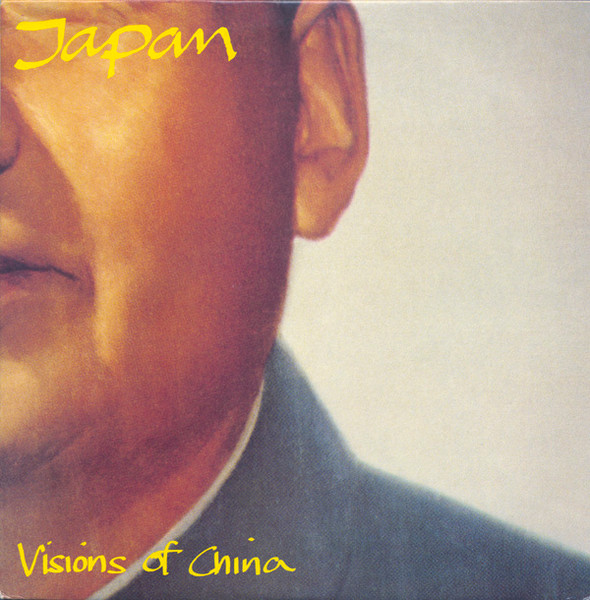
That time would prove to be late 1981, and the release of their fifth studio album, Tin Drum. In an era when synth-based pop music was becoming increasingly prevalent, Japan shifted the goalposts in quite a dramatic fashion. The songs, both in terms of their titles and the way they sounded, very much leaned towards the country and region after which the band had long ago taken their name. The synths, drums and bass seemed to create music that seemed beyond the capabilities of most of their contemporaries, while lead singer David Sylvian‘s imitation of the Bryan Ferry-like croon was the perfect accompaniment.
The new sound proved to be a hit with the critics, with Paul Morley at the NME being particularly enthusiastic. It was synthpop with an arty twist, possibly bordering on the pretentiousness of the type that could be thrown at some of Morley’s writing? At the same time, the undoubted good looks of all members of the band meant the publications and magazines primed for the that teenage female market were full of photos and words about the band. It was very much a win-win situation.
The lead-off second single lifted from the album remains quite timeless,
mp3: Japan – Visions Of China
The b-side was a remix of a song that had originally closed their previous studio album, Gentlemen Take Polaroids.
mp3: Japan – Taking Islands in Africa (remix)
It wasn’t quite as big a hit as I had actually thought, spending just three weeks in the Top 40 and peaking at #32. I’m guessing it was just a bit too strange sounding for daytime radio and with the album not yet having been released, the critics had yet to really do their fawning pieces on the band that would take them into the higher echelons of the charts.
#8: Hermann ♥’s Pauline (1997, Creation Records, CRE252)
I’ve mentioned before that, the only thing you should expect about the Super Furry Animals is the unexpected. So when the first track from the band’s second album was unveiled in May 1997, it’s perhaps little surprise that we got a strange, psychedelic odyssey about Albert Einstein’s parents!
mp3: Hermann ♥’s Pauline [single version]
According to Wikipedia: “The song was inspired by the pitstops that the band would take at motorway service stations whilst out on tour, where Gruff Rhys would peruse through bitesized biographies about famous people.” It’s really not a track you’d earmark as a single. Indeed, when the album ‘Radiator’ was released three months later, it was clear there were numerous tracks that might have been better suited as the first single. But then, perhaps that wouldn’t have been a very super furry thing to do.
Nevertheless, it has become a real fan favourite. Maybe, in part, because the band didn’t play it live for many years due to it being too difficult to do so, so when they eventually did figure it out for the live setting, it would have been a big surprise to the fans.
I think it probably has the most entertainingly odd opening verse of any Top 40 hit ever:
Hermann loves Pauline, and Pauline loves Hermann They made love and gave birth to a little German They called him MC2 because he looked like no other An asthma sufferer like Ernesto Guevara
The single version shortens the electronic sounds at the very beginning and end of the song; other than that, it’s identical to the album version. The wonderful sleeve, designed by Pete Fowler, marked the beginning of a collaboration between the band and artist that would last another dozen years. Hermann ♥’s Pauline charted at #26 in the UK in its first week before subsequently falling away. It was released in the regular three formats. The 7” and cassette featured this rowdy little upstart as its b-side:
mp3: Calimero
The CD had another Welsh language track, but this one had an altogether different feel.
mp3: Trôns Mr Urdd
My Welsh is very poor, and Google translate doesn’t really shed much light on things. But, from what I can make out (and I may well have got this entirely wrong) – the first of these tracks bemoans the cynicism and lack of respect for others in modern society, ending with the English phrase “I feel so sad…”. The latter song may or may not have something to do with cross-dressing. Please feel free to correct me. Unless I’m so embarrassingly wrong, in which case it might be kinder to leave me in ignorance…
Bonus track this week – well if there was a demo for Hermann… it has not been issued, so instead here’s an early version of another track that would grace the second LP. The Placid Casual was track 2 on ‘Radiator’, but its demo recorded the previous year in 1996 sounded rather different to the finished article.
mp3: The Placid Casual [demo]
In 1998, the band established Placid Casual Recordings, a label they could release any solo or side project material on. I’ve no idea if the label was named after this song, but it’s unlikely to have been the other way round.
Today’s featured Scottish act’s song comes courtesy of its inclusion on David Cameron’s Eton Mess, a compilation album released in October 2015 on Song, By Toad Records. This is the sixth time I’ve gone to that album, and here’s a reminder of what it was all about:-
“Almost all of the singers and bands were, at the time, unknown with very little more than a few tracks available online or via a limited physical release, most often cheaply done on a cassette. Label owner, Matthew Young, said at the time:-
“Most of the bands are friends and a lot of musicians feature on several of the album’s tracks, one of the reasons why we’ve put the compilation together. It feels like there’s this pool of really talented musicians bubbling away and all sorts of excellent music is starting to emerge from the mix. Bands are forming, breaking up, and starting again all the time. When you see a loose collection of bands connecting like this you never know what is going to happen. A few will disappear, some will do okay, some might pave the way for others, and a few of these bands could go on to do really well.”
The track from Dearness was this:-
mp3: Dearness – It’s Ok, You’re Fine
A more than decent lo-fi indie number. Dearness was the stage name used by Ryan Drever, the bass player with PAWS, for his solo material. In addition to this track on the compilation, there was a very limited cassette/CD release of an album, Accidental Gold, also back in 2015. It’s OK, You’re Fine is also on said album, and while the cassette/CD has long sold out, it is available digitally via bandcamp. Click here.
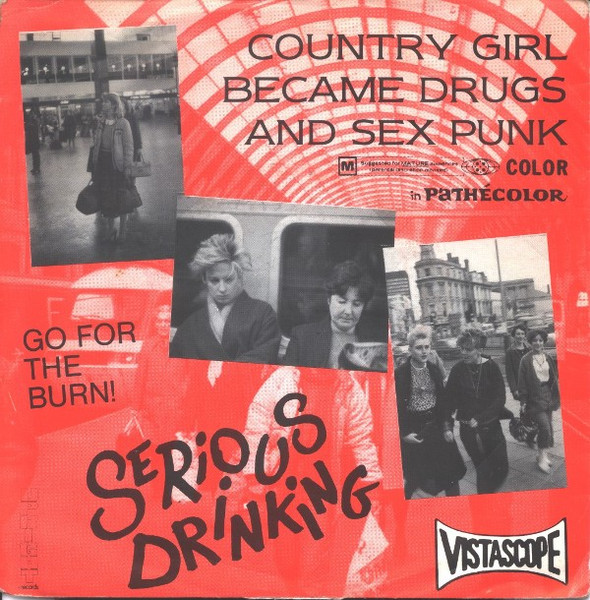
#090: Serious Drinking – ‘Country Girl Became Sex And Drugs Punk’ (Upright ’84)
Hello friends,
to be honest to you: it took me a considerable amount of my teenage years to learn that music and, more importantly, lyrics does (or should this be ‘do’?) not necessarily always need to be deep and meaningful in order to be good, in fact sometimes all you need is a good laugh, really! It’s hard to describe, but if you had to compare, say, Joy Division or Mazzy Star to Half Man Half Biscuit or I, Ludicrous – would you be able to judge which band is better? I certainly could not do this, because all of them are great – in their own style.
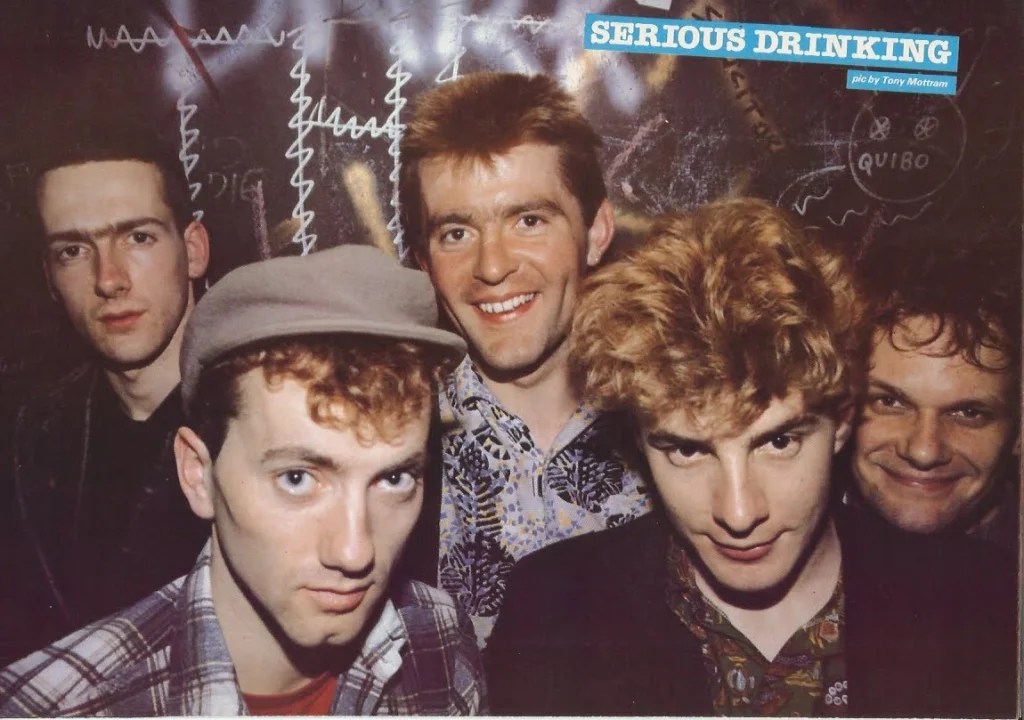
Serious Drinking, despite their name, do not have to be taken all too serious, I would say – but the thing is, if I had to guess: they never expected to be taken too seriously, contrary to many other bands. And that’s an attitude I can sympathize with, to be sure!
So, a brief CV for you: Serious Drinking came from Norwich, were active from ’81 to ’85, two albums, two (great) compilations, three singles, heavily into football, girls, drinking, not consequently in this exact sequence – and that’s all you need to know really.
And should you still be wondering what I was trying to say above, perhaps the band’s humour is best shown in the title of the second album, a quote from one of those hilarious 60’s ‘Batman’ movies starring Adam West, in which Batman says to Robin: ‘They may be drinkers, Robin, but they’re also human beings …. they may be salvaged!’
I always loved this title, and this humour is drawing a more or less continuous line throughout many songs Serious Drinking wrote: ‘Love On The Terraces’, ‘Bobby Moore Was Innocent’, ‘Don’t Shoot Me Down’, ‘Baby I’m Dying A Death’. Especially the latter is ace, and I could easily have chosen it here, but no, I went for their final single instead, because it’s a song which tells a story, and mind you, it doesn’t happen often that a story as sad as this one puts a grin on my face until the needle reaches the lead-out groove … each and every time:
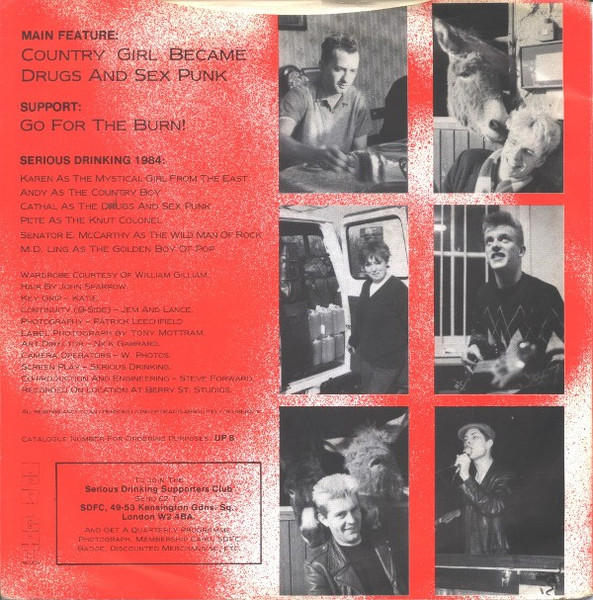
mp3: Serious Drinking – Country Girl Became Sex And Drugs Punk
Perhaps I should dedicate this to SWC, because a) he lives in the middle of nowhere and b) he has a young daughter: so be warned, my friend!
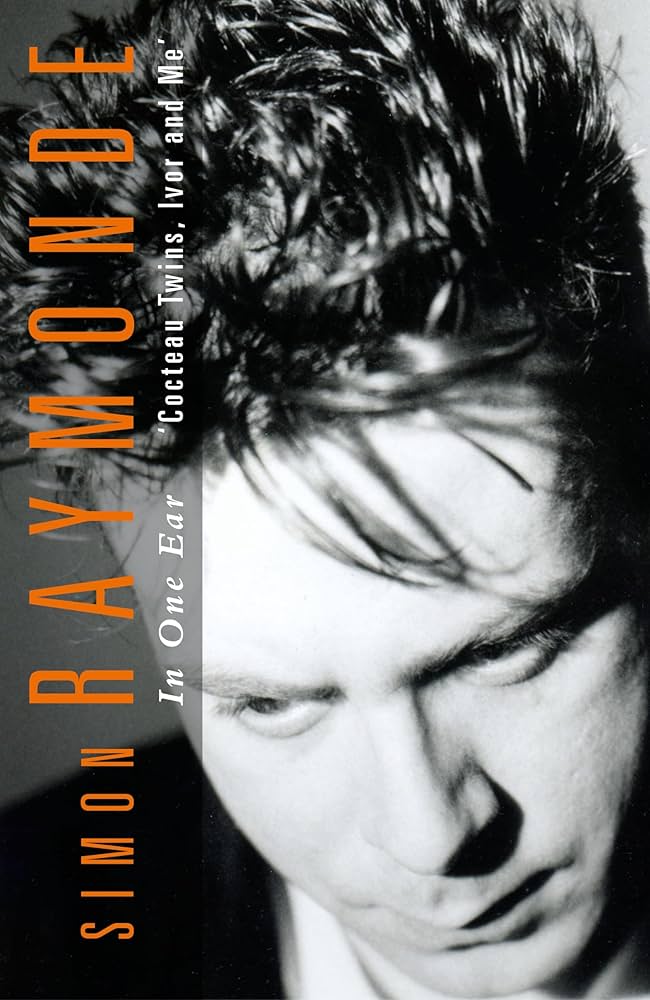
Another music autobiography that was purchased, for the most part, on the back of reading some very favourable review, but also because I hoped to learn a great deal more about the Cocteau Twins.
The PR blurb for the book, which was published in September 2024, has been heavily used on the various websites from where it can be published, and I’m not going to buck the trend:-
“The page-turning memoir of Cocteau Twins’ Simon Raymonde, charting his life and legacy in music. As one-third of seminal band Cocteau Twins, Simon Raymonde helped to create some of the most beautiful and memorable albums of the ’80s and ’90s – music that continues to cast a spell over millions. This is the story of the band, in his words.
Beginning with Simon’s remarkable childhood and exploring his relationship with his father, Ivor Raymonde (the legendary producer, musician and arranger for acts such as the Walker Brothers and songwriter for artists including Dusty Springfield), the book will journey through the musician’s rise to prominence and his time with Cocteau Twins and This Mortal Coil.
It will also chart the successful career he has forged running his own label, Bella Union, for the past twenty-seven years, discovering and developing globally renowned artists like Beach House, Fleet Foxes, Father John Misty and John Grant.
And the narrative will lead us back to the present day, reflecting on Simon’s most recent experiences in the music industry – all while going deaf in one ear.
A must-read for music fans, this is the incredible tale of Simon’s life and legacy.”
It really is the case that the 368 pages of text contain some incredible tales, from all aspects of Simon’s life, with quite a few of them being genuinely jaw-dropping. I have, however, got to get something off my chest right away before getting into the meat of this review, namely that some of the stories/events/happenings feel as if they should be taken with a huge pinch of salt – I am particularly thinking of him attending a football match in Glasgow in the mid 80s and his night in a Las Vegas casino in 1991, along with the events over the next 24 hours as he made his way unaccompanied to the band’s next gig in Phoenix.
These, and a couple of other passages irritated me more than they should have, and put me in such a mood that I almost put the book to one side, vowing never to pick it up again. But I persisted, often returning a day or two later after in the meantime read some pages of another book that was on the beside table or spent my daylight hours listening to music or blogging, and am really grateful that I did, but not for the reasons I was anticipating.
The PR blurb is, as is often the case, a tad misleading as ‘In One Ear’ is not the story of the Cocteau Twins, and at no point does Simon ever claim it is meant to be. He is at pains to point out that he wasn’t involved in the formation of the band, and more than once reminds readers that, due to him being heavily involved with the work of This Mortal Coil, he wasn’t part of the recording of Victorialand, the Cocteau Twins’ fourth studio album, released in 1986. He is very discreet about a number of things, not willing to going into great detail about things which were pertinent only to Elizabeth Frazer and Robin Guthrie, but he reveals just enough about life in the studio, on tour and dealing with the various aspects of the record industry to make that part of the book a fast-flowing and entertaining read.
I kind of got bogged down a bit with much of the Bella Union story, mainly as it’s a label whose acts have never really been among my favourites. Over the years, I have paid attention to ‘end of year’ lists and gone out and bought CDs by the likes of Fleet Foxes, Father John Misty, Midlake and John Grant, only to find that they end up gathering dust up on the shelves after one or two listens. But I am clearly in a minority given that the label, founded in 1997 and initially intended as a vehicle for Cocteau Twins releases after the group’s unhappy time with Fontana, is very much still on the go all these years later, bringing a great deal of pleasure to millions of music fans all over the globe.
The book’s greatest strength, I feel, is when Simon veers away from the shenanigans of the music industry and writes about himself and his family, and in particular his relationship with his parents. There is a superb 40-page interlude in the second half of the book which is devoted to telling the story of his father, Ivor Raymonde, a famous musician, songwriter and arranger back in the 60s and 70s. I knew Ivor was famed for his work with Dusty Springfield, but had no idea he was involved in the work and successes of many others from the era, including Joe Meek, Scott Walker and Marty Wilde, among others. Ivor would pass away in 1990, at the young age of 63, and many years later his son would pay tribute by compiling and issuing two volumes of songs on Bella Union.
The closing chapters reintroduce his mother, who for the most part has been a peripheral figure in the book, with Simon admitting they were never close when he was growing up. It took until her later years for them to really form a happy relationship, and the most moving parts of the book come with his description of her final few months of life. This was another occasion when I had to put the book down, but not for the previously cited reasons.
As these types of books go, there aren’t too many examples of name-dropping within the actual text, but it is very clear that Simon has met an incredible number of people throughout his life to whom he is grateful. There is possibly the most-packed acknowledgements section at the end I’ve ever come across, which runs to four-and-a-half tightly spaced pages with what must be some 500 people mentioned, all of whom he says has at one time left a lasting impression on him, even if they had no idea why.
Overall impressions? A more than decent read, let down by what feels like the occasional flight of fantasy; but then again, very few, if any, autobiographies ever offer up a straightforward and totally truthful account of events, so I shouldn’t be too harsh.
mp3: Cocteau Twins – Frou-Frou Foxes In Midsummer Fires
The closing track on Heaven or Las Vegas (1990), with the book revealing that Simon wrote the music the day after his dad’s funeral, having come into the studio early as he couldn’t sleep.
Side 1, Track 2 of Low. The eleventh studio album from David Bowie and the first of what is now referred to as the Berlin Trilogy, even though most of the record was recorded in September/October 1976 at the Château d’Hérouville in France.
And yes, it is a short post today, but then again, that’s the nature of the Songs Under Two Minutes series. Besides, I was tired after yesterday’s offering!
I finished off last month’s two-part look back at the singles chart of 1984 with a degree of pessimism that 1984 wasn’t really shaping up to be a vintage year judging by the quality of new entries in the month of March. Will the four charts to fall in the month of April offer any rays of sunshine?
1-7 April
Lionel Richie was still saying Hello, and in the very confusing promo video, asking someone…..a blind woman much younger than himself….if it was him she was looking for. Urgh.
Ballads were seemingly all the rage among the mainstream as the highest new entry, at #26 belonged to Phil Collins with Against All Odds (Take A Look at Me Now). Before the month was out, this one would be stuck at #2…..initially kept off the top spot by ole’ Lionel.
So far….so awful. Thankfully, Bob and his boys offered some respite
mp3: The Cure – The Caterpillar (#31)
Or did they? Let’s be honest about things. The Cure had given us some great singles in the early 80s and would do so from the mid-80s onwards. But their sole 45 from 1984 is a bit meh….and indeed, the parent album The Top, is one which, while subject to positive reviews at the time, has come to be regarded as one of their less stellar offerings. The Caterpillar would spend seven weeks in the charts, peaking at #14.
mp3: The Psychedelic Furs – Heaven (#39)
Here’s one whose production values and techniques highlight it could only be from the 80s. I’ve a lot of time for a number of the early Psychedelic Furs material, but fourth album, Mirror Moves, from which Heaven was the lead-off single was where they began to lose me. As I wrote many years ago in a previous posting on the band, I found myself wondering why it was that I once thought they were an important part of the alternative music scene in the UK in the early 80s when in fact they were really always a mainstream act bordering on the different. Heaven would briefly break into the Top 30 the following week, and other than the later re-release of Pretty In Pink to tie-in with the film of that name, would be their best achieving 45.
mp3: Killing Joke – Eighties (#60)
I’m kind of surprised that I’ve never featured this before on the blog….but then again, it’s not actually a piece of vinyl I own. Indeed, I don’t have too much by Killing Joke gathering dust on the shelves. But this one, which was clearly ripped off a few years later by Kurt Cobain when he wrote Come As You Are, is a more than listenable number. It spent five weeks in the chart, and by the look of things, sold roughly the same number of copies each and every week with chart positions of 60, 62, 61, 63 and 64.
mp3: Malcolm X and Keith Le Blanc – No Sell Out (#69)
On which samples of words spoken in speeches by the assassinated political activist were put to a hip hop beat. The lack of radio play in the UK hindered sales, with it eventually reaching just #60. It was, however, a mainstay of student union discos across the land. Well, I certainly ensured it got played it on the occasional Thursday alt-night at Strathclyde.
mp3: Talk Talk – Such A Shame (#70)
The follow-up to It’s My Life which had peaked at #46 in January fared no better, staggering its way up to #49 in mid-April. It did much better in other markets, reaching #1 in Italy and Switzerland, and #2 in Austria and West Germany.
8-14 April
I Want To Break Free by Queen was your highest new entry at #18. I’ve nothing to add to that sentence. Next highest was from an electronic duo, many of whose earliest singles had excited me.
mp3: Orchestral Manoeuvres In The Dark – Locomotion (#28)
The duo had taken a bit of a commercial battering with the singles taken from 1983’s Dazzle Ships, with one reaching #20 and the other only hitting #42. A more pop-focussed approach was adopted for 1984’s follow-up, Junk Culture, with this lead off effort eventually peaking at #5. I know this era of OMD has its fans, but I’m not among them.
mp3: Blancmange – Don’t Tell Me (#32)
The third 45 to be lifted from the soon-to-be released Mange Tout provided Blancmange with a fifth successive Top 40 hit, The rather excellent Don’t Tell Me would subsequently become one of their biggest, reaching #8, just one place below Living On The Ceiling, their breakthrough single back in 1982.
mp3: Spear of Destiny – Liberator (#67)
Prisoner of Love, released in January 1984, had not been the hoped-for smash for Spear of Destiny and record label Epic, only reaching #59. Hopes were high for Liberator, but it fared even worse, coming in at #67 and not getting any higher. The consolation was that parent album, One Eyed Jacks, released at the end of April did reach #22.
mp3: Tracie – Souls On Fire (#73)
Tracie Young was a protégé of Paul Weller. Aged 17, she had sent a demo tape to the singer when he was looking to sign acts to his newly established Respond Records. She was immediately asked to provide backing vocals to The Jam‘s final single, Beat Surrender, in November 1982, and then became part of The Style Council as backing vocalist and touring performer. Her debut solo single, The House That Jack Built, attributed solely to Tracie, went Top 10 in April 1983, but the subsequent solo album, Far From The Hurting Kind, sold poorly and reached just #64.
Twelve months after the big hit, an effort was made to re-start her career with a new single. Souls On Fire flopped, peaking at #73. There was one more single later in the year….watch out for it later in this series.
15-21 April
mp3: Echo & The Bunnymen – Silver (#32)
The Killing Moon had been a big hit earlier in the year, and the music press was buzzing with anticipation for the release of the forthcoming album, Ocean Rain. It’s fair to say that the band’s manager, Bill Drummond, was really talking things up. In many ways, Silver was something of an anti-climax; it was a decent enough tune, but it didn’t feel that the hype was fully justified. It was the Bunnymen, but not quite as we knew them. It came in at #32, and didn’t get any higher than #30.
mp3: Sandie Shaw – Hand In Glove (#44)
Well, well, well.
The Smiths, and Morrissey in particular, remained irked that their debut single had failed to trouble the charts. Having talked often in the press of his love for 60s bare-footed chanteuse Sandie Shaw, he persuaded her to provide a vocal to a re-recorded version of the tune, on which Johnny Marr, Andy Rourke and Mike Joyce all played. It would eventually reach #27 and indeed offer up an enjoyable appearance on Top of The Pops, in which Sandie at one point gently sends-up Morrissey. Worth also mentioning that it was the first time in fifteen years that she had been on the show.
mp3: Bruce Foxton – It Makes Me Wonder (#74)
The first couple of singles by the ex-Jam bassist in 1983 had done OK, with debut effort Freak reaching #23. The debut album, Touch Sensitive, was scheduled for release in May 1984 and so this further advance single was released. Sadly, but not too unsurprisingly, as the quality was lacking, both it and the album sold poorly and Bruce Foxton would be dropped by his record label by the year-end.
22-28 April
Those of you who watched the Sandie Shaw TOTP clip and listened carefully to the presenters’ introduction would have heard that Duran Duran were coming up later on the same show. It would be to perform their latest smash.
mp3: Duran Duran – The Reflex (#5)
An unusually high new entry for the early part of 1984. It was their 11th hit single in a row, and would ultimately provide them with a second #1 – the other had been Is There Something I Should Know? back in March 1983. Nobody knew it at the time, as the future looked ridiculously rosy, but it was the last time they had a #1.
mp3: New Order – Thieves Like Us (#21)
Blue Monday, and to a lesser extent, Confusion, had made stars out of New Order, but they confounded many of their newly founded fans by making their next single an indie effort rather than one aimed at the dance floor. Oh, and to make things even more perverse, it was released only on 12″, allowing for its full running time of more than six-and-a-half minutes, but there was an edited version made available as a promo 7″ to radio stations. Thieves Like Us would reach #18 in the chart which straddled April/May 1984….and led to a live TOTP appearance in which Bernard sounded……….well, I’ll leave it you to decide!
mp3: Cocteau Twins – Pearly-Dewdrops Drop (#38)
A reminder that 1984 was occasionally capable of offering unexpected hit singles. This would eventually climb to #29, and be the first and last time the Cocteau Twins would breach the Top 30 – not that they nor 4AD were all that bothered, as it really was about album sales. Just a pity there was no TOTP appearance, but they had already appeared earlier in the year on another of the BBC’s programmes.
A reminder that I’ll be back later in the month with April 1984 singles that didn’t reach the Top 75.
Today’s offering comes courtesy of its inclusion on the Indietracks Compilation 2013.
mp3: Making Marks – Ticket Machine
Making Marks formed in Oslo, Norway in 2012 and over the course of what was a short career would release two singles and an album for the London-based Fika Recordings and one single for a local label, Snertingdal Records. The four band members were Ola Innset (guitar and vocals), Nina Bø (vocals and keyboards), Marie Sneve (bass) and Jørgen Nordby (drums).
Ticket Machine was the debut single, appearing in October 2012. It was also included on their sole album A Thousand Half-Truths, which came out in March 2014 and proved to be their last-ever release.
The verdict from Villain Towers? The opening notes are an absolute delight, as they are very reminiscent of the much-loved Cats on Fire. The vocals, which come in just before the 30-second mark, wouldn’t be out of place at a lively American hoe down. In essence, it’s a mix of indie and country, and it works really well.
JC
PS :
I want to take the opportunity to say thank you to everyone who left such kind words alongside last Friday’s posting about my late friend, Kenno.
It turned out, as expected, to be the most perfect of memorial services. An enormous turnout, with wonderful contributions from friends, work colleagues and family members. Lots of smiles and laughs, but the tears flowed too…..especially when the songs chosen by Kenno and the family were played. I particularly welled up when some lines from Town Called Malice were included within the tribute delivered by the celebrant.
Stop apologising for the things you’ve never done. Time is short and life is cruel.
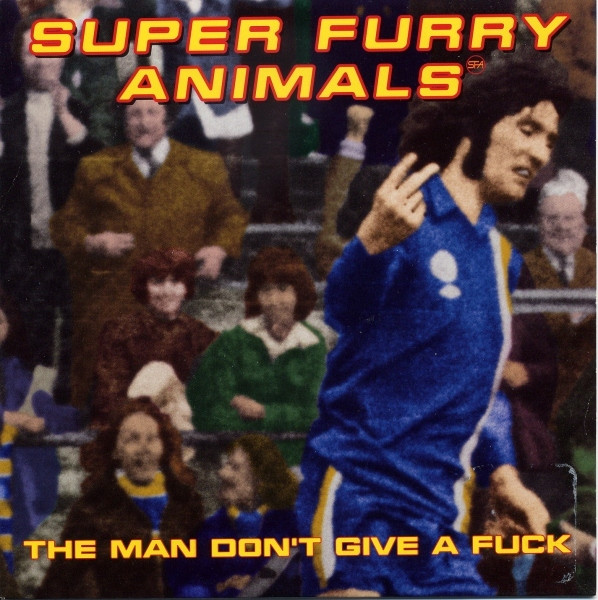
#7: The Man Don’t Give A Fuck (1996, Creation Records, CRE247)
Last week, I mentioned that a track planned to feature as a b-side to If You Don’t Want Me To Destroy You had to be swapped out in favour of another track. That eschewed track did finally get a release in December 1996, but as a single in its own right.
I wondered how much I’d need to write about The Man Don’t Give A Fuck as I thought it had been featured by numerous members of our blogging family over the years. But when I looked into it, it appears that none of those I expected to have written about it (JC, Swiss Adam, Jez) actually had done. I could be wrong, of course, but I never found anything. It seems it was just me, back here. Unless you know better…
Demoed back in 1995, the song is built around a sample from Steely Dan’s Show Biz Kids. It wasn’t finished in time for the album, and when it was finished and mooted as a b-side, they couldn’t get clearance for the sample from Steely Dan’s Donald Fagan. Eventually, the greedy bastard Fagan agreed to allow the song to be released in exchange for 95% of the royalties! The band actually agreed to this, taking the stance that as it was unlikely ever to be played on the radio for its prolific use of the f-bomb, it was unlikely to earn them much dough anyway. This was coupled with plans to release it in very limited quantities for one week only.
The song is described by Gruff Rhys as a multi-purpose protest song which can be used against “any organisation which you feel is terrorising you as an individual, anyone who’s cramping your style”. Its release was also seen as a way of demonstrating to people how ridiculous censorship is, with Rhys claiming no one is offended by the word ‘fuck’ anymore “unless you’re in the church where it’s beaten into you that … swearing is bad.”
The Man Don’t Give A Fuck entered the UK singles chart at number 22 and dropped to number 65 the following week as the limited run of copies of all formats sold out. It set a new record for the most number of f-words in a UK chart single, an honour the band would hold onto for three years before Insane Clown Posse’s Fuck The World beat it. They did get the record back though, but that comes later in the series.
Since its release, The Man Don’t Give A Fuck has become one of the band’s most popular tracks. It was the regular set closer of their live shows for the next 20 years and always took the roof off.
The 7” was issued on blue vinyl and contained just the one track. The CD included two remixes, one of which is called the Howard Marks mix. The band’s admiration for the notorious Welsh drug smuggler was already known, and the claim was that he came into the studio to remix the track. The more accepted version of events is that, while Marks probably was in the studio, the band members themselves did the actual remix.
mp3: The Man Don’t Give A Fuck [Howard Marks mix]
mp3: The Man Don’t Give A Fuck [Wishmountain mix]
The 12” featured a third remix, and to be fair is even less worthy of your time than the other two.
mp3: The Man Don’t Give A Fuck [Darren Price ‘mix’]
This week’s bonus track is the original 1995 demo. Of all the demos I’ve featured so far in the series, this one is clearly the roughest and least developed. It’s really interesting to compare it with the finished version, and you can understand why it wasn’t ready for the album.
mp3: The Man Don’t Give A Fuck [demo]
And in case you’ve never heard it, here’s the song that infamous sample was taken from (at 3:52):
David McClymont is probably best known as the bass player with Orange Juice between 1978 and 1983. He played on all the Postcard releases, and the first two albums released by Polydor, with his departure being down to that old favourite, ‘musical differences’. By 1986, he was a member of The Moodists, a post-punk band that had formed in Australia back in 1980, but had spent much of the decade living and working in London, and were indeed briefly part of the Creation Records roster in 1985.
David came in as the replacement for long-time member Chris Walsh, who had been with the band since 1981, and would play on their two final EPs, which were issued by T.I.M. Records, a short-lived London-based indie label that was in existence between 1986 and 1988. While I have no firm knowledge of the timeline, David moved to live in Melbourne after The Moodists split up, becoming so immersed in and knowledgeable about his new home that he became one of the co-authors of the city’s very first Lonely Planet City Guide published back in 1993.
He continued to keep up an interest and involvement in music, albeit in a low-key fashion, certainly to those of us here in the UK. In 2014, he started to release material under his own name on Bandcamp, but very much totally under the radar of those of us who remembered him from his days with Orange Juice.
He had, however, kept in contact with a few old friends from Scotland, including Stephen McRobbie (aka Stephen Pastel), whose encouragement and advice helped lead to the release of the compilation double-album, Centuries, in 2022, made up of 27 songs that had been self-recorded over a period of ten years. The compilation was issued by Last Night From Glasgow, with the label then also electing to release, in 2023, Mountains, an album of entirely new music.
mp3 : David McClymont – Lost In Transit
There’s a fair degree of abstract/experimental music on both albums, alongside what can easily be classified as straight-forward pop songs of the low-key variety. Lost In Transit is one of those.
Today, I’ll be saying a very fond but sad farewell to David Kennedy, a very dear friend, who was taken by cancer at the stupidly young age of 59.
Kenno was what I most enjoyed calling him, as to do so would mean we were in a social setting. It was David whenever we dealt with one another over work-related issues; he was, for the best part of 30 years, the Head of Communications for the organisation which looks after the interests of all local councils in Scotland, and I, for quite a number of those years, was either a political advisor and/or spin doctor for one of those councils. He was brilliant at his job, making it look easy thanks to his professionalism and dedication, along with an incredible ability to get on with everyone he dealt with, be they politicians, journalists or work colleagues. I don’t ever recall meeting anyone who didn’t like David Kennedy, the communications guru.
I got lucky. Two of his closest colleagues at work were James and Alan – better known round these parts as Jacques the Kipper and Aldo, and through them, I got to socialise with Kenno outside the work environment, and before long, we saw ourselves more as friends than as folk who occasionally chatted about the Scottish political media.
By far, his biggest love was for his family – his wife Jane and their kids, Rachel and Adam. He was also very close to his parents. In later years, he doted on the family dog. His other big passions were football and music. His team was Heart of Midlothian FC and his pop tastes were incredibly eclectic, but his biggest idols were Paul Weller and Dusty Springfield – indeed, the puppy which came into the family home a few years back was named Dusty. He was also something of a mod at heart, to the extent that many years ago he bought himself a scooter which he called Ruby, and they spent many warm afternoons and evenings heading out on adventures around the country roads close to where he lived, in a small semi-rural town some ten miles south-west of Edinburgh.
Kenno was brought up in what, back in the 60s, would best be described as a classic working-class family, and the traits and values passed down by his parents never left him. He remained a committed socialist his whole life, but of the pragmatic rather than dogmatic type. He grasped the educational opportunities afforded him and in doing so, not only ensured his career would be spent in white-collar industries rather than in any sort of back-breaking manual labour, but made his parents incredibly proud of his achievements.
It didn’t take long for us to realise and acknowledge that while we might have been products of two cities separated by 45 miles on different sides of Scotland, we really had an awful lot in common. We even discovered our teenage years had seen us go out and earn money delivering newspapers to the houses of our neighbours, and coming to something of a realisation that this may have subconsciously led us both to our eventual careers.
In saying all that, the best times we always had would come when we weren’t being serious with one another. The occasions when I would accuse him of not really being working class as he was from snobby Edinburgh where his secondary school offered the option of playing rugby as well as football; he would retort by reminding me that I now resided in one of the poshest districts of Glasgow and indeed lived in a property (he called it a castle) which was known to all and sundry as Villain Towers. When I would accuse him of having dull and boring music tastes, on the basis that all his gigs seemed to be only singers/band who had chart-topping hits and were always in venues that were large-scale and comfortably seated, he would accuse me of not really liking all the stuff I mentioned on the blog, and that it was just a front and a sad effort to still appear hip and/or trendy.
Kenno was, as you might expect from a man with such a great grounding in communications, a very early adopter and user of social media. His Facebook postings to his well over 600 friends were always worth reading. He championed loads of causes, and he wrote of his admiration for those who achieved political and social change in an unjust world. He was also an incredibly witty and funny person, capable of sending himself up something rotten. He was forever posting the most ludicrous betting tips; every time Hearts took the field, Kenno would be urging you to place a bet on them winning, coming up with two or three other equally unlikely suggestions for an accumulator that invited ridicule – and he got it in spades. Oh, and he was forever reminding everyone of what was the best day of any week, doing so with some sort of photo of Bob Hoskins and Helen Mirren as they appeared in the 1980 film, The Long Good Friday.
A few years ago, we were out having a few drinks and laughs when Kenno mentioned that, despite his surname and the fact he loved a pint of Guinness, he had never set foot in Ireland. Making a mental note of said fact, it would later lead to me hatching a specific plan as part of what I intended to be a year-long run of events to celebrate my 60th birthday.
Seven of us, including Jacques and Aldo, ended up spending an unforgettable weekend in and around Westport in County Mayo back in May 2023. Kenno, more than anyone, relished the occasion, incredibly happy that he had made it across to Ireland and that it had gone beyond his wildest expectations. Such was his infectious personality that he instantly became friends with a good number of people in the town, all of whom told him to hurry back. He was keen to take them up on their offers, determined the next time to take Jane along so that she could see for herself just what made the town and people of Westport so very special.
Sadly, it never happened. Kenno, until maybe a year or so ago, had lived a very healthy and untroubled life, and then he was diagnosed with an aggressive form of cancer that was already at an advanced stage. He fought his illness as hard as anyone could, undergoing a nine-hour operation, six cycles of chemo, six rounds of radiotherapy and two lots of targeted drug therapy. But the bastard disease claimed another victim.
Jane, Rachel and Adam are determined that today will very much be a celebration of David’s life, and I have no doubt it will be. Just about every one of those Facebook friends will be there, along with as big a number again who don’t use social media. We will come from all corners of Scotland (and beyond) and all walks of life, and we will pay a full and deserved tribute to an extraordinary man.
Rest in Peace, mate….and be assured that you really did make the world a better place for those of us lucky enough to have known you.
mp3 : The Jam – A Solid Bond In Your Heart (demo)
Better known as a hit single for The Style Council, this early fully-worked-up demo take also includes a few lines that would later be used as part of Beat Surrender, the final 45 released by The Jam. And in the TSC video, Paul Weller can be seen riding a scooter………









 THE NEW VINYL VILLAIN