A guest posting by Fraser Pettigrew (aka our New Zealand correspondent)
I know it’s hard to believe, but my musical life has not always been filled with ineffably cool and mould-breaking alternative rock and avant-garde sounds of impeccable obscurity, as it is now. I consider myself a child of punk rock, but I can’t say I was there at its birth, nor even that I embraced it in its infancy. There was a time before punk, and I was there, listening to other stuff. I warn you, some of what follows may shock you…
In the early 1970s I was a typical pre-teen pop fan, captivated by the glam stars on Top of the Pops, especially the rock-weighted hits of T-Rex, Slade, Sweet, Suzi Quatro, David Bowie and Gary Glitter. Particular singles lodge in my memory from that era: Gudbuy T’Jane, Wigwam Bam, Blockbuster, Solid Gold Easy Action, Children of the Revolution, Starman, The Jean Genie, Rebel Rebel, Can the Can, 48 Crash, Leader of the Gang, Rock’n’Roll part 1.
(JC interjects………anyone born in the UK in 1963 will have a similar story……I know I have!)
So far, so cool. Most of that music was still loved by the kids that started sticking safety pins through their ears a few years later. But the glitter faded in the middle of the decade as pop fashions changed or inspiration wore thin, and I was changing too. By the end of 1976 I was 13 and had already begun listening to more mature sounds on account of my older brother’s developing taste. This is where it gets ugly.
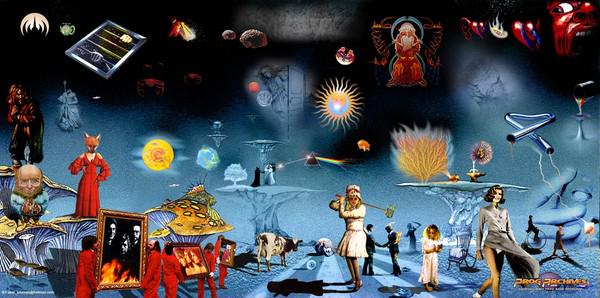
My brother’s record collection was a roll-call of prog-rock’s finest: Genesis, Yes, Pink Floyd. Also, God help us, Emerson, Lake and Palmer. Obviously singles were no longer the thing, and my borrowed playlist was now a run-down of the early-70s album charts, strangely still contemporary with the glam era but stylistically a million miles away from it: Trespass, Foxtrot, Selling England by the Pound, Fragile, Dark Side of the Moon, Wish You Were Here…
(JC again interjects…..at which point I’m delighted by the fact I was the oldest child in the family!!!)
There were brighter moments. Rolled Gold, Abbey Road and Let It Be got consistent exposure, and a smattering of Sensational Alex Harvey Band lightened the prog landscape, if lightened is quite the word for Harvey’s gritty and somewhat misanthropic world-view. The song Anthem from The Impossible Dream album is an enduring echo from that time, evoking strong recollections of the young adult science fantasy ‘Sword of the Spirits’ novels by John Christopher that I was reading at the time.
But I was deeply embedded in the prog albums. I played them often enough to fairly say that I knew them inside-out. Meticulously hand-drawn reproductions of artist Roger Dean’s stylised Yes logo were a favourite adornment for school jotters. Admiration for Genesis caught up with the current moment with Trick of the Tail and Wind and Wuthering. My brother bought Pink Floyd’s Animals. My own record collection started, not with prog, but with Sgt Pepper’s Lonely Hearts Club Band and The White Album.
And then something happened. 1977 happened, to be precise. I was not, as you have probably sensed, keenly aware of what was going on in the music scene at that time. Despite the growing media panic, the first I heard of punk rock was on a school trip in May ’77. Although punk history goes back well into 1976 it wasn’t until the following year that it made a serious impact on the mainstream. If you were into punk in 1976 you must have been part of the Bromley Contingent, or you’re suffering from false memory syndrome.
A couple of punk bands appeared on Top of the Pops soon after I became aware that punk was a thing. The Boomtown Rats were Looking After No. 1 and Mary of the 4th Form brazenly appealed to our stirring hormones. I remember The Jam playing All Around The World and The Stranglers declared there were No More Heroes. The notorious Sex Pistols and the pure of principle Clash never appeared, of course, but I came to know who they were, and they all stood, or rather slouched in marked contrast to the saccharine disco pish that filled up the rest of the weekly show.
At school, one of our music teachers periodically offered us the chance to play some of our own favourite records in the class. My mate Drew brought in Rattus Norvegicus and invited the teacher to play the first track. “Some day I’m going to smack your face!” barked Hugh Cornwell. “Beeeeeeat you honey till you drop!” Miss Cavaye tried not to look disapproving and may have made some courteous observations on Dave Greenfield’s arpeggiated keyboard figures. Another girl in the class followed up with a track by Rush. We probably didn’t try to disguise our disapproval, and would have made disparaging remarks about arpeggiated guitar figures if we had the faintest idea what it meant.
The next time The Jam appeared on Top of the Pops I was fully invested, and deployed three pounds of accumulated pocket money to buy This Is The Modern World. It didn’t matter to me that it was neither then nor now considered to be a very good album; to me, it was the first step into a new world and the first manifestation of a personal metamorphosis.
I was still listening to The Beatles, but I was susceptible to the influence of my friends from whom it had become clear that music with long hair and flared trousers was no longer tolerable. I think the adrenalin energy of punk was gradually rendering the elongated indulgence of prog incompatible for me in any case, but I would have to be honest and admit that I didn’t reject my old favourites entirely of my own accord. I sought peer approval, as you tend to when you’re 13, but the explosive change of 1977 made it easy to switch.
It’s fair to say that all of us will have gone through changes in our musical taste as we moved from childhood into adulthood, growing out of the music that appealed to us in youth faster than our clothes got too small for us. The coincidence of that growth spurt with the revolutionary moment of punk was a momentous one for me. It’s a time in life when we crave independence, assert our individuality and search instinctively for our own personal identity. Punk laid an epochal transformation on a plate for me and I lapped it up.
My brother clung faithfully to the old guard. Not being the best-buddy kind of siblings, that probably only encouraged me to reject his record collection as I established mine along quite different lines. Yes logos were blotted out and by the end of the year I was artistically proficient in rendering The Jam’s spray-can design and even imitations of Jamie Reid’s ransom note lettering of the Sex Pistols, despite not actually owning anything by them at that point.
By the start of 1978 I was a mature and discerning fan of the new wave, ready to embrace the radical eclecticism spawned by the effective death (already!) of punk, symbolically marked by the final debacle in the brief career of the Sex Pistols that January. I had started listening to the John Peel Show and buying the NME and Sounds. From all of this a kind of philosophy emerged that has guided my cultural life ever since. Embrace the new, seek out the inventive and the innovative, the unconventional and the iconoclastic. Reject imitation and repetition, stasis and complacency, the status quo. Especially Status Quo.
In old wave parlance we might have said ‘Keep on runnin’ and ‘Don’t Look Back’. The music of Yes and Genesis and Pink Floyd was now most decidedly of the past and became dead to me. In the years since, I have discovered and come to love a great deal of music from that old, long-haired, flared-trousered past, from Neil Young and Joni Mitchell to Van Morrison and Bob Dylan. But I’ve never been able to go back to the prog. It now exists in my memory like a kind of dream, an unreal world of English whimsy, science fantasy landscapes and gigantic hallucinatory stage sets and light shows. It feels unconnected to any sense of reality or actual lived experience. I just can’t go back there.
Neil Young put it well on his 1979 album Rust Never Sleeps. In the song Thrasher he drew out an extended metaphor for restless artistic integrity. “I searched out my companions, they were lost in crystal canyons”: I pictured them floundering in a Roger Dean landscape, though other kinds of crystals were probably involved. “It was then that I knew I’d had enough, burned my credit cards for fuel/Headed out to where the pavement turns to sand…”
“It’s better to burn out than it is to rust,” he sang on the opening track, My My Hey Hey (Out of the Blue), referencing ‘Johnny Rotten’. He wasn’t about to go all punk rock, but the point was clear.
In writing this piece, however, I realise I have potentially put myself in a difficult spot, as JC might dredge up something dreadful from Nursery Cryme or Tales from Topographic Oceans and I’ll feel compelled to listen to it, at risk of precipitating some kind of psychological flashback crisis. I recommend therefore that any of you who might feel similar trepidation ensure that you have a paramusical crash-team on stand-by, ready to administer a life-saving dose of 1977 by The Clash, or Art School by The Jam. Anything that delivers a full-bore shot of life-giving energy from that pivotal moment in popular music history. Anything that screams ‘keep on runnin’, or ‘don’t look back’.
mp3: T-Rex – Solid Gold Easy Action
mp3: Slade – Gudbuy T’Jane
mp3: SAHB – Anthem
mp3: Yes – Roundabout
mp3: Genesis – I Know What I Like
mp3: Pink Floyd – Great Gig in the Sky
mp3: Neil Young – Thrasher
mp3: Stranglers – Sometimes
mp3: The Clash – 1977
mp3: The Jam – Art School
mp3: The Adverts – New Church
 THE NEW VINYL VILLAIN
As ever evocative writing.
Here’s to more.
Flimflamfan
Sorry, Fraser… an aside.
Just read the sidebars issue statement JC. I hope you get it sorted soon.
Flimflamfan
Excellent – I do wonder just how many of our musical journeys have followed a path similar to this? Sounds like my own experience (sans Mud in the early 70s before moving on to 10cc just prior to Prog. I too can no longer revisit Yes or ELP but similarly have learned to accept Neil and Joni are a-ok.
Brilliant
Superb.
SC.
I never lost my taste for the Beatles and the referenced proggy albums. I eventually went in the same musical direction as our hero and JC, as lots of the class of ’63 did, but never felt the need to jettison the old stuff that hooked me in the first place.
Superb writing, Fraser – and, more importantly, a captivating story.
I bet we all have formative-years bands and artists we later denied. But I also bet we return to those songs now and again (particularly as the years accumulate, and we give less and less of a jot regarding what people think about us liking such tracks). Now where on earth is that Red Box single of mine?
Strangeways
Lovely read and, as someone also born in 1963, as JC says – yes, a very similar story, albeit a girl (my pre-punk music taste mostly revolved around Abba!) C
Brilliant writing Fraser and yes , this happened to me as well. There are still a lot of records in my collection I didn’t listen to them during the last years. Probably I will rediscover them one day.
Belated thanks for your comments, folks. Just got back from a holiday in Vietnam and brought a stinky cold back with me :^(
Fraser