
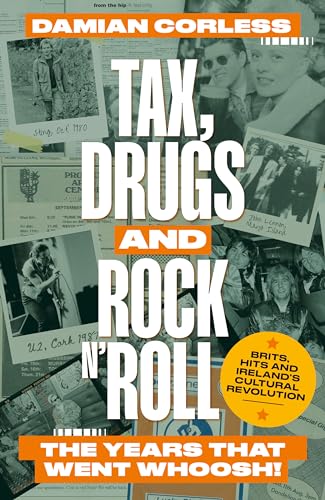
A good friend of mine spent time last year touring much of the coast of Ireland in a camper van. He drove from Scotland to Cork to get things underway, and while in the city he picked up the book, Tax, Drugs and Rock’n’Roll to accompany him on the journey, having come across it in a store and reading the back page blurb:-
“How did an influx of British pop stars in the early 1980s kick-start a cultural transformation in Ireland? The stars hadn’t come for the atmosphere or the creature comforts. They’d come for the tax breaks, to endure a ho-hum year of exile beyond the grasp of the UK taxman. What they found exceeded their expectations.”
Having read the book during the three-and-a-bit weeks he was on the road, my friend passed the book to me, saying that he’d be interested to hear what I thought of it. Crucially, he didn’t say whether or not he had liked its contents…..
The author is Damian Corless, a Dublin-born music journalist, author, part-time bass player in bands and occasional writer of comedy sketches for TV programmes in Ireland and the UK. He begins the book with a prologue dating back to February 1981 when a newly emerging star of the Irish scene called Bono crashed his car into a telegraph pole outside the Corless family home, a random accident which changed the course of Damien’s life, and just four years later he landed a job on Hot Press, a monthly music and politics magazine based in Dublin. There is no question that he’s very well-placed and connected to tell this story.
The book doesn’t just look at the musicians who came for the tax breaks in the 80s. Indeed, its early chapters go back in time to John Lennon buying an island off the coast of Mayo in 1967, and the reasons why actors such as Peter Sellers and Robert Shaw set up home in Ireland in the 70s, before spending many pages describing how live music and culture was organised across Ireland, with constant reminders of how very rural and underdeveloped the country was for much of the 20th century. In due course, we reached the point in time where the stories of how Phil Lynott and The Boomtown Rats came to be well-known are told, before a diversion into the tale of John Lydon ending up in jail after a fight in a Dublin pub in 1980.
It was all interesting stuff, but a long way removed from what the premise of the book was meant to be, but I suppose the scene had to be set and the context for what happened in the 80s had to be laid out, but it did feel like I was reading it under false pretences.
It took until Chapter 6 before we reached the part the blurb had promised. A chapter called ‘Frances Rossi: The Rocker Who Set The Ball Rolling’. It turned out that the Status Quo frontman, having intended to spend a year in Dublin in 1979 to reduce his UK tax bill, ended up falling for the city and staying there for a number of years. The chapter was based on lengthy interviews with Rossi, and I have to say that I found it a bit of a chore, as I found his stories and anecdotes to be dull. It was also a sobering reminder that the remainder of the book was going to celebrate rich tax-dodgers……..
Sting and Andy Summers of The Police soon followed Frances Rossi’s move to the Emerald Isle, but unlike the pony-tailed rocker, they never settled and moved away almost as soon as the time had come when there was no longer any tax gains to be had. Members of Spandau Ballet, The Thompson Twins, Frankie Goes To Hollywood and Def Leppard were among those who arrived in later years, and while some of the anecdotes recounted in the book did bring the occasional smile (Holly Johnson accidentally finding himself as a shopkeeper for day in a small village shop primarily selling pottery), it was all just a tad self-indulgent.
Having said that, by Chapter 10 and Page 131, it was back to telling the story of how Ireland itself was beginning to change. The remainder of the book looks at politics, censorship, the opening of a swanky Dublin nightclub (complete with VIP section for musicians and actors), the rise of U2, the successes of the Irish football team under an English manager, the decreasing influence of the Catholic Church in Irish society, the emergence of a new breed of Irish comedians and the vast physical regeneratuion of much of Dublin city centre.
The author brings his book to an end in 1995 when a peace process with the north of the country begins to become a reality. The closing chapter brings together the various strands that had been explored, and makes the very valid point that Ireland had, over the course of less than two decades, undergone something of a cultural and social revolution. But I have to say, that I found very little evidence that any of it was kick-started by UK musicians seeking tax breaks.
All in all, a frustrating read as it wasn’t the book I imagined it to be based on the back page blurb, with the British pop stars taking up a very small part of its overall contents. And while it proved to be a worthy read for its wider context, it is not really a book about music or musicians.
mp3: A House – Here Come The Good Times
And yes, today was deliberately chosen to offer up this review.
 THE NEW VINYL VILLAIN
The book is rubbish. There’s no two ways about it.
His signature story about U2 crashing his car outside DC’s ma’s house has appeared in print so many times over the years that it’s beyond hackneyed.
If you’d said you ‘d liked the book I’d’ve had to stop reading the blog. I’d argue that television and youth demographics (50pc under 25 in the mid 80s ,where he sets out his stall) did far more than tax breaks to change or save the country. Status Quo get a hilarious amount of space in the book considering nobody knew they were even in Dublin at the time.
To paraphrase an actual writer from the same part of the world: the central tenet cannot hold.
I could go in for hours and I probably…
Wintering May park