
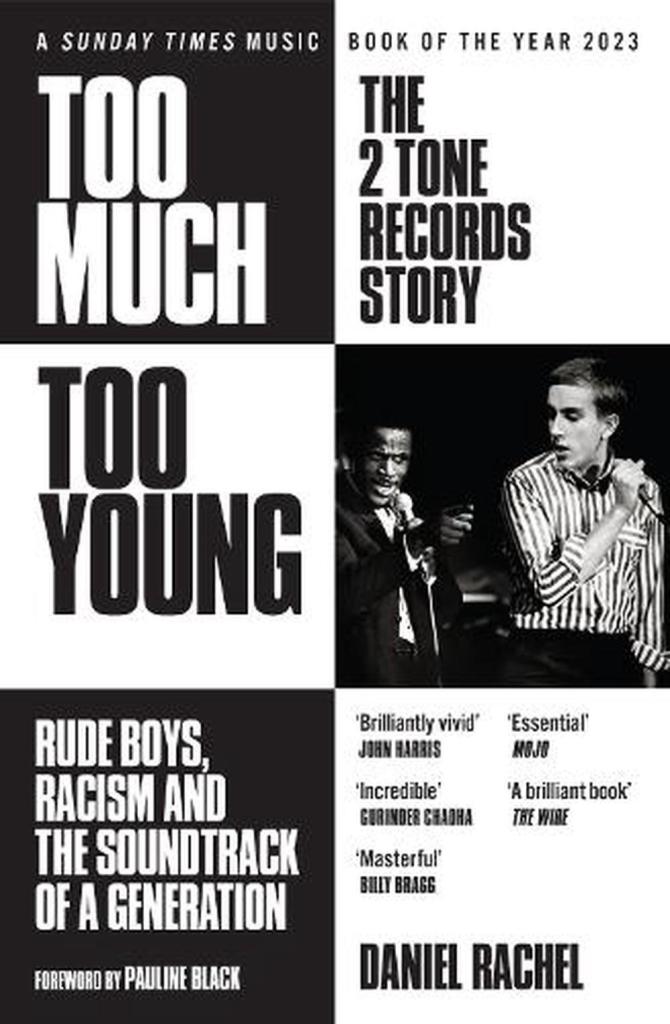
First published, to much acclaim, in hardback in 2023, an updated paperback edition was printed and issued by White Rabbit Books in April 2024. Here’s the blurb from the publishers:-
In 1979, 2 Tone exploded into the national consciousness as records by The Specials, The Selecter, Madness, The Beat, and The Bodysnatchers burst onto the charts and a youth movement was born.
2 Tone was black and white: a multi-racial force of British and Caribbean island musicians singing about social issues, racism, class and gender struggles. It spoke of injustices in society and took fight against right wing extremism.
The music of 2 Tone was exuberant: white youth learning to dance to the infectious rhythm of ska and reggae; and crossed with a punk attitude to create an original hybrid. The idea of 2 Tone was born in Coventry, masterminded by a middle-class art student raised in the church. Jerry Dammers had a vision of an English Motown. Borrowing £700, the label’s first record featured ‘Gangsters’ by The Specials’ backed by an instrumental track by the, as yet, unformed, Selecter. Within two months the single was at number six in the national charts. Dammers signed Madness, The Beat and The Bodysnatchers as a glut of successive hits propelled 2 Tone onto Top of the Pops and into the hearts and minds of a generation. However, soon infighting amongst the bands and the pressures of running a label caused 2 Tone to bow to an inevitable weight of expectation and recrimination.
Still under the auspices of Jerry Dammers, 2 Tone entered in a new phase. Perhaps not as commercially successful as its 1979-1981 incarnation the label nevertheless continued to thrive for a further four years releasing a string of fresh signings and a stunning end-piece finale in ‘(Free) Nelson Mandela’.
Told in three parts, Too Much Too Young is the definitive story of a label that for a brief, bright burning moment, shaped British culture.
So…the question that arises. Is it the definitive story?
I think the answer has to be a resounding ‘Yes’, and indeed none other than Pauline Black, the lead singer with The Selecter says the same thing in her foreword to the paperback edition. She describes the book, the hardback edition of which appeared when a remastered copy of the 1981 film Dance Craze, along with its accompanying soundtrack had been released as a ‘….comprehensive, cautionary, but nonetheless celebratory saga of the 2 Tone label.’
It rightly focusses on the life and work of Jerry Dammers, but it really benefits from giving voice to a cast of many dozens who were involved, be they musicians, producers, band management, promotors, tour organisers, fans, journalists or record company execs. It also benefits from fantastic research by the author with countless quotes given at the time to the various music papers and magazines being used to shape the narrative.
The book, despite being almost 500 pages in length, rattles along at a fast pace. 2 Tone was an instant success, with Gangsters by The Specials reaching #6 in the summer of 1979, and before the year had ended, each of Madness, The Selecter and The Beat would also hit the charts with singles released on the label.
As the publisher states, the book is in three parts, the first of which will be the best known, taking in those early hits, the subsequent departures of Madness and The Beat as well as the signing of The Bodysnatchers. It genuinely is incredible to be reminded of just how much happened in that short period of time, not just in terms of a new and highly successful record label emerging out of nowhere, but that it was all done against a troubling background where the idea of mixed-race bands didn’t go down well with many elements of society, while the punk element of the music, also attracted the wrong sort of attention.
The story of the 2 Tone Tour, in which The Specials, Madness, and The Selecter crisscrossed the UK from September through to December (during which time all three appeared on the same edition of Top of The Pops) seems beyond belief, not least how the musicians and their entourage faced up to the constant fear and worry of crowd violence from racist right-wing thugs, all of which sadly came to a terrifying crescendo at gig in Hatfield on 27 October. It was reading about such violence that led to me deciding not to use the ticket I had for the show in Glasgow the following month – a decision I came to regret as the show passed without incident and by all accounts was one of the best nights that the now long-closed venue of Tiffany’s had ever seen.
The second part, which takes in events from late 1979 through to the autumn of 1981 when Terry Hall, Lynval Golding and Neville Staple left The Specials to form Fun Boy Three, was the section of the book I found to be most fascinating. The mix of contemporary quotes/ interviews given to the press and subsequent recollections from many of those involved paints a complex picture of the issues and problems facing the label, its bands and indeed the individuals within the bands, along with the increasingly- thorny relationship with parent label Chrysalis Records. The deliberate effort by Jerry Dammers to move away from what was the atypical 2 Tone sound, culminating in the songs to be found on More Specials, the band’s second album released in September 1980 and the single Ghost Town, released in June 1981, caused all sorts of friction, and while some think it was just bloodymindedness on his part, others believe it was the mark of his unique talent and genius. The author leaves it to the individual reader to make their own mind up.
The final part, with a satisfying and welcome amount of detail, covers the final five years of 2 Tone’s existence, with chapters devoted to Rhoda Dakar, The Appollinaires, The Higsons and The Friday Club. It might well be a long way removed from the happy times of the opening chapters – I certainly had a feeling of melancholy as I turned the pages – but again, praise has to be given to the author for the skilful way he navigates his way through the turbulent waters.
The 2 Tone legacy is far greater in quality than quantity. There were just 29 singles, 6 studio albums and 2 compilations across the six years. Just twelve of the singles were released between 1982 and 1986, and only one of them was a chart hit. But it’s the voices of the people involved that make this such great, engrossing and essential read. The author, in his acknowledgements at the end, offers ‘an enormous thank you to all the contributors who generously gave their time to talk to me’. It’s a list which runs to over 100 names all told, which in itself tells you how deep the research has been.
I’ll just about leave the last word to Suggs.
‘Daniel Rachel has bagged the whirlwind of 2 Tone with joy, honesty and compassion.’
He sure has.
mp3: The Specials – Ghost Town (12″ version)
 THE NEW VINYL VILLAIN
Thank you – just purchased it! Part of the soundtrack to my college years in the US.
Ordered. I enjoyed the CBGB book that was previously recommended, and which I also recommend. Loving this book o’ the month series.
His other book ‘Walls Come Tumbling Down’ is worth a read too.
WinterInMaypark
Looks like a great read – ordered now!
Thanks,
Dirk
Re what WinterInMaypark said about Daniel’s previous book………Agreed!!!!!!