I’m hoping I can make this a monthly feature.
The idea is to give you some thoughts on a book, associated with music, that I’ll have recently just finished reading. Who knows, if I can get my act together, it night even become a bit more frequent….and as with all TVV series, the door is very firmly open if anyone who wants to submit a guest posting.
This was one which was on the Xmas wishlist. I’ll set the scene by quoting how Amazon sold it to me in terms of it being added to said wishlist.
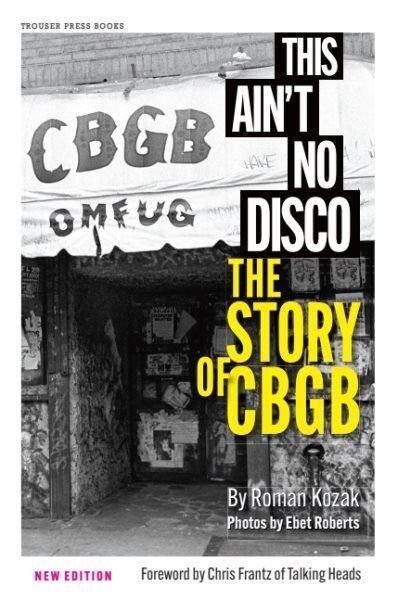
Originally published in 1988 and out of print for decades, This Ain’t No Disco tells the real story of CBGB, the birthplace and incubator of American punk and new wave music. The Ramones, Blondie, Television, Talking Heads and many other rock greats all got their starts there. Written by a club regular well before the legend overtook the reality (while CBGB was still open and most of its principals alive), this is an honest, opinionated, outrageous, hilarious document of 15 years of late, loud nights at CBGB, with memories, stories and gossip from dozens of people who played, worked or just hung out in the long, dark club on the Bowery in New York City.
This new edition (published on 15 October 2024) adds a new foreword by Chris Frantz of Talking Heads, a new selection of photographs by the acclaimed Ebet Roberts and archival reporting by Ira Robbins about the club’s closing in 2006. It contains exclusive interviews with Hilly Kristal (CBGB founder), Joey Ramone and Dee Dee Ramone (Ramones), Clem Burke and Chris Stein (Blondie), David Byrne (Talking Heads), Jim Carroll, Willy DeVille (Mink DeVille), Annie Golden (Shirts), Richard Hell and Richard Lloyd (Television), Lenny Kaye (Patti Smith Group), Handsome Dick Manitoba (Dictators), Wendy O. Williams (Plasmatics) and many others.
As a teenager, I was fascinated by America, and in particular New York City. It was a place I never imagined I’d get to see as, until the late 1970s/early 80s, transatlantic air travel was very much the preserve of the well-heeled and/or famous. Besides, the newspapers didn’t sell the city too well, and so the fascination was something which always felt as if it would be a pipe dream. In terms of music, I really was only aware of five venues – Madison Square Gardens, Greenwich Village, Max’s Kansas City, Hurrah’s and CBGB – with the latter three being down to reading about them in the UK music papers or seeing them as locations where some of the new wave acts had made live recordings for b-sides and/or for use on compilation albums.
Blondie was one of the first groups that this late-teen fell for, and almost all the interviews and/or background pieces in the music papers made many references to how their development had centred around loads of gigs at CGGB. My first ever trip to New York wasn’t until a time when my job took me there, and such was the packed schedule that there was no time at all to try and visit the venue – indeed, much to my frustration, I couldn’t even free up any time to take in any sort of live music while I was in thercity. I’ve only been back to NYC on two more occasions – the first again being on business, and the second being when I had one overnight stay to break up a return trip from a Caribbean, and the day was spent doing the whistle-stop touristy stuff on a bus. As such, and much to my annoyance, I’ve still never been to a gig inb New York.
So, the idea of reading This Ain’t No Disco was to have an imaginary visit to the esteemed venue back in the day, ideally on a night when one of my favourites happened to be playing. I have to say that I thoroughly enjoyed Roman Kozak‘s account of things, and he really did bring to life the sights, sounds and personnel who made it such a success, very much against the odds. I knew that the club was in a far from luxurious or even welcoming part of the city, but had no idea that it was actually beneath an establishment called the Palace Hotel, which was the largest flophouse for homeless men on the streets of Manhattan, and that 315 Bowery was a notorious address.
There was so much I either learned or was reminded of. I knew that CBGB was short for ‘Country, Bluegrass, Blues’ as the idea when it had opened up was to concentrate on those types of music – the fact it ended up being at the heart of the new wave scene in New York wasn’t part of the original plan, but then again I had long forgotten that the second part of the venue’s name was ‘OMFUG’ which was short for ‘Other Music for Uplifting Gourmandizers;, so it was always a likelihood that Hilly Kristal would open its doors to whoever was capable of drawing a crowd.
And while Hilly is at the heart of much of the book, the author really does draw on the thoughts and memories of unsung heroes who worked at the club in all sorts of capacities from bartending, security, finance, kitchen staff, sound technicians and so on, as well as members of the Kristal family. The famous musicians (or those who became famous) are well-quoted, but so too are those from bands who never made it, but were very much part of the scene in and around the club. Those who wrote about what has happening are given space to offer their own recollections. I learned about Merv Ferguson, a Scotsman who was integral to the operations of the venue, and indeed is described as ‘the heart, soul and glue that held CBGB together’ prior to his death, in his early 40s, after succumbing to cancer of the colon. I found out more about bands such as the Dead Boys who I only vaguely knew of in passing and read, for the first time, about acts such as Tuff Darts and The Shirts, of whom my knowledge beforehand was zilch.
It’s an oral history as told by many different people, and as such, some incidents and events are recalled in ways that can seem contradictory. But I think this is one of the book’s strengths. Roman Kozak, who himself died at the age of 40 just after the book was originally published, doesn’t put his voice above anyone else’s to offer his take on things. His trade and profession was as a writer/editor, initially in newspapers and later at Billboard magazine, which is primarily a trade paper for the music industry, and he seems more than happy to let those who wrote for the likes of Village Voice, Trouser Press and Soho Weekly News to provide a more astute take on things.
I hadn’t appreciated how the club had evolved in the wake of the new wave/post-punk era coming to an end. The book’s original publication in 1988 came at a time when it was increasingly home to a scene around metal/hardcore, with the pogo dancing of the 70s being replaced by body slamming. I’m not entirely sure that if I had made it to NYC in the mid-20s whether or not a visit to CBGB would have thrilled me.
The newly published version of This Ain’t No Party is interesting for the fact that nobody has come in to try and offer a take on things between 1988 and 2006 when the club was forced to close its doors after a long-running dispute with the landlord ended with the lease not being renewed. It simply offers up a couple of magazine pieces – one of which was written in 2005 when it became increasingly clear the club was seriously under threat, and the other being an article written for a New York newspaper the day after the final gig, which had been a three-hours long set by Patti Smith, with all sorts of alumni on stage or in the audience.
There was a much to enjoy about the book. As the blurb on the back page says, ‘written long before the legend overtook the reality – while the club was still open and most of the principals still alive – this is the real story’.
And it’s a really good one at that.
mp3: Patti Smith – Kimberley
mp3: Television – Friction
mp3: Blondie – X-Offender
mp3: Talking Heads – Life During Wartime
 THE NEW VINYL VILLAIN
I didn’t get to CBGBs until the early 90s when the scene had long moved on. It was still a grungy atmospheric dive on the Bowery, but also a bit of a heritage pilgrimage site for Europunks. Saw a couple of unmemorable shows there. Still wear the T-shirt occasionally. The city’s creative indie hub moved out to Williamsburg, but even that has become a gentrified hipster hub these days. I’ve seen a few great shows in the city, including Teenage Fanclub in some little downtown Manhattan venue, fuelled by free whisky as part of “Scottish Week”, and a wonderful solo performance by Jay Farrar in a book shop, sorry store, that I stumbled on one wintry afternoon. Saw No Direction Home this week, which is quite evocative of downtown New York’s importance as the hub of a very different scene about 14 years before CBGBs.
Amazon?? Jaysus.
Anyway, Life During Wartime is maybe their best moment.
WinterInMaypark
What a great review of the book, I’ll add it my wishlist! Cheers.
Coincidentally I am just reading the book about the Ramones by the bloke who runs the world’s only Ramones-museum (in Berlin), Flo Hayder. Alas it’s available in German only, if it weren’t, I would highly recommend it! I am still in the 1976 era, so CBGBs is frequently being mentioned, as you might imagine. I knew it was an important venue, but how groundbreaking Hilly Kristal was for US Punk has only now fully become evident to me.
I’m not a Talking Heads archivist but by their third lp in ’79 where Life During Wartime comes from, they moved out of playing small venues and were to be seen at festivals and small stadiums. At their early shows, a song from the first lp would be more accurate (plus the odd cover like 123 Red Light or 96 Tears).
Damn, CB’s. What an excellent, exciting, disgusting place. I was too young to go there in its mid-70’s heyday but I did go regularly once I moved to the city in 1981. By the time my own band played there in 1987 Blondie, Television, and the Patti Smith Group had already broken up. Talking Heads would limp on for a couple of years but their best stuff was behind them. Same can be said for the Ramones, the last of the big 5 original acts. I liked Hilly. He was a genial hippy who was stoned most of the time. CBGB’s is a good example of what made NYC so interesting and cool back in the days before gentrification, and epitomizes why the city is much less fun than it used to be.
Cheers Magical….
I don’t disagree with what you’ve said, but I included Life During Wartime simply as a mod to the the title of the book.
JC
Only used Amazon to get a list of possible books from Santa. They weren’t ordered from there!!!
^^ fair play ^^
WinterInMaypark